Quick answer
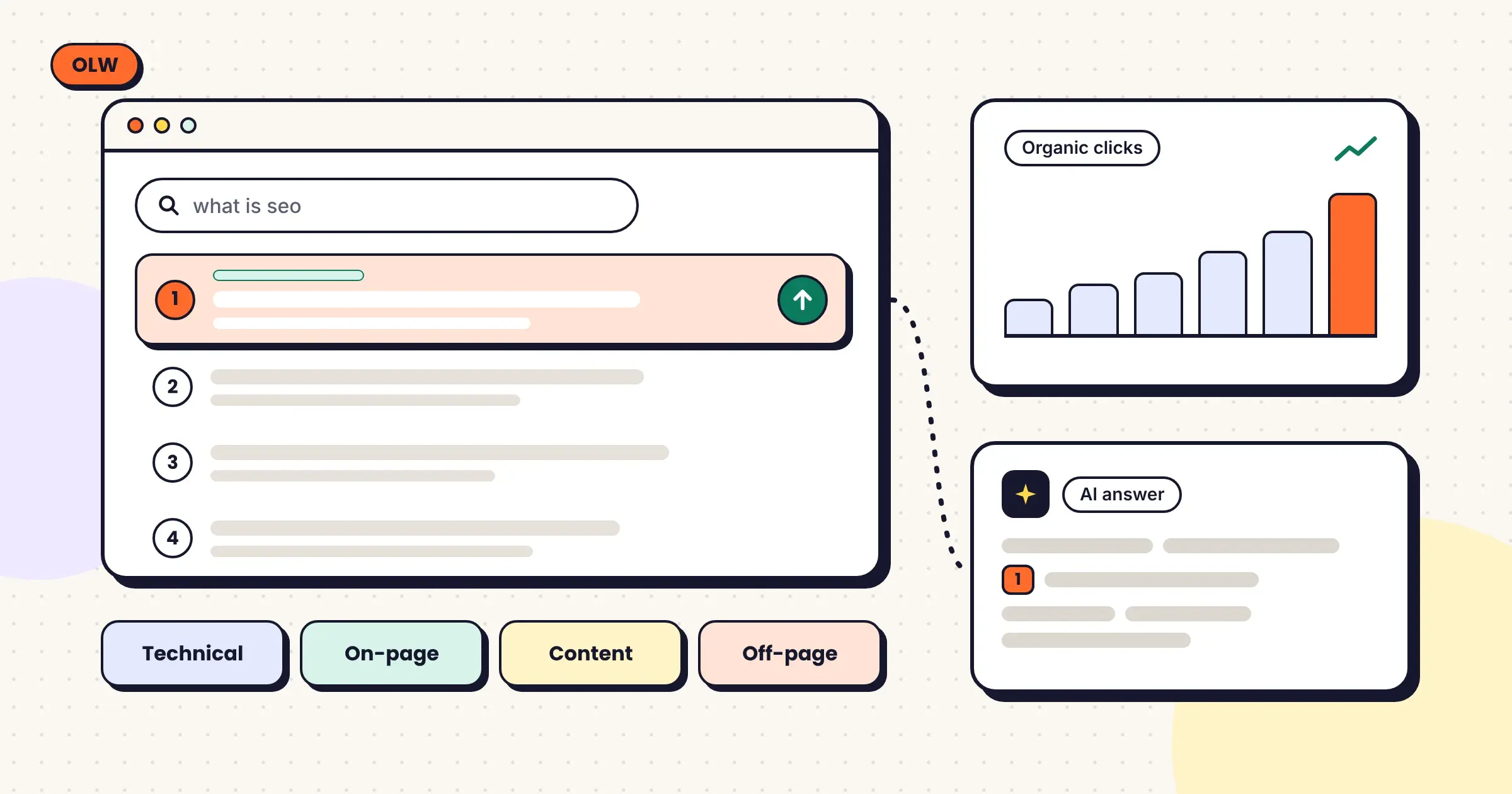
SEO (search engine optimization) is the work of making your website easy for search engines to find, understand and trust, so your pages show up when people search for what you offer. You don’t pay for those clicks. You earn them with useful pages, a site that works, and other websites vouching for you.
Key takeaways
- SEO is not dead. In the 12 months to September 2026, search engines sent websites 65 times more visits than AI chatbots did, across the 7,255 most visited sites we track.
- AI search is built on SEO. ChatGPT, Gemini and Google’s AI Overviews pull from pages that are crawled, indexed and trusted. AEO and GEO are branches of SEO, not replacements.
- Every business does SEO differently. A plumber, an online store and a software company need different pages, but the same foundations.
- SEO has four pillars: technical, on-page, content and off-page. Your weakest one caps your results.
- Expect early signs in about 3 months and real results in 6 to 12. Use the 7-step flowchart and the 49-point checklist below to start.
“Is SEO dead?”
I get asked that every week. By founders. By marketing managers. By people who have just been handed the website and told to “fix the traffic.”
I get it. Every feed is full of AI. ChatGPT answers questions. Google writes its own summaries. If a robot answers everything, why would anyone still optimize for search?
So in 2025 we stopped guessing and started counting. Our 24-month study of AI chatbots vs search engines found chatbots growing fast but nowhere near replacing search. Since then we’ve tracked the traffic of 7,255 of the world’s most visited websites every month, along with 49 search engines and 125 AI chatbots, in our digital market intelligence tracker.
Here’s what the latest data says. (How we collect it, and its limits, is explained in the methodology at the end.)
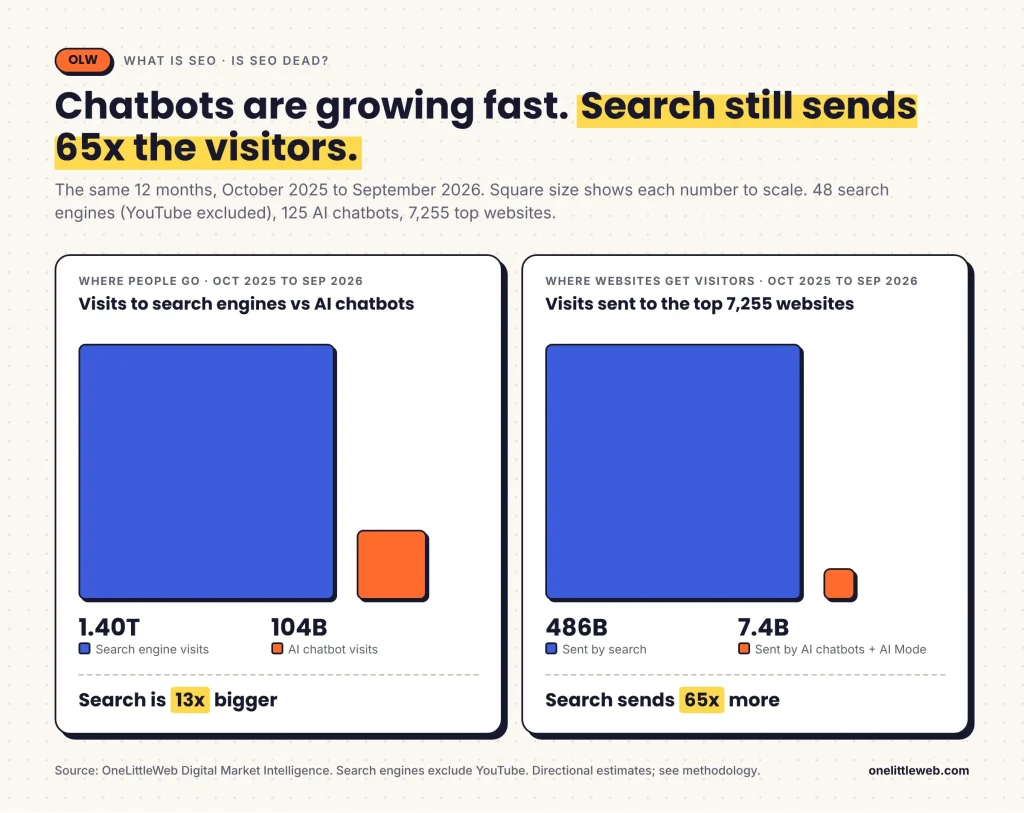
Two things are true at once. AI chatbots grew 60% in a year, which is remarkable. Search engines dipped about 3%, but over the same 12 months they still handled 1.4 trillion visits, 13 times as many as chatbots. And they sent websites 65 visits for every one that came from AI.
So no, SEO is not dead. But it has changed. The results page looks different, AI answers sit on top of it, and the businesses that win understand both.
That’s what this guide is for. If you’re new, it will take you from “what is SEO?” to a step-by-step plan, a flowchart with a check at every step, and a 49-point checklist. If you’ve done SEO for years, it gives you fresh data to bring to your next budget meeting.
Plain English. Real numbers. Every claim linked to its source.
What is SEO?
SEO stands for search engine optimization. It is everything you do to help a search engine find your pages, understand what they’re about, and decide they deserve to rank.
Think of a search engine as a librarian with a few hundred billion books and less than a second to answer each question. SEO makes sure your book is on the shelf, has a clear title, answers the question well, and gets recommended by other books.
The parts of a results page SEO can win
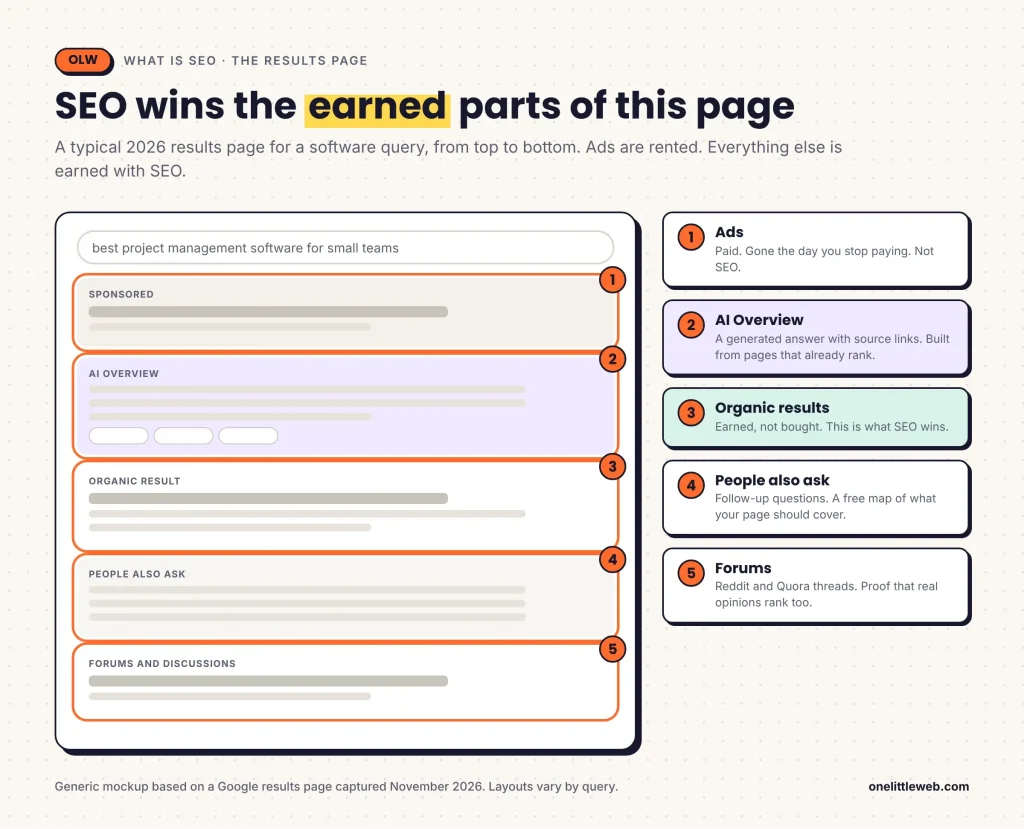
Search for anything today and you’ll see much more than ten links. Some of the page is paid. Most of it is earned.
SEO vs SEM vs PPC
These three get mixed up constantly. The difference is who you pay and what happens when you stop.
| SEO | PPC | SEM | |
|---|---|---|---|
| What it is | Earning unpaid (organic) rankings | Paying per click for ad placements | The umbrella term for both |
| Cost model | Time, content, links | Every click costs money | Both |
| Speed | Months | Same day | Mixed |
| When you stop | Rankings fade slowly | Traffic stops that day | Depends on the mix |
| Best for | Compounding traffic you own | Testing offers, fast demand capture | Using both together |
What SEO is not
- Not tricks. Google says it “doesn’t accept payment to crawl a site more frequently, or rank it higher” (Google Search Central). There is no back door.
- Not a one-off project. Competitors publish, Google updates, pages age. SEO is maintenance, like a garden.
- Not only Google. It covers Bing, YouTube, Amazon, app stores and, increasingly, the AI answers built on top of search indexes.
SEO, AEO and GEO: how search changed, and what didn’t
If SEO feels confusing right now, it’s partly because the vocabulary exploded. AEO. GEO. AI SEO. LLM optimization. Every month brings a new acronym and a new prediction that the old one is finished.
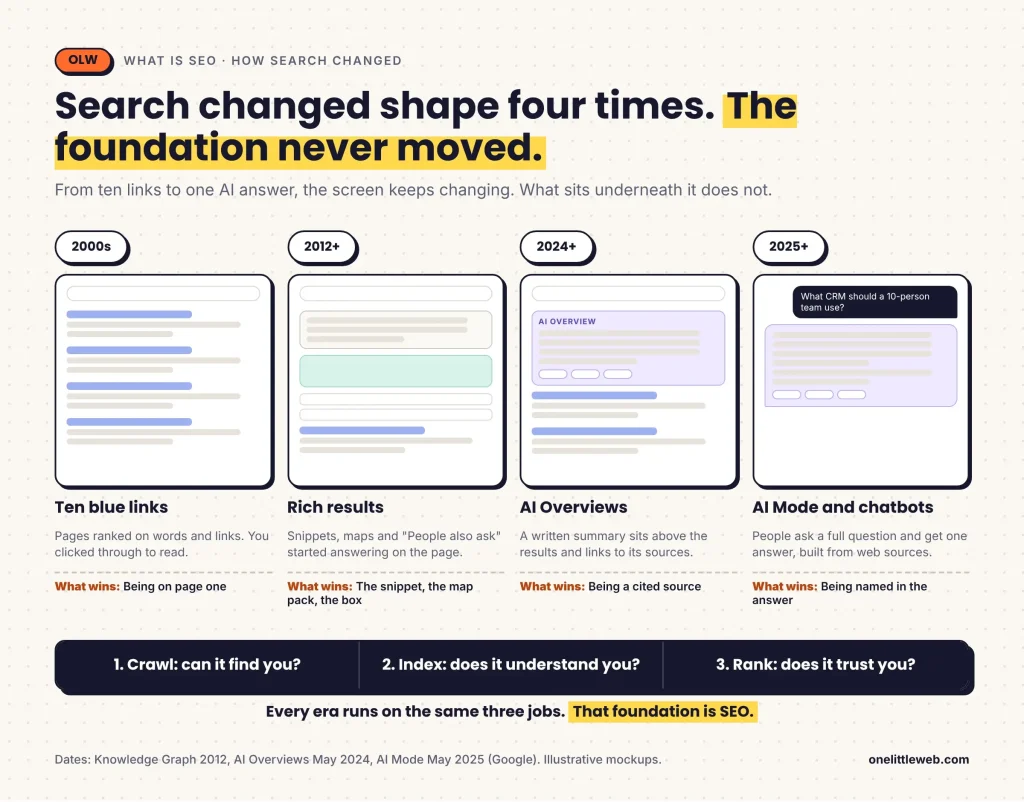
Step back and the picture gets simpler. The way people see answers has changed four times. The way those answers are found hasn’t.
From ten links to one answer
In the 2000s, search was a list. You scanned ten blue links and clicked one. Winning meant page one.
Around 2012, Google started answering on the page itself: knowledge panels, featured snippets, maps, “People also ask.” Winning meant owning the box.
In May 2024, AI Overviews arrived: a written summary at the top, with links to its sources. They now reach more than 2.5 billion people a month (Google I/O, May 2026). Winning meant being one of those sources.
Then came full conversations. ChatGPT, Gemini, Perplexity and Google’s AI Mode, which passed 1 billion monthly users in 2026 (Google). People ask a whole question and get one answer. Winning means being named in it.
Same question, two screens
Here’s the part most “SEO is dead” posts leave out. The AI doesn’t invent its answer from nowhere. It runs searches behind the scenes (Google calls this query fan-out), reads the pages that rank, and writes a summary from them.
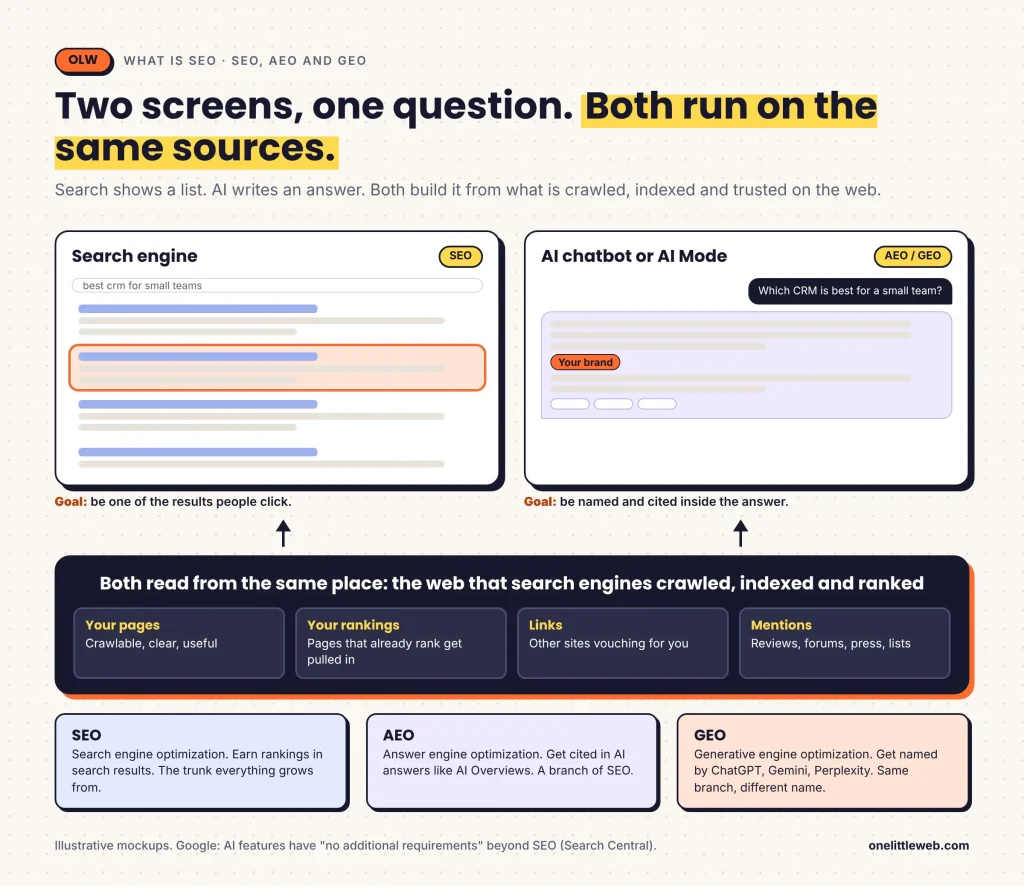
That’s why Google says there are “no additional requirements to appear in AI Overviews or AI Mode,” and that “the best practices for SEO remain relevant for AI features” (Google Search Central).
So what are AEO and GEO?
- SEO earns rankings in search results. It’s the trunk.
- AEO (answer engine optimization) aims to get your pages cited inside AI answers, like Google’s AI Overviews.
- GEO (generative engine optimization) aims to get your brand named by chatbots like ChatGPT and Gemini. In practice, AEO and GEO are the same branch with different names.
They’re not either-or. You can’t skip SEO and do AEO, because a page that can’t be crawled, isn’t indexed and isn’t trusted won’t be quoted by any AI. What AEO adds on top is a few extra habits: clear answers at the top of each section, being mentioned on forums, reviews and lists the AI reads, and measuring brand mentions, not just clicks. Our full guide to AEO covers those.
Here’s what that looks like in a real search. Last week I typed “best project management software for small teams” into Google.
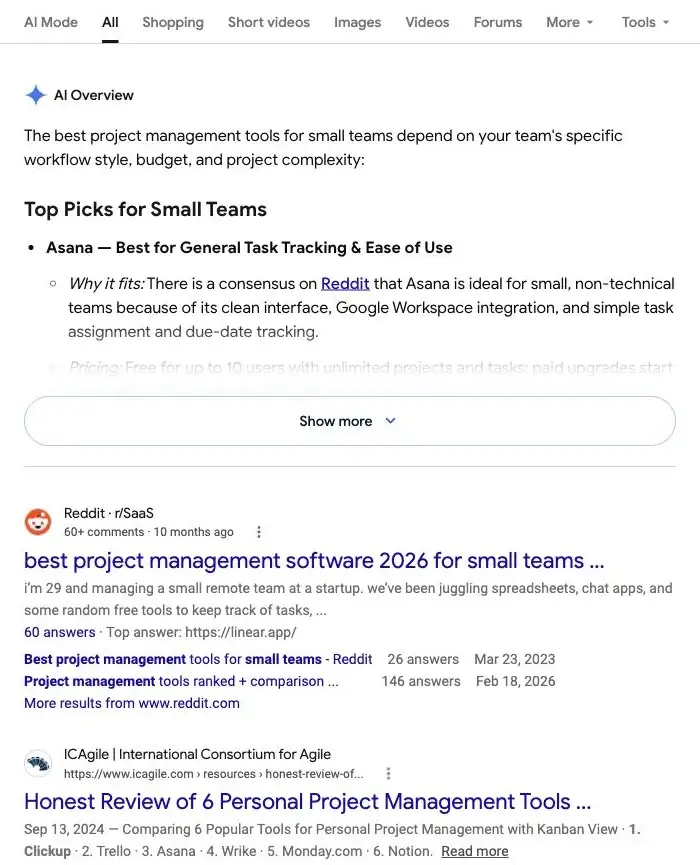
The AI answer came first. Its main source was a Reddit thread that also ranked first below it. No vendor appeared until after the forums and review sites. The lesson: the AI rewarded the pages SEO had already put on top.
Is SEO still worth it in 2027? What the data says
This is the question behind most “what is SEO” searches, even if nobody types it. Is it worth the time and money, or is everyone moving to AI?
Here’s the case, with our own numbers first.
The gap is closing, but it’s still huge
In October 2024, search engines got 32 visits for every one visit to an AI chatbot. By September 2026, that was down to 10. That’s real change, and anyone who tells you AI doesn’t matter isn’t looking at the data.
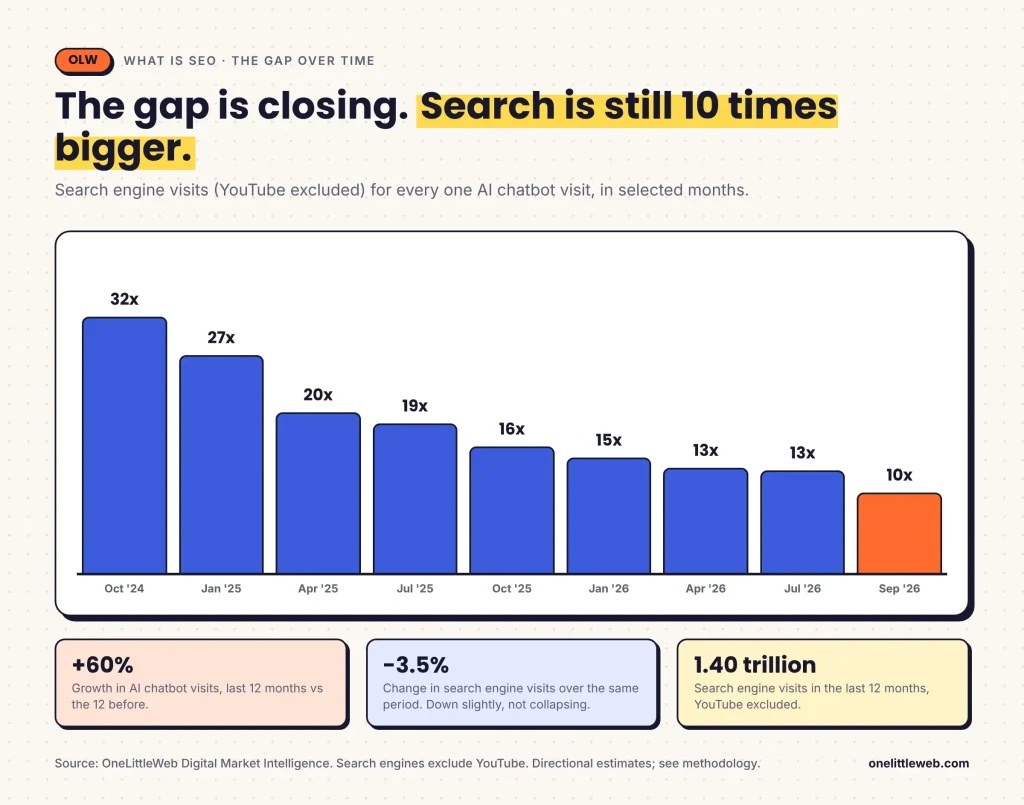
But look at the other side. Search engine visits dipped just 3.5%, to about 1.4 trillion over the last 12 months. Chatbots are adding to search far more than they are replacing it. Google says query growth is the highest it has been in five years (Alphabet Q3 2026), and it still holds 91% of global search share (Statcounter, October 2026).
Where your visitors actually come from
Usage is one thing. Visits to your website are what pay the bills.
Over the last 12 months, search engines sent 486 billion visits to the 7,255 sites we track. AI chatbots and Google’s AI Mode together sent 7.4 billion.
That gap isn’t only about size. It’s about behavior. Put the two numbers next to each platform’s own traffic and you see what each one is built to do.
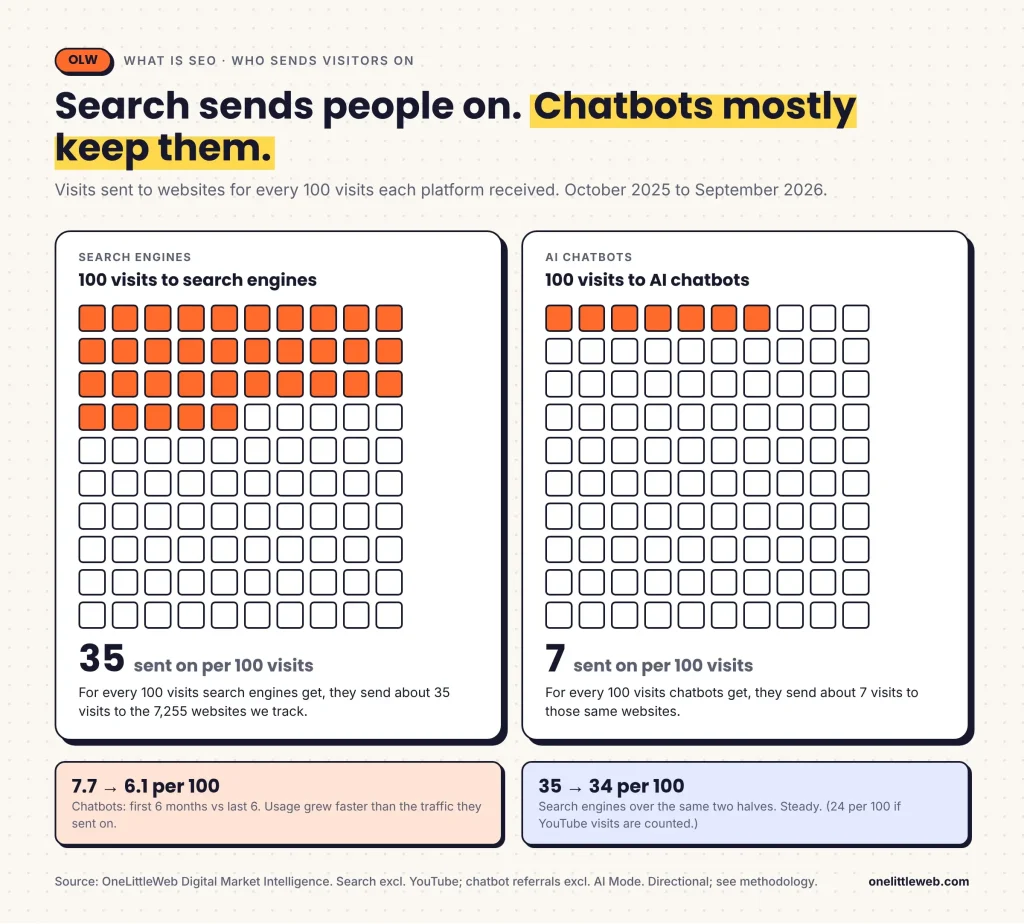
Search engines are built to send people somewhere else. For every 100 visits they get, the websites we track get about 35 visits back from search. Chatbots are built to answer in place. For every 100 chatbot visits, those same websites get about 7.
And the chatbot number is shrinking. Chatbot visits grew 23% from the first half of the year to the second, but the visits they sent to websites grew just 2%. So the rate fell from 7.7 to 6.1 per 100. Search held steady at about 35.
So “chatbots are growing” and “chatbots send you customers” are two very different claims. Only the first one is true at scale today. Both are worth watching. Only search is big enough to build a business on right now.
That’s the real answer to “SEO or AEO?” Do both, in that order. SEO is where today’s traffic comes from. AEO protects tomorrow’s. And because AI answers draw on the same rankings, the work overlaps far more than it differs.
Which kinds of sites live on search
Search matters more to some businesses than others. We pulled the share of each category’s traffic that arrives from a search engine.
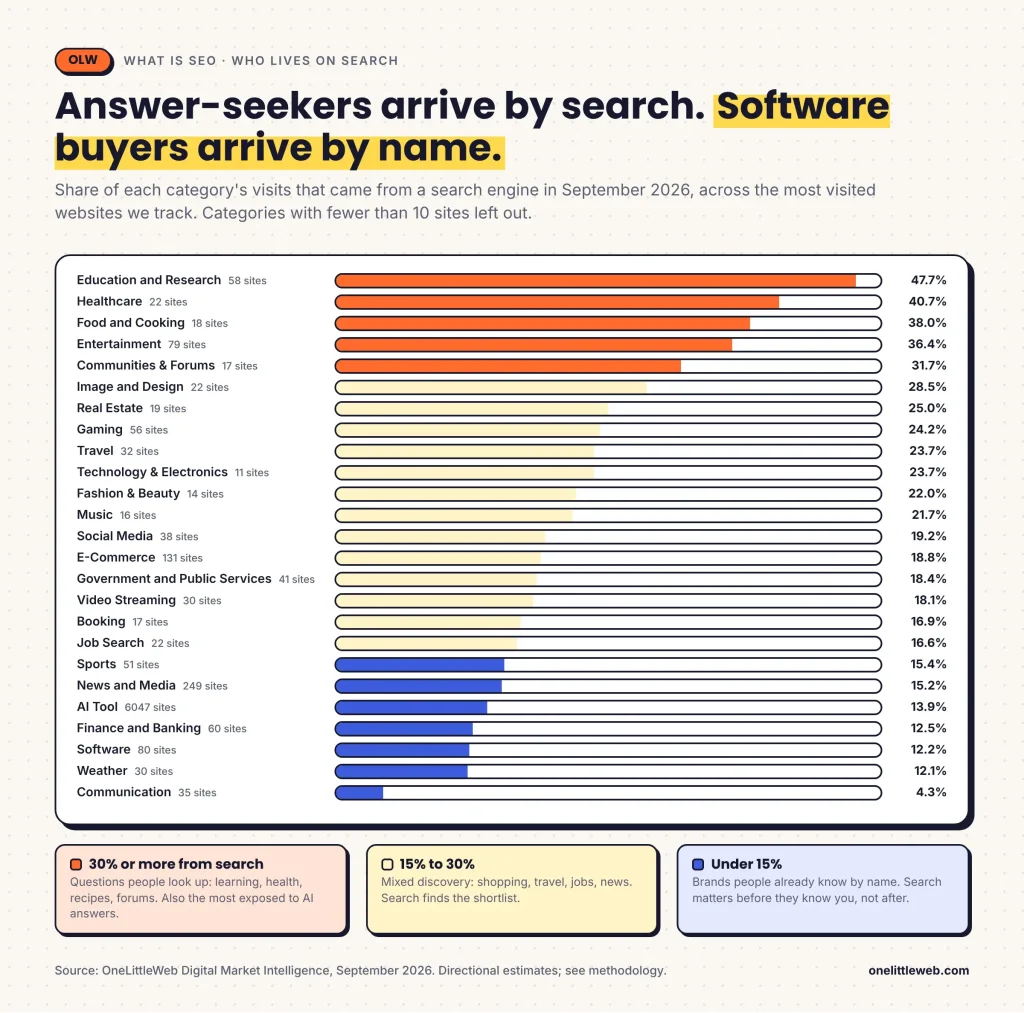
Education, health, food and forums get 32% to 48% of their visits from search, because people arrive with a question. Software, finance and messaging apps get 4% to 13%, because their visitors type the brand name.
Don’t misread the low numbers. These are the biggest brands on the internet, and most of their visitors already know them. For a business people haven’t heard of yet, search is how they find out you exist.
Who should worry about zero-click searches
Not every search sends a click. SparkToro found 58.5% of US Google searches ended without a click to any website (SparkToro, 2024). Pew found people clicked a regular result on 8% of visits when an AI summary appeared, against 15% when it didn’t (Pew Research, July 2025).
That hurts sites whose product is the answer: definitions, conversions, quick facts, generic how-tos. If someone can get what they need from a two-line summary, they will.
It barely touches businesses whose product happens after the click. Nobody gets a haircut, buys boots or signs up for software inside an AI summary. The summary can shortlist you. The sale still happens on your site.
What one ranking is actually worth
Traffic numbers are abstract. Revenue isn’t. Here’s a worked example for one keyword at a software company.
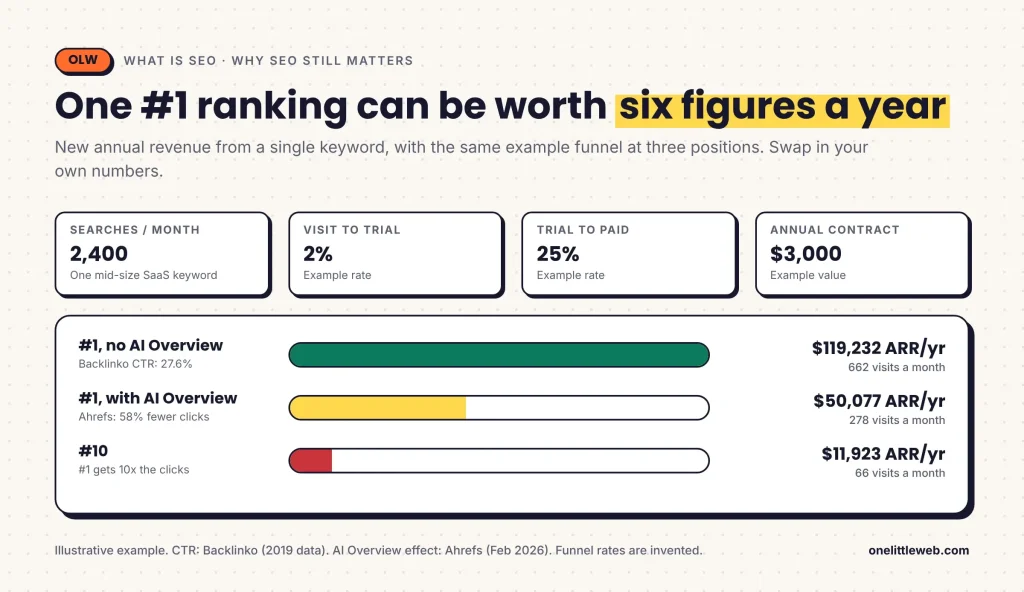
The math: monthly searches × click-through rate × conversion rate × customer value.
The #1 result gets about 27.6% of clicks and is 10 times more likely to be clicked than #10 (Backlinko, 2019 data). When an AI Overview appears, Ahrefs measured a 58% drop in position-one click-through rate (Ahrefs, February 2026).
Even after that hit, this one ranking is worth about $50,000 a year. The same math works for any business. A dentist can swap in the value of a new patient. An online store can use average order value. A law firm can use the value of a case. Run it with your own numbers and the question changes from “is SEO worth it?” to “how many rankings like this can we win?”
SEO for every kind of business
People search for “what is SEO” from every industry, and the right plan depends on yours. The foundations are the same. The pages that win, and how exposed you are to AI answers, are not.
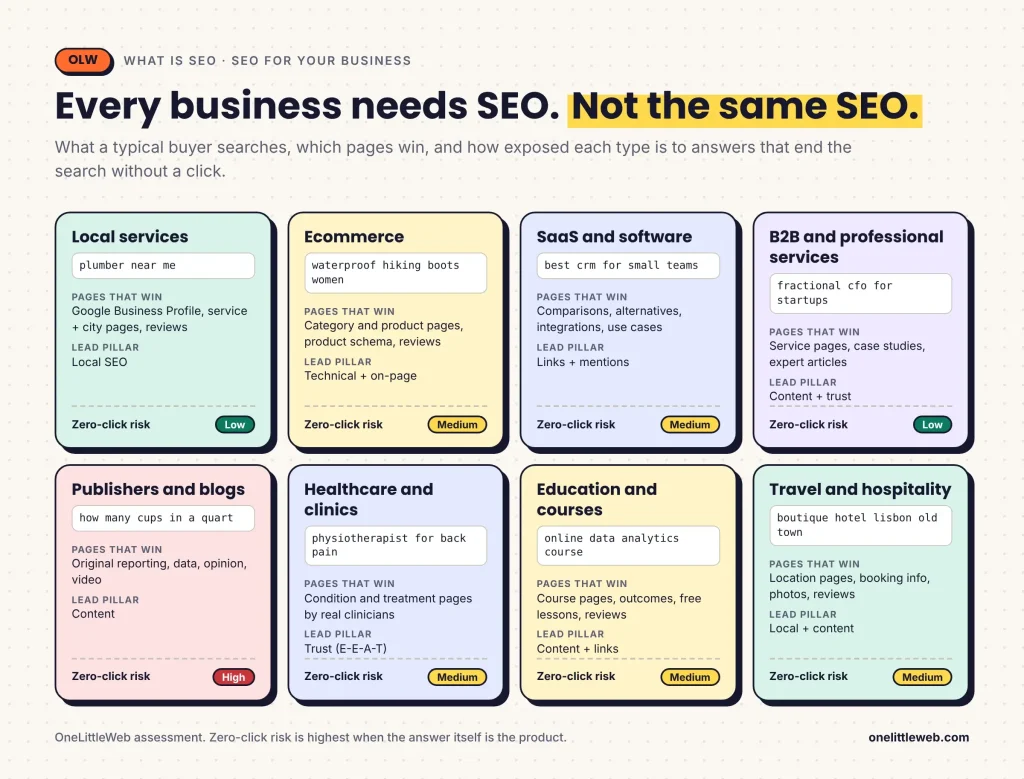
Local services
Plumbers, dentists, salons, lawyers, restaurants. Your customers search with “near me” or a city name, and the map pack decides who gets the call. Your Google Business Profile, reviews and one page per service and area matter more than blog posts. AI answers rarely replace a local visit, so zero-click risk is low. Local SEO done well can transform a small business: one dental clinic we worked with grew from 1,000 to more than 36,000 monthly visits in 13 months (case study).
Ecommerce
Your category and product pages are your SEO. Most of the work is technical: thousands of similar URLs, filters that create duplicates, product schema, and fast pages on mobile. Reviews help both rankings and conversions. AI shopping answers are growing, so get your products listed and reviewed where AI looks.
SaaS and software
The money is at the bottom of the funnel: “[category] software,” “[competitor] alternatives,” “[tool A] vs [tool B].” Remember the project management search: Reddit and review sites ranked above every vendor. Getting mentioned on the pages that already rank matters as much as ranking yourself, and that same consensus is what AI chatbots repeat. More in the SaaS section below.
B2B and professional services
Agencies, consultants, accountants, IT firms. Buyers search for the service plus a qualifier: “fractional CFO for startups,” “SOC 2 consultant.” Clear service pages, case studies with real numbers, and expert articles that show your thinking do the heavy lifting. Trust signals are everything here.
Publishers, blogs and media
This is where AI hits hardest. If your page answers “how many cups in a quart,” an AI summary can answer it too. The way forward is content an AI can’t produce on its own: original reporting, data, strong opinions, first-hand testing and video. Build an audience you can reach directly, like email, so you don’t rely on any one channel.
Healthcare, education and travel
All three get a large share of their traffic from search, and all three need trust. Google holds health and money topics to a higher standard, so show real credentials. Clinics and schools compete locally as well as nationally. Travel and hospitality sites win with location pages, real photos and booking details an AI summary can’t replace.
Whatever your business, the next sections apply to you. How search engines work doesn’t change by industry.
How search engines work
You don’t need to be an engineer to do SEO. But you do need to know the three jobs Google does, because almost every SEO problem is a failure at one of them.
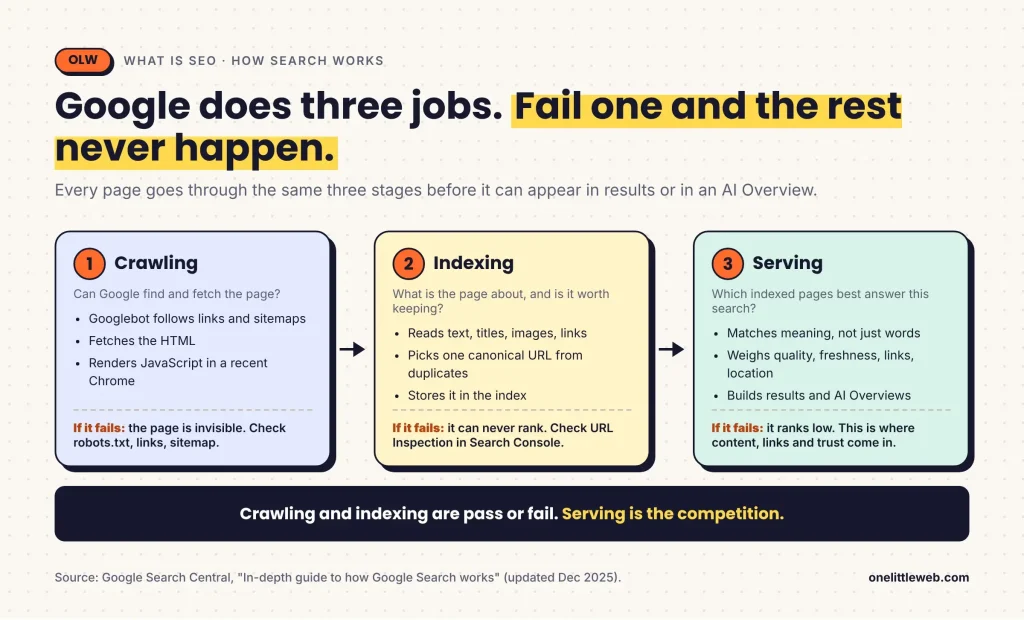
1. Crawling: can Google find the page?
Google’s crawler, Googlebot, discovers pages by following links and reading sitemaps. It fetches the HTML and renders JavaScript “using a recent version of Chrome” (Google).
If no links point to a page, it isn’t in your sitemap, or it’s blocked in robots.txt, Google may never find it. A page that can’t be crawled can’t rank. Ever.
2. Indexing: does Google understand it and keep it?
Next, Google works out what the page is about: the text, titles, images and links. If several URLs show the same content, it picks one canonical version. Then it decides whether the page is worth storing in its index.
You can check any page in seconds with the URL Inspection tool in Google Search Console. If it says “URL is on Google,” the page is indexed and eligible to rank. If not, it tells you why.
3. Serving: which page best answers this search?
This is ranking, and it’s where the competition happens. When someone searches, Google pulls matching pages from its index and orders them using many ranking systems. Google publishes the list: link analysis and PageRank, freshness, passage ranking, reviews, spam detection and more (Google ranking systems guide).
You don’t need to memorize them. They all ask the same question: is this the most useful, trustworthy answer for this person right now?
E-E-A-T, in plain English
You’ll see this acronym everywhere. It stands for Experience, Expertise, Authoritativeness and Trust.
Here’s what many guides get wrong: Google says E-E-A-T “itself isn’t a specific ranking factor” (Google). It describes what Google’s systems try to reward. It isn’t a score you can tune. Google also says trust matters most.
In practice: show who wrote it, with a real byline. Show how it was made, including any AI use. And make it clear the page exists to help a reader, not to game a ranking.
The 4 pillars of SEO
Every SEO task fits into one of four buckets. Beginners usually pour everything into one, often content, and wonder why nothing moves.
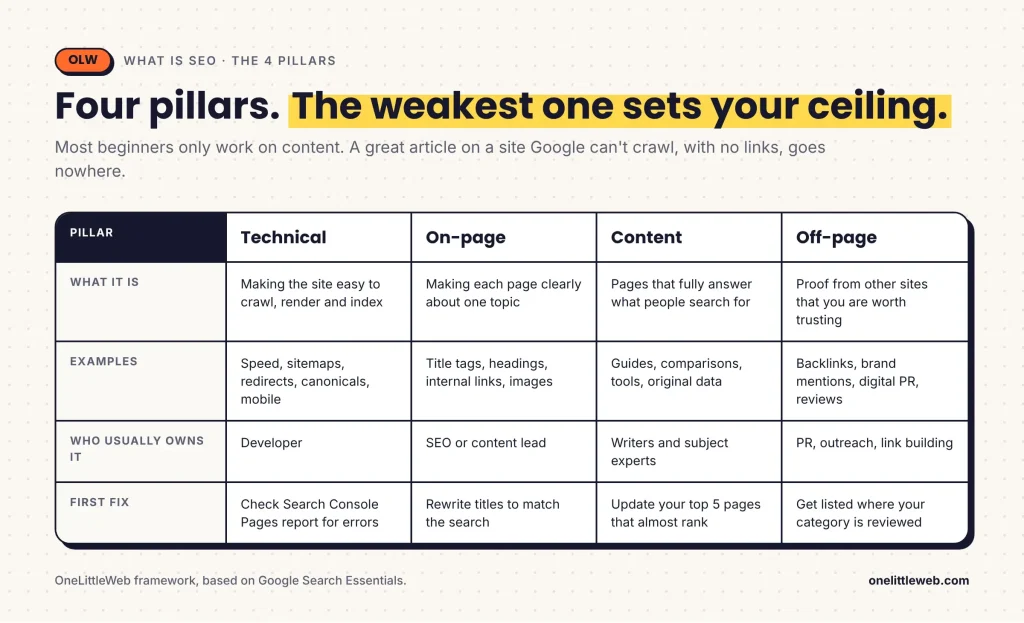
Technical SEO
Making sure search engines can crawl, render and index your site without friction: speed, mobile usability, XML sitemaps, redirects, canonical tags, structured data and error fixes. Google lists technical requirements as the first part of its Search Essentials (Google Search Essentials).
On-page SEO
Making each page clearly about one topic: title tags, headings, URL, internal links, image alt text, and matching what the searcher actually wants. It’s the pillar you control most, and the fastest to improve.
Content
Pages that answer what people search for better than what already ranks. Not longer. Better. Google says length “alone doesn’t matter for ranking purposes” (Google SEO Starter Guide).
Off-page SEO: links, mentions and digital PR
Proof from other websites that you’re worth trusting. Links still matter: Google says link analysis and PageRank remain “part of our core ranking systems” (Google). Brand mentions, reviews and press coverage matter more every year, especially for AI answers.
It’s the hardest pillar to do well and the one most teams under-invest in. It’s also what we do every day through link building and digital PR.
How to do SEO, step by step
For many people, this is where SEO becomes a nightmare. There are hundreds of tasks and no obvious order. So here’s the order we use, as a flowchart. Seven steps, and a check after each one. If a check fails, fix it before moving on.
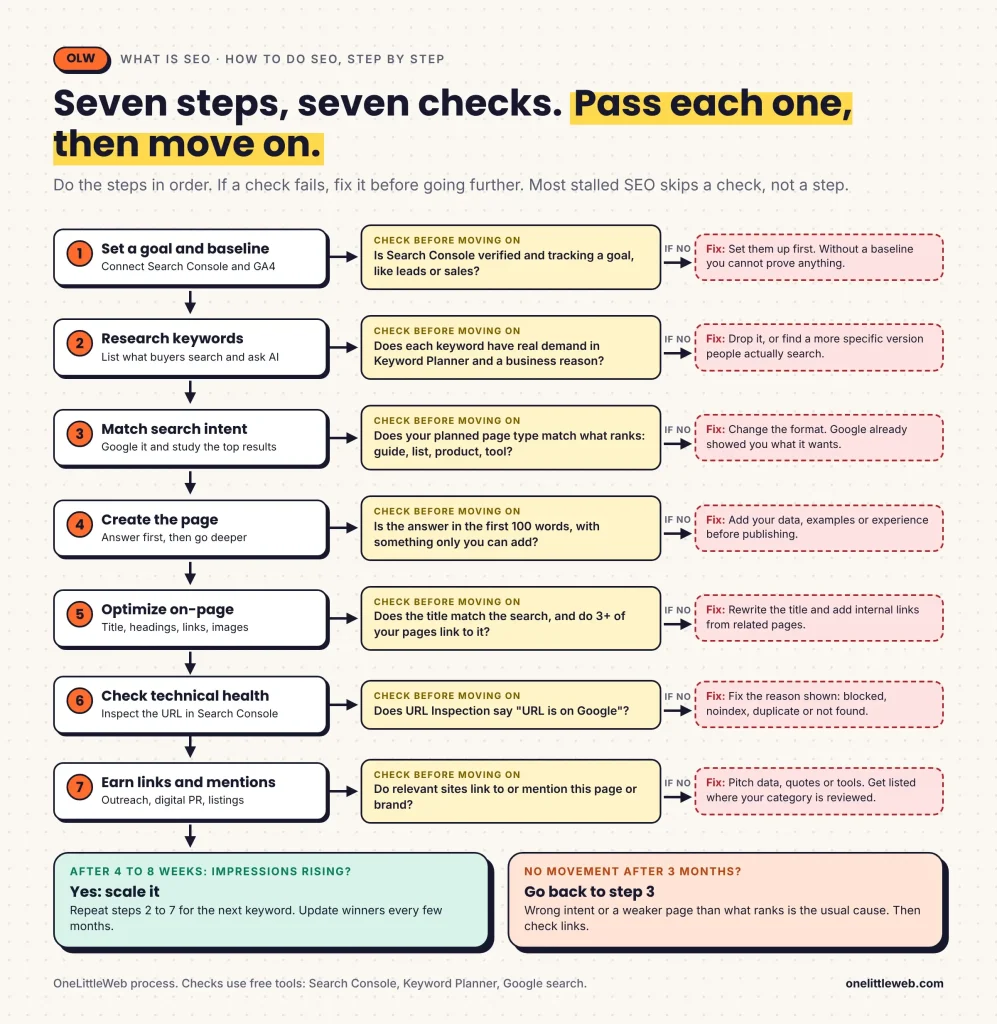
Step 1: Set a goal and a baseline
Pick one business goal: calls, bookings, sales, leads, sign-ups. Then write down where you are today.
Set up two free tools. Google Search Console shows how Google sees your site: the searches you appear for, your clicks, and your average position. Google Analytics 4 shows what visitors do after they arrive.
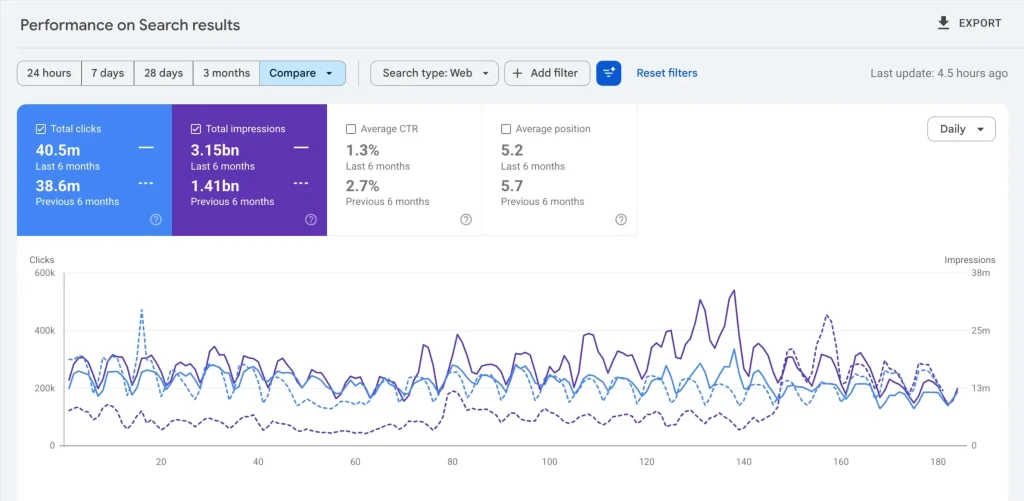
Learn four terms from that report. Clicks: people who came to your site. Impressions: how often you appeared. CTR: clicks divided by impressions. Position: your average ranking (Google).
Now read the client report above with those terms. Clicks grew from 38.6 million to 40.5 million. Impressions more than doubled, from 1.41 billion to 3.15 billion. Average position improved from 5.7 to 5.2. Yet CTR fell from 2.7% to 1.3%, because impressions grew much faster than clicks.
That pattern is common right now: AI Overviews and AI Mode put sites in front of far more searches without a click every time. It’s why you judge SEO by clicks and conversions first, and treat impressions as a sign of reach.
Check: Search Console is verified, and you can see at least one conversion in Analytics.
Step 2: Research keywords (and AI prompts)
Find the words your customers type. Start with your own Search Console queries, then expand with a keyword tool. Check demand in Google Keyword Planner, which is free with a Google Ads account. Third-party tools are great for ideas but often overstate volume.
Also write down the questions customers ask AI assistants. They’re longer and more specific. Google says AI Mode queries are on average three times longer than traditional searches (Alphabet Q3 2026).
Aim for 20 to 50 targets, grouped by topic. Our keyword research tools roundup compares the main options.
Check: each keyword has real demand and a reason it would bring you business.
Step 3: Match each keyword to the right page type
Google the keyword and look at what ranks. That’s Google telling you what searchers want.
If the top results are all list posts, a product page won’t break in. If they’re all local businesses, a national blog post won’t either. Copy the format, beat the substance. One page per intent. Two pages chasing the same search compete with each other.
Check: your planned page is the same type as most of the top 5.
Step 4: Create content worth ranking
Answer the question early. Then go deeper than what already ranks, with something only you can add: your data, your examples, your experience, your opinion.
A simple test: if this page disappeared, would anyone miss it? If not, it won’t rank for long.
Check: the answer appears in the first 100 words, and the page includes something competitors don’t have.
Step 5: Optimize on-page elements
Write a title tag that matches the search and makes people want to click. Use headings that follow the reader’s questions. Link to the page from related pages on your site. Describe images with alt text. Add structured data where it’s accurate.
Skip outdated checklist items. Google says it “doesn’t use the keywords meta tag” (Google).
Check: the title matches the search, and at least 3 of your own pages link to this one.
Step 6: Fix the technical foundations
Open the Pages report in Search Console. It lists every page Google couldn’t index and why. Fix those first. Then check speed and mobile on your most important pages, submit an XML sitemap, and merge duplicates. Once your site grows, an audit tool helps. Our SEO audit tools roundup covers the best.
Check: URL Inspection says “URL is on Google” for the page.
Step 7: Earn links and mentions
This is the step most guides rush and most teams skip. It’s also what separates sites that rank from sites that wait.
Good links come from being worth linking to: original data, useful tools, expert quotes, and real relationships with publishers in your space. Local businesses can start with chambers of commerce, suppliers and local press. Buying links in bulk breaks Google’s link spam policy and can sink a site (Google).
Check: relevant sites link to or mention the page or your brand.
Links are the hardest part of SEO to do well. They take outreach, relationships and content worth citing, and most in-house teams don’t have the time. Building them is what we do every day. See how our link building works.
Then: measure, and repeat
Give it 4 to 8 weeks. If impressions are rising, repeat steps 2 to 7 for the next keyword. If nothing has moved after 3 months, go back to step 3. Wrong intent, or a weaker page than what already ranks, is the usual cause.
Your first 30 days
If your site already has some pages, here’s what month one looks like.
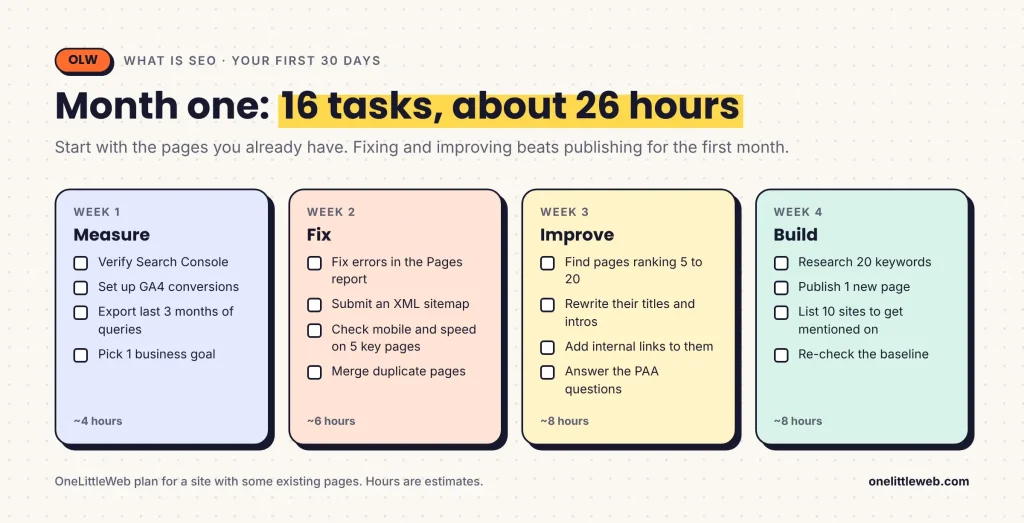
Notice where new content shows up: week four. The fastest wins usually come from pages already ranking on page two. A better title, a stronger intro and a few internal links can move them to page one within weeks.
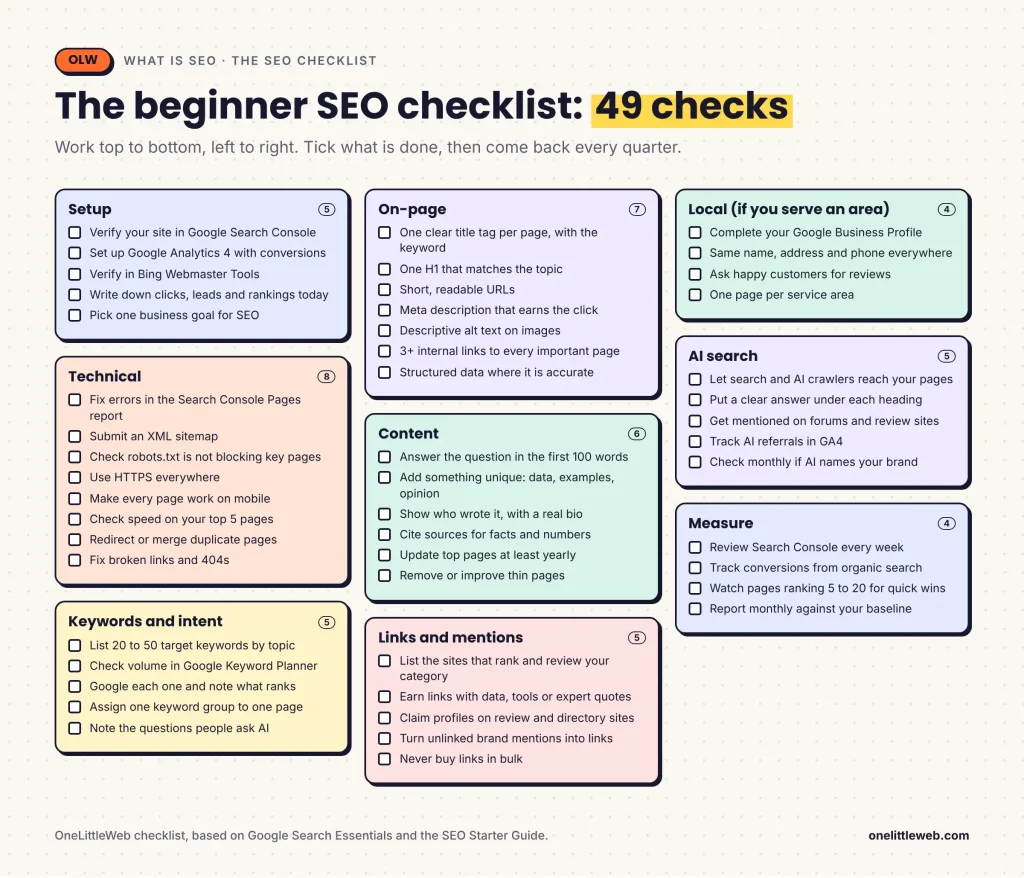
The SEO checklist: 49 checks
Here’s everything above in one list. Save it, print it, and work through it in order. If you’re a local business, don’t skip the local section. If you’re not, skip it.
Setup
- Verify your site in Google Search Console
- Set up Google Analytics 4 and mark your conversions
- Verify your site in Bing Webmaster Tools
- Write down today’s clicks, leads and rankings
- Pick one business goal for SEO
Technical
- Fix every error in the Search Console Pages report
- Submit an XML sitemap
- Check robots.txt isn’t blocking important pages
- Use HTTPS on every page
- Make every page work well on a phone
- Check speed on your 5 most important pages
- Redirect or merge duplicate pages
- Fix broken links and 404 errors
Keywords and intent
- List 20 to 50 target keywords, grouped by topic
- Check search volume in Google Keyword Planner
- Google each one and note what type of page ranks
- Assign each keyword group to one page only
- Note the questions customers ask AI assistants
On-page
- One clear title tag per page, including the main keyword
- One H1 heading that matches the topic
- Short, readable URLs
- A meta description that makes people want to click
- Descriptive alt text on images
- At least 3 internal links to every important page
- Structured data (schema) where it’s accurate
Content
- Answer the main question in the first 100 words
- Add something unique: your data, examples or opinion
- Show who wrote it, with a real author bio
- Cite sources for facts and numbers
- Update your top pages at least once a year
- Remove or improve thin pages
Links and mentions
- List the sites that rank for and review your category
- Earn links with data, tools or expert quotes
- Claim your profiles on review and directory sites
- Ask sites that mention you without a link to add one
- Never buy links in bulk
Local (if you serve an area)
- Complete every field in your Google Business Profile
- Use the same name, address and phone number everywhere
- Ask happy customers for reviews, and reply to them
- Create one page per service area
AI search
- Let search engine and AI crawlers reach your public pages
- Put a clear, direct answer under each heading
- Get mentioned on forums, review sites and “best of” lists
- Track AI referrals (chatgpt.com, perplexity.ai, gemini.google.com) in GA4
- Check once a month whether AI assistants name your brand
Measure
- Review Search Console every week
- Track conversions from organic search
- Watch pages ranking in positions 5 to 20 for quick wins
- Report monthly against your baseline
How to measure SEO success
Measure what matters to the business first, then the signals that predict it.
Core metrics
- Conversions from organic search. Leads, calls, bookings, sales. The number your boss cares about.
- Clicks and impressions. From Search Console. Impressions rise first; clicks follow.
- Rankings for your target keywords. Track the ones tied to revenue. A rank tracker automates it.
- Pages indexed. From the Pages report. If it drops, something broke.
- Referring domains. How many different sites link to you.
AI visibility metrics
Search Console now includes a report for generative AI features in Google Search. Track it next to the classic reports. Set up a GA4 channel for referrals from AI assistants, and check each month whether they mention your brand for your main topics. Our AEO guide walks through the free setup.
Leading vs lagging indicators
Revenue shows up last. In the first months, watch the leading signals: pages indexed, impressions, the number of keywords you rank for at all, and positions on pages two and three. When those move, clicks and revenue follow.
How long SEO takes, and what it costs
These are the two questions every client asks first. Here are honest answers.
How long does SEO take?
Google says “some changes might take effect in a few hours, others could take several months” (Google SEO Starter Guide). In our experience, a site with some authority sees early signs in about 3 months and meaningful results in 6 to 12.
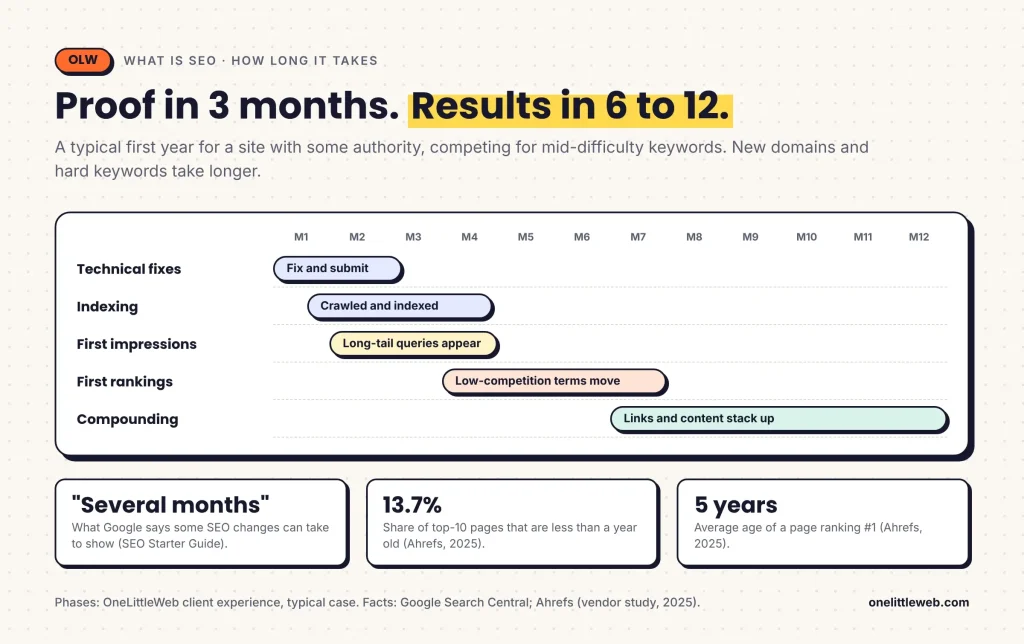
The data backs up the patience. Only 13.7% of pages in the top 10 are less than a year old, and the average #1 page is about 5 years old (Ahrefs, 2025).
What changes the timeline
- Your site’s authority. Established domains with links rank new pages faster.
- Keyword competition. A niche local term can move in weeks. “What is SEO” takes years.
- Content quality and consistency. Regular, useful publishing builds depth on a topic.
- Links. The biggest accelerator, and the hardest to rush safely.
- Technical health. Fixing crawl and indexing problems can bring quick wins on its own.
What does SEO cost?
It depends on who does it. The largest public pricing survey found most businesses spend $500 to $5,000 a month, with an average hourly rate of $111 (Ahrefs SEO pricing survey; surveyed in 2023, so current rates are likely somewhat higher).
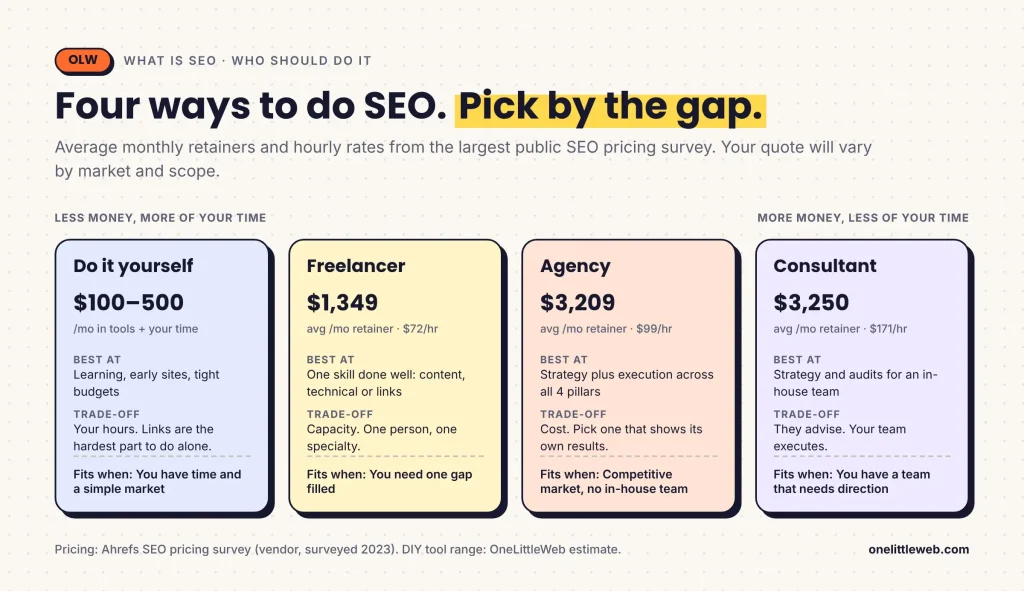
DIY, freelancer or agency?
- Do it yourself if you have time, a simple market and a willingness to learn. Use the checklist above. Expect links to be the hardest part.
- Hire a freelancer to fill one gap: technical fixes, content or outreach.
- Hire an agency when your market is competitive, you need all four pillars, and you don’t have an in-house team. Ask to see their own results, and walk away from anyone who promises rankings. Google is blunt: “No one can guarantee a #1 ranking on Google” (Google, “Do you need an SEO?”).
- Hire a consultant when you have a team that needs direction more than hands.
If you’re weighing agencies, we’ve compared the top SEO companies with a weighted scoring method. And if you’re in a competitive market without link-building capacity in-house, that’s exactly what our SEO services are built for.
White hat vs black hat SEO, and the myths to ignore
White hat SEO follows the search engines’ rules. Black hat tries to trick them. Black hat sometimes works for a while. Then an update or a manual penalty wipes out the site and everything built on it.
What Google penalizes
Google publishes its spam policies (Google spam policies). The ones beginners stumble into most:
- Link spam: buying or trading links to manipulate rankings.
- Scaled content abuse: mass-producing pages, with AI or otherwise, mainly to rank rather than to help.
- Keyword stuffing: cramming the same words in unnaturally.
- Cloaking: showing search engines different content from what users see.
- Site reputation abuse: hosting unrelated third-party content on a trusted site to borrow its rankings.
- Expired domain abuse: buying old domains to exploit their history for unrelated content.
8 SEO myths to ignore
- “SEO is dead because of AI.” Search still sends websites 65 times more visits than AI, and AI answers are built on search results.
- “Longer content ranks better.” Google says length alone doesn’t matter. Completeness does.
- “You need meta keywords.” Google doesn’t use them.
- “E-E-A-T is a ranking factor you can optimize.” Google says it isn’t a specific ranking factor.
- “AI content is penalized.” Google judges the content, not the tool. What’s penalized is using AI mainly to manipulate rankings.
- “Submitting your site to Google makes it rank.” Submission helps discovery. It does nothing for ranking.
- “More pages means more traffic.” Thin pages can drag a site down. Fewer, better pages usually win.
- “Social shares are a ranking factor.” Social can drive visits and earn links, but shares themselves aren’t a direct signal.
Common SEO mistakes beginners make
- Targeting keywords that are too hard. A new site going after “CRM software” or “lawyer” will wait years. Start specific.
- Ignoring search intent. Writing a guide when Google ranks product pages, or the reverse.
- Publishing before fixing. New content on a site with indexing errors is wasted.
- Never building links. Great content with zero links rarely ranks in competitive spaces.
- Two pages chasing the same keyword. Merge them.
- Forgetting internal links. New pages with no links from your own site are hard for Google to find and value.
- Chasing AI and ignoring search. AI visibility starts with ranking. Skip the foundation and there’s nothing for AI to cite.
- Measuring traffic instead of revenue. Traffic that doesn’t convert isn’t a win.
- Giving up at month three. That’s usually right before it starts working.
- Trusting tool estimates over Search Console. Third-party traffic estimates can be far off. Search Console shows your real clicks.
SEO for SaaS companies: what’s different
SaaS is where we spend most of our time, and it plays by slightly different rules.
- The money is at the bottom of the funnel. “[Category] software,” “[competitor] alternatives” and “[tool A] vs [tool B]” convert far better than top-of-funnel guides. Build those pages first.
- Third-party pages decide the shortlist. In the search from earlier, Reddit and review sites ranked above every vendor. Getting mentioned on the pages that already rank matters as much as ranking yourself.
- Integration and use-case pages scale. “[Your product] + Slack” and “[category] for agencies” capture specific, high-intent demand.
- Docs and help centers rank. Treat them as SEO assets, not just support content.
- AI assistants are now a buying channel. Buyers ask ChatGPT for software recommendations. The mentions that win the shortlist also win the AI answer.
What this looks like in practice: for one AI SaaS client, our SEO and link building took organic traffic from 10.5 million to 18.5 million monthly visits in 12 months, a 76% increase, building around 35 high-authority links a month. AI assistants started sending them about 40,000 visits a month too. Read the case study, or see how we’d approach your category.
How to learn SEO
The best way to learn SEO is to do it on a site you control. Reading without practice doesn’t stick.
- Start a practice project. A blog on something you know, or a section of your company site. Somewhere you can change things and watch what happens.
- Read Google’s own documentation first. The SEO Starter Guide and Search Essentials are free, current and straight from the source.
- Live in Search Console. Check it weekly. It’s the best free SEO teacher there is.
- Follow a few practitioners, not dozens. Pick 3 to 5 who show their data. Our list of top SEO experts is a good place to start.
- Give it 90 days. Month one: basics and tools. Month two: fix and improve existing pages. Month three: publish, build a few links, and measure what changed.
SEO FAQ
What is SEO in simple terms?
SEO is making your website easy for search engines to find, understand and trust, so your pages show up when people search for what you offer. The clicks are free, but you earn them with useful content, a working site and links from other sites.
Is SEO dead because of AI?
No. In the 12 months to September 2026, search engines (excluding YouTube) got about 13 times more visits than AI chatbots, and sent websites 65 times more traffic, based on our tracking of 7,255 top sites. AI chatbots are growing fast, but they’re being added on top of search, not replacing it.
What is the difference between SEO, AEO and GEO?
SEO aims to rank your pages in search results. AEO (answer engine optimization) and GEO (generative engine optimization) aim to get your brand cited or named in AI answers. AI answers are built from pages that are crawled, indexed and trusted, so AEO and GEO are branches of SEO, not replacements.
What are the main types of SEO?
There are four: technical SEO (can search engines crawl and index you), on-page SEO (is each page clearly about one topic), content (does it fully answer the search) and off-page SEO (do other sites link to and mention you). Local, ecommerce and SaaS SEO build on these.
Does every business need SEO?
Almost every business whose customers search before they buy. That includes local services, online stores, software, professional services, clinics, schools and travel. The pages that win differ by business type, but the foundations are the same.
Can I do SEO myself?
Yes. The basics are learnable with free tools like Google Search Console and Google’s own guides. Most people can handle technical fixes, on-page work and content. Link building is usually where DIY stalls, because it takes time and relationships.
How long does SEO take to work?
Google says some changes take hours and others take several months. Most sites with some authority see early signs in about 3 months and meaningful results in 6 to 12. New domains and very competitive keywords take longer.
How much does SEO cost?
Most businesses spend $500 to $5,000 a month, according to Ahrefs’ pricing survey. Freelancers average around $1,350 a month and agencies around $3,200. Doing it yourself costs mainly tools and time.
Does AI-generated content rank?
It can. Google evaluates the content, not how it was made. What breaks Google’s rules is using AI mainly to manipulate rankings, such as mass-producing thin pages. AI-assisted content that is accurate, original and useful can rank like anything else.
What is the most important ranking factor?
There’s no single one. Google uses many ranking systems. In practice, the biggest levers are matching search intent, being the most useful answer, technical accessibility, and links from trusted sites. A weakness in one holds the others back.
Where to go next
This guide is the hub. Each section has a deeper guide behind it.
- What Is AEO? Answer engine optimization
- AI chatbots vs search engines: our traffic study
- Best keyword research tools
- Best SEO tools
- Best SEO audit tools
- Best link building tools
- Digital market intelligence: the most visited websites
Methodology: how we collected our market data
The traffic charts in this guide come from OneLittleWeb Digital Market Intelligence, our own tracker of website and AI tool traffic. Here’s what the numbers are, what they aren’t, and why the live dashboard may not match them exactly.
Where the numbers come from
- Estimates, not site analytics. Visit counts are estimated from third-party traffic data (SEMrush, Ahrefs and Aitools.xyz), not measured inside each website.
- What a “visit” means. Estimated monthly visits. Returning users are counted again each month, so these are not counts of unique people.
- What we track. 7,255 of the world’s most visited websites, including 125 AI chatbots and the dashboard’s search engine category.
- Search engines exclude YouTube. The dashboard’s search engine category has 49 sites, including YouTube and country versions of Google such as google.de. We removed YouTube, which is mainly a video platform, so our figures cover 48 search engines. The live dashboard includes YouTube, which makes up about a third of that category’s visits, so its search engine totals are higher than ours.
- Traffic sources. “Search,” “AI traffic” (visits referred by AI chatbots) and “Google AI Mode” are classified by the data providers. AI referrals are tracked from February 2025 and Google AI Mode from September 2025, so we only compare months where both sides were tracked.
Periods used
- Search vs chatbots and visits sent to websites (top chart): both panels cover the same 12 months, October 2025 to September 2026. Growth for chatbot and search engine visits compares that period with October 2024 to September 2025. Growth for visits sent to websites compares the last 6 months (April to September 2026) with the 6 before, because AI referral tracking doesn’t cover the full prior year.
- The gap over time: selected months from October 2024 to September 2026.
- Visits sent per 100 visits received: October 2025 to September 2026. Search: visits referred by search to the 7,255 tracked sites, divided by visits to search engines (YouTube excluded; about 24 per 100 if YouTube is included). Chatbots: visits referred by AI chatbots, divided by visits to the 125 chatbots. Google AI Mode referrals are left out because AI Mode runs inside Google, whose visits sit in the search engine total. These rates only count visits to the sites we track, so both are lower than the true share of people who click through to any website.
- Search share by category: September 2026, categories with at least 10 tracked sites, search engines excluded.
- Data pulled November 4 and 5, 2026. September 2026 was the latest month available.
Why the live dashboard may show different numbers
The dashboard is live. The charts here are a snapshot. The two will drift apart over time because:
- it’s refreshed every one to two months as new data arrives;
- we add websites, and occasionally remove them, based on relevance and importance;
- data providers revise their estimates, and we correct discrepancies or update calculations when we find them;
- some months, such as December, are interpolated in the dashboard and can be restated later. Our December 2025 figure is the interpolated value as of our pull; leaving December out entirely changes the 65x referral gap to 64x.
Known limitations
- Estimates can be off for individual sites, especially smaller ones. Totals across thousands of sites are more stable than any single number.
- Country-level data is under review, so we don’t use it here.
- The September 2026 chatbot total includes an unusually large jump from a single country that we’re reviewing. If it’s revised down, the gap between search and chatbots gets wider, not narrower.
- Other researchers using different data sources, site lists or definitions will get different totals.
Read these numbers as directional: trends, proportions and orders of magnitude, not exact counts. None of these limitations changes the core finding: search is still many times bigger than AI chatbots, and still sends websites far more visitors.