Quick answer
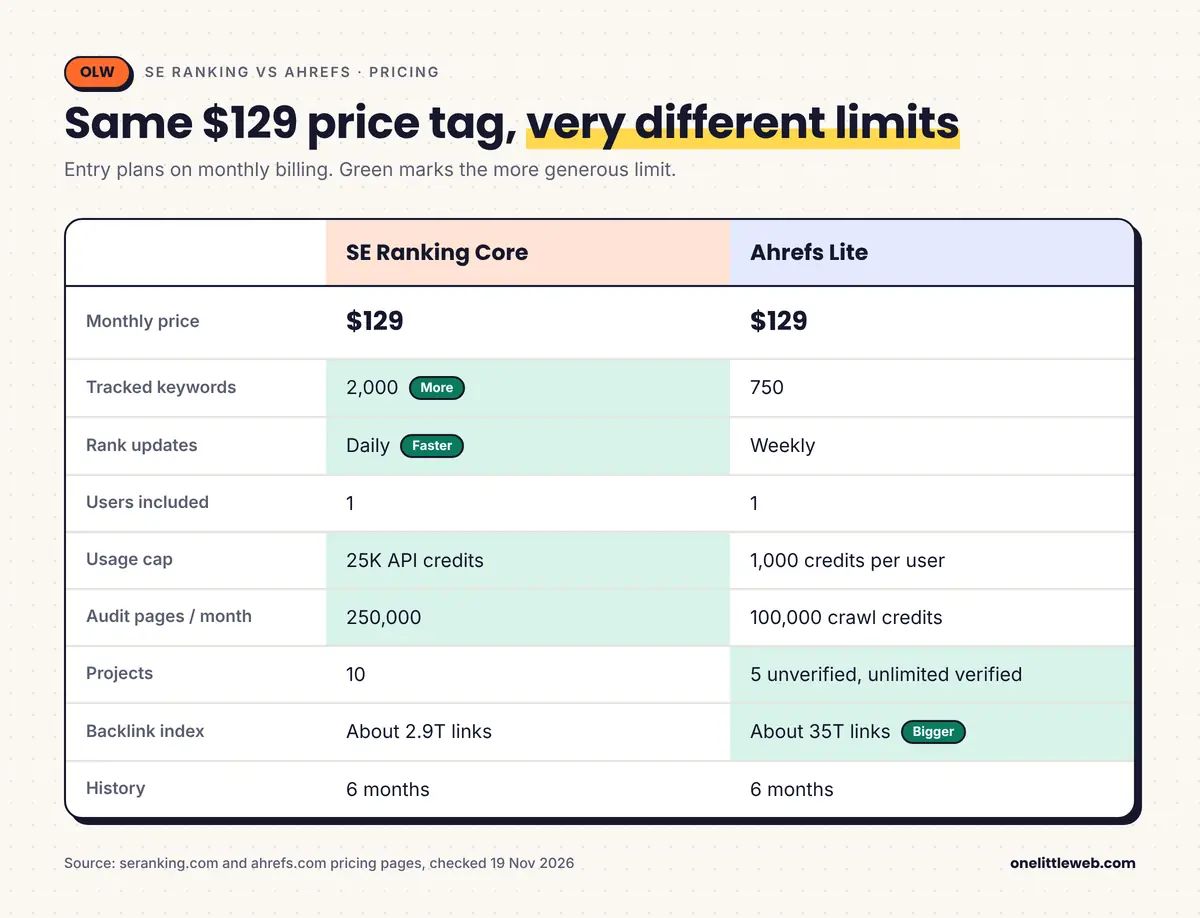
SE Ranking vs Ahrefs now comes down to limits, not price. Both start at $129 a month. Pick Ahrefs if backlinks and deep research drive your work. Pick SE Ranking if you need daily rank tracking, more seats and client reports for less.
Key takeaways
- Same entry price. SE Ranking Core and Ahrefs Lite both cost $129 a month after SE Ranking’s 2026 plan change.
- Backlinks favor Ahrefs. About 35T links vs 2.9T. In our own test, SE Ranking found about half the linking sites Ahrefs found.
- Rank tracking favors SE Ranking. Daily on every plan vs weekly on Ahrefs unless you pay $200 a month per project.
- Teams pay less on SE Ranking. Growth includes 3 seats. Ahrefs charges $40 to $80 for each extra user.
- AI tracking differs. SE Visible is included. Ahrefs Brand Radar AI starts at $199 a month but covers more engines.
- Agencies get white-label on SE Ranking only. The Agency Pack costs $69 a month.
Most SE Ranking vs Ahrefs comparisons still tell you SE Ranking costs $65 a month. That price is gone.
In early 2026, SE Ranking rebuilt its plans. Its entry plan now costs $129 a month. That is the exact same sticker price as Ahrefs Lite.
So the old “cheap tool vs premium tool” story no longer works. The real question now is what each $129 actually buys you. I checked both pricing pages on 19 November 2026, and the limits behind that price are very different.
SE Ranking vs Ahrefs at a glance
Prices checked 19 November 2026, monthly billing unless noted.
| SE Ranking | Ahrefs | |
|---|---|---|
| Starting price | $129/mo Core ($103.20/mo billed yearly) | $129/mo Lite (no annual price published) |
| Cheapest way in | 14-day free trial | $29/mo Starter, or free Ahrefs Webmaster Tools |
| Users included | 1 (Core), 3 (Growth) | 1 on every self-serve plan |
| Extra users | From $16/mo | $40 to $80/mo depending on plan |
| Tracked keywords (entry plan) | 2,000 | 750 |
| Rank update frequency | Daily on all plans | Weekly (daily costs $200/mo per project) |
| Keyword database | About 5.3B keywords, 188 locations | 28.7B keywords, 217 locations |
| Backlink index | About 2.9T backlinks | About 35T backlinks |
| History on entry plan | 6 months | 6 months |
| Usage limits | Research API credits (25K on Core) | 1,000 credits per user on Lite |
| AI search tracking | SE Visible included (5 AI engines) | Brand Radar AI from $199/mo (6 AI engines) |
| White-label reports | Agency Pack, +$69/mo | Not available |
| G2 rating | 4.7/5 (1,591 reviews) | 4.5/5 (713 reviews) |
How we compared SE Ranking and Ahrefs
I want to be clear about what this comparison is based on.
Ahrefs is part of our daily stack at OLW. Our SEO team uses it for link building campaigns, backlink audits and competitor research across client work. Those parts of the article come from hands-on use.
SE Ranking is research-based in this article. I pulled its current plans, limits and database figures straight from its own pages. I also read user reviews on G2 and Capterra and recent Reddit threads.
A few more things I did:
- Checked both pricing pages directly on 19 November 2026, instead of trusting third-party lists.
- Read the five top-ranking comparisons for this keyword. All five still quote SE Ranking’s old 2025 prices.
- Pulled live ratings from G2 and Capterra in November 2026.
- Ran a live test. We put onelittleweb.com through both tools’ free backlink checkers on the same day and compared the results. You’ll find them in the backlink section.
One honest note on bias. Many comparison pages for this keyword earn affiliate commission. One of the top results, Exploding Topics, is owned by Semrush and ends by recommending Semrush. Keep that in mind when you read other verdicts, including ours.
Two all-in-one SEO platforms with different roots
Both are all-in-one SEO platforms. That means one subscription covers the same core jobs that most of the best SEO tools handle: keyword research, backlink analysis, rank tracking, site audits, competitor research and content tools. That is why people compare them.
But they started in different places, and it still shows.
Ahrefs launched in 2011 in Singapore as a backlink checker. Its crawler and link index are still its biggest strength. Everything else was built around that data.
SE Ranking launched in 2013 as a rank tracker. Daily tracking, reporting and agency features are still where it feels most at home.
So when you compare them, ask a simple question. Is your daily work closer to “find and analyze links” or “track and report rankings”? Your answer points to the right tool most of the time.
SE Ranking: what you get
Best for: freelancers, small agencies and in-house teams that report rankings to clients or bosses
Starting price: $129/mo (Core), or $103.20/mo billed yearly
Key differentiator: daily rank tracking, included seats and white-label reporting at a mid-market price
Quick overview
SE Ranking is an all-in-one SEO platform that started as a rank tracker in 2013. It still feels built around one job: tracking positions and turning them into reports. Since its 2026 plan change, Core and Growth also include AI visibility tracking, content writing credits and access to its API and MCP server.
It is aimed at people who manage several sites and need clear reports more than deep link research. Compared with Ahrefs, it gives you more tracked keywords, more seats and more audit pages for the same money. The trade-off is a smaller keyword and backlink database. Our view here is based on SE Ranking’s own pages, review data and our live backlink test.
Key features
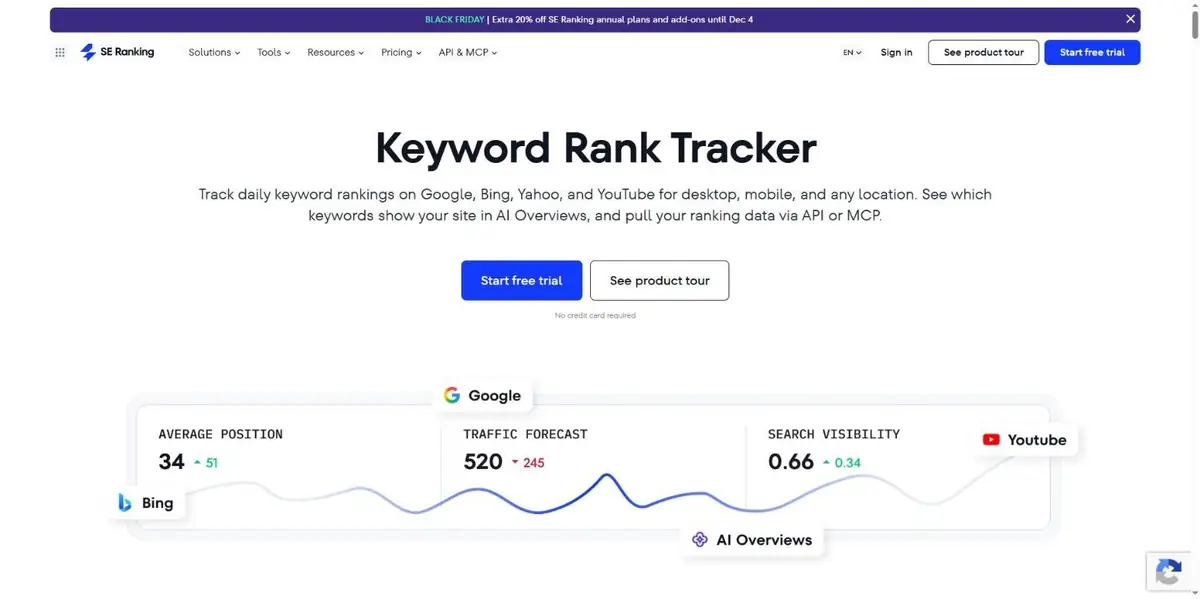
- Daily rank tracker: tracks rankings every day on Google, Bing, Yahoo and YouTube, on desktop and mobile, for any location. It also shows which keywords trigger AI Overviews for your site.
- Website audit: crawls 250,000 pages a month on Core and 2 million on Growth, with no need to verify the site first.
- Competitive research: shows a competitor’s organic keywords, traffic estimates, top pages and 12 months of paid ad history.
- Backlink checker and monitor: about 2.9 trillion backlinks, with Domain Trust scores, anchor text and lost or new link tracking.
- SE Visible: tracks 25 AI prompts daily across AI Overviews, AI Mode, Gemini, ChatGPT and Copilot.
- Content marketing tools: an AI writer and Content Editor, with 25 or 50 articles a month included.
- Agency Pack: white-label reports, 30 client seats and a lead generator for +$69/mo.
- API and MCP access: 25K or 100K research API credits a month, usable from AI assistants through MCP.
Pros
- Daily rank updates on every plan, with no add-on
- 3 user seats on Growth, and cheap extra seats
- White-label reporting for agencies at a low add-on price
- AI visibility tracking included in both main plans
- 14-day free trial with no credit card
- Top marks for support on G2 (9.4 vs 8.4 for Ahrefs)
Cons
- Backlink index is about 12 times smaller than Ahrefs’. In our test it found about half of the linking sites Ahrefs found.
- Keyword database is about 5 times smaller, which shows up in niche and long-tail research
- Setup takes longer, since you add keywords, competitors and prompts before dashboards fill up
- Entry price doubled in 2026, so it is no longer the “cheap” option at the bottom tier
- Some negative reviews mention billing and refund problems
Skip SE Ranking if
You sell link building or digital PR, or you live in Keywords Explorer every day. The smaller databases will slow you down.
Verdict
SE Ranking is the better value for anyone whose work is mostly tracking, auditing and reporting. It is not a full replacement for Ahrefs if backlinks are your core product.
Ahrefs: what you get
Best for: link builders, content teams and SEOs who need the deepest data on competitors
Starting price: $129/mo (Lite), or $29/mo Starter for light lookups
Key differentiator: a 35 trillion link backlink index and 28.7 billion keyword database
Quick overview
Ahrefs started in 2011 as a backlink checker and grew into a full SEO and marketing platform. Its own crawler is one of the most active on the web, and its pricing page now advertises 16+ years of web-scale data. That data is the main reason to pay for it.
It suits SEOs who research competitors, plan content and build links every day. Compared with SE Ranking, it gives you much more data per search, faster link discovery and stronger content research. The trade-off is weekly rank tracking, paid extra seats and a credit cap on Lite. Our view comes from daily use at OLW across client campaigns, and we cover it in more depth in our full Ahrefs review.
Key features
- Site Explorer: backlinks, referring domains, organic keywords, top pages and traffic history for any site.
- Keywords Explorer: 28.7 billion keywords across 217 locations, with Keyword Difficulty and Traffic Potential.
- Content Explorer (Standard+): search a huge page index by topic, links and traffic to find content ideas and link prospects.
- Site Audit: 100,000 to 1.5 million crawl credits a month, plus always-on audits and Patches with Project Boost.
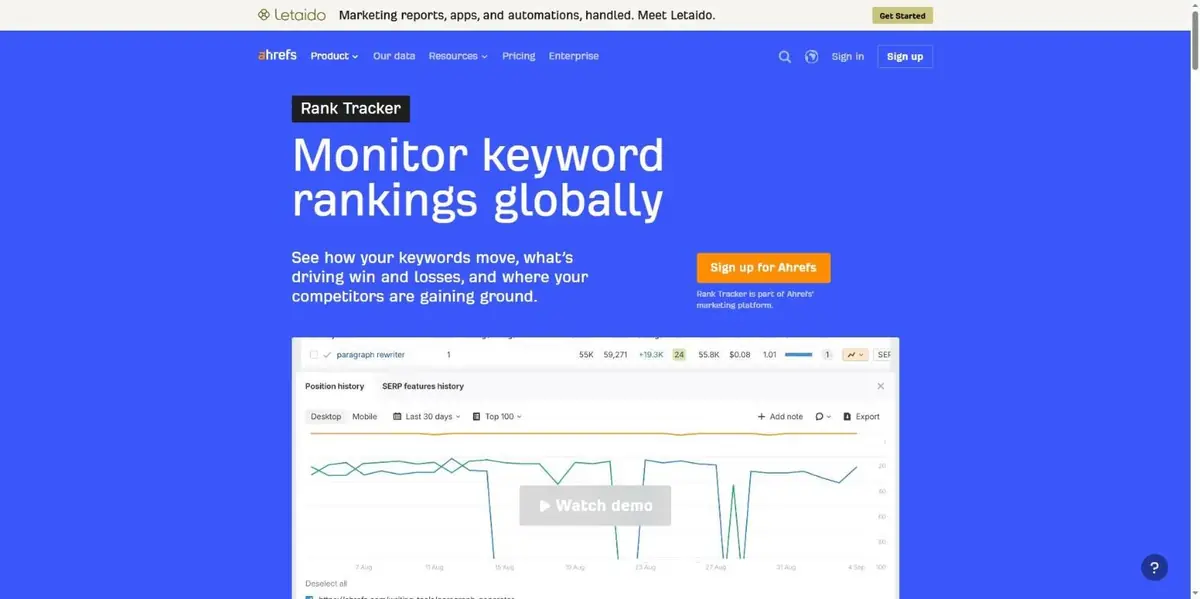
- Rank Tracker: weekly updates, 19 SERP features including AI Overviews, and ZIP-level locations.
- Brand Radar AI: AI visibility research across more than 475 million prompts, from $199/mo.
- Ahrefs Webmaster Tools: free Site Explorer and Site Audit data for sites you own.
- API and MCP access: included from Lite, so you can pull Ahrefs data into AI assistants and scripts.
Pros
- The biggest backlink index we use, refreshed every 15 to 30 minutes
- Deep keyword data, especially for long-tail and international research
- Content Explorer is a great tool for content ideas and link prospects
- Unlimited verified projects on every plan
- A real free tier and a $29 Starter plan
- Clean, fast interface once you learn it
Cons
- Rank tracking is weekly unless you pay $200/mo per project
- Only 1 user on every self-serve plan, with $40 to $80/mo for each extra
- Lite caps each user at 1,000 credits a month
- No white-label reporting
- AI tracking (Brand Radar AI) costs extra
- No free trial
Skip Ahrefs if
You mainly need daily rankings and client reports for a team on a tight budget. You’ll pay for data depth you won’t use.
Verdict
Ahrefs is still the stronger research tool, and it’s our main backlink tool at OLW. It gets expensive fast once you add people, daily tracking and AI visibility.
Pricing: the gap closed, the limits didn’t
This is where most comparisons are now wrong. So let me give you the current numbers.
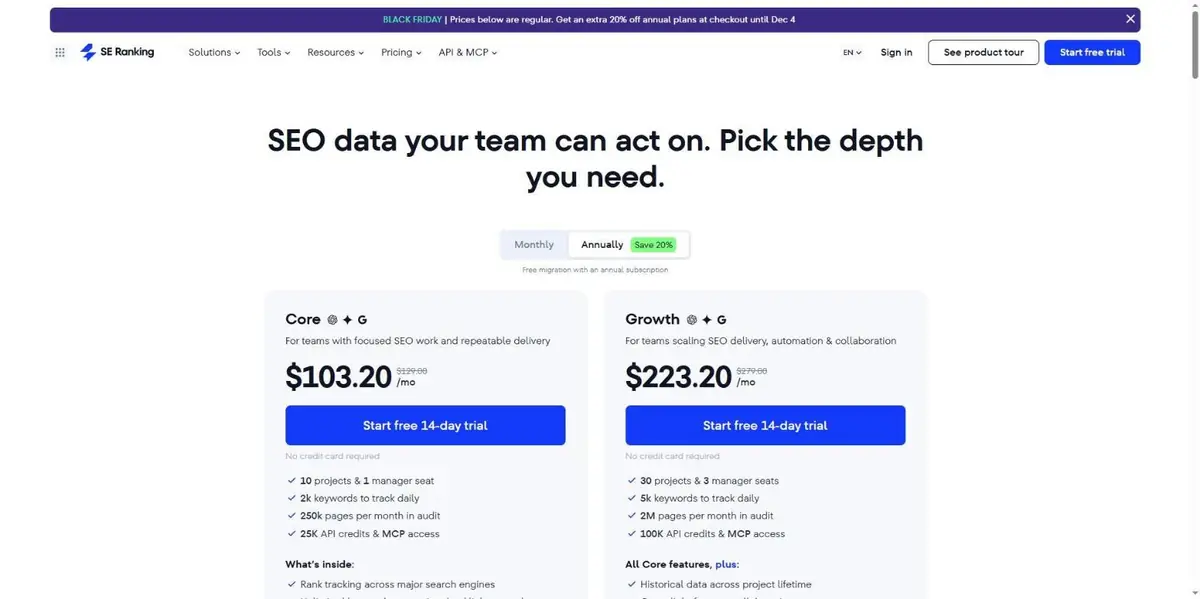
SE Ranking plans after the 2026 restructure
In early 2026, SE Ranking dropped its old Essential ($65), Pro ($119) and Business ($259) plans, as TechRadar’s SE Ranking review also notes. It replaced them with Core, Growth and Enterprise.
| Core | Growth | Enterprise | |
|---|---|---|---|
| Monthly billing | $129/mo | $279/mo | Custom |
| Annual billing | $103.20/mo | $223.20/mo | Custom |
| Manager seats | 1 | 3 | Custom |
| Projects | 10 | 30 | Custom |
| Keywords tracked daily | 2,000 | 5,000 | Custom |
| Pages audited per month | 250,000 | 2,000,000 | Custom |
| Research API credits | 25K | 100K | Custom |
| Historical data | 6 months | All time | Custom |
| AI visibility (SE Visible) | 25 prompts daily | 25 prompts daily | Custom |
Annual billing saves 20%, and SE Ranking shows the yearly prices openly on its pricing page.
When we checked on 19 November 2026, SE Ranking was also running a Black Friday deal: an extra 20% off annual plans and add-ons until 4 December. Seasonal deals like this come and go, so check the page before you buy.
The free trial lasts 14 days and needs no credit card. It includes up to 10 projects and 750 keywords tracked daily.
Ahrefs plans
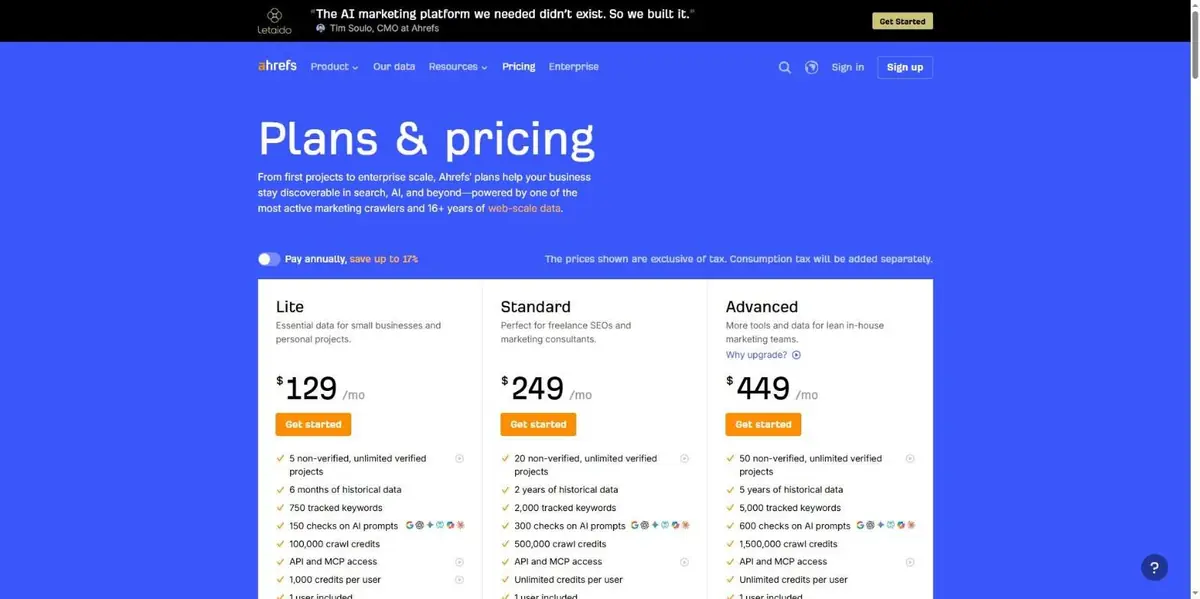
Ahrefs kept its plan names but keeps adjusting limits.
| Lite | Standard | Advanced | Enterprise | |
|---|---|---|---|---|
| Monthly price | $129 | $249 | $449 | Sales quote |
| Users included | 1 | 1 | 1 | From 3 |
| Extra user cost | $40/mo (up to 2) | $60/mo (up to 5) | $80/mo (up to 10) | $100/mo |
| Unverified projects | 5 | 20 | 50 | 100 |
| Tracked keywords | 750 | 2,000 | 5,000 | From 10,000 |
| Rank updates | Weekly | Weekly | Weekly | Weekly |
| Site Audit crawl credits | 100,000 | 500,000 | 1.5M | From 5M |
| Historical data | 6 months | 2 years | 5 years | Unlimited |
| Credits per user | 1,000/mo | Unlimited | Unlimited | Unlimited |
| AI prompt checks | 150/mo | 300/mo | 600/mo | From 2,500/mo |
Ahrefs says annual billing saves “up to 17%,” but it does not list annual prices on its pricing page. Third-party breakdowns put Lite at about $1,290 a year.
One detail most comparisons miss: Ahrefs counts projects differently. Sites you verify you own (through Google Search Console, a DNS record or a file) are unlimited on every plan. The 5, 20 or 50 project limit only applies to sites you can’t verify, like competitors or prospects. SE Ranking caps all projects at 10 on Core and 30 on Growth.
Standard is the plan most working SEOs end up on. It unlocks Content Explorer, broken backlinks, linking authors, keyword clusters and search intent data. Those are locked on Lite.
Historical data limits
Both entry plans keep only 6 months of history. That sounds fine until a client asks how this November compares with last November.
For year-over-year reports, you need SE Ranking Growth (all-time history) or Ahrefs Standard (2 years). Ahrefs Advanced extends that to 5 years.
Ahrefs Starter and the free tier
Ahrefs has two cheaper ways in that SE Ranking does not match.
- Starter ($29/mo): light keyword and competitor lookups, monthly only. Good for checking a few ideas, not for client work.
- Ahrefs Webmaster Tools (free): limited Site Explorer and Site Audit data for sites you verify you own.
If you only need to audit and monitor your own website, the free tier can be enough. We often point small business owners there before they spend anything.
Ahrefs credits, explained
This is the part that frustrates Lite users most.
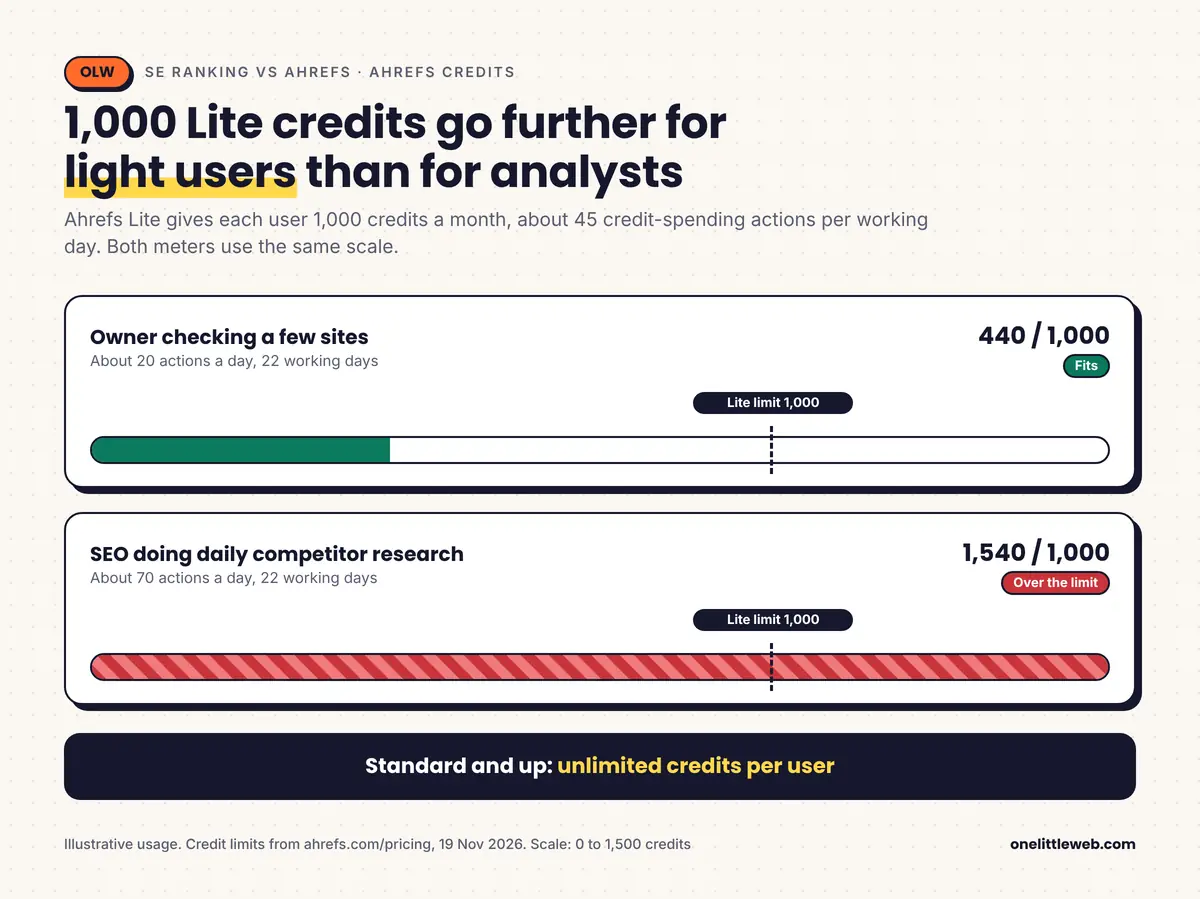
On Lite, each user gets 1,000 credits a month. Many actions in Site Explorer, Keywords Explorer and other tools spend credits. That works out to about 45 credit-spending actions per working day, as Ryan Doser’s Ahrefs pricing breakdown points out.
For one person checking a few sites, that is fine. For someone doing competitor research all day, it runs out. Credit complaints show up again and again in Ahrefs reviews on Capterra.
Standard and above remove the per-user credit cap. In practice, that makes Standard the real starting point for daily professional use.
What you’ll actually pay at real-world scale
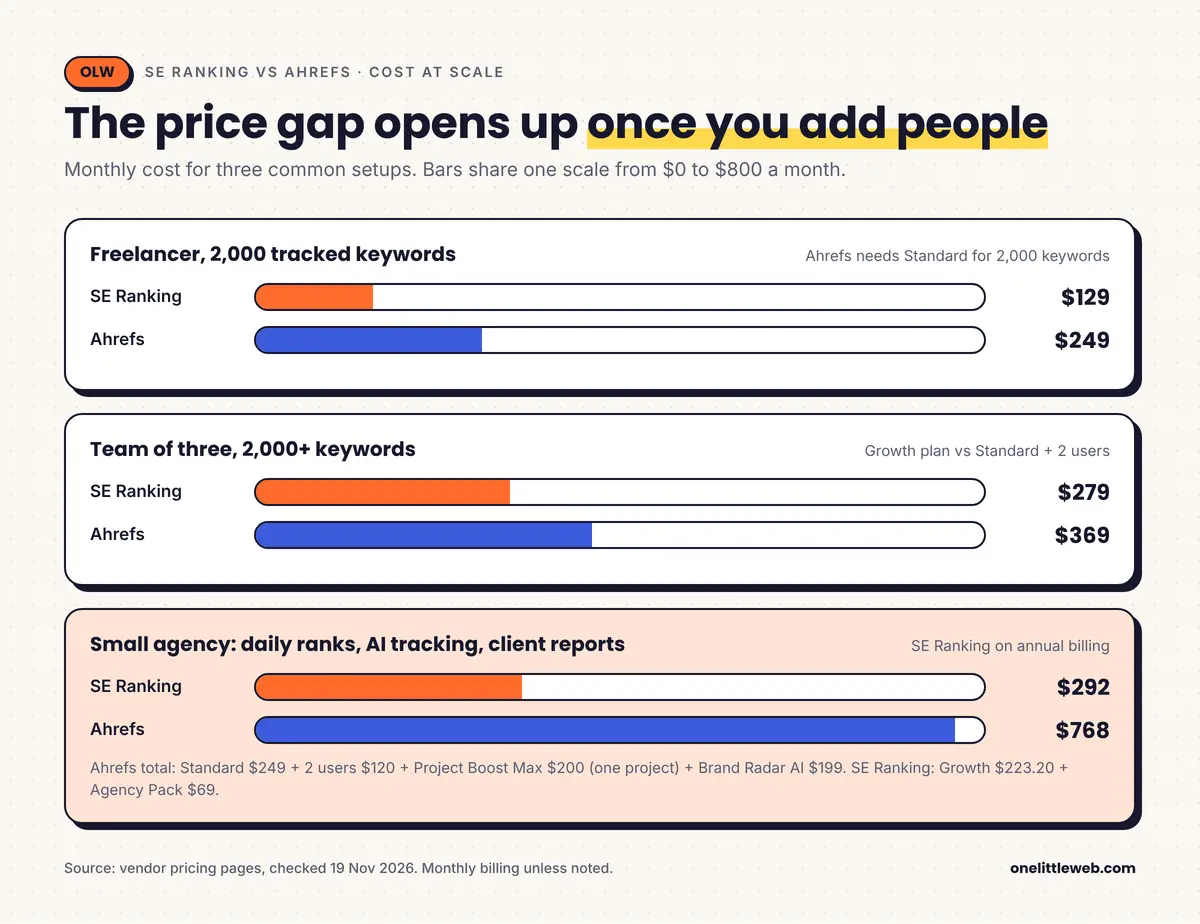
Sticker prices hide the add-ons. Here is what three common setups cost, using monthly billing unless noted.
Freelance SEO, about 2,000 keywords
Freelance SEOs feel tool costs the most, because the subscription comes straight out of their margin. This is where SE Ranking’s daily tracking and lower add-on costs make the biggest difference.
- SE Ranking: Core at $129/mo covers 2,000 keywords, tracked daily.
- Ahrefs: Lite at $129/mo only tracks 750. You need Standard at $249/mo for 2,000, still updated weekly.
Three-person team, 2,000+ keywords
- SE Ranking: Growth at $279/mo includes 3 seats and 5,000 daily keywords.
- Ahrefs: Standard at $249/mo plus two users at $60 each comes to $369/mo.
Small agency: daily tracking, AI tracking, client reports
| Need | SE Ranking (annual billing) | Ahrefs (monthly) |
|---|---|---|
| Base plan, 3 users | Growth $223.20 | Standard $249 + $120 for 2 users |
| Daily rank tracking | Included | Project Boost Max $200 per project |
| AI search tracking | SE Visible included | Brand Radar AI from $199 |
| White-label reports | Agency Pack $69 | Not available |
| Total | About $292/mo | About $768/mo |
The Ahrefs figure assumes daily tracking on only one project. Add more projects and the gap gets bigger.
That said, the Ahrefs bill buys a much bigger backlink and keyword database. If link data is the core of your service, that may be worth the premium.
Keyword research: depth vs good-enough coverage
Both tools give you search volume, keyword difficulty, CPC, intent and SERP data. The difference is how much data sits behind them.
Ahrefs has 28.7 billion filtered keywords across 217 locations, drawn from a pool of about 110 billion. Its US database alone holds roughly 2 to 2.5 billion keywords. It also shows Traffic Potential, which estimates traffic from the whole topic, not just one keyword.
SE Ranking has about 5.3 billion keywords across 188 locations. Its US database holds about 584 million keywords. SE Ranking says it focuses on keywords that actually get searches, not endless zero-volume long tail.
What does that mean in practice? For mainstream topics in the US, UK or Europe, SE Ranking returns plenty of ideas. For niche B2B topics, long-tail content plans or smaller markets, Ahrefs usually finds more. If keyword research is your main job, see our roundup of keyword research tools.
Why keyword difficulty scores don’t match
Do not expect the two tools to agree on difficulty. In one test by Exploding Topics, “seo statistics” scored 76 (“super hard”) in Ahrefs and “elementary” in SE Ranking.
Each tool uses its own formula. Ahrefs bases its score mainly on how many referring domains the top 10 pages have. SE Ranking does not publish its full formula, so treat its score as a relative guide inside the tool, not an absolute measure.
My advice: pick one tool and learn what its scores mean for your sites. Then check real SERPs before you commit to a hard keyword. Comparing raw scores across tools will only confuse you.
Backlink analysis: where Ahrefs still leads
This is the clearest win in the whole comparison.
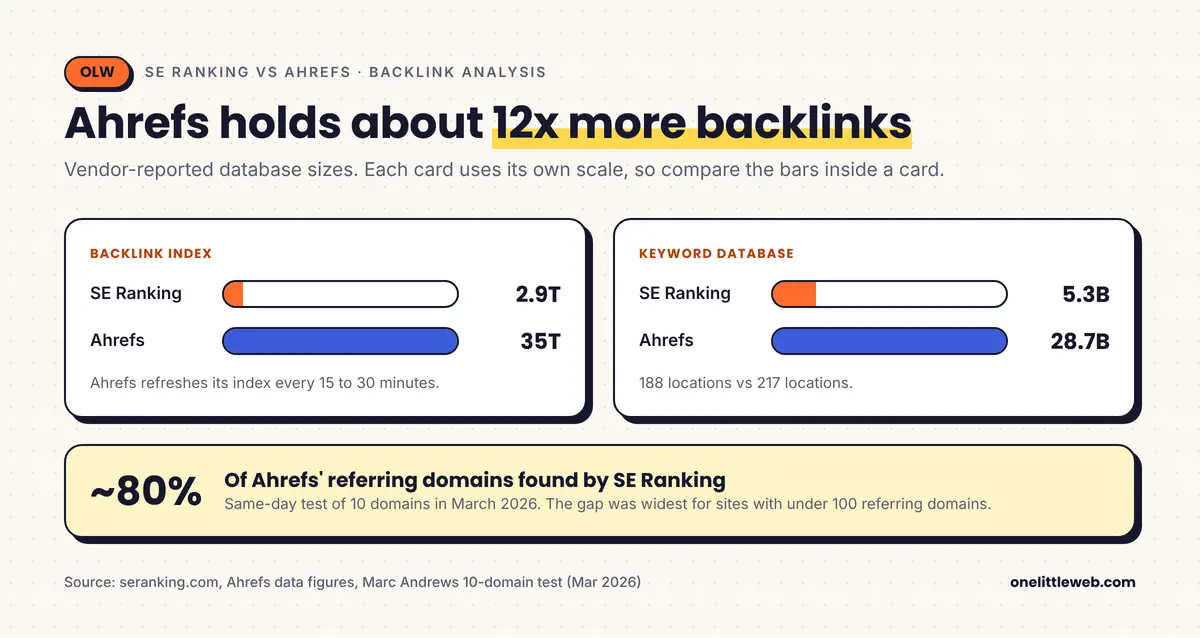
Ahrefs reports about 35 trillion live backlinks across roughly 500 million referring domains. Its index refreshes every 15 to 30 minutes.
SE Ranking reports about 2.9 trillion backlinks and 411 to 428 million indexed domains.
That is roughly 12 times more backlinks in Ahrefs. One independent tester ran 10 domains through both tools on the same day in March 2026. SE Ranking found about 80% of the referring domains Ahrefs found. The gap was widest for small sites with under 100 referring domains.
Our live test: onelittleweb.com in both tools
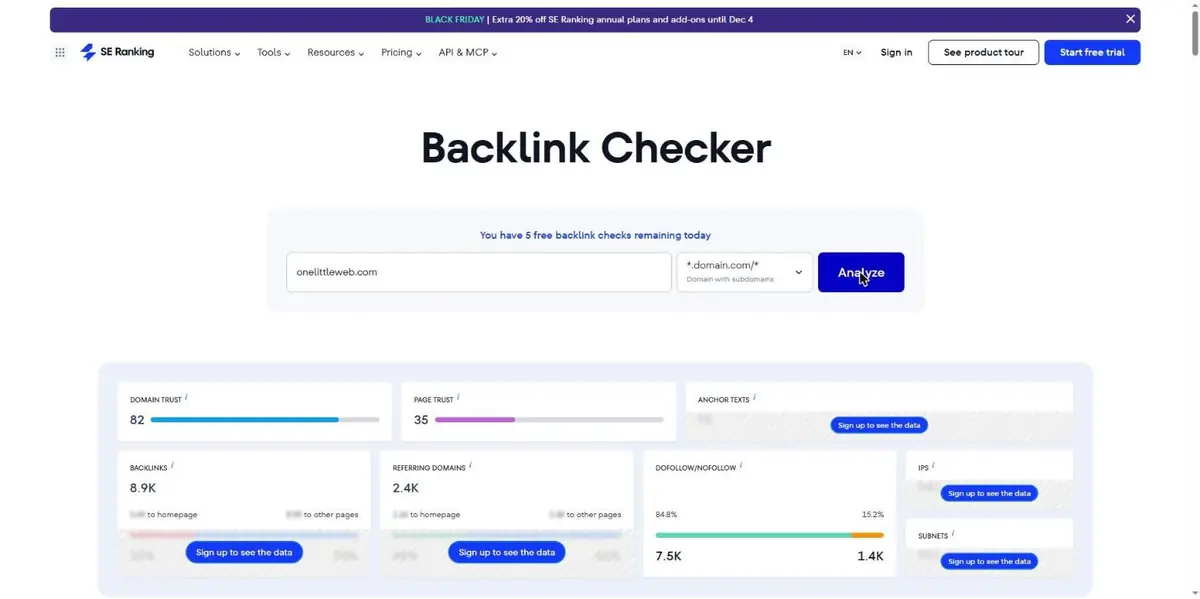
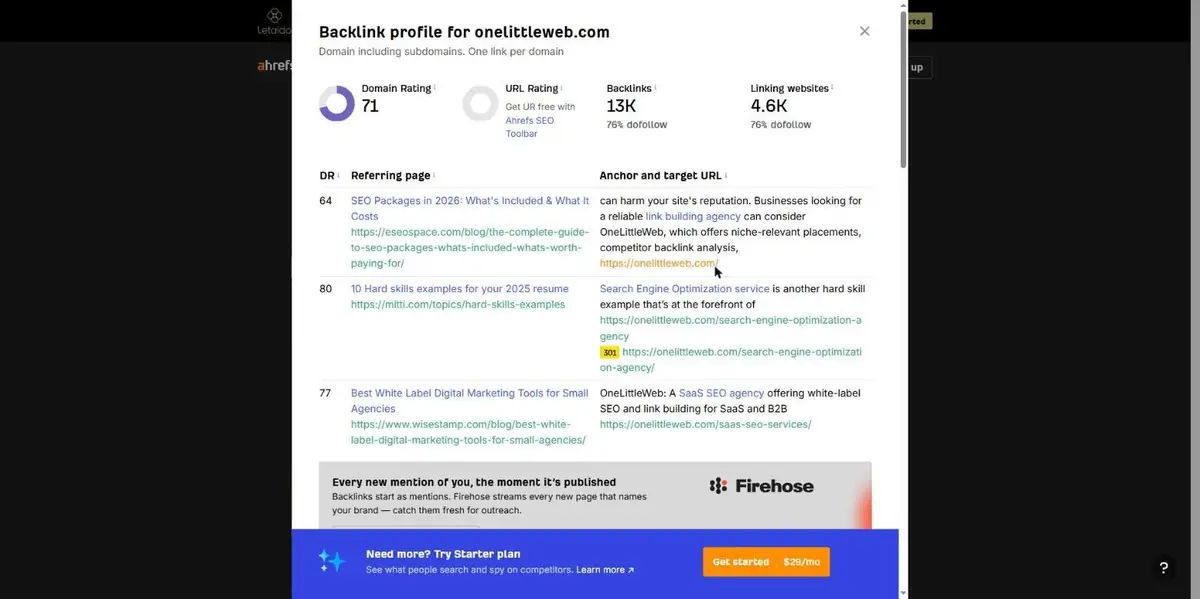
Vendor numbers only tell part of the story. So we ran our own site, onelittleweb.com, through both tools’ free backlink checkers on 19 November 2026.
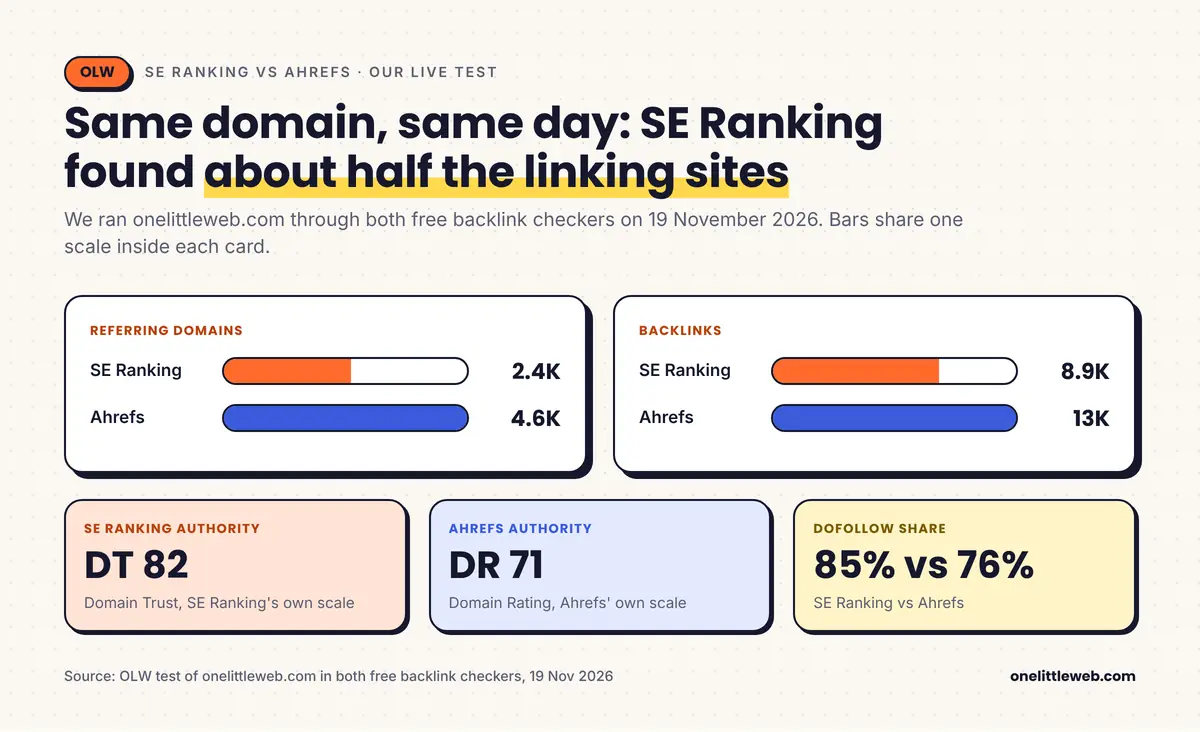
| Metric | SE Ranking | Ahrefs |
|---|---|---|
| Authority score | Domain Trust 82 | Domain Rating 71 |
| Backlinks | 8.9K | 13K |
| Referring domains | 2.4K | 4.6K |
| Dofollow share | 84.8% | 76% |
SE Ranking found about 68% of the backlinks Ahrefs found, and only about 52% of the referring domains. That gap is bigger than the 80% figure from the 10-domain test above.
Two lessons stood out for us. First, the authority scores point in opposite directions: SE Ranking gave us a higher score (82) than Ahrefs did (71). That says nothing about which tool “likes” your site more. They are simply different formulas on different data.
Second, the free checkers only show a sample. Paid plans show more. But the same-day, same-domain gap is a fair signal of how much each index sees.
We run link building campaigns for AI and SaaS clients at OLW, and Ahrefs is our main backlink tool. When we check a competitor’s link gap, every missing referring domain is a missed outreach target. New links also show up in Ahrefs faster. In that same 10-domain test, Ahrefs caught 91% of new links within 48 hours, compared with 78% for SE Ranking. That matters when you report link building wins to a client.
For a local business checking its own links once a month, SE Ranking’s data is usually enough. For link building as a service, Ahrefs is worth it, usually alongside a few other link building tools.
Domain Rating vs Domain Trust
Each tool has its own authority score.
- Domain Rating (DR) is Ahrefs’ 0 to 100 score based on backlink profile strength.
- Domain Trust (DT) is SE Ranking’s version.
They are not the same scale. A DR 50 site will not have a DT of 50. Never compare them across tools, and never set outreach rules that mix the two.
Rank tracking: SE Ranking’s home turf
This is the section most comparisons skip. It is also where SE Ranking wins clearly. (If you’re new to this, start with our guide on how to check keyword rankings.)
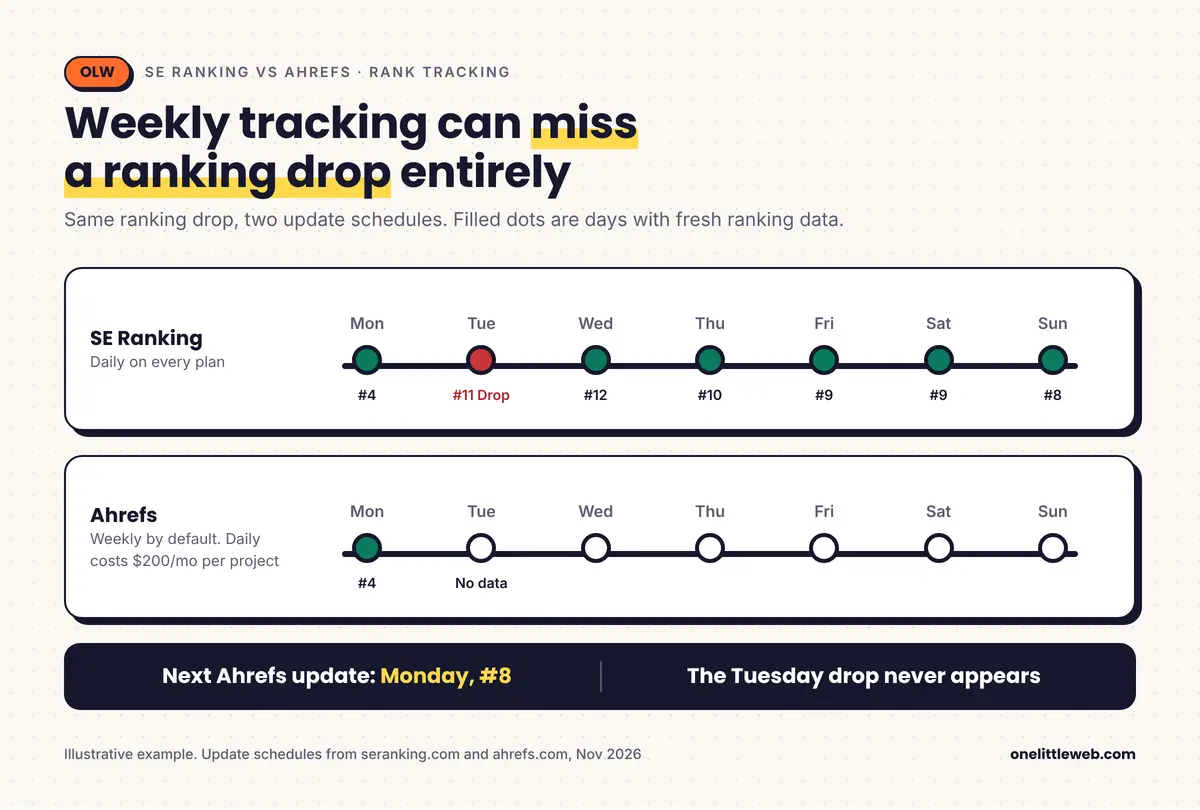
SE Ranking updates rankings daily on every plan. Core tracks 2,000 keywords and Growth tracks 5,000.
Ahrefs updates weekly by default. Lite tracks 750 keywords, Standard 2,000 and Advanced 5,000. To get daily updates, you need Project Boost Max at $200 a month per project.
Ahrefs Rank Tracker does have strong features. It tracks 19 SERP features including AI Overviews, covers 190+ locations and goes down to ZIP code level. Its data also connects neatly to the rest of Ahrefs.
There is one more difference worth knowing. SE Ranking tracks Google, Bing, Yahoo and YouTube in the same tool. Ahrefs Rank Tracker focuses on Google. If you report Bing or YouTube rankings to clients, that alone can decide it.
So why does daily vs weekly matter? During a Google core update, rankings can move every day for two weeks. With weekly data, you see one jump and miss the pattern. For client reporting, daily data also lets you answer “what happened on Tuesday?” without guessing. We compare dedicated options in our list of rank tracking software.
Site audit: bigger crawls on SE Ranking, smarter extras on Ahrefs
Both tools crawl your site and flag technical issues like broken links, redirects, missing tags and Core Web Vitals problems.
The limits differ a lot.
- SE Ranking: 250,000 pages a month on Core, 2 million on Growth.
- Ahrefs: 100,000 crawl credits on Lite, 500,000 on Standard, 1.5 million on Advanced. Each project is also capped at 25,000, 50,000 or 250,000 pages.
For a large ecommerce site, Ahrefs Lite’s 25,000-page project cap is a real wall. Our SEO audit tools guide covers crawlers built for bigger sites.
Ahrefs has a few extras. Its Project Boost add-ons unlock always-on auditing and Patches, which can push fixes like title changes live. The free Ahrefs Webmaster Tools also includes Site Audit for your own verified sites.
We use Ahrefs Site Audit when we onboard new clients at OLW. It gives us a fast list of technical fixes before any link or content work starts.
Search engines, local SEO and integrations
These features rarely decide the whole purchase. But they often settle it once the big factors are close.
Search engines covered
- SE Ranking tracks Google, Bing, Yahoo and YouTube rankings, and flags AI Overview appearances.
- Ahrefs focuses on Google for rank tracking. Keywords Explorer adds keyword data for YouTube, Amazon and other platforms.
Local SEO
Both tools can track rankings at city level. Ahrefs goes down to ZIP code in Rank Tracker and is testing a Google Business Profile monitor (in beta on its pricing page).
SE Ranking has a dedicated local marketing toolkit with its own limits. (Our local SEO guide explains what to track first.) For agencies that manage many local business clients, SE Ranking’s daily local tracking plus white-label reports is the stronger package.
API, MCP and reporting integrations
Both tools now include API and MCP access on their main plans. That means you can pull data into scripts, dashboards or AI assistants like Claude and ChatGPT.
- SE Ranking: 25K research API credits on Core and 100K on Growth. A larger API add-on and a standalone API plan (from $179/mo, annual) are available.
- Ahrefs: API and MCP access from Lite, with higher row limits on higher plans. Looker Studio integration starts on Advanced.
At OLW, we use the Ahrefs MCP connection to pull backlink and keyword data into our own research workflows. It saves a lot of exporting and copy-pasting.
Competitor research and content tools
Both tools let you enter a competitor’s domain and see its keywords, top pages, traffic estimates and paid ads. SE Ranking keeps 12 months of competitor ad history, which is handy if you also run PPC. For more options, see our competitor analysis tools roundup. Ahrefs shows long-term organic traffic trends, limited by your plan’s history allowance.
Ahrefs is stronger for content research. Content Explorer (Standard and up) lets you search a huge index of pages by topic, links and traffic. Its Content Kit add-on, from $99 a month, adds AI writing and optimization help.
SE Ranking includes content tools inside its plans. Core includes 25 content marketing articles a month and Growth includes 50. These are articles you can draft with its AI writer and optimize in its Content Editor, which scores your draft against top-ranking pages. It also has local marketing and PPC research tools, though some come with separate limits.
If content research drives your strategy, Ahrefs Standard gives you more. We cover dedicated editors in our content optimization tools list. If you want writing help included in the base price, SE Ranking is simpler.
AI search visibility: SE Visible vs Brand Radar
This is the newest decision factor, and the one most comparisons barely cover.
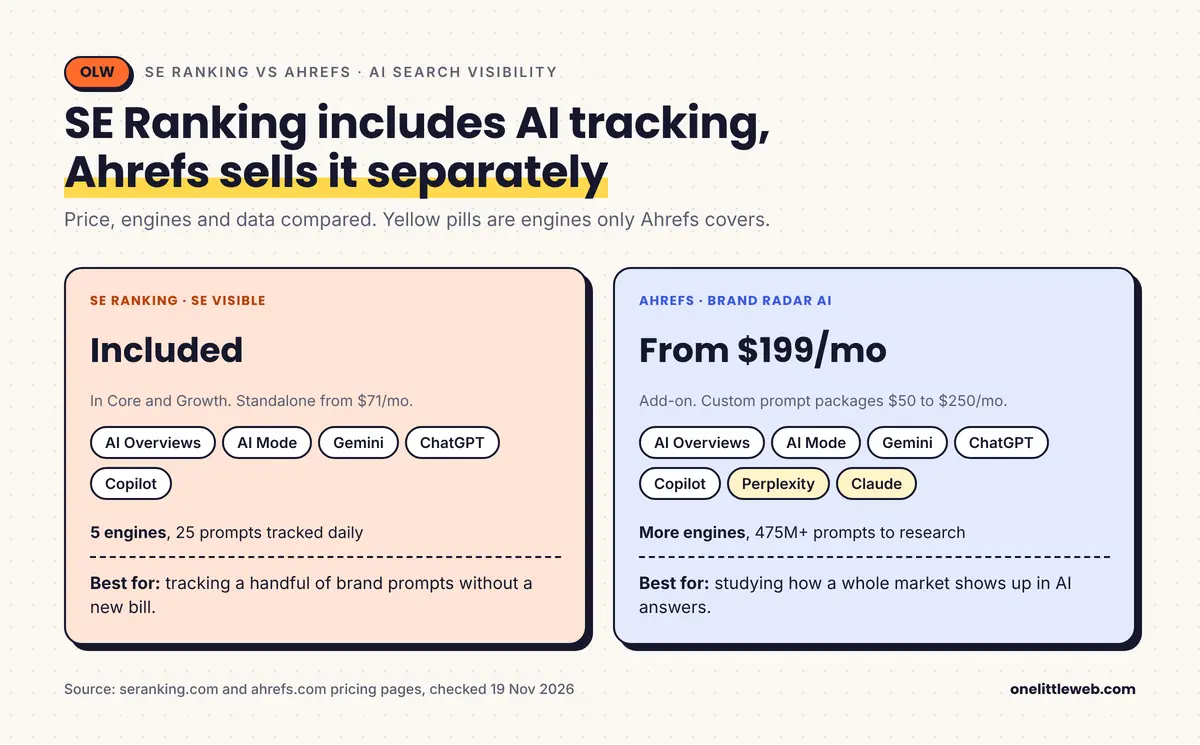
SE Ranking now bundles AI tracking, called SE Visible, into Core and Growth. Each plan tracks 25 prompts daily across five AI engines: Google AI Overviews, AI Mode, Gemini, ChatGPT and Copilot. You can also buy SE Visible on its own from $71 a month.
This changed recently. Until late October 2026, SE Ranking sold AI tracking as a separate add-on. That add-on is gone, according to PricingSaaS’s change log.
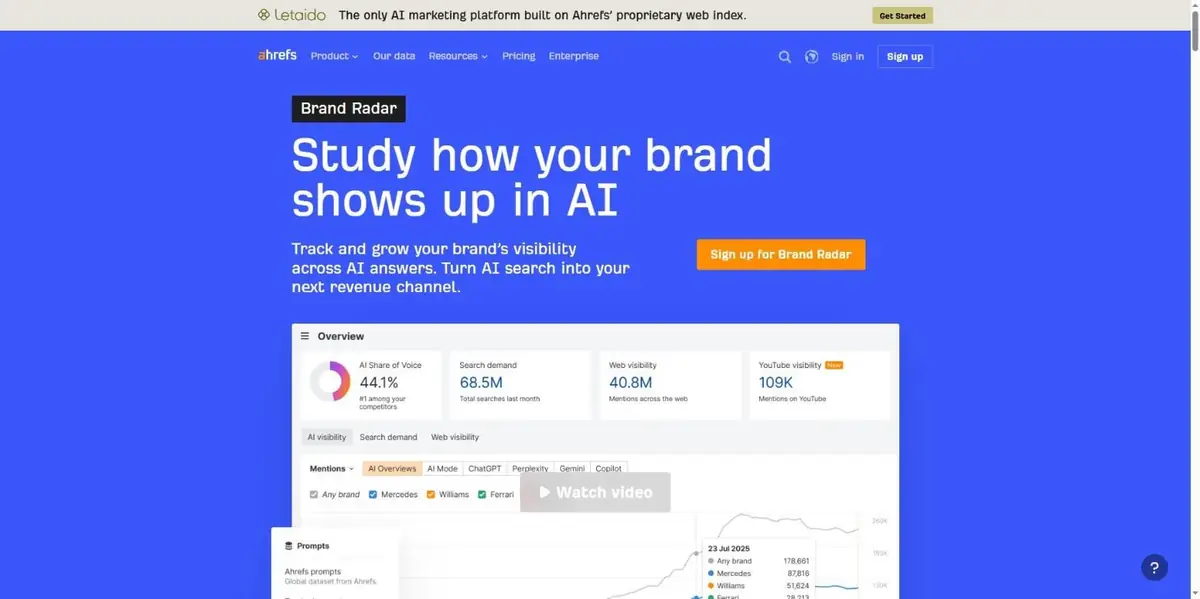
Ahrefs sells Brand Radar AI from $199 a month. It covers AI Overviews, AI Mode, ChatGPT, Gemini, Copilot and Perplexity, and its pricing page also lists Claude for tracked prompts. Every Ahrefs plan also includes a small allowance of AI prompt checks: 150 a month on Lite, 300 on Standard and 600 on Advanced. It also lets you research any brand across more than 475 million prompts in Ahrefs’ database. Extra custom prompt packages cost $50 to $250 a month.
My take: SE Ranking is the cheaper way to start tracking a handful of brand prompts. Ahrefs is the better research tool if you want to see how a whole market shows up in AI answers, including Perplexity and Claude.
AI tracking is still young in both tools. Treat the numbers as directional, not exact. For dedicated trackers, see our AI answer tracking tools, and for what to do with the data, read our guide to AI search optimization.
Teams, agencies and client reporting
For agencies, this section can decide the whole comparison. It is also the biggest factor in our list of the best SEO tools for agencies.
SE Ranking is built for client work.
- Growth includes 3 manager seats.
- The Agency Pack (+$69/mo, annual billing only) adds 30 projects, 30 client seats, white-label reporting, unlimited scheduled reports with AI summaries, a Lead Generator and a listing in SE Ranking’s Agency Catalog.
Ahrefs is built for analysts.
- Every self-serve plan includes 1 user. Extra users cost $40 to $80 a month each.
- There is no native white-label reporting. The Report Builder add-on costs $99 a month, and Looker Studio integration starts on Advanced.
If you send branded monthly reports to clients, SE Ranking saves both money and hours. (We compare more options in our guide to SEO reporting tools.) If your team mostly does research and sends findings in your own decks, Ahrefs works fine.
Ease of use, support and user ratings
Review sites lean toward SE Ranking on usability and support, and toward Ahrefs on raw functionality.
G2 (November 2026)
| SE Ranking | Ahrefs | |
|---|---|---|
| Overall | 4.7/5 (1,591 reviews) | 4.5/5 (713 reviews) |
| Ease of use | 9.2 | 8.8 |
| Ease of setup | 9.3 | 9.0 |
| Quality of support | 9.4 | 8.4 |
| Meets requirements | 9.2 | 9.0 |
Capterra (August 2026 data)
| SE Ranking | Ahrefs | |
|---|---|---|
| Overall | 4.7 (297 reviews) | 4.7 (585 reviews) |
| Value for money | 4.7 | 4.2 |
| Functionality | 4.6 | 4.7 |
| Ease of use | 4.6 | 4.5 |
| Customer service | 4.7 | 4.5 |
Ratings change often. Check the live pages before you decide.
The complaints are useful too. Ahrefs reviewers mostly complain about price, the credit model and support. SE Ranking’s negative reviews mostly mention billing and refund problems, plus some reliability issues.
On setup, the tools feel different. Ahrefs works the moment you paste in a URL. In our day-to-day use at OLW, the learning curve is in Ahrefs’ depth, not its layout. New team members find Site Explorer quickly, but it takes a few weeks to learn which reports spend credits and which filters matter. SE Ranking asks you to add keywords, competitors, search engines and AI prompts before its dashboards fill up. One Reddit user in r/localseo called the setup “front-loaded.” It pays off later, but expect an hour or two of setup.
How accurate are they? Use Google Search Console as the referee
Every SEO tool estimates traffic. Only Google Search Console shows your real clicks and impressions, through its Performance report. So the best accuracy test is simple: compare each tool’s estimates against GSC for the same site and date.
At OLW, we trust GSC far more than any third-party estimate, Ahrefs included.
There is also a 2026 twist. In mid-2026, an agency user on r/ahrefs (summarized here) reported one client’s tracked organic keywords in Ahrefs falling from about 700 to 144 after a Google API change. Another tool showed about 850. Other users pointed out that any tool’s counts can shift after changes like this.
The takeaway: use either tool for trends and comparisons, and use GSC for your real numbers.
Who should choose which
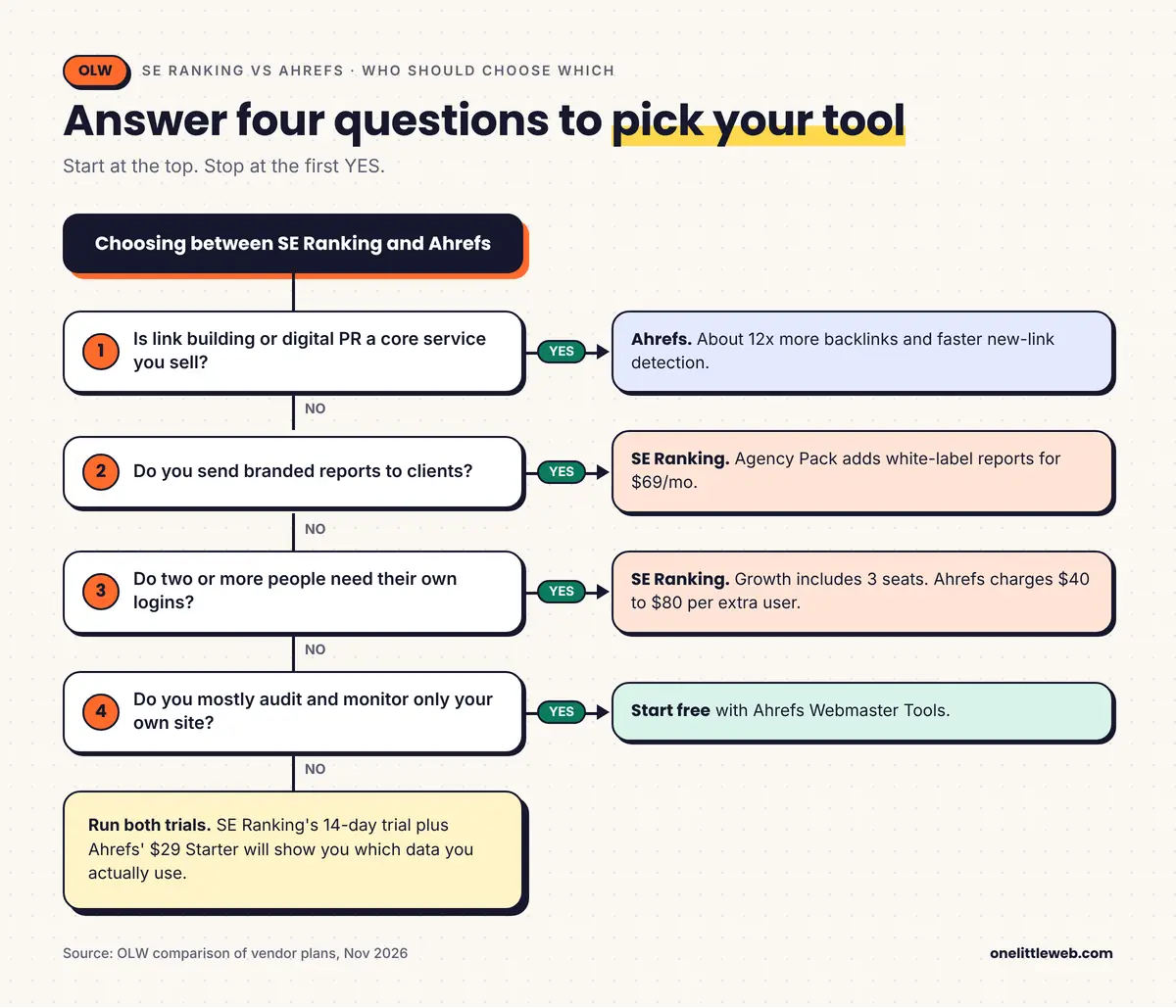
Choose SE Ranking if you:
- Need daily rank tracking without paying per project
- Manage clients and want white-label reports and client seats
- Have a team of two or three and want seats included
- Want basic AI search tracking included in your plan
- Prefer a free trial before you pay
Choose Ahrefs if you:
- Do link building, digital PR or backlink audits as a core service
- Research niche, long-tail or international keywords
- Need deep content research with Content Explorer
- Want to analyze AI visibility across a whole market, including Perplexity and Claude
- Only need free audits of your own site (Ahrefs Webmaster Tools)
Skip SE Ranking if:
Backlink data is the product you sell. In tests, SE Ranking missed between 1 in 5 and 1 in 2 of the referring domains Ahrefs found. That will cost you outreach targets.
Skip Ahrefs if:
You need several users, daily tracking and client reports on a tight budget. The add-ons stack up fast. Our Ahrefs alternatives guide has more options.
Switching between the tools
If you’re moving from one tool to the other, plan for a few things:
- Rank history does not transfer. Export your old ranking data before you cancel. Your new tool starts from day one.
- Run both in parallel for a few weeks. SE Ranking’s 14-day trial makes this easy when moving to SE Ranking. Expect different numbers for difficulty, traffic and authority.
- Re-set your benchmarks. DR and DT targets, KD cut-offs and traffic baselines all need new reference points.
Consider Semrush if:
You also need PPC, social and broader marketing tools in one place. We compare it in our Semrush review, our Semrush vs Ahrefs breakdown and our Ahrefs vs Semrush vs Moz comparison.
Score breakdown
We scored both tools on criteria drawn from the pain points we found in reviews, Reddit threads and our own client work.
| Tool | Data depth (25%) | Price for limits (20%) | Rank tracking (15%) | Team & agency fit (15%) | AI search visibility (10%) | Ease of use & support (10%) | Free access/trial (5%) | Overall |
|---|---|---|---|---|---|---|---|---|
| Ahrefs | 9.5 | 6.0 | 6.5 | 5.5 | 8.5 | 7.5 | 7.5 | 7.4 |
| SE Ranking | 7.0 | 9.0 | 9.0 | 9.0 | 7.5 | 8.5 | 8.0 | 8.3 |
A higher overall score does not make SE Ranking the better tool for everyone. If data depth matters most to you, weight it higher and Ahrefs wins.
Our scoring methodology
Here is what earned a high or low score on each criterion.
- Data depth (25%): High scores go to large, fresh keyword and backlink databases with broad location coverage. Ahrefs scored high on its 35T backlinks and 28.7B keywords. SE Ranking lost points for a database about 5 to 12 times smaller.
- Price for limits (20%): We compared what each dollar buys in keywords, seats, credits and history. Credit caps and paid seats lowered Ahrefs’ score.
- Rank tracking (15%): Daily updates and generous keyword limits score high. Weekly updates with a paid daily upgrade score lower.
- Team & agency fit (15%): Included seats, client access and white-label reporting score high. Paid-only seats and no white-label score low.
- AI search visibility (10%): We looked at engine coverage, prompt data and cost. Ahrefs covers more engines and data. SE Ranking includes tracking at no extra cost.
- Ease of use & support (10%): Based on G2 and Capterra sub-scores plus setup effort.
- Free access/trial (5%): SE Ranking’s full 14-day trial and Ahrefs’ free tier plus $29 Starter both count.
Overall score = each criterion score × its weight, added together.
Frequently Asked Questions
Is SE Ranking cheaper than Ahrefs in 2027?
Not at the entry level anymore. Both start at $129 a month on monthly billing. SE Ranking becomes cheaper once you need more users, daily tracking or client reports. Billed yearly, SE Ranking Core costs $103.20 a month.
Is SE Ranking as accurate as Ahrefs?
For keywords and rankings, both are good enough for most sites. For backlinks, Ahrefs finds more. In our own test on onelittleweb.com, SE Ranking found about half the referring domains Ahrefs found (2.4K vs 4.6K). A separate 10-domain test put the figure at about 80%. Check both against Google Search Console for your own site.
Does Ahrefs have a free trial?
No. Instead, Ahrefs offers a free tier, Ahrefs Webmaster Tools, for sites you own, and a $29 a month Starter plan. SE Ranking offers a 14-day free trial with no credit card.
Can SE Ranking replace Ahrefs for link building?
For light link checks, yes. For link building as a service, not really. Ahrefs’ backlink index is about 12 times larger and updates every 15 to 30 minutes.
Does Ahrefs track rankings daily?
Not by default. Ahrefs Rank Tracker updates weekly on all plans. Daily updates need the Project Boost Max add-on at $200 a month per project.
What are Ahrefs credits?
Credits limit how much research you can do on the Lite plan. Each user gets 1,000 credits a month, and many reports spend them. Standard and higher plans have unlimited credits per user.
Which is better for agencies?
SE Ranking for most small agencies. Growth includes 3 seats, and the Agency Pack adds white-label reports and 30 client seats for $69 a month. Agencies that sell link building often run Ahrefs alongside it.
Do SE Ranking and Ahrefs track AI Overviews and ChatGPT?
Yes. SE Ranking includes SE Visible, which tracks 25 prompts daily across five AI engines. Ahrefs sells Brand Radar AI from $199 a month, covering six engines including Perplexity and Claude.
Does SE Ranking track Bing and YouTube?
Yes. SE Ranking tracks rankings on Google, Bing, Yahoo and YouTube in one tool. Ahrefs Rank Tracker focuses on Google rankings.
Which has the bigger keyword database?
Ahrefs, by a wide margin. It has 28.7 billion keywords across 217 locations. SE Ranking has about 5.3 billion across 188 locations.
Can I use both tools together?
Yes, and many agencies do. A common setup is SE Ranking for daily rank tracking and client reports, and Ahrefs for backlink research and content gaps. Ahrefs’ free Webmaster Tools can also sit next to SE Ranking at no cost.
Final verdict
SE Ranking and Ahrefs no longer differ much on starting price. They differ on what you get for it.
Here is the simplest way to decide. Write down the three tasks you do most each week.
If two of them involve links, competitor gaps or content research, pick Ahrefs. That data is what you are paying for, and SE Ranking can’t match it.
If two of them involve rank reports, client updates or team collaboration, pick SE Ranking. You get more seats, daily data and agency tools for far less.
Still unsure? Start SE Ranking’s free trial and use Ahrefs Webmaster Tools on your own site at the same time. Two weeks of real use will tell you more than any comparison.
If you’d rather not run the tools yourself, our team at OLW handles outreach link building and SEO for SaaS companies every day. You can see the results in our AI writing tool case study, where we grew a client from 626 to 263,112 monthly search clicks in six months.