Quick answer
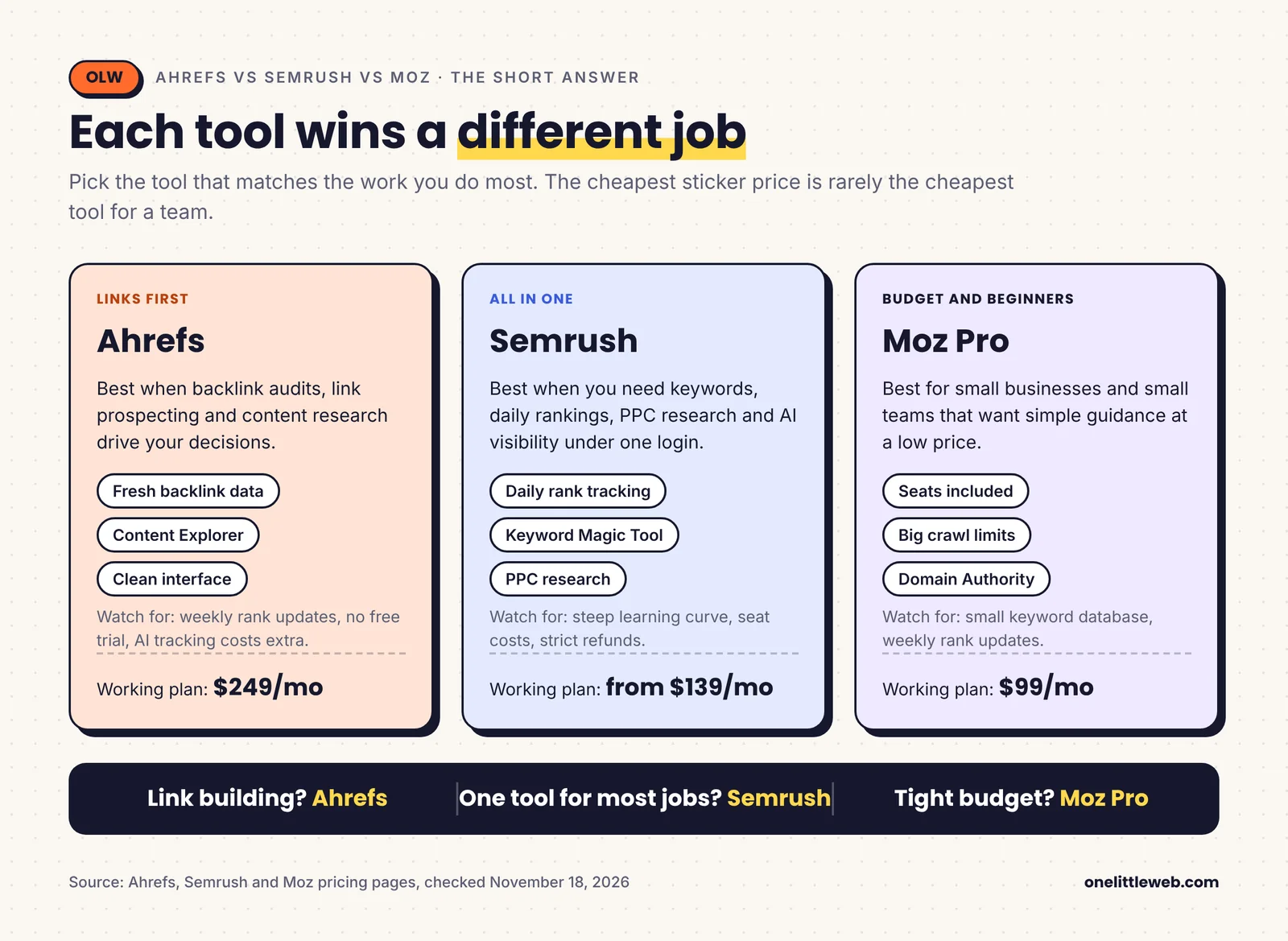
The Ahrefs vs Semrush vs Moz decision depends on the work you do most. Pick Ahrefs if links are your main job, Semrush if you want one tool for most of your search marketing, and Moz Pro if you’re a small business on a tight budget. Overall, I score Semrush 8.2, Ahrefs 7.8 and Moz Pro 7.3 out of 10.
Key takeaways
- Ahrefs for links. It has the freshest, easiest backlink data of the three. The real working plan is Standard at $249 a month.
- Semrush for breadth. Daily rank tracking, PPC research and AI visibility in one login, from $139 a month.
- Moz Pro for small budgets. Standard is $99 a month and now includes AI visibility tracking. Medium and Large bundle 2 and 3 seats.
- Team size flips the price order. A five-person agency with AI tracking pays about $11,616 a year on Ahrefs, $5,748 on Semrush and $4,764 on Moz.
- Authority scores don’t match. Our own site shows DR 71 in Ahrefs and Authority Score 44 in Semrush on the same day.
- Only Semrush updates rankings daily. Ahrefs and Moz both update weekly on standard plans.
At OneLittleWeb, we pay for two of these three tools every month. That alone tells you something. No single one does everything well.
Ahrefs is where we go for links. Semrush is where we go for keyword planning, daily rankings and AI search tracking. Moz is the one I recommend to small business clients who need something simple and cheap.
In this guide, I’ll break down why, with real pricing and real team costs. Then you can pick the one tool that fits you, or decide if you need two.
Ahrefs vs Semrush vs Moz at a glance
If you only read one section, read this one.
| Ahrefs | Semrush | Moz Pro | |
|---|---|---|---|
| Best for | Link builders and content teams | Agencies wanting one tool for most jobs | Small businesses and beginners |
| Starting price | $29 Starter, $129 Lite | $139 SEO | $49 Starter, $99 Standard |
| Real working plan | Standard, $249 | SEO $139 or Starter $199 | Standard, $99 |
| Annual discount | Up to 17% | Up to 17% | 20% |
| Free trial | No | Yes, plus a free plan | Yes, on the Medium plan |
| Users included | 1 | 1 | 1 to 3 |
| Extra user | $40 to $80/mo | From $45/mo | $49/mo |
| Backlink index (vendor claim) | ~35T | ~43T | ~44T |
| Keyword database (vendor claim) | ~28.7B | ~27B to 28.8B | ~1.25B |
| Rank tracking updates | Weekly | Daily | Weekly |
| AI visibility | Prompt checks in plan, Brand Radar from $199 | Bundled from Starter, $199 | Included from Standard, $99 |
| Authority metric | Domain Rating | Authority Score | Domain Authority |
| PPC research | Limited | Strong | None |
| Ownership | Independent | Adobe | Ziff Davis |
Skip it if. Skip Ahrefs if you need daily rankings or a free trial. Skip Semrush if you run one small site or only need one job done. Skip Moz Pro if you need deep keyword data or serious competitor research.
How I compared them
Most comparison posts don’t tell you how they reached their verdict. Here’s how I reached mine.
- Hands-on, for Ahrefs and Semrush. Our SEO team at OneLittleWeb uses both every week for link building, keyword research, audits and client reporting.
- Research-based, for Moz. We don’t run Moz Pro day to day. My Moz analysis comes from Moz’s own pricing and help pages, its plan change logs, third-party tests and user reviews.
- Pricing checked on November 18, 2026. I pulled all three prices directly from the vendors’ pricing pages, and the screenshots below are from that day.
- Ground truth from Google Search Console. Every tool here estimates traffic. Only Google Search Console shows your real clicks, so I treat it as the benchmark.
A note on bias. Many pages ranking for this keyword earn affiliate commissions, mostly from Semrush. This article has no affiliate links. We do pay for Ahrefs and Semrush, and I’ve tried not to let that habit decide the verdict.
What each tool really is
Before we compare features, it helps to know what each tool was built to do. That original focus still shapes everything.
What is Ahrefs?
Ahrefs launched in 2011 as a backlink checker. It still runs one of the busiest web crawlers in SEO, and that crawler is the core of the product.
Over time it added keyword research, site audits, rank tracking and content research. Links are still where it’s strongest. It’s an independent, self-funded company.
Ahrefs suits people who make decisions from link data: link builders, content strategists and agencies doing competitor research. We use it at OLW mainly for backlink audits, link prospecting and Content Explorer research. You can read our full Ahrefs review for more.
Key features
- Site Explorer: backlinks, referring domains, organic keywords and top pages for any domain
- Keywords Explorer: volumes, difficulty and Traffic Potential, which estimates traffic for a whole topic
- Content Explorer: a searchable index of billions of pages for link prospects and content ideas
- Site Audit: checks for more than 170 technical and on-page issues
- Brand Radar: AI search visibility tracking, sold as a separate subscription
Pros
- Backlink data that’s fresh and easy to filter
- Clean interface that new team members pick up fast
- Unlimited credits from the Standard plan up
- API and MCP access from the Lite plan
Cons
- No free trial, and refunds are rare
- Rank tracking updates weekly on standard plans
- Lite caps you at 1,000 credits and leaves out Content Explorer
- Serious AI visibility tracking and reporting cost extra
What is Semrush?
Semrush started in 2008 and grew into the broadest marketing suite of the three. It covers SEO, PPC, content, local, social and AI search tracking.
Adobe completed its acquisition of Semrush on April 28, 2026, so it’s now part of a much larger company. Many extra tools are sold as separate toolkits around the core SEO plan.
Semrush suits agencies and marketing teams that want one login for most of their search work. At OLW, it’s our default for keyword planning, daily rank tracking and AI visibility reporting. Our Semrush review goes deeper.
Key features
- Keyword Magic Tool: huge keyword lists with intent labels and filters
- Backlink Analytics: link profiles and Authority Score for any domain
- Position Tracking: daily rank updates on every paid plan
- AI Visibility Toolkit: brand mentions across ChatGPT, AI Overviews and other AI answers
- Advertising Toolkit: competitor ad copy and paid keyword research
Pros
- The widest feature set of the three
- Daily rank tracking on every paid plan
- AI visibility bundled into plans from $199
- Free plan and free trial let you test first
Cons
- Steeper learning curve because there’s so much in it
- Seat costs add up fast for teams
- Many tools sit in paid toolkits outside the main plan
- Strict refund rules on monthly plans
What is Moz Pro?
Moz began as SEOmoz in 2004. It’s best known for creating Domain Authority, still the most quoted authority score in SEO.
Moz Pro is its SEO suite, covering keyword research, link analysis, site crawls and rank tracking. It’s the cheapest of the three to start, and its Medium and Large plans include extra seats.
Through 2026, Moz added AI visibility dashboards, tracked prompts and AI content briefs to every plan from Standard up. Moz Pro suits small businesses, beginners and small teams that want clear guidance more than raw data volume. This section is research-based, as OLW doesn’t use Moz Pro day to day.
Key features
- Link Explorer: backlinks, Domain Authority and Spam Score
- Keyword Explorer: keyword suggestions with a Priority score
- Site Crawl: 400,000 pages a month on Standard, up to 5 million on Large
- AI Visibility: dashboards and tracked prompts across GPT, Gemini and Google AI Mode, from the Standard plan
- MozBar: free browser extension that shows DA on any page
Pros
- Lowest entry price of the three
- Medium and Large include 2 and 3 seats
- Biggest crawl allowance per dollar
- AI visibility included from the $99 Standard plan
Cons
- Much smaller keyword database
- Weekly rank tracking only
- Only 50 tracked keywords on Starter
- Free trial only on the Medium plan
Pricing compared (November 2026)
This is where most comparison pages go wrong. All three tools changed their pricing in 2026, and much of what’s online is out of date.
Ahrefs pricing
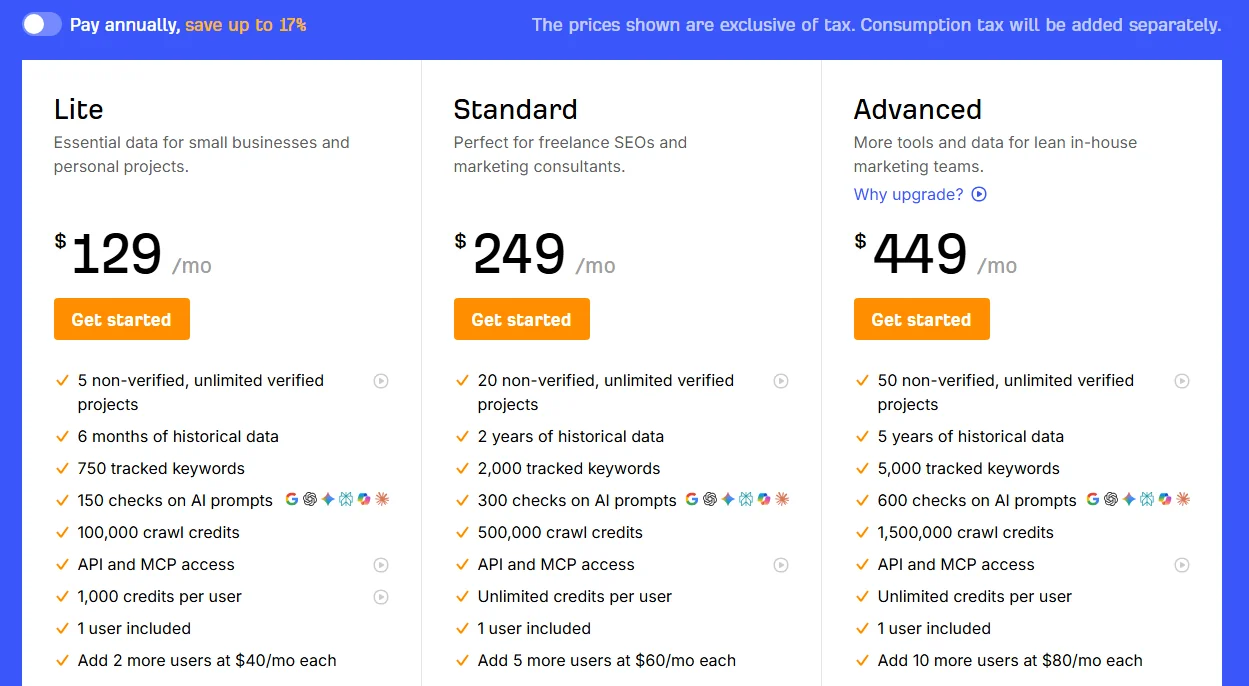
| Plan | Monthly | Projects | Tracked keywords | History | Credits |
|---|---|---|---|---|---|
| Starter | $29 | Limited | None | Limited | Small allowance |
| Lite | $129 | 5 | 750 | 6 months | 1,000 per user |
| Standard | $249 | 20 | 2,000 | 2 years | Unlimited |
| Advanced | $449 | 50 | 5,000 | 5 years | Unlimited |
| Enterprise | Talk to sales | 100 | 10,000+ | Unlimited | Unlimited |
Annual billing saves up to 17%. Each plan from Lite to Advanced includes one user. Extra users cost $40, $60 or $80 a month depending on the plan.
The real entry point for professional work is Standard. Lite leaves out Content Explorer and caps your credits, and that cap runs out fast once you research several competitors.
Semrush pricing
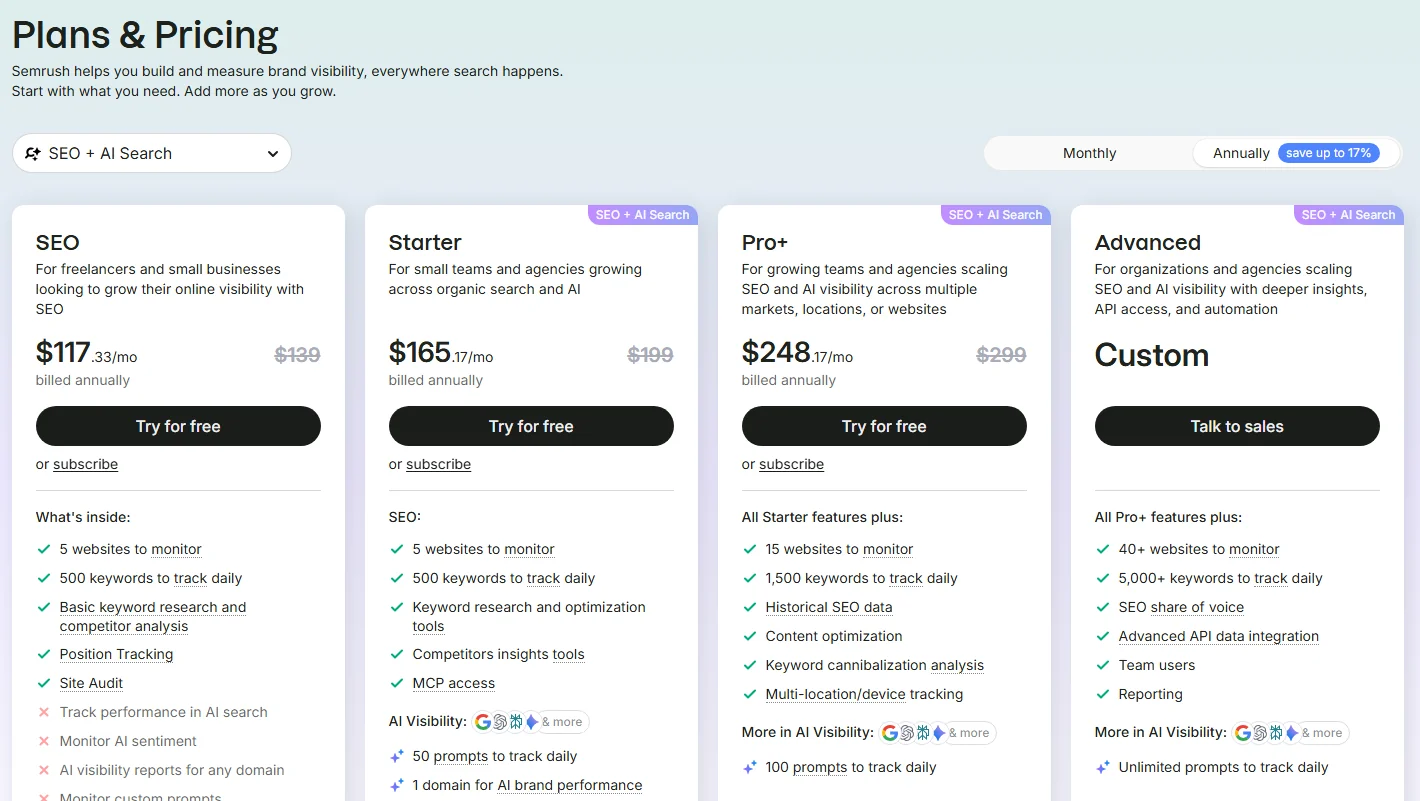
| Plan | Monthly | Annual (per month) | Projects | Tracked keywords | AI prompts |
|---|---|---|---|---|---|
| Free | $0 | $0 | 1 | Limited | Limited |
| SEO | $139 | $117.33 | 5 | 500 | None |
| Starter | $199 | $165.17 | 5 | 500 | 50 |
| Pro+ | $299 | $248.17 | 15 | 1,500 | 100 |
| Advanced | Custom | Custom | 40+ | 5,000+ | Unlimited |
All Semrush keywords update daily. Historical data starts on Pro+. Advanced API data integration comes with Advanced.
You’ll also see Semrush’s older Pro, Guru and Business plans quoted at $139.95, $249.95 and $499.95. These sit under a line Semrush calls SEO Classic. Check which line you’re looking at before you buy.
Moz Pro pricing
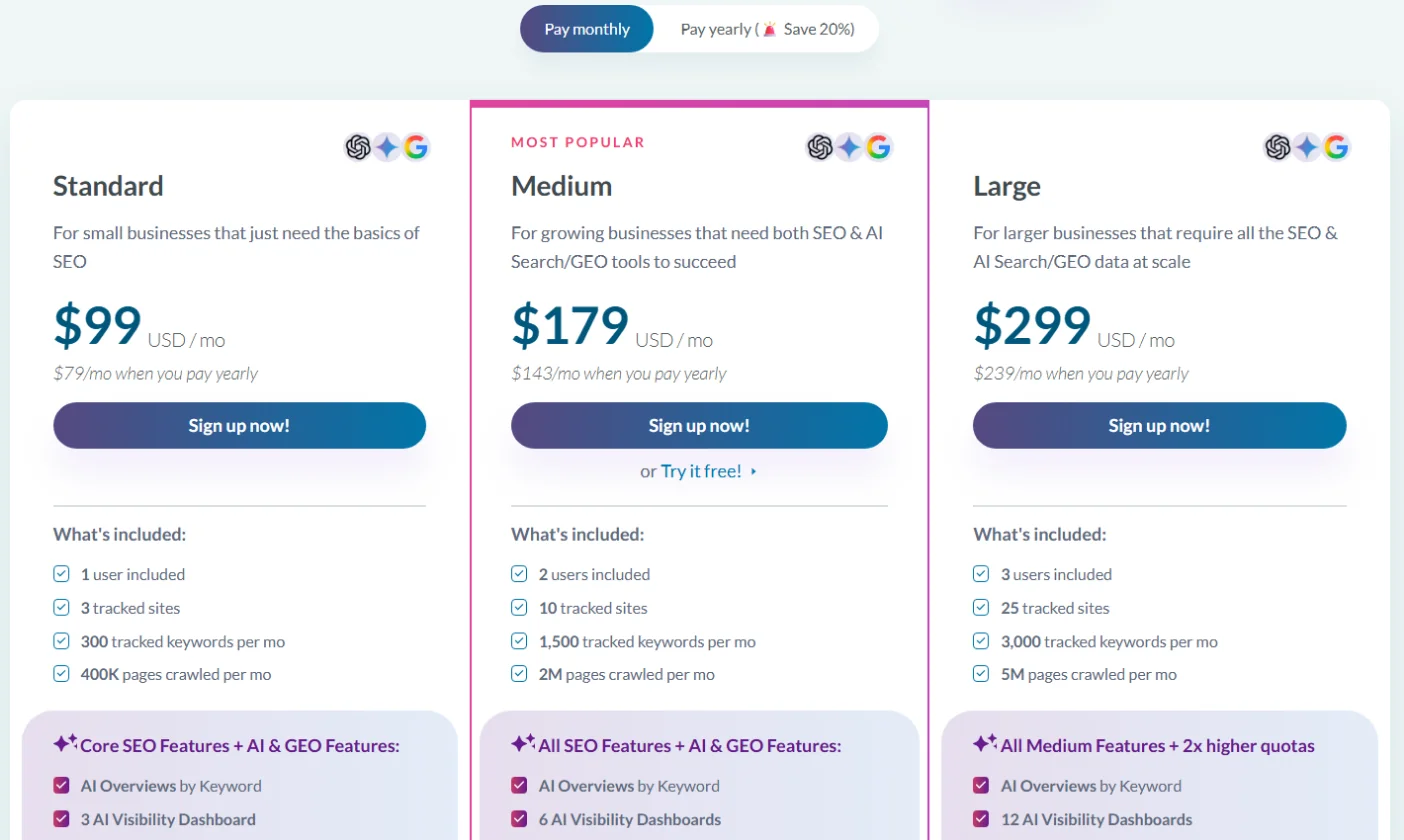
| Plan | Monthly | Annual (per month) | Users | Tracked sites | Tracked keywords | AI prompts |
|---|---|---|---|---|---|---|
| Starter | $49 | Not listed | 1 | 1 | 50 | None listed |
| Standard | $99 | $79 | 1 | 3 | 300 | 150 |
| Medium | $179 | $143 | 2 | 10 | 1,500 | 300 |
| Large | $299 | $239 | 3 | 25 | 3,000 | 600 |
Annual billing saves 20%, the biggest discount of the three. Moz lists Starter separately as an entry plan for people managing a single website.
What changed in 2026. Semrush rebuilt its plans into SEO, Starter, Pro+ and Advanced, with AI visibility bundled from Starter, and Advanced now shows custom pricing. Moz raised Starter from $39 to $49 on October 31, 2026 and moved AI visibility into the $99 Standard plan. Ahrefs now lists Enterprise as “talk to sales.” A few 2026 articles also claim Semrush cut prices to $119.95. Semrush’s own page shows $139, so don’t budget on the lower number.
What you actually pay with a team
Sticker prices assume one person. Most SEO work involves more than one. Once you add seats and AI tracking, the order changes.
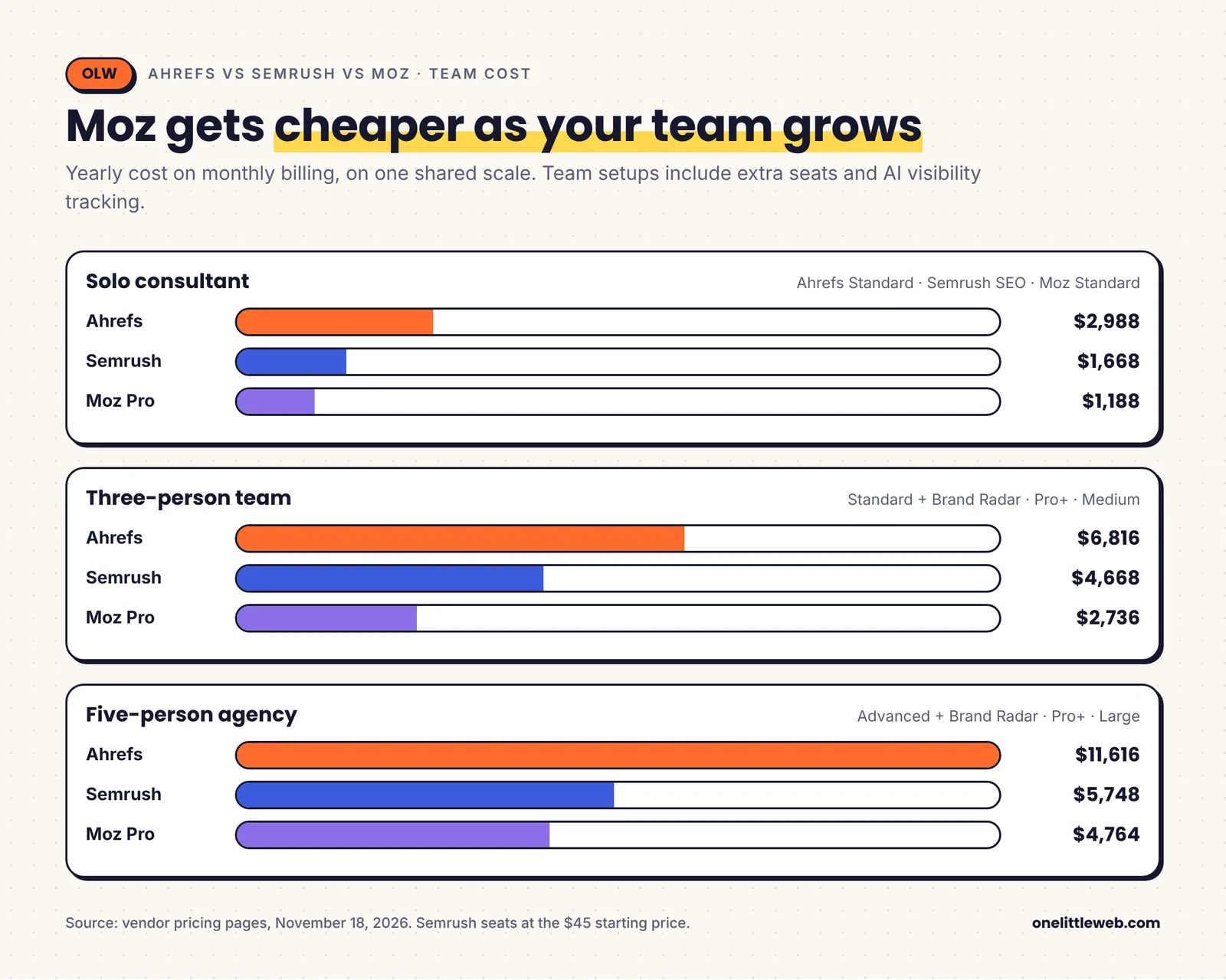
Here are the assumptions behind the numbers:
- Ahrefs seats at $60 on Standard and $80 on Advanced, plus Brand Radar at $199 a month for AI tracking
- Semrush seats at $45, the published starting price. Higher tiers may charge more.
- Moz seats at $49, on top of the seats each plan already includes
Solo consultant
| Tool | Plan | Monthly | Yearly |
|---|---|---|---|
| Ahrefs | Standard | $249 | $2,988 |
| Semrush | SEO | $139 | $1,668 |
| Moz Pro | Standard | $99 | $1,188 |
For one person, Semrush and Moz are far cheaper than a useful Ahrefs plan. Moz Standard even includes AI visibility tracking at that price.
Three-person team, AI visibility wanted
| Tool | Setup | Monthly | Yearly |
|---|---|---|---|
| Ahrefs | Standard + 2 seats ($120) + Brand Radar ($199) | $568 | $6,816 |
| Semrush | Pro+ + 2 seats ($90) | $389 | $4,668 |
| Moz Pro | Medium (2 seats) + 1 seat ($49) | $228 | $2,736 |
Five-person agency, AI visibility wanted
| Tool | Setup | Monthly | Yearly |
|---|---|---|---|
| Ahrefs | Advanced + 4 seats ($320) + Brand Radar ($199) | $968 | $11,616 |
| Semrush | Pro+ + 4 seats ($180) | $479 | $5,748 |
| Moz Pro | Large (3 seats) + 2 seats ($98) | $397 | $4,764 |
Two caveats. Semrush Pro+ caps you at 15 projects, so an agency with more clients needs the custom-priced Advanced plan. And Moz Large is cheap, but its keyword data is far thinner than the other two.
Check: Moz gets relatively cheaper as your team grows, because seats are bundled. Ahrefs gets relatively more expensive, because seats and serious AI tracking are both extra.
Backlink data
For many buyers, this is the deciding category. It’s also where vendor numbers mislead the most.
Index size: what the vendors claim
| Ahrefs | Semrush | Moz | |
|---|---|---|---|
| Backlinks (vendor claim) | ~35 trillion | ~43 trillion | ~44 trillion |
On those numbers, Moz wins. In practice, almost nobody who tests these tools ranks Moz first for backlinks.
The counts aren’t like for like. Semrush’s figure includes live and dead links. Ahrefs reports live external links. Each tool also decides differently what counts as a link worth storing, so a bigger number can simply mean more old or low-value links.
What we saw on our own site
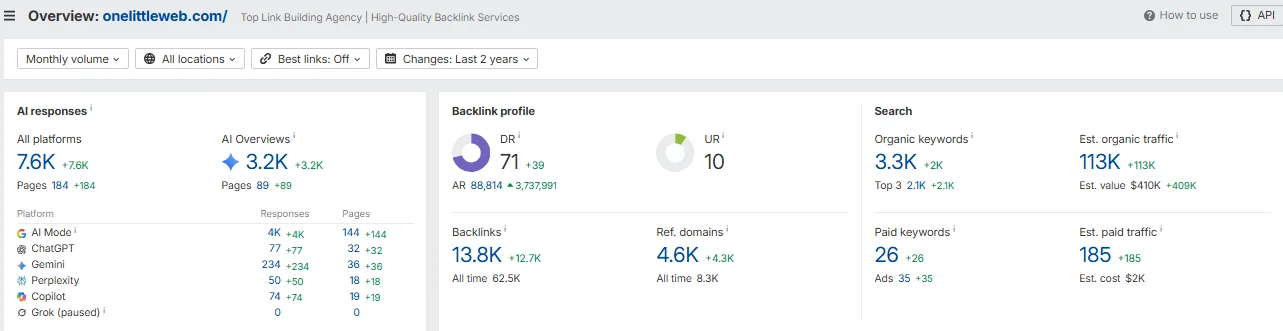
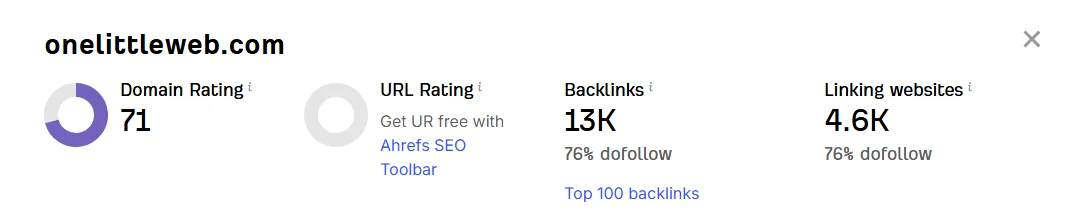
On November 18, 2026, I checked onelittleweb.com in both free authority checkers. Ahrefs reported 13K backlinks from 4.6K linking websites. Semrush reported 27.2K backlinks from 8.1K referring domains.
Same site, same day, and Semrush found roughly twice as many of each. That doesn’t make Semrush more accurate. It shows the two tools count and keep links differently, so pick one tool for link reporting and stick with it.
Freshness and usefulness
What matters more is how fast a tool finds new links and how easy it is to act on them. This is where Ahrefs earns its reputation.
In our link building work, new links usually show up in Ahrefs before the other tools. Its filters for dofollow, anchor text and first-seen date make link audits faster. An agency comparison by The Blueprint Training scored backlink analysis 10 out of 10 for Ahrefs and 7 for both Semrush and Moz.
Semrush is close behind, and its larger counts can help with big audits. For outreach and competitor link gaps, though, we still open Ahrefs first. Moz Link Explorer covers the basics well and adds Spam Score, but it falls short on freshness and depth for active link building.
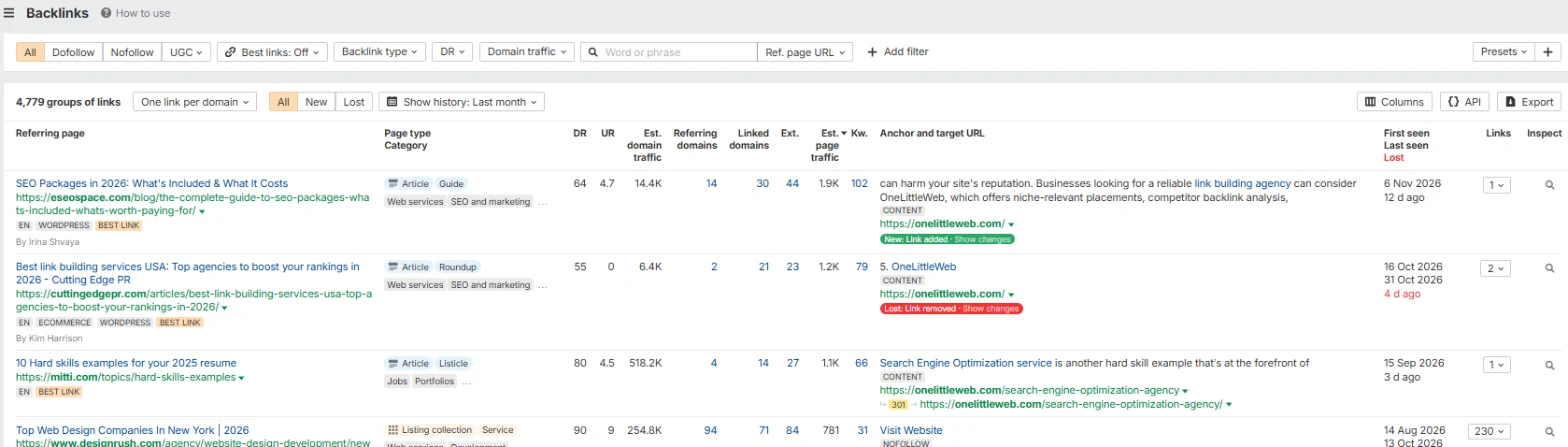
Check: If backlinks are your main job, Ahrefs is the clear pick. See our link building service for how we use it on client campaigns.
Keyword research
Keyword research is the other job most people buy these tools for.
| Ahrefs | Semrush | Moz | |
|---|---|---|---|
| Keywords (vendor claim) | ~28.7 billion | ~27 to 28.8 billion | ~1.25 billion |
Ahrefs and Semrush are close enough that the difference won’t show up in daily work. Moz is in a different league, with roughly one twentieth of the data.
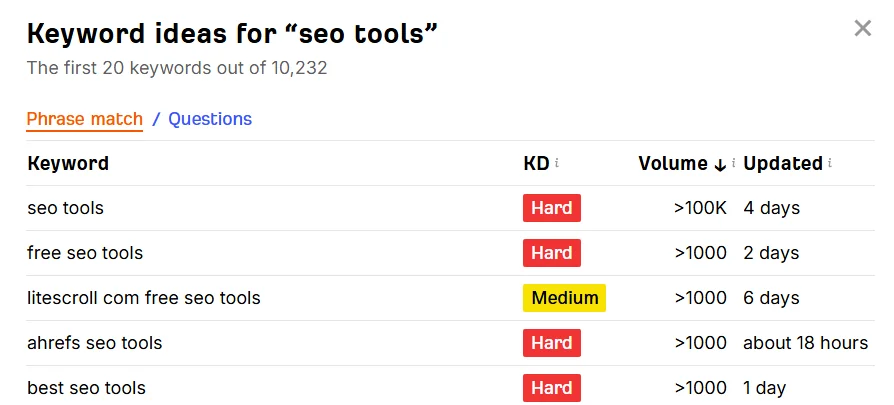
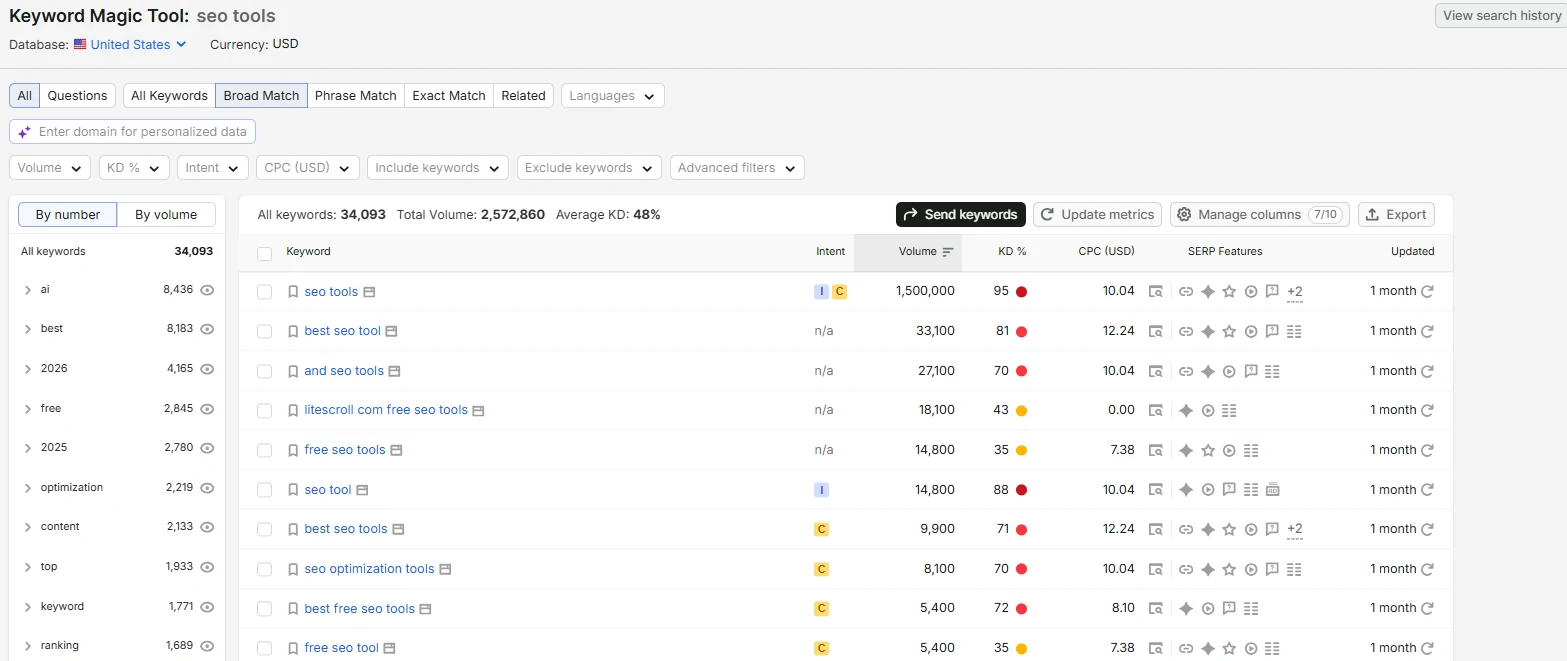
Semrush Keyword Magic Tool is our go-to for building keyword lists. You start with one seed term and get thousands of variations, grouped by topic and labelled by intent. For planning a content cluster, it saves real time.
Ahrefs Keywords Explorer is strongest at judging a topic’s real potential. Its Traffic Potential metric estimates how much traffic the top page gets across all its keywords. On Lite, every search uses a credit, so heavy research gets rationed.
Moz Keyword Explorer keeps things simple with a Priority score that blends volume, difficulty and opportunity. It’s beginner friendly. It also caps suggestions at 1,000 per search, and with a smaller database you’ll see fewer long-tail ideas.
Check: Semrush wins narrowly. It’s better for building big lists, while Ahrefs is better for judging which topics are worth it.
Domain Rating vs Domain Authority vs Authority Score
Each tool has its own “how strong is this site” score. People mix them up constantly, and it causes bad decisions.
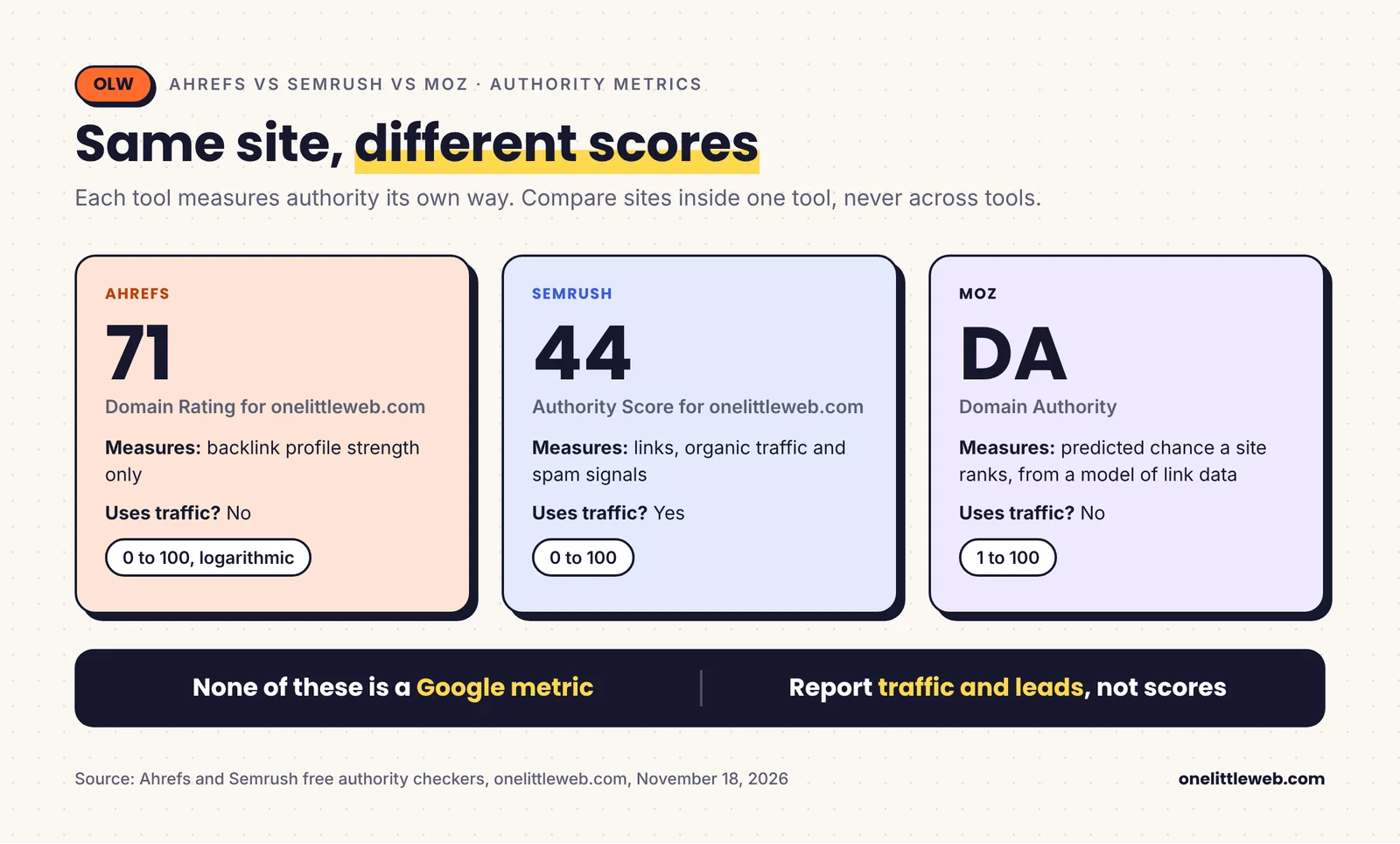
| Metric | Tool | What it measures | Scale |
|---|---|---|---|
| Domain Rating (DR) | Ahrefs | Strength of a site’s backlink profile only | 0 to 100, logarithmic |
| Domain Authority (DA) | Moz | Predicted chance a site ranks, from a model of link data | 1 to 100 |
| Authority Score (AS) | Semrush | A mix of link strength, organic traffic and spam signals | 0 to 100 |
Here’s our own site as an example. On the same day, Ahrefs gave onelittleweb.com a Domain Rating of 71.
Semrush gave the same site an Authority Score of 44. Its score blends link power, organic traffic and a natural profile check, so a site with strong links but modest traffic scores lower.
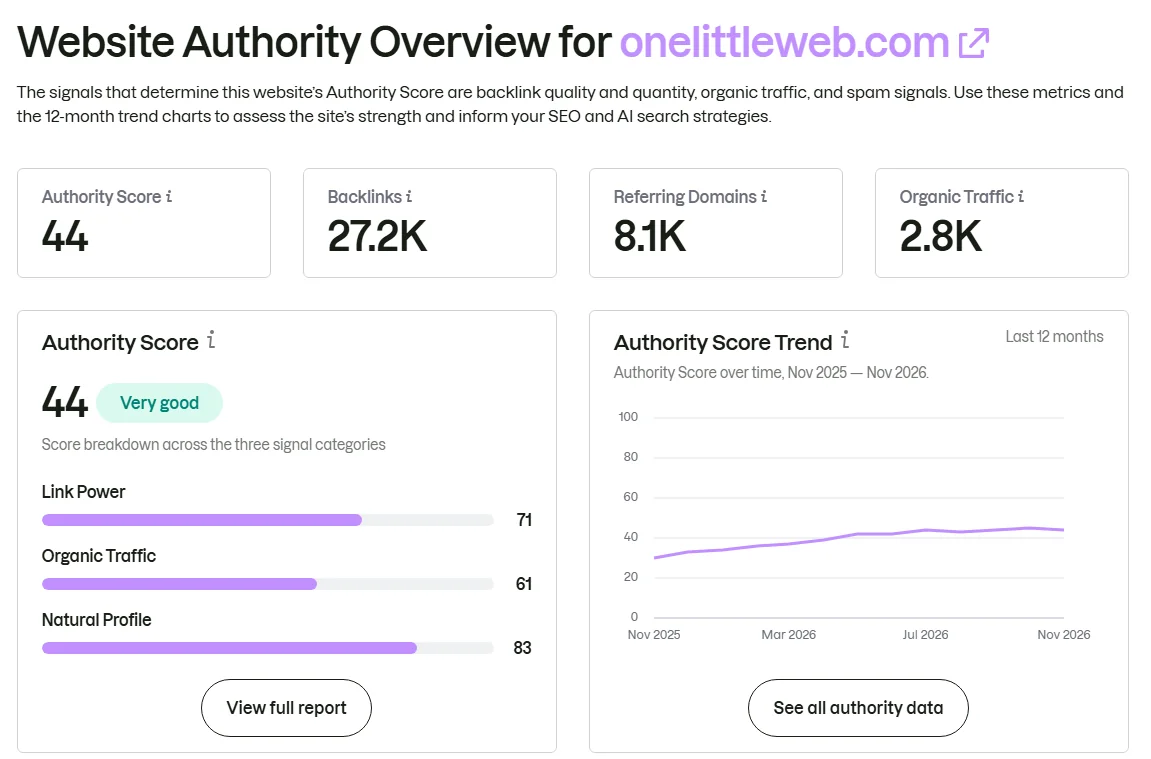
Other sites see the same gap. RightBlogger compared DR and DA on its own site and got DR 70 against DA 31. None of these is a Google metric, and Google doesn’t use any of them to rank pages.
Here’s how we handle them at OLW:
- Stay in one tool. Compare sites using one metric from one tool. Never compare one site’s DR with another site’s DA.
- Vet, then verify. Use DR or DA for quick link prospect vetting, then look at the site’s real traffic.
- Report outcomes. Show clients traffic and leads, not authority scores. A score can drop while traffic grows.
Rank tracking
How often your rankings update matters most when you report to clients or watch a launch.
| Ahrefs | Semrush | Moz | |
|---|---|---|---|
| Update frequency | Weekly | Daily | Weekly |
| Entry-plan tracked keywords | 750 (Lite) | 500 (SEO) | 50 (Starter), 300 (Standard) |
| Search engines | Google, Bing and others | Google, Bing, Yahoo |
Semrush is the only one with daily updates on every paid plan. When a client asks why traffic dipped on Tuesday, a weekly tracker can’t answer that.
Ahrefs tracks more keywords at entry level, but its weekly updates are a real limit for agency work. Moz support has confirmed its tracking tools are built for weekly updates too, with an on-demand Rank Checker for spot checks. You’ll see some reviews call Moz’s tracking daily. Moz’s own help forum says weekly, so I’d trust that.

One catch we found in our own account. Semrush switched a low-activity tracking campaign to weekly updates and showed a button to switch back to daily. If you rely on daily data, check that setting.
Check: For client reporting, Semrush’s daily updates make it the clear pick.
Site audits
All three crawl your site and flag technical issues. The differences come down to crawl capacity and how clearly they explain fixes.
Moz is surprisingly generous here. Standard allows 400,000 crawled pages a month, Medium 2 million and Large 5 million. Ahrefs Lite gives 100,000 crawl credits and Semrush’s SEO plan covers about 100,000 pages a month.
Ahrefs Site Audit checks over 170 issue types and presents them cleanly. We find it the easiest to hand to a developer. Semrush Site Audit is just as thorough and links issues to its other tools, though the volume of warnings can overwhelm beginners.
Check: For one large site on a small budget, Moz’s crawl allowance is a real advantage. For agencies auditing many sites, Ahrefs and Semrush both do the job well.
Traffic estimates and why Search Console wins
Every tool here will estimate how much traffic a competitor gets. None of them actually knows.
They model traffic from rankings, search volume and click-through rate assumptions, so the numbers are directional at best. We regularly see estimates miss our clients’ real Search Console numbers, in both directions.
You’ll find claims online that one tool is within 10 to 15% of real traffic. I haven’t seen a test with enough sites and a clear method to back any accuracy figure, so I wouldn’t rely on one. Moz doesn’t offer a full traffic model like the other two.
Our rule at OLW is simple:
- Use Ahrefs or Semrush estimates to compare competitors and spot trends.
- Use Google Search Console for your own site’s real numbers.
- Never put a tool’s traffic estimate in a client report as fact.
AI visibility tracking
This is the fastest-changing part of the comparison. All three tools now track how brands show up in AI answers, but they package it very differently.
| Ahrefs | Semrush | Moz Pro | |
|---|---|---|---|
| How you get it | 150 to 600 prompt checks a month in plan; Brand Radar from $199/mo | Bundled in Starter ($199) and up, or a $99/mo add-on | Included from Standard ($99) |
| Tracked prompts | Small allowance in plan | 50 (Starter) to unlimited (Advanced) | 150 (Standard) to 600 (Large) |
| AI platforms | Several AI assistants and AI Overviews | ChatGPT, AI Overviews, AI Mode, Perplexity, Gemini | GPT, Gemini, Google AI Mode |
| Update cadence | Varies by product | Daily | Weekly |
Semrush is the most complete option right now, with daily prompt tracking and the widest platform list. We use it for AI visibility reporting with clients.
Ahrefs now includes a small number of AI prompt checks in every plan. Serious monitoring means adding Brand Radar from $199 a month, so a team on Standard pays $448 a month before seats.
Moz is the story most reviews miss. It moved AI visibility into the $99 Standard plan, with 3 dashboards and 150 tracked prompts. Tracking updates weekly and covers three AI models. For a small team, that’s strong value. As our view of Moz is research-based, I’d test it on your brand first.
One caution for all three. AI answers change from one query to the next, so treat these tools as trend trackers, not exact measurements. Our LLM tracking tools roundup covers dedicated options.
Check: Semrush wins for most teams. Moz is the best value if you only need weekly AI tracking on a small budget.
PPC, local and API extras
These won’t decide the choice for most people, but they can for some.
- PPC research. Semrush is the only real option. Its Advertising Toolkit shows competitors’ ads, ad copy and paid keywords. Ahrefs has limited paid data and Moz has none.
- Local SEO. Semrush’s Local Toolkit costs $30 or $60 per location a month. Moz Local is a separate listings product, also priced per location. Ahrefs doesn’t offer listing management.
- API and MCP access. Ahrefs includes API and MCP access from Lite. Semrush includes MCP from Starter, with advanced API data on Advanced. The standalone Moz API has a free tier of 50 rows a month and paid plans from $20 a month for 3,000 rows.
MCP, or Model Context Protocol, is what lets an AI assistant like Claude or ChatGPT query a tool’s data directly. If your team works this way, check these limits before you pick a plan.
Ease of use
Ahrefs is the easier of the two we use daily. New team members at OLW usually find their way around it quickly. Reports are clean and filters are where you expect them.
Semrush takes longer. There are so many tools and toolkits that new users often don’t know where to start. Once you learn it, it’s very efficient, but the first couple of weeks can feel heavy.
Moz is widely rated as the most beginner friendly, and its learning resources are excellent. If you’re new to SEO or running marketing alongside other jobs, that counts for a lot.
What users say
Review platforms tell a split story for all three tools.
| Tool | G2 | Capterra | Trustpilot |
|---|---|---|---|
| Ahrefs | 4.5 | 4.7 | 1.9 to 2.1 |
| Semrush | About 4.5 | Not checked | 1.7 to 2.2 |
| Moz Pro | 4.3 | 4.5 | 2.4 to 3.1 |
Ratings shift often and sources disagree, so treat these as ranges.
On G2 and Capterra, where reviewers are usually working marketers, all three score well. On Trustpilot, all three score badly. Most low Trustpilot reviews are about billing, renewals and refunds rather than data, so read them as a warning about account management.
Refunds, cancellation and ownership
- Semrush offers a 7-day refund on your first annual subscription only. Monthly plans aren’t refunded. If you start a trial, set a reminder.
- Ahrefs has no free trial and generally doesn’t issue refunds. Starter at $29 is the cheapest way to look inside, and Ahrefs Free covers sites you own.
- Moz offers a free trial on the Medium plan. Check the terms on its pricing page before you sign up.
Ownership is worth a thought too. Adobe completed its purchase of Semrush on April 28, 2026. So far the product hasn’t changed for existing users, but big acquisitions often bring pricing changes over time. Ahrefs is independent. Moz has been owned by Ziff Davis since 2021.
Which one should you choose?
Here’s how I’d decide, based on your role.
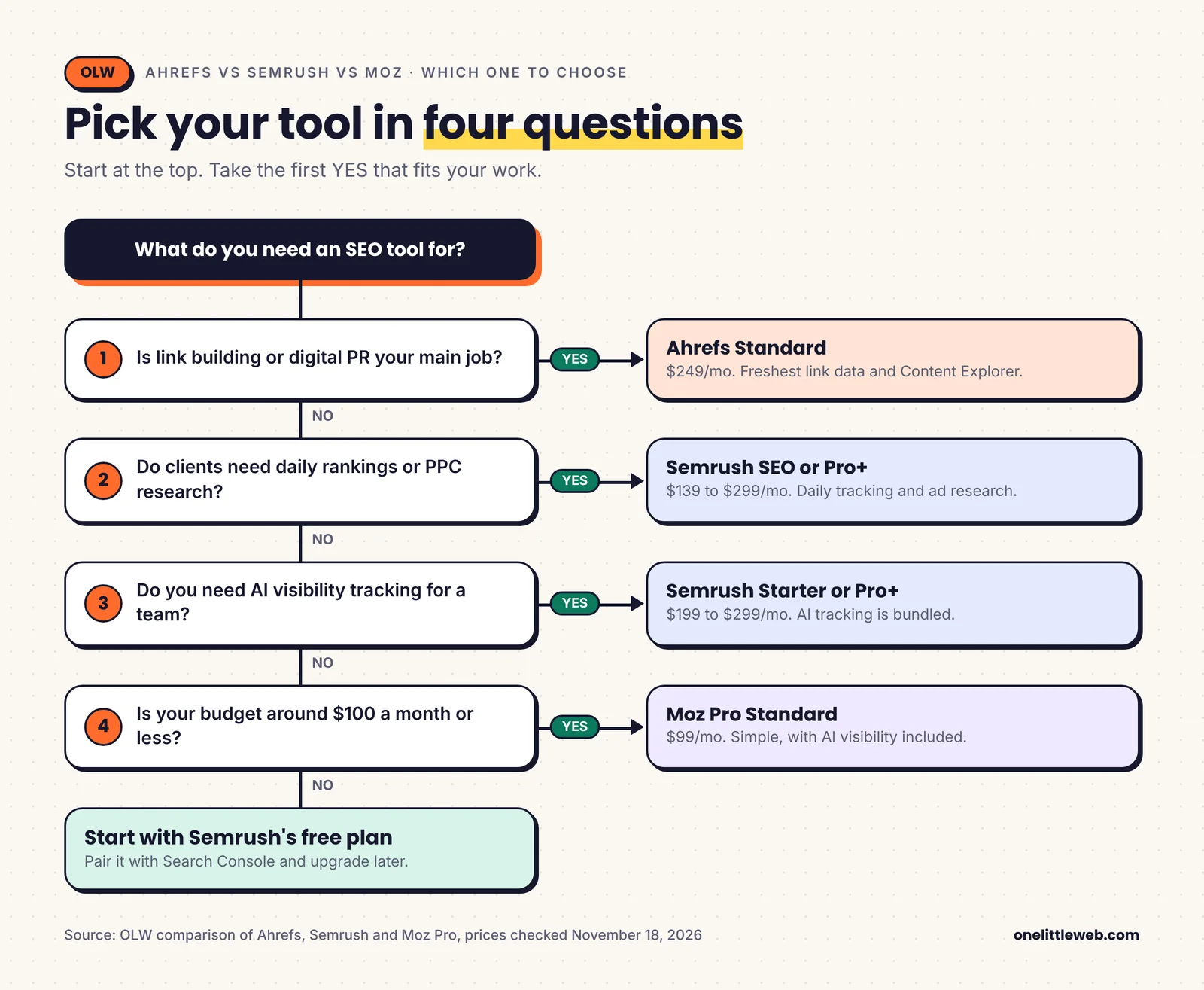
- Solo freelancer or consultant: Semrush SEO at $139 for keywords and rankings, or Ahrefs Standard at $249 if most of your work is link building.
- Agency with five or more people: Semrush Pro+ for daily rank tracking and bundled AI visibility. Add Ahrefs if you sell link building.
- In-house SEO on one brand: Ahrefs Standard or Advanced, depending on how much history you need.
- Small business owner: Moz Standard at $99. It’s simpler, cheaper and now includes AI visibility. Pair it with Search Console.
- Link builder or digital PR team: Ahrefs, without much debate.
- SEO plus PPC team: Semrush. Neither of the others competes on paid search.
- Very small budget: You may not need any of the three yet. Search Console is free, and Ahrefs Free covers your own site.
Still comparing? Our Ahrefs alternatives and Semrush alternatives guides cover cheaper options like SE Ranking.
Should you run two of them?
For many agencies, yes. We do.
At OLW, Ahrefs handles backlink audits, link prospecting and content research. Semrush handles keyword planning, daily rank tracking, AI visibility reporting and PPC research. Each covers the other’s weak spot. Our Semrush vs Ahrefs comparison goes deeper on that pairing.
For a solo user or a small business, two tools rarely pay off. If you do run two, don’t pay twice for the same thing. Skip Brand Radar if Semrush already tracks your AI visibility, and don’t track the same keywords in both tools.
Score breakdown
| Tool | Backlinks (20%) | Keywords (15%) | Team cost (15%) | Rank tracking (10%) | AI visibility (10%) | Site audit (10%) | Ease of use (10%) | Extras (10%) | Overall |
|---|---|---|---|---|---|---|---|---|---|
| Semrush | 8.0 | 9.5 | 6.0 | 9.0 | 8.5 | 8.5 | 7.0 | 9.5 | 8.2 |
| Ahrefs | 9.5 | 9.0 | 6.5 | 6.0 | 6.5 | 8.5 | 8.5 | 6.5 | 7.8 |
| Moz Pro | 7.0 | 6.0 | 9.0 | 6.0 | 8.0 | 7.5 | 8.5 | 6.5 | 7.3 |
The overall score is a weighted average. Ahrefs and Semrush scores reflect hands-on OLW use, while Moz scores are research-based. If backlinks are 80% of your work, Ahrefs is your tool whatever the total says.
The bottom line
There’s no single best tool here. There’s a best tool for your job.
Pick Ahrefs if links are your main work. Pick Semrush if you want one tool for most of your search marketing, including AI visibility and daily rankings. Pick Moz Pro if you’re a small business or beginner who wants a clear, affordable tool.
Whatever you choose, check the current pricing page before you pay. All three changed their plans in 2026, and they’ll likely change again.
If you’d rather have experts run your SEO than learn three dashboards, that’s the work we do every day. Take a look at our SEO services.
Frequently Asked Questions
Is Semrush better than Ahrefs?
For breadth, yes. Semrush covers SEO, PPC, local and AI visibility, with daily rank tracking. Ahrefs is better for backlink data and content research. Most agencies would pick Semrush as a single tool and add Ahrefs for link work.
Is Moz still worth it in 2027?
For small businesses and beginners, yes. It’s the cheapest of the three, includes seats on Medium and Large, and now bundles AI visibility from the $99 Standard plan. For serious keyword or competitor research, its smaller database holds it back.
Which is the cheapest: Ahrefs, Semrush or Moz?
Moz Pro, at $49 a month for Starter or $99 for Standard. Ahrefs Starter is $29, but it’s a limited taster plan. For a working plan, Moz Standard is the cheapest of the three.
Which has the best backlink data?
Ahrefs. Moz and Semrush claim bigger link indexes, but Ahrefs finds new links fast and makes link data the easiest to act on.
Is Domain Authority the same as Domain Rating?
No. Domain Authority is Moz’s prediction of how likely a site is to rank. Domain Rating is Ahrefs’ measure of backlink strength. They often differ a lot for the same site, and neither is used by Google.
Does Ahrefs have a free trial?
No. You can use Ahrefs Free for sites you own, or pay $29 for Starter to try the research tools.
Which tool tracks AI search visibility?
All three now do. Semrush bundles it from the $199 Starter plan. Moz includes it from the $99 Standard plan. Ahrefs includes a small number of prompt checks in each plan and sells Brand Radar from $199 a month for deeper tracking.
Which is best for beginners?
Moz Pro. Its interface is simpler and its learning resources are some of the best in SEO.
Which is best for agencies?
Semrush, mainly for daily rank tracking, bundled AI visibility and PPC research. Many agencies add Ahrefs for link building.
Can I use Google Search Console instead?
For your own site, Search Console gives you real data that none of these tools have. It can’t show you competitors, backlinks or keyword ideas beyond your own rankings, so most sites benefit from Search Console plus one paid tool.
Where to Go Next
- Semrush vs Ahrefs: our head-to-head comparison
- Ahrefs review
- Semrush review
- Best LLM tracking tools
- AI search optimization guide
Methodology
Sources
- Ahrefs, Semrush and Moz Pro pricing pages, checked and captured on November 18, 2026
- Ahrefs and Semrush free authority checkers, run on onelittleweb.com on November 18, 2026
- Moz help forum answers on rank tracking cadence, and Moz plan change logs for 2026
- Vendor-published index sizes, as reported by each vendor and by third-party comparisons
- G2, Capterra and Trustpilot ratings as reported in November 2026
Why numbers may differ
- Vendors count backlinks and keywords differently, so index sizes aren’t like for like.
- Semrush shows annual prices by default. Monthly prices in this article come from the same pricing page.
- Seat prices above the published starting price are not listed on all three pricing pages.
Limitations
- Moz Pro analysis is research-based. OLW’s team doesn’t use Moz day to day.
- Authority scores were checked once, on one site, and will move over time.
- Review ratings and counts change weekly.
Prices and ratings in this comparison were checked in November 2026 and will change, so confirm them on each vendor’s site before you buy.