Quick answer
Local SEO is the work of getting your business in front of people who search nearby, in the Google map pack, the local blue links and AI answers. Google ranks local results mainly on relevance, distance and prominence. You improve them with a complete Business Profile, a page for each service, consistent listings and a steady flow of reviews.
Key takeaways
- Your Business Profile wins the map pack. Experts put profile signals at 32% of map pack weight, and primary category is the single top factor.
- Your website wins the blue links. On-page signals carry 33% of local organic weight, and a dedicated page per service is the top organic factor.
- Being open matters now. Whether you’re open at the time of the search ranked fifth among map pack factors in 2026.
- Reviews need to be recent. 47% of consumers skip businesses with under 20 reviews, and 74% only care about reviews from the last three months.
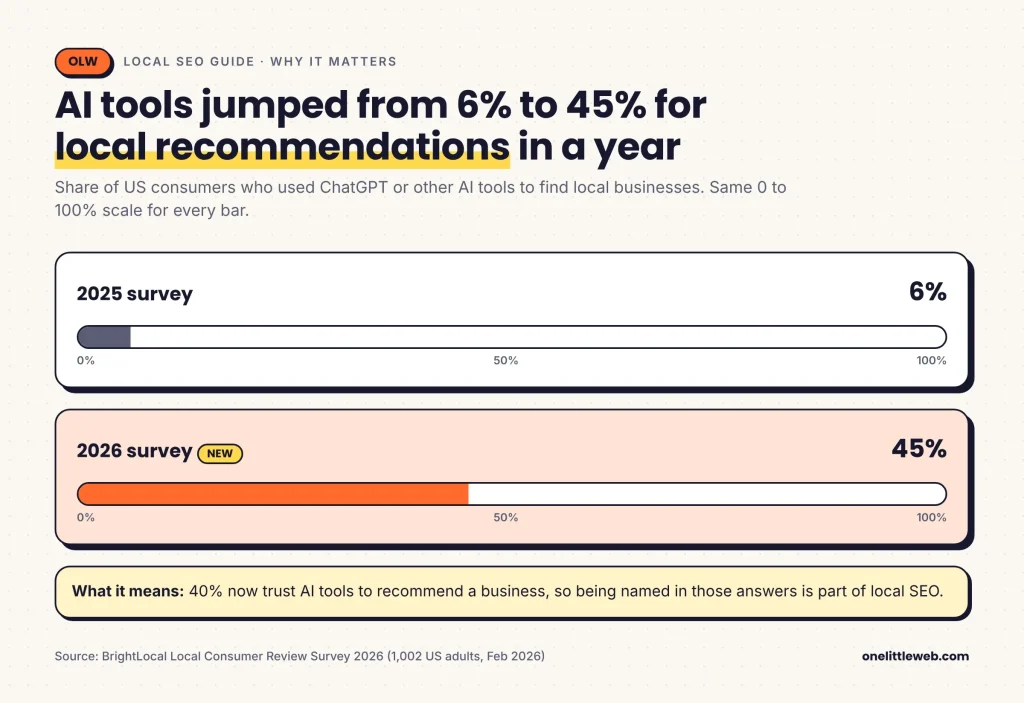
- AI answers are a real channel. 45% of consumers used ChatGPT or similar tools for local recommendations in 2026, up from 6% a year earlier.
- You can’t buy local rankings. Google says there’s no way to pay for a better local position.
Most local SEO guides stop at “claim your profile and get reviews.” Some of the top-ranking ones still quote a ranking survey from 2021.
This one goes further. You’ll get the 2026 data on what moves rankings, a worked 30-day plan for a real kind of business, and the part most guides skip: how to get named when someone asks ChatGPT for a plumber.
I’ve worked in SEO for more than 12 years, and local SEO is one of the services we run at OneLittleWeb. The pattern I see most often is simple. Businesses spend money on tactics before the basics are right.
So this guide follows the order that actually works. Every step tells you what to do, why it matters and how to check it’s done.
What is local SEO?
Local SEO is the work of making a business show up when someone searches for what it sells near a specific place. It’s for any business that customers visit, or that travels to customers, like a plumber or a cleaner.
The searches look like “emergency plumber,” “dentist in Philadelphia” or “coffee shop near me.” Google reads them as having local intent and answers with nearby businesses instead of articles.
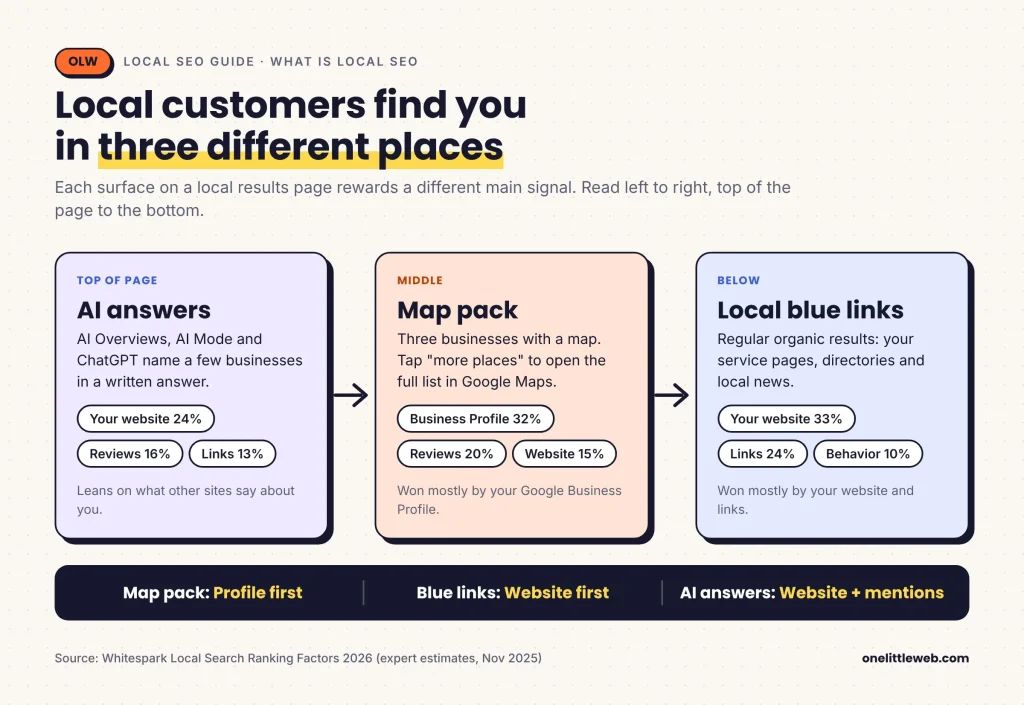
Those answers show up in three places on the results page:
- AI answers: AI Overviews, AI Mode and chatbots like ChatGPT that name a few businesses in a written reply.
- The map pack: the box of three businesses with a map, which opens the full Google Maps list.
- Local blue links: regular organic results, such as service pages, directories and local news.
Local SEO vs standard SEO
Local SEO targets searchers in one area, while standard SEO targets anyone, anywhere. The tactics overlap, but the scoreboard is different.
| Local SEO | Standard SEO | |
|---|---|---|
| Who you reach | People in a city, town or neighborhood | Anyone, often nationwide or global |
| Where you rank | Map pack, Google Maps, local blue links, AI answers | Blue links, featured snippets, AI answers |
| Main asset | Google Business Profile plus service pages | Website content and backlinks |
| Trust signals | Reviews, consistent listings, local mentions | Links, topical authority, brand searches |
| Typical query | “boiler repair Chicago” | “how does a boiler work” |
| Typical goal | Calls, direction requests, bookings, foot traffic | Traffic, sign-ups, online sales |
If you sell online to a whole country, standard SEO matters more. If you need people to call, visit or book nearby, local SEO is where your leads come from.
Why local SEO matters in 2026
Local search is where ready-to-buy customers make fast decisions. Two shifts make it more important this year than last.
Customers search often and decide from a short list
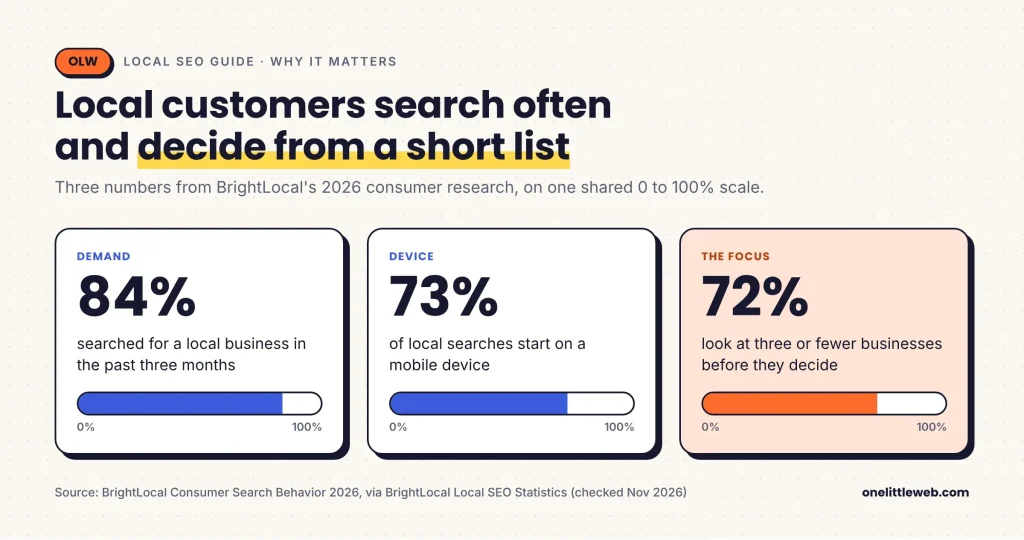
In BrightLocal’s 2026 consumer research, 84% of consumers had searched for a local business in the past three months. And 72% looked at three or fewer businesses before choosing one.
That second number is the one to remember. If you’re not in the first few names a searcher sees, you’re usually not in the running.
Most of those searches happen on a phone. 73% of local searches start on a mobile device, so your profile and pages have to work on a small screen.
AI tools are now a local discovery channel
BrightLocal’s 2026 review survey found 45% of consumers used ChatGPT or other AI tools for local recommendations. A year earlier, that figure was 6%.
Trust is following use. 40% of consumers said they trust AI platforms to recommend a business.
AI answers pull from different sources than the map pack, so ranking on Maps doesn’t guarantee you’ll be named. Step 7 covers how to close that gap.
Local SEO myths vs reality
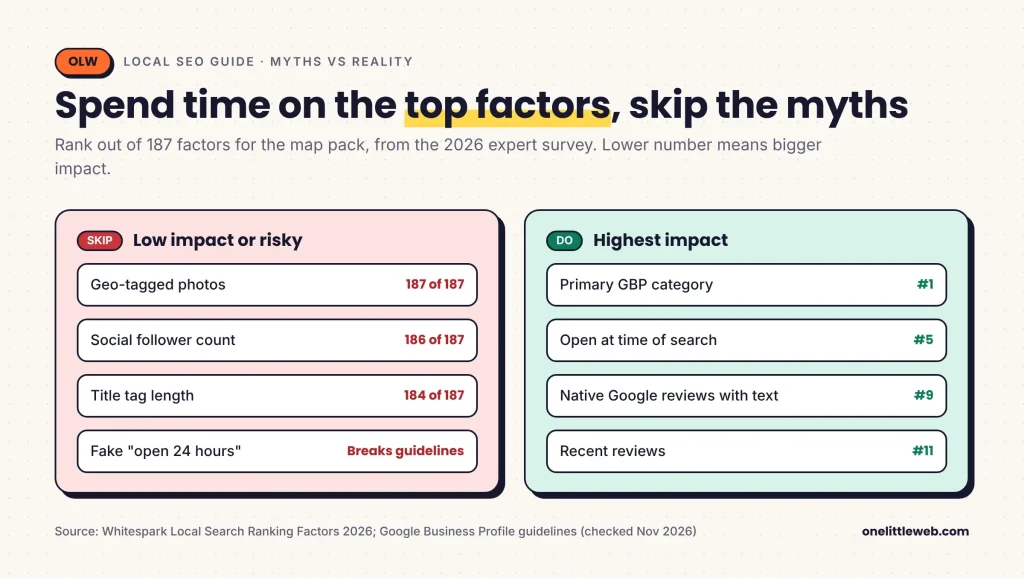
A lot of local SEO advice is aimed at things that barely move rankings. Whitespark’s 2026 survey asked 47 local search experts to score 187 factors, and the bottom of the list is useful too.
Geo-tagged photos came last. Social follower count and title tag length sat just above them. If someone sells you on these, your money is better spent elsewhere.
The top of the list is mostly unglamorous: the right primary category, accurate hours and a steady stream of real Google reviews.
How to do local SEO: 8 steps
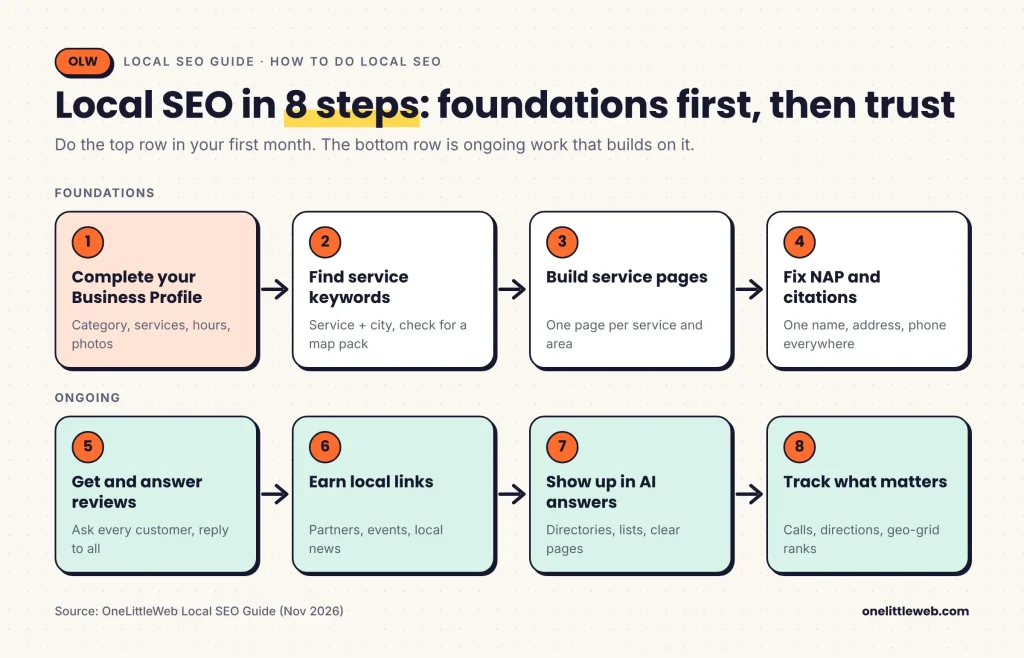
A good local SEO strategy fixes the foundations first, then builds trust over time. Work through these steps in order, because each one makes the next count for more.
Before you start, you need a real, eligible location (a place customers visit, or a base you travel from), a basic website and one fixed version of your business name, address and phone number. That last one is called your NAP.
Step 1: Claim, verify and complete your Google Business Profile
Your Business Profile is the biggest single lever for the map pack. Claim it at business.google.com and verify it, since Google says verified businesses are more likely to show up.
Then fill in every field you can:
- Primary category: the most specific one that completes “this business IS a.” It was the top map pack factor in 2026.
- Secondary categories: only ones that describe your core business.
- Services: add Google’s suggested services first. Whitespark’s own testing found they affect rankings.
- Hours: include holiday hours. Being open at search time now ranks fifth.
- Photos and videos: real ones of your team, place and work.
- Description: plain words on what you do and where. Google doesn’t allow links or sale offers here.
Google says customers are 70% more likely to visit a business with a complete profile. Completeness helps you rank and helps you convert.
Check: every field in your profile is filled, and your hours match what’s on your door.
Step 2: Find service-based local keywords
List every service you sell, then find the words people type for each one. A plumber’s list might include drain cleaning, water heater repair and burst pipe repair.
Each service becomes a search term with a local modifier: “boiler repair Chicago” or “emergency plumber near me.” To check local intent, search it. If a map pack shows up, it’s a local keyword.
Semrush and Ahrefs show search volume, and Google Keyword Planner gives city-level ranges. Don’t skip small numbers. For a local service, 50 searches a month from people ready to call is worth a page.
Check: you have a list of every service, each with its main search term and a note on whether it shows a map pack.
Step 3: Build a page for each service and area
Give every main service its own page. A dedicated page per service was the number one local organic factor in 2026, and second for AI visibility.
On each page, put the service and city in the title tag, H1 and URL. Write a meta description that says who you help and where.
Add your NAP, a map and LocalBusiness schema to your contact or location page. If you serve several towns, write genuinely different content for each one. Swapping the city name on copied text helps nobody.
Check: each service has its own URL, with the service and city in its title tag and H1.
Step 4: Lock down your NAP and build citations
A citation is any online mention of your business name, address and phone number. Yelp, Apple Maps, Bing Places, Facebook and Yellow Pages are the obvious ones.
Start with an audit. Search your old addresses and phone numbers, then fix every listing that doesn’t match your current NAP exactly.
Then find new citation opportunities:
- Industry directories your local competitors appear on (Ahrefs’ Link Intersect or Semrush’s Backlink Gap shows these)
- Your local chamber of commerce
- Local event pages, sponsorships and community calendars
- Career and job sites that show your address
- Mentions in local news, blogs and association sites
Citations now matter more for AI answers than for the map pack. Three of the top five AI visibility factors in Whitespark’s 2026 survey were citation factors.
Check: searching your old phone number returns no live listings.
Step 5: Get more reviews and reply to every one
Reviews build trust with people and with Google. Ask every happy customer, every time, with a direct review link or a QR code on a receipt or counter card.
The bar keeps rising. In BrightLocal’s 2026 survey, 47% of consumers wouldn’t use a business with fewer than 20 reviews, and 31% need at least 4.5 stars.
Reply to every review, including the negative ones. 80% said they’re likely to use a business that responds to all its reviews. But 50% were put off by generic, templated replies.
Never pay for reviews or offer discounts in exchange. It breaks Google’s policies, and in the US the FTC rule on fake reviews can bring fines.
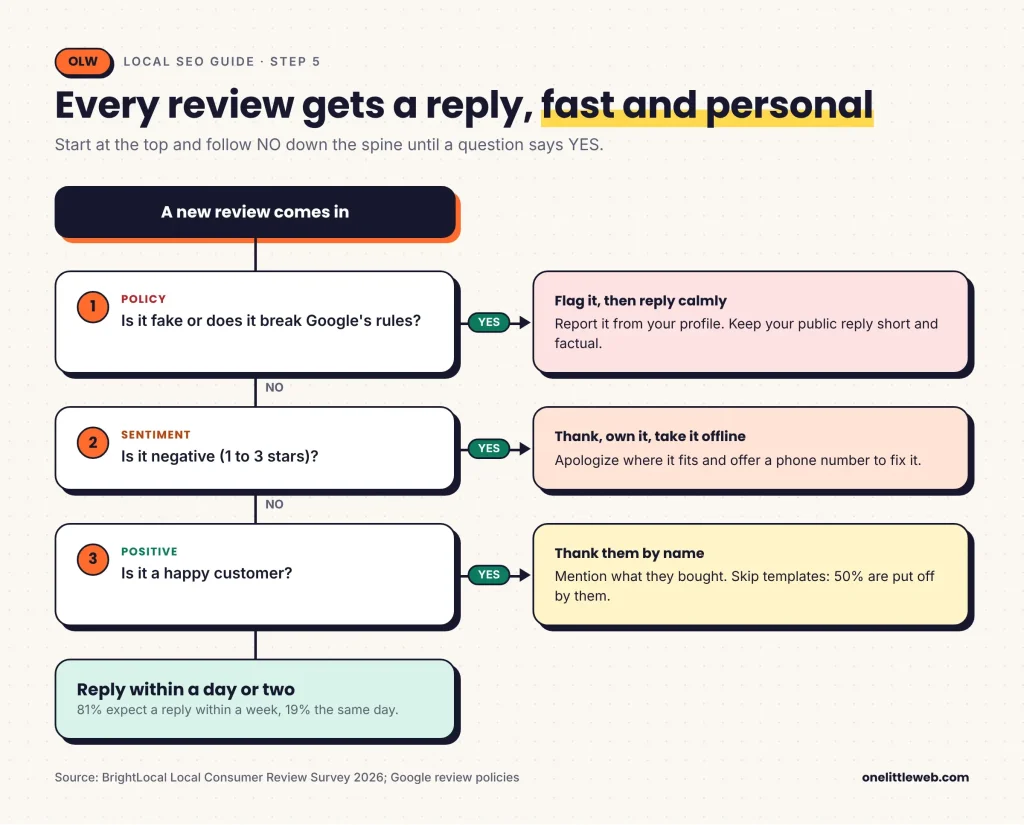
Check: you have at least one review from the last month, and every review has a personal reply.
Step 6: Earn local links and mentions
Links from local and industry sites tell Google you’re a real part of your community. They matter most for the blue links, where experts weight links at 24%.
The easiest wins come from people you already know: suppliers, partners, a charity you support or an event you sponsor. A bakery can donate to a school fair. A printing company can print the flyers. Both usually earn a mention on the event’s page.
Pitch local news when you have real news, like a new location or a milestone. If a site mentions you without linking, a polite email often turns that unlinked mention into a link.
Check: you’ve listed five local partners or events and asked each one about a mention.
Step 7: Show up in AI answers
AI answers pull from different places than the map pack. Whitespark’s experts rank expert “best of” lists, dedicated service pages and prominence on industry sites as the top AI visibility factors.
So focus on what an AI can read and trust:
- Get listed and reviewed on the main directories for your industry, not only Google
- Ask to be included on credible local “best of” lists
- Keep your service pages clear, factual and easy to scan
- Make sure every listing shows the same hours and phone number
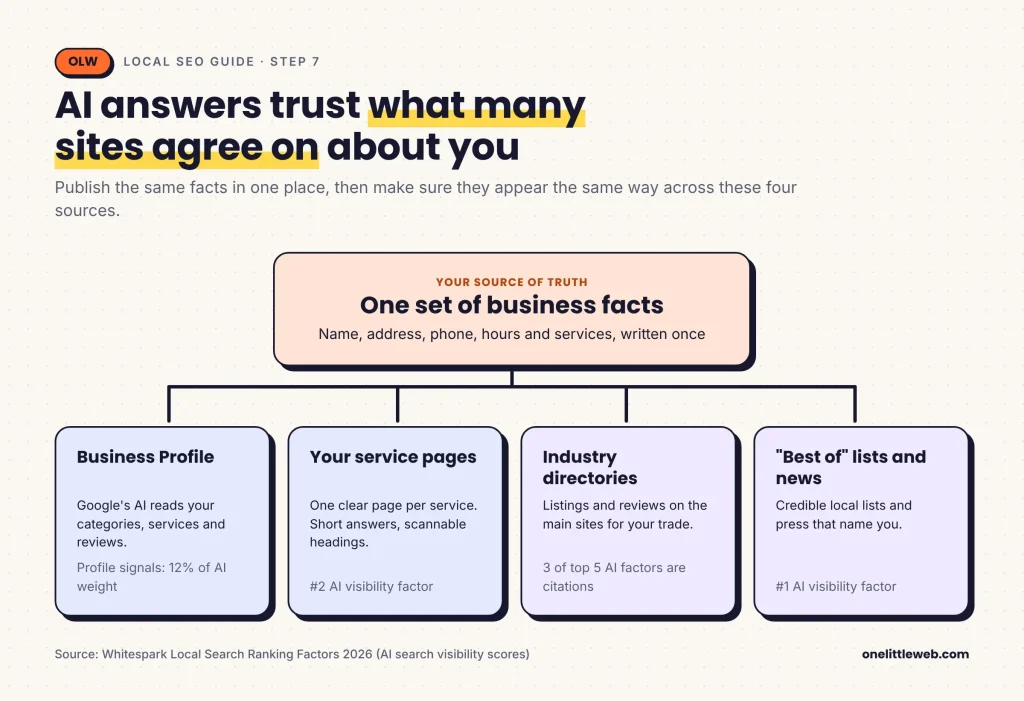
Check: your business details read the same on your profile, your site and your top three directories.
Step 8: Track what matters
Track customer actions as well as rankings. Calls, direction requests and bookings are what pay the bills.
Rankings also change street by street, so one search from your office won’t tell you much. The tracking section below shows how to set up each layer.
Check: you have a monthly date in your calendar to review calls, GSC clicks and a geo-grid scan.
How local search works: what each surface rewards
Google says local results are based mainly on relevance, distance and prominence. Relevance is how well your profile matches the search. Distance is how far you are from the searcher. Prominence is how well known you are, including your links, review count and rating.
Experts also estimate how much each group of signals counts on each surface. These are survey estimates, not Google figures, but the pattern is consistent.
| Signal group | Map pack | Local organic | AI answers |
|---|---|---|---|
| Google Business Profile | 32% | 7% | 12% |
| Reviews | 20% | 6% | 16% |
| On-page (your website) | 15% | 33% | 24% |
| Links | 8% | 24% | 13% |
| Behavioral (clicks, calls) | 9% | 10% | 4% |
The takeaway is simple. Your profile wins the map pack, your website wins the blue links, and AI answers lean on your website, your reviews and what other sites say about you. The map pack ads you see above the pack don’t change any of this: Google says there’s no way to pay for a better local ranking.
Anatomy of a strong Business Profile
Six parts of your profile do most of the work. Here’s where each one sits on a typical profile.
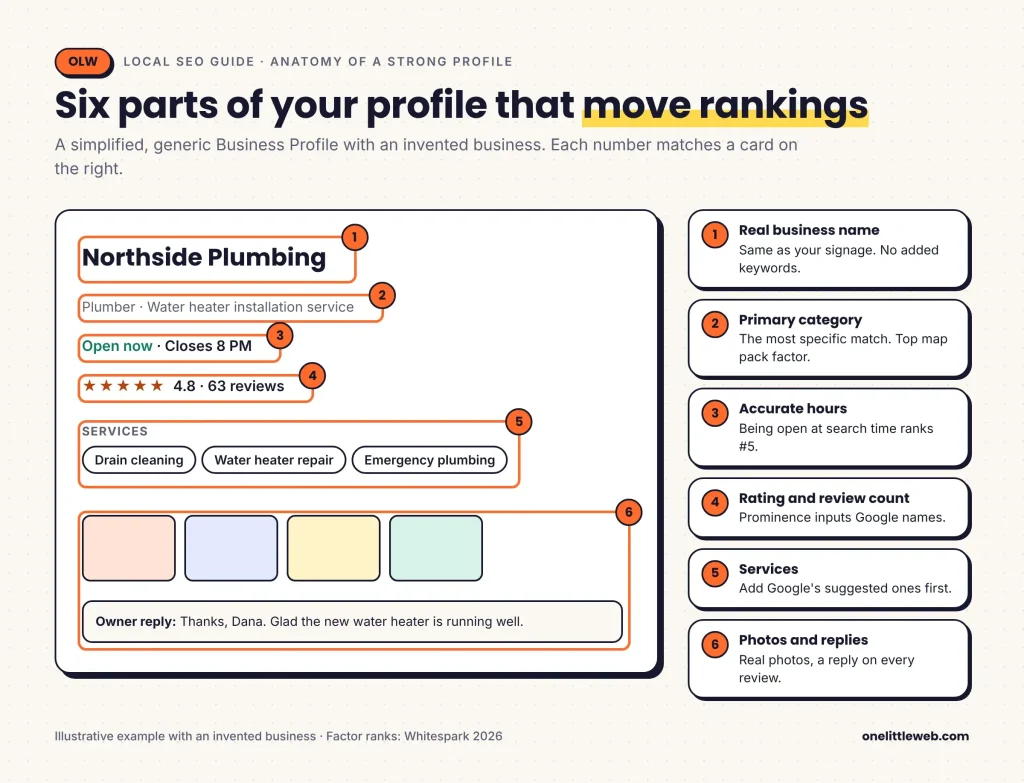
Keywords in the business name are a strong ranking factor, which is exactly why people abuse them. Google’s guidelines ban it, and it can get your profile suspended. Use your real-world name only.
The owner reply on each review counts too. It shows future customers you’re paying attention, even when the review is short.
Local SEO by business type
How you set up your profile depends on where you meet customers. Google’s guidelines treat storefronts and service-area businesses differently.
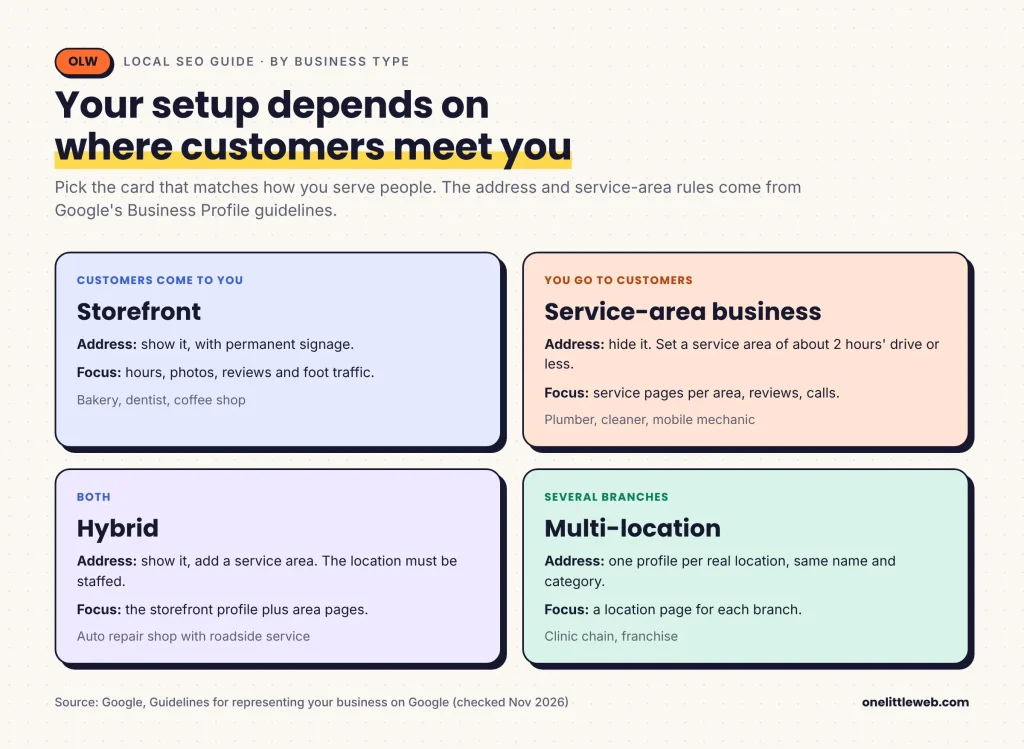
- Storefront: show your address with permanent signage. Focus on hours, photos and reviews.
- Service-area business: hide your address and set a service area of about two hours’ drive or less. Focus on service pages per area.
- Hybrid: show your address and add a service area. The location must be staffed during your hours.
- Multi-location: one profile per real location, with the same name and category. Give each branch its own location page.
Virtual offices and PO boxes don’t qualify for a profile at all.
What the first 30 days look like
Here’s how the steps fit together for one business. This is an illustration with an invented business: a two-van plumbing company in Chicago, run from the owner’s home.
At the start, the profile shows the home address, has “Plumber” as the only category and 9 reviews. There are no service pages, and two old phone numbers sit on directories.
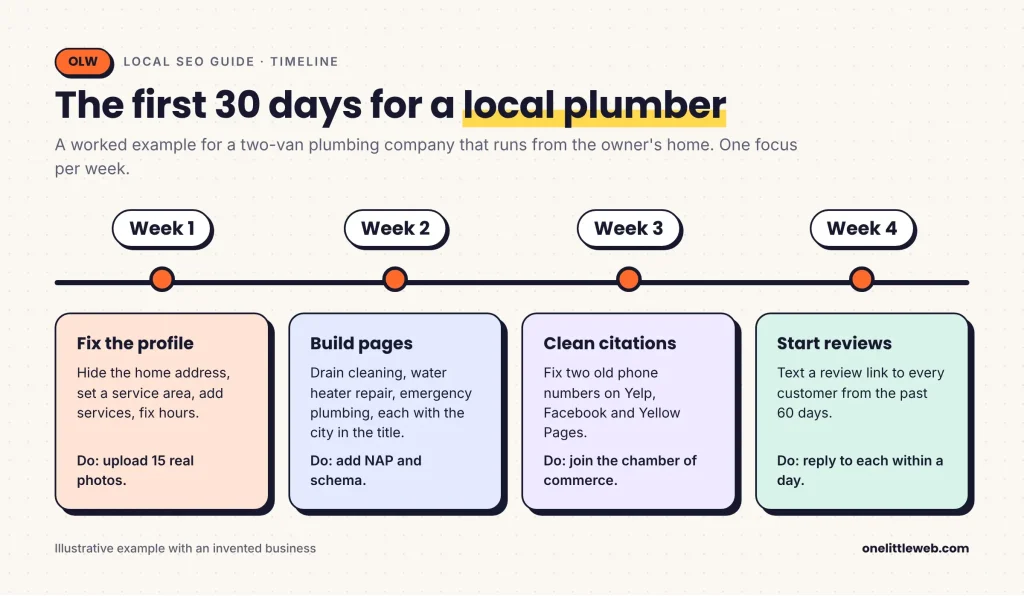
At day 30, watch calls and direction requests in the profile, impressions for service keywords in Google Search Console and a geo-grid scan for “emergency plumber.”
Don’t expect the top of the map pack in a month. Distance still limits how far from the owner’s base the business can rank, and no amount of work changes that.
How to track local SEO
Track three layers: what customers do, where you rank and whether AI tools name you.
| Layer | Tool | What to watch | How often |
|---|---|---|---|
| Customer actions | Business Profile performance, Google Search Console | Calls, direction requests, website clicks, local queries | Monthly |
| Rankings | Geo-grid tracker (BrightLocal, Whitespark, Semrush) | Map pack position across your area | Monthly |
| AI visibility | ChatGPT, Google AI Mode | Whether you’re named, and which sites are cited | Monthly |
Customer actions
Your Business Profile performance screen shows calls, direction requests and website clicks. Google Search Console shows which local queries bring clicks to your service pages.
- Verify your site in Google Search Console.
- Filter the Performance report by queries that contain your city or “near me.”
- Note calls and direction requests from your profile at the end of each month.
Rankings
A geo-grid tracker checks your map pack position from many points across a map of your area. It shows where you’re strong and where you drop off.
Track your top three service keywords. Re-scan after each big change so you can connect results to the work.
AI visibility
Ask the same questions every month in a private browser window and note who gets named. Use prompts like these:
Who is the best emergency plumber in Chicago?
Recommend a water heater repair company near Lincoln Park, Chicago.
Which plumbers in Chicago have the best reviews?
Swap in your own service and city. If competitors appear and you don’t, check which sites the answer cites, then work on getting listed there.
Local SEO mistakes to avoid
- Stuffing keywords into your business name. It breaks Google’s guidelines and can get your profile suspended.
- Showing a home address as a service-area business. Whitespark’s experts rate it as a serious suspension risk. Hide it and set a service area.
- Listing fake hours. Setting “open 24 hours” to rank longer backfires when customers find a locked door, and it breaks Google’s guidelines.
- Buying or gating reviews. Paying for reviews, or only asking happy customers to post, breaks Google’s policy and can bring FTC fines in the US.
- Copying one location page for every town. Thin, swapped-name pages rarely rank and don’t help anyone decide.
- Ignoring wrong listings. BrightLocal found 62% of consumers would avoid a business with incorrect information online.
- Leaving reviews unanswered. 42% of consumers are unlikely to use a business that never replies.
Do it yourself or get help
You can do the core of local SEO for free. Paid tools start at around $31 a month. The real cost is your time.
| Option | Price (as of Nov 10, 2026) | What you get | Best for |
|---|---|---|---|
| Google Business Profile, Search Console, Bing Places, Apple Business Connect | Free | Listings, reviews, performance data | Every business |
| BrightLocal Track / Manage / Grow | $31 / $40 / $49 a month for one location, billed yearly | Rank tracking, geo-grids, listing sync, review tools | Owners who track their own results |
| BrightLocal Citation Builder | $2 to $3.20 per citation | Manual listing builds and cleanup | A one-off citation fix |
| BrightLocal managed service | From $499 a month | Hands-off local SEO by their team | Owners with no time |
If you run one location on a tight budget, the free tools plus a few hours a week cover steps 1 to 5. Pay for a tracker once you need to see rankings across your whole service area.
If you’d rather hand it off, our team at OneLittleWeb offers local SEO alongside our SEO and link building work. You can also compare options in our list of SEO companies for small businesses.
Local SEO FAQ
How long does local SEO take to work?
Profile fixes like categories, hours and services can show up within weeks, while reviews, pages and links usually take a few months to add up. Competitive cities and industries take longer.
Is local SEO free?
The core tools are free: Google Business Profile, Google Search Console, Bing Places and Apple Business Connect. You only pay for tracking tools, citation services or someone’s time.
Can I do local SEO without a physical address?
Yes, if you travel to your customers. Set up a service-area profile, hide your address and list the areas you serve. You can’t use a virtual office or PO box.
Do I need a website for local SEO?
You can appear in the map pack with only a Business Profile, but you’ll struggle beyond it. On-page signals are the biggest group for local organic results and AI answers in Whitespark’s 2026 survey.
How many reviews do I need?
Aim for at least 20 recent reviews, then keep them coming. 47% of consumers won’t use a business with fewer than 20, and 74% only care about reviews from the last three months.
Can I pay Google for a better local ranking?
No. Google says there’s no way to request or pay for a better local ranking, though ads can appear above the map pack.
Should I put keywords in my business name?
No. Google’s guidelines require your real-world name, and adding keywords can get your profile suspended.
What’s the difference between Google Maps and local search results?
The map pack shows three businesses with a map, Google Maps shows the full list, and local organic results are the regular blue links below. Each one rewards different signals.
Does local SEO help with ChatGPT and AI answers?
Yes. AI answers lean on your website, your reviews and consistent listings across directories and best-of lists, so the same work helps you get named.
What should I do first?
Complete and verify your Google Business Profile. It’s free, and it’s the biggest single lever for the map pack.
Where to go next
Start with a 15-minute check of your Business Profile:
- Primary category is the most specific one available
- Hours and holiday hours are correct
- Google’s suggested services are added
- The name matches your signage, with no extra keywords
- The phone number matches your website exactly
- Your latest review has a personal reply
Then keep learning:
- AI search optimization guide
- SEO companies for small businesses
- Top SEO agencies in London
- About OneLittleWeb
Methodology
Sources
- Google: Tips to improve your local ranking, Guidelines for representing your business and Complete your Business Profile.
- Whitespark Local Search Ranking Factors 2026, a survey of 47 experts scoring 187 factors.
- BrightLocal Local Consumer Review Survey 2026, 1,002 US adults.
- BrightLocal Local SEO Statistics for consumer search behavior figures.
Periods
- Whitespark’s report was published on November 6, 2025.
- BrightLocal’s review survey was published on February 11, 2026.
- All pages and prices were checked on November 10, 2026.
Examples
- The Chicago plumber and Northside Plumbing are invented businesses used for teaching.
Why numbers may differ
- Whitespark’s signal-group weights are expert estimates shown in a chart, not figures from Google.
- BrightLocal’s surveys cover US consumers, so other markets may differ.
Limitations
- Google doesn’t publish its local ranking weights, so no study can confirm them.
- Tool prices change often. Check the vendor’s pricing page before you buy.
Every number in this guide links to a source we opened and checked on November 10, 2026.