Quick answer
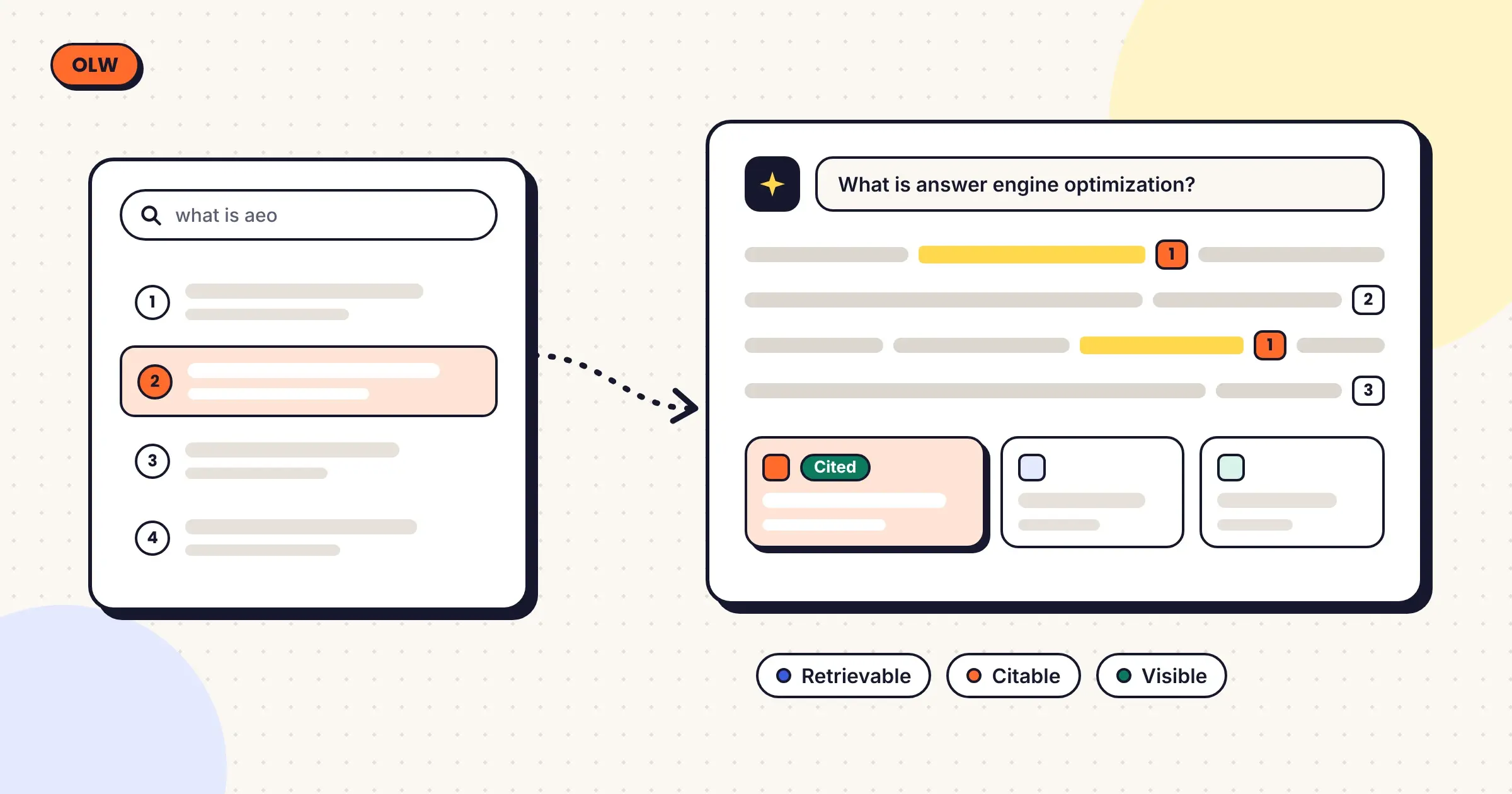
Answer engine optimization (AEO) is the work of making your brand and your pages the sources that AI answers are built from. Search engines rank links. Answer engines such as ChatGPT, Google AI Overviews, AI Mode, Perplexity and Gemini generate one answer and cite a handful of sources inside it. AEO is how you become one of those sources.
Key takeaways
- AEO is SEO plus three extra jobs: be retrievable (crawlers can read you), be citable (passages are easy to lift), and be visible (other sites name you).
- AEO, GEO, AI SEO and LLMO describe the same goal. Use the term your client uses. We say AEO.
- Google’s own July 2026 guide says llms.txt is ignored, chunking is unnecessary, and to “prioritize effective SEO strategies over AEO/GEO hacks.” Schema helps machines understand you. It does not buy citations.
- Earned media drives most citations. Muck Rack’s May 2026 study of 25M+ AI-cited links found about 84% came from earned media.
- Measure it free first: the Search Console generative AI report, Bing’s AI Performance report, a GA4 referral filter and a 25-prompt sheet.
- Do not choose between SEO and AEO. In our tracker of 7,255 top sites, chatbot visits grew 489% since January 2024 while search engine visits held steady, and search engines still get 10 times the visits. Over the last 12 months, search sent websites 65 times more visitors than AI did.
- Expect the first citations within 60 to 90 days on pages that already rank. New pages take longer.
In June 2024 one of our clients, an AI SaaS company, got about 2,000 visits a month from chatbots.
Twelve months later it was 40,000.
Over the same year their organic traffic went from 10.5 million to 18.5 million visits a month. Same site. Same team. We did not run a separate “AI campaign.” We did good SEO, built about 35 high-authority links a month, and restructured the pages that mattered so an AI could quote them. You can read the full case study here.
That is AEO. It is not a new discipline with a secret handshake. It is SEO with a different finish line.
This guide is the one I wish we had in 2024. It covers what AEO is, how answer engines actually choose what to cite, the numbers that hold up, a 90-day plan, how to measure it for free, and the mistakes that waste budgets. It ends with a 28-point checklist and an FAQ.
No hype. Every claim is dated and linked. Let’s go.
What is answer engine optimization?
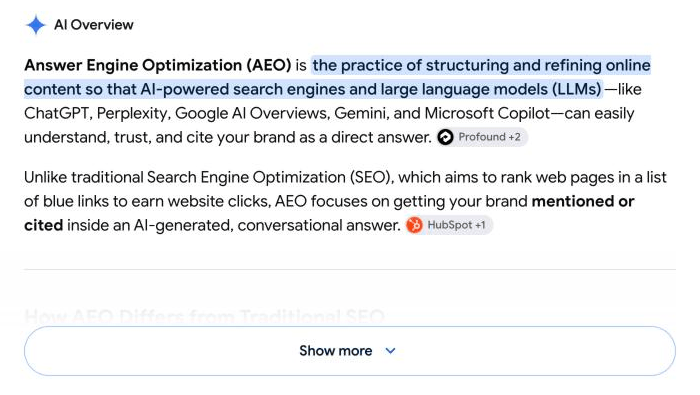
Answer engine optimization is the practice of structuring your content, your technical setup and your off-site presence so that AI systems retrieve your pages, quote them, and name your brand when they answer a question.
The key word is answer.
A search engine returns a list. The person picks a link. An answer engine returns a paragraph. The person reads it and, most of the time, stops there. Pew Research found that when Google shows an AI summary, people click a traditional result on only 8% of visits, against 15% when there is no summary. They click a link inside the summary just 1% of the time (Pew, July 2025).
So the prize moved. It used to be the click. Now it is being the source the answer is made from.
What counts as an answer engine in 2027
Any system that generates a direct answer and decides which sources to use. Today that means:
- Google AI Overviews and AI Mode. AI Overviews now reach over 2.5 billion monthly users (Google I/O, May 2026). AI Mode is the full chat experience inside Google Search.
- ChatGPT. OpenAI reported more than 900 million weekly active users in February 2026 (OpenAI). When it searches the web it cites sources.
- Perplexity. Searches the web in real time and attaches numbered citations to every answer (Perplexity help center).
- Gemini, Copilot and Claude. Each grounds answers in web search to some degree and cites when it does.
- Voice assistants and in-app assistants built on top of these models.
If a product can say “according to [your brand],” it is an answer engine, and it is in scope.
Where the term came from, and why it is back
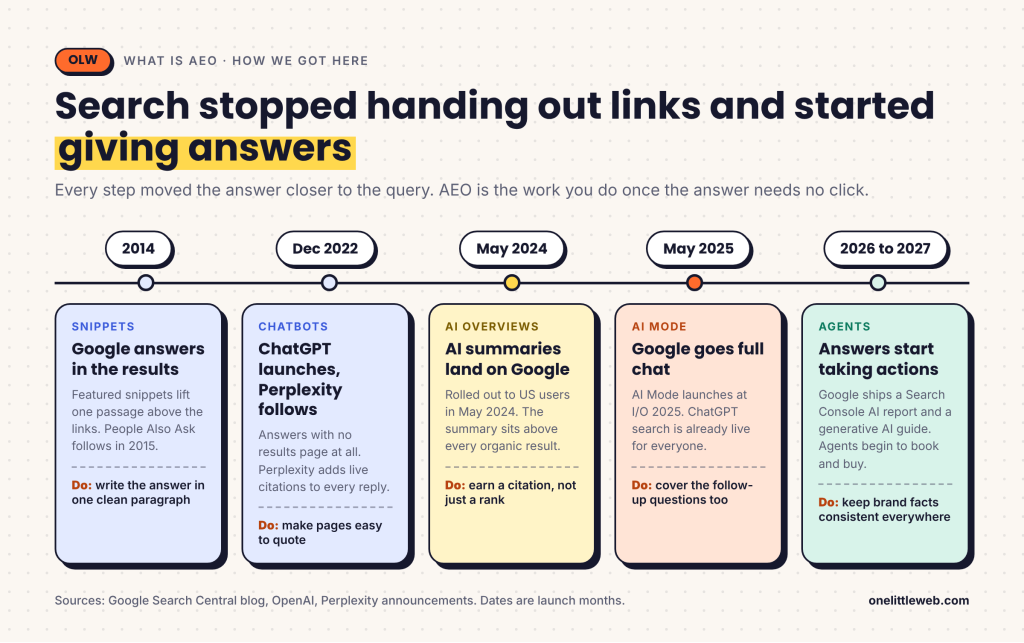
“Answer engine” is older than ChatGPT. Featured snippets arrived in 2014. People Also Ask followed in 2015. SEOs started talking about “answer engine optimization” when Alexa and Google Assistant read those snippets out loud.
Then it went quiet. Voice search never changed how people buy things.
ChatGPT changed that in December 2022. Google AI Overviews rolled out to US users in May 2024. AI Mode launched at Google I/O in May 2025. Now the “answer” is the default interface for a large share of searches, and the term came back with a bigger job.
AEO vs SEO vs GEO: what is actually different
This is the question people argue about most, so here is the short version.
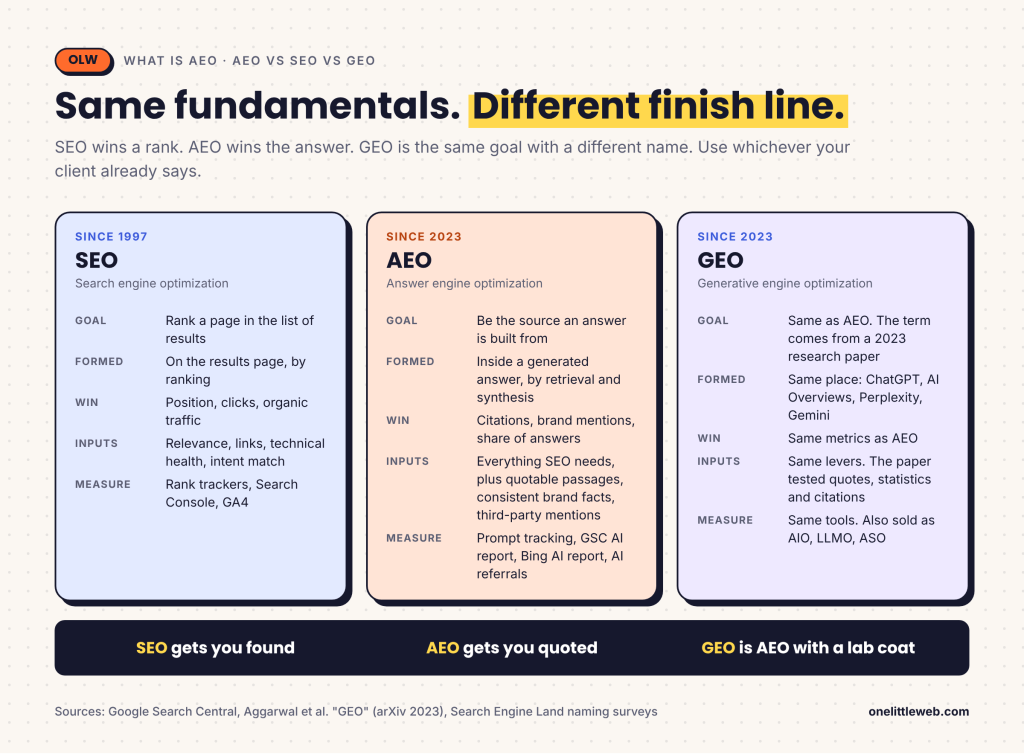
SEO gets you found. AEO gets you quoted. GEO is AEO with a lab coat.
The side-by-side
| SEO | AEO | GEO | |
|---|---|---|---|
| Goal | Rank a page in a list of results | Be a source the answer is built from | Same as AEO |
| Where it happens | The results page | Inside a generated answer | Inside a generated answer |
| Unit of success | Position, clicks, traffic | Citations, brand mentions, share of answers | Same as AEO |
| Inputs | Relevance, links, technical health | All of SEO, plus quotable passages, consistent brand facts, third-party mentions | Same levers |
| How you measure | Rank trackers, Search Console, GA4 | Prompt tracking, GSC generative AI report, Bing AI Performance, AI referrals | Same tools |
| Origin | Late 1990s | Voice-search era, revived 2023 | A 2023 research paper |
Why Google says “it’s still SEO,” and where that is only half true
Google is blunt about this. Its documentation says there are “no additional requirements to appear in AI Overviews or AI Mode, nor other special optimizations necessary” (Google Search Central). John Mueller’s May 2025 post says to “focus on your visitors and provide them with unique, satisfying content” (Search Central blog).
For Google, that is mostly right. Ahrefs looked at 1.9 million AI Overview citations and found 76.1% of cited pages already rank in the top 10 for the query (Ahrefs, July 2025). If you rank, you are in the pool.
It is half true for everyone else. ChatGPT and Perplexity do not use Google’s index. They use their own crawlers and partners. Being in Google’s top 10 does not put you in theirs. And none of the engines rank your page. They grade passages. A page can sit at #3 and still get skipped because its answer is buried in paragraph nine.
So: keep SEO as the base. Then add the three AEO jobs on top.
Which term should you use?
Nobody agrees. In a Fractl survey of 342 search marketers, 42% said they use “GEO,” 16% “AI SEO,” and 14% “SEO or AEO” (Search Engine Land). Among 200+ senior SEOs, 36% said clients call it “AI search optimization” (SEOFOMO via SEL).
We say AEO because “answer” names the thing you are optimizing for. Our service pages say GEO because that is what buyers search for. Pick one, define it once, move on.
How answer engines actually produce an answer
Most AEO advice is folklore because it skips this part. Once you see the four steps, every tactic later in this guide turns into cause and effect.
Step 1: Query fan-out
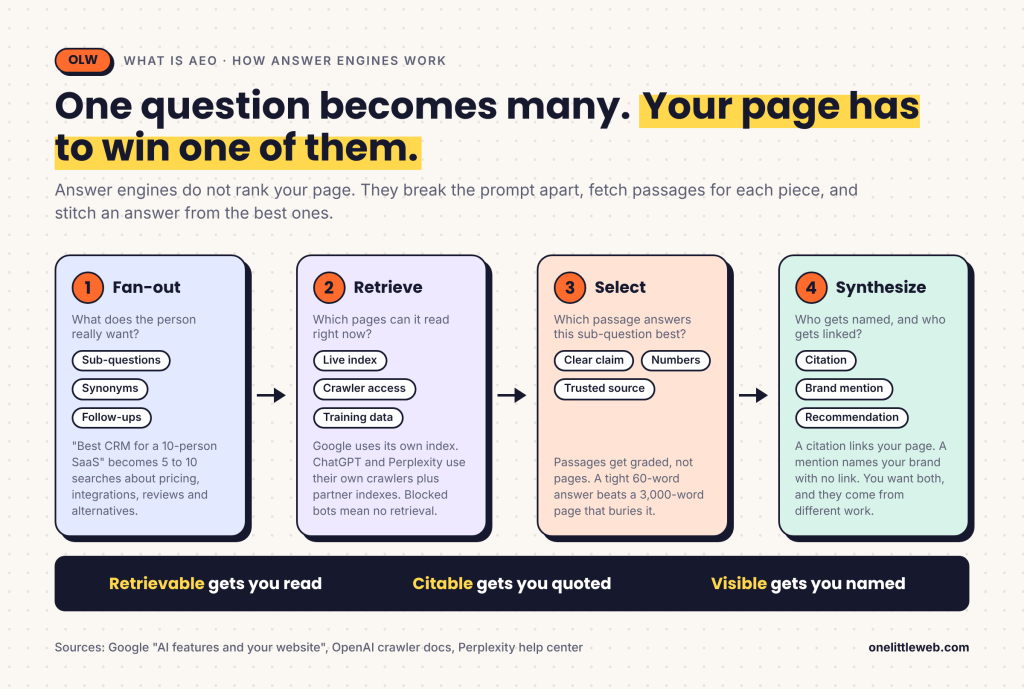
You type “best CRM for a 10-person SaaS.” The engine does not search that once. It breaks it into five to ten sub-queries: pricing tiers, integrations with your stack, reviews, alternatives, “CRM for startups.” Google describes this as query fan-out in its AI Mode documentation.
What it means for you: a page that only answers the head question loses to a page that also covers the follow-ups.
Step 2: Retrieval and grounding
For each sub-query the engine pulls candidate pages. Google uses its own index. ChatGPT uses OAI-SearchBot, which OpenAI says “is used to surface websites in search results in ChatGPT’s search features,” plus partner indexes (OpenAI crawler docs). Perplexity runs PerplexityBot and searches in real time.
What it means for you: if a crawler is blocked, or your content only loads through JavaScript, you are not in the pool. This is the cheapest thing to fix and the most often ignored.
Step 3: Passage selection
The engine does not read whole pages. It grades passages against each sub-query. A clear 60-word answer with a number in it beats a 3,000-word page that makes the reader work.
The GEO paper from Princeton and IIT Delhi tested this. Adding quotations, statistics and source citations to a page raised its visibility in generative-engine answers by 30 to 40%. Keyword stuffing performed worse than doing nothing (Aggarwal et al., KDD 2024).
Step 4: Synthesis, citation and mention
The model writes the answer from the selected passages and decides what to credit. Two different things can happen here, and they are not the same:
- A citation links to your page. It comes from your page being retrieved and selected.
- A mention names your brand with no link. It comes from the model having seen your brand named, in context, across the web.
Muck Rack measured how often engines cite at all: ChatGPT cites sources in 96% of responses, Gemini 82%, Claude 55% (Muck Rack, May 2026).
The three levers
Everything in AEO is one of these:
- Retrievability. Can the engine fetch and parse your page? (Technical.)
- Citability. Is there a passage worth lifting? (Content.)
- Visibility. Do other sources name you for this topic? (Authority.)
Retrievable gets you read. Citable gets you quoted. Visible gets you named. The 90-day plan below runs in that order.
Why AEO matters now: the numbers that hold up
Every AEO article has a stats section. Most of the stats contradict each other. Here are the ones that come from a primary source, with the caveats attached.
Zero-click behaviour is real, and dated
- When an AI summary appears, click-through to traditional results drops from 15% to 8% of visits. Links inside the summary get clicked 1% of the time. Sample: about 900 US adults, March 2025 (Pew Research).
- AI Overviews appear on 21% of keywords and 57.9% of question-style queries, across 146 million SERPs (Ahrefs).
- Google’s counter: organic click volume is “relatively stable year-over-year” and “average click quality has increased” (Liz Reid, Google, August 2025).
Read those together and the picture is clear. Fewer clicks per query, more queries, and the clicks that remain are further down the funnel.
AI referrals convert better, with a selection-bias caveat
Semrush’s 2025 study estimated the average AI search visitor is 4.4 times as valuable as a traditional organic visitor, based on conversion rate, and projected AI search could overtake traditional search traffic by early 2028 (Semrush, July 2025).
Two caveats. Semrush sells an AI visibility tool. And AI referrals are small and self-selected today: people who click out of an answer have already read a summary and decided they want more. That is a warm visitor by definition. The 4.4x is real for that visitor. It does not mean AI traffic will convert at 4.4x once it is 30% of your sessions.
In our own client data the pattern holds in direction, not magnitude. Chatbot sessions convert better than average organic. They are also still under 5% of total sessions for most sites, which matches the SEOFOMO survey where 62% of senior SEOs said AI search drives under 5% of revenue.
Who this matters for most
- SaaS and B2B. Highest impact. “Best X for Y” and “X vs Y” prompts are exactly what buyers ask chatbots, and the answers name three to five vendors. If you are not one of them, you were never in the deal.
- E-commerce. Rising fast. Product entity data, reviews and merchant feeds feed shopping answers, and agentic checkout is arriving.
- Local. Lower today. Maps and the local pack still dominate, but “best plumber near me that does X” is increasingly answered in prose, from reviews and Google Business Profile data.
Should you invest in SEO, AEO or both? And who is actually in danger
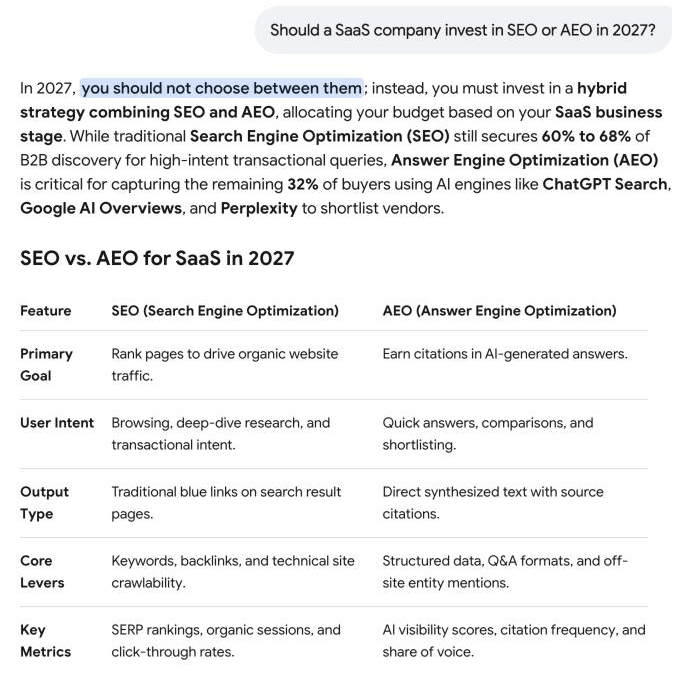
This is the question underneath every AEO conversation, and most guides skip it. Business owners are not asking “what is AEO.” They are asking: “If the answer shows up without a click, why would I pay for any of this?”
Fair question. Here is how I answer it, with our own traffic data.
“SEO is dead” is the wrong question
Every answer engine except ChatGPT is built on a search index, and ChatGPT uses one too when it searches. For Google specifically, 76.1% of AI Overview citations come from pages already in the top 10. There is no AEO without the retrieval layer, and the retrieval layer is SEO.
So the choice is not SEO or AEO. The choice is whether the SEO you already do is finished at “ranked” or finished at “cited.”
What the traffic market is actually doing
We track monthly traffic to 7,255 of the world’s most visited websites, by source, in our digital market intelligence tracker. The chatbot numbers come from our AI chatbots tracker, the search numbers from our search engines tracker, and the referral split from our AI traffic and search traffic pages.
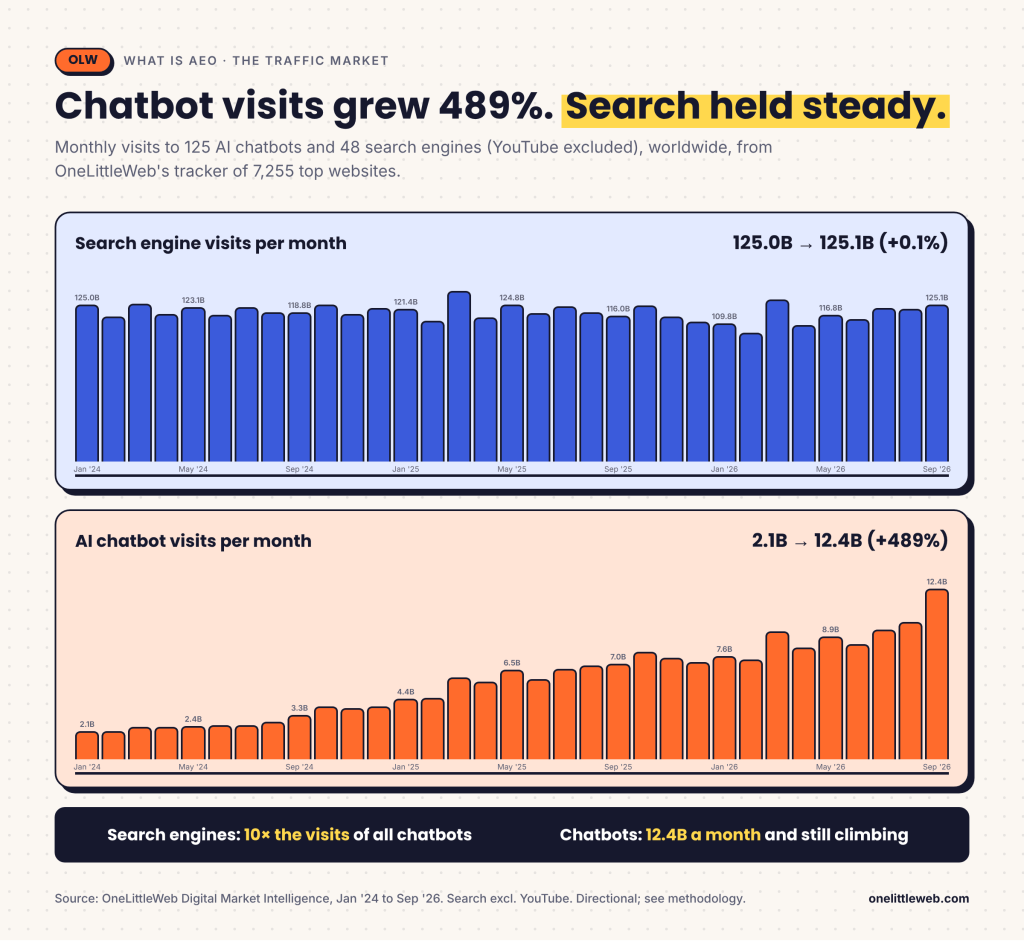
Between January 2024 and September 2026, visits to the 125 AI chatbots we track grew from 2.1 billion a month to 12.4 billion. That is up 489%. ChatGPT alone went from 2.0 billion to 8.2 billion. Claude and Gemini each passed 1.4 billion.
Over the same period, visits to the 48 search engines we track (YouTube excluded) held steady: 125.0 billion a month in January 2024, 125.1 billion in September 2026. Search engines still get 10 times the visits of every chatbot combined. AI is not replacing search. It is being added on top of it.
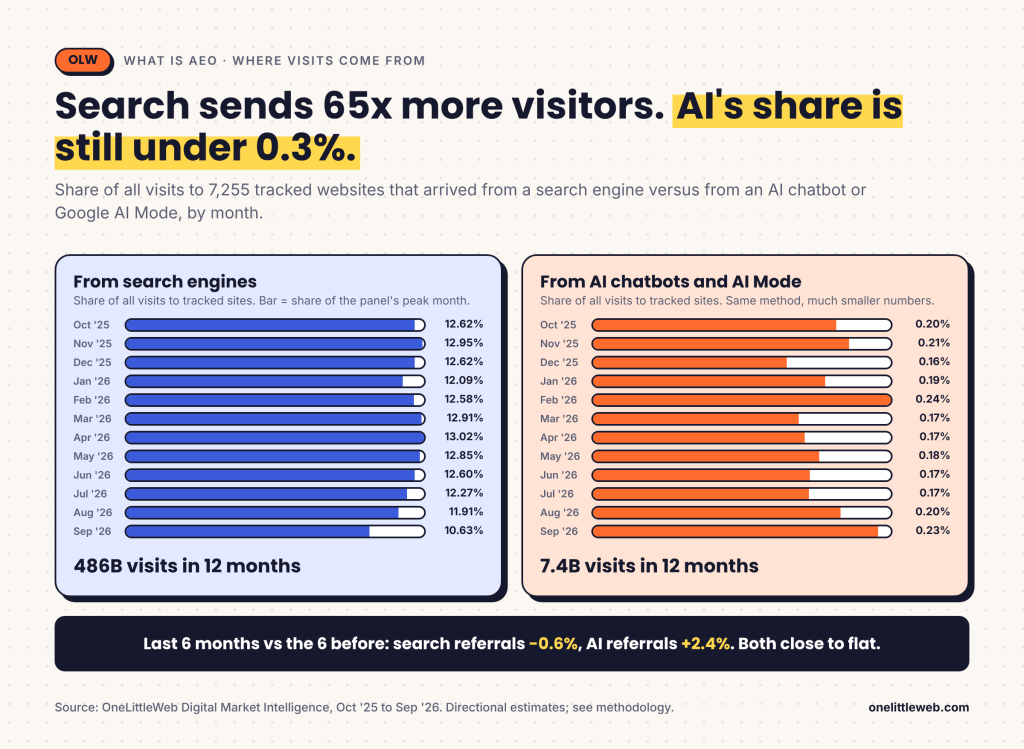
The referral side matters more for site owners. Over the last 12 months (October 2025 to September 2026), search engines sent 486 billion visits to the sites we track, about 12% of all their traffic. AI chatbots and Google AI Mode together sent 7.4 billion, about 0.2%. That is 65 times less. Google AI Mode is the fastest-growing piece: from 6 million referrals in September 2025, its first tracked month, to 88 million in September 2026. But overall, AI referrals rose just 2% from the first half of that year to the second. Search is still the river. AI is a tributary that is only slowly getting wider.
Two honest caveats. These are estimates from SEMrush, Ahrefs and Aitools.xyz, useful for direction and share, not for exact counts. See the methodology at the end for definitions and limits. And “AI traffic” only counts visits that leave a chatbot with a referrer. A lot of AI influence never shows up as a click at all, which is exactly why presence has to be measured separately from traffic.
Who zero-click actually hurts
The sites in trouble share one trait: the visit was the product. If the answer can be consumed inside the AI’s reply, the page has nothing left to sell.
- Definition and quick-fact sites. “What is X,” conversions, dates, specs. The answer engine is a better version of the page.
- Generic how-to content with no product behind it. Ad-supported tutorials for things the model can explain in six steps.
- Coupon, aggregator and “best of” pages built from other people’s data. The engine aggregates better and cites the originals.
- Thin affiliate roundups. When the engine names the three products, the roundup that named the same three is redundant.
- News rewrites and commodity content. Summaries of other people’s reporting lose to the summary.
Our search traffic tracker hints at the split. In September 2026, search referrals to Entertainment and Video Streaming sites fell against the previous month, while AI Tools and Software rose. One month is a signal, not a trend, so we are watching it. But the logic holds: software is something you still have to go and use.
Who is fine, and who is better off
Everyone whose revenue happens after the click, not on it.
- Software and SaaS. The answer can recommend you. It cannot run your product. A citation in “best CRM for small teams” is a shortlist placement you used to pay a review site for.
- Services and agencies. The answer can name you. It cannot do the work.
- E-commerce. The answer can compare. It cannot ship. And with agentic checkout arriving, being the recommended option becomes being the purchased option.
- Local businesses. Nobody gets a haircut from a chatbot.
- Anyone with original data or a real opinion. Engines must attribute what they cannot generate themselves. Original research is the most cited content type we see.
For these businesses, fewer clicks per query with higher intent per click is a better funnel, not a worse one. Pew’s 8% versus 15% click rate looks like a loss until you notice that the 8% already read a summary and chose to continue. Google reports its clicks are “higher quality.” Semrush measured the AI visitor at 4.4x the value of an organic one. Our own client data points the same direction.
The decision
Ask one question about your business, then follow the branch.
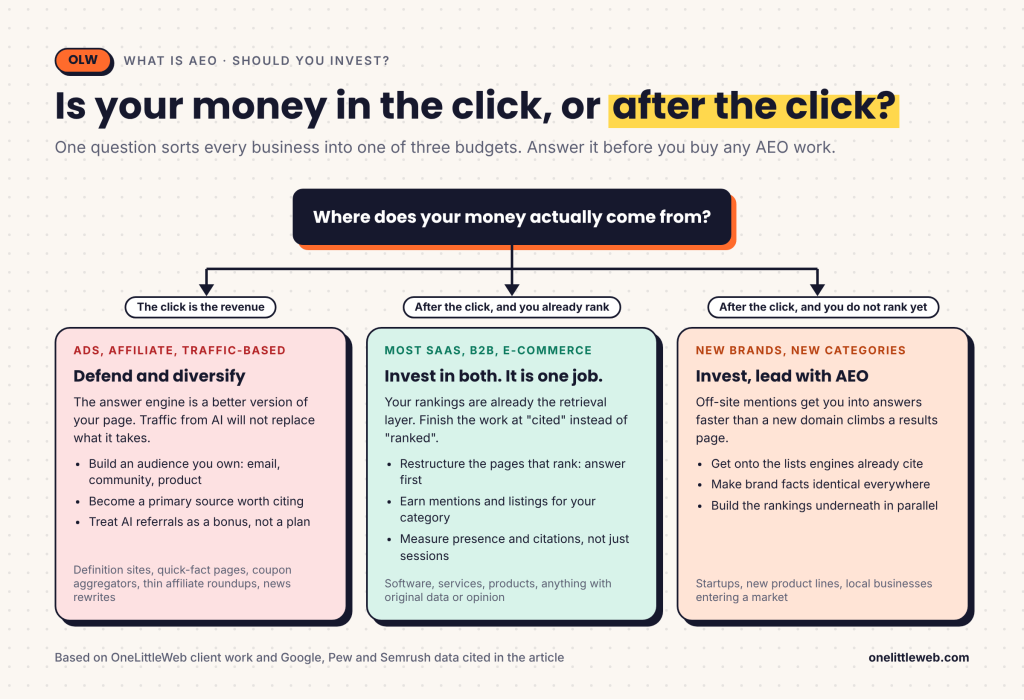
- Revenue is the click (ads, affiliate, traffic-based). Defend and diversify. Build an audience you own (email, community, product), become a primary source worth citing, and treat AI referrals as a bonus, not a plan.
- Revenue is after the click, and you already rank. Invest in both, because they are the same work. Finish your SEO at “cited,” earn the mentions, measure presence. This is most SaaS and B2B companies.
- Revenue is after the click, and you do not rank yet. Invest, and lead with AEO. Off-site mentions and listings get you into answers faster than a new domain can climb a results page. Build the rankings underneath in parallel.
Where the money actually comes from
Four places, in the order they show up.
- Shortlist placement. When an engine names three vendors, the deal happens among those three. Being named is the whole game for considered purchases.
- AI referrals that convert. Small volume, high intent. Track conversions, not sessions, or you will under-invest.
- Brand demand. People who read your name in an answer search for you directly later. It shows up as branded search growth, not AI traffic.
- Agent transactions. Coming in 2027. The recommended option becomes the transacted option. Clean, machine-readable product data is the ticket.
Our AI SaaS client is the pattern in miniature: chatbot sessions went from 2,000 to 40,000 a month in a year, and organic grew 76% over the same period, from the same work. Nothing about AEO cost them SEO. It compounded it.
What answer engines reward: the citation inputs, ranked
Twelve of the thirteen top-ranking AEO guides we analysed mention “brand mentions.” None of them rank the inputs. Here they are, in the order the evidence supports.
1. Earned media and third-party mentions
This is the big one. Muck Rack analysed more than 25 million links cited by AI engines and found about 84% came from earned media: coverage, reviews, listicles, industry sites. Only 27% came from journalism specifically (Muck Rack, May 2026).
Ahrefs found the same thing from the other direction. Brand web mentions were “the number one correlating factor with AI Overview visibility” at r = 0.664 (Ahrefs).
This is why we treat digital PR as an AEO channel, not a link-building tactic. A link passes authority. A mention in the right sentence (“[Brand], a CRM built for small SaaS teams”) teaches the model what you are and who you are for.
2. Consistency of brand facts
Models learn entities. If your site says one thing, your LinkedIn says another, G2 lists an old price and a 2023 listicle describes a product you killed, the model hedges or picks the wrong fact. Make what you are, who you are for, what you cost and where you are identical everywhere you are listed.
3. Answer-shaped content
Passage-level clarity. Question-led headings. A definition in the first 60 words. Lists for steps and tables for comparisons. One original number per page. This is the content lever, and it is what the GEO paper measured: quotes, statistics and citations lifted visibility 30 to 40%.
4. E-E-A-T and freshness
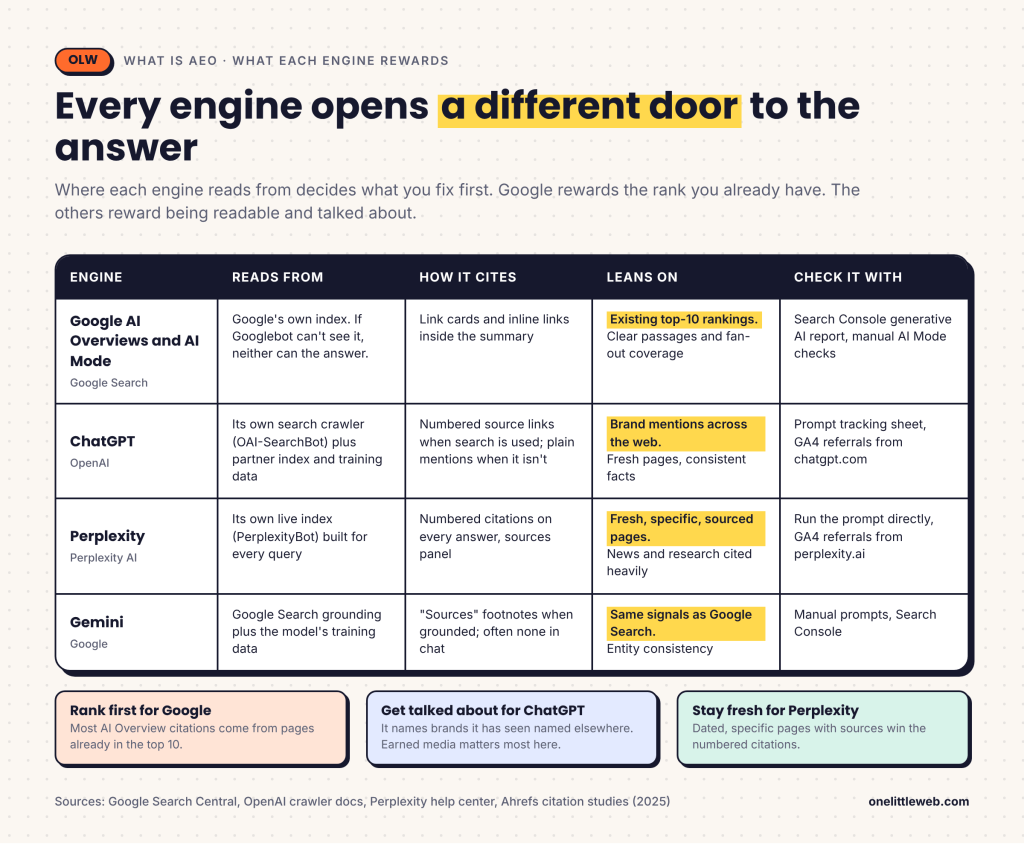
Named authors with real bios. Dated updates. Primary sources linked. Perplexity in particular leans on fresh, specific, well-sourced pages, which is why news and research get cited so heavily there.
5. Platform differences
The inputs are the same. The weighting is not.
And here is where those six names came from:
The AEO playbook: a 90-day plan
This is the order we run it in for clients. Measurement first, because you cannot show progress without a baseline, and because the baseline tells you which pages to touch.
Days 1 to 14: Baseline
- Pick 20 to 30 prompts your buyers actually type. Mix “what is,” “how to,” “best X for Y,” and “X vs Y.” Include your brand name in three of them.
- Run each prompt in Google AI Mode, ChatGPT (with search on), Perplexity and Gemini.
- Log: were you mentioned, were you cited, which competitors were named, which third-party pages were cited, was anything said about you wrong.
- Pull the Search Console generative AI report and the Bing AI Performance report. Save a copy.
- Check server logs for GPTBot, OAI-SearchBot, PerplexityBot, Google-Extended and ClaudeBot. Are they fetching anything?
Two weeks in, you know three things: which prompts you are invisible for, which third-party pages the engines trust for your category, and whether the engines can even read you.
Days 15 to 30: Retrievability
- Allow the crawlers you want in robots.txt. OpenAI documents GPTBot (training), OAI-SearchBot (search) and ChatGPT-User (on-demand fetch) separately. You can allow search and block training.
- Fetch key pages with JavaScript off. If the answer disappears, it is invisible to most retrievers.
- Fix soft 404s, slow pages and login walls on anything you want cited.
- Consolidate duplicate pages on the same topic. One URL per question.
- Check schema for accuracy, not volume. Organization, Article, Product, FAQ where they are true.
On llms.txt: Google says AI text files and Markdown copies “will neither harm nor help your site’s visibility or rankings in Google Search, as Google Search ignores them” (Google, July 2026). Other engines have not committed to it either. It is harmless. It is not a lever.
Days 31 to 60: Citability
Now the pages. Start with pages that already rank in the top 10 for a prompt’s matching query, because that is where Google citations come from. Use this tree for every prompt on your sheet.
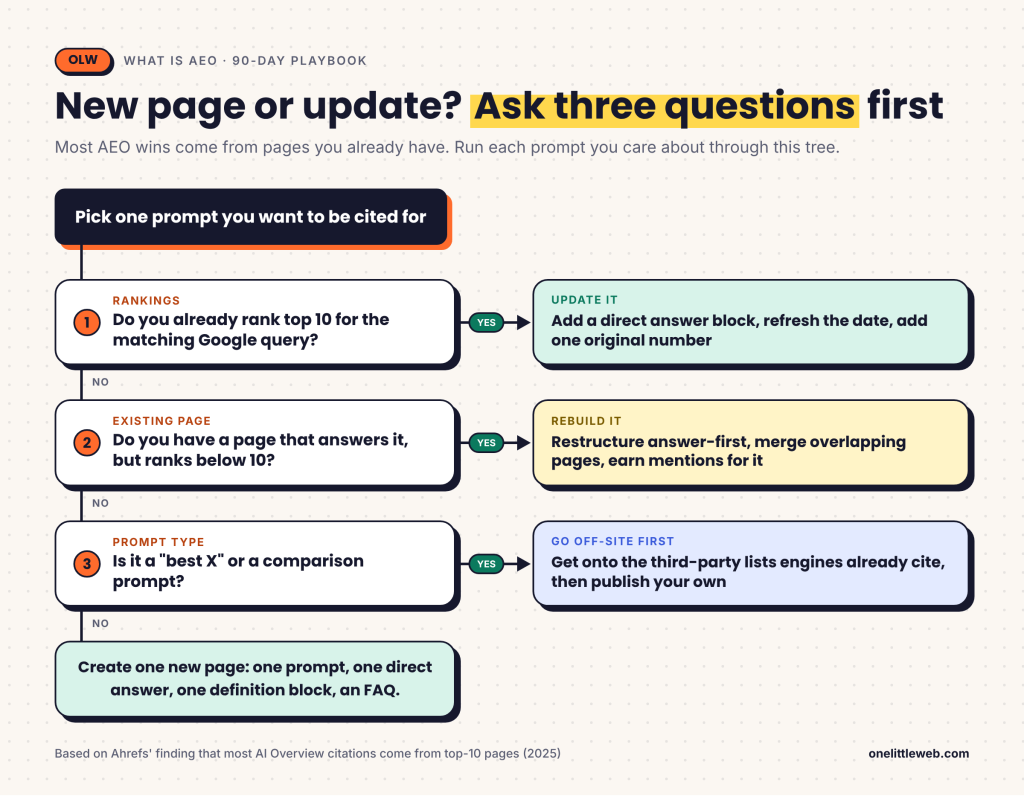
For each page you touch:
- Put the direct answer in the first 60 words, in one paragraph, under an H1 or H2 that is the question.
- Turn headings into the questions people ask. “Pricing” becomes “How much does X cost in 2027?”
- Open each section with the claim, then the proof.
- Add one original number: a test, a dataset, a client result. Engines quote numbers.
- Put steps in ordered lists and comparisons in tables.
- Add an FAQ with the follow-up questions from your fan-out research. Mark it up with FAQ schema if the answers are real.
- Update the date, and mean it.
Google’s guide is explicit that you do not need to “write in a specific way just for generative AI search” and that “there’s no requirement to break your content into tiny pieces.” That is correct. Answer-first writing is not an AI trick. It is what good writing for humans looks like, and the engines reward it for the same reason humans do.
Days 61 to 90: Visibility
Now the off-site work, which is where the citations actually come from.
- Take the third-party pages your baseline showed the engines citing. Get onto them. Reviews sites, “best X” listicles, industry roundups, comparison pages.
- Run one digital PR campaign built on original data. Data gets covered, and coverage gets cited.
- Fix your presence where buyers ask questions: Reddit threads, LinkedIn, YouTube, podcasts. Models read those.
- Make brand facts identical across your site, Crunchbase, LinkedIn, G2, Capterra and your Wikipedia-style listings.
- Do not buy mentions. Google’s guide warns that “seeking inauthentic ‘mentions’ across the web isn’t as helpful as it might seem.”
Ongoing
Re-run the prompt sheet monthly. When an engine says something wrong about you, find the source page it is quoting and fix it there. Refresh your top cited pages quarterly. Report presence and citations, not just traffic.
Schema, llms.txt and other “AEO hacks”: what the evidence says
If you are getting pitched on any of these, here is what the data shows.
Schema markup
Correlation: yes. Ahrefs found cited pages are about three times more likely to carry schema. Causation: no. When they tracked 1,885 pages that added JSON-LD, “adding schema produced no major uplift in citations on any platform” (Ahrefs). Good pages tend to have schema. Schema does not make a page good.
Use it for what it does: helping machines understand entities. Organization, Product, Article, FAQ. Keep it accurate.
llms.txt
Ignored by Google, per Google. Not adopted by OpenAI or Perplexity in any documented way. Ship it if you like. Do not report it as work.
Chunking, Markdown mirrors and “writing for AI”
Google’s July 2026 guide addresses all three directly: no chunking requirement, Markdown copies ignored, no AI-specific writing style needed. The guide’s summary line is worth framing: “Prioritize effective SEO strategies over AEO/GEO hacks.”
Keyword stuffing for AI
The GEO paper tested it. It performed worse than the unoptimized baseline. The engines are language models. They notice.
Bought mentions and fake reviews
See Google’s warning above. Also, models are trained on the same web that eventually flags those sources. The downside is permanent.
How to measure AEO (free tools first, paid tools second)
Most measurement sections in AEO guides are product tours. Here is what you can do for free, and when paying makes sense.
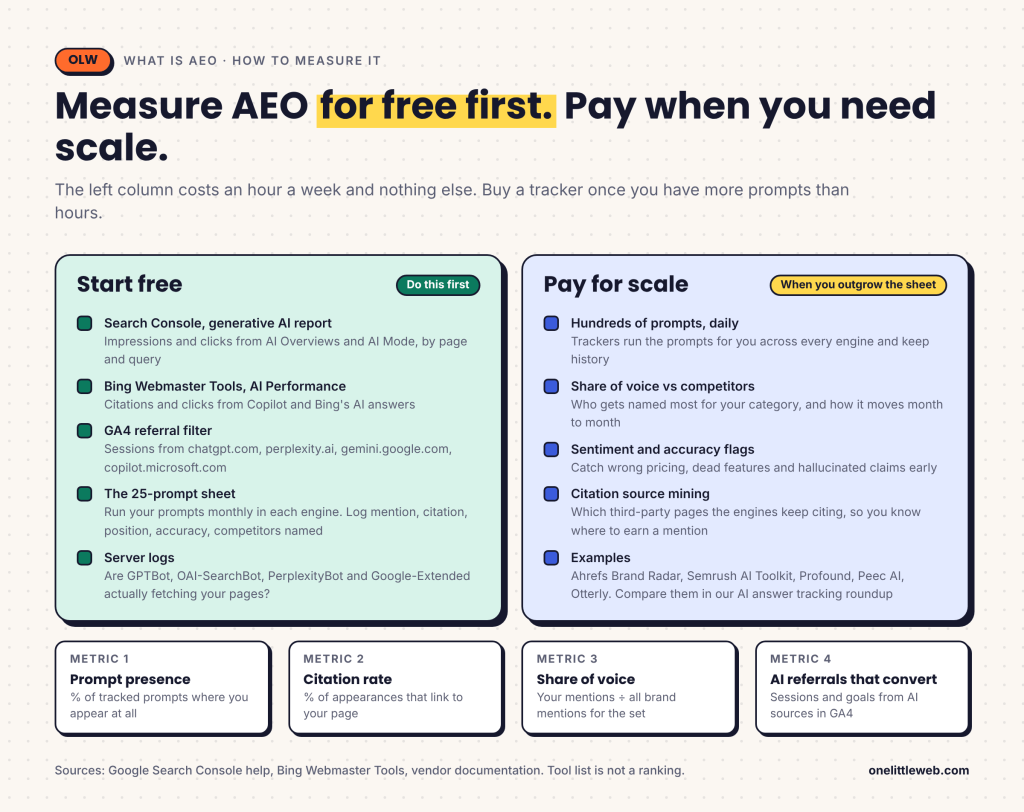
Free: the platform reports
- Google Search Console, generative AI report. Added June 2026. Shows impressions from AI Overviews and AI Mode by page, country, device and date. Initially rolled out to a subset of sites (Google).
- Bing Webmaster Tools, AI Performance. Public preview since February 2026. Shows citations “across Microsoft Copilot, AI-generated summaries in Bing, and select partner integrations” (Bing). ChatGPT’s search uses Bing’s index in part, so this report is more useful than it sounds.
Free: GA4
Build a channel group called “AI referrals” with referrer contains chatgpt.com, perplexity.ai, gemini.google.com, copilot.microsoft.com, claude.ai. Track sessions and, more importantly, conversions from it. This is the number your CFO will care about.
Free: the prompt sheet
The 20 to 30 prompts from your baseline, re-run monthly, logged in a spreadsheet. Columns: prompt, engine, mentioned (y/n), cited (y/n), position in answer, competitors named, source pages cited, accuracy issues. One hour a month. This is the single most useful AEO artefact we have.
The four metrics that matter
- Prompt presence. Share of tracked prompts where you appear at all.
- Citation rate. Share of appearances that link to your page.
- Share of voice. Your mentions divided by all brand mentions across the prompt set.
- AI referral conversions. From GA4. Sessions are vanity. Goals are not.
When to pay for a tracker
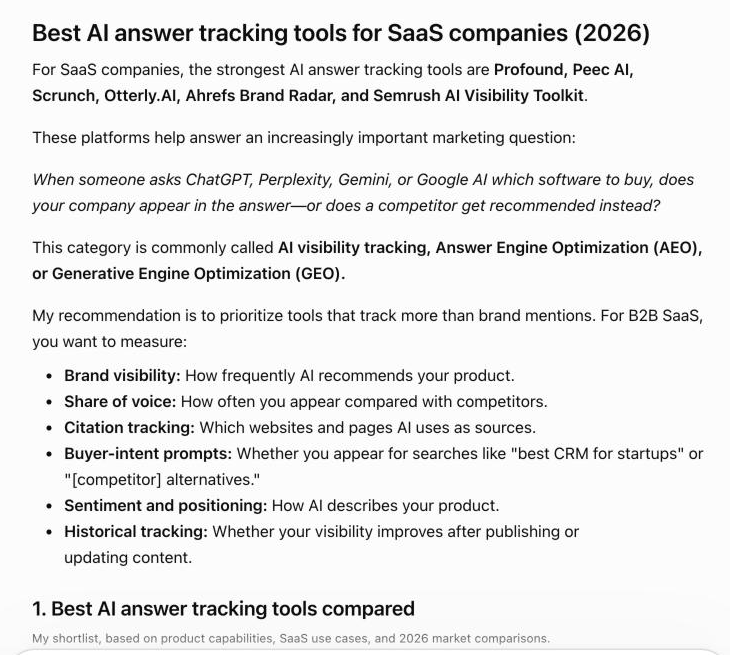
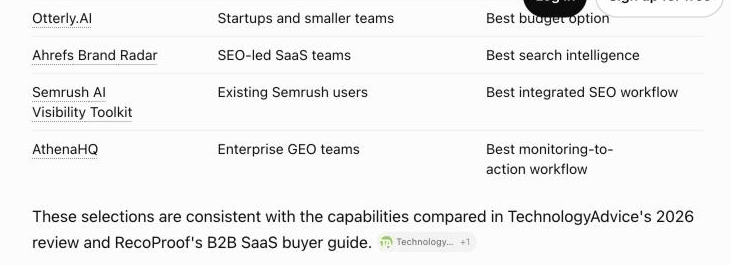
When you have more prompts than hours. Paid tools (Ahrefs Brand Radar, Semrush AI Toolkit, Profound, Peec AI, Otterly and others) run hundreds of prompts daily, keep history, compute share of voice against competitors and mine which third-party pages get cited. We compared them in our AI answer tracking tools roundup. None of them replace the free reports. They scale them.
Common AEO mistakes, and what no one should promise you
The skepticism is fair. A lot of AEO is agencies renaming SEO and adding a zero to the invoice. Here is how to tell.
- Chasing llms.txt and schema instead of mentions. Cheap to do, easy to report, close to zero effect. If the plan leads with these, it is a plan for looking busy.
- Blocking the wrong crawlers. Plenty of sites blocked GPTBot in 2023 to stop training and never noticed they also blocked the search bot. Check robots.txt today.
- Rewriting every page into FAQ soup. Twenty questions with two-sentence answers is not citable. It is thin. One clear answer and a real article beats it.
- Reporting traffic instead of presence. AI referral traffic is small and will stay small for a while. If traffic is the only metric, AEO will always look like a failure even when it is working.
- Guarantees and 30-day promises. Nobody controls what a model says. Anyone guaranteeing a ChatGPT recommendation is guessing or lying.
- “Proprietary AEO frameworks.” There are three levers. Retrievable, citable, visible. Anyone with more than that has repackaged SEO and given it a name.
AEO for SaaS, e-commerce and local businesses: what changes
SaaS and B2B
The prompts that matter are “best X for Y,” “X vs Y,” “X alternatives” and “is X worth it.” Engines answer those from review sites and listicles, so your first job is off-site: G2, Capterra, the comparison articles already ranking. Your second job is a comparison page of your own that is more honest than the listicles. Your third is making your pricing page the clearest pricing page in your category, because “how much does X cost” is one of the most common fan-out queries.
E-commerce
Product entity data does the work. Accurate Product schema, structured specs, real reviews, a merchant feed that matches the page. Google’s July 2026 guide notes that “protocols like Universal Commerce Protocol (UCP) are emerging that will allow Search agents to do more.” Agentic checkout is coming. Clean product data is the preparation.
Local
Google Business Profile completeness, review volume and recency, and NAP consistency. Then one page per service that answers the question in plain words. Local AEO is mostly local SEO done properly, with better answers on the service pages.
What’s next: AEO in 2027
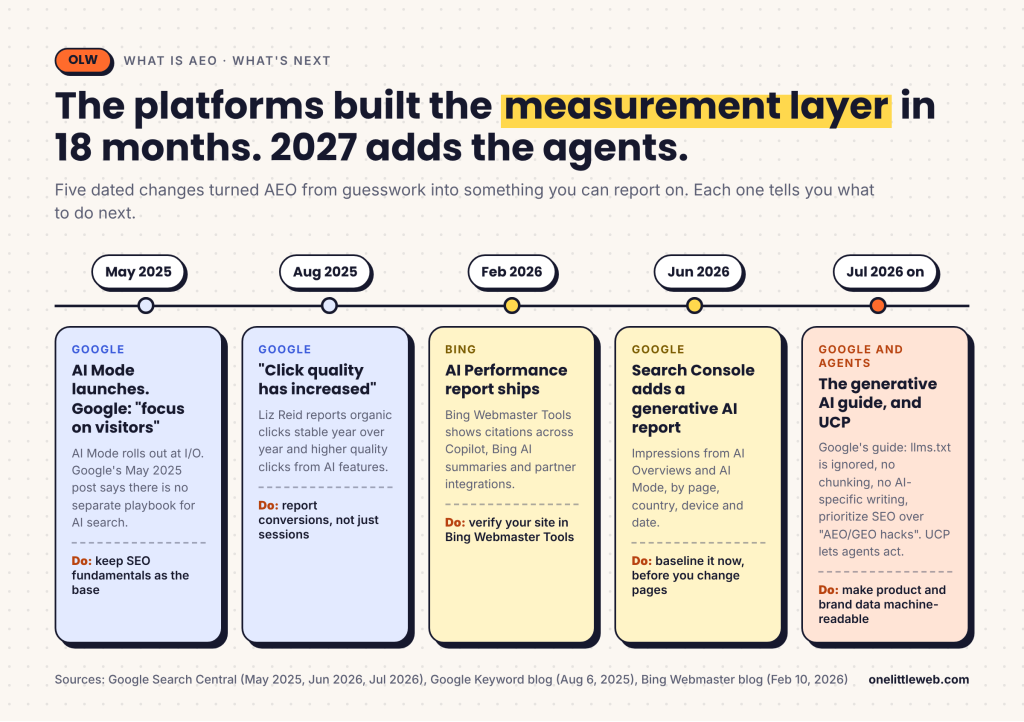
Agents that act
Google is already naming the protocol (UCP). The shift is from “which brand gets recommended” to “which brand gets transacted with.” That depends on structured, machine-readable product and brand data, and on being the recommended option in the first place. The AEO work you do now is the qualifying round.
Ads inside answers
Google is testing ads in AI Mode and AI Overviews. OpenAI has an ads crawler (OAI-AdsBot) documented alongside its search crawler. Paid placement in answers will arrive. Organic citations will be worth more when it does, not less, because they will be the only part of the answer people trust.
Will the acronyms survive?
Probably not. In two years this will all be called SEO again, the way “mobile SEO” became SEO. The work will not change. The report will.
The AEO checklist
Twenty-eight items, four groups, in the order they pay off. Download it, print it, tick it.
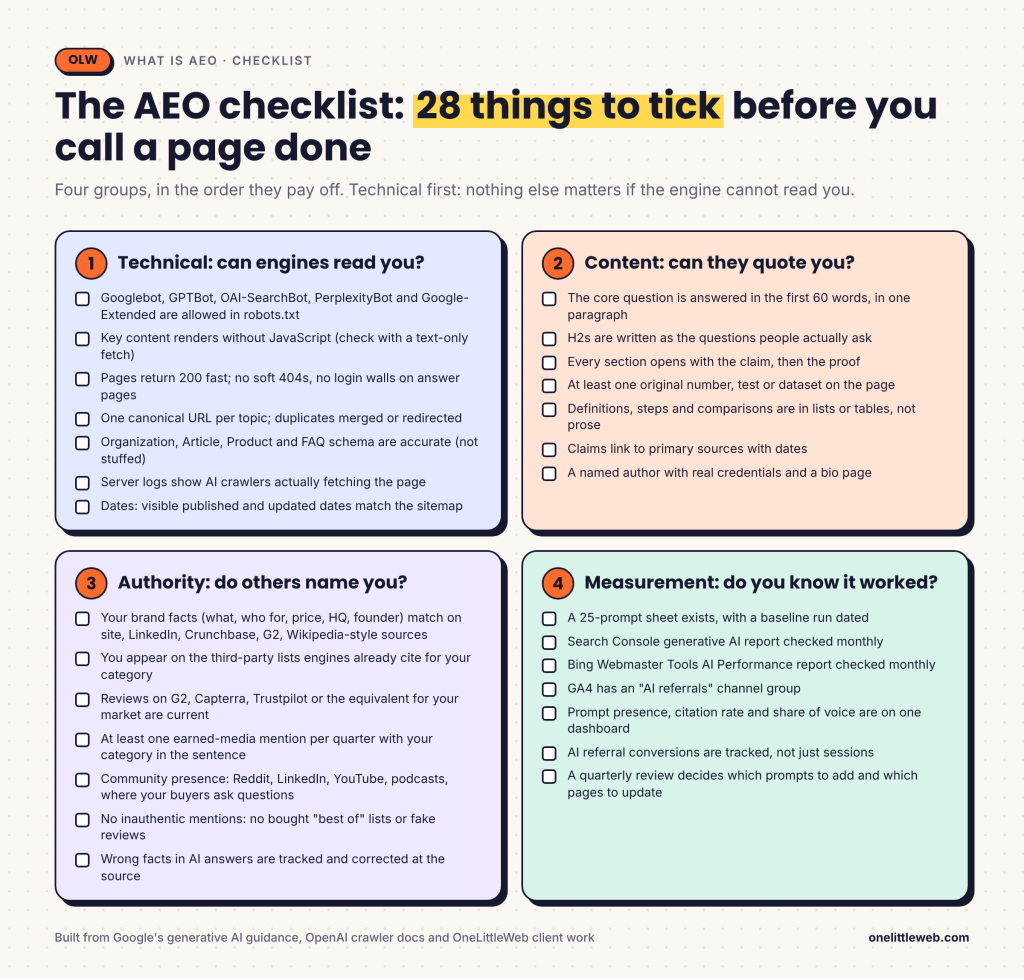
Technical: can engines read you?
- Googlebot, GPTBot, OAI-SearchBot, PerplexityBot and Google-Extended allowed in robots.txt
- Key content renders without JavaScript
- Pages return 200 fast; no soft 404s or login walls on answer pages
- One canonical URL per topic
- Organization, Article, Product and FAQ schema accurate
- Server logs show AI crawlers fetching the page
- Visible published and updated dates match the sitemap
Content: can they quote you?
- Core question answered in the first 60 words
- H2s written as real questions
- Each section opens with the claim, then the proof
- At least one original number on the page
- Steps in lists, comparisons in tables
- Claims linked to dated primary sources
- Named author with credentials and a bio page
Authority: do others name you?
- Brand facts identical across site, LinkedIn, Crunchbase, G2 and directories
- Present on the third-party lists engines already cite
- Reviews current on G2, Capterra, Trustpilot or your market’s equivalent
- At least one earned-media mention per quarter with your category in the sentence
- Active where buyers ask questions: Reddit, LinkedIn, YouTube, podcasts
- No bought lists, no fake reviews
- Wrong facts in AI answers tracked and corrected at source
Measurement: do you know it worked?
- 25-prompt sheet with a dated baseline
- Search Console generative AI report checked monthly
- Bing Webmaster Tools AI Performance checked monthly
- GA4 “AI referrals” channel group
- Prompt presence, citation rate and share of voice on one dashboard
- AI referral conversions tracked, not just sessions
- Quarterly review of prompts to add and pages to update
Frequently asked questions about AEO
What does AEO stand for?
Answer engine optimization. It is the practice of making your content and brand the sources that AI-generated answers are built from and cite.
What is the difference between AEO and SEO?
SEO aims to rank a page in a list of results. AEO aims to be a cited source inside a generated answer. AEO needs everything SEO needs, plus quotable passages, consistent brand facts and third-party mentions.
What is the difference between AEO and GEO?
Nothing meaningful. Generative engine optimization comes from a 2023 research paper; answer engine optimization comes from the voice-search era. Both describe optimizing for AI-generated answers. Use whichever term your team already uses.
Should I invest in SEO or AEO?
Both, if your revenue happens after the click. They are the same work finished at a different line. If your revenue is the click itself (ads, affiliate), defend and diversify instead. Our data across 7,255 top sites shows search engine visits holding steady while chatbot visits grow fast, and search still sending websites 65 times more visitors, so neither is going away.
Does AEO replace SEO?
No. For Google, 76% of AI Overview citations come from pages already in the top 10. SEO is the base layer. AEO adds retrievability, citability and visibility on top.
How do answer engines decide what to cite?
They split the question into sub-queries, retrieve pages for each, grade passages for clarity and trust, then write an answer and credit the passages they used. Pages with clear answers, numbers and sources, from brands that are named elsewhere, win.
Does schema markup help with AI citations?
It helps machines understand your entities. It does not cause citations. Ahrefs tracked 1,885 pages that added schema and found no major uplift on any platform.
Do I need an llms.txt file?
No. Google states it ignores llms.txt and Markdown copies. No other major engine has documented using it. It is harmless, not helpful.
Do backlinks still matter for AEO?
Yes, twice. They drive the rankings that feed Google’s AI citations, and the mentions that come with earned links teach models what your brand is. Muck Rack found 84% of AI citations come from earned media.
How do I measure AEO?
Start free: the Search Console generative AI report, Bing’s AI Performance report, a GA4 “AI referrals” channel group and a monthly prompt sheet. Track prompt presence, citation rate, share of voice and AI referral conversions. Add a paid tracker when prompts outnumber hours.
How long does AEO take to show results?
For pages that already rank, citation changes typically show within 60 to 90 days of restructuring. Brand mentions from PR and listings take three to six months to show up in model answers. New pages on new topics take longer than both.
Is AEO only for big brands?
No. Small brands with a clear niche often get cited more than large ones with vague positioning, because the model can tell exactly what they are for. Specificity beats size.
Can I do AEO myself?
The technical and content work, yes, with this guide. The visibility work, earned media and listings, is where most teams need help, because it is slow and relationship-driven.
Does AEO matter for local businesses?
Less than for SaaS today, and growing. Keep Google Business Profile complete, reviews current and service pages answer-first. That covers most of it.
How OneLittleWeb approaches AEO
We run the plan above for SaaS and B2B clients. The short version: a baseline audit across the four engines, technical and content fixes on the pages that already rank, then digital PR and listings work to earn the mentions that actually move citations. Our GEO services page has the details and a free audit. If you only do one thing after reading this, build the prompt sheet. Everything else follows from what it shows you.
Methodology: how we collected our market data
The traffic charts in this guide come from OneLittleWeb Digital Market Intelligence, our own tracker of website and AI tool traffic. Here’s what the numbers are, what they aren’t, and why the live dashboard may not match them exactly.
Where the numbers come from
- Estimates, not site analytics. Visit counts are estimated from third-party traffic data (SEMrush, Ahrefs and Aitools.xyz), not measured inside each website.
- What a “visit” means. Estimated monthly visits. Returning users are counted again each month, so these are not counts of unique people.
- What we track. 7,255 of the world’s most visited websites, including 125 AI chatbots and the dashboard’s search engine category.
- Search engines exclude YouTube. The dashboard’s search engine category has 49 sites, including YouTube and country versions of Google such as google.de. We removed YouTube, which is mainly a video platform, so our figures cover 48 search engines. The live dashboard includes YouTube, which makes up about a third of that category’s visits, so its search engine totals are higher than ours.
- Traffic sources. “Search,” “AI traffic” (visits referred by AI chatbots) and “Google AI Mode” are classified by the data providers. AI referrals are tracked from February 2025 and Google AI Mode from September 2025.
Periods used
- Search engines vs chatbots (chart 09): monthly, January 2024 to September 2026.
- Where visits come from (chart 10): monthly, October 2025 to September 2026. Growth compares the last 6 months with the 6 before.
- Data pulled November 4 and 5, 2026. September 2026 was the latest month available.
Why the live dashboard may show different numbers
The dashboard is live. The charts here are a snapshot. The two will drift apart over time because:
- it’s refreshed every one to two months as new data arrives;
- we add websites, and occasionally remove them, based on relevance and importance;
- data providers revise their estimates, and we correct discrepancies or update calculations when we find them;
- some months, such as December, are interpolated in the dashboard and can be restated later.
Known limitations
- Estimates can be off for individual sites, especially smaller ones. Totals across thousands of sites are more stable than any single number.
- Country-level data is under review, so we don’t use it here.
- The September 2026 chatbot total includes an unusually large jump from a single country that we’re reviewing. If it’s revised down, chatbot growth would be lower and the gap between search and chatbots wider.
- Other researchers using different data sources, site lists or definitions will get different totals.
Read these numbers as directional: trends, proportions and orders of magnitude, not exact counts. None of these limitations changes the core finding: search is still many times bigger than AI chatbots, and still sends websites far more visitors.