Quick answer
SEO (search engine optimization) gets your pages ranked in search results. AEO (answer engine optimization) gets your content used as the answer on the results page: featured snippets, voice answers and AI Overviews. GEO (generative engine optimization) gets your brand named and cited inside AI chatbot answers like ChatGPT, Gemini and Google AI Mode.
They’re not three separate strategies. They’re one discipline aimed at three places people find answers, built on the same foundation. Do SEO first, then add the AEO and GEO layer on top.
Key takeaways
- Nobody agrees on the definitions. The top-ranking guides define AEO and GEO four different ways. Focus on the surface you want to win, not the label.
- They overlap, but only halfway. In our test of 30 customer questions, 50% of the pages Google AI Mode linked also ranked in Google’s top 10.
- Most tactics pay off three times. Crawlable pages, clear answers and original proof help SEO, AEO and GEO at once.
- The difference is off your website. Lists, reviews and community mentions matter far more for GEO than for classic SEO.
- Search is still the biggest channel. Search engines sent the sites we track 486 billion visits in a year. AI chatbots sent 7.1 billion, but chatbot use grew 60%.
Search “AEO vs GEO” and read the top five results.
You’ll get five different answers.
One says AEO is about featured snippets. Another says it’s about AI citations. A third says AEO and GEO are the same thing. Google says it’s all just SEO.
No wonder people are confused. In Google Keyword Planner, searches comparing these terms have jumped in a year: “aeo vs geo” is up 233%, “seo aeo geo” is up 319% and “seo vs aeo” is up 81%.
So we did what the ranking pages didn’t. We mapped who says what, tested how much the three actually overlap on 30 real questions, and sized each channel with data from the 7,255 websites we track. Here’s what we found, in plain English, and where to start.
Is AI recommending your business?
Get a free AI visibility audit. We check how ChatGPT, Google AI Mode and AI Overviews describe you, which competitors they name instead, and what to fix first.
SEO, AEO and GEO in one sentence each
Start with the simplest version. Each term describes winning a different spot in the search journey.
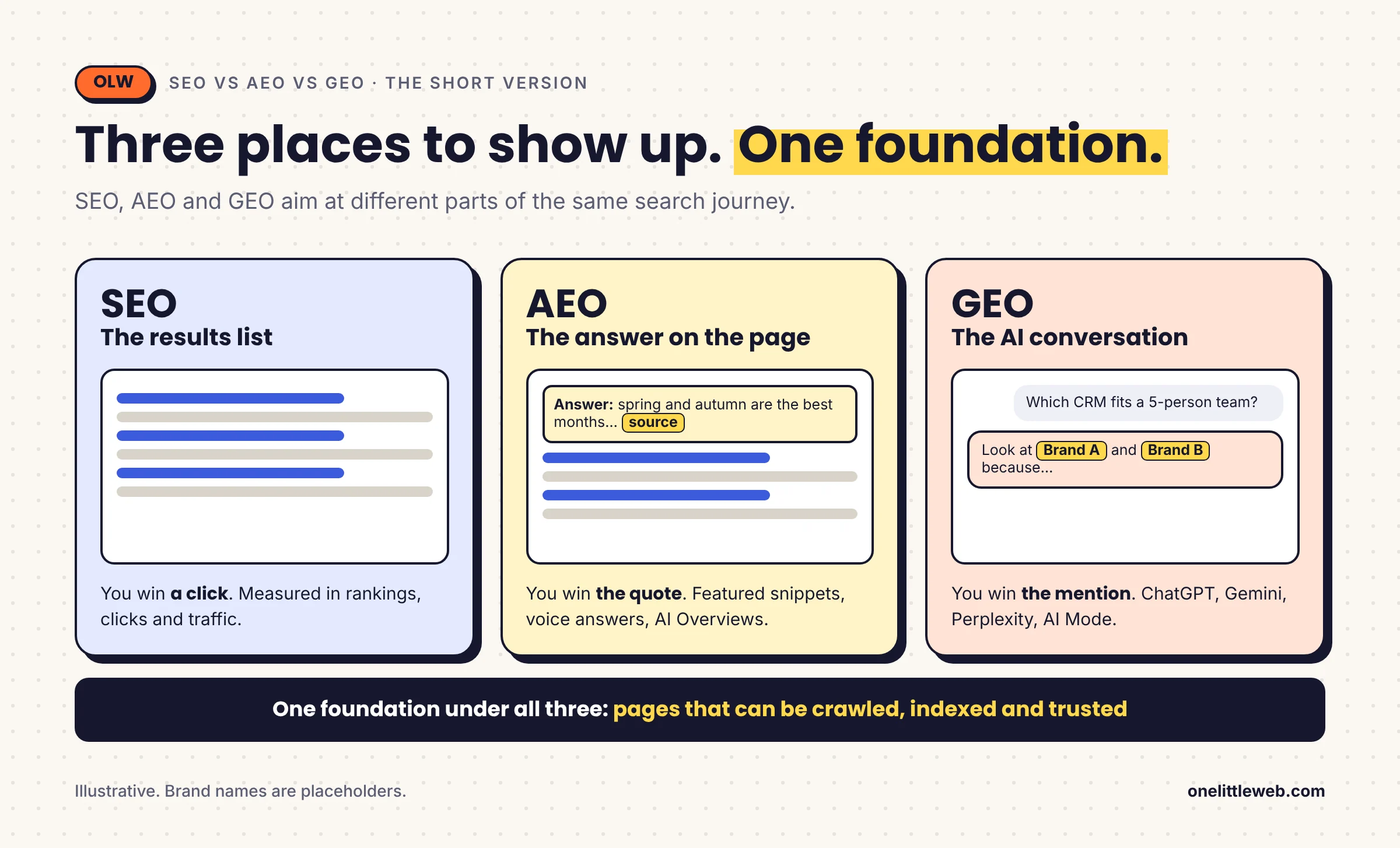
- SEO (search engine optimization): making your pages rank in search results so people click through to you.
- AEO (answer engine optimization): making your content the answer that appears on the results page itself, such as a featured snippet, a voice assistant reply or a Google AI Overview.
- GEO (generative engine optimization): making your brand one of the names an AI chatbot recommends and cites when someone asks it a question.
You’ll also see AIO (AI optimization), LLMO (large language model optimization), AI SEO and “search everywhere optimization.” They all point at the same idea: being visible wherever people get answers, not just in the ten blue links.
Where the three terms came from
Each acronym was coined at the moment the results page changed. That history explains most of the confusion.
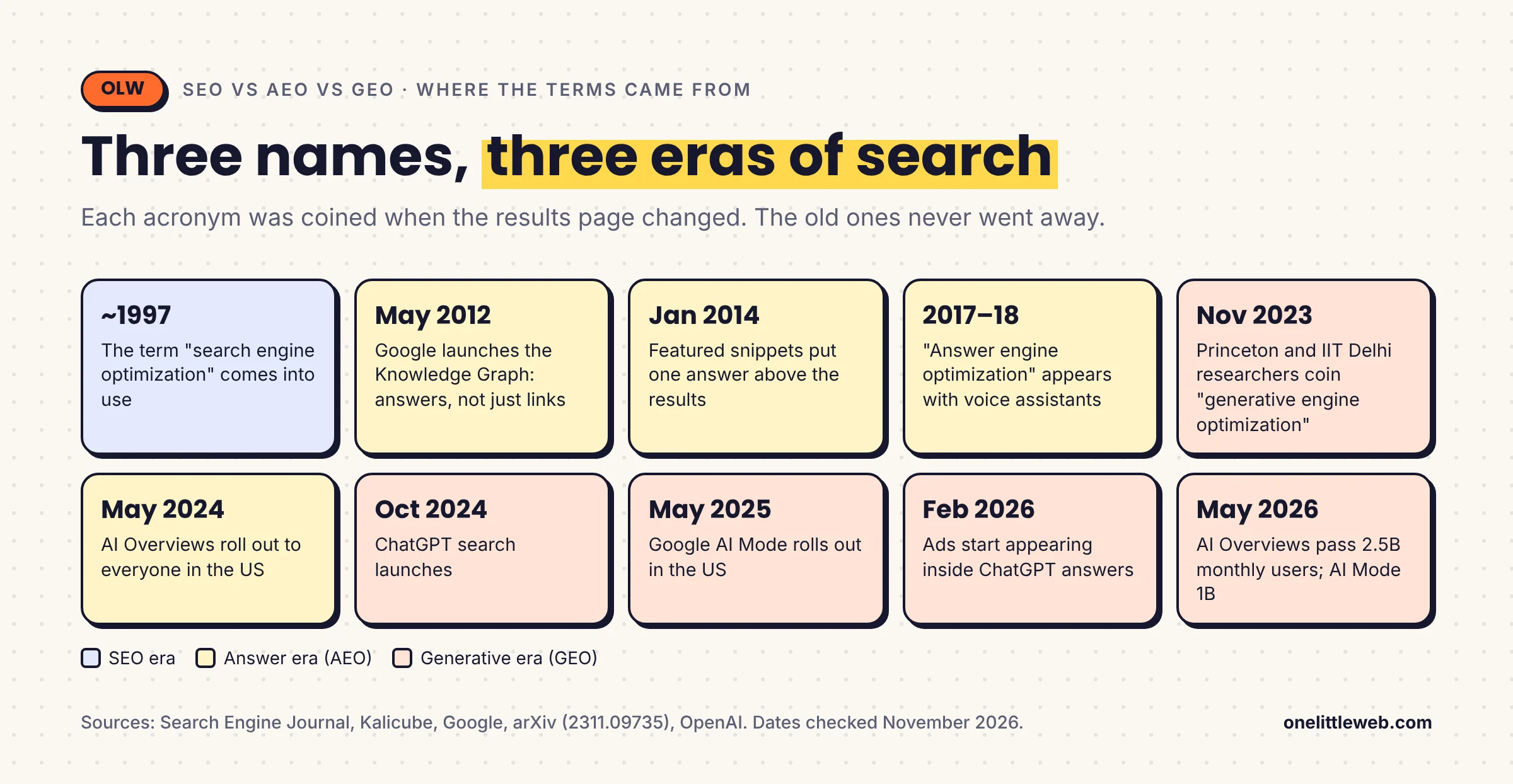
SEO came first. The term came into use around 1997. The earliest commonly cited use is John Audette of Multimedia Marketing Group in February 1997, though several people claim to have coined it (Search Engine Journal).
AEO arrived with answers on the page. Google launched the Knowledge Graph in May 2012 (Google) and featured snippets in January 2014 (Google). As voice assistants spread, “answer engine optimization” appeared around 2017 to 2018. Jason Barnard of Kalicube says he coined it in 2017 (Kalicube).
GEO came from a research lab. In November 2023, researchers from Princeton and IIT Delhi published “GEO: Generative Engine Optimization.” They found the right content changes could boost a source’s visibility in AI answers by up to 40% (arXiv).
Then AI answers went mainstream. AI Overviews rolled out to everyone in the US in May 2024 (Google). ChatGPT search launched that October (OpenAI). Google AI Mode reached all US users in May 2025 (Google). By May 2026, AI Overviews had more than 2.5 billion monthly users and AI Mode more than 1 billion (Google I/O 2026).
Why nobody agrees on what AEO and GEO mean
Here’s the part most comparison guides skip. The experts ranking for these terms define them differently, and some contradict each other outright.
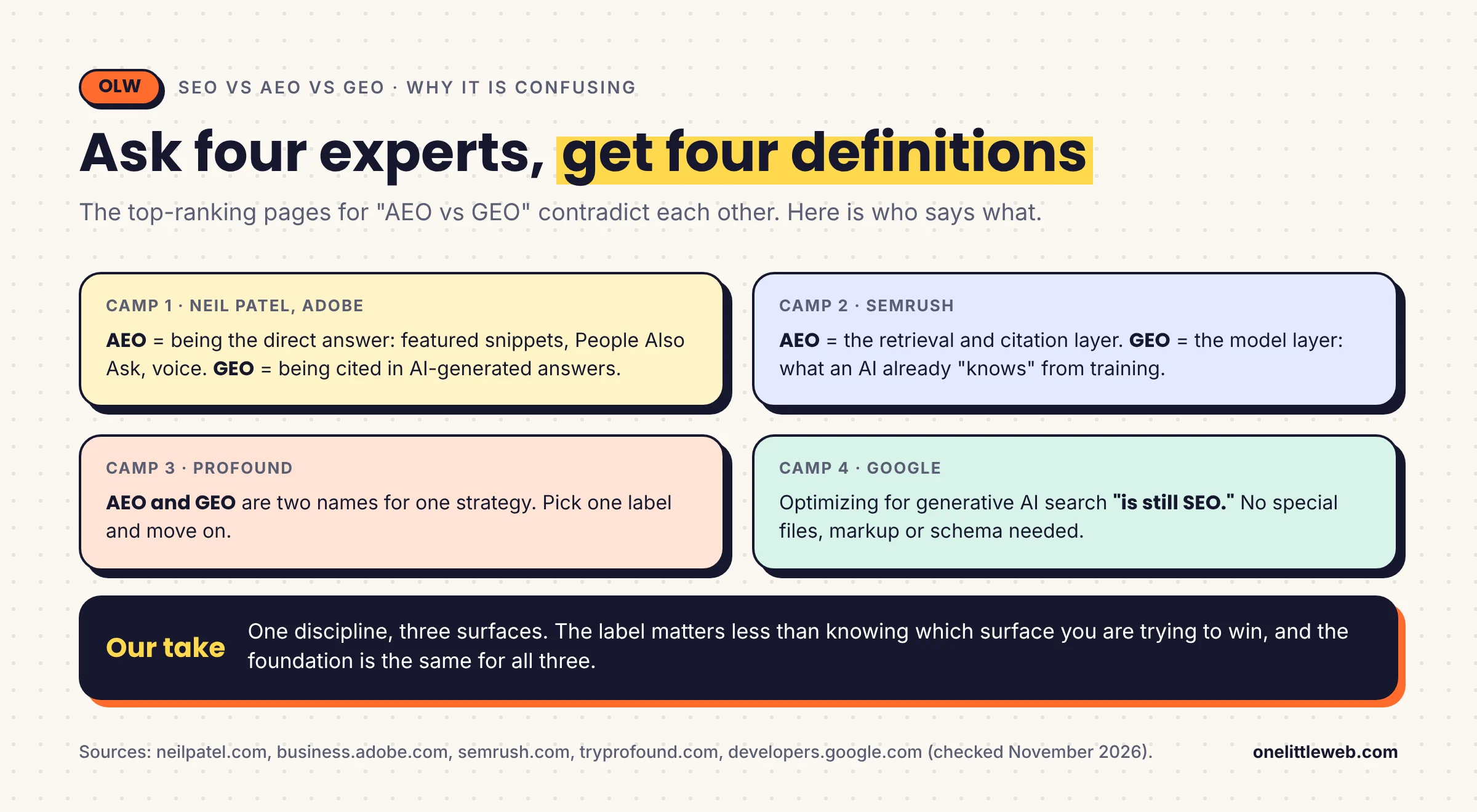
- Camp 1: AEO is snippets, GEO is AI. Neil Patel describes AEO as showing up as a direct answer (featured snippets, People Also Ask, voice) and GEO as being the source for AI Overviews and ChatGPT (Neil Patel). Adobe draws a similar line between extraction and synthesis (Adobe).
- Camp 2: AEO is retrieval, GEO is memory. Semrush says AEO “focuses on the retrieval and citation layer,” while GEO targets the model layer: what an AI already knows from training (Semrush).
- Camp 3: they’re the same. Profound calls AEO and GEO “two names, one strategy” (Profound).
- Camp 4: it’s all SEO. Google says optimizing for generative AI search “is optimizing for the search experience, and thus still SEO.” It also says you don’t need special AI files, markup or schema (Google Search Central).
Our take: it’s one discipline aimed at three surfaces. The label matters far less than knowing which surface you’re trying to win, because the foundation is the same for all of them. We go deeper on the AEO side in our guide to answer engine optimization.
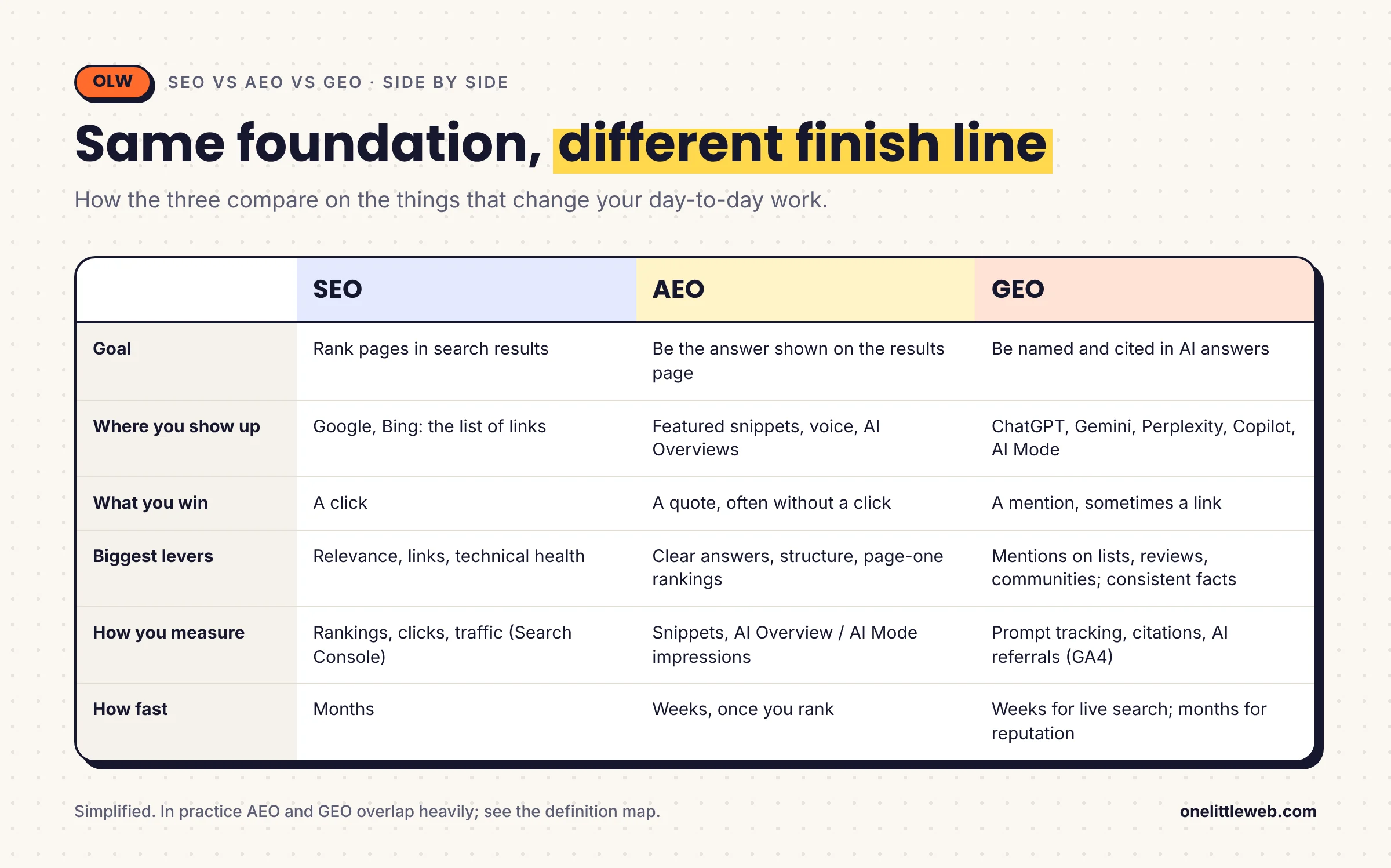
SEO vs AEO vs GEO: the side-by-side
If you only need the differences, this is the table to keep.
AEO vs SEO
SEO wins you a place in the list. AEO wins you the answer above it. The catch: an answer often satisfies the searcher without a click. When Google shows an AI summary, people click a traditional result in 8% of visits, against 15% without one (Pew Research).
So AEO changes what you measure. Being quoted builds trust even when no one clicks. Our featured snippets guide covers the classic version of this.
GEO vs SEO
SEO is about your pages. GEO is about your brand. A chatbot answer is built from many sources, and the most influential ones are often not your own website: “best of” lists, review sites, Reddit threads and news coverage.
That’s why brand mentions across the web are so strongly linked to AI visibility. And it’s why GEO looks a lot like digital PR.
AEO vs GEO
In practice, the line is thin. Both aim to make your content the source an AI answer is built from. If there’s a useful split, it’s this: AEO is about answers inside a search engine (Google’s AI Overviews, featured snippets), and GEO is about answers inside chatbots (ChatGPT, Gemini, Perplexity). Google AI Mode sits right in the middle.
How much do SEO, AEO and GEO really overlap? We tested it
Every comparison guide says the three “overlap.” None says by how much. So we checked.
On November 8, 2026, we searched 30 real customer questions across six types of business, from “how much does a roof replacement cost” to “best password manager for business” to “is laser eye surgery worth it.” For each one we recorded Google’s top 10 web results and the pages linked in the Google AI Mode answer.
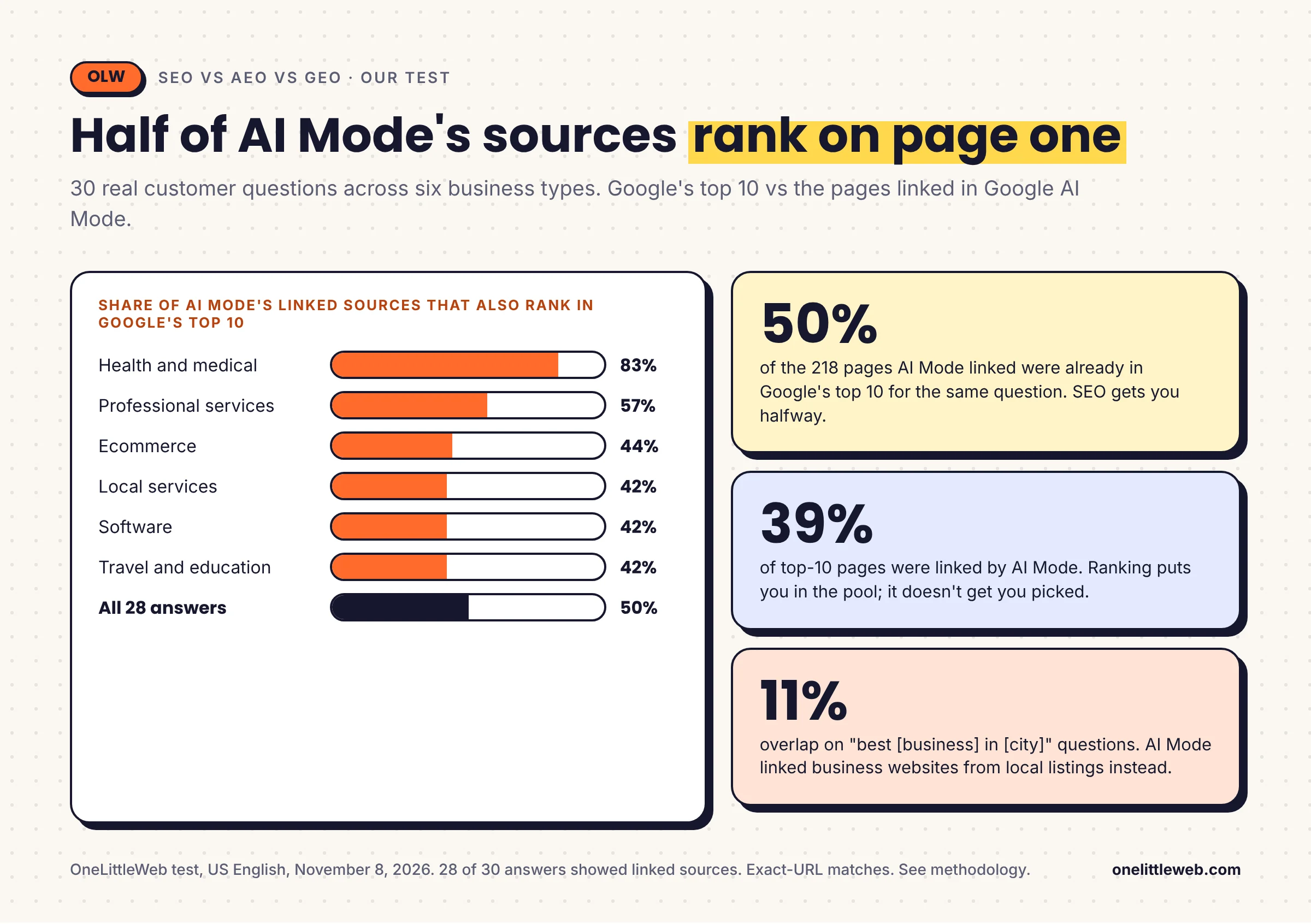
Here’s what stood out:
- SEO gets you halfway. Of the 218 pages AI Mode linked, 50% were already in Google’s top 10 for the same question. Counting by website instead of exact page, it was 61%.
- Ranking isn’t enough. Only 39% of the top-10 pages were linked by AI Mode. Being on page one puts you in the pool. It doesn’t guarantee you’re picked.
- Health questions overlap the most. 83% of AI Mode’s sources for health questions already ranked, mostly hospitals and medical publishers. On high-stakes topics, AI leans on the same trusted pages Google ranks.
- Local “best in city” questions overlap the least. For “best dentist in Chicago,” “best moving companies in New York” and “best hotels in Lisbon,” only 11% overlapped. AI Mode linked individual business websites instead, the kind you reach through local listings and a Google Business Profile.
- The rest came from outside the top 10. YouTube videos, forum threads, product pages and brand sites that didn’t rank for that exact query. Many likely came from the related searches AI Mode runs in the background, which Google calls query fan-out.
Bigger studies point the same way. Ahrefs found that 38% of AI Overview citations came from the top 10 in early 2026, down from about 76% in mid-2025 (Ahrefs). And across platforms, overlap is even smaller: 91% of AI citations show up in only one of ChatGPT, Perplexity or Google AI Overviews (Growth Memo).
Same question, four screens
Here’s what that looks like for one question, “best time to visit Japan,” on the same day.
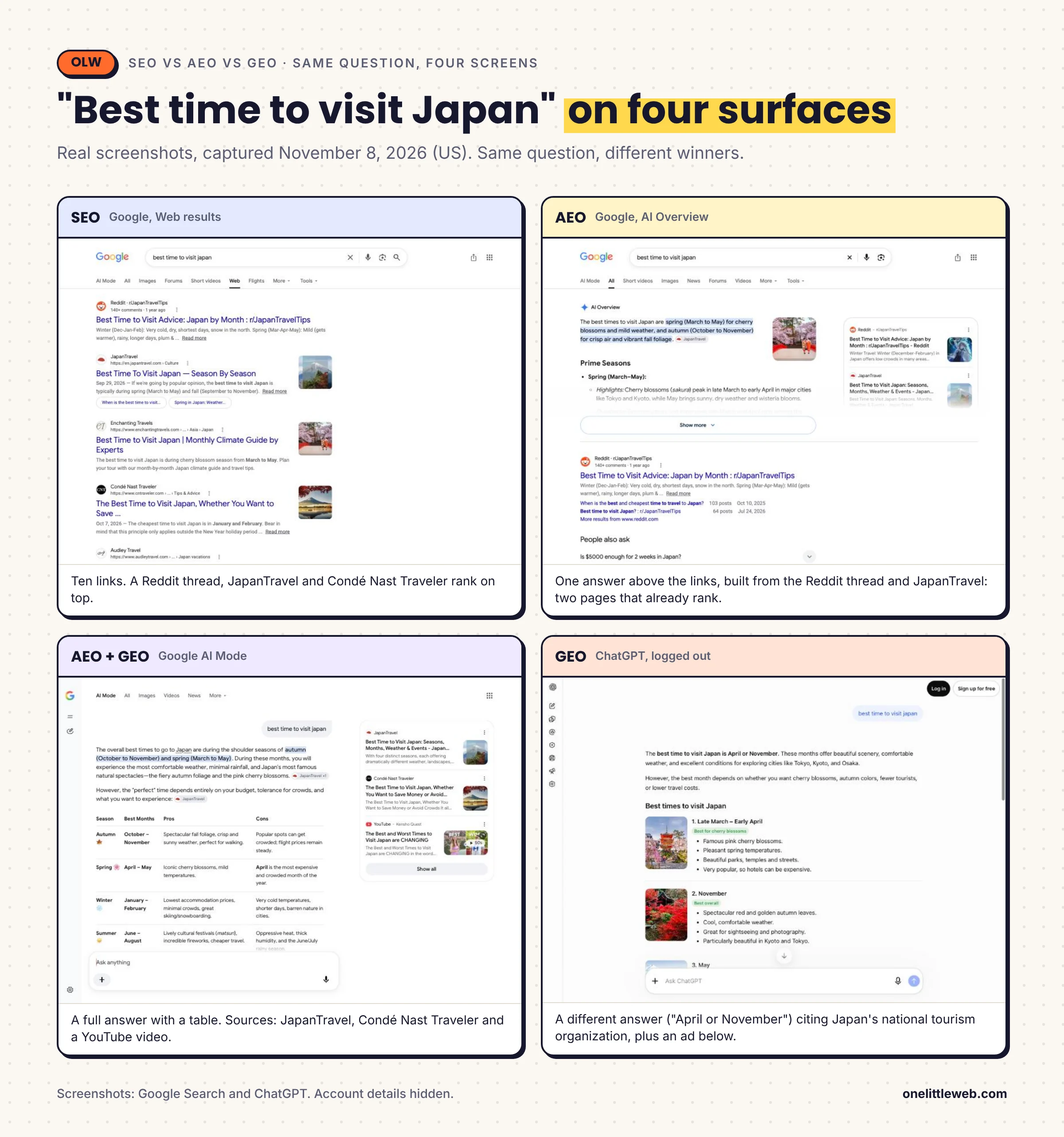
The pages that ranked in classic search fed both of Google’s AI answers. JapanTravel ranked second and was cited in the AI Overview and AI Mode. Condé Nast Traveler ranked fourth and made it into AI Mode.
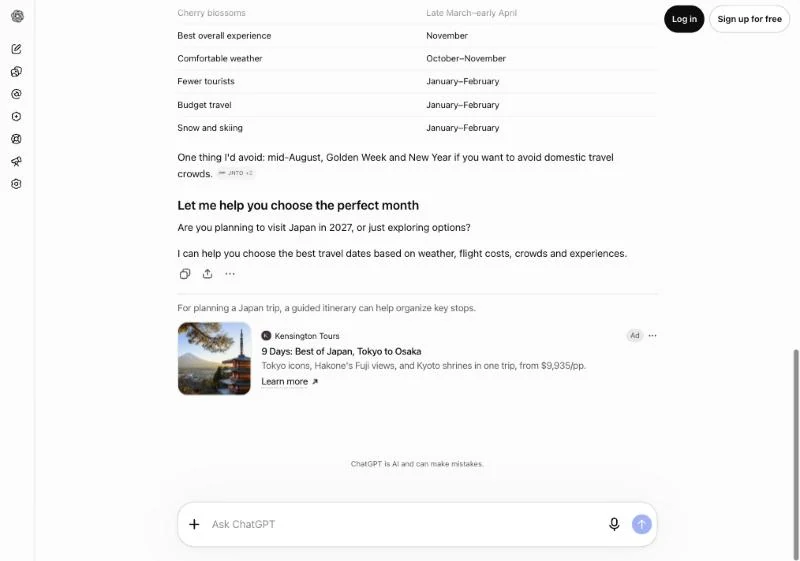
ChatGPT went its own way. It gave a different answer (“April or November”) and cited Japan’s national tourism organization, which wasn’t in Google’s top results at all. That’s the GEO gap in one picture: what wins Google doesn’t automatically win the chatbots.
Which audience each one reaches
Should you care about all three? The numbers say yes, but not equally.
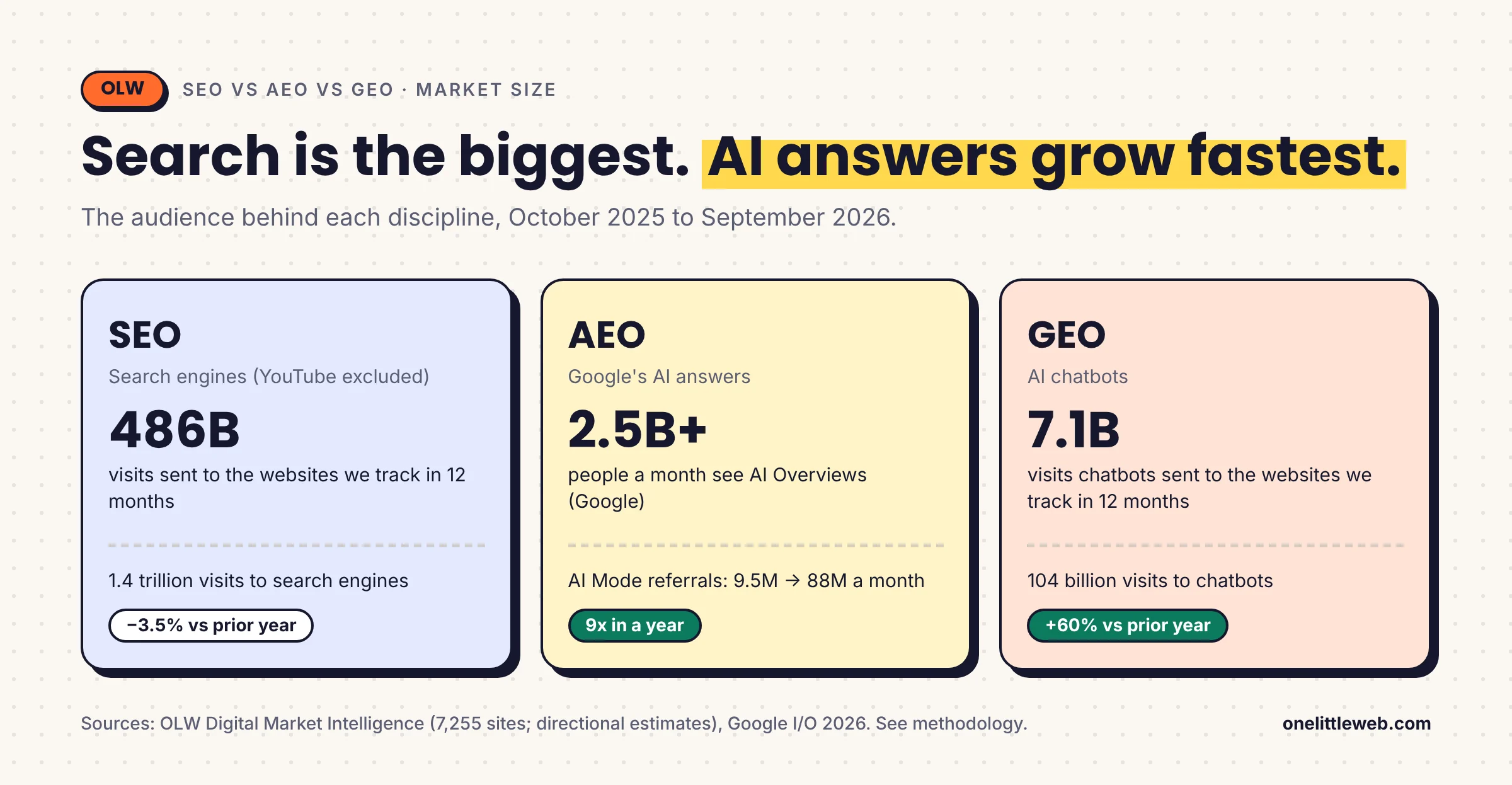
- SEO’s channel is still the giant. From October 2025 to September 2026, search engines sent the 7,255 websites we track 486 billion visits. Search engines themselves got about 1.4 trillion visits, down 3.5% on the year before.
- AEO’s channel is inside Google. AI Overviews reach more than 2.5 billion people a month. Google AI Mode sent our tracked sites 9.5 million visits in October 2025 and 88 million in September 2026.
- GEO’s channel is the fastest-growing. Chatbots got 104 billion visits, up 60%, and sent tracked sites about 7.1 billion visits. That’s small next to search, but it’s a market most industries would gladly take.
The practical reading: protect your search traffic with SEO, and build the AEO and GEO layer now, while it’s still small enough to win. For the full search vs AI picture, see the data in our SEO guide.
One tactic, three payoffs: what to actually do
Here’s the good news for your budget. You don’t need three separate strategies. Most of the work pays off in all three places.
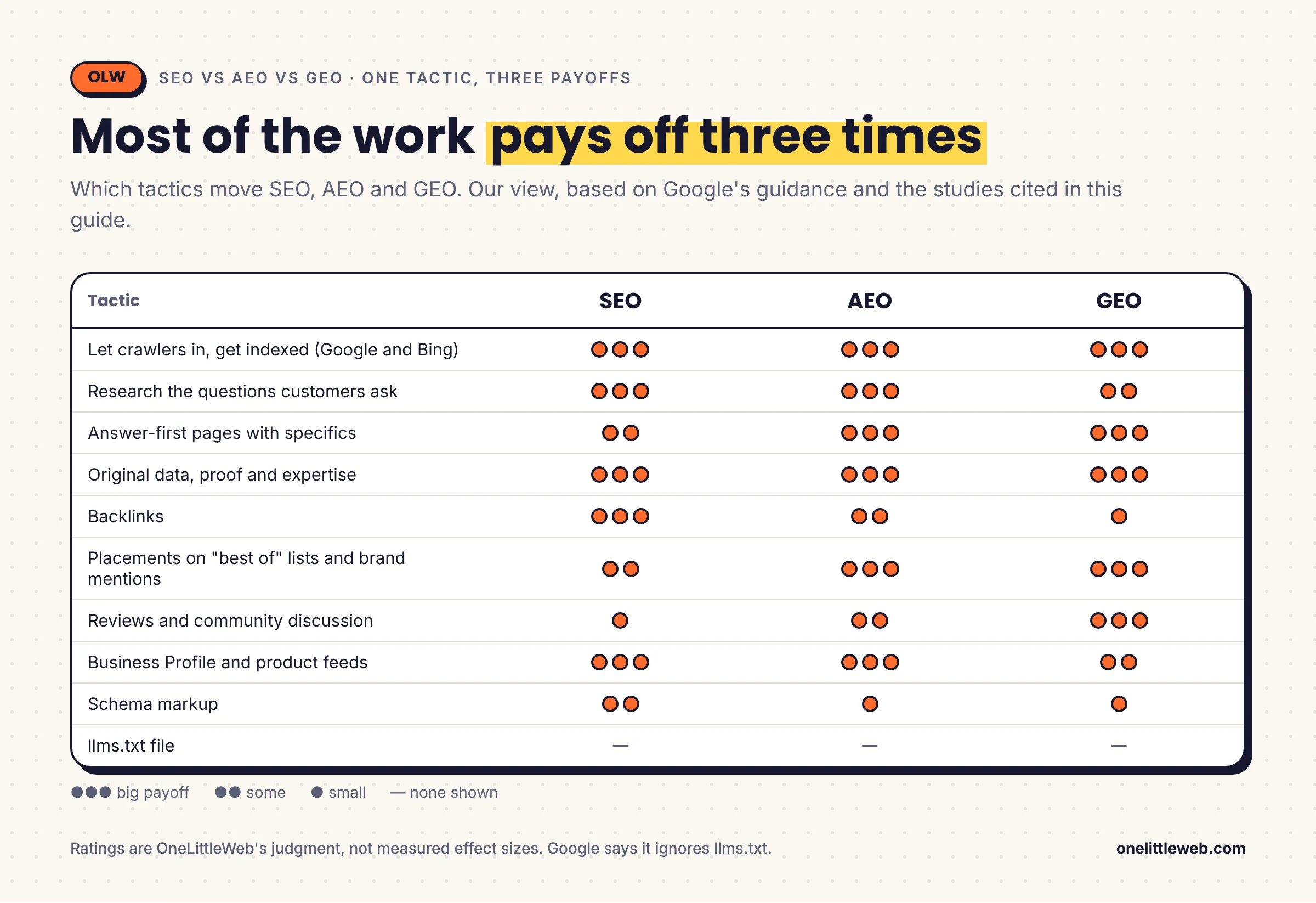
Where they diverge:
- Backlinks are still a core SEO signal. For AI answers, the mention matters as much as the link.
- “Best of” lists and brand mentions are the biggest lever for AEO and GEO. AI answers lean on the pages that compare options, so being listed there gets you named. (Step 7 of our AI search optimization guide shows how.)
- Reviews and community threads barely move rankings but strongly shape what chatbots say about you.
- Schema markup helps rich results in classic search. Google says no special schema is needed for its AI features (Google). Our schema guide covers what’s still worth adding.
- llms.txt is the one “AI tactic” with no payoff shown. Google says it ignores these files.
Which one should your business prioritize?
The order matters more than the acronym. Each layer depends on the one before it.
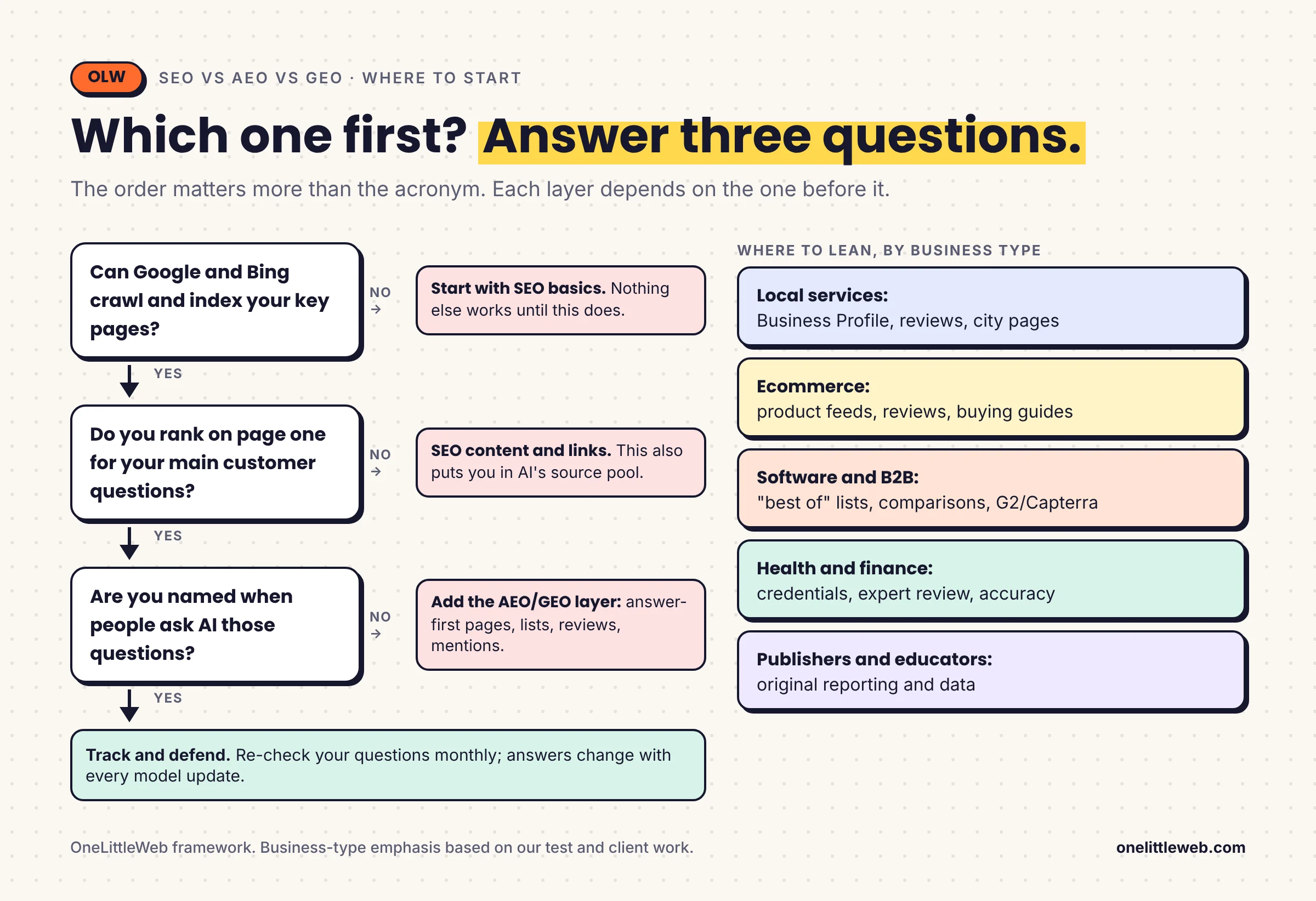
- Can Google and Bing crawl and index your key pages? If not, start there. No AI can quote a page it can’t read.
- Do you rank on page one for your main customer questions? If not, SEO content and links come next. That also puts you in the pool AI answers draw from.
- Are you named when people ask AI those questions? If not, add the AEO and GEO layer: answer-first pages, list placements, reviews and mentions.
Then lean into what fits your business:
- Local services (plumbers, dentists, movers): Google Business Profile, reviews and service pages. Our test showed AI Mode linking straight to local business sites for “best in city” questions.
- Ecommerce: product feeds, honest reviews and buying guides.
- Software and B2B: “best of” lists, comparison pages and review platforms like G2 and Capterra.
- Health and finance: named experts, credentials and accuracy. These topics had the highest overlap with classic rankings in our test.
- Publishers and educators: original reporting and data that AI has to attribute.
How to measure each one
Each layer needs its own scoreboard:
- SEO: rankings, clicks and traffic in Google Search Console and Bing Webmaster Tools.
- AEO: featured snippets you hold, and Search Console’s generative AI report, which shows impressions in AI Overviews and AI Mode.
- GEO: a monthly list of customer questions you check in ChatGPT, Gemini and Perplexity; AI referral traffic in Google Analytics; and, at scale, a paid tracker.
We cover the full setup, including a copy-paste GA4 filter, in the tracking section of our AI search optimization guide. For tools, see our AI answer tracking tools roundup.
Where this is heading
Three changes are blurring the lines further:
- Google is merging the surfaces. AI Mode is classic search, answer and conversation in one place. Separating SEO from AEO there makes little sense.
- Ads now appear inside answers. ChatGPT started showing ads in February 2026, and OpenAI opened a self-serve Ads Manager in May 2026 (OpenAI). Paid placement is coming to AI answers the way it came to search results.
- The acronyms will probably fade. Within a few years, “search” will likely just mean all of it again.
Do it yourself, or get help
Most of the foundation is doable in-house: technical fixes, answer-first content and a monthly check of your customer questions.
The hard part is the off-site layer: earning a place on the lists, reviews and publications AI relies on. That takes relationships and time, and it’s most of what we do for clients through digital PR and link building. If you’d rather hand over the whole thing, see our AI SEO and GEO services, or start with the free audit below.
See where you stand in AI answers
Free AI visibility audit: how AI describes your business, who it recommends instead, and your three biggest fixes.
SEO vs AEO vs GEO: FAQ
What is the difference between SEO, AEO and GEO?
SEO gets your pages ranked in search results. AEO gets your content used as the answer on the results page, such as featured snippets and AI Overviews. GEO gets your brand named and cited in AI chatbot answers like ChatGPT and Gemini. All three rest on the same foundation of crawlable, trusted pages.
Does AEO replace SEO?
No. AEO builds on SEO. In our test, half of the pages Google AI Mode linked already ranked in Google’s top 10, and Google says optimizing for its AI features is still SEO. Without rankings, you’re rarely in the pool AI answers draw from.
Is AEO part of SEO?
Yes, in practice. AEO uses the same foundations as SEO, with extra focus on clear, quotable answers and on being mentioned by other trusted sites. Google treats optimizing for its AI features as part of SEO.
Are AEO and GEO the same thing?
Mostly. Some experts use AEO for answers inside search engines and GEO for answers inside chatbots; others treat them as two names for one strategy. The tactics are almost identical, so pick whichever term your team uses.
Is GEO better than SEO?
No, they serve different channels. Search engines still send far more visitors: 486 billion visits to the sites we track in a year, against 7.1 billion from AI chatbots. GEO is growing faster, so the best approach is SEO first, with GEO added on top.
Is AI SEO the same as GEO?
Usually, yes. “AI SEO” is a broader label that can also mean using AI tools to do SEO. When people mean optimizing for AI answers, AI SEO, GEO and AEO describe the same work.
Is SEO dead because of AI?
No. Search engines got about 1.4 trillion visits in the past year and sent the websites we track 486 billion visits. AI answers also draw heavily on pages that already rank. SEO is changing, not dying.
How do I use AEO and GEO together?
Start with pages that answer customer questions clearly, with specifics and proof. Then work off your site: get listed on the “best of” pages and review sites AI cites, keep your business facts consistent everywhere, and check monthly how AI describes you.
Do I need a separate agency for AEO or GEO?
Not usually. Most AEO and GEO work overlaps with good SEO and digital PR. What matters is that whoever you hire tracks AI visibility, not just rankings, and can earn mentions on the third-party sites AI relies on.
How long do SEO, AEO and GEO take to work?
SEO usually takes months. AEO and GEO improvements on platforms that search the live web can show within weeks once you rank, while reputation work like reviews and list placements takes three to twelve months to change how AI describes you.
Where to go next
- What Is SEO? Our beginner’s guide
- What Is AEO? Answer engine optimization explained
- AI search optimization: the step-by-step playbook
- AI answer tracking tools
- Live data: websites by AI traffic
Methodology
The overlap test
- Date and setup: November 8, 2026, Google US English (gl=us, hl=en), in a signed-in browser. Results can vary by person, location and day.
- Questions: 30 questions, five each from six business types: local services, ecommerce, software, professional services, health, and travel and education.
- Classic results: the top 10 organic web results (Google’s “Web” filter), excluding ads and other features.
- AI Mode: every external link shown in the Google AI Mode answer, deduplicated by page. Two answers (both legal and accounting questions) showed no linked sources and were left out, leaving 28 answers and 218 linked pages.
- Overlap: an AI Mode link counts as overlapping when the exact page (domain and path) appears in that question’s top 10. Website-level overlap counts the domain only.
- Screenshots: captured the same day for “best time to visit Japan.” ChatGPT was used logged out. Account details are hidden.
- This is a small, single-day test meant to show the pattern, not a statistical study. The question list and raw results are available on request.
Market data
- Source: OneLittleWeb Digital Market Intelligence, our tracker of 7,255 websites. Visits are estimates from third-party traffic data (SEMrush, Ahrefs and Aitools.xyz), not measured inside each site. Returning users are counted again each month.
- Period: October 2025 to September 2026, compared with the 12 months before. Data pulled and validated November 5, 2026.
- Search engines are the 48 tracked engines, excluding YouTube (which the dashboard groups under search engines).
- AI chatbot referrals (7.1 billion) are visits referred to tracked websites by AI chatbots; Google AI Mode is tracked separately (from September 2025) and not included in that figure. December values in the dashboard are interpolated.
- Why the live dashboard may differ: it’s refreshed every one to two months, websites are added or removed based on relevance, providers revise estimates, and we correct calculations when we find discrepancies.
- Read these numbers as directional: trends and orders of magnitude, not exact counts.