Quick answer
LLM SEO is the work of getting your brand mentioned, cited and recommended inside answers from ChatGPT, Google AI Overviews, Perplexity, Gemini and other AI tools. It builds on normal SEO, then adds crawler access, brand mentions on trusted sites and a new way of measuring results.
Key takeaways
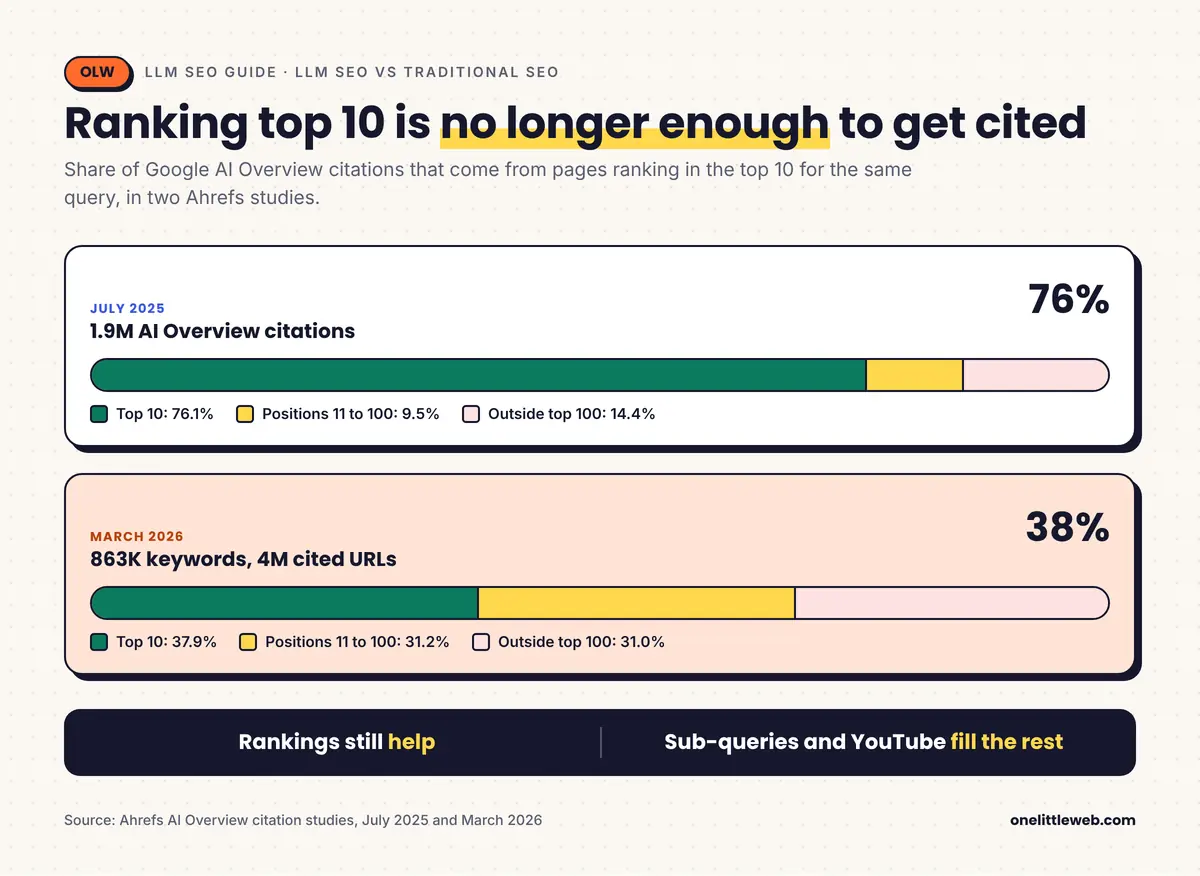
- SEO is still the base. AI Overviews pull from Google’s index, but only 38% of cited pages rank in the top 10 for the same query (Ahrefs, 2026).
- Mentions matter more than you think. Branded web mentions showed the strongest link to AI Overview visibility in an Ahrefs study of about 75,000 brands (0.664 correlation).
- Let the search bots in. Blocking OAI-SearchBot or Claude-SearchBot can keep you out of ChatGPT and Claude answers.
- Each platform picks sources differently. Only a handful of top-cited domains overlap across AI Overviews, ChatGPT and Perplexity.
- Fresh pages win more often. AI-cited content is 25.7% fresher than what ranks in normal results.
- Track share, not rank. AI tools repeat the same brand list less than 1 time in 100, so measure how often you appear.
- The traffic is small but valuable. AI referrals are under 1% of most sites’ visits, yet they often convert several times better than organic.
My clients’ rankings look fine. Their clicks don’t.
That’s the conversation I have most weeks now. A SaaS client still holds page one for its main keywords. But when a buyer asks ChatGPT “what’s the best tool for X,” the answer names three competitors and skips them.
The click data backs this up. Pew Research found that Google users clicked a normal result in 8% of visits when an AI summary showed up, versus 15% when it didn’t. Links inside the AI summary got clicked in about 1% of visits.
Meanwhile, ChatGPT hit 900 million weekly users in February 2026. A lot of buying research now happens inside an AI answer, before anyone sees a search result.
At OneLittleWeb, a big part of our client list is AI and SaaS brands. For them, showing up in “best tool for” prompts is now as important as ranking on Google. This guide is what we’ve learned doing that work.
One more thing before we start. Most LLM SEO guides you’ll find are written by companies that sell AI tracking tools. That doesn’t make them wrong, but it shapes what they tell you to buy. I’ll show you what the data says, what Google says, and where the evidence is still thin.
What is LLM SEO?
LLM SEO (also called LLMO, or large language model optimization) is the practice of making your brand and content easy for AI tools to find, trust and use in their answers.
A large language model (LLM) is the AI system behind tools like ChatGPT, Gemini, Claude and Google’s AI Overviews. When someone asks it a question, it writes an answer. LLM SEO is about being part of that answer.
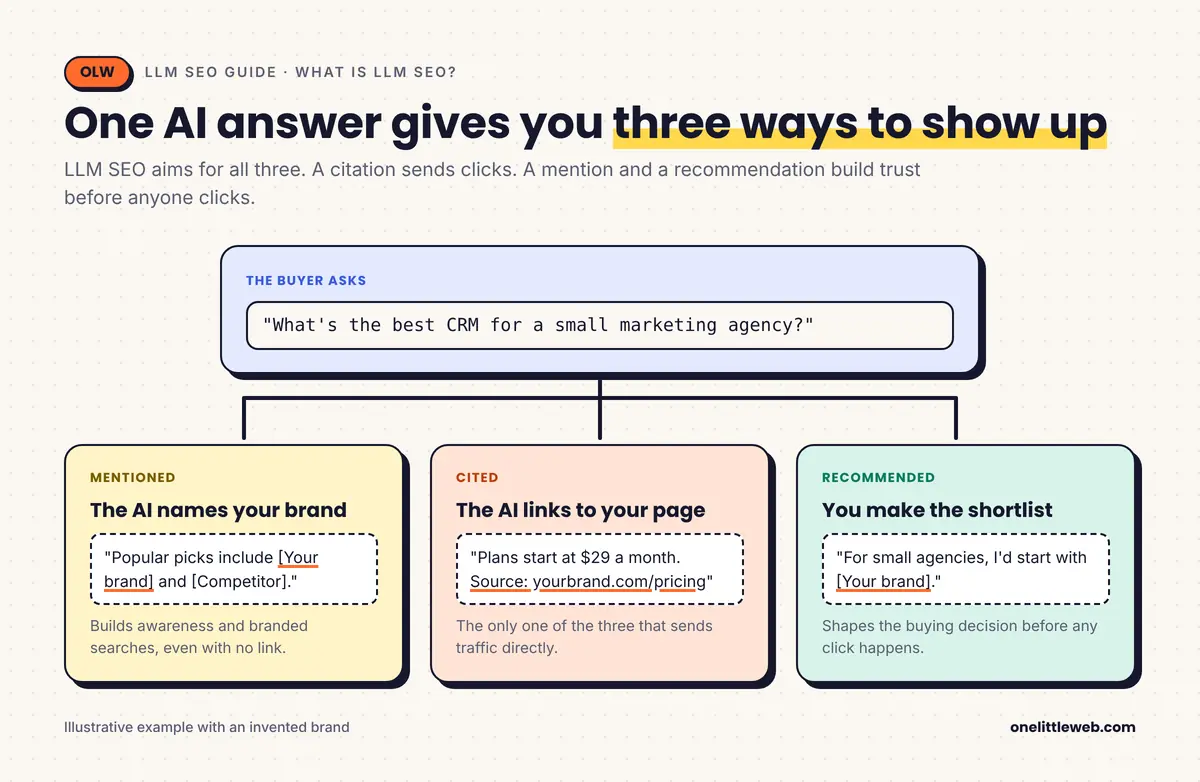
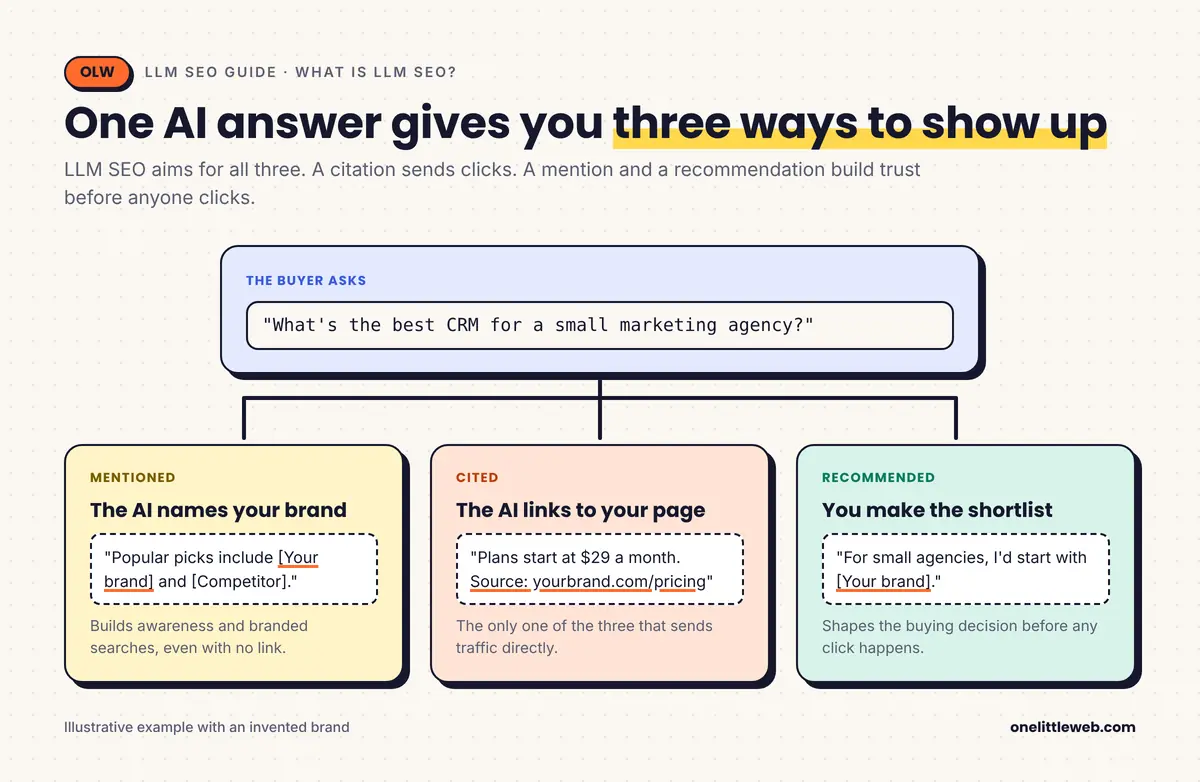
There are three ways to show up:
- Mentioned. The AI names your brand in the answer, with or without a link.
- Cited. The AI links to your page as a source for a claim.
- Recommended. The AI puts you on its shortlist when someone asks what to buy or use.
A citation drives traffic. A mention and a recommendation drive trust and branded search. You want all three.
You’ll also hear GEO (generative engine optimization) and AEO (answer engine optimization). In practice, they overlap almost completely with LLM SEO. If you want the full breakdown, read our guide on SEO vs AEO vs GEO.
Google’s own take is blunt. Its 2026 guide says that optimizing for generative AI search “is still SEO.” I mostly agree, with a few important additions that I’ll cover below.
One thing to drop right away is the idea of “ranking #1 in ChatGPT.” AI answers don’t have fixed positions. The same question can give a different answer every time it’s asked. So the goal is to show up as often as possible, not to hold a spot.
How LLMs find and choose sources
You can’t optimize for something you don’t understand. So before the tactics, here’s how AI tools actually decide what to say and who to cite.
Two pathways: training data vs live retrieval
An LLM can know about your brand in two ways.
1. Training data. Before a model is released, it learns from a huge snapshot of the web. Public datasets like Common Crawl make up a large part of that. If your brand shows up often and consistently across the web, the model “remembers” it.
This is slow. What the model learned is fixed until the next version comes out, which can take months. And it rarely produces a link.
2. Live retrieval. When an AI tool searches the web before answering, it’s using retrieval-augmented generation (RAG). It runs searches, reads a few pages, then writes an answer and cites them.
ChatGPT search, Perplexity, Google AI Overviews and Copilot all work this way. This path is much faster. Once a page is indexed and crawlable, it can be cited within days.
The two paths use different crawlers too. OpenAI’s GPTBot collects training data. Its OAI-SearchBot handles content for ChatGPT search. We’ll come back to why that matters in Step 2.
What this means for you: live retrieval is where most of your quick wins are. Training data is a long game you win through brand mentions over time.
Query fan-out: one prompt becomes many searches
AI prompts are long. One study of about 1,800 ChatGPT conversations found the average prompt was 42 words, and about 75% were commands (“compare these,” “give me a list”) rather than questions. Compare that to AI Overview searches, which peak at around three words.
So the AI does something called query fan-out. It breaks one long prompt into several smaller searches, runs them, and pulls sources from all of them.
Take a prompt like “best CRM for a small marketing agency with under 10 people.” It might fan out into:
- best CRM for small agencies
- CRM pricing for small teams
- HubSpot vs Pipedrive for agencies
- CRM with client reporting features
Each sub-query gets its own results. That’s why Ahrefs found that many AI Overview citations come from pages that rank for these sub-queries, not for the original search.
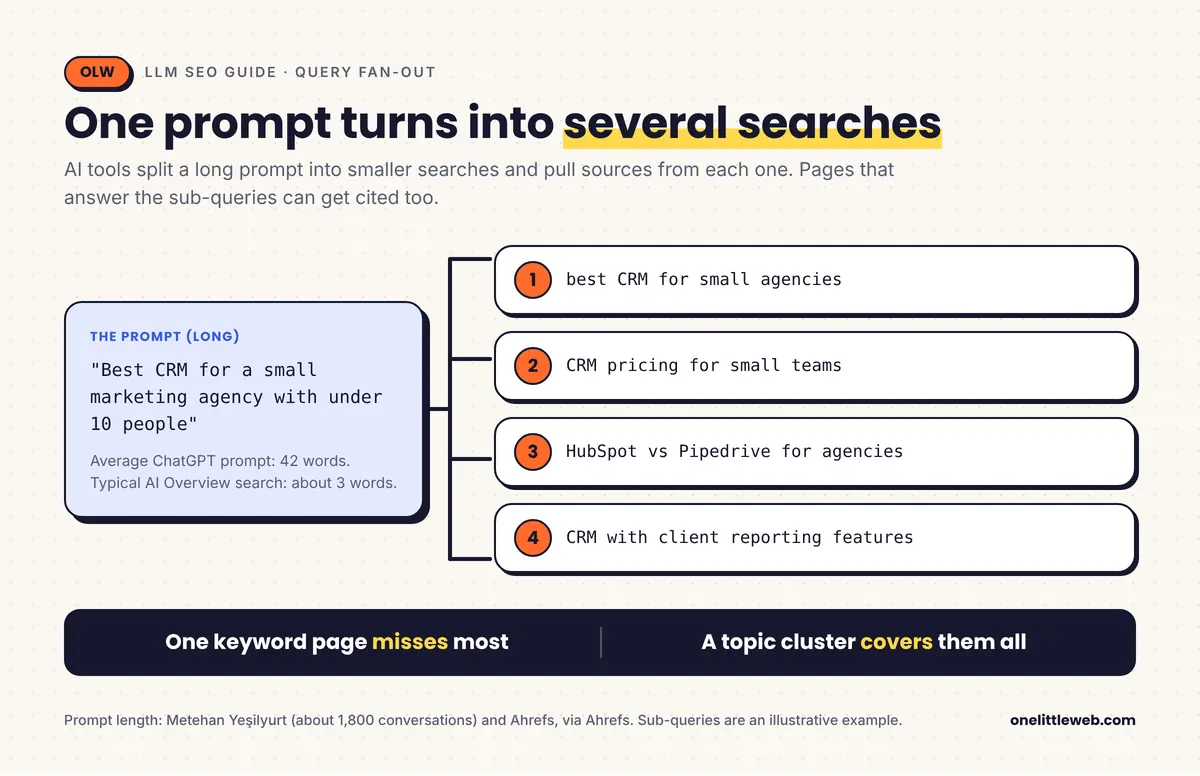
What this means for you: one great page for one keyword isn’t enough. You need pages that answer the related questions a buyer would ask too. That’s topical authority, and it matters even more for AI.
Where each platform gets its sources
This is where most guides get vague. Each AI tool pulls from different places, and they don’t agree with each other much.
Ahrefs looked at how closely each platform’s citations line up with pages that are already highly linked. The match was strong for Google AI Overviews (about 0.7), moderate for Perplexity (about 0.4) and weak for ChatGPT (about 0.1).
Ahrefs also compared the top 50 most-cited domains on each platform. Only a handful showed up on all three lists. They reported that 86% of sources were unique to one platform.
ChatGPT is the hardest to pin down. In 2024, Seer Interactive found 87% of ChatGPT search citations matched Bing’s top results. Then 2025 tests by several SEOs showed a much closer match with Google. A September 2026 investigation by Peec AI found ChatGPT now uses its own search index plus at least eight outside providers, including Google and Bing data.
So the safe answer is: ChatGPT’s sources are mixed, and they keep changing.
| Platform | Main source index | What it leans on | What that means for you |
|---|---|---|---|
| Google AI Overviews / AI Mode | Google’s own index | Pages that rank for the query and its sub-queries; YouTube | Strong Google SEO is the price of entry |
| ChatGPT | Own index plus outside providers (Bing, Google data and others) | Well-known sites, Wikipedia, review and list pages | Be indexed in both Google and Bing; build brand mentions |
| Perplexity | Own crawler plus live web search | Fresh pages, Reddit, forums | Allow PerplexityBot; keep pages current |
| Microsoft Copilot | Bing | Bing rankings | Verify in Bing Webmaster Tools |
| Gemini | Google index and Google properties | Same as Google SEO | |
| Claude | Own search crawler plus web search | Pages Claude-SearchBot can index | Allow Claude-SearchBot |
What this means for you: there’s no single “AI algorithm” to beat. Pick the platforms your buyers use, then work on the sources those platforms trust.
LLM SEO vs traditional SEO
If you’re wondering whether this is just SEO with a new name, you’re half right.
The foundation is the same. Pages still need to be crawlable, indexed, useful and trusted. Google says its AI features are built on its core Search systems.
But the link between rankings and AI citations is getting weaker. In July 2025, Ahrefs found 76% of AI Overview citations came from pages ranking in the top 10. By March 2026, with a larger dataset of 863,000 keywords and 4 million cited URLs, that number dropped to 38%.
Of the rest, about 31% ranked between positions 11 and 100. Another 31% didn’t rank in the top 100 at all. Among those, 18.2% were YouTube videos.
So ranking still helps a lot. It’s just no longer enough on its own.
| Traditional SEO | LLM SEO | |
|---|---|---|
| Goal | Rank a page in search results | Get mentioned, cited or recommended in AI answers |
| Unit of success | Position and clicks | Share of answers and citations |
| Main signals | Relevance, links, content quality, page experience | All of those, plus brand mentions across the web and crawler access |
| Where it happens | Your page in a list of links | Inside the AI’s answer, often without a click |
| How you measure | Search Console, rank trackers, analytics | Prompt tracking, Search Console’s AI report, AI referral traffic |
| Speed | Weeks to months | Days for live retrieval; months for training data |
The biggest shift I’ve seen with clients is off-site work. In normal SEO, links do most of the off-site lifting. In LLM SEO, plain brand mentions on the right sites matter just as much, even without a link.
For the broader strategy across all AI search surfaces, see our AI Search Optimization guide.
Why LLM SEO matters now
AI answers sit above the clicks
AI Overviews now show up on a large share of Google searches. How large depends on who you ask and what queries they track:
- 39% of US desktop searches (Comscore, Q2 2026)
- 43% of US searches, up from 15% a year earlier (Similarweb, July 2026)
- About 87 to 88% of commercial and buying-intent searches (Peec AI, April 2026; Semrush, October 2026)
The numbers differ because the query mix differs. Studies of all searches include lots of navigation and brand queries. Studies of buying-intent queries find AI Overviews on almost every result.
And when an AI Overview shows up, people click less. Pew found visits with an AI summary ended without any further browsing 26% of the time, versus 16% without one.
The traffic is small, but it converts
Here’s the part most guides skip. AI referral traffic is still tiny.
We saw this in our own research too. In our AI Chatbots vs Search Engines study, AI chatbot visits grew 80.92% to 55.2 billion between April 2024 and March 2025. Search engines still got about 34 times more visits over the same year.
Ahrefs tracked 74,752 websites and found all AI chatbots together sent 0.28% of web traffic in March 2026. ChatGPT sent about ten times more than any other AI tool.
Marie Haynes looked at 100 websites and 145 million sessions. ChatGPT sent 0.62% as many sessions as Google organic.
But those visitors convert well. In that same study, 13.8% of ChatGPT visitors converted, compared with 3.02% from Google organic. Ahrefs saw something similar on its own site: AI search was 0.5% of visitors but drove 12.1% of signups.
Still, volume wins. In the Haynes study, Google organic drove 27 times as many conversions as all LLMs combined.
The takeaway: don’t drop Google SEO to chase AI traffic. Add LLM SEO on top, because the visitors it brings are often ready to buy.
AI shapes the shortlist before the click
The bigger impact isn’t the traffic you can see. It’s the decisions made inside the answer.
When a buyer asks “what’s the best X for Y,” the AI hands them a shortlist. If you’re not on it, you often never get considered. With 900 million people using ChatGPT every week, that shortlist is now a major sales channel.
We see this with our SaaS clients.
[TO DO: OLW data: anonymized example of a SaaS client where sales calls mention ChatGPT or AI Overviews as the discovery source, or demo requests from AI referrals.]
LLM SEO myths vs what works
A whole industry has popped up selling AI search “hacks.” In 2026, Google published a guide that calls several of them out directly. Here’s how they hold up.
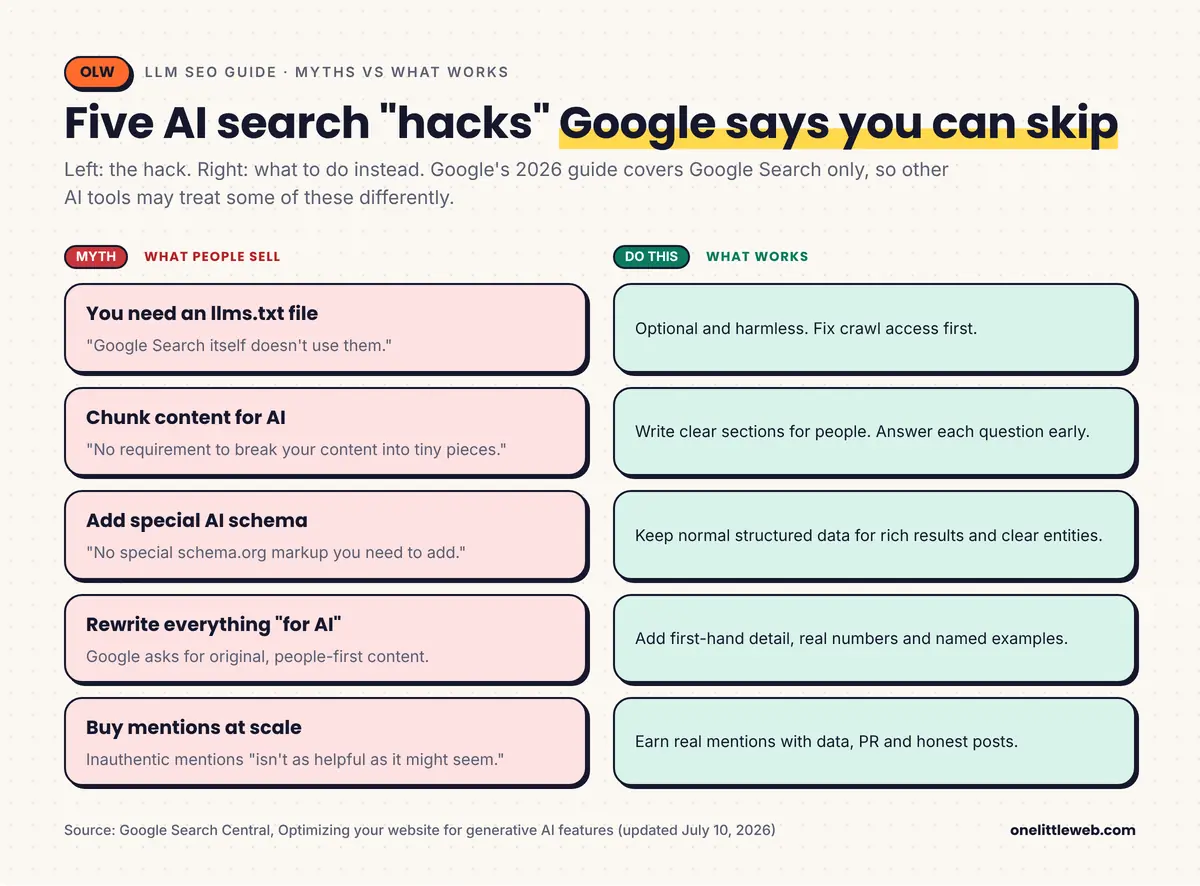
Myth 1: You need an llms.txt file. For Google, no. Google’s guide says “Google Search itself doesn’t use them.” It also says the file won’t help or hurt you, and other services may read it. My take: it’s harmless and low priority. Don’t expect it to move anything.
Myth 2: You need to “chunk” content for AI. Google says there’s “no requirement to break your content into tiny pieces.” It also says there’s no ideal page length. Write clear sections for people, and AI tools can pull what they need.
Myth 3: You need special AI schema. Google says “there’s no special schema.org markup you need to add” for its AI features. Normal structured data is still worth using for rich results and to make your entities clear. Just don’t treat it as an AI switch.
Myth 4: You should rewrite content “for AI.” Google’s core advice is original, first-hand content written for people. Pages that sound like they were written for a machine tend to lose with both readers and search systems.
Myth 5: You can buy your way into answers with mentions. Google says seeking inauthentic mentions “isn’t as helpful as it might seem.” Real mentions help. Paid spam on Reddit or fake listicles carries real risk.
One important caveat. Google’s guide only covers Google Search. ChatGPT, Perplexity and Claude follow their own rules. That’s why the steps below cover crawler access and indexing beyond Google.
How to do LLM SEO: 8 steps
Here’s the process we use with clients. Steps 1 to 3 are technical and quick. Steps 4 to 8 are where the long-term gains come from.
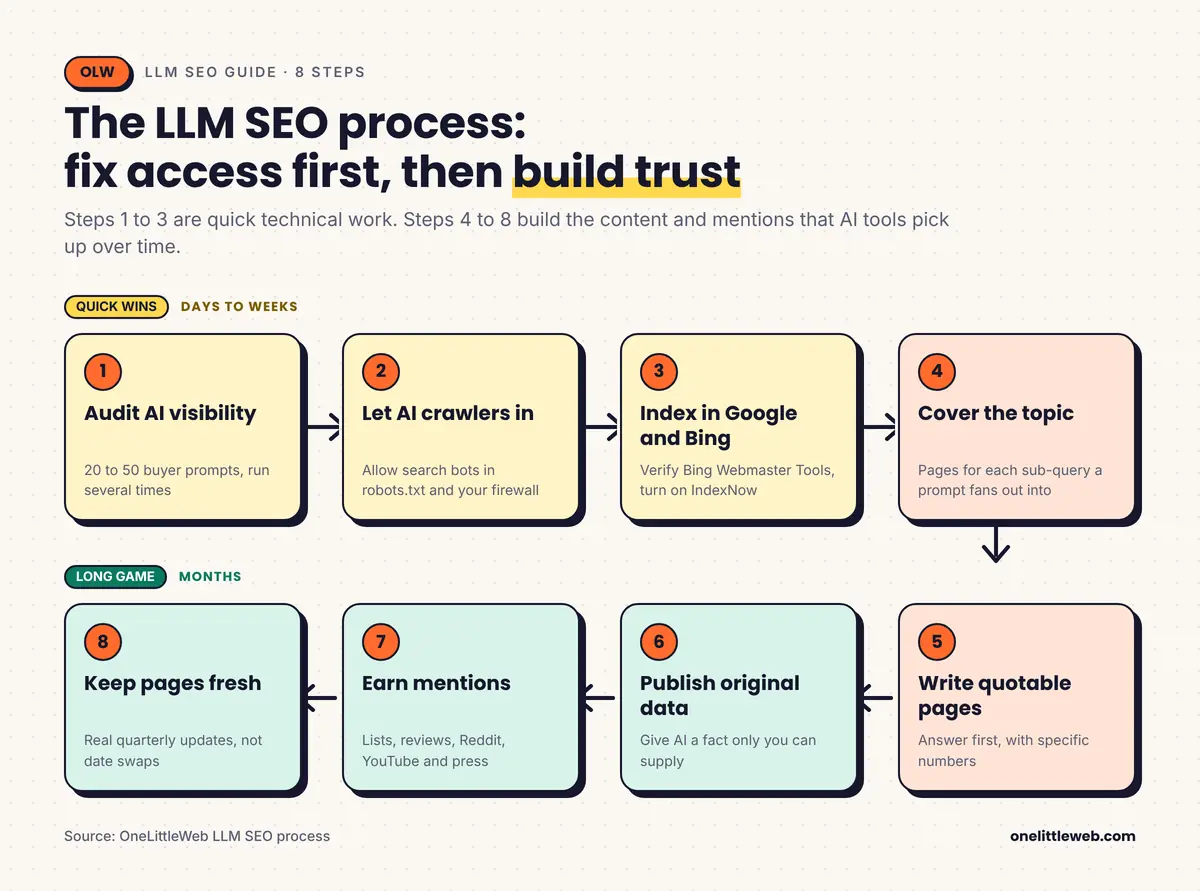
Step 1: Audit your current AI visibility
Start by finding out where you stand.
Write down 20 to 50 prompts your buyers would actually type. Mix them up:
- “Best [category] for [audience]”
- “[Your brand] vs [competitor]”
- “Is [your brand] worth it?”
- “How do I [problem your product solves]?”
Run each prompt in ChatGPT, Google (AI Overviews and AI Mode), Perplexity and Gemini. Run each one several times, because answers change.
For every run, note three things: whether you’re mentioned, who else is mentioned, and which pages get cited.
I always do this by hand first, even if a client already pays for a tracking tool. Reading the answers yourself shows you why competitors get picked, not just that they do.
If you have Google Search Console, also open the new Generative AI performance report. It shows which of your pages already appear in AI Overviews and AI Mode.
Check: You know which prompts name you, which name competitors instead, and which pages the AI cites.
Step 2: Let the right AI crawlers in
If an AI tool can’t read your site, it can’t cite it. This is the most common problem I find in audits.
Most AI companies now run separate bots for training, search and user requests. You can allow or block each one in robots.txt.
| Company | Training bot | Search bot | User-triggered fetch |
|---|---|---|---|
| OpenAI | GPTBot | OAI-SearchBot | ChatGPT-User |
| Anthropic | ClaudeBot | Claude-SearchBot | Claude-User |
| Perplexity | (none listed) | PerplexityBot | Perplexity-User |
| Google-Extended (Gemini training control) | Googlebot | (n/a) |
The search bots are the ones that matter most for visibility. OpenAI says sites that opt out of OAI-SearchBot won’t be shown in ChatGPT search answers. Anthropic says blocking Claude-SearchBot “may reduce your site’s visibility.”
The training bots are a separate choice. Blocking GPTBot or ClaudeBot keeps your future content out of model training, but it doesn’t block search. Ahrefs found about 5.9% of websites block GPTBot.
Also note the user-triggered fetchers. OpenAI says robots.txt rules “may not apply” to ChatGPT-User, because a person asked for the page.
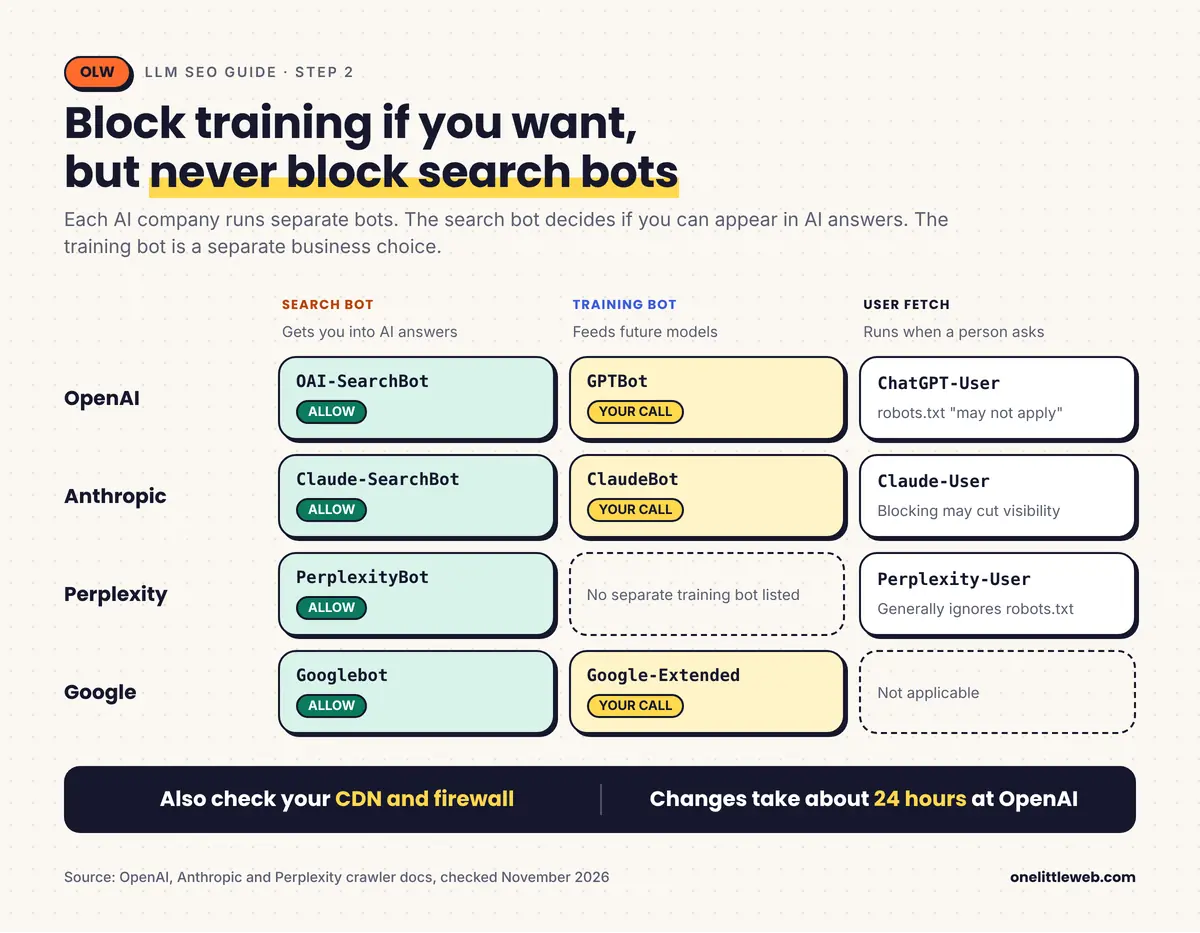
A setup that allows search while opting out of training looks like this:
User-agent: OAI-SearchBot
Allow: /

User-agent: Claude-SearchBot
Allow: /

User-agent: PerplexityBot
Allow: /

User-agent: GPTBot
Disallow: /

User-agent: ClaudeBot
Disallow: /
Whether you block training is your call. Many of our clients allow it, because being in the training data helps the model know their brand.
Two more things to check:
- Your CDN or firewall. Some hosting and security tools block AI bots by default. Your robots.txt can say “allow” while your firewall says “no.”
- JavaScript. If your key content only loads with JavaScript, some AI crawlers won’t see it. Server-side rendering fixes this.
OpenAI says robots.txt changes can take about 24 hours to show up in its systems.
Check: Search bots are allowed, training bots are set on purpose, and your key pages show their content without JavaScript.
Step 3: Get indexed in Google and Bing
AI tools can only cite what their search sources have indexed. So you need to be in both major indexes.
Google is covered by normal SEO. Bing is often forgotten. Microsoft Copilot runs on Bing, and ChatGPT has used Bing data alongside other sources.
Verify your site in Bing Webmaster Tools and submit your sitemap. Then turn on IndexNow if your CMS supports it, so Bing hears about new and updated pages right away.
In our audits, a surprising number of sites have never been verified in Bing at all. It takes a few minutes and closes a real gap.
Check: Your top 20 pages are indexed in both Google and Bing.
Step 4: Cover the topic, not one keyword
Remember query fan-out. One prompt becomes several searches. If you only have a page for the main query, you miss the rest.
Take your most important buying prompt. List the sub-questions an AI would search to answer it: pricing, comparisons, features, use cases, alternatives.
Then check if you have a page that answers each one well. Where you don’t, that’s your content plan.
This is the same topical authority work that helps in Google. It just pays off twice now. We build these clusters for clients using a semantic map of entities and sub-topics, so each page covers what the AI is likely to look for.
Check: Each core prompt has pages answering its likely sub-questions, linked together.
Step 5: Write pages AI can quote
AI tools quote content that’s clear, specific and easy to lift out. Vague writing doesn’t get used.
Compare these two lines:
- Vague: “Our tool offers flexible pricing that suits teams of all sizes.”
- Quotable: “Plans start at $29 per month for 3 users. The Pro plan is $79 per month and adds API access.”
The second one answers a real question with real numbers. That’s what gets cited.
A few habits that help:
- Answer first. Put the direct answer in the first one or two sentences of each section.
- Name things. Use specific product names, numbers, dates and places.
- Use tables for comparisons. They’re easy for both people and AI to read.
- Show who wrote it. Clear author info and first-hand experience support trust (E-E-A-T).
You don’t need to break pages into tiny chunks. Google says that’s not needed. Just write clear sections, each with one job.
Check: Each key section answers one question in its first two sentences, with at least one specific fact.
Step 6: Publish original data
AI tools need facts to back up their answers. If you’re the source of a fact, you get cited.
Ahrefs shared an example from Checkr. The company published a job market study that got little press pickup. Yet ChatGPT mentioned Checkr’s data in every test answer on that topic. It’s one case, but it shows how original data can travel.
Original data can be simple:
- A survey of your customers
- Stats from your own product usage
- A pricing comparison you update every quarter
- An analysis of public data nobody has summarized yet
Data studies also earn brand mentions and links when others quote them. We run these for clients as part of our digital PR work, and they’re one of the most reliable ways we’ve found to show up in AI answers.
Check: Your site has at least one stat other people would want to quote.
Step 7: Earn mentions on sites AI trusts
This is the step that moves the needle most, in my experience.
Ahrefs studied about 75,000 brands. Branded web mentions had the strongest link to showing up in AI Overviews, with a 0.664 correlation. Branded anchor text was next at 0.527. The number of pages on a site barely mattered (0.17).
That’s a correlation, not proof of cause. But it matches what we see: brands that get talked about get recommended.
Start with the pages AI already cites for your prompts. You found them in Step 1. Then work on getting included:
- “Best of” lists and roundups on trusted sites in your niche
- Review sites like G2, Capterra or Trustpilot, depending on your market
- Reddit and forums where your buyers ask for advice
- YouTube, which makes up a real share of AI Overview citations
- News and industry press, through digital PR
On Reddit, take part as a real person. Answer questions, disclose who you are, and don’t drop links everywhere. Google warns that chasing inauthentic mentions doesn’t help, and Reddit communities spot it fast.
Also watch what AI says about you, not just whether it mentions you. If answers describe your product wrongly or negatively, fix the sources they pull from.
Check: You appear on the lists, reviews and threads that AI cites for your top prompts.
Step 8: Keep key pages fresh
AI tools prefer recent content. Ahrefs analyzed 17 million citations across seven AI platforms. Cited content was 25.7% fresher than pages ranking in normal search results.
That doesn’t mean changing the date on a page. It means real updates: new prices, new screenshots, new data, new sections for new questions.
Pick your top 10 to 20 pages, the ones AI cites or should cite. Review them every quarter. Update anything that’s out of date and note what changed.
Check: Your most important pages have a review date on the calendar.
Platform playbook: what matters most where
If you can’t do everything at once, start with the platforms your buyers use. Here’s where to focus on each one.
| Platform | Where sources come from | Biggest lever | How to measure |
|---|---|---|---|
| Google AI Overviews / AI Mode | Google index, including sub-query results | Strong SEO and topic clusters | Search Console Generative AI report |
| ChatGPT | Own index plus outside providers | Brand mentions on trusted sites; Bing and Google indexing | Prompt tracking; GA4 referrals from chatgpt.com |
| Perplexity | Own crawler plus live web | Fresh pages; forum presence | Prompt tracking; GA4 referrals |
| Microsoft Copilot | Bing | Bing Webmaster Tools and IndexNow | Prompt tracking; Bing tools |
| Gemini | Same as Google SEO | Prompt tracking | |
| Claude | Own search crawler plus web search | Allow Claude-SearchBot | Prompt tracking; GA4 referrals from claude.ai |
For most businesses, I’d start with Google AI Overviews. It reaches the most people, and you get first-party data in Search Console. Then move to ChatGPT, which sends the most AI referral traffic.
If you want to see how the two biggest assistants compare as products, we break it down in Perplexity vs ChatGPT.
LLM SEO by business type
The basics are the same for everyone. What changes is where you put most of your effort.
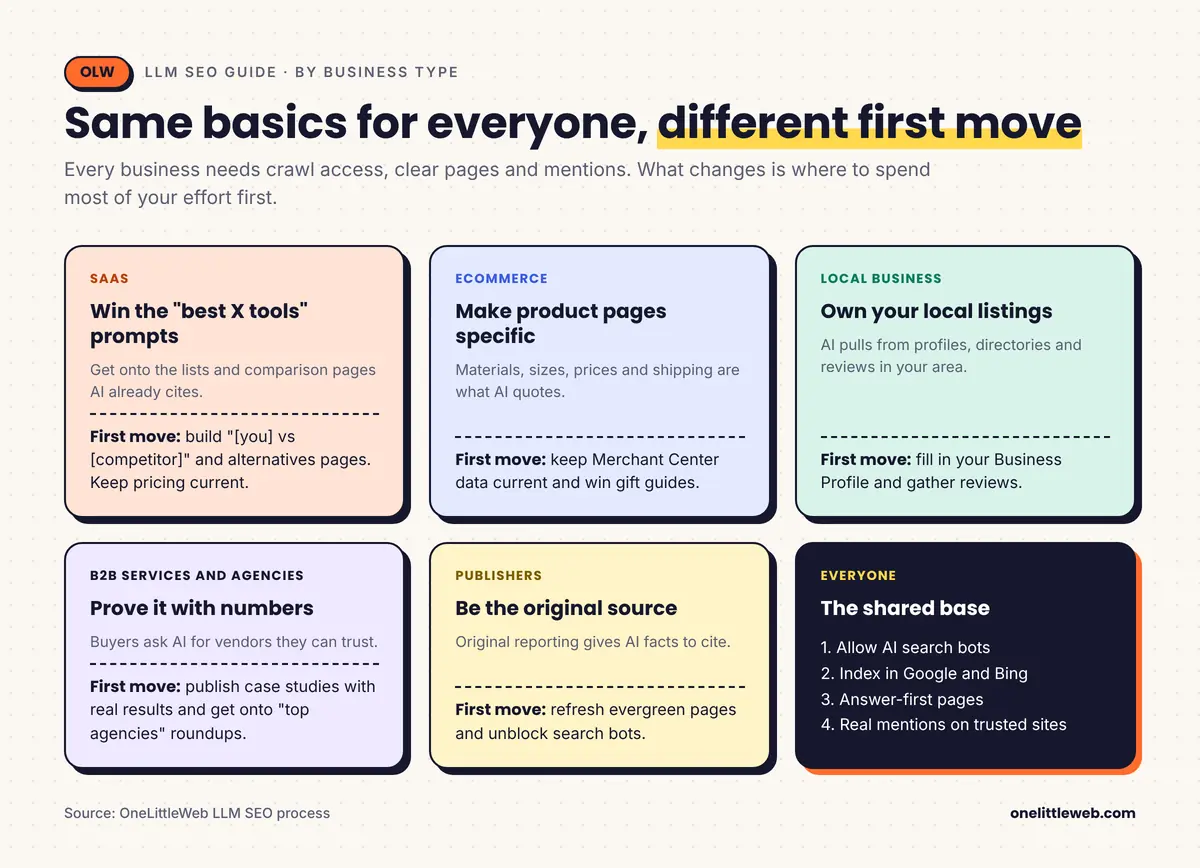
- SaaS. Get on the “best X tools” lists and comparison pages that AI cites. Build “[you] vs [competitor]” and alternatives pages. Keep pricing pages current, because AI quotes them. This is most of our work with AI and SaaS clients.
- Ecommerce. Make product pages specific: materials, sizes, prices, shipping. Keep Merchant Center data current for Google. Earn reviews and gift-guide mentions.
- Local businesses. Keep your Google Business Profile complete and accurate. Be listed on the review sites and directories AI pulls from in your area. Collect detailed reviews.
- B2B services and agencies. Publish case studies with real numbers. Get listed on industry directories and “top agencies” roundups. Share original research your buyers would cite.
- Publishers. Lean into original reporting and data. Update evergreen pages often. Make sure your site isn’t blocking the search bots by accident.
How long LLM SEO takes
There are two timelines running at once.
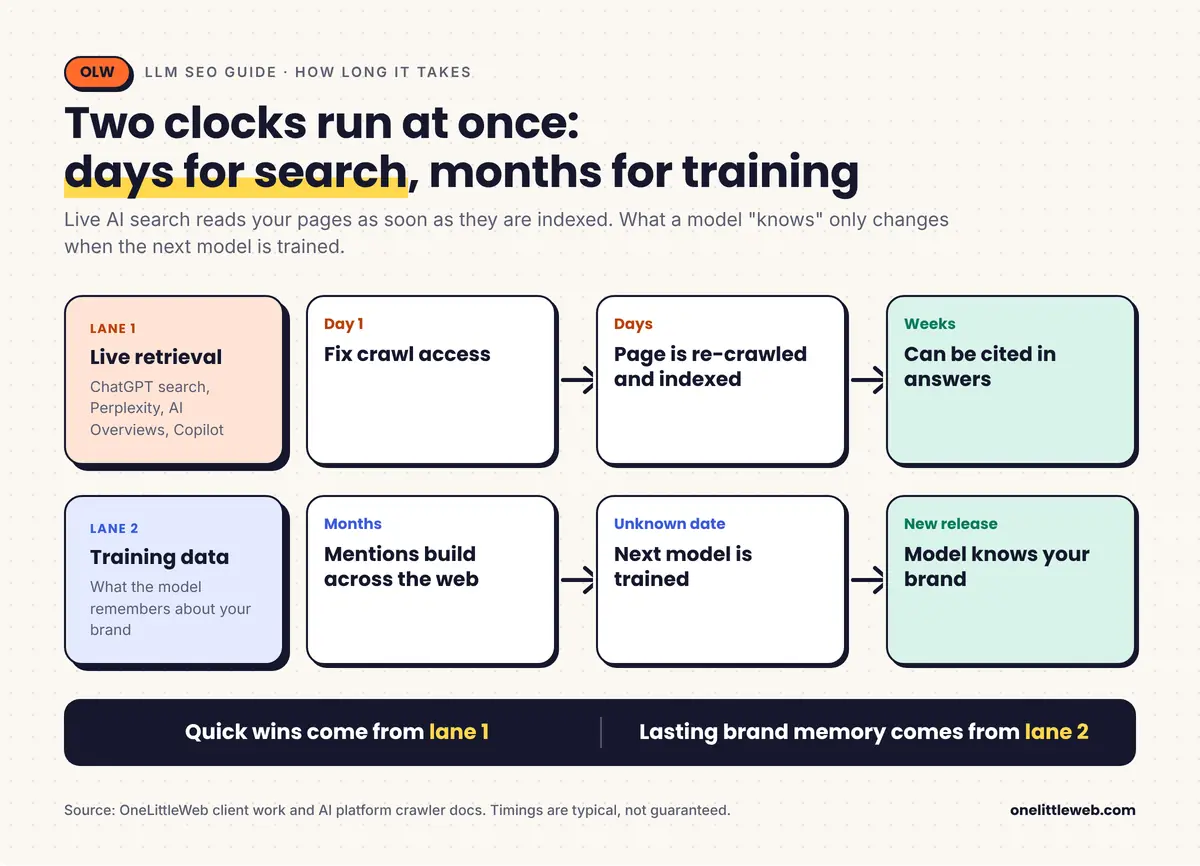
Live retrieval is fast. Once a page is crawlable and indexed, AI search tools can cite it within days. Fixing a crawler block or updating a key page can show results within a few weeks.
Training data is slow. Brand mentions you earn today only shape what a model “knows” after its next training run. That can be months away, and you don’t control when.
In our client work, technical fixes and page updates usually show up first. Mention building takes longer but has the bigger, longer-lasting effect.
[TO DO: OLW data: typical timeline we see from first fixes to measurable change in prompt visibility.]
How to measure LLM SEO
Measuring AI visibility is messy. The answers change every time.
SparkToro and Gumshoe.ai ran 2,961 tests with around 600 volunteers. There was less than a 1 in 100 chance that ChatGPT or Google’s AI would give the same list of brands twice for the same prompt. The same list in the same order came up less than 1 in 1,000 times.
So tracking a single “position” is mostly noise. What’s more stable is how often you appear across many runs. That’s your visibility rate, or share of voice.
Use four layers together:
| Layer | What it shows | Tool | Cost |
|---|---|---|---|
| Prompt tracking | How often you’re mentioned and cited for key prompts | Spreadsheet or AI visibility tool | Free to paid |
| Google AI impressions | How often your pages appear in AI Overviews and AI Mode | Search Console Generative AI report | Free |
| AI referral traffic | Visits and conversions from AI tools | GA4 | Free |
| Brand mentions | Where you’re talked about across the web | Ahrefs, Semrush or a mention tracker | Paid |
Prompt tracking
Take the prompt list from Step 1. Run each prompt at least five times per platform each month. Then calculate your visibility rate.
Prompt | Platform | Runs | Times mentioned | Times cited | Visibility rate
best crm for small agencies | ChatGPT | 5 | 3 | 1 | 60%
best crm for small agencies | AI Overviews | 5 | 2 | 2 | 40%
Track the trend month over month. Also track your share of voice: your mentions divided by all brand mentions across your prompt set.
Search Console’s Generative AI report
Google added a Generative AI performance report to Search Console in June 2026. It rolled out to all sites worldwide by August 31, 2026.
It shows impressions from AI Overviews and AI Mode, broken down by page, country, device and date. Data starts from May 18, 2026. There’s a separate report for AI features in Discover.
This is the only first-party AI visibility data any major platform gives you right now. Check it monthly to see which pages Google’s AI is using.
[TO DO: add screenshot of the Search Console Generative AI performance report, impressions by page]
AI referral traffic in GA4
GA4 lumps AI traffic in with other referrals by default. Set up a custom channel so you can see it on its own:
- In GA4, go to Admin, then Data display, then Channel groups.
- Create a new channel group (copy the default one).
- Add a channel called “AI Referrals.”
- Set the condition to Source matches regex, using the pattern below.
- Move the channel above “Referral” so it takes priority.
- Save, then compare conversions from AI Referrals against Organic Search.
.*(chatgpt.com|openai.com|perplexity.ai|gemini.google.com|claude.ai|copilot.microsoft.com).*
Keep in mind that some AI traffic arrives with no referrer at all. It shows up as direct traffic. So your GA4 number is a floor, not the full picture.
Tracking tools and what they cost
If manual tracking gets too big, a tool can automate it. Entry prices in 2026 range from about $29 a month to custom enterprise deals:
- Otterly.AI: from about $29/month
- Semrush AI Visibility Toolkit: about $99/month per domain
- Ahrefs Brand Radar: about $199/month per AI platform, or $699 for all
- Profound: custom enterprise pricing
[TO DO: verify every price on the vendor’s own pricing page]
Keep two things in mind. First, given how random AI answers are, no tool can give you an exact “rank.” Look for tools that report visibility rates across many runs. Second, many of these vendors also publish the guides telling you to buy tracking. Start with manual tracking and Search Console, then buy a tool once you know what you need.
For a full comparison, see our roundup of the best LLM tracking tools.
Common LLM SEO mistakes
- Blocking search bots by accident. A firewall or CDN setting can block OAI-SearchBot or PerplexityBot even when robots.txt allows them. Check your server logs.
- Treating llms.txt as a ranking lever. Google doesn’t use it. Add it if you like, but don’t spend a week on it.
- Tracking single positions. AI answers change almost every time. Track visibility rates over many runs.
- Spamming Reddit. Fake accounts and drive-by links get removed and can hurt your brand in the answers AI gives.
- Rewriting everything “for AI.” Content written for machines reads badly. Write for people with clear, specific answers.
- Ignoring Bing. Copilot runs on it, and ChatGPT has drawn on its data. Verification takes minutes.
- Faking freshness. Changing the date without changing the content doesn’t fool anyone for long.
- Dropping Google SEO for AI traffic. Google organic still drives far more conversions for most sites. LLM SEO goes on top, not instead.
Do it yourself or get help?
A lot of LLM SEO is doable in-house. Checking robots.txt, verifying Bing, building a prompt sheet and setting up GA4 can all be done in an afternoon.
Where it gets harder is the off-site work. Earning mentions on trusted lists, running data studies and building topic clusters take time, contacts and a steady process.
That’s the work we do every day at OneLittleWeb. If you’d like help, our AI SEO and GEO services cover the full process, and our digital PR and link building team handles the mention building. You can see how this played out for one client in our AI SaaS SEO and GEO case study.
FAQ
What is LLM SEO?
LLM SEO is the practice of getting your brand mentioned, cited and recommended in answers from AI tools like ChatGPT, Google AI Overviews, Perplexity and Gemini. It builds on traditional SEO and adds crawler access, brand mentions and new ways to measure results.
Is LLM SEO different from GEO and AEO?
Not much. LLM SEO, GEO (generative engine optimization) and AEO (answer engine optimization) describe nearly the same work. The names differ mostly by who’s using them. Google itself says optimizing for its AI features “is still SEO.”
Can you rank #1 in ChatGPT?
No, because ChatGPT doesn’t have fixed rankings. SparkToro found AI tools return the same brand list less than 1 time in 100 for the same prompt. The goal is to appear as often as possible across many answers.
Does ChatGPT use Google or Bing?
Both, and more. Early tests showed a strong match with Bing. Later tests showed a strong match with Google. A September 2026 investigation found ChatGPT uses its own index plus at least eight outside providers. Being indexed in both Google and Bing is the safe bet.
Do I need an llms.txt file?
Not for Google. Google says its search doesn’t use llms.txt, and the file won’t help or hurt your visibility there. Other AI services may read it, so it’s harmless to add, but it’s a low priority.
Should I block GPTBot?
That’s a business choice. GPTBot collects training data. Blocking it keeps your future content out of OpenAI’s model training but doesn’t remove you from ChatGPT search. To stay in ChatGPT search answers, make sure you don’t block OAI-SearchBot.
Does schema markup help with LLM SEO?
It’s useful but not required. Google says there’s no special schema you need for its AI features. Standard structured data still helps with rich results and makes your entities clearer, so keep using it.
How do I track traffic from ChatGPT?
In GA4, create a custom channel group with a regex rule that matches chatgpt.com and other AI domains. Some AI visits come with no referrer and show as direct traffic, so your number will be a little low.
How long does LLM SEO take?
Technical fixes and page updates can show up in AI search answers within days to weeks, because AI search tools read live pages. Changes to what a model “knows” from training data take months and depend on the next model release.
Is traditional SEO still worth it?
Yes. Google AI Overviews pull from Google’s index, and Google organic still sends far more traffic and conversions than AI tools for most sites. LLM SEO works best as an addition to strong SEO, not a replacement.
Where to go next
- AI Search Optimization: How to Get Your Business Found in AI Answers
- SEO vs AEO vs GEO: What’s the Difference?
- Best LLM Tracking Tools for Brand Mentions and Citations
- Perplexity vs ChatGPT
- LLM Traffic Dashboard
- Best SEO Books for Google and AI Search
Methodology
Sources
This guide uses public studies and official documentation. Main sources: Ahrefs (AI Overview citations, LLM search, AI chatbot traffic), Pew Research Center, SparkToro and Gumshoe.ai, Google Search Central, OpenAI and Anthropic crawler docs, Marie Haynes via Search Engine Land, Comscore, Similarweb, Peec AI, Seer Interactive and Semrush. OLW’s own AI Chatbots vs Search Engines study uses Semrush and aitools.xyz web-visit estimates (April 2023 to March 2025, web only, no apps).
Time periods
- Pew click data: March 2025 browsing from 900 US adults.
- Ahrefs AI Overview citations: July 2025 (1.9M citations) and March 2026 (4M cited URLs).
- AI Overview prevalence: April to October 2026, depending on the study.
- Google’s AI optimization guide: last updated July 10, 2026.
Why numbers differ
Studies track different query sets, countries and devices. A study of buying-intent searches will show far more AI Overviews than one of all searches. We show ranges where studies disagree.
Limitations
- Most findings are correlations, not proof of cause.
- Several studies come from SEO tool vendors who also sell AI tracking.
- AI platforms change how they source answers often. ChatGPT’s sourcing in particular has shifted several times.
Last checked November 2026.