Quick answer
AI search optimization is making sure AI tools like Google AI Overviews, AI Mode, ChatGPT and Perplexity can find your business, understand it, trust it and recommend it. It builds on SEO. In practice: let AI crawlers in, get indexed by Google and Bing, answer real customer questions clearly, back every claim with proof, keep your business facts consistent, get listed on the pages AI already cites, and earn reviews AI can verify.
Key takeaways
- It’s still SEO, plus reputation. Google says the same best practices apply to its AI features. What changes is how much weight your reputation off your own website carries.
- AI sends people to sources it can verify. In our tracking of 7,255 top websites, the clicks AI sends outside AI companies and search engines went mostly to tools, communities, research sites and marketplaces.
- Google AI Mode is the fastest-growing AI traffic source we track: from 9.5 million to 88 million visits a month in a year.
- Get on the lists AI reads. The “best of” lists, reviews and communities that rank in Google are often the same pages AI answers draw on. Earning a place on them helps you in both.
- Self-praise doesn’t work. “#1 in town” means nothing to AI. Reviews, community mentions, lists and press do.
- Skip the hacks. llms.txt files, chopping pages into chunks and special “AI schema” aren’t what gets you cited.
- Track it in three layers: a monthly question list (by hand or with an AI assistant), free dashboards (Search Console, Bing, GA4), and a paid tracker once you need daily data.
Ask ChatGPT for a good accountant near you. Ask Google’s AI Mode which running shoes are best for flat feet. Ask Perplexity which project management tool suits a small team.
You get one answer. Three or four names. Maybe a few links.
If your business is in that answer, you’re on the shortlist before the customer has visited a single website. If you’re not, you were never considered.
That’s the problem AI search optimization solves. And it doesn’t matter whether you run a plumbing company, an online store, a dental clinic, a law practice, a SaaS product or a consultancy. Your customers are asking AI the same kinds of questions about your industry.
We’ve spent the last two years doing SEO and AI search work for our clients, and we track how traffic flows between AI tools and the 7,255 most visited websites in our digital market intelligence tracker. This guide puts both together: what to do, in what order, how to check each step, and what to ignore.
No hacks. Plain steps. Every claim linked to a source you can check.
What AI search optimization means (in one minute)
AI search optimization is the work of making your business the one AI tools find, trust and recommend when people ask questions.
It covers the places people now get AI answers:
- Google AI Overviews: the AI summary at the top of many Google results.
- Google AI Mode: Google’s full chat-style search.
- ChatGPT, Perplexity, Gemini, Microsoft Copilot and Claude: assistants that search the web and cite sources.
Is this different from SEO? Less than people think. Google’s own guide answers it directly: optimizing for its AI features “is optimizing for the search experience, and thus still SEO” (Google Search Central).
What changes is the finish line. SEO aims to rank a page. AI search optimization aims to get your business named and cited inside an answer. That puts more weight on two things: how clearly your pages answer questions, and what the rest of the internet says about you.
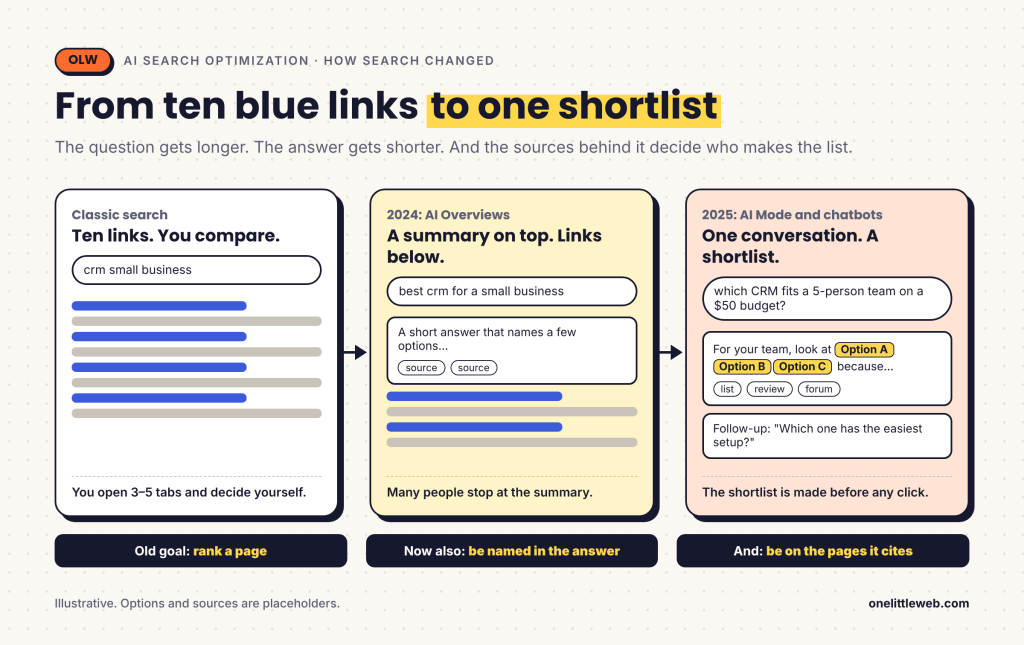
Look at the last panel. The customer asks a full question, gets a shortlist, asks a follow-up, and decides. The pages the AI read to build that shortlist matter as much as your own website. Step 7 is about getting onto them.
You’ll also hear this called AEO (answer engine optimization) or GEO (generative engine optimization). They describe the same goal. If you want the concepts and history, read our guide to AEO. This guide is about doing it.
Why it’s worth doing now, and why SEO still comes first
Is there really a market here, or is this hype? Let’s look at the numbers.
How big is the opportunity?
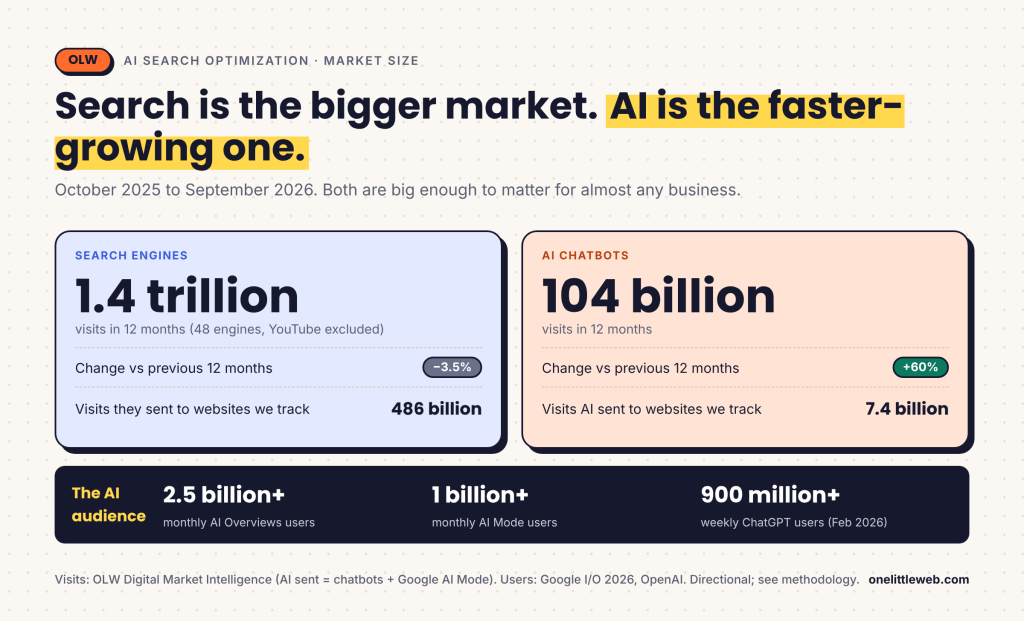
Over the last 12 months, the 48 search engines we track got about 1.4 trillion visits. AI chatbots got 104 billion, 60% more than the year before, while search dipped 3.5%.
The audience is already huge. Google’s AI Overviews reach more than 2.5 billion people a month, and AI Mode passed 1 billion monthly users (Google I/O, May 2026). ChatGPT has more than 900 million weekly users (OpenAI, February 2026).
Now the part that matters for a business: visits sent to websites. Search engines sent the sites we track 486 billion visits. AI tools sent 7.4 billion, about 65 times fewer. Small next to search, but 7.4 billion visits is still a market most industries would love to have. And many AI answers shape a decision without any click at all.
So the honest answer: search is still the bigger prize, and AI is the fast-growing layer on top of it. You need both, and you get both from the same foundations.
Google AI Mode is the fastest-growing AI traffic source
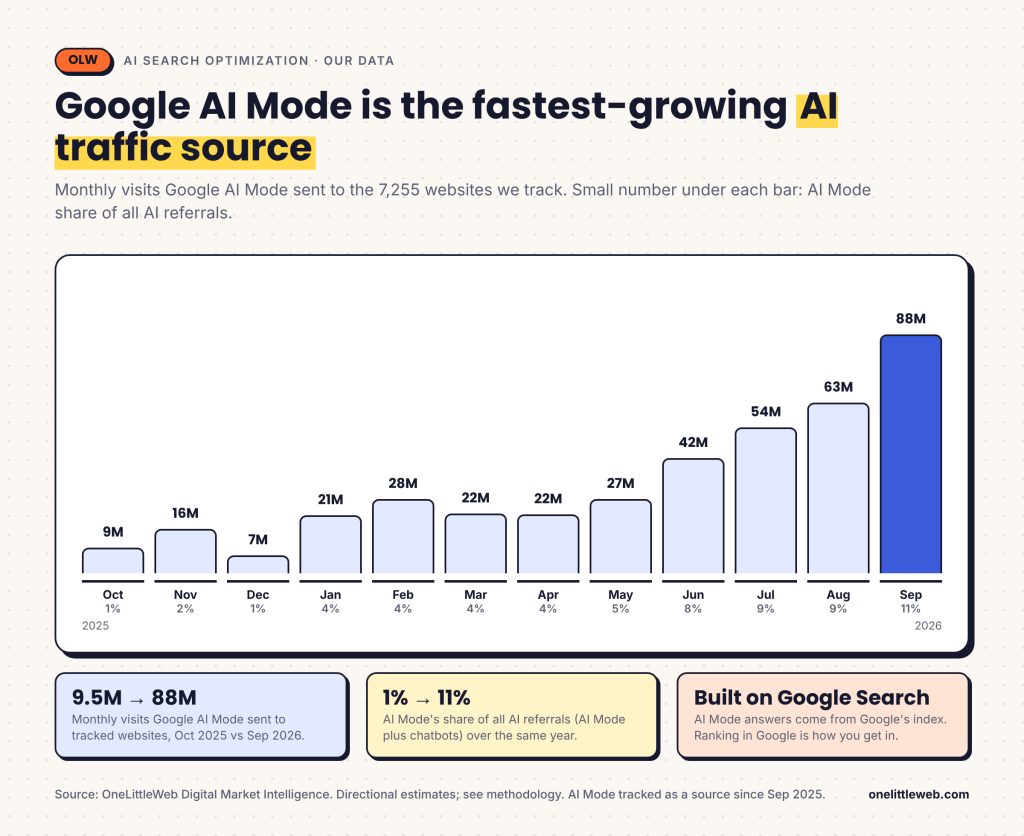
In October 2025, Google AI Mode sent about 9.5 million visits to the websites we track. By September 2026, it sent 88 million. That’s now 11% of all the traffic AI tools send to websites, up from 1%.
AI Mode answers are built from Google’s search index. So the fastest-growing AI traffic source is one you reach through ordinary SEO.
That’s why this guide starts with SEO foundations and builds up from there. Skip them and there’s nothing for AI to find. (For the full search vs AI comparison, see the data in our SEO guide.)
Where AI actually sends people
Here’s the part most guides miss. When an AI tool does send someone to a website, where do they go?
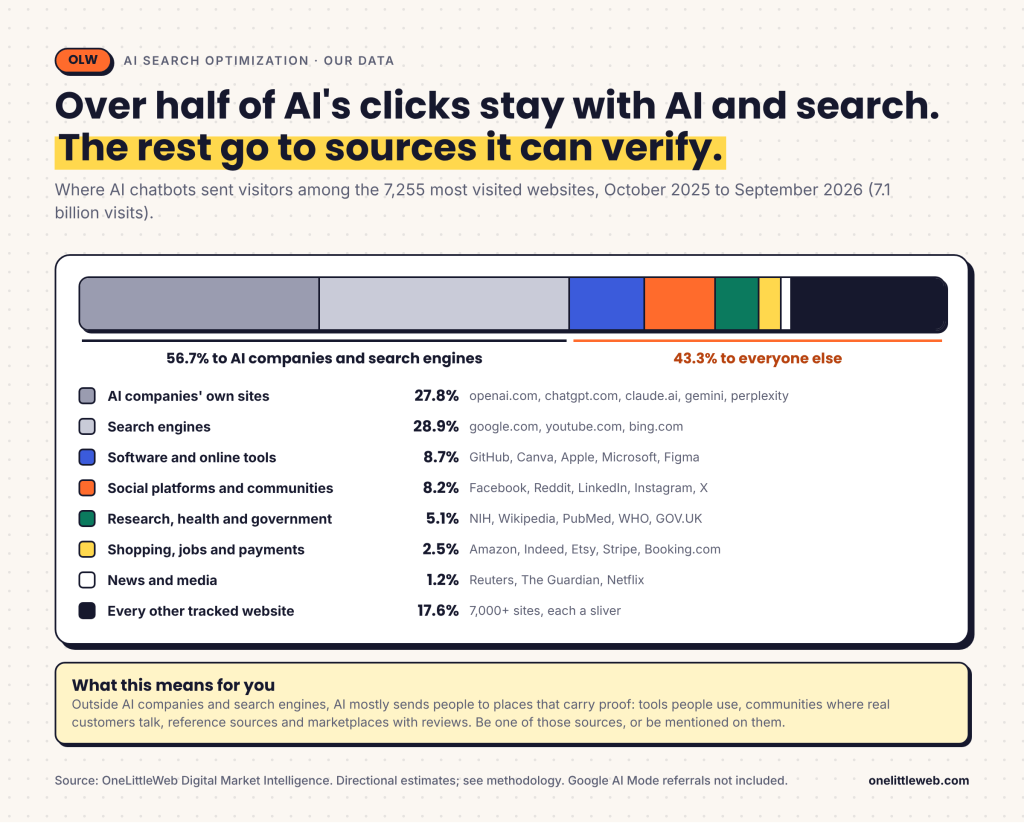
More than half of the visits AI chatbots sent went back to AI companies’ own websites (like openai.com) or to search engines (mostly google.com). The share held steady month after month.
The rest, about 3 billion visits a year, went to places that carry proof:
- Tools people use: GitHub, Canva, Figma, Microsoft.
- Communities where real people talk: Reddit, Facebook, LinkedIn, Instagram.
- Reference and research: Wikipedia, NIH, PubMed, government sites.
- Marketplaces with reviews: Amazon, Etsy, Indeed, Booking.com.
The lesson for any business: AI leans on sources it can verify. Your job is to become one, and to be mentioned on the others. Steps 7 and 8 below are built around exactly that.
What Google says vs what the data shows
Before the steps, clear out the noise. A lot of “AI optimization” advice contradicts Google’s own guidance, and some of it contradicts the data too. Here’s where things stand.
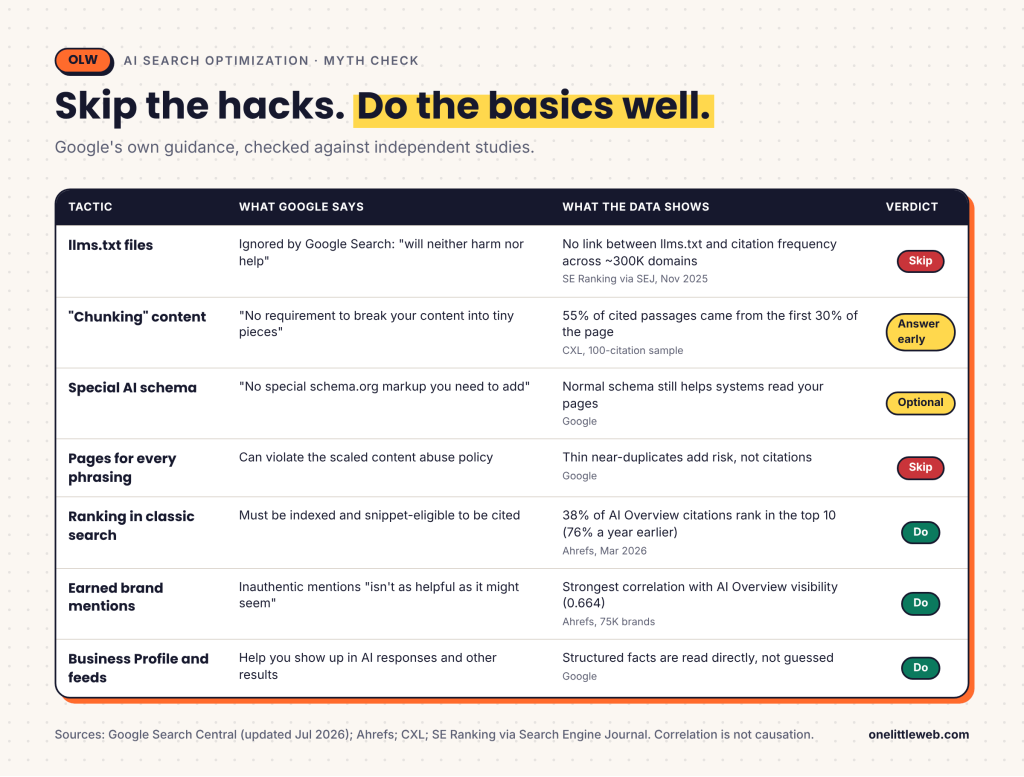
Google’s summary is worth repeating: “Prioritize effective SEO strategies over ‘AEO/GEO hacks'” (Google). Google also says you can ignore “chunking” content and AI text files like llms.txt.
Where independent research adds something Google’s guide doesn’t stress, it’s reputation. In a study of 75,000 brands, Ahrefs found that brand mentions across the web had the strongest link to appearing in AI Overviews, stronger than links or search volume (Ahrefs). That’s steps 7 and 8.
Rankings still matter, but less than they used to. In March 2026, 38% of AI Overview citations ranked in Google’s top 10, down from 76% a year earlier, as AI answers started pulling from many related searches at once (Ahrefs). Ranking gets you in the pool. Reputation and clear answers get you picked.
How to optimize for AI search: 8 steps
For many business owners, this is where AI search feels overwhelming. So here it is in order, in three phases: get found, get quoted, get trusted. Each step ends with a check, so you know when you’re done.
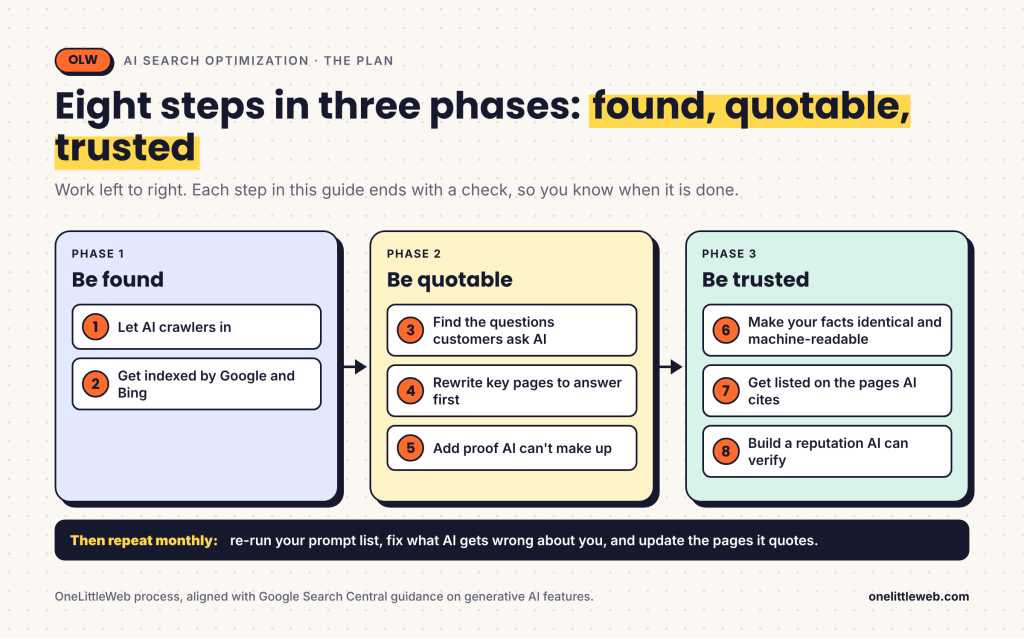
Step 1: Let AI crawlers in
AI tools can only use what their crawlers can read. Many websites block them by accident: a security plugin, a firewall rule or an old robots.txt line.
Each AI company runs separate bots for different jobs. Some fetch pages for live answers. Some collect data for training. You can allow the first kind and still block the second.
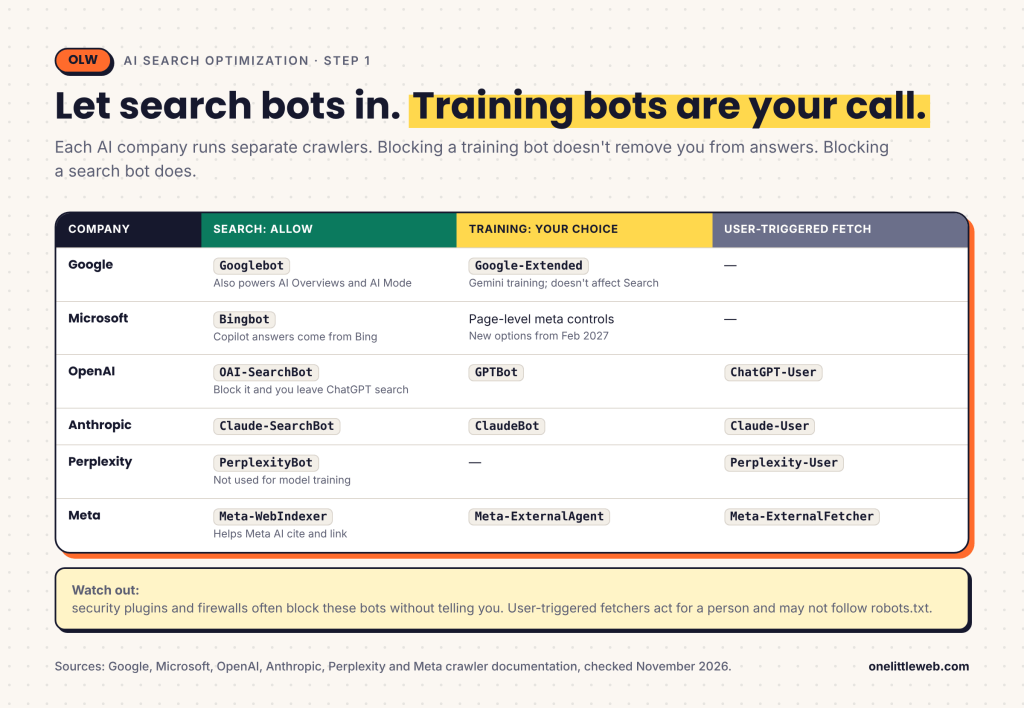
Also check that your important pages work without JavaScript. Many AI crawlers don’t run it, so content that only loads through scripts may be invisible to them.
Check: your robots.txt and firewall allow the search bots, and your key pages show their main content with JavaScript turned off.
Step 2: Get indexed by Google and Bing
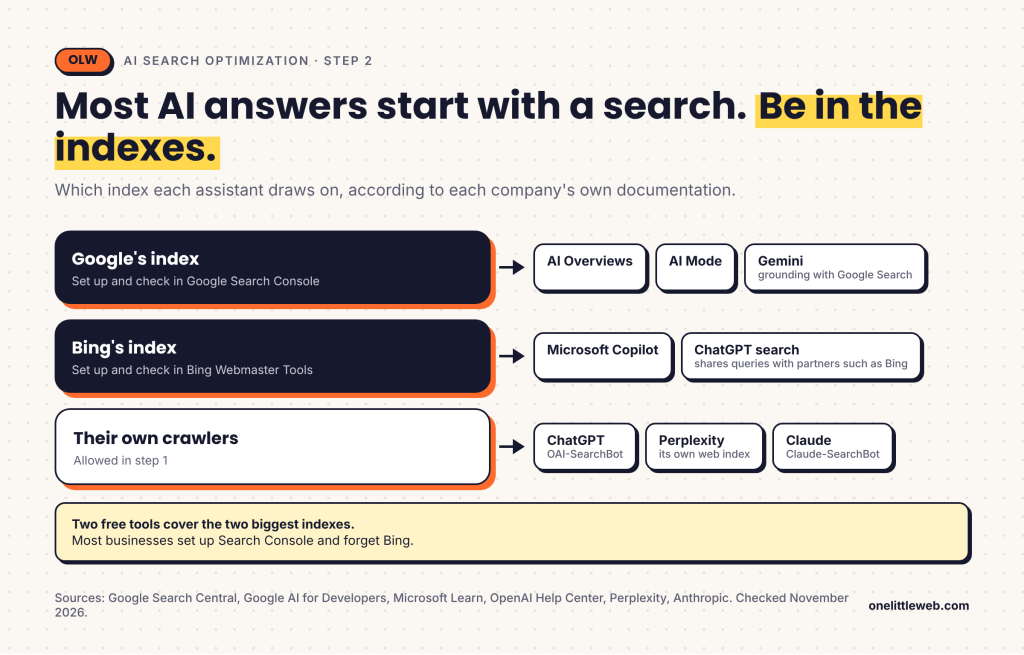
Most AI answers start with a web search. Google’s AI features use Google’s index. Microsoft Copilot sends its searches to Bing (Microsoft). ChatGPT search uses its own crawler and shares queries with search partners such as Bing (OpenAI). Perplexity runs its own web index, and Claude has its own search crawler.
For Google, the rule is simple: to be cited, a page must be “indexed and eligible to be shown in Google Search with a snippet” (Google).
So two free tools matter more than ever: Google Search Console and Bing Webmaster Tools. Most businesses set up the first and forget the second.
If you’re new to indexing, our SEO guide explains how it works in plain English.
Check: your key pages show “URL is on Google” in Search Console’s URL Inspection, and the same pages are indexed in Bing Webmaster Tools.
Step 3: Find the questions your customers ask AI, and baseline them
You can’t improve what you haven’t looked at. List 20 to 30 questions your customers ask before they buy, book or compare. Then ask them yourself.
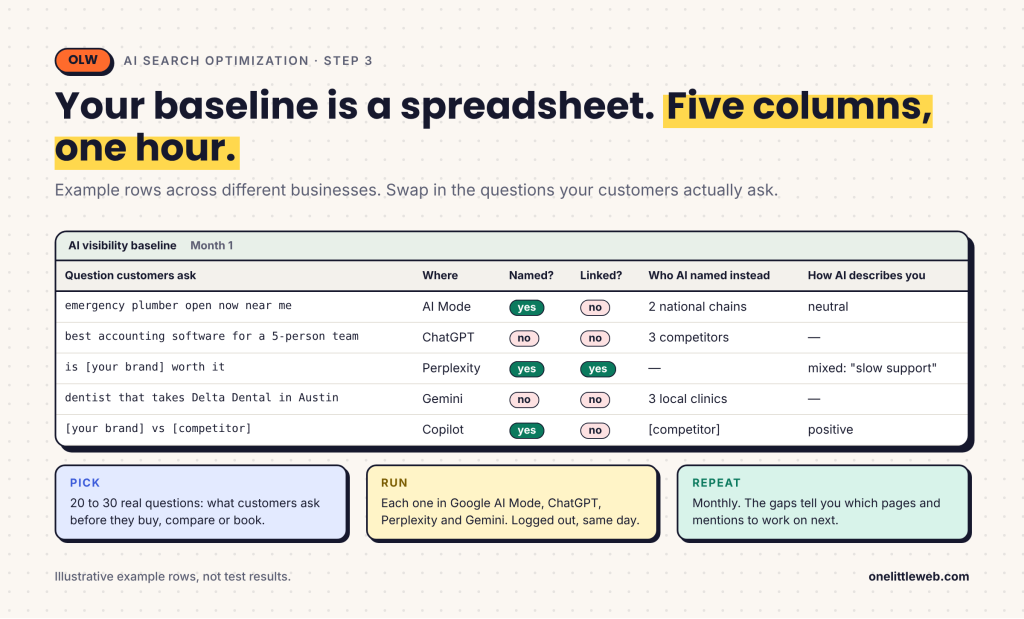
Mix question types: “best [service] near me”, “[product] for [specific need]”, “is [your brand] good”, “[you] vs [competitor]”. Write them the way a customer would say them out loud. AI questions tend to be longer and more specific than searches.
For each answer, write down whether you were named, whether you were linked, who was named instead, and what the AI said about you. The last column matters most. If AI describes you wrongly, it learned that from somewhere, and you can fix the source.
Check: 20 to 30 questions logged across Google AI Mode, ChatGPT, Perplexity and Gemini, with the date.
Step 4: Rewrite your key pages to answer first
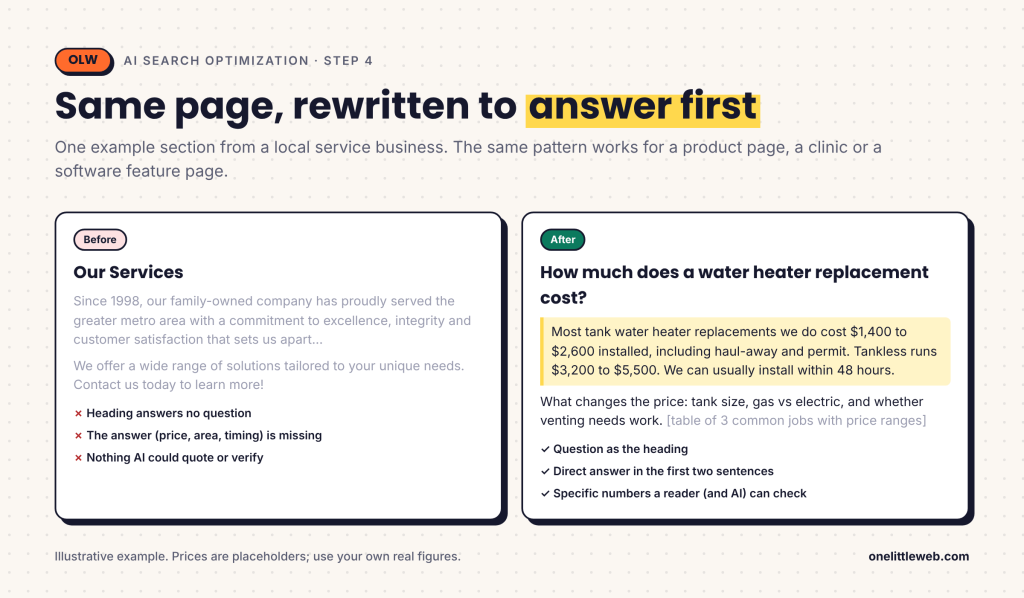
AI tools pull passages, not whole pages. A clear answer near the top of a section is easier to find and quote than one buried in paragraph six.
Start with pages that already get traffic or rank on page one or two. Then for each page:
- Use the questions from step 3 as headings.
- Answer in the first one or two sentences, with specifics: prices, times, sizes, places.
- Put comparisons in tables and steps in numbered lists.
- Add the follow-up questions people ask next, with short answers.
Don’t overdo it. Google says there’s no need to break content into tiny pieces or to write in a special style for AI. Answer-first writing simply helps human readers and AI at the same time.
Check: on each priority page, the main question is answered in the first two sentences under its heading.
Step 5: Add proof AI can’t make up
Anyone can write “quality service” or “easy to use”. So can an AI. That’s why generic pages rarely get cited: there’s nothing in them the AI couldn’t have written itself.
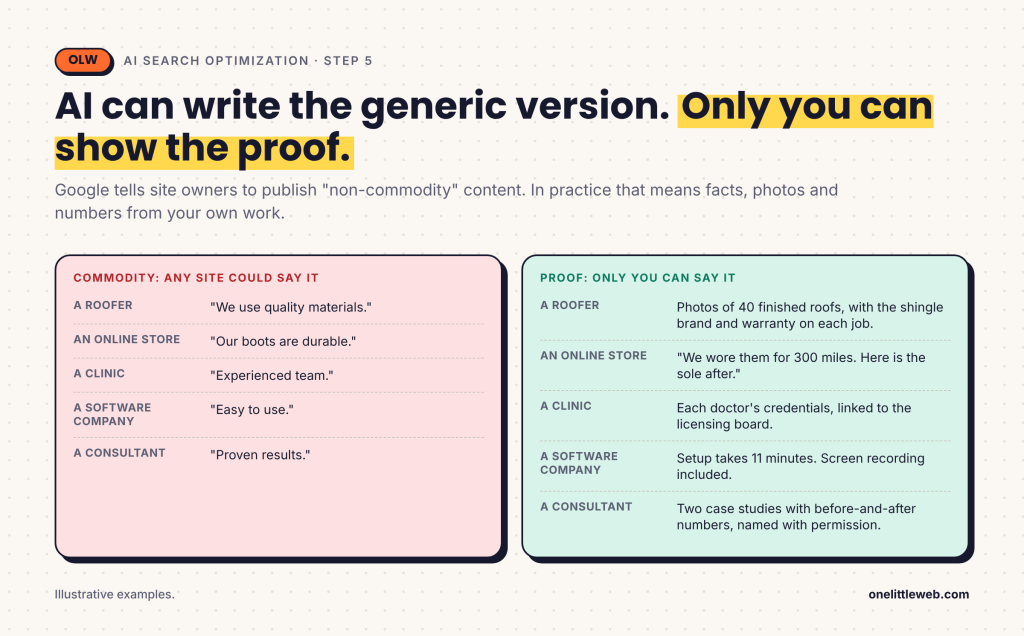
Google’s guide tells site owners to create “non-commodity” content: something more than what’s already been said elsewhere (Google). For a business, that means what only you know: real prices, project photos, measured results, customer stories with permission, your team’s credentials, and your own data.
Check: every priority page has at least one fact, number or image that only your business could provide.
Step 6: Make your business facts identical, and machine-readable
AI tools build a picture of your business from many sources. If your website, Google Business Profile, directories and social profiles disagree on your name, address, services or prices, the AI hedges, or repeats the wrong one.
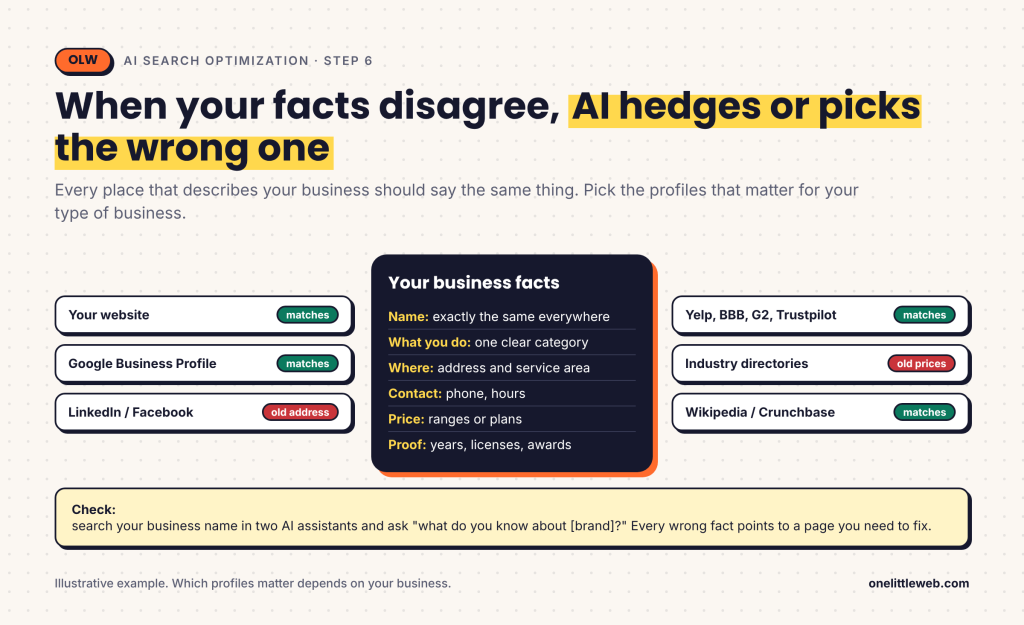
Write your core facts down once: name, category, what you do, where you work, contact details, prices or plans, and proof points like years in business and licenses. Then update every profile that matters for your type of business.
Next, hand those facts over in a format machines read directly, instead of making AI guess from your pages.
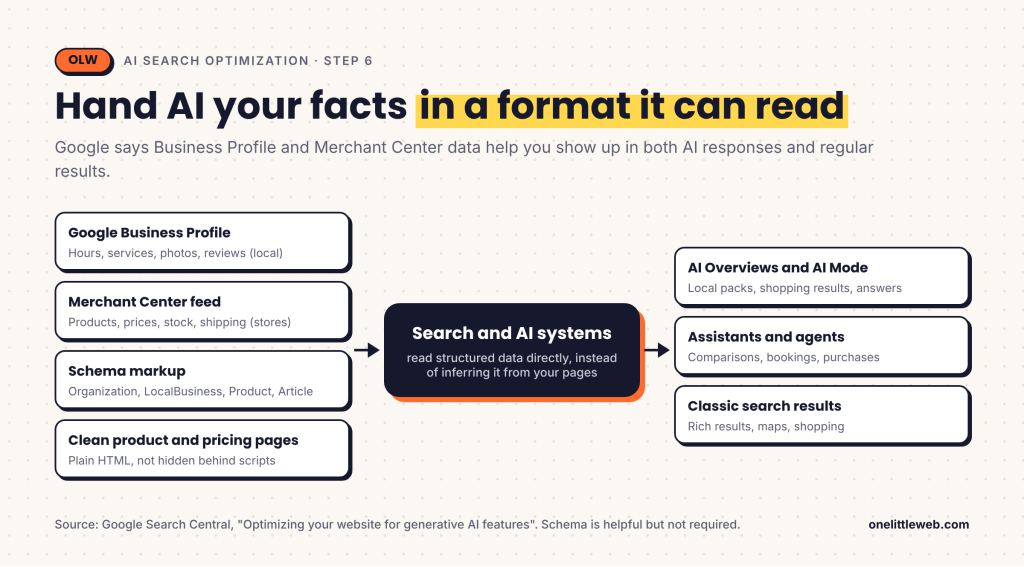
- Local businesses: a complete Google Business Profile with services, hours, photos and reviews.
- Stores: an accurate Merchant Center product feed with prices, stock and shipping.
- Everyone: accurate schema markup for your organization, products, articles and FAQs. Google says it isn’t required for AI features, but it helps systems understand your pages.
Google says Business Profile and Merchant Center data “can help your products and services to be visible in both AI responses” and in regular search results (Google). As AI agents start booking and buying on people’s behalf, clean product and service data will matter more, not less.
Check: ask two AI assistants “what do you know about [your business]?” Every wrong fact should trace back to a page you’ve now fixed. Your Business Profile or Merchant Center shows no errors, and your schema passes Google’s Rich Results Test.
Step 7: Get listed on the pages AI already cites
If you do one thing beyond the basics, make it this.
AI answers aren’t written from nothing. They’re built from a handful of pages: “best of” lists, review sites, comparison articles, community threads and industry guides. Those same pages usually rank in Google too. Get on them, and you show up in both places at once.
We see this pattern across our client work: brands that earn a place on the top lists for their category get named in AI answers far more often than brands that only work on their own site. Here’s what it looks like for one real question.
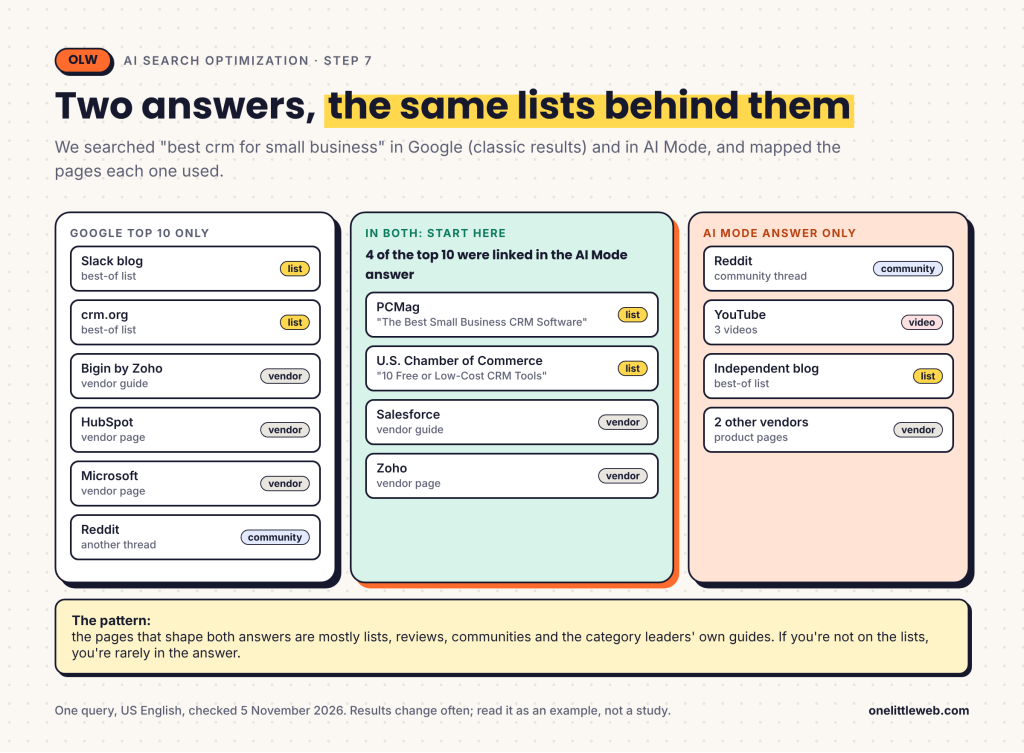
When we searched “best crm for small business”, four of Google’s top 10 results were also linked in the AI Mode answer. Two of those four were “best of” lists, from PCMag and the U.S. Chamber of Commerce. The AI answer also leaned on a Reddit thread, YouTube videos and another independent list. A CRM company that isn’t on those pages is fighting for the shortlist with one hand tied.
Swap in your own industry and the pattern holds: “best plumbers in [city]” lists, “top accounting firms for startups” articles, “best running shoes for flat feet” reviews. Here’s how to work it:
- Find the pages. For each question in your step 3 sheet, note the pages the AI answers link to. Then search the same question in Google and note the top 10.
- Start where they overlap. Pages that appear in both are your highest-value targets. Next come lists that rank well and are updated often.
- Be honest about fit. Go after lists where you’d genuinely earn a place. A list of “best enterprise software” won’t help a two-person studio.
- Earn the placement. Contact the editor or author with something useful: what’s new, real customer results, data, a free trial or sample to test. For lists built on reviews, collect reviews on the platform the list uses. For association and directory lists, apply.
- Become a source yourself. Publish fair comparisons, original data and guides that others quote. AI cites those too.
- Keep it current. Lists get refreshed. Track where you’re listed, keep the relationships, and send updates when you have news.
This is link building for the AI era. A good list placement usually brings a mention for AI and a link that helps your classic rankings. That’s why it’s the center of how we run digital PR and link building for clients.
One warning: earn placements, don’t buy them on pages nobody reads. Pay-to-play lists and link schemes break Google’s spam policies, and Google says chasing inauthentic mentions “isn’t as helpful as it might seem” (Google). If a page doesn’t rank and nobody reads it, AI has no reason to read it either.
Check: for your top 10 questions, you’ve listed the pages AI and Google rely on, and you’re named on at least three of them.
Step 8: Build a reputation AI can verify
Lists are one kind of proof. The rest is everything else people say about you, and AI reads that too.
AI assistants lean on consensus. When several independent sources say similar things about you, the AI has a reason to repeat it. When the only source is your own website, it doesn’t.
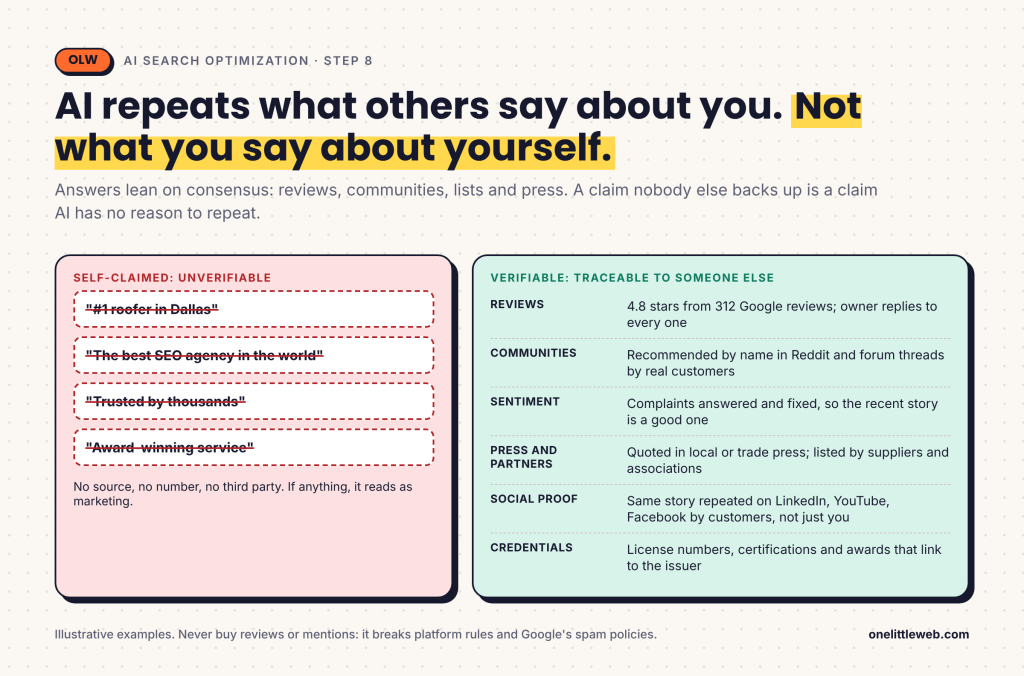
Here’s what verifiable reputation looks like in practice:
- Reviews on the platforms your customers use: Google, Yelp, Trustpilot, G2, Capterra, Amazon, industry sites. Recent, plentiful and answered.
- Community mentions in Reddit threads, forums, Facebook groups and Q&A sites, by real customers.
- Press and partners: local news, trade publications, supplier and association directories.
- Consistent social presence that tells the same story as your website, ideally with customers saying it too.
- Credentials that link to the issuer: license numbers, certifications, awards.
Sentiment counts as well. If the most visible threads about you are complaints, that’s what AI will summarize. Reply to reviews, fix the real problems behind them, and ask happy customers to share their experience where others look.
And never claim what you can’t prove. “Best in the city” or “#1 provider” with no source is a red flag to customers and gives AI nothing to repeat. Buying reviews breaks platform rules and can do lasting damage when it’s found.
Check: your review profiles are complete, recent and answered, and when you ask AI “what do people say about [your business]?”, the answer matches reality.
Platform by platform: what matters most where
The eight steps work everywhere. But each platform leans a little differently. Here’s the short version.
| Platform | Where answers come from | Crawler to allow | Do this first |
|---|---|---|---|
| Google AI Overviews | Google’s search index | Googlebot | Rank on page one for the question; answer it near the top |
| Google AI Mode | Google’s index, many related searches at once | Googlebot | Cover the follow-up questions, not just the main one |
| ChatGPT search | OpenAI’s crawler plus search partners such as Bing | OAI-SearchBot | Allow OAI-SearchBot; earn mentions on lists and reviews |
| Perplexity | Its own web index | PerplexityBot | Keep key pages fresh, specific and well sourced |
| Gemini | Google Search | Googlebot | Same as Google: SEO plus Business Profile and Merchant data |
| Microsoft Copilot | Bing | Bingbot | Verify your site in Bing Webmaster Tools; submit sitemaps |
| Claude | Web search, with its own search crawler | Claude-SearchBot | Allow its search bot; consistent facts and mentions |
One practical point: Google-Extended is a separate control for whether Google can use your content to train Gemini models. Google says it “does not impact a site’s inclusion in Google Search” (Google). AI Overviews and AI Mode are controlled through regular Googlebot and snippet settings.
What a page AI search can quote looks like
Put steps 4 and 5 together and you get a recognizable page shape. It works for a service page, a product page, a clinic’s treatment page or a software feature page.
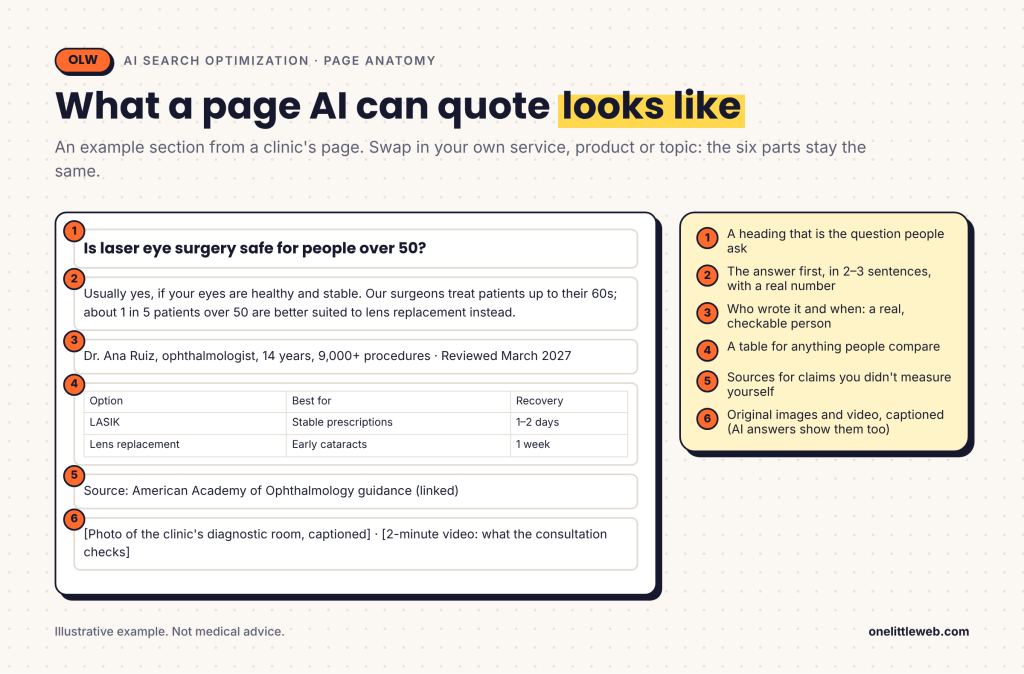
Two details are easy to miss. First, a real author with real credentials, so readers and systems can check who’s behind the advice. Second, original images and video with captions. They’re proof no one else can copy, and they make the page more useful to the people who click through.
What to focus on for your type of business
Every business needs steps 1, 2 and 6. After that, where you start depends on what you sell and how customers choose.
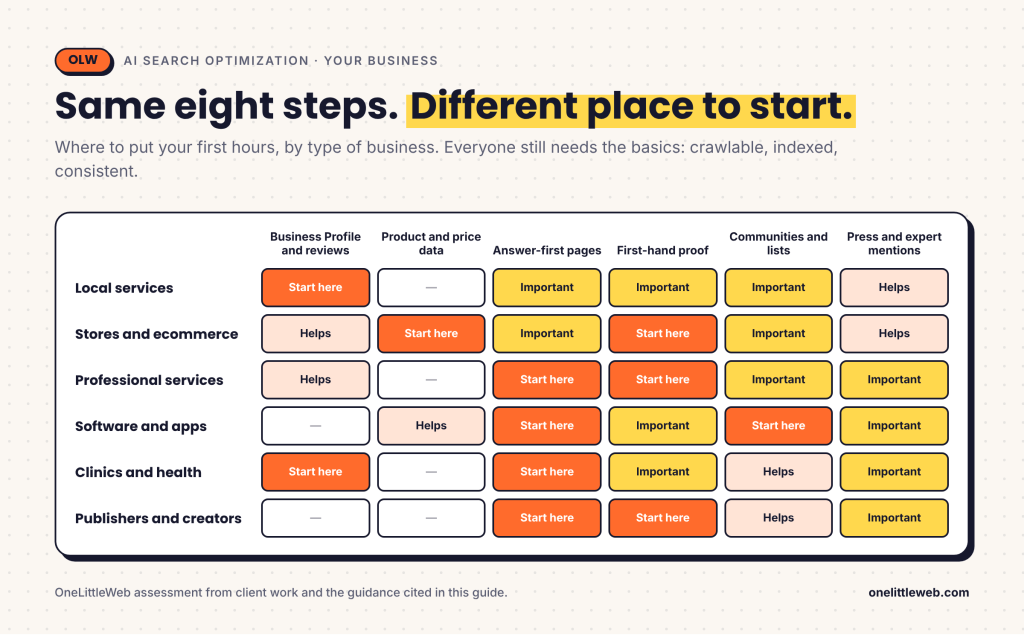
- Local services (plumbers, roofers, salons, contractors): Google Business Profile, reviews and replies, and service pages that answer price and availability questions.
- Stores and ecommerce: Merchant Center feeds, product pages with real specs and photos, and reviews on your site and on marketplaces.
- Professional services (law, accounting, agencies, consultants): answer-first expert content, case studies with real numbers, and mentions in trade press and directories.
- Software and apps: comparison and use-case pages, review platforms like G2 and Capterra, and being included in independent “best of” lists. (This is where much of our AI SEO work happens.)
- Clinics and health: pages reviewed by named clinicians, accurate Business Profiles, and reviews. Health topics are held to a higher standard of trust.
- Publishers and creators: original reporting, data and opinion that AI must attribute rather than summarize away.
How long AI search optimization takes
Some changes show up in weeks. Others take months. It helps to think of two lanes.
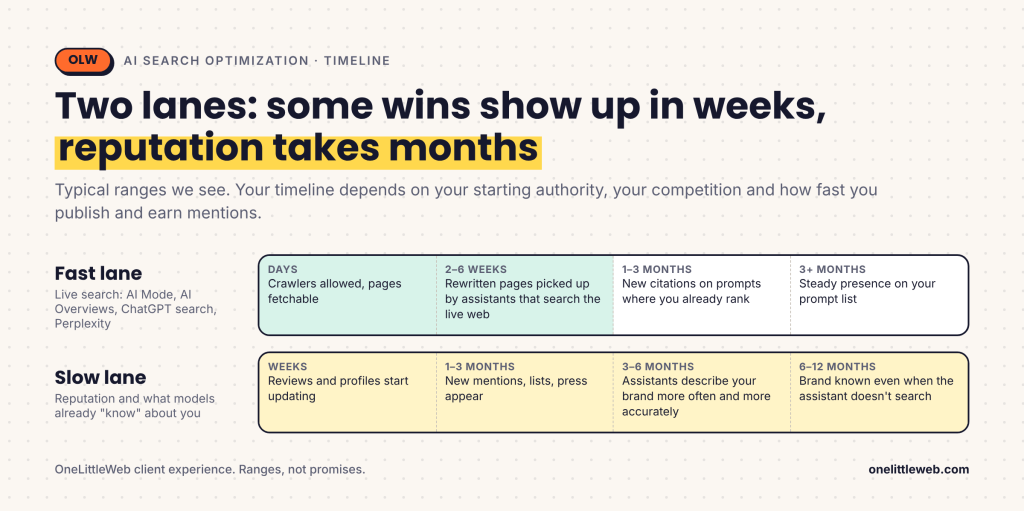
The fast lane is live search. AI Mode, AI Overviews, ChatGPT search and Perplexity look at the web when they answer, so fixes to access and pages can show up within weeks, especially where you already rank.
The slow lane is reputation: reviews, mentions, lists and press, and what AI models already “believe” about your brand. That builds over months. It’s also the part competitors can’t copy quickly.
Anyone promising guaranteed AI rankings in 30 days is guessing. As Google puts it: “No third-party tool has access to our internal ranking or AI systems.”
How to track your AI search visibility
You can track AI visibility three ways. Most businesses should use the first two from day one and add the third when the numbers start to matter.
| Layer | Cost | What it tells you | Best for |
|---|---|---|---|
| 1. Question checks (by hand or with an AI assistant) | Free, about an hour a month | Whether you’re named, linked and described correctly, and which pages AI cites | Everyone, from day one |
| 2. Free dashboards (Search Console, Bing, GA4) | Free | AI Overviews and AI Mode impressions, Copilot citations, AI referral visits and conversions | Everyone, set up once |
| 3. Paid trackers | Monthly subscription | Daily tracking across platforms, share of answers vs competitors, cited sources over time | Competitive markets, many questions |
Layer 1: check your questions, by hand or with AI
Re-run your step 3 question list every month and log the results. It’s the only method that shows you exactly what customers see and what AI says about you.
You don’t have to do it all by hand. AI assistants like Claude or ChatGPT can run the checks and do the logging for you. Paste your list into an assistant with web search turned on and use a prompt like this:
For each question below, search the web and answer it the way you
normally would. Then give me one table row per question with:
1) the businesses you named, in order
2) whether [Your Business] was named (yes/no) and how you described it
3) the URLs you used as sources

Questions:
[paste your 20-30 questions]
Then ask it to compare this month’s table with last month’s, and to list the cited pages that don’t mention you yet. That last list is your step 7 target list.
Two cautions. An assistant’s answer depends on its version, your location and your account, so treat it as a consistent sample, not what every customer sees. And check Google AI Mode and AI Overviews directly in Google, since a chatbot can’t show you Google’s results.
Layer 2: set up the free dashboards
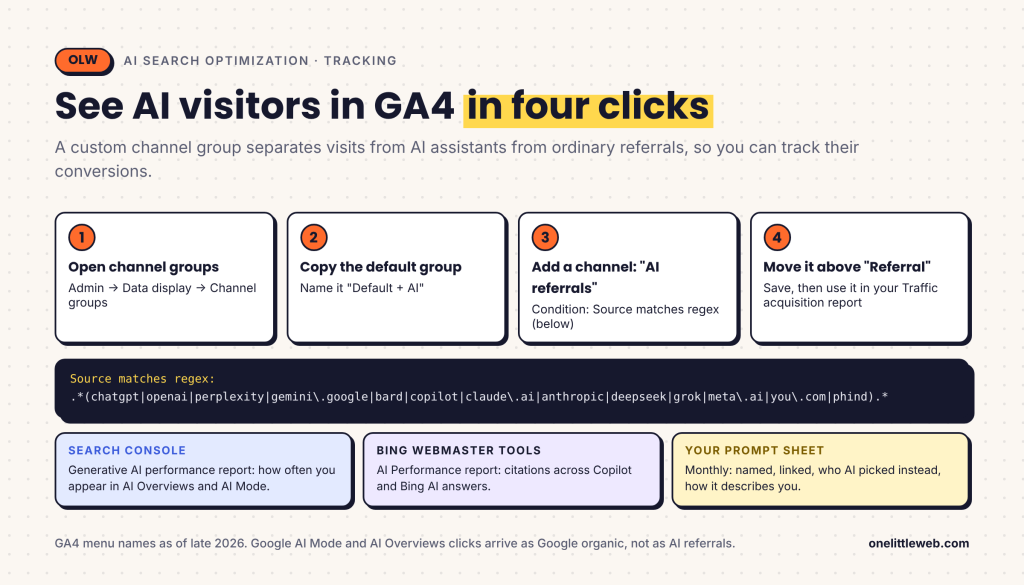
- Google Search Console: the generative AI performance report shows how often links to your site appeared in AI Overviews and AI Mode. It reached all websites in August 2026 (Google). Clicks from AI features are counted inside your normal “Web” search traffic.
- Bing Webmaster Tools: the AI Performance report shows how often your pages are cited in Microsoft Copilot, Bing’s AI summaries and some partner apps (Bing).
- Google Analytics 4: create a custom channel called “AI referrals” so visits from ChatGPT, Perplexity, Gemini, Copilot and Claude are separated from other referrals. Then watch conversions, not just visits.
Here’s the regex to paste into GA4 (Source matches regex):
.*(chatgpt|openai|perplexity|gemini\.google|bard|copilot|claude\.ai|anthropic|deepseek|grok|meta\.ai|you\.com|phind).*
Layer 3: add a paid tracker for ongoing monitoring
AI visibility tools run hundreds of questions daily across platforms, track your share of answers against competitors and show which sources get cited over time. They’re worth it once your question list outgrows a spreadsheet, or when you’re reporting AI visibility to a team or client. We’ve compared them in our AI answer tracking tools roundup and our LLM tracking tools roundup. If you also track classic rankings, see our rank tracking software picks.
One caution from Google: “Be wary of third-party tools that promise ranking success or claim to use ‘internal’ Google metrics.”
For a deeper walkthrough of the metrics, see the measurement section of our AEO guide.
Mistakes that waste AI search budgets
- Blocking the wrong bots. Blocking AI training bots is a fair choice. Blocking their search bots by accident removes you from answers.
- Treating llms.txt as the strategy. Google ignores it. It’s harmless, but it isn’t a plan.
- Publishing a page for every phrasing of a question. Google says separate pages for every variation of a query can violate its scaled content abuse policy.
- Self-claimed rankings. “#1 in [city]” without proof convinces nobody, human or machine.
- Fake reviews and pay-to-play lists. They break platform rules, and a list nobody reads gives AI nothing to read either.
- Working only on your own website. AI answers lean on other people’s pages. If you’re not on the lists and reviews it cites, a perfect website isn’t enough.
- Ignoring Bing. It feeds Copilot and other assistants. Ten minutes to set up.
- Measuring visits only. Many AI influences never become a click. Track mentions, accuracy and conversions too.
- Forgetting SEO. AI answers draw on pages that rank. No foundation, no citations.
Do it yourself, or get help?
Most of this guide is doable on your own. Steps 1, 2, 3 and 6 need time more than expertise. Steps 4 and 5 need someone who knows your business well.
Steps 7 and 8 are where most businesses get stuck. Earning a place on the lists AI cites, plus press, reviews and links, takes relationships, outreach and patience. It’s also the part that moves AI answers the most.
If you’d rather have experts run it, that’s what our AI SEO and GEO services do. For one AI SaaS client, chatbot traffic went from 2,000 to 40,000 visits a month in a year, while organic search grew 76% from the same work (case study).
AI search optimization FAQ
What is AI search optimization?
It’s the work of making your business easy for AI tools like Google AI Overviews, AI Mode, ChatGPT and Perplexity to find, understand, trust and recommend. It builds on SEO and adds a stronger focus on clear answers and a reputation AI can verify across the web.
How do I optimize my website for AI search?
Let AI search crawlers in, get indexed in Google and Bing, find the questions customers ask AI, rewrite key pages to answer them first, add proof only you can provide, keep your business facts consistent everywhere, earn genuine reviews and mentions, and keep your Business Profile or product feeds complete.
Is SEO dead because of AI search?
No. Google says optimizing for its AI features is still SEO, and AI answers draw on pages that rank. Search engines also still send websites far more visitors than AI tools do, about 65 times more over the last year in our tracking of 7,255 top sites.
Does llms.txt help with AI search?
Not in Google. Google says it ignores AI text files like llms.txt and that they neither help nor harm visibility. Other platforms haven’t documented using it. It’s harmless to have, but it isn’t a strategy.
Does schema markup help AI citations?
It helps search engines understand your pages, and Google recommends continuing to use it. But Google says no special schema is required for its AI features. Use it for accuracy, not as a shortcut.
How long does AI search optimization take?
Fixes to crawler access and page content can show up within weeks on platforms that search the live web, especially where you already rank. Reputation work such as reviews, mentions and press usually takes three to twelve months to change how AI describes your business.
How do I get my business mentioned by ChatGPT?
Allow OpenAI’s search crawler (OAI-SearchBot), make sure your key pages are indexed in Bing as well as Google, and answer customer questions clearly on your site. Then check which lists, review sites and communities ChatGPT cites for your questions, and earn a place on them.
How do I track traffic from AI search?
Use Google Search Console’s generative AI report for impressions in AI Overviews and AI Mode, Bing Webmaster Tools’ AI Performance report for Copilot, and a custom “AI referrals” channel in GA4 for ChatGPT, Perplexity and others. Add a monthly check of the questions you care about, and a paid tracker if you need daily data.
How do I get my business on the lists AI uses?
Find the “best of” lists, reviews and comparison pages that AI answers and Google’s top 10 both use for your questions. Start with the ones that appear in both. Contact the editors with real news, results or data, collect reviews on the platforms those lists rely on, and keep the relationship going as lists are updated. Avoid pay-to-play lists that nobody reads.
Can I use ChatGPT or Claude to track my AI visibility?
Yes. Paste your list of customer questions into an assistant with web search and ask it to answer each one, then report which businesses it named, whether yours was included, and which sources it used. Results vary by account and location, so treat them as a sample, and check Google’s AI features directly in Google.
Where to go next
- What Is SEO? Our beginner’s guide
- What Is AEO? Answer engine optimization explained
- AI answer tracking tools
- Best AI SEO tools
- Live data: websites by AI traffic
Methodology: how we collected our market data
The traffic charts in this guide come from OneLittleWeb Digital Market Intelligence, our own tracker of website and AI tool traffic. Here’s what the numbers are, what they aren’t, and why the live dashboard may not match them exactly.
Where the numbers come from
- Estimates, not site analytics. Visit counts are estimated from third-party traffic data (SEMrush, Ahrefs and Aitools.xyz), not measured inside each website.
- What a “visit” means. Estimated monthly visits. Returning users are counted again each month.
- AI referrals. “AI traffic” is visits referred to a website by AI chatbots; “Google AI Mode” is tracked as a separate source. Both are classified by the data providers. AI chatbot referrals are tracked from February 2025 and Google AI Mode from September 2025.
- Where AI sends visitors (chart 01). For each month, we took the 100 websites receiving the most AI chatbot referrals, grouped them by category, and identified AI companies’ own sites by name (for example openai.com, chatgpt.com, claude.ai). Everything outside each month’s top 100 is shown as “every other tracked website”. Google AI Mode referrals are not included in this chart.
Periods used
- Market size: October 2025 to September 2026 compared with the 12 months before. Search engines are the 48 tracked engines excluding YouTube. “Visits sent to websites” counts referrals to all 7,255 tracked sites; the AI figure combines AI chatbots and Google AI Mode.
- Where AI sends visitors: October 2025 to September 2026 combined (7.1 billion AI chatbot referrals). Monthly shares were stable: AI companies 22% to 35%, search engines 22% to 32%.
- Google AI Mode: monthly, October 2025 to September 2026. December values in the dashboard are interpolated.
- Data pulled November 5, 2026. September 2026 was the latest month available.
The step 7 example
The citation map compares Google’s top 10 organic results (web results only) with the pages linked in a Google AI Mode answer for one query, “best crm for small business”, searched in US English on November 5, 2026. It’s a single example to show the pattern, not a statistical study. AI answers and rankings change often.
Why the live dashboard may show different numbers
The dashboard is live; these charts are a snapshot. They will drift apart because the dashboard is refreshed every one to two months, websites are added or removed based on relevance, data providers revise their estimates, and we correct discrepancies or update calculations when we find them.
Known limitations
- Estimates can be off for individual sites. Totals across thousands of sites are more stable than any single number.
- Referrals only count visits that arrive with a recognizable AI source. Much of AI’s influence never becomes a click.
- Country-level data is under review, and we don’t use it here.
Read these numbers as directional: trends, proportions and orders of magnitude, not exact counts.