Do you know what ChatGPT says when someone asks for the best option in your industry? Most teams don’t. All they do is check the search engine ranking. But very few check what AI answers or recommendations buyers are getting.
The good news is, AI answer tracking software does that checking for you. What they do is run all the prompts your buyers usually search with and see if your brand gets mentioned in those answers or not. But which answer tracking tool or platform to choose from?
Glad that you asked. I’ve gathered the top 6 AI answer tracking platforms here with features, pricing, which AI engines they cover, and all the necessary details that you would need.
I personally use a lot of these tools on a daily basis. So, my take on these tools comes from personal experience and will obviously have biases.
- Both AI visibility & Search engine ranking are 2 separate numbers. So, it’s possible to rank at number 1 and still miss the AI answers completely.
- Check what a tool counts before you compare plan names. One prompt checked daily on four AI engines uses four times the quota of the same prompt on one engine.
- If you already use Ahrefs or Semrush, start there. Both of those tools include AI answer tracking.
- If you’re looking for a dedicated standalone tool, Peec AI or Otterly AI can be a good pick without the add-ons.
- Start with 25 to 50 high-intent prompts. Grow the list once you see where competitors beat you.
Why AI Answer Tracking Matters Now
Most of the people still use Google every day. But a growing number of them now get a full answer from an AI tool before they see a single blue link. If your brand isn’t in that short answer, the click never happens. It changes the whole meaning of visibility.
In June 2025, Semrush published a study of more than 500 digital marketing and SEO topics. It found the average visitor from AI search was worth 4.4 times more than a traditional organic visitor. That was measured by conversion rate, and “AI search” meant sources like ChatGPT, not Google.
Well, Semrush has its own AI visibility tool. So take that with a grain of salt. But it lines up with what we see nowadays in search. Visitors you get from AI answers have already done their research.
The thing is, you can influence the AI answer.
How We Chose These Platforms
We chose these 6 tools based on some specific criteria. Based on these, you can compare and see where each of these AI answer tracking tools lands.
- Overall performance of the AI engine based on Google AI Overview, AI Mode, ChatGPT, Perplexity, and Gemini
- Effectiveness of situation monitoring
- Competitor data, including analysis of sentiment and citations
- Capability to relate the AI data with SEO and traffic measurement
- Starting price.
What an AI Answer Tracker Actually Measures
The AI answer trackers usually measure a few different things, not just whether you are mentioned in the answer or not. Here are the things they measure:
- How many times your brand gets mentioned in the AI answer
- How often your brand gets citations. You get direct traffic from citations.
- What percentage of those ai answers mention you vs. mentions your competitors.
- They track whether you are mentioned in a positive sentiment or negative.
- Where you show up inside the answer is also important.
A lot of these tools have a large prebuilt prompt database. Semrush claims they have 239 million prompts; on the other hand, Ahrefs claims they have 495 million prompts in their database. You can use both prebuilt and your own tracked prompt at the same time.
Top AI Answer Tracking Platforms at a Glance
| Platform | Best for | AI engines covered | Entry pricing |
| Semrush | Groups that seek AI and SEO visibility in a single location | Google AI Overviews, AI Mode, ChatGPT, Perplexity, Gemini | Free plan; AI Visibility toolkit from $99/mo |
| SISTRIX | Current users of SISTRIX and international SEO teams | Google AI Overviews plus AI chatbot answers (beta) | From €119/mo with AI features currently included |
| Ahrefs Brand Radar | Users of Ahrefs seeking extensive analysis options | AI Overviews, AI Mode, ChatGPT, Perplexity, Gemini, Copilot (Claude via Custom Prompts) | AI Visibility Index from $199/mo |
| Profound | Corporate answer engine technology groups | Up to 9 engines on Enterprise | Free trial; custom Enterprise pricing |
| Peec AI | Streamlined teams looking for uncomplicated reporting on a regular basis | Choice of 3 models per self-serve plan, more as add-ons | Starter plan with 50 prompts |
| Otterly.AI | Freelancers and small enterprises | ChatGPT, AI Overviews, Perplexity, Copilot (AI Mode and Gemini as add-ons) | Lite plan with 15 prompts |
1. Semrush
Best for: The marketing departments and agencies are on the lookout for tools to monitor the AI-driven responses of their target audiences in addition to their SEO, content, and competitor information.
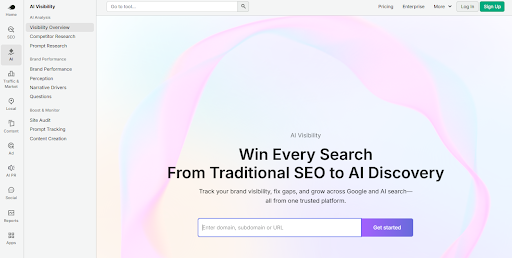
Semrush launched its AI Visibility Toolkit in September 2025. It now bundles that toolkit with its SEO Toolkit under the name Semrush One.
So you don’t need a separate tool for AI answers. You can track the Google rankings and the AI visibility in the same place. If your team already uses Semrush, then tracking the AI answers here is the best option for you. Sure, it’s lighter in depth than a dedicated prompt tracker, but it’s decent and gets the job done without costing you extra money.
Key strengths:
- Through Brand Performance reports, updates are provided every week regarding Voice Share and sentiment, including ChatGPT, AI Mode, Perplexity, and Gemini.
- Position Tracking tracks Google rankings and AI Overview shows both AI displays and AI prompts used every day.
- The Site Audit identifies the blocked data miners, including OAI-SearchBot, PerplexityBot, and Claude-SearchBot as AI Visibility conducts AI searching analysis on 100 pages at once.
Large companies could upgrade to Enterprise AIO which allows unlimited monitoring on top of personalized help and custom integrations.
Limitation: Engine coverage varies from report to report; prompt limits are given with a scale of an entry SEO and AI search pack with 50 daily tracked prompts.
Pricing: Free plans are available, while the prices for the AI Visibility toolkit start at $99, and for SEO pricing packs ; from $139.95 per month.
2. SISTRIX
Best for: Teams that already use the services of SISTRIX for Google search engine optimization, particularly across many nations.
SISTRIX has measured Google visibility since 2008. It’s especially popular with European SEO teams.
Its AI and chatbot features sit inside the regular toolbox and are still labeled beta. AI Check needs no setup at all. Type in a brand or domain, and you see the prompts where it’s mentioned or cited.
The upside of beta is price. Right now, SISTRIX customers get the AI features at no extra cost, and SISTRIX says over 1,000 companies already use them.
The downside is coverage. Prompt Tracking covers four AI surfaces, which is fewer than Ahrefs or Profound. Pricing may also change when the beta ends.
We haven’t used SISTRIX at OLW. This section is research-based, drawn from SISTRIX’s docs and changelog.
Key strengths:
- Sentiment scoring from -100 to +100 shows how the AI systems are talking about the brand by platform.
- The Recommendation Map shows situations where you can observe your brand’s recommendations and only competitors.
- Prompt Tracking shows the visibility of your custom prompt sets.
Limitation: It should be noted that the AI features are still in beta and SISTRIX may additionally charge for it later.
Pricing: It starts from €119/month (taxes excluded) for all packages, with AI Check and Prompt Tracking included in the offer.
3. Ahrefs Brand Radar
Best for: Ahrefs customers interested in evaluating brand potential with AI.
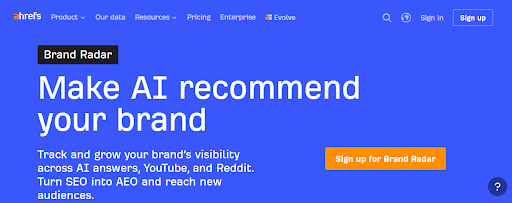
Brand Radar works in two ways. The AI Visibility Index has already run over 495 million prompts through six AI platforms and stored every answer. Custom Prompts track your own list of buyer questions.
The index is what sets it apart. You can look up a competitor, a whole category or your own brand today, with history back to 2025. There’s no waiting for data to build up.
We use Ahrefs daily at OLW for backlink and keyword work. That matters here, because Brand Radar ties every AI mention back to real search demand and the pages that got cited.
There are two catches. The index is re-tested monthly on a 90-day window, so it’s better for trends than for last week’s change. And it works best for brands that already have real search volume.
Key strengths:
- Among key elements constituting the Index are AI Overviews, AI Mode, ChatGPT, Perplexity, Gemini and Copilot.
- Among indicators included are Mentions, Citations, Share of Voice ratio and metrics on impressions.
- Custom Prompts consist of Claude and what you can ask to your potential clients on daily basis.
Limitation: Index questions are simulated on monthly basis for 90 days so changes occurring very recently may not be visible.
Pricing: The AI Visibility Index starts from $199/month, Custom Prompts from $50/month.
4. Profound
Best for: Enterprise brands with dedicated teams for answering engines optimization.
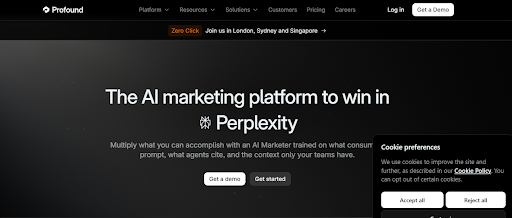
Profound is a standalone AI visibility platform built for large companies. It now pitches itself as an “AI Marketer,” with agents that handle research and content work on top of its tracking data.
Its pricing has changed this year. Earlier in 2026, Profound listed self-serve Starter and Growth plans. As of October 2026, its pricing page shows only a free trial and custom Enterprise pricing for brands.
That matters because a lot of reviews still quote the old $99 plan. It’s no longer there.
On Enterprise, Profound can track up to nine engines, including DeepSeek, Claude and Exa. It also offers SSO/SAML and SOC 2 compliance, which security teams will ask about.
We haven’t used Profound at OLW. This section is research-based, from Profound’s pricing page and help center.
Key strengths:
- Brands can try prompt tracking free of charge before switching to a tailor-made Enterprise plan.
- Enterprise plans keep tabs on 9 answering engines and several organizations.
- It also comes equipped with SSO/SAML and SOC 2 compliance for security-oriented groups.
Limitation: Companies cannot sign up for a self-service paid service meaning than a personalized Enterprise agreement is needed in order for full access.
Pricing: Free trial and customized Enterprise pricing afterwards. Marketing agencies can self-service for $399 monthly for every client workspace.
5. Peec AI
Best for: Lean marketing teams that want daily reports without using a complete SEO package..
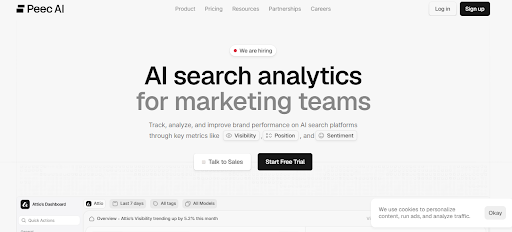
Peec AI only does AI search analytics. You add prompts, pick three models, and Peec runs them every day. It then tracks your visibility, position, sentiment and share of voice against competitors.
Every plan includes unlimited users. Tracking extra countries or languages doesn’t cost more either, because pricing is tied to prompts and models, not regions.
Peec says more than 3,500 brands and agencies use it.
The main limit is the three-model cap on self-serve plans. Extra models cost more, and Claude is only available on Enterprise.
We haven’t used Peec AI at OLW. This section is research-based, from Peec’s pricing page and docs.
Key strengths:
- The Starter plan is designed for analytics based on 50 prompts among 3 model types, and there are no limits as to how many users you can have.
- Your AI source analytics will provide information on what domains and URLs your AI solutions have cited and also show the gaps where your competitors were mentioned but you were not.
- Your audit of crawlability reveals the total of 40+ AI bots allowed by your robots.txt file.
Limitation: The self-service plans provide you with a maximum of 3 models each, while each subsequent model is offered for additional funds.
Pricing: The cost of self-service plans is dependent on the number of prompts, and yearly payment gives a discount of 15%.
6. Otterly AI
Best for: Freelancers, consultants and small companies launching in AI tracking.
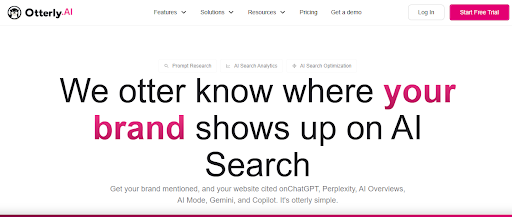
Otterly AI is the cheapest way into proper daily AI tracking on this list. The $29 Lite plan covers ChatGPT, Google AI Overviews, Perplexity and Microsoft Copilot, with unlimited team members.
It also goes past a simple dashboard. Every plan includes a GEO audit, a crawlability check and a set of weekly recommendations.
Two things to watch. Fifteen prompts is a small list. And engine add-ons are priced by plan, so the same add-on costs far more on Premium than on Lite.
Key strengths:
- Basic plans cover ChatGPT, Google AI Overview, Perplexity and Microsoft Copilot.
- Google AI Mode and Gemini are paid features.
- Standard and Premium subscription holders can add their prompts in blocks of 100.
Limitation: Lite subscription is limited to 15 prompts that can be quickly used when monitoring competitors.
Pricing: Lite (15), Standard (100) and Premium (400), with separate plans for enterprises.
Frequently Asked Questions
Well, it’s only natural to have questions if you are not familiar with AI tools and how they track your prompts. Here are some commonly asked questions about them.
What does AI Answer Presence Tracking mean?
It refers to the method of observing how your business shows up in the answers provided through different AI products, namely ChatGPT, Gemini, and Google AI Overview.
What AI platforms should I monitor first?
Monitor ChatGPT and Google AI Overview first, as they have quite a large user base. You can monitor Perplexity, Gemini or AI Mode depending on your customers’ search behavior.
How many prompts should I monitor?
A small group of 25 to 50 prompts will be the right place to start, based on your product category, comparative analysis, and purchase inquiry. You can expand the monitored prompts depending on the data obtained later.
Is AI Overview tracking free of charge?
Somehow. As some technologies provide AI Overview tracking in their free plans already; however, you will have to subscribe to a paid plan for prompt monitoring across AI products
When do AI answers change?
Quite frequently. The answers change for many reasons; therefore, most platforms update their data on a daily and weekly basis.
Conclusion
Even before clicking any link, buyers make their buying decision nowadays. And it is often the AI tools that shape those decisions with their answers. So, if you are not tracking the results or answers, you’re only guessing.
And contrary to popular belief, you don’t need to spend a lot to track your AI visibility. Chances are there is a tracker in your existing SEO tool already. Or you can simply start with an affordable or cheaper plan with 30-50 prompts at the beginning.