Quick answer
SaaS content marketing is creating content that helps people find, try, buy and keep using your software. The strategies that work tie every piece to signups or retention, put bottom-of-funnel pages first, show the product inside the answer, and measure revenue, not just traffic.
Key takeaways
- Content has four jobs. Acquire, convert, activate and retain. Most teams only cover the first.
- Price point matters. Content fits best when customers pay roughly $100 to $10,000 a year.
- Your sales model shapes content. PLG needs tutorials and templates. Sales-led needs case studies and ROI content.
- Score topics by business potential. A low-volume keyword can beat a big one if your product is the answer.
- Publish BOFU pages first. Comparison and alternatives pages target buyers who are ready to choose.
- Plan for AI search. About 71% of B2B software buyers use AI chatbots during research.
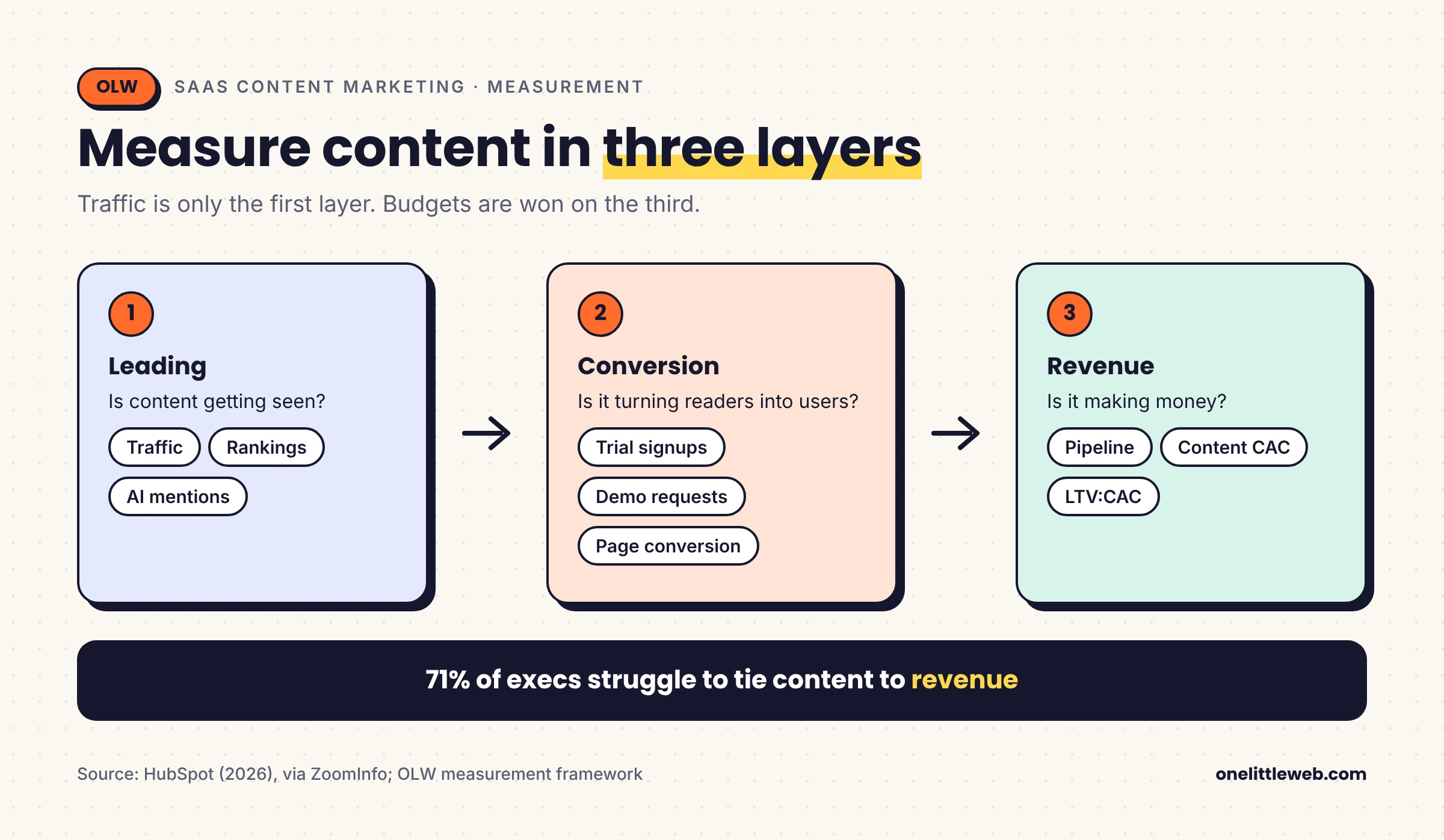
- Measure three layers. Leading, conversion and revenue metrics, so content survives budget reviews.
Most SaaS blogs don’t have a traffic problem. They have a signup problem.
I’ve seen it many times. A company publishes 100 posts, traffic climbs, and the trial numbers barely move. The Content Marketing Institute found that 40% of B2B marketers name conversion as their biggest content challenge.
At OneLittleWeb, we’ve spent 8+ years running SEO and content campaigns, many of them for AI and SaaS brands. The pattern is clear. Content that drives revenue is planned around the product, the buyer, and the numbers that matter after the click.
This guide shows you how to build that kind of strategy, including the parts most guides skip: how your go-to-market model changes your content, how to show up in AI search, and how to measure what content actually earns.
What is SaaS content marketing?
SaaS content marketing is creating and sharing content that helps people find, try, buy and keep using a software product. That covers blog posts, comparison pages, tutorials, templates, free tools and help docs.
The goal isn’t traffic for its own sake. It’s signups, activated users, and customers who renew.
That last part is what makes SaaS different. A store sells a product once. A SaaS company has to keep earning the sale every month or every year. In my experience, four things change how content works here:
- Revenue is recurring. A customer who churns after two months can cost more than they paid, so onboarding and help content matter as much as blog posts.
- The product can close the deal. With a free trial or freemium plan, content only needs to get people to the “this works” moment.
- Sales cycles are long. Siege Media reports an average SaaS sales cycle of about 84 days, often with a buying committee of user, manager and finance lead.
- Contract value sets the math. If one deal is worth $50,000 a year, a keyword with 50 monthly searches can still pay off.
Put together, this means content has four jobs across the customer lifecycle, not one.
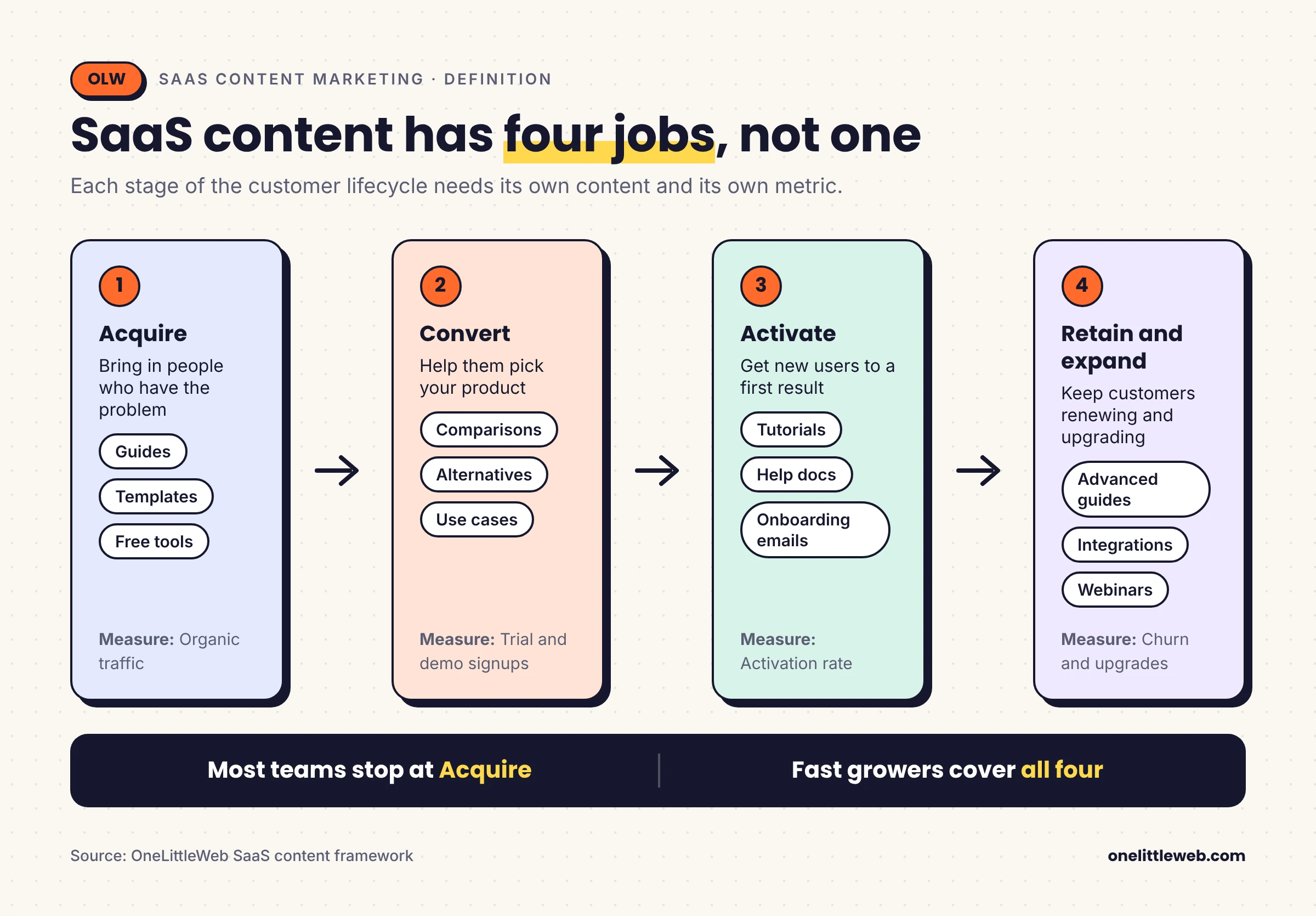
Most teams put almost all their effort into the first job. The companies that grow fastest through content cover all four.
Why content marketing matters for SaaS growth
For most SaaS companies, content is worth it. But it depends on your price point, your costs, and how patient you can be.
It fits a specific price range
Ahrefs, which runs almost all of its marketing through content, says content fits best when customers pay roughly $100 to $10,000 a year.
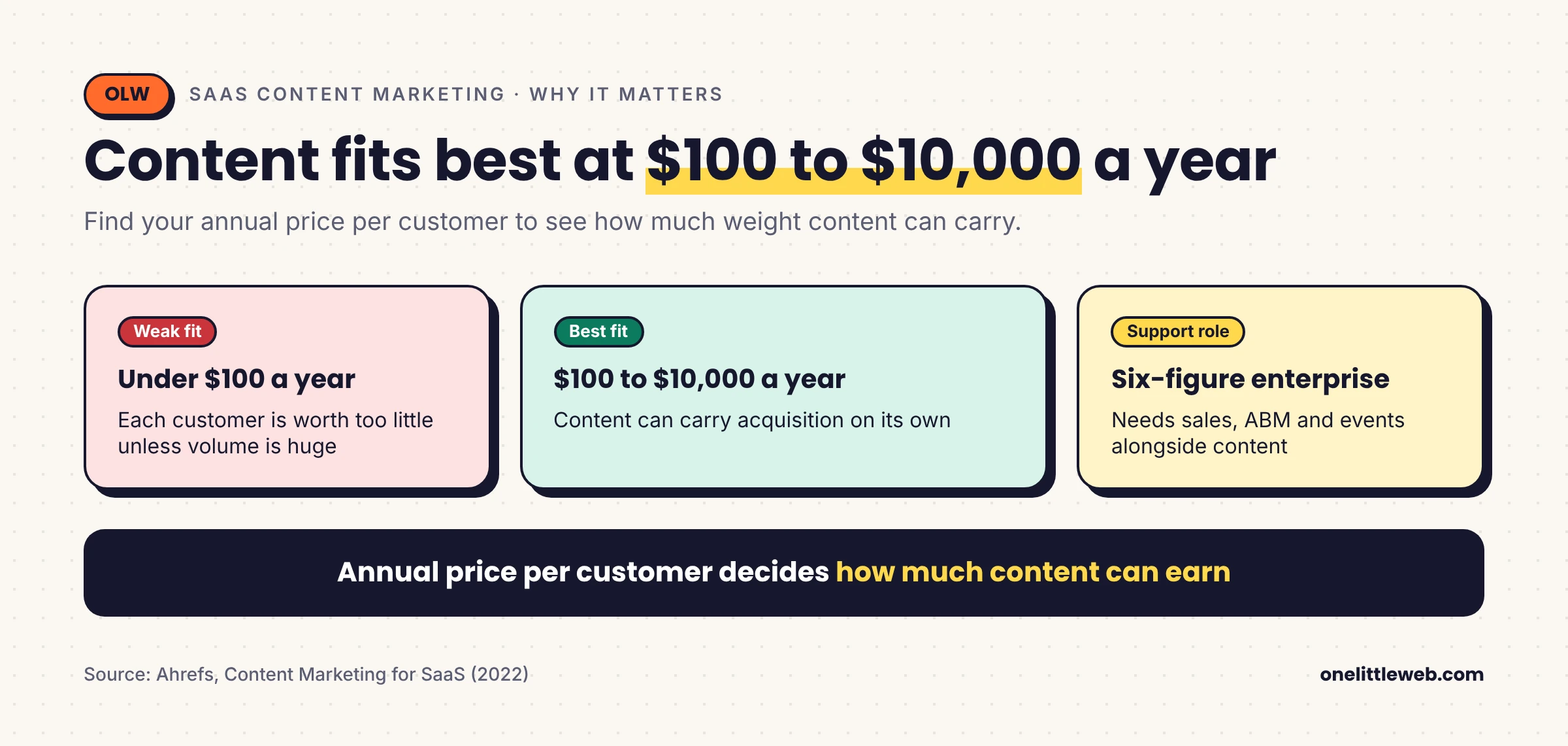
Below that range, each customer is worth too little unless you have huge volume. Above it, enterprise deals usually need sales teams, account-based marketing and events alongside content. Content still helps there, but it plays a supporting role.
It lowers customer acquisition cost
Paid ads stop the moment you stop paying. Content keeps working.
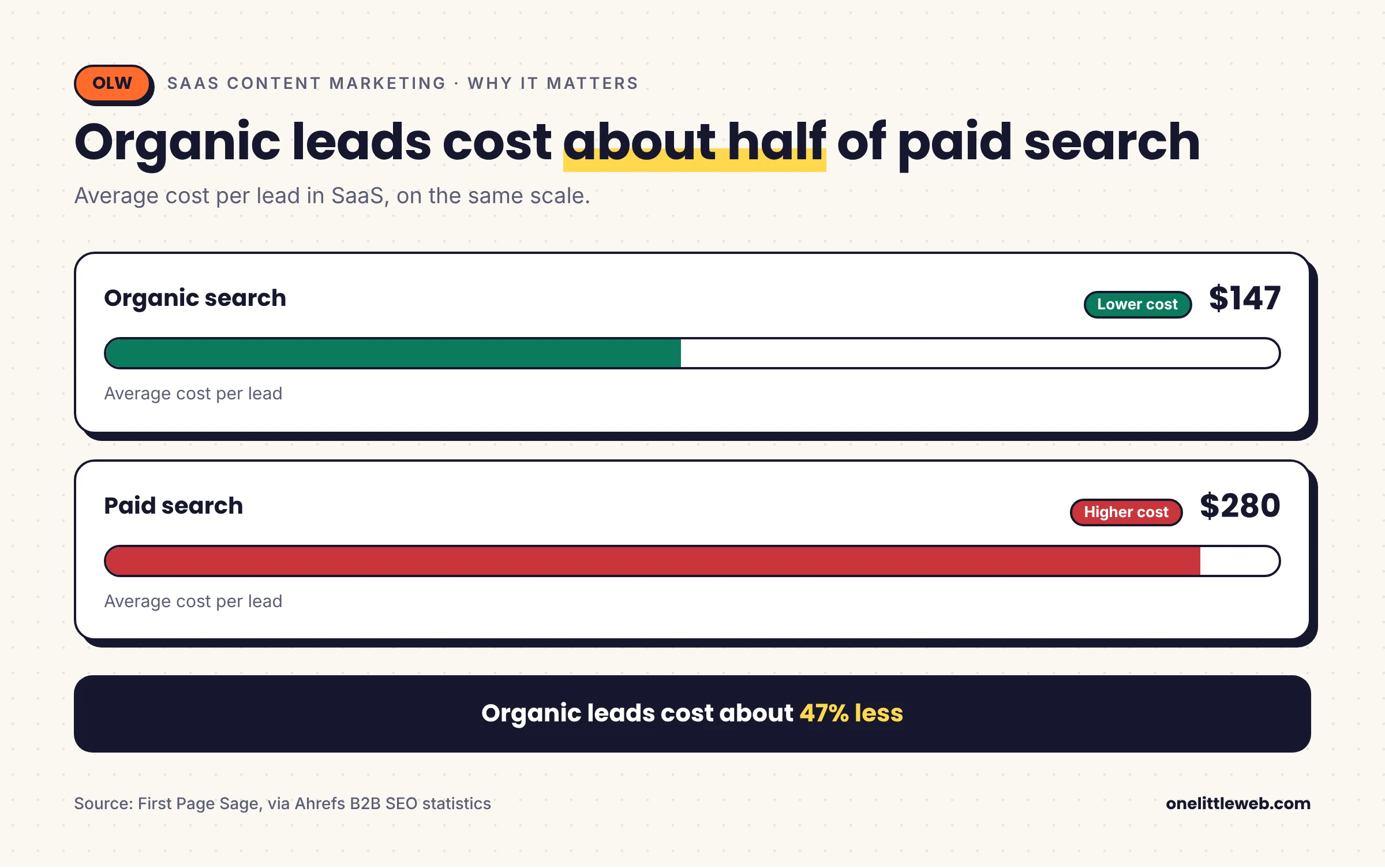
First Page Sage data, cited by Ahrefs, puts the average cost per lead from organic search at $147, compared with $280 from paid search. That gap widens over time as older pages keep bringing in leads with no extra spend.
It compounds, slowly
Content is slow at the start. In our campaigns, new pages usually take 3 to 6 months to settle in the rankings, and pipeline impact often shows up between months 6 and 12.
For context, Campfire Labs analyzed 500+ B2B SaaS sites and found average organic traffic growth of about 24% a year, or roughly 2% a month. Steady, not explosive.
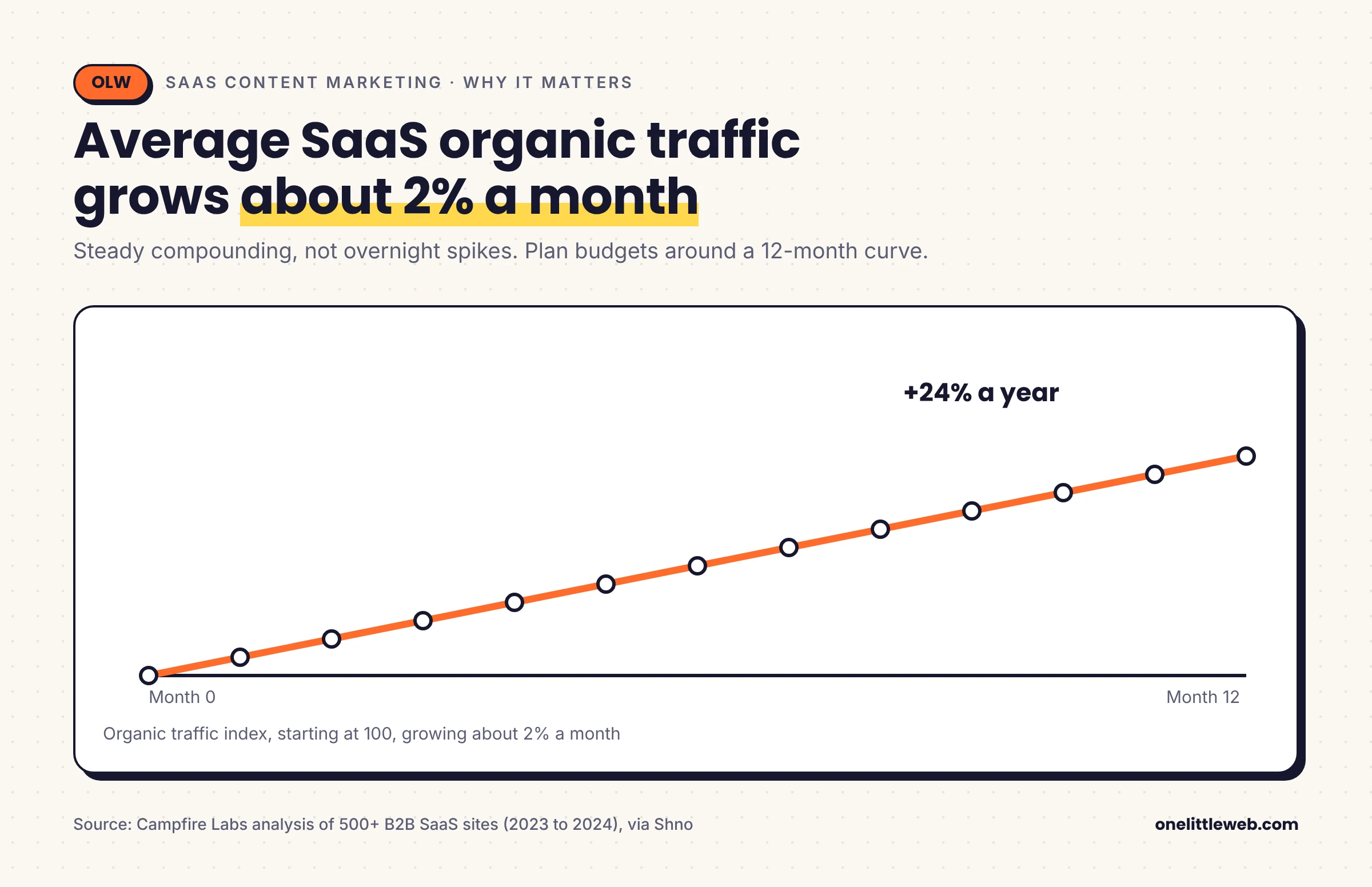
Content is a strong fit if your plan sits in that price range, people search for the problem you solve, you offer a trial or easy demo, and you can commit to at least 6 to 12 months.
SaaS content marketing myths vs reality
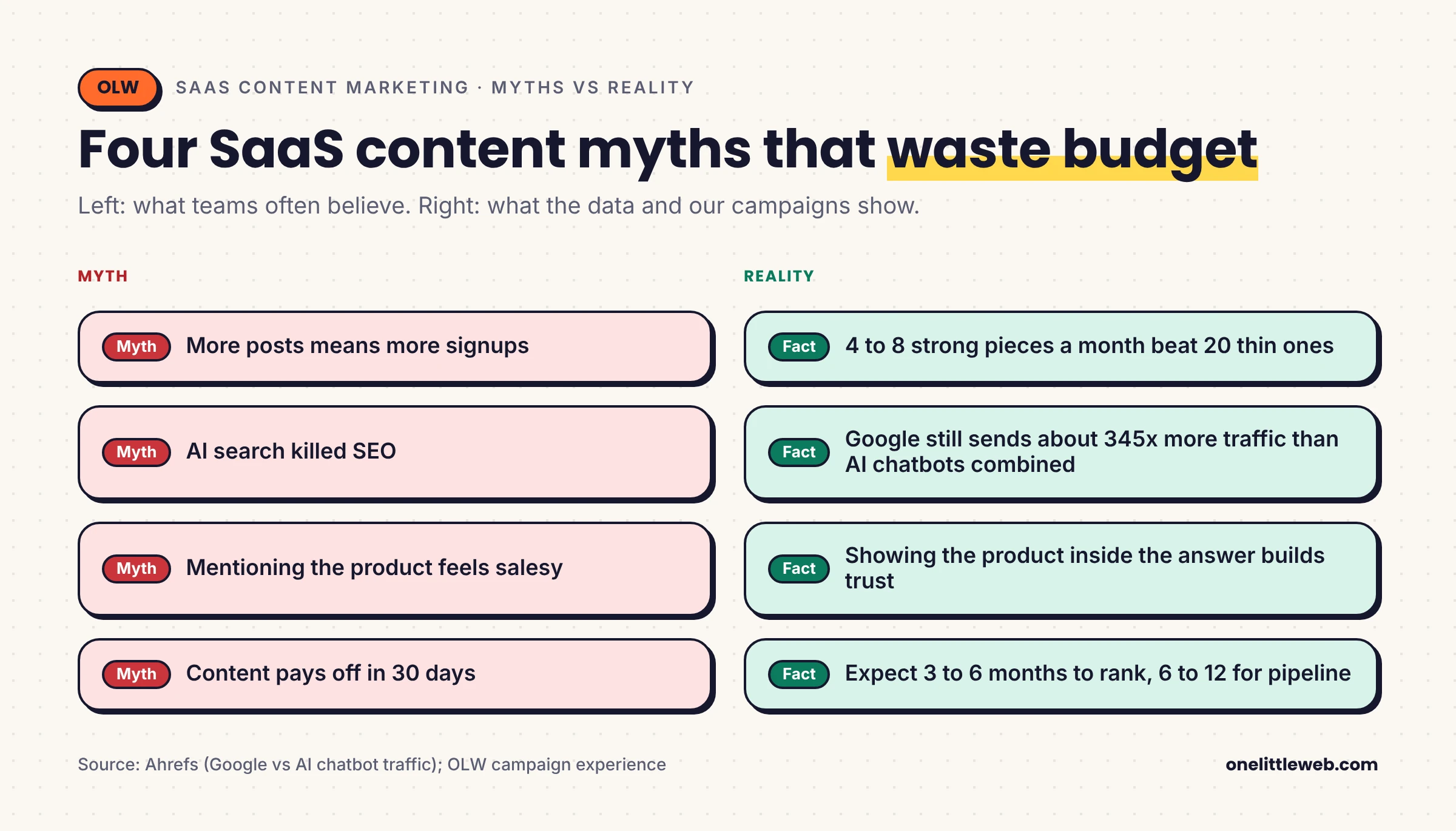
The most expensive myth is that more posts mean more signups. Volume without business potential brings visitors who never try the product.
The second is that AI search killed SEO. Ahrefs found Google still sends about 345 times more traffic to websites than ChatGPT, Gemini and Perplexity combined. AI search adds a channel. It doesn’t replace one.
The third is that mentioning your product feels salesy. It only does when it’s forced. Showing the product solving the reader’s problem is what builds trust.
And no, content doesn’t pay off in 30 days. Teams that expect it to usually quit right before it starts working.
How to build a SaaS content marketing strategy: 9 steps
These are the same nine steps we follow at OLW when we plan content for SaaS clients. Steps 3 and 4 matter most, because they decide whether content drives signups or just traffic.
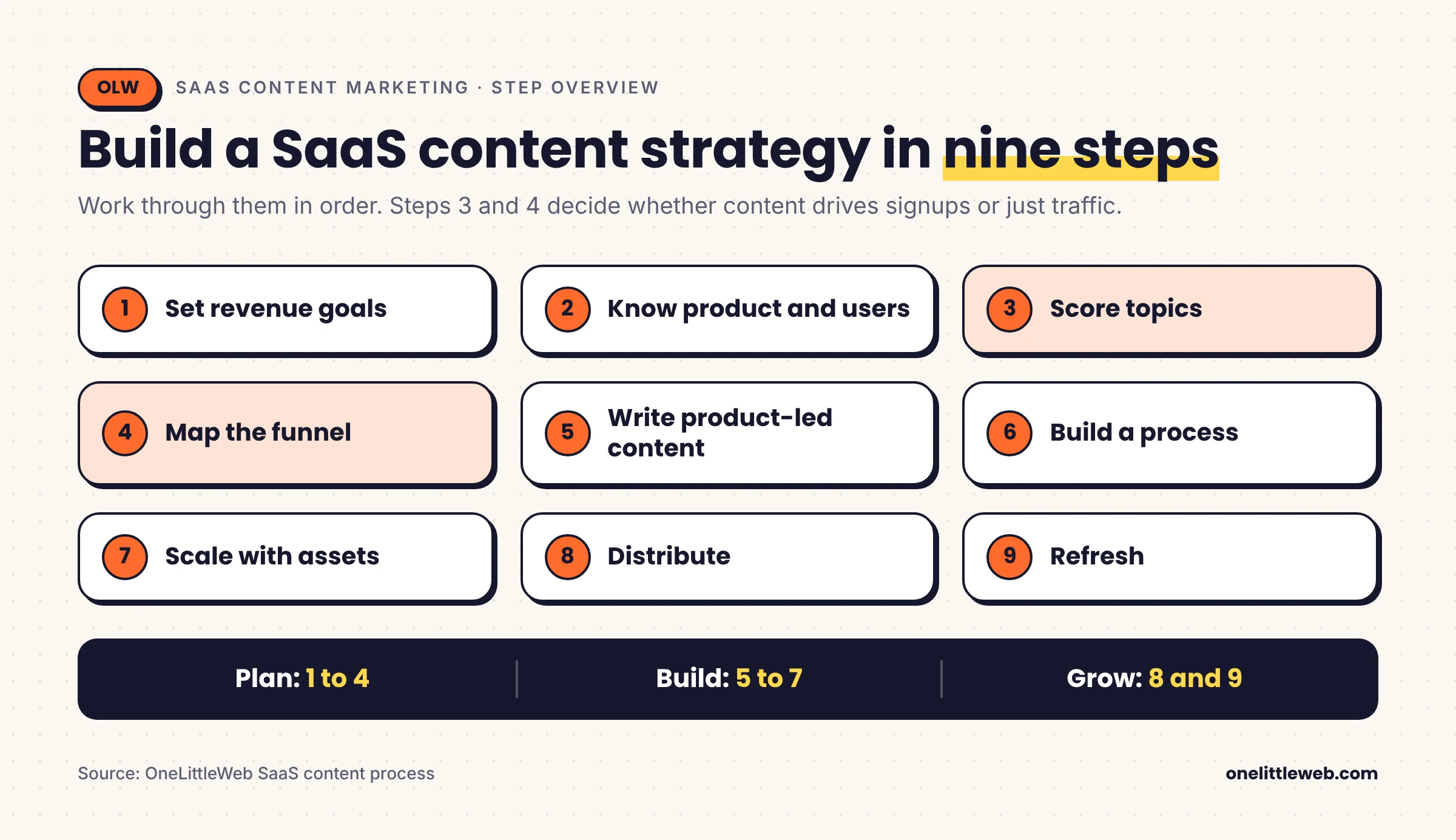
Step 1: Set goals tied to revenue and company stage
Start with what the business needs right now. A good goal connects to revenue. “Publish 20 posts” is an activity. “Get 100 trial signups a month from organic” is a goal.
Your stage changes which goal makes sense. Semrush suggests examples like these:
- Bootstrapped: 100 signups a month from content
- Seed to Series A: grow blog traffic 30% in a year
- Series B+: improve activation rate by 15%
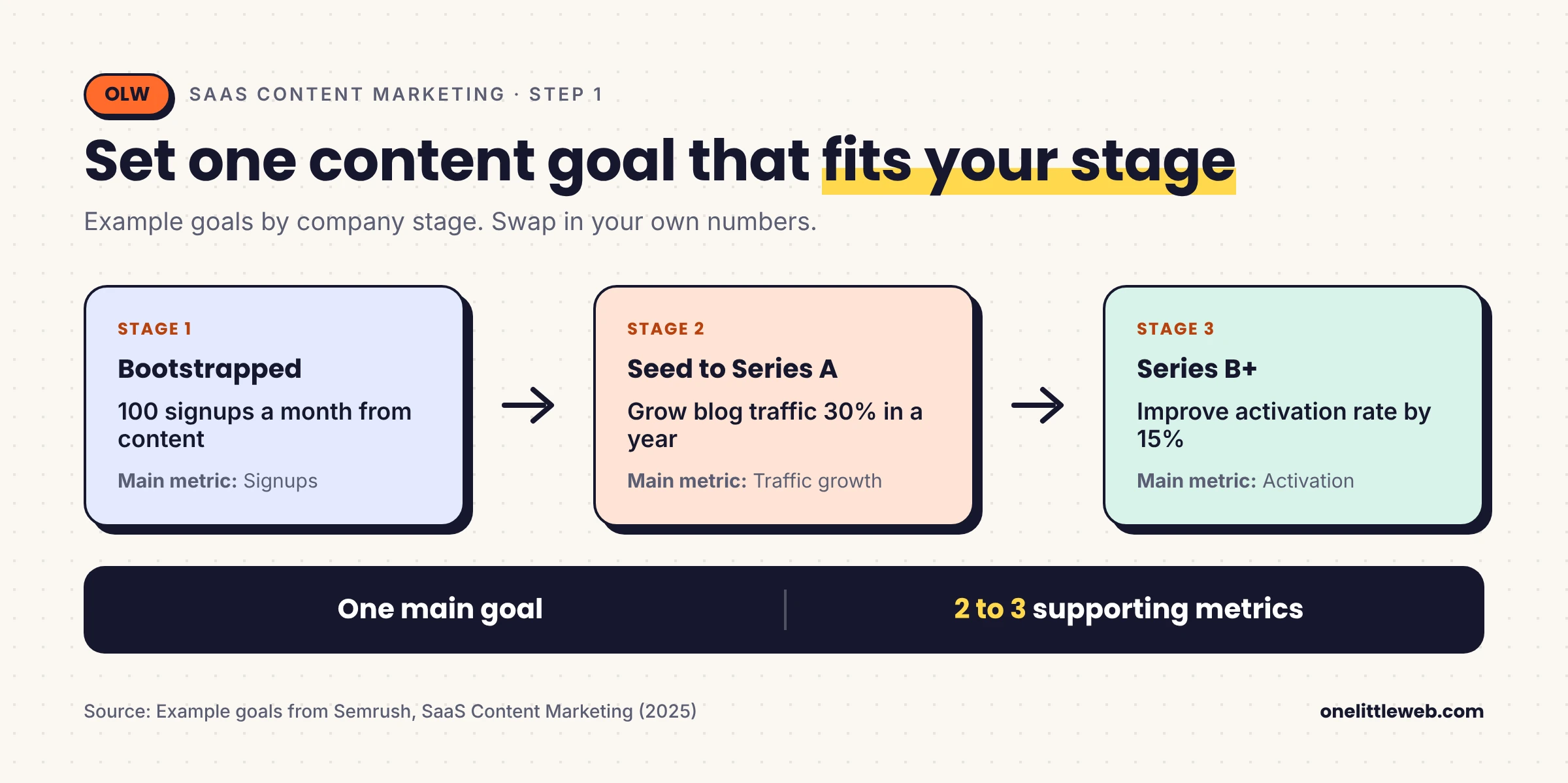
Pick one main goal and two or three supporting metrics. More than that and the team loses focus.
Check: Can you name the one revenue metric content is responsible for this quarter?
Step 2: Know your product and your users deeply
You can’t write good SaaS content about a product you don’t understand. Ahrefs puts new marketing hires through about three months in customer support before they write.
You don’t need to go that far, but you do need real input. The best sources we use:
- Sales call recordings: the exact objections buyers raise
- Support tickets: where users get stuck
- G2 and Capterra reviews: what people love and hate about you and competitors
- Reddit and communities: how people describe the problem in their own words
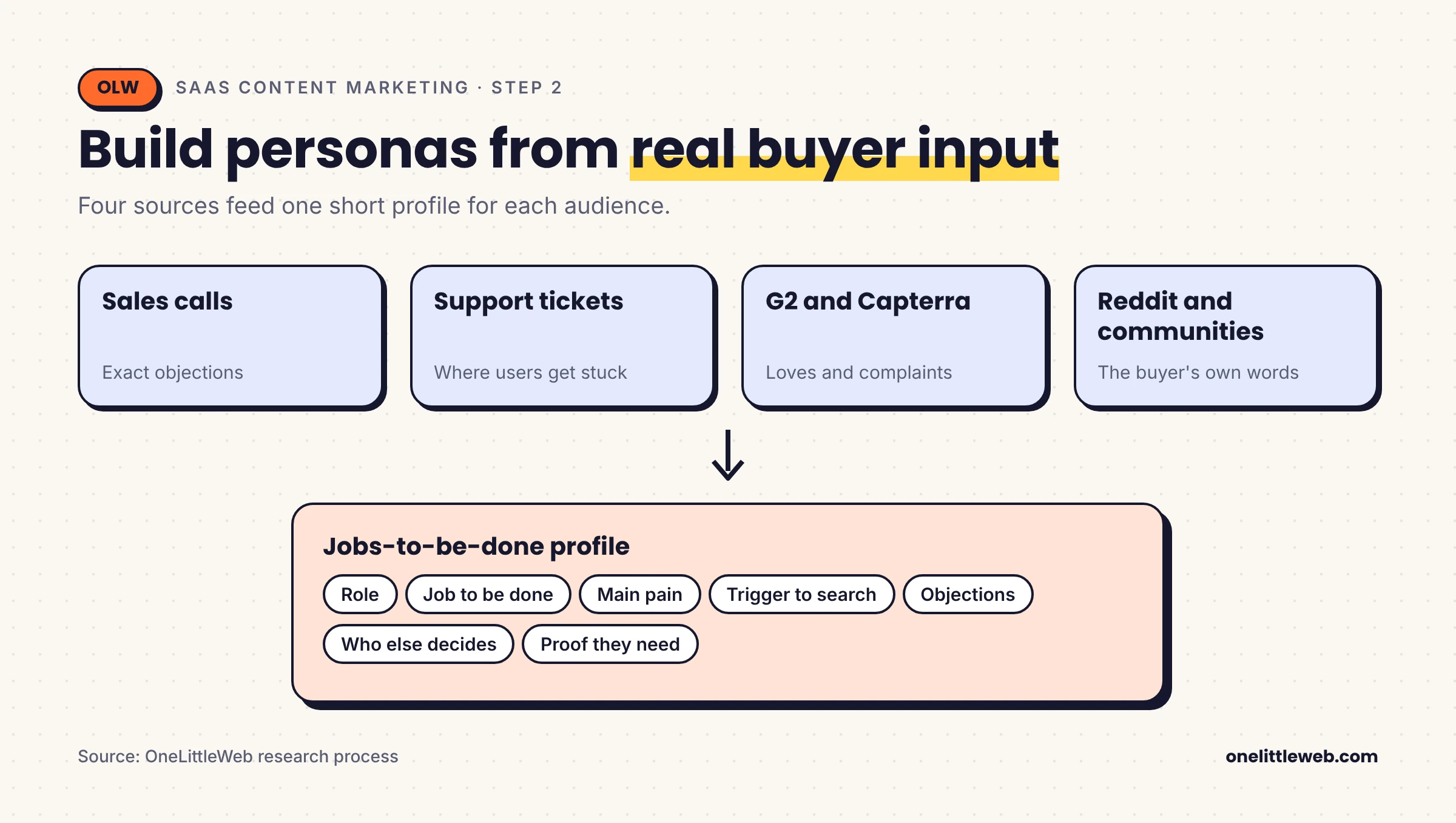
Instead of a fluffy persona, write a short jobs-to-be-done profile for each audience:
| Field | Example (AI writing tool) |
|---|---|
| Role | Content lead at a 20-person SaaS startup |
| Job to be done | Publish 8 quality posts a month with a team of two |
| Main pain | Drafts take too long and sound generic |
| Trigger to search | Missed publishing targets two months in a row |
| Objections | “AI content won’t rank” and “It’ll sound robotic” |
| Who else decides | Head of marketing (budget), founder (brand voice) |
| Proof they need | Examples, before/after drafts, a free trial |
Check: Do you know who uses the product and who approves the budget, and what each one worries about?
Step 3: Find topics with traffic and business potential
This is where most SaaS content goes wrong. Teams chase high-volume keywords that have nothing to do with the product.
Start by sorting keywords by how aware the searcher is:
| Awareness | What they search | Example (time tracking tool) | Priority |
|---|---|---|---|
| Product-aware | Brand, competitors, “X vs Y” | “Toggl alternatives” | Highest |
| Solution-aware | The tool category | “best time tracking software” | High |
| Problem-aware | The pain | “how to track billable hours” | Medium |
| Unaware | Broad topics | “productivity tips” | Low |
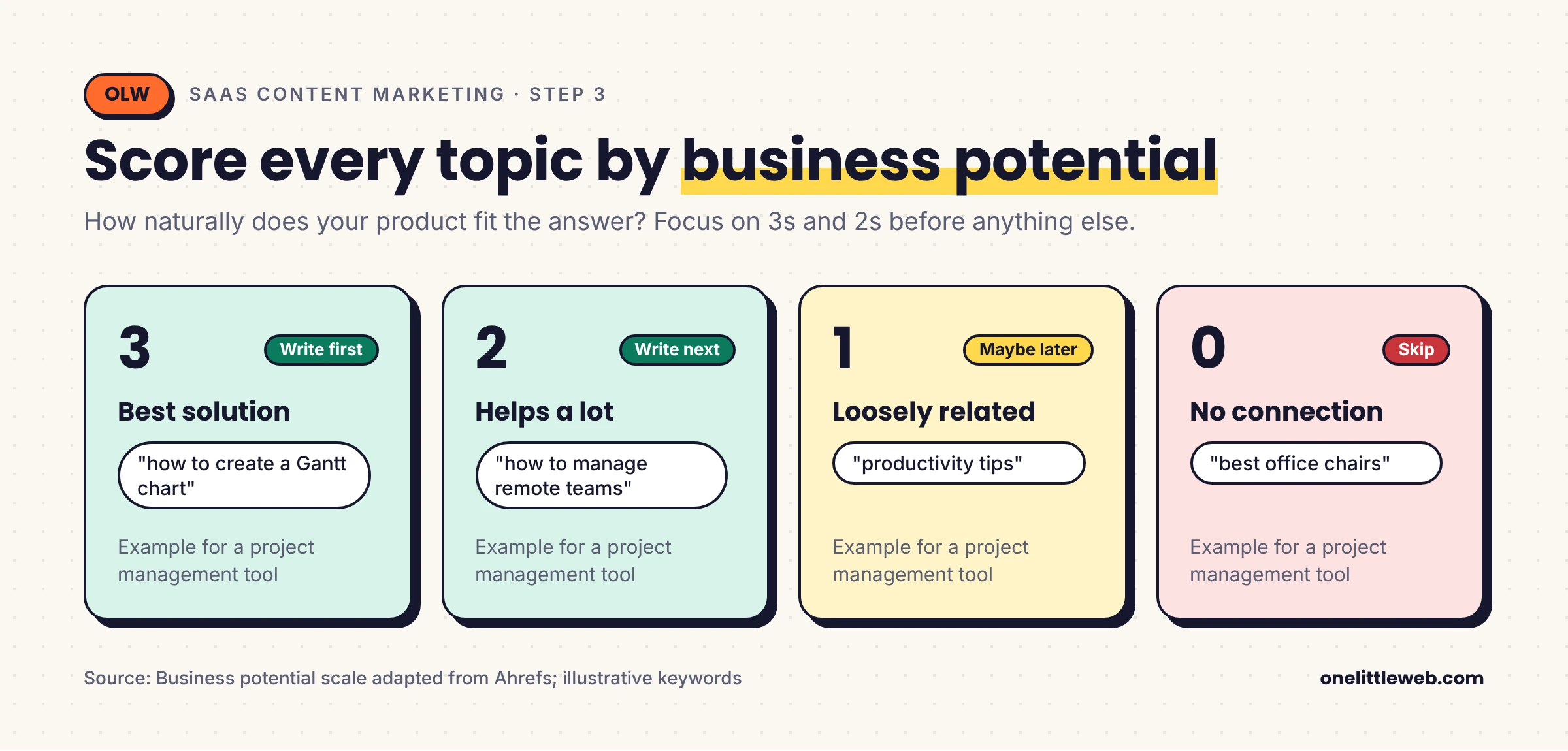
Then check three things for every topic: traffic potential, keyword difficulty, and business potential. A good starting filter in Ahrefs Keywords Explorer is a Keyword Difficulty of 20 or lower and a Traffic Potential of 100 or more.
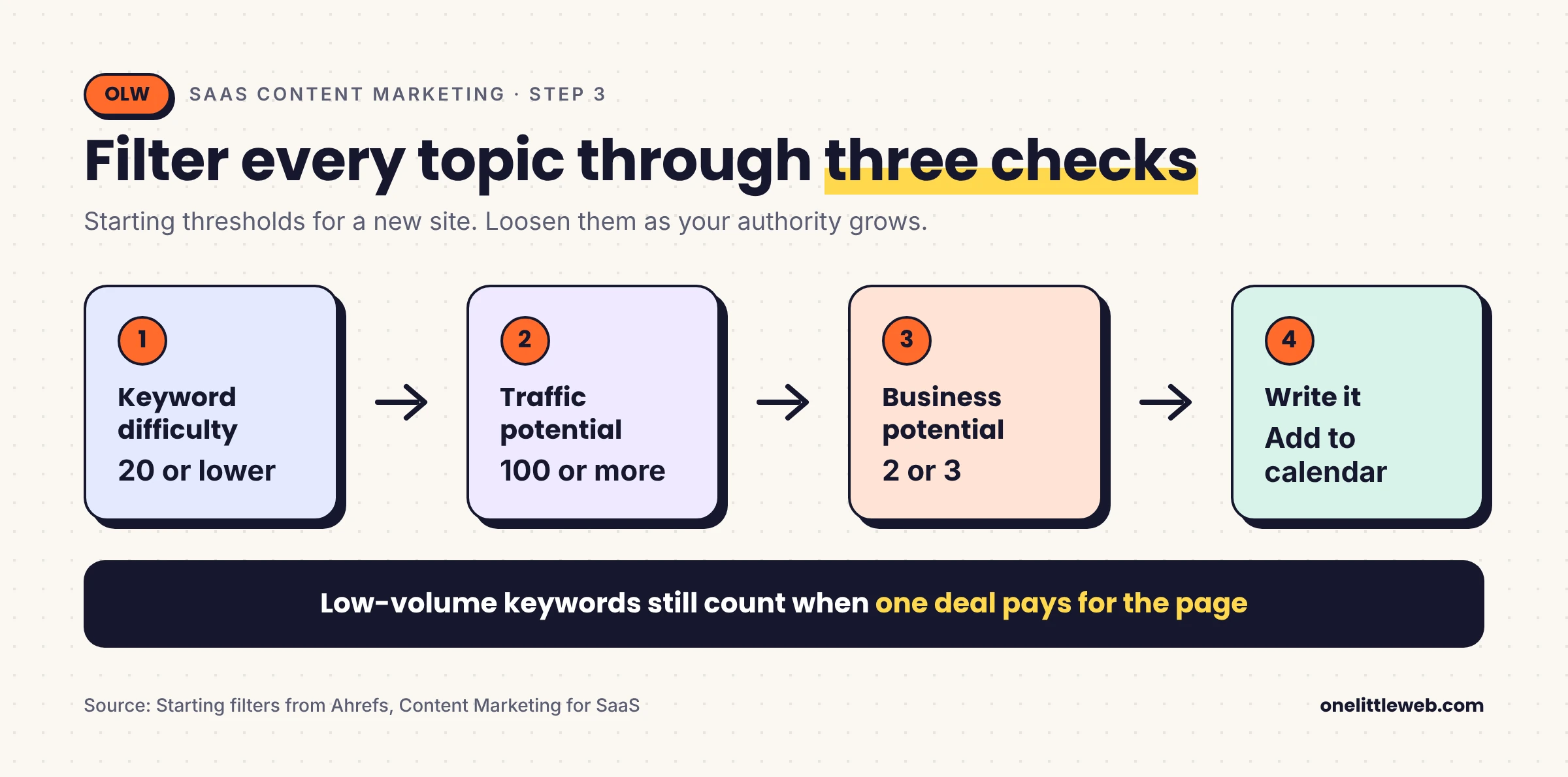
Don’t ignore low-volume topics. Siege Media points out that keywords with 100 or fewer monthly searches can be very valuable in SaaS. If one sale is worth $50,000, one ranking page can pay for a year of content.
To find gaps, run a content gap check against two or three competitors to see keywords they rank for that you don’t.
Check: Does every topic on your list score at least a 2 for business potential?
Step 4: Map content to every funnel stage
Once you have topics, organize them by where the reader is in the buying journey. Many teams only produce top-of-funnel posts. That brings traffic, but not signups.
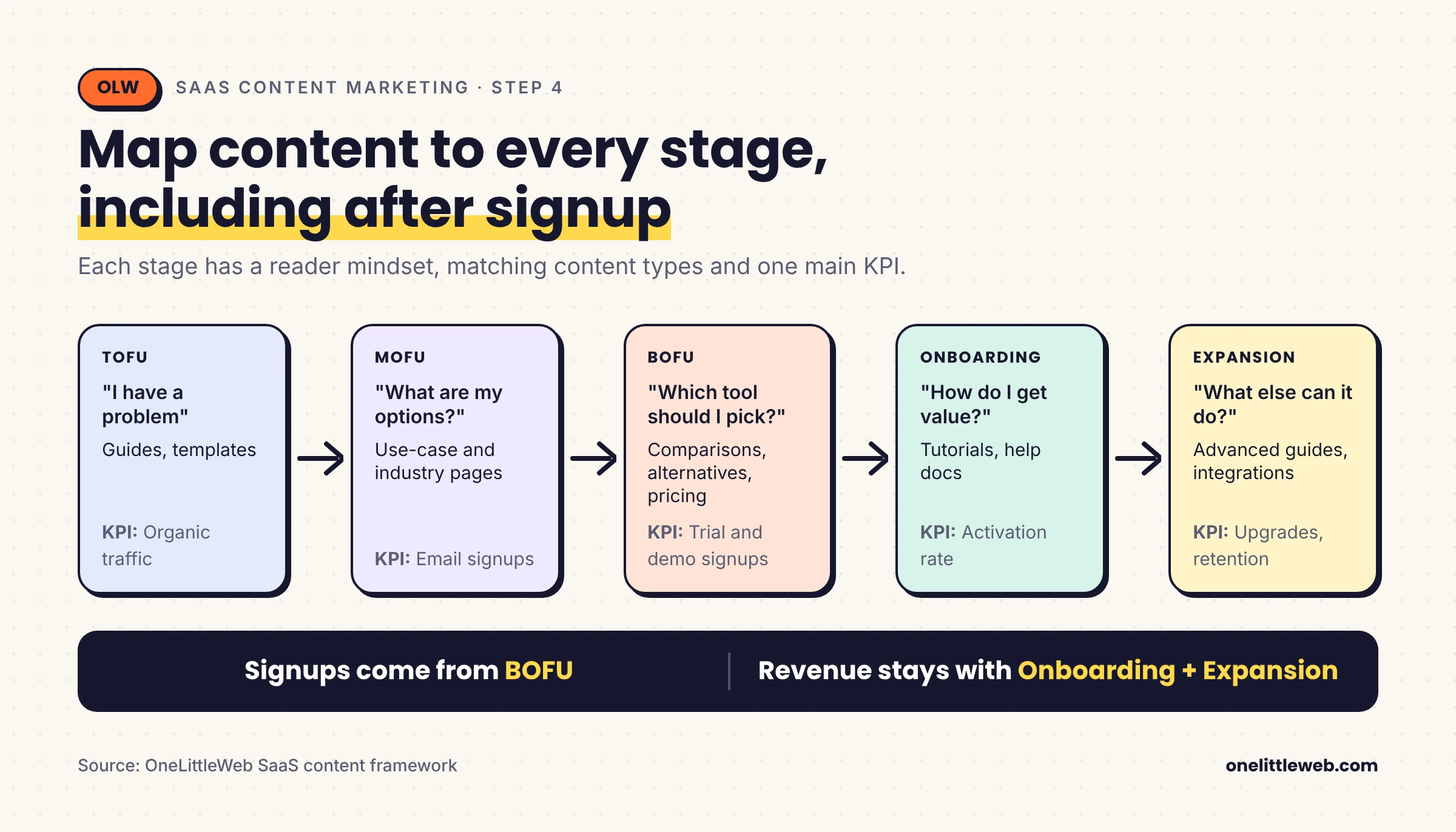
BOFU pages deserve special attention. “[Your tool] vs [competitor]” and “[competitor] alternatives” pages target people who are ready to buy. In our experience, they often convert several times better than general blog posts.
Industry pages matter too. StrataBeat’s 2025 study of 300 B2B SaaS sites found that companies segmenting content by industry grew organic traffic 28.7% on average, compared with 4.1% for those that didn’t.
Group related topics into clusters with one pillar page and linked supporting articles. That helps Google see you as an authority on the subject.
Check: Do you have at least three BOFU pages and some content for users after they sign up?
Step 5: Create product-led content that ranks
Product-led content means the product shows up naturally inside the answer, not as a sales pitch at the end.
First, match search intent. Look at what’s ranking and check the three Cs:
- Content type: blog post, landing page, tool or video?
- Content format: how-to, list, comparison or template?
- Content angle: beginner, fast, free, or for a specific industry?
Then bring in the product where it actually helps:
Forced: “Remote teams need good communication. Try [Tool] today!”
Natural: “Here’s how to set up a weekly async check-in. I’ll use [Tool] to show it, but the same steps work in any project tracker.”
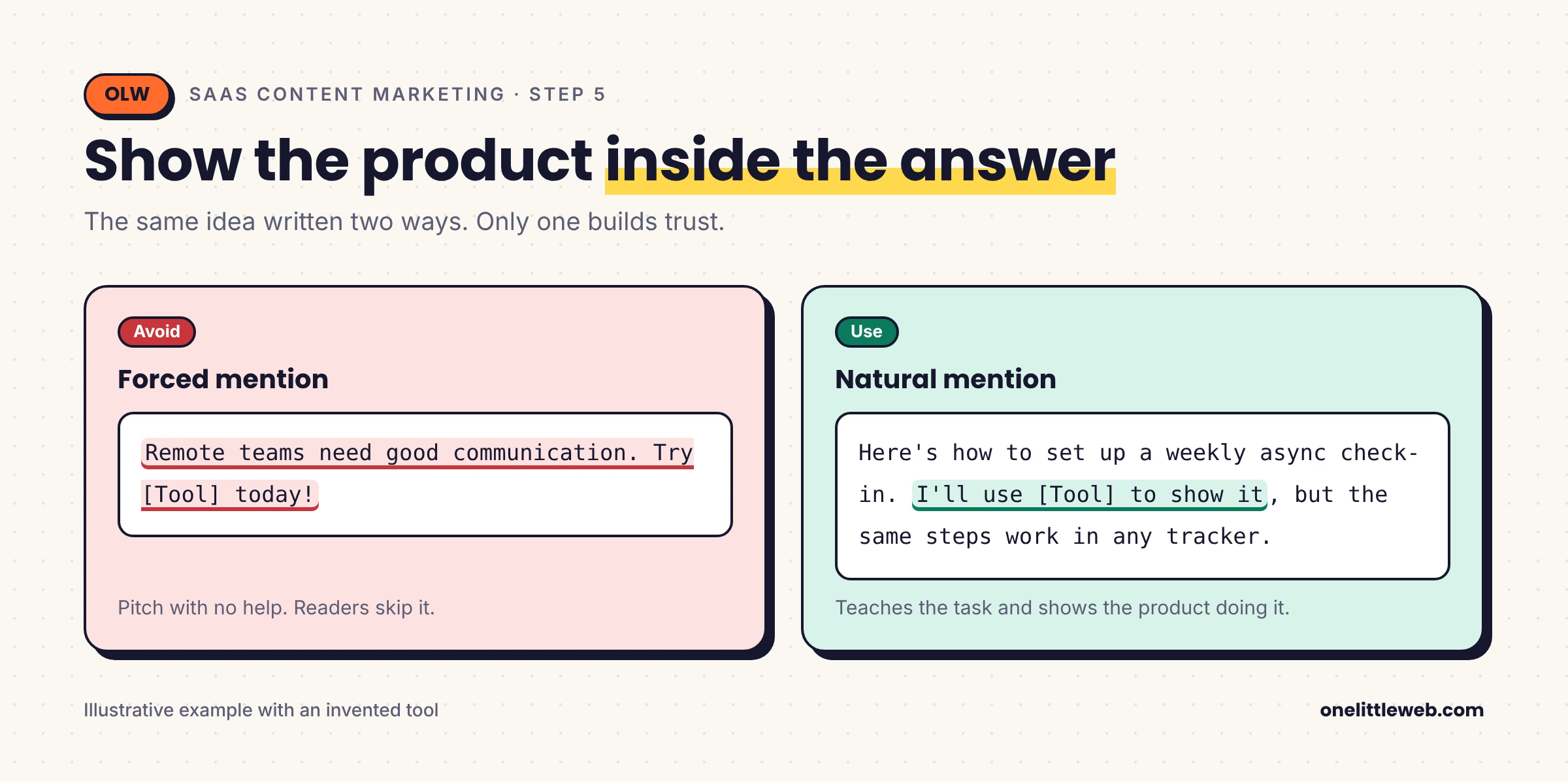
Use a brief for every piece. Ours always includes:
- Target keyword and search intent
- Audience and their main pain point
- Business potential score and where the product fits
- Required sections and questions to answer
- Entities, stats and sources to include
- Internal links and the main CTA
- An SME to interview, with 3 to 5 questions
A note on AI: we use AI tools at OLW to speed up research and first drafts. But every piece gets input from someone who knows the product, plus a human editor. Unedited AI content tends to be generic, and generic content doesn’t convert SaaS buyers.
Check: Would the article still be useful if you removed the product mentions? It should be.
Step 6: Build a repeatable content production process
Most SaaS teams don’t fail at ideas. They fail at shipping consistently.
On a small team, one person may cover several roles: content strategist, writer, subject matter expert (SME), editor and designer.
This is the pipeline we run at OLW:
- Keyword research and topic scoring
- Content brief
- SME interview (20 to 30 minutes is usually enough)
- First draft
- Edit for accuracy and voice
- SEO and internal linking pass
- Screenshots and visuals
- Publish and distribute
- Review performance at 30, 90 and 180 days
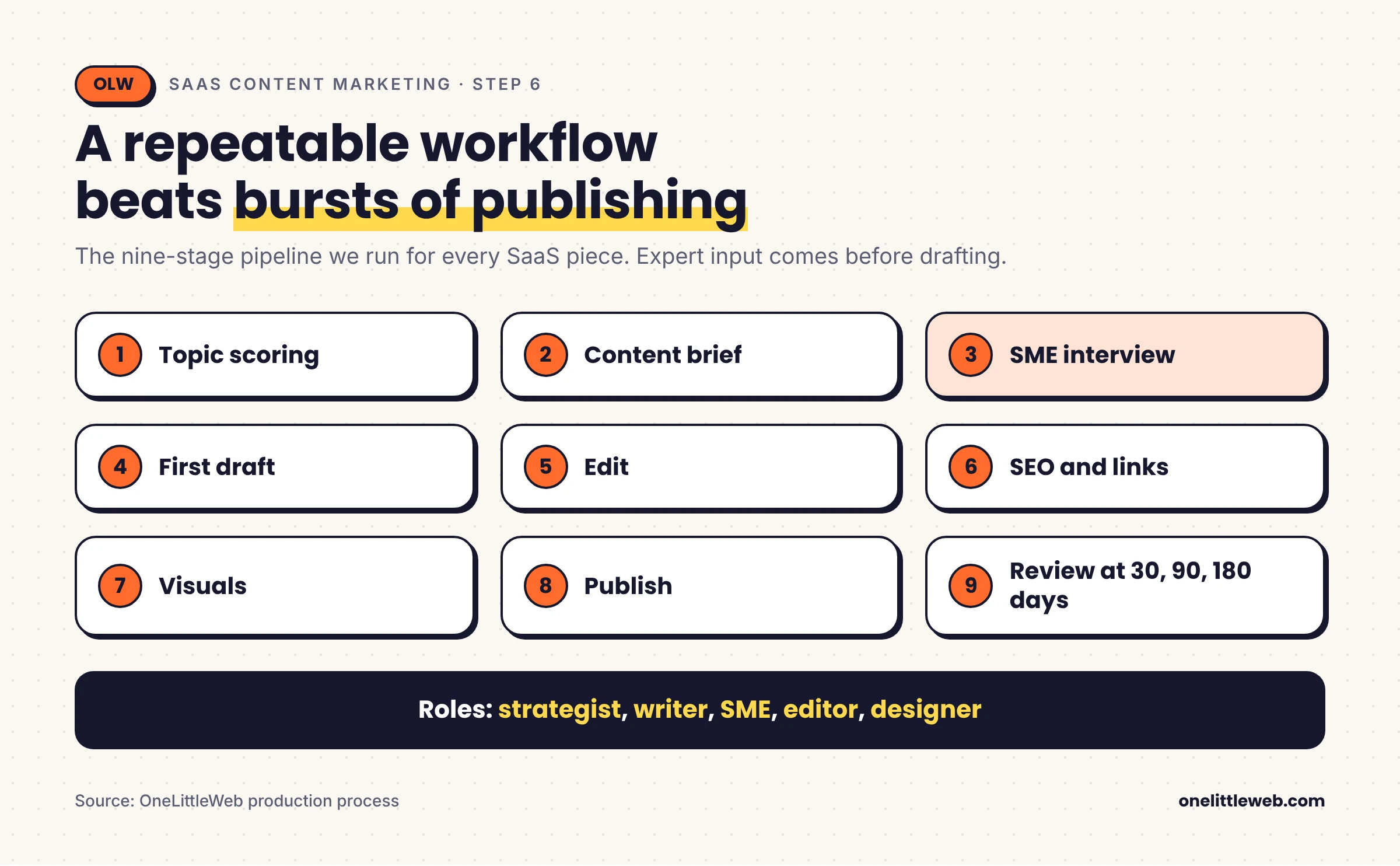
For most early-stage SaaS companies, 4 to 8 strong pieces a month beat 20 thin ones. Product people are busy, so record a short call, send three focused questions, or pull quotes from sales calls and Slack threads.
Check: Is there one owner for the content calendar, and does every piece get SME input?
Step 7: Scale with programmatic, free tool and data assets
Blog posts aren’t the only way to grow. Some of the biggest SaaS content wins come from other formats.
- Programmatic pages: Zapier built a page for each app and app pair. Ahrefs counted about 4,403 app pages and 38,612 pair pages bringing in over 299,000 monthly visits at the time of its analysis.
- Free tools: HubSpot’s website grader and email signature generator pull in traffic and links. We’ve seen the same with our own AI checker and humanizer tools.
- Original research: Zendesk’s CX Trends report has earned over 48,200 backlinks, according to Siege Media.
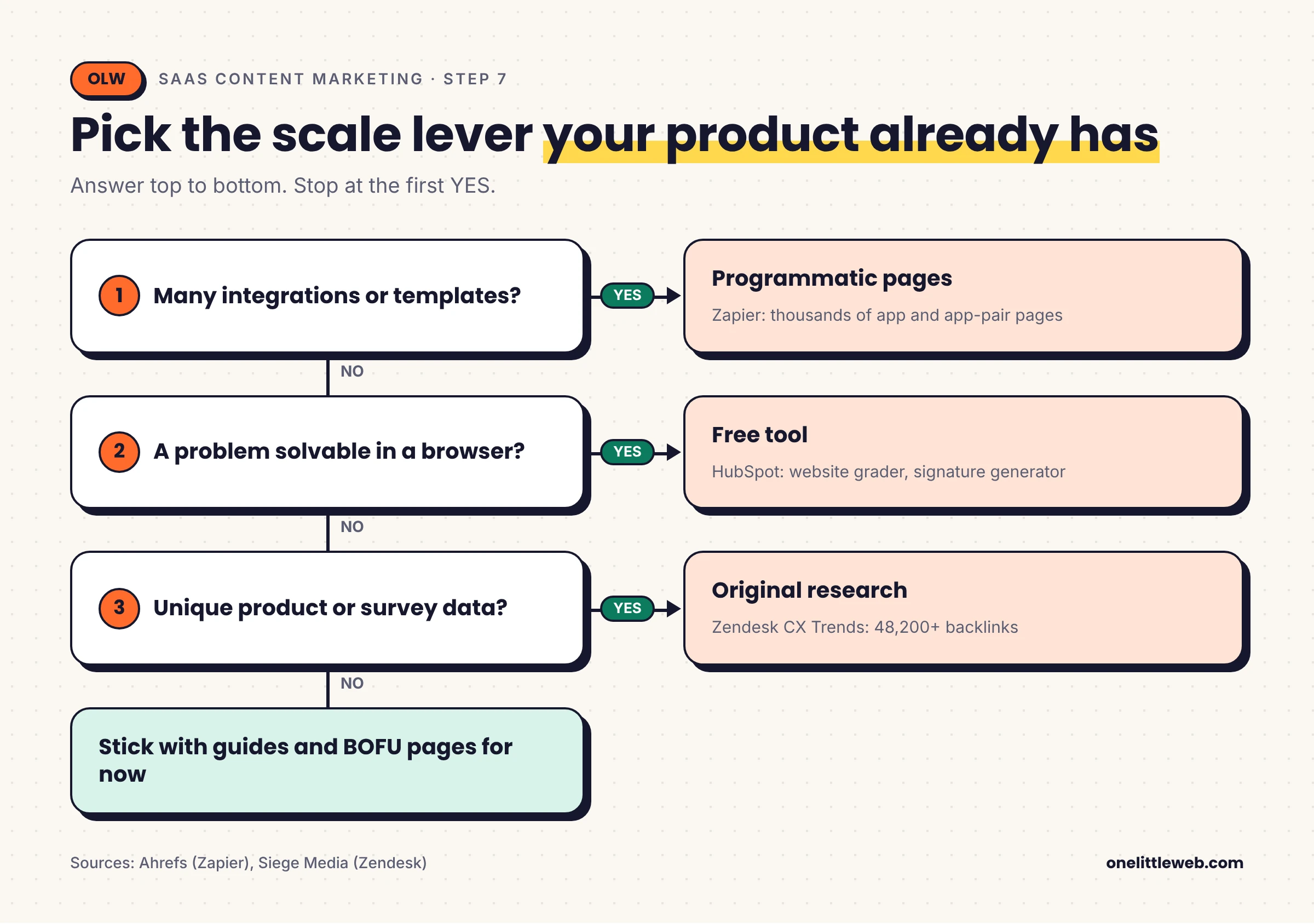
Pick the lever that fits your product. Many integrations or templates point to programmatic pages. A simple problem solvable in a browser points to a free tool. Unique data points to research.
Check: Have you picked one scalable asset that fits what your product already has?
Step 8: Distribute and promote every piece
Publishing is only half the job. New content needs a push in its first few weeks.
- LinkedIn: founder and team posts, especially for B2B
- Email newsletter: existing users and subscribers
- Communities: Slack groups, Reddit and niche forums
- Sales team: content reps can send to prospects
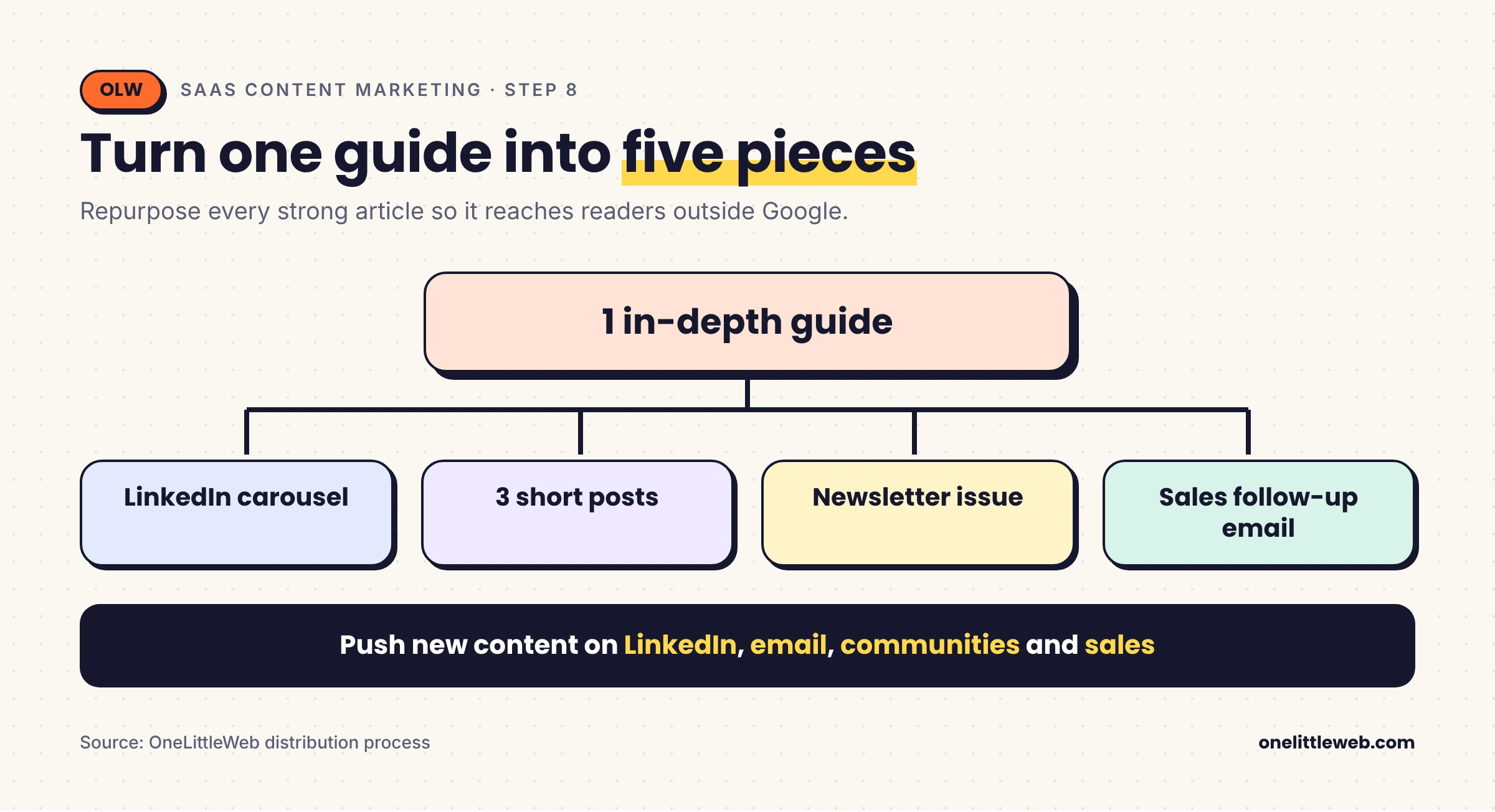
One in-depth guide can become a LinkedIn carousel, three short posts, a newsletter issue and a sales follow-up email. Links still matter for rankings too. If you need help there, see our link building service.
Check: Does every new piece have at least three planned distribution actions?
Step 9: Refresh content on a schedule
Content decays. Competitors publish better pages, screenshots go out of date and stats get old.
Siege Media recommends reviewing content at least every 12 months, and BOFU pages every 6 months. Comparison and pricing pages go stale fastest because competitors change features and prices.
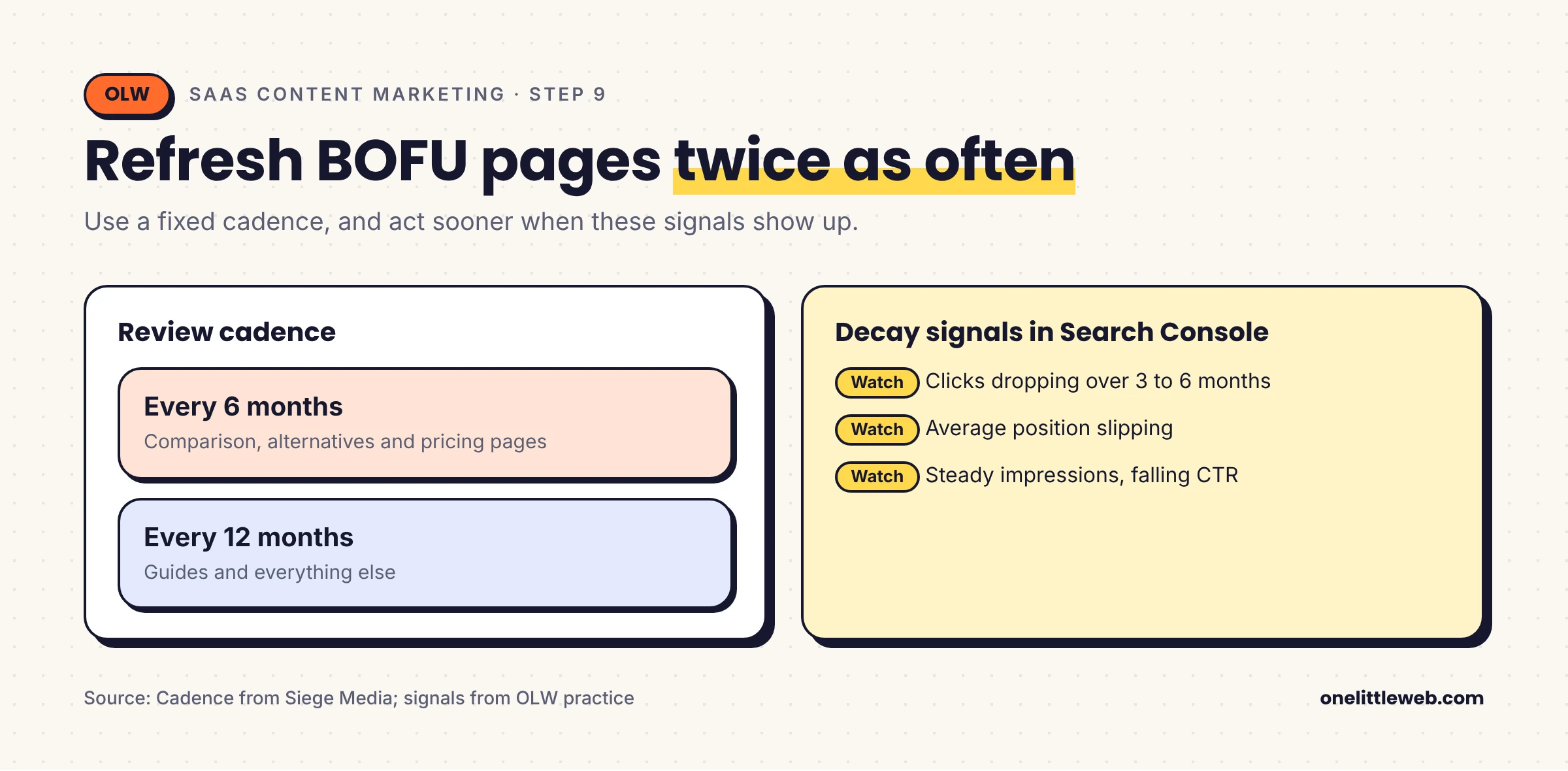
In Google Search Console, watch for clicks dropping over 3 to 6 months, average position slipping, and steady impressions with falling CTR. When you refresh, actually improve the page. Changing only the date doesn’t help.
Check: Is every BOFU page on a 6-month review calendar?
The core types of SaaS content
Here’s how the main SaaS content types compare, based on how we use them with clients.
| Content type | Funnel stage | Best for | Measure |
|---|---|---|---|
| Educational guides | TOFU | Awareness, links, authority | Traffic, assisted signups |
| Comparison pages | BOFU | Buyers with a shortlist | Trial or demo conversion |
| Alternatives pages | BOFU | Capturing switchers | Signups, migrations |
| Use-case and industry pages | MOFU to BOFU | “Does this work for me?” | Signups by segment |
| Integration pages | MOFU to BOFU | Products in a big tool ecosystem | Signups, integration use |
| Templates and free tools | TOFU to MOFU | Traffic, links, product entry | Usage, email captures |
| Case studies | BOFU | Buying committees | Influence on win rate |
| Original research | TOFU | Backlinks, PR, AI citations | Referring domains |
| Help docs | Post-signup | Activation, retention | Ticket deflection |
| Video, webinars, newsletters | MOFU, post-signup | Nurturing long cycles | Watch time, clicks |
You don’t need all ten at once. Most SaaS companies get the best start from guides, comparison pages and one or two use-case pages, then add the rest as they grow. Good comparison pages are honest about where the competitor is stronger, and good case studies use real numbers: “cut reporting from 6 hours to 40 minutes a week” beats “saved time.”
Anatomy of a SaaS comparison page
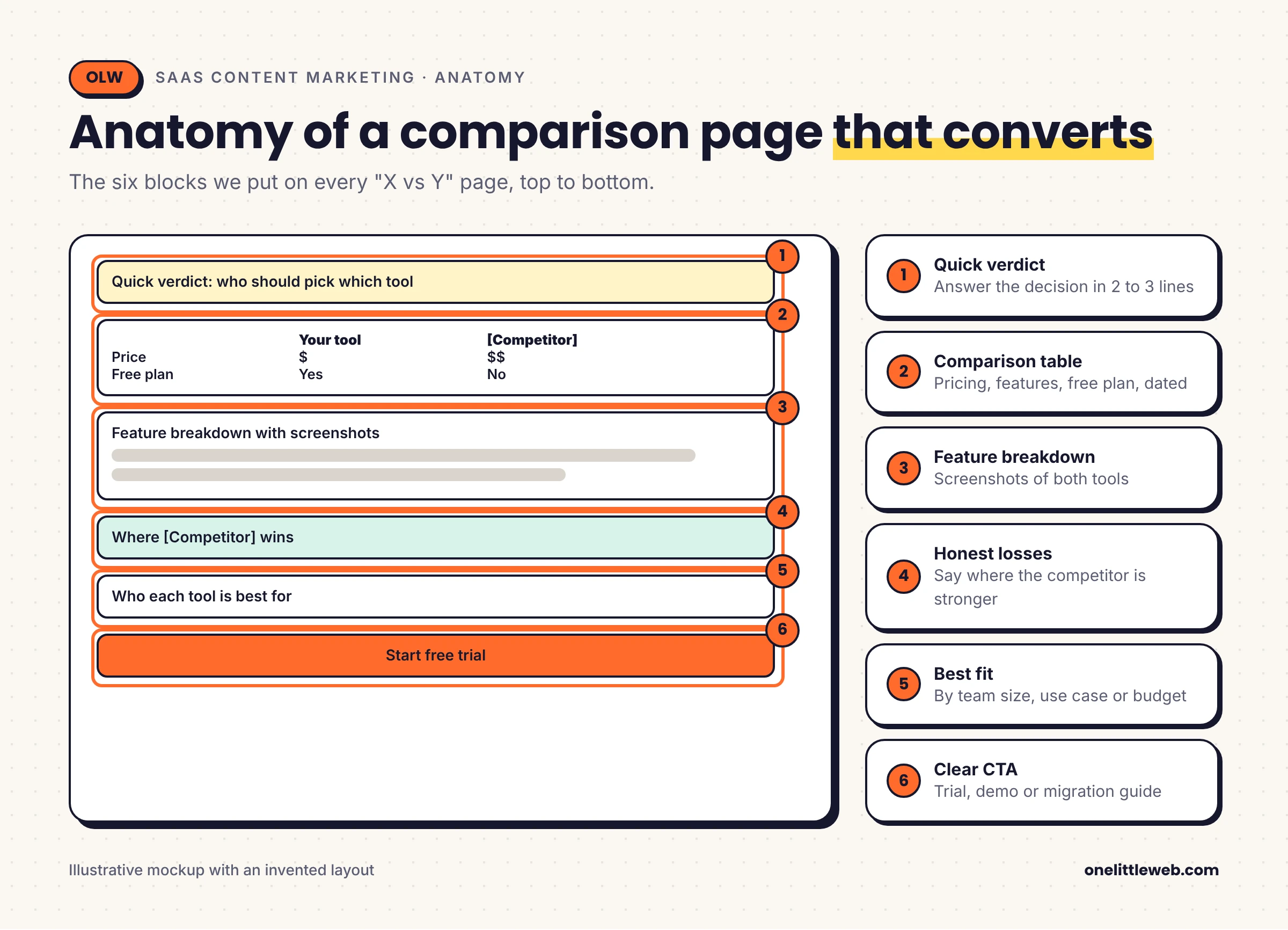
Comparison pages drive more signups than almost any other content type, so it’s worth getting the structure right.
Open with a quick verdict so readers get the answer in two or three lines. Follow it with a table of pricing, features, integrations and free plan, with the date you checked prices.
Then break down each feature area with screenshots of both tools, and say honestly where the competitor wins. That honesty is what makes readers believe the parts where you win. Close with who each tool fits best and a clear trial, demo or migration CTA.
SaaS content by business model
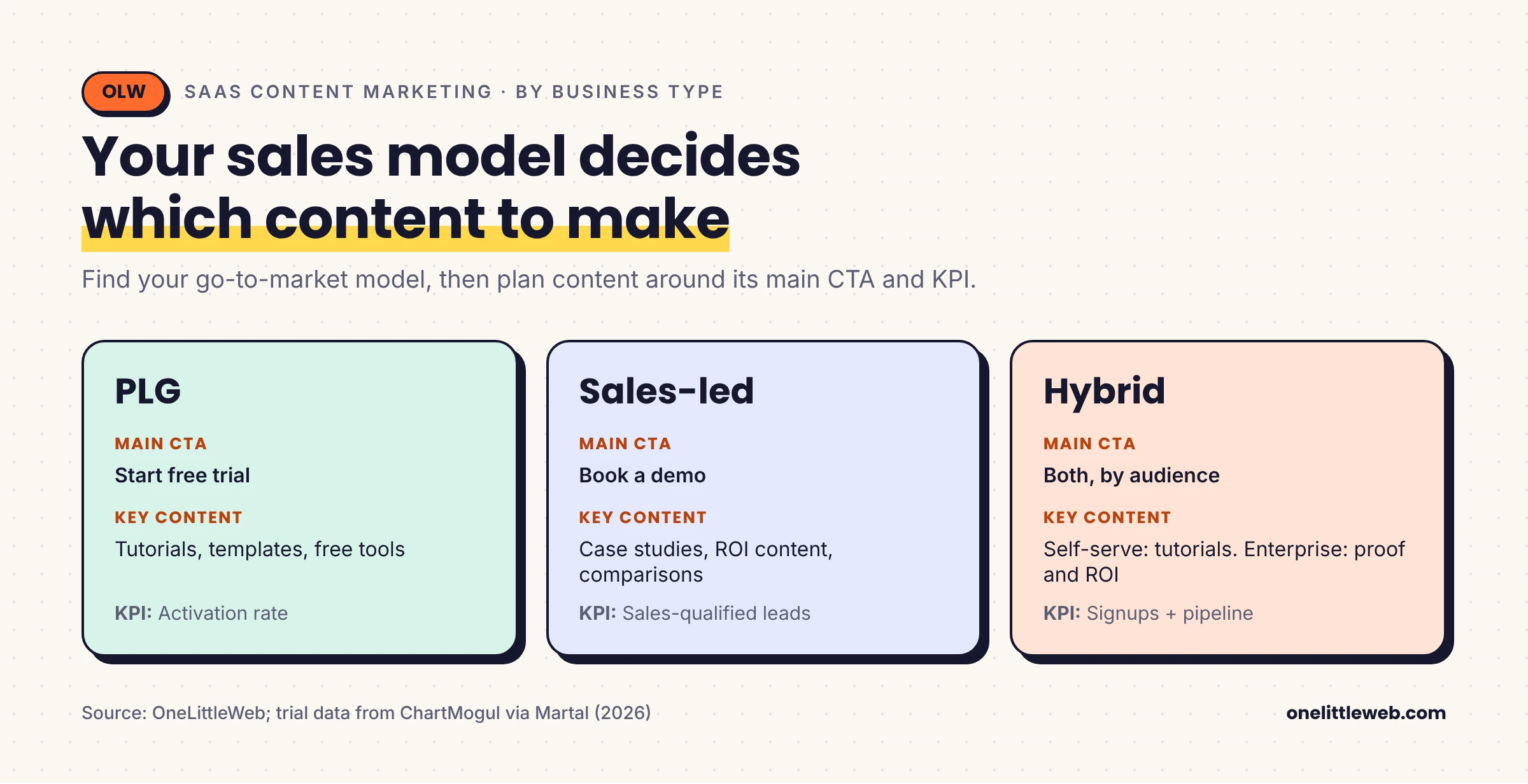
- Product-led (PLG): the product does the selling. ChartMogul’s data on 200 B2B products shows a median free-to-paid rate of about 8%, and card-required trials convert closer to 30%. Focus on tutorials, templates and onboarding.
- Sales-led: a rep closes the deal, and content is often read by people who never touch the product, like a CFO. Focus on case studies, ROI explainers and comparisons.
- Hybrid: split content by audience. Self-serve readers get tutorials. Enterprise readers get proof, security details and ROI.
- Early-stage startups: start with BOFU pages and a handful of product-led guides before building big clusters.
- Integration-heavy products: integration pages can become your biggest traffic source, as Zapier showed.
How long SaaS content marketing takes
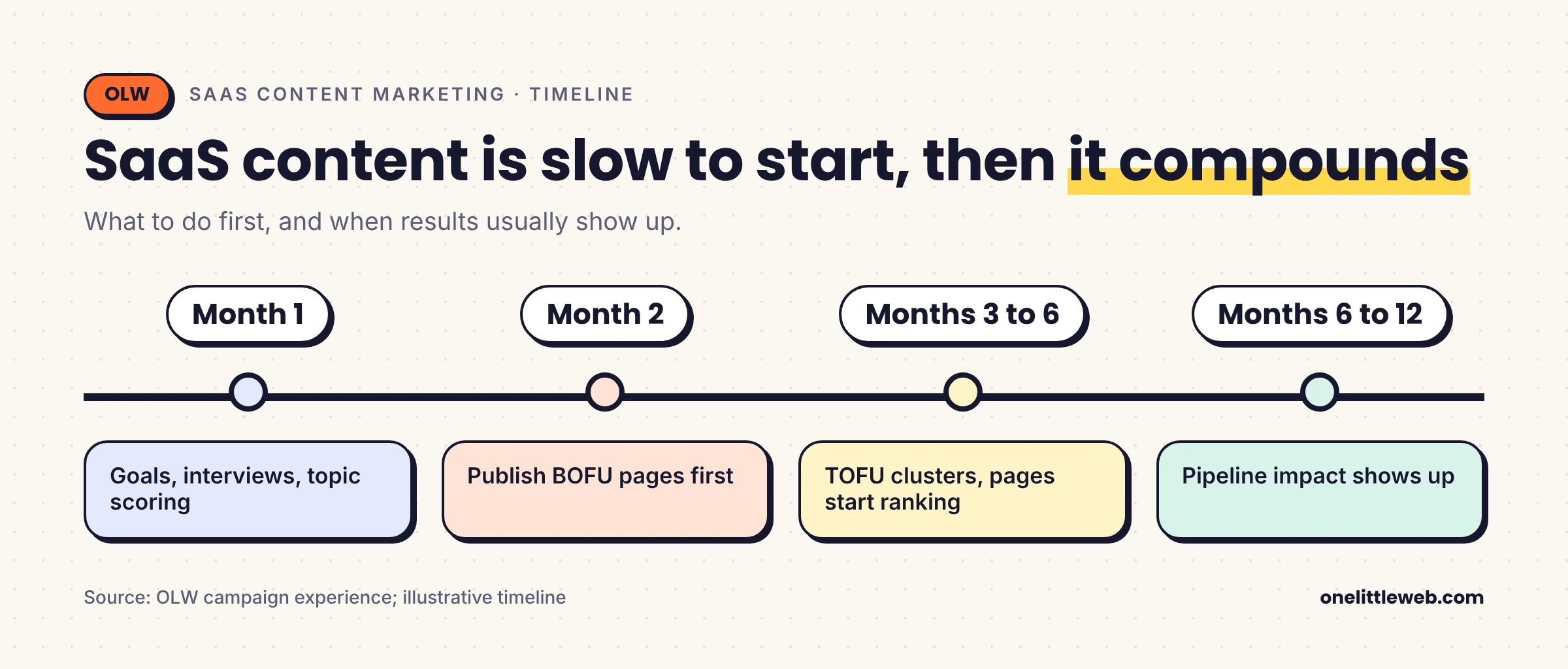
Month 1 is setup: one revenue-tied goal, interviews with sales and support, and a topic list scored by business potential.
Month 2 is for BOFU pages: comparisons, alternatives and key use cases. They take less volume to pay off and often convert first.
From month 3, start your first TOFU cluster and set up conversion tracking. Pages typically settle in rankings between months 3 and 6, and pipeline impact shows up between months 6 and 12.
How to measure SaaS content marketing success
HubSpot found that 71% of marketing executives say attributing content to revenue is their biggest measurement challenge. The fix is to track three layers, not just traffic.
| Layer | Question it answers | Metrics | Where to track |
|---|---|---|---|
| Leading | Is content getting seen? | Organic traffic, rankings, AI mentions | Search Console, Ahrefs |
| Conversion | Is it turning readers into users? | Trial signups, demo requests, conversion rate | GA4, product analytics |
| Revenue | Is it making money? | Pipeline, CAC, LTV, activation, churn | CRM, billing data |
Leading metrics
Traffic and rankings are early signals. If traffic grows and signups don’t, something is wrong with your topics or your calls to action.
AI visibility belongs here too. About 71% of B2B software buyers use AI chatbots during research, according to G2. To show up there, put a direct answer at the top of each section, define your product and category clearly, publish original data, and get listed on G2 and in third-party roundups. You can track AI mentions with tools like Ahrefs Brand Radar.
Conversion metrics
Benchmarks vary by source, so use them loosely. Your own trend over time matters more. These formulas cover most of what you need:
Organic signup rate   = organic signups / organic sessions x 100
Page-level conversion = signups from a page / visits to that page x 100
Activation rate       = users reaching the key action / new signups x 100
Set up tracking in this order:
- Conversion events in GA4 for trial signup, demo request and email signup
- UTM tags on every link in newsletters, social and sales emails
- A “How did you hear about us?” field on the signup or demo form
- CRM source fields so sales can see which content a lead read
Revenue metrics
Content-sourced pipeline = deal value where first or last touch was content
Content CAC              = total content spend / new customers from content
LTV:CAC                  = customer lifetime value / acquisition cost (target 3:1+)
For attribution, track first-touch and last-touch side by side. First-touch shows how content brings people in. Last-touch usually favors pricing and BOFU pages. Multi-touch is more accurate but needs better tracking.
Common SaaS content marketing mistakes
- Chasing volume over business potential. A post with 20,000 searches and no product fit brings visitors who never sign up.
- Skipping BOFU content. 80 blog posts and no comparison pages leaves the easiest wins on the table.
- Leaving the product out. Generic advice gives readers no reason to try your tool.
- No expert input. Content without product or customer knowledge reads as shallow.
- Publish and forget. Without refreshes, pages slowly lose rankings.
- A slow site. Siege Media found 48% of SaaS homepages fail or need improvement on desktop Core Web Vitals.
- Measuring only traffic. If you can’t connect content to signups, it becomes the first budget cut.
Do it yourself or get help?
An in-house team knows your product best but takes months to hire and train. Freelancers are flexible, but someone still has to own the strategy.
Whichever route you take, budget for strategy and research, writing and editing, SME time, design, SEO tools (Ahrefs plans start at $129 a month for Lite and $249 for Standard, checked November 2026), and link building.
An agency gives you strategy, writing, SEO and link building in one place, though it still needs access to your product team. At OLW, we work mostly with AI and SaaS companies. If you want help, see our SaaS SEO services and link building service.
FAQ
What is SaaS content marketing?
SaaS content marketing is creating and sharing content that helps people find, try, buy and keep using a software product. It covers guides, comparison pages, tutorials, templates, free tools and help docs, and it is measured by signups, activation and retention, not just traffic.
How long does SaaS content marketing take to work?
Most pages take 3 to 6 months to rank, and meaningful pipeline impact usually shows up within 6 to 12 months. Comparison and alternatives pages often convert sooner because they target buyers who are ready to decide.
How much should a SaaS company spend on content marketing?
It depends on stage and goals. Early-stage teams often start with a few thousand dollars a month for freelancers or a small agency retainer. The better number to watch is cost per signup over time, which usually drops as content builds up.
What types of content work best for SaaS?
Comparison pages, alternatives pages, product-led tutorials, templates and free tools tend to drive the most signups. Top-of-funnel guides help with awareness, links and topical authority.
Is SEO still worth it for SaaS with AI search?
Yes. Google still sends far more traffic than AI chatbots, and the same practices, like clear answers, original data and strong authority, help you appear in both.
What is the difference between SaaS SEO and SaaS content marketing?
SaaS SEO focuses on ranking in search, including technical fixes and links. Content marketing is broader. It covers what you create and how you distribute it across search, email, social and sales.
How many blog posts should a SaaS company publish per month?
There is no magic number. For most early-stage SaaS companies, 4 to 8 strong pieces a month work better than 20 thin ones, because consistency and quality build topical authority.
Should SaaS content mention the product?
Yes, when it fits. Show the product inside the answer, like using it to demonstrate a workflow, instead of adding a sales pitch at the end. Skip product mentions on topics where it has no real connection.
How do you measure SaaS content marketing ROI?
Track three layers: leading metrics like traffic and rankings, conversion metrics like trial and demo signups, and revenue metrics like pipeline, content CAC and LTV. Page-level conversion shows which content types actually earn signups.