Quick answer
Semrush vs Similarweb comparison comes down to the job. Semrush is the better SEO tool, with keyword research, backlinks, rank tracking and audits from $139.95 a month. Similarweb is the better market intelligence tool, with all-channel traffic, audience and app data from $125 a month billed yearly.
Key takeaways
- Compare the right plans. Semrush Traffic & Market ($289/mo) is the real rival to Similarweb Competitive Intelligence ($125 to $199/mo).
- SEO depth favors Semrush. 28.8 billion keywords and 43 trillion backlinks vs Similarweb’s 7 billion+ keywords.
- Market data favors Similarweb. Audiences, apps and every traffic channel come on its entry plan.
- Accuracy depends on site size. Studies split the win, and both tools struggle under 5,000 monthly visits.
- History is a big gap. Semrush traffic data goes back to 2017; Similarweb self-serve keeps 3 to 6 months.
- Cost for both is close. Traffic plus SEO runs $428.95/mo on Semrush vs $399/mo on Similarweb, monthly billing.
Most Semrush vs Similarweb reviews compare the wrong plans.
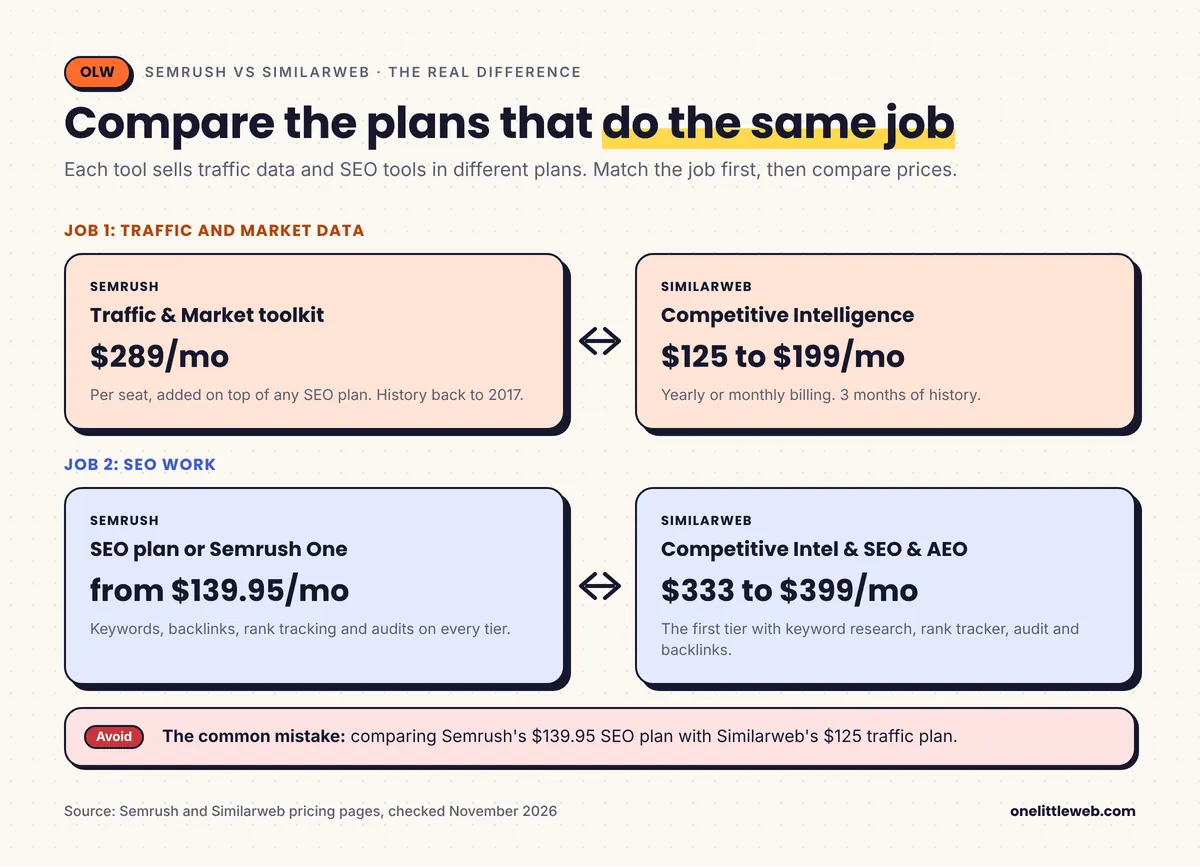
They put Semrush’s $139.95 SEO plan next to Similarweb’s $125 traffic plan and call it a fair fight. Those plans do different jobs. Semrush’s traffic data lives in a separate toolkit that costs $289 a month on top of your SEO plan.
Our SEO team at OneLittleWeb uses Semrush every day across client campaigns. In this guide, I’ll match the plans that actually compete and show you what each setup really costs.
Semrush vs Similarweb at a glance
| Semrush | Similarweb | |
|---|---|---|
| Best for | SEO teams, agencies, content marketers | Market researchers, analysts, investors, performance marketers |
| Core job | Run and grow SEO | Understand markets and competitors across every channel |
| Entry price | $139.95/mo (SEO plan) | $125/mo billed yearly, $199 monthly |
| All-channel traffic data | Traffic & Market toolkit, $289/mo extra | Included from the entry plan |
| Keyword research, backlinks, audits | Included from $139.95/mo | From $333/mo billed yearly ($399 monthly) |
| Keyword database | 28.8 billion | 7 billion+ |
| Backlink database | 43 trillion links | 3.6 trillion links (vendor figures conflict) |
| Traffic history | Back to 2017 in Traffic & Market | 3 to 6 months on self-serve plans |
| Extra user | $45 to $100/mo (SEO); $289 per Traffic & Market seat | Priced per seat; close to plan cost |
| Small sites | Shows estimates, often noisy | No numbers below 5,000 visits |
| App data | No | Yes |
| AI search tracking | Semrush One from $199/mo | AEO plans from $99/mo |
| Free access | 10 reports a day | Free website checker and Chrome extension |
| G2 rating | 4.4/5 (4,323 reviews) | 4.4/5 (1,346 reviews) |
Prices checked on vendor pages in November 2026.
The real difference: SEO suite vs market intelligence platform
What Semrush is
Semrush is an SEO and search visibility platform. It launched in 2008 and became an Adobe company when Adobe closed the deal on April 28, 2026.
Its home turf is search. Keyword research, backlink analysis, rank tracking, site audits and content tools all sit in one account. Its newer Semrush One plans also track how your brand shows up in AI answers.
We use Semrush every day at OLW. It’s the tool our team opens first when a new SEO client signs.
What Similarweb is
Similarweb is a digital intelligence platform. It was founded in 2007 and trades on the NYSE as SMWB.
Its home turf is the whole market. It estimates how much traffic any site or app gets, where that traffic comes from and who the visitors are. Sales teams, investors and research analysts use it as much as marketers do.
SEO tools exist in Similarweb too. But they sit on higher plans and the data sets are smaller.
The matchup most reviews get wrong
Most comparisons put Semrush’s $139.95 SEO plan against Similarweb’s $125 traffic plan. That’s two different products.
The fair matchup looks like this:
- For traffic and market data: Semrush Traffic & Market ($289/mo) vs Similarweb Competitive Intelligence ($125 to $199/mo)
- For SEO work: Semrush SEO or Semrush One (from $139.95/mo) vs Similarweb’s SEO tier ($333 to $399/mo)
Keep these two pairs in mind. Every section below uses them.
How we compared Semrush and Similarweb
Our SEO team uses Semrush hands-on across client campaigns. That includes keyword research, link audits, rank tracking and traffic checks on competitors. My Semrush notes come from that daily use.
We don’t run paid Similarweb seats at OLW. So the Similarweb sections are research-based. I used its free website checker, then cross-checked vendor docs, the pricing page and three published accuracy studies.
All prices were checked on the vendors’ own pages in November 2026. G2 and Capterra ratings were checked the same month.
How each tool estimates traffic
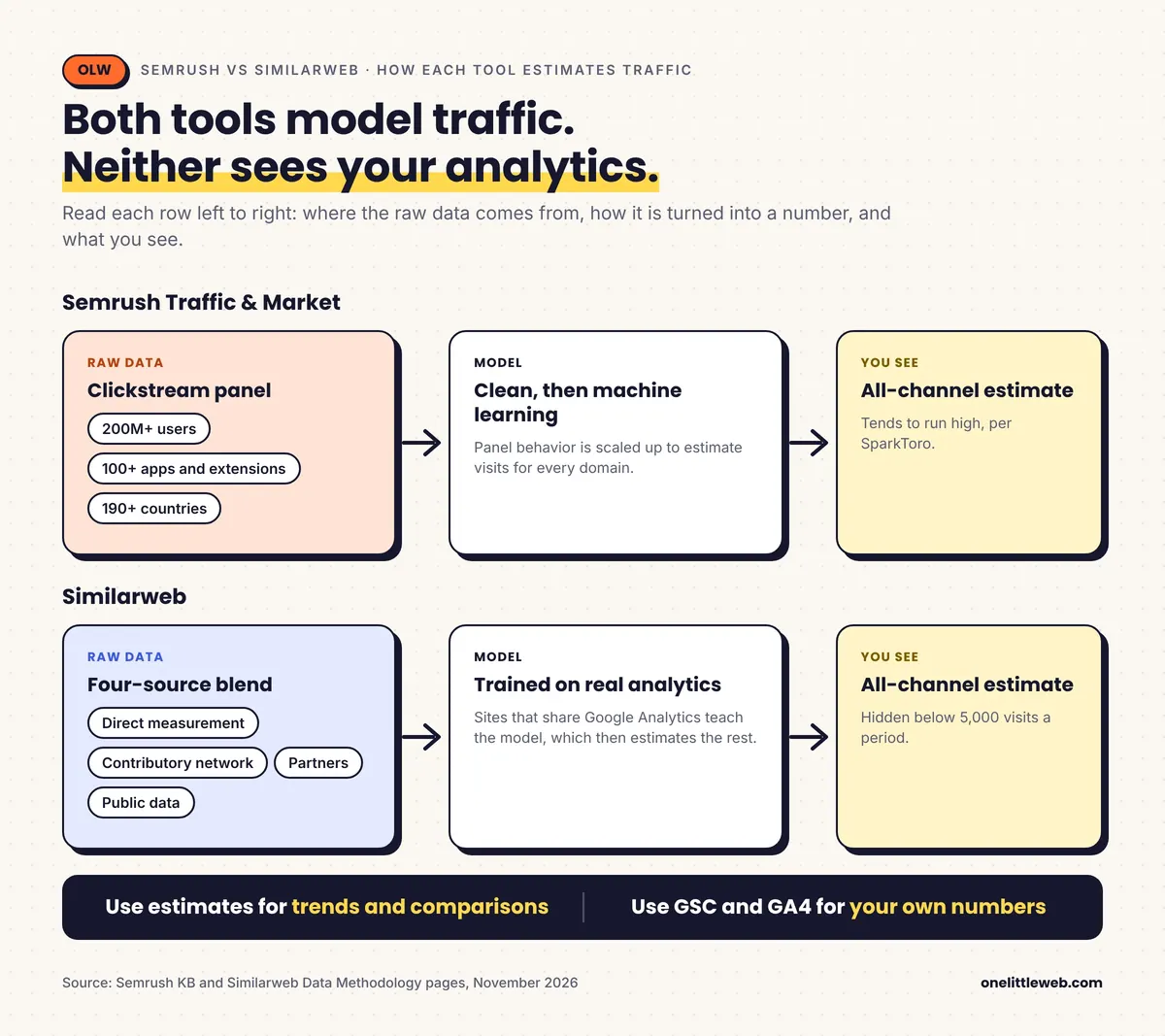
Neither tool can see another site’s analytics. Both build estimates. How they build them explains most of the differences you’ll see.
Semrush: a clickstream panel
Semrush’s Traffic & Market toolkit runs on clickstream data. That’s anonymized browsing data from a panel of over 200 million internet users in 190+ countries, collected through 100+ apps and browser extensions.
Semrush cleans that data, then feeds it into machine learning models that estimate visits for every domain. Semrush’s knowledge base describes four stages: collection, cleaning, modeling and delivery.
Similarweb: a four-source blend
Similarweb says it blends four kinds of data:
- Direct measurement: sites and apps that share their Google Analytics data with Similarweb
- Contributory network: anonymous traffic data from Similarweb products installed on devices
- Partnerships: data from partners such as internet providers
- Public data extraction: crawled public data
The direct measurement data trains the model. Similarweb then uses that model to estimate traffic for every other site.
This is Similarweb’s main accuracy argument. It learns from real analytics, then predicts the rest.
Semrush shows two different traffic numbers
This one trips up a lot of people.
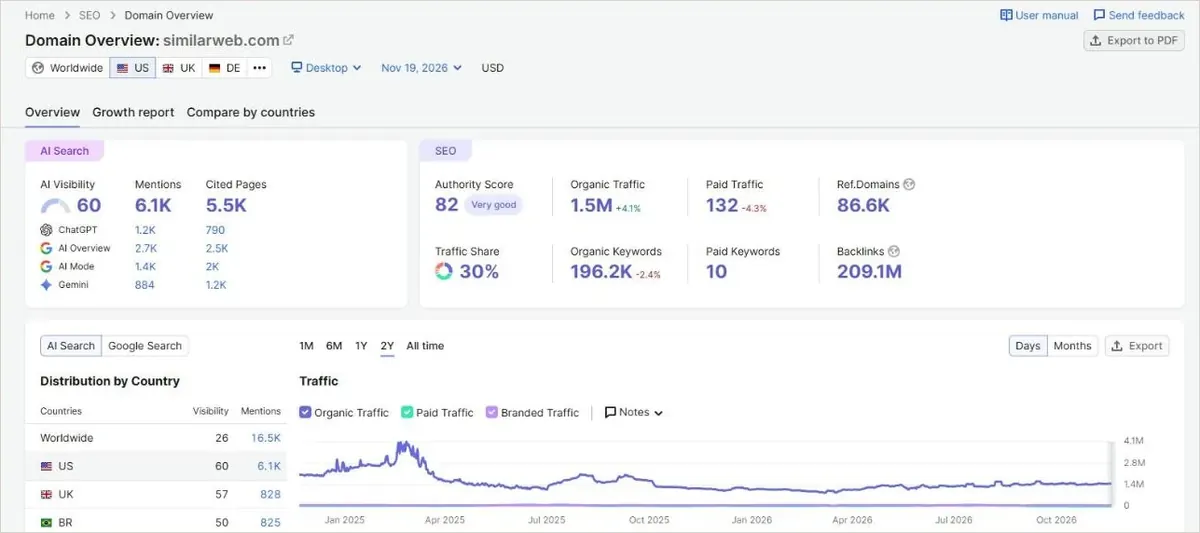
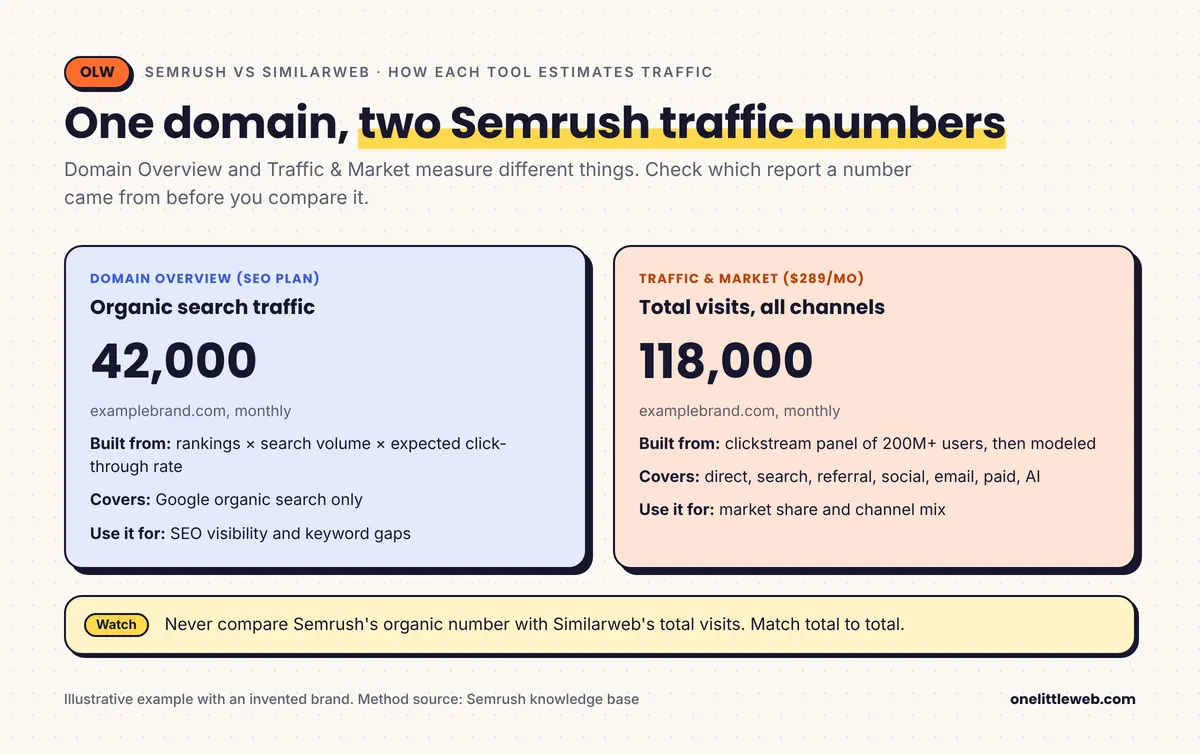
The organic traffic you see in Semrush’s Domain Overview is a keyword model. Semrush takes a site’s rankings, multiplies by search volume and expected click-through rate, and adds it up.
The traffic you see in Traffic & Market is a clickstream estimate. It covers every channel, not only Google organic.
So the two numbers can disagree. When someone tells me “Semrush says 50,000 visits,” my first question is which report they opened.
Here’s a real example. When I checked similarweb.com on November 20, 2026, Domain Overview showed 1.5M US organic visits. Traffic & Market showed 22M worldwide visits for October across every channel. Both are correct. They just measure different things.
The small-site blind spot
Similarweb shows no numeric data when a site’s estimated visits fall under 5,000 for the period. Its help center says the variance is too high below that line.
Semrush will still show a number for small sites. But panel data gets thin there too, so treat those numbers as rough.
If your market is full of niche B2B sites with a few thousand visits each, neither tool will give you a sharp picture. Your own Google Search Console is the only reliable source for your own site.
Which is more accurate?
Short answer: it depends on site size, and no tool is accurate enough to quote as fact.
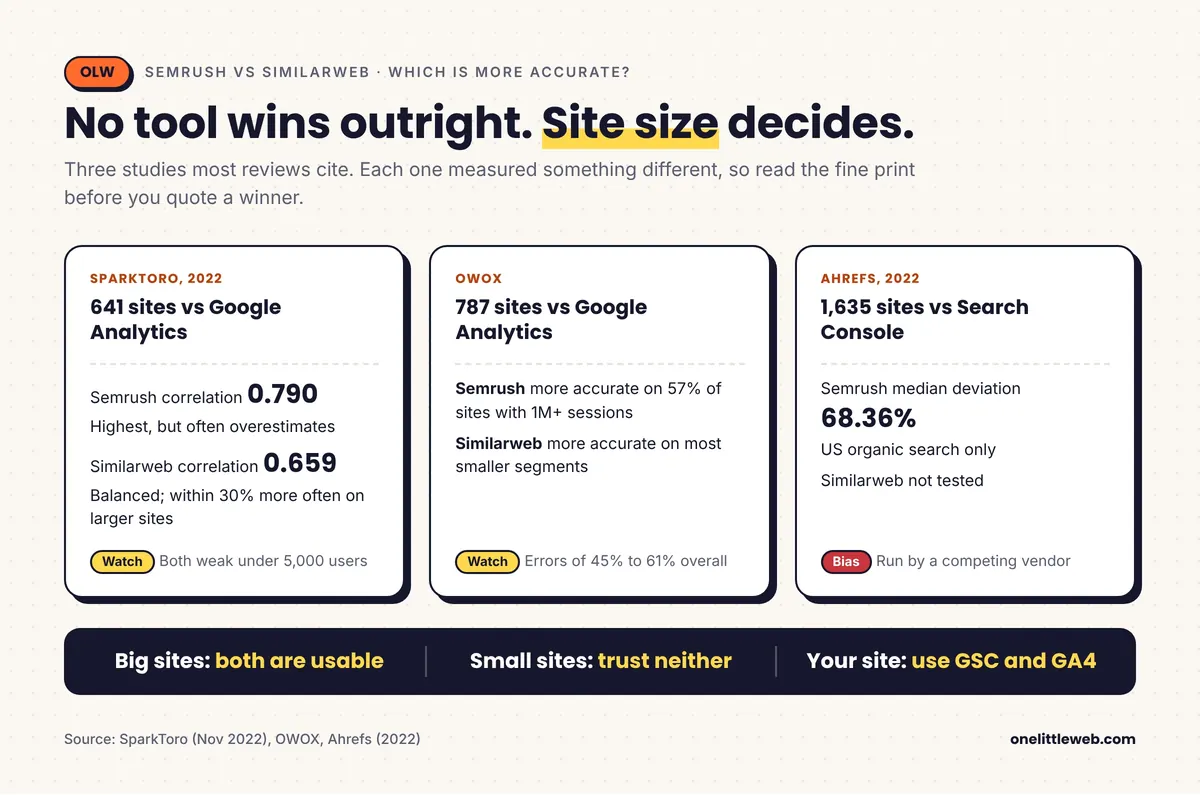
Here’s what the three studies most people cite actually found.
| Study | Sample | What it measured | Semrush | Similarweb |
|---|---|---|---|---|
| SparkToro (2022) | 641 sites, 12 months | Correlation with Google Analytics users | 0.790 (highest), tends to overestimate | 0.659, balanced over and under |
| OWOX | 787 sites | Accuracy vs Google Analytics by site size | More accurate on 57% of sites with 1M+ sessions | More accurate on most smaller segments |
| Ahrefs (2022) | 1,635 sites | US organic estimate vs Search Console | 68.36% median deviation | Not tested |
SparkToro’s study is the most useful one. Semrush tracked the overall trend best. But Similarweb’s estimates landed within 30% of real numbers more often on larger sites, and Rand Fishkin picked it for big sites. Both tools struggled under 5,000 monthly users.
The OWOX test found the same split. Semrush did better on very large sites. Similarweb did better on smaller ones.
Watch for vendor bias
Similarweb’s help center says the SparkToro study found it “most accurate.” That’s a selective read. On correlation, the study ranked Semrush first.
The Ahrefs study has its own problem. Ahrefs ran it, and Ahrefs sells a competing tool.
Even Similarweb admits the limits. It says two analytics tools on the same site can disagree by up to 30%. Expect trends to match, not exact numbers.
How I calibrate any estimate
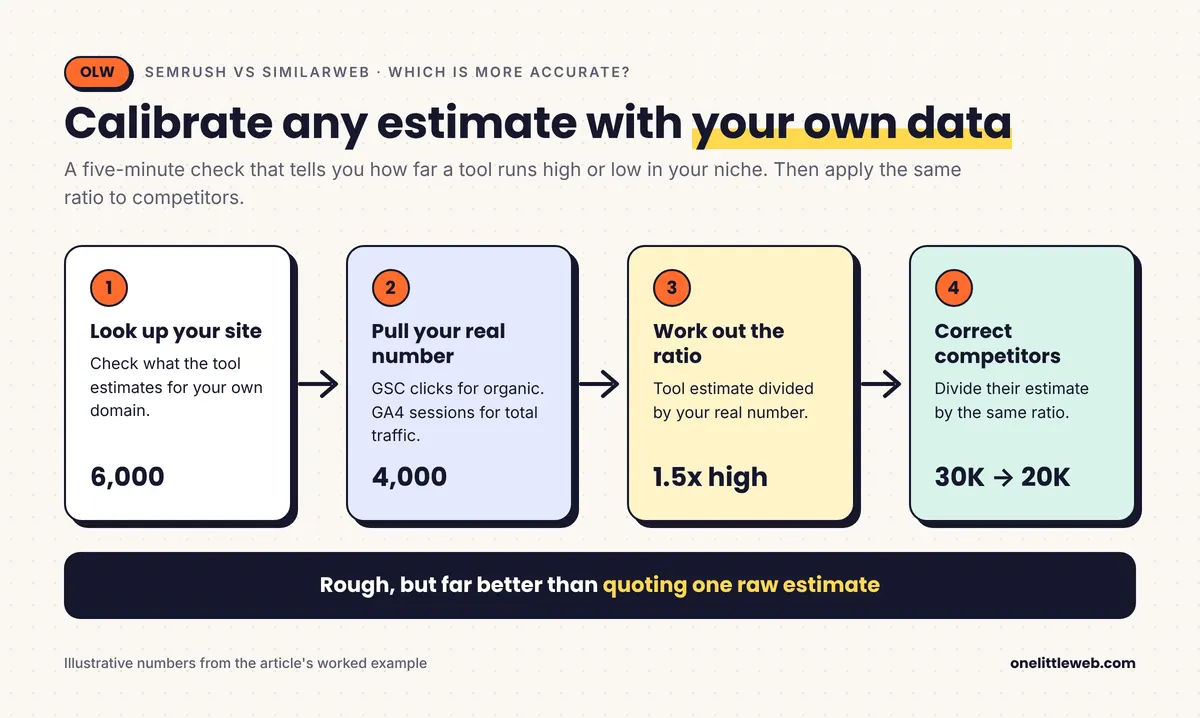
I use a simple ratio check before trusting any tool on a new market.
- Look up your own site in the tool.
- Compare that number to your real data. Use Search Console clicks when you check organic estimates, since it only counts Google search clicks. Use GA4 sessions when you check total traffic, since it covers every channel.
- Work out the ratio. If Search Console shows 4,000 clicks and the tool says 6,000, it runs about 1.5x high for your niche.
- Apply the same ratio to competitors as a rough correction.
It isn’t perfect. But it turns a guess into an informed guess, and it takes five minutes.
Traffic and market analysis
This is Similarweb’s home turf, and it shows.
Similarweb
Every Similarweb plan includes traffic and engagement, audience demographics, a marketing channel overview and competitor alerts.
The channel view covers direct, organic search, paid search, referral, social, email and display. You can see deduplicated audiences, which tells you how many unique people visit a group of sites. You also get industry benchmarks and app data that Semrush doesn’t offer at all.
For market sizing, investor research or sales prospecting, this depth is hard to beat.
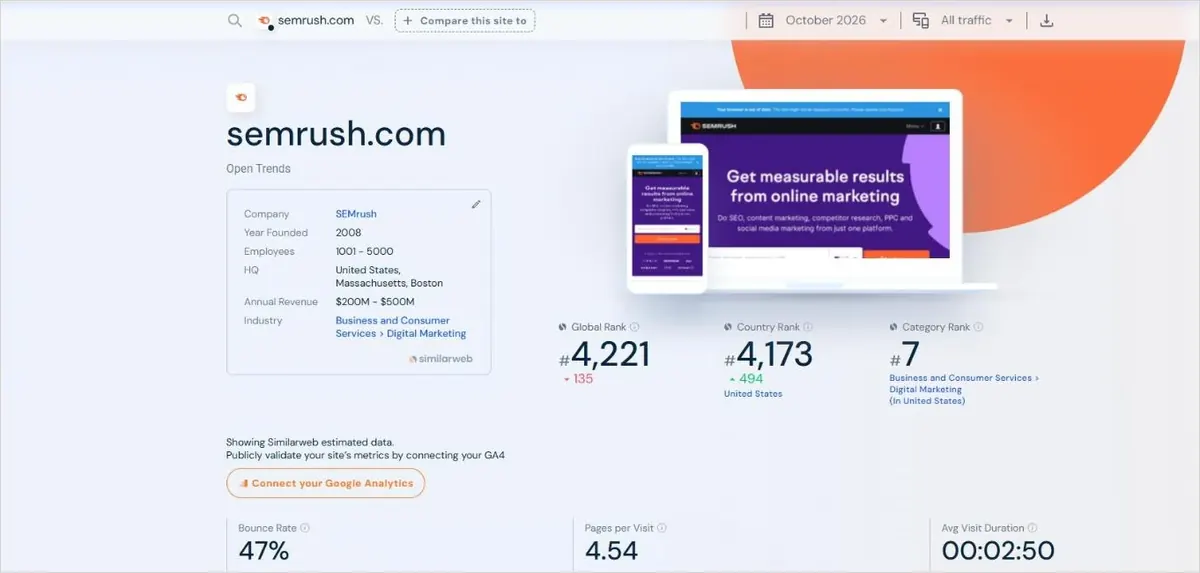
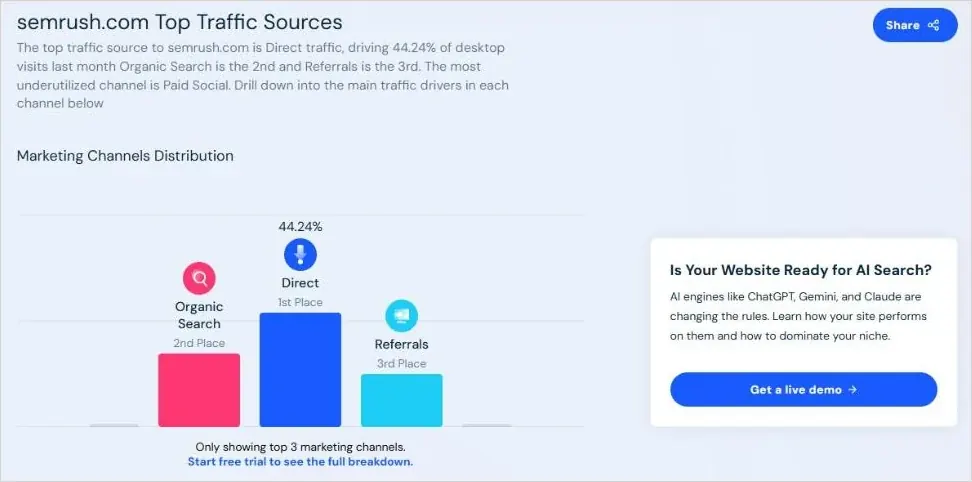
The free checker is a good taste. I ran it on semrush.com, and it showed ranks, engagement and the top 3 channels. Everything past that sits behind a trial.
Semrush Traffic & Market
Semrush’s answer is the Traffic & Market toolkit at $289 a month. It covers traffic analytics, market overview, channel mix, top pages and conversions, plus daily trends.
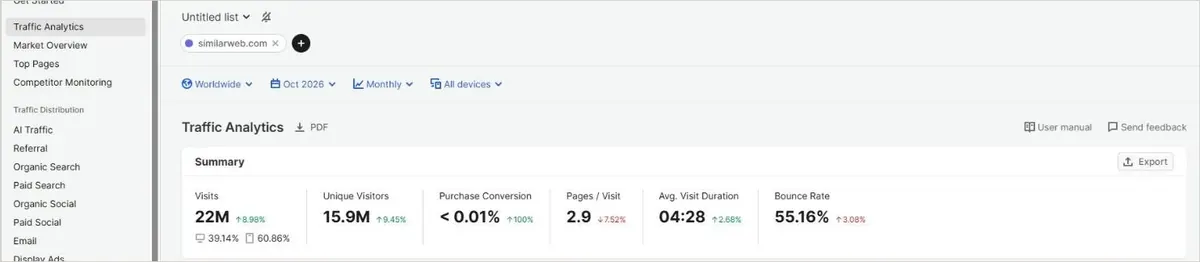
It tracks up to 100 competitors across 190+ countries. It also breaks out AI traffic, meaning referral visits from ChatGPT, Claude and Gemini. That channel is growing fast. Adobe reported AI traffic to US retail sites rose 269% year over year as of March 2026.
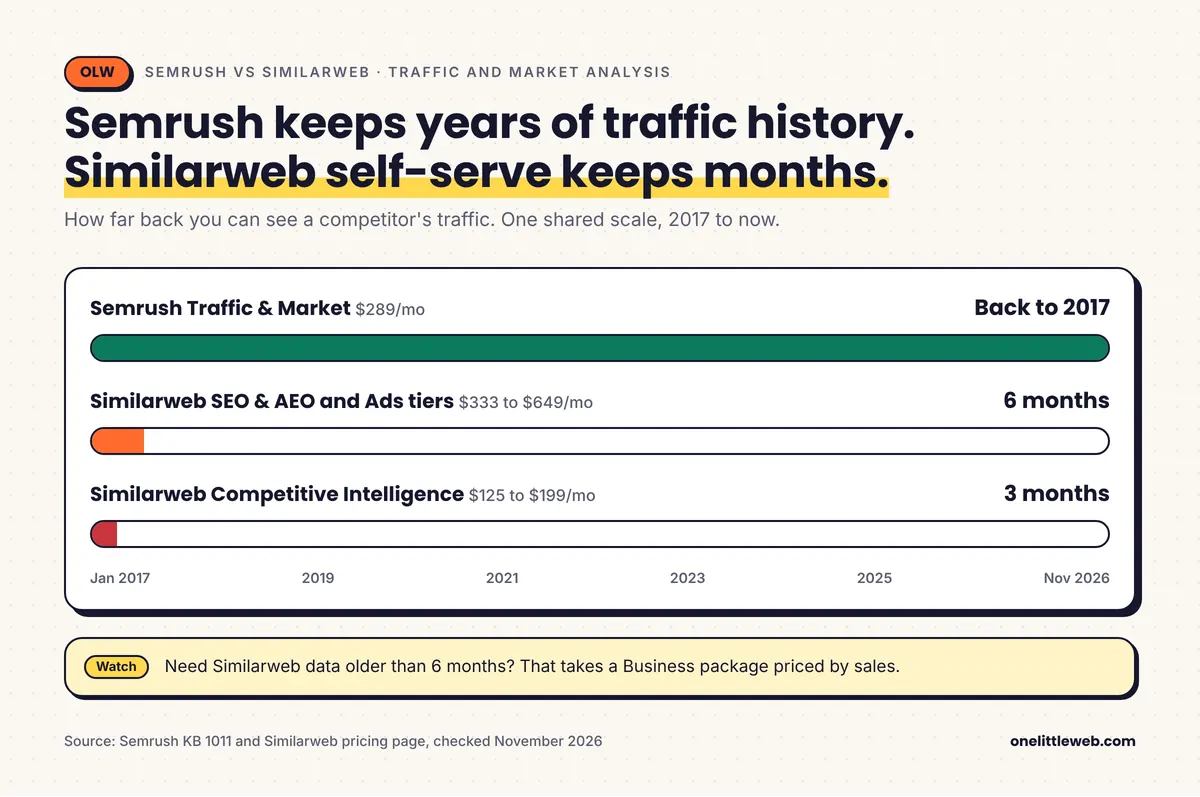
The standout is history. Semrush says Traffic & Market data goes back to 2017. Similarweb’s self-serve plans cap you at 3 or 6 months.
That matters when you want to show how a competitor’s traffic moved after a Google core update a year ago. You can’t tell that story with 3 months of data.
App and mobile data
Similarweb covers websites and mobile apps. It says it tracks over 1 billion websites and 8 million apps, and it splits web traffic by desktop and mobile web.
Semrush Traffic & Market also splits desktop and mobile web visits. It has no app data. If you research app-first brands, only Similarweb gives you that side of the market.
Data freshness
Semrush Traffic & Market includes daily traffic insights through its Daily Trends dashboard. Similarweb releases its main traffic data monthly and offers a “last 28 days” view for recent trends. Its backlink data updates daily.
For spotting a competitor’s campaign launch this week, Semrush’s daily view is handier.
Verdict: Similarweb wins on market, audience and app depth. Semrush wins on history and daily trends per dollar.
Audience insights and demographics
Traffic numbers tell you how big a site is. Audience data tells you who those visitors are. Both tools now cover this, but they come at it from different angles.
Similarweb
Audience demographics come with every Similarweb self-serve plan. For any site, you see age and gender splits and top countries. The platform also has an Audience Interests report. That report shows which other sites the same people visit.
Its Audience Overlap feature compares up to 5 sites at once. It shows how many of your visitors also visit a competitor, and how loyal each audience is. Similarweb pitches this as a way to see your untapped audience.
For brand and media teams, this is the most useful part of the platform. You can find partner sites, ad placements and new segments without running a survey.
Semrush Traffic & Market
Semrush added the same kind of data inside Traffic & Market. Its Audience Profile area has four dashboards:
- Demographics: age and gender split by domain
- Audience Overlap: Venn diagrams showing shared and untapped visitors across sites
- Socioeconomics: income, education and employment patterns
- Behavior: other sites the audience visits
I use Audience Overlap when a client wants to find guest post or partnership targets. If a site shares a big chunk of your competitor’s audience but not yours, it’s a good outreach lead.
The catch is cost. You only get these dashboards with the $289 Traffic & Market toolkit. The SEO plans don’t include them.
Verdict: Similarweb, because audience data comes on its cheapest plan. Semrush is close if you already pay for Traffic & Market.
Keyword research
Semrush has the bigger and more SEO-focused keyword set.
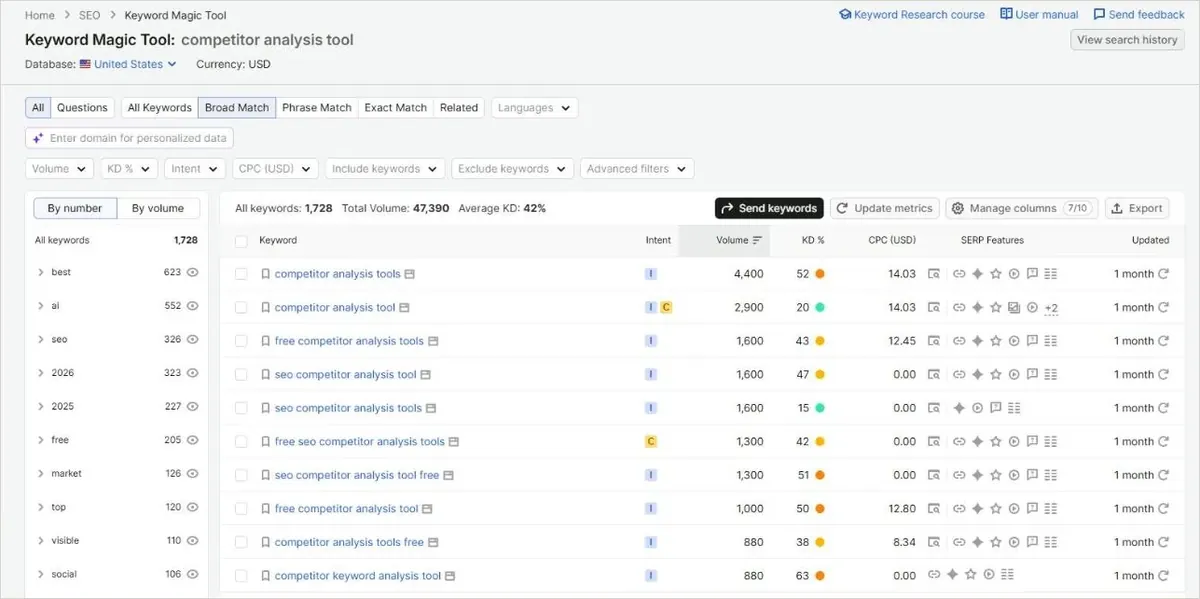
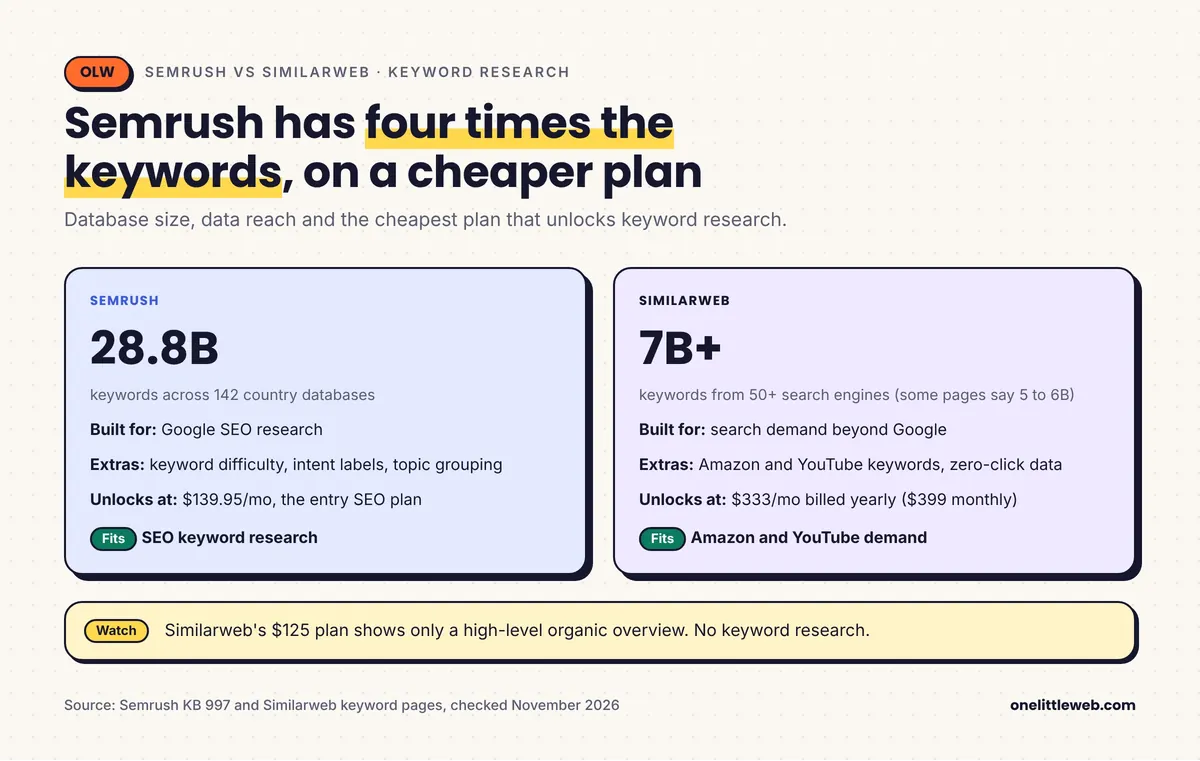
Semrush’s database holds 28.8 billion keywords across 142 country databases. Its Keyword Magic Tool adds keyword difficulty, intent labels and topic grouping. I use it to build content plans for nearly every client.
Similarweb lists 7 billion+ keywords from 50+ search engines (some of its pages say 5 to 6 billion). Its edge is reach beyond Google. You get Amazon and YouTube keyword data, plus zero-click search data.
The catch is pricing. Similarweb’s keyword research sits on the $333/month tier and up. On the $125 plan, you only get a high-level organic overview.
Verdict: Semrush for SEO keyword research. Similarweb if you need Amazon or YouTube search demand.
Backlink analysis
This isn’t close.
Semrush tracks 43 trillion backlinks and 808 million domains. Its crawler visits about 10 billion pages a day. We use it weekly for link audits and link building prospecting.
Similarweb’s backlink numbers are smaller and less clear. Its help center says 3.6 trillion links across 200 million domains. Its marketing page says 360 trillion. We couldn’t confirm which is current, so plan around the lower figure.
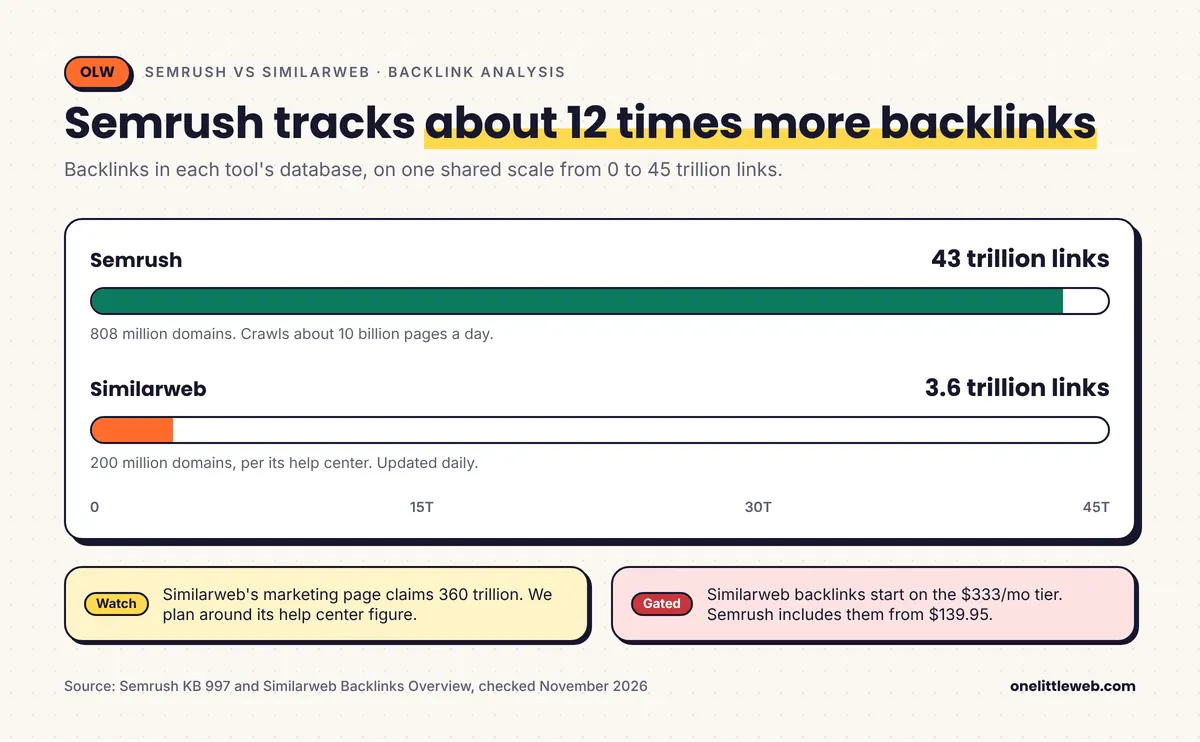
If links matter to your SEO, Semrush is the better tool.
Verdict: Semrush.
Rank tracking, site audits and SEO workflow
Semrush is built for the weekly SEO routine.
Every Semrush plan includes rank tracking, site audit, on-page checks and content tools. Tracked keywords scale by plan: 500 on SEO and Starter, 1,500 on Pro+ and 5,000+ on Advanced.
Similarweb has a rank tracker and a site audit too. They live on the $333 tier. Style Factory’s review notes its audit checks 300+ issues. But the rest of the SEO workflow is thinner.
If you manage several client sites, Semrush’s project setup makes life easier. If tracking is your main need, our list of the best rank tracking software covers cheaper options too.
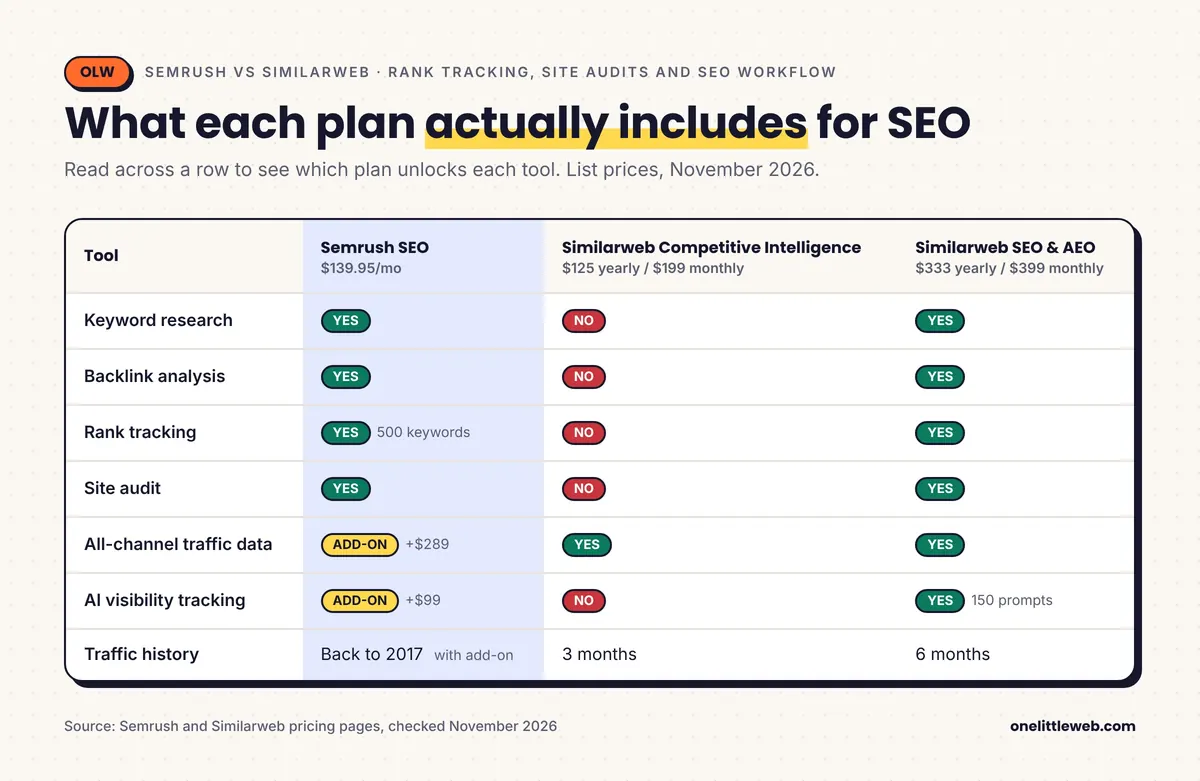
Verdict: Semrush.
Content research and top pages
Both tools can show you which pages win traffic for a competitor. Only one helps you write the content that competes with them.
Finding a competitor’s top pages
In Semrush, the Organic Research report lists the pages that bring a site the most search traffic. Traffic & Market adds a Top Pages report that counts visits from every channel, not just search.
Similarweb has a Website Content report that splits any site into folders, subdomains and popular pages. Its Top Organic Pages tool does the search-only version. Page-level Popular Pages has been sold as a premium add-on for higher packages, so check what your plan includes before you count on it.
Planning and writing content
This is where Semrush pulls ahead. Classic Guru and higher plans include Topic Research, the SEO Content Template and the SEO Writing Assistant.
The Content Toolkit is also sold on its own for $60 a month. It bundles topic ideas, SEO briefs, an AI article writer with 5 SEO-boosted articles a month and a content optimizer.
At OLW, we use the Writing Assistant as a final check on client drafts. It flags missing related terms and readability issues before an article goes live.
Similarweb doesn’t have a content writing or optimization tool. Its keyword and page data can feed a content plan, but you’ll write and check the drafts somewhere else.
Verdict: Semrush. Similarweb helps you see what works for competitors, but Semrush helps you build the page.
AI search visibility
Both tools now track how brands appear in AI answers.
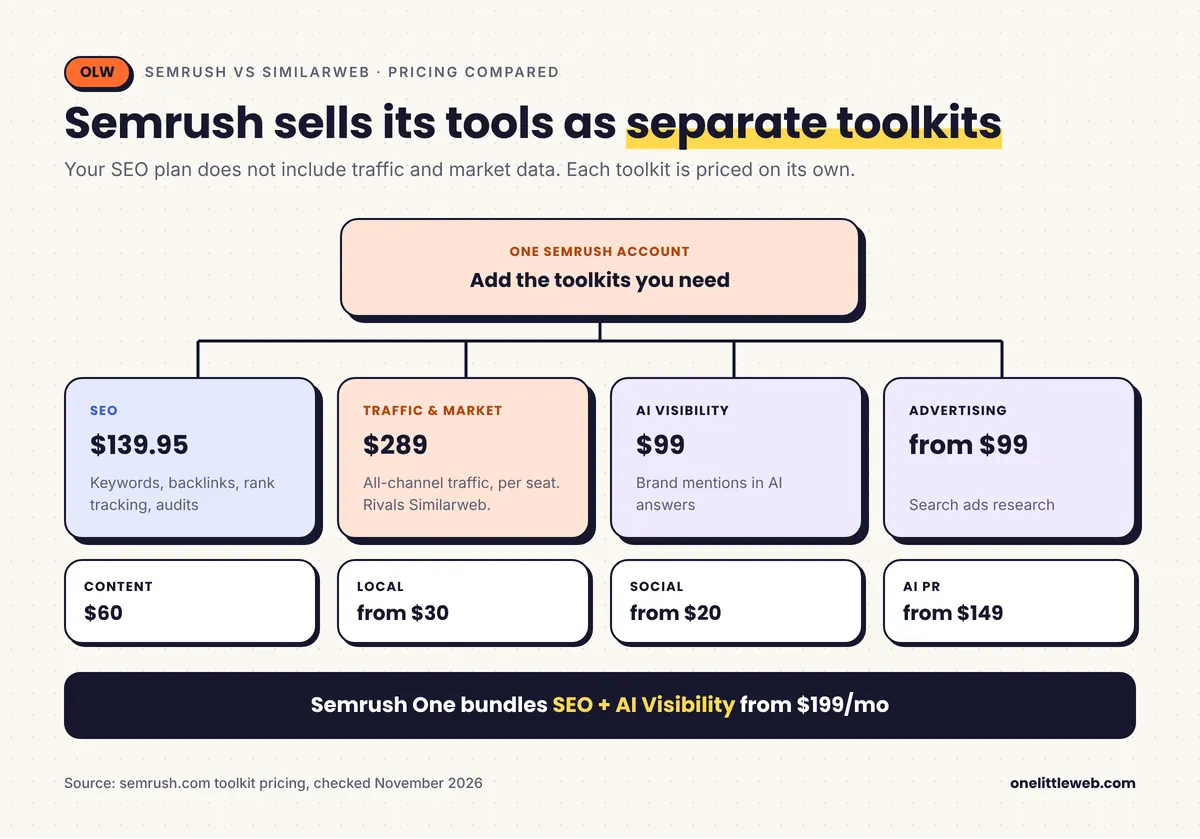
Semrush: Semrush One bundles SEO with AI Visibility. Starter ($199/mo) tracks 50 prompts a day and Pro+ ($299) tracks 100. Advanced moved to custom pricing with unlimited prompts. You can also buy the AI Visibility toolkit alone for $99.
Similarweb: AEO Intelligence costs $99/month billed yearly or $129 monthly. It tracks 150 prompts, plus sentiment, citations and AI traffic. The $333 tier includes the same AEO tools with SEO and competitive data.
Similarweb’s AEO plan is cheaper if AI visibility is all you need. Semrush is easier if you want AI and SEO data in one place. For more options, see our roundup of AI answer tracking tools.
PPC and ad intelligence
Similarweb’s ad data is broader. Its top self-serve tier ($542 yearly, $649 monthly) adds ad spend, creatives, and search and display insights.
Semrush covers search ads well through its Advertising toolkit from $99 a month. For display, video and social ads, Semrush points you to the AdClarity app in its App Center.
Verdict: Similarweb for display and ad spend. Semrush for Google Ads keyword research.
Ecommerce and Amazon data
If you sell on marketplaces, this section may decide it for you.
Similarweb Shopper Intelligence
Similarweb sells a separate product for retail called Shopper Intelligence (also marketed as Retail Intelligence). It’s not part of the Web Intelligence plans priced above.
According to Similarweb, it covers Amazon plus 650+ retailers such as Walmart, Target and eBay. It tracks 200K+ brands and 660M+ products with weekly, product-level data. That includes sales estimates, search terms, pricing and how shoppers reach a listing.
Even inside Web Intelligence, Similarweb gives you Amazon keyword data on the $333 tier. That’s a real gap in most SEO tools.
Semrush
Semrush has no marketplace sales data in its core toolkits. Traffic & Market shows how much traffic a store’s website gets, but not what sells on Amazon.
For Amazon sellers, Semrush points you to ecommerce apps in its App Center. These used to be its Sellzone toolkit and include tools like Keyword Wizard for Amazon. Each app is billed on its own.
Verdict: Similarweb for brands that sell on Amazon and other marketplaces. Semrush for growing traffic to your own store.
API, integrations and AI assistants
If you want the data in your own dashboards, check API access before you buy. Neither tool includes it on entry plans.
Semrush splits its API in two, according to its developer docs:
- Standard API: SEO data. It needs the SEO Business plan, and you buy API units separately.
- Trends API: Traffic & Market data. It comes in Basic and Premium levels, with 10,000 requests a month by default.
Semrush also connects to Looker Studio on Guru and above, and it now offers an MCP server so AI assistants can pull its data.
Similarweb sells API access with its Business packages, along with data feeds, an MCP connection and AI agents. Its API is billed in data credits, and each endpoint lists how many credits a result costs.
For an agency feeding client reports, Semrush is easier to start with. For a data team pulling market data at scale, Similarweb’s API is the more complete product, but you’ll need a sales call to get a price.
Pricing compared
Semrush plans (November 2026)
| Plan | Monthly | Billed yearly (per month) | Key limits |
|---|---|---|---|
| SEO (Classic Pro) | $139.95 | $117.33 | 5 projects, 500 tracked keywords |
| Classic Guru | $249.95 | $208.33 | 15 projects, 1,500 keywords, historical data |
| Classic Business | Custom | Custom | 40+ websites, Share of Voice, API |
| Semrush One Starter | $199 | $165.17 | SEO + 50 AI prompts/day |
| Semrush One Pro+ | $299 | $248.17 | 15 sites, 1,500 keywords, 100 prompts/day |
| Semrush One Advanced | Custom | Custom | 40+ sites, 5,000+ keywords, unlimited prompts |
| Traffic & Market Pro | $289 | Listed as $289 | 1 seat, 3,000 requests/day |
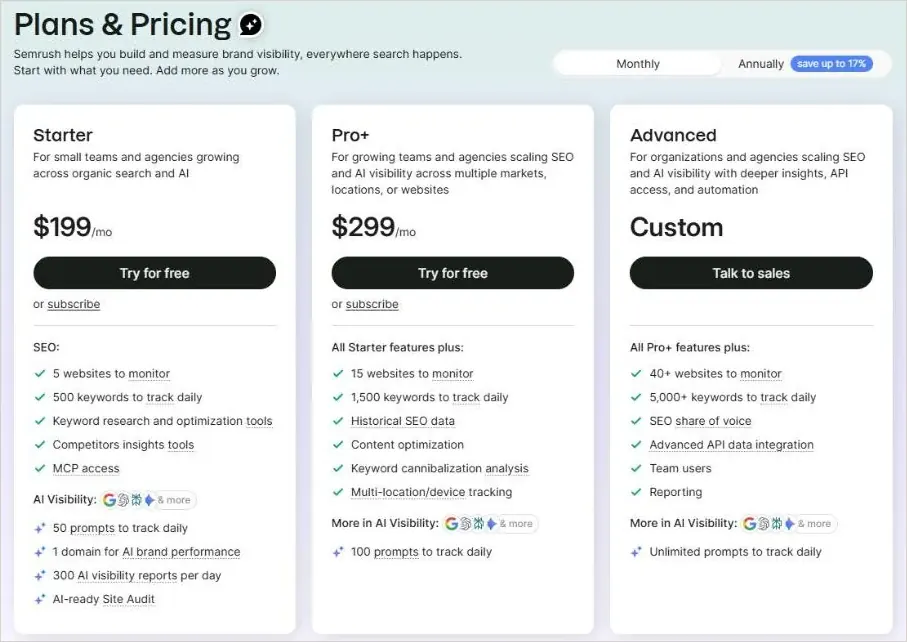
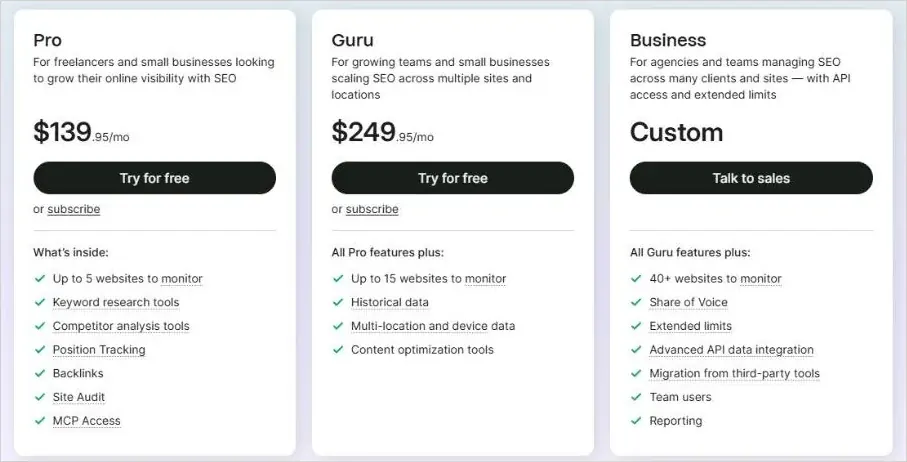
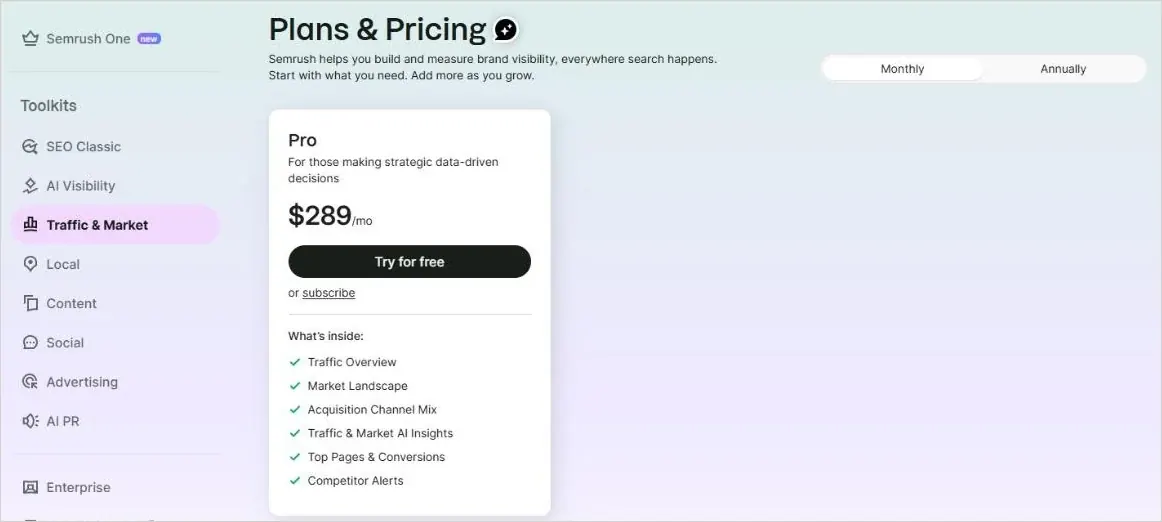
Extra users cost $45, $80 or $100 a month depending on tier. On Semrush One, each extra user also needs AI Visibility access for $99. Traffic & Market seats are bought separately at $289 each.
Semrush has a free plan with 10 reports a day. Most paid plans have a 7-day trial. Standard API access starts on Advanced or Classic Business. Traffic & Market data comes through a separate Trends API.
Similarweb plans (November 2026)
| Plan | Billed yearly (per month) | Monthly | History | What’s included |
|---|---|---|---|---|
| AEO Intelligence | $99 | $129 | 3 months | AI visibility, 150 prompts |
| Competitive Intelligence | $125 | $199 | 3 months | Traffic, audience, channels, alerts |
| Competitive Intel & SEO & AEO | $333 | $399 | 6 months | Adds keyword research, rank tracker, audit, backlinks, AEO |
| + Ads | $542 | $649 | 6 months | Adds ad intelligence |
| Business / Enterprise | Quote | Quote | Longer | API, data feeds, AI agents, more seats |
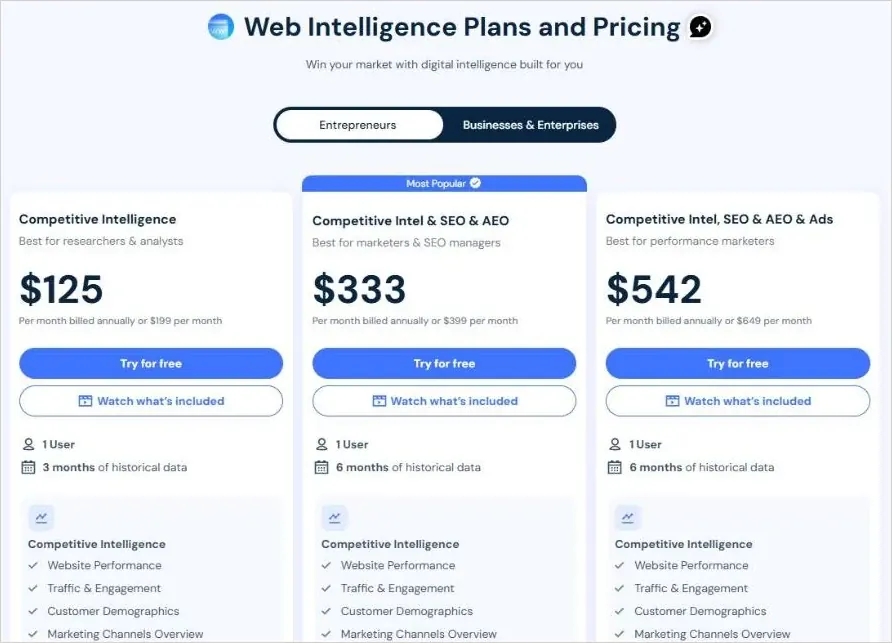
Every self-serve plan includes one user. Similarweb doesn’t publish Business pricing. Third-party trackers put team contracts around $14,000 to $35,000 a year, so treat those as rough guides.
Every self-serve plan has a free trial. The pricing page doesn’t list the length; third-party reviews report 7 days. API access, data feeds and longer history only come with Business packages.
One quirk: you can’t switch to yearly billing on the pricing page. Similarweb’s FAQ says to contact support.
The apples-to-apples cost
| What you need | Semrush | Similarweb |
|---|---|---|
| Traffic and market data only | $289/mo (Traffic & Market) | $125/mo yearly or $199 monthly |
| SEO tools only | $139.95/mo | $333/mo yearly or $399 monthly |
| Traffic data + SEO tools | $428.95/mo ($139.95 + $289) | $333/mo yearly or $399 monthly |
For one user who needs both, Similarweb is cheaper. For SEO alone, Semrush costs less than half.
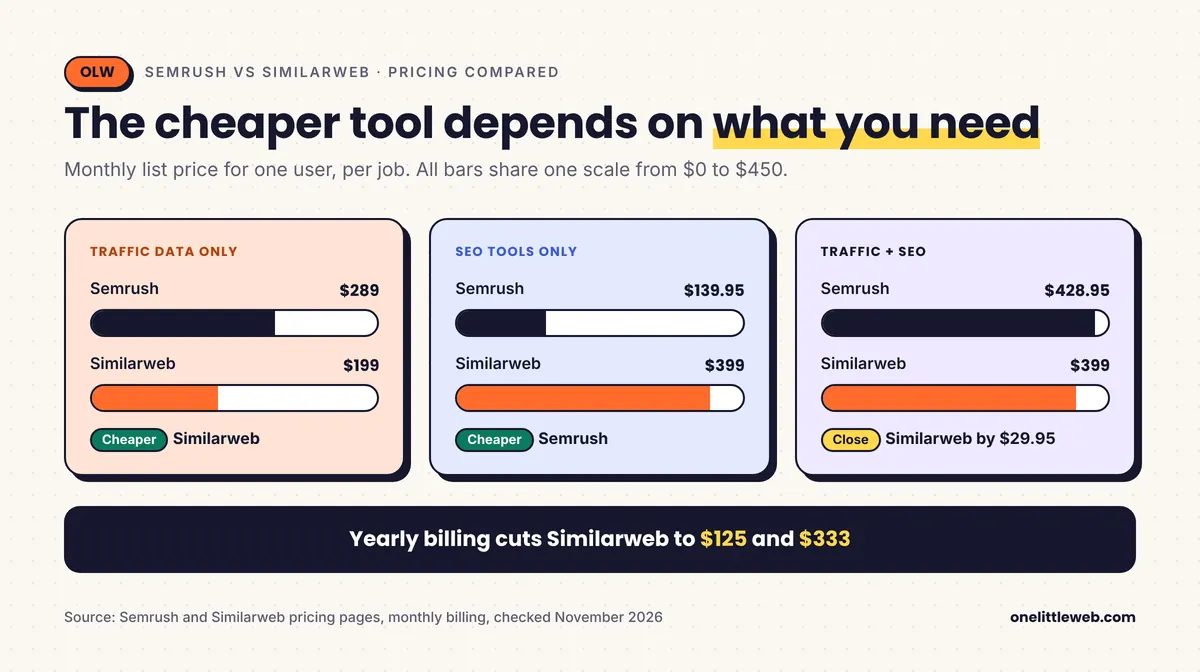
Cost for 1, 3 and 5 users (traffic data + SEO, monthly billing)
| Team size | Semrush (SEO + Traffic & Market) | Similarweb (SEO & AEO tier) |
|---|---|---|
| 1 user | $428.95 | $399 |
| 3 users | $1,096.95 | about $1,097 |
| 5 users | $1,764.95 | about $1,795 |
Semrush math: $139.95 + $45 per extra SEO user + $289 per Traffic & Market seat. Similarweb math uses the $349 extra-seat price reported by Style Factory; Similarweb doesn’t publish seat prices, so confirm with sales.
The totals land close once a team needs everything. The real savings come from not buying what you don’t use. Most SEO teams only need one or two Traffic & Market seats, not five.
Ease of use, support and user reviews
Users rate them almost the same overall. Similarweb gets slightly better marks for ease of use and support.
| Semrush | Similarweb | |
|---|---|---|
| G2 rating | 4.4/5 (4,324 reviews) | 4.4/5 (1,345 reviews) |
| G2 ease of use | 8.3 | 8.6 |
| G2 quality of support | 8.4 | 8.8 |
| G2 meets requirements | 8.7 | 8.4 |
| Capterra rating | 4.6/5 (2,329 reviews) | 4.6/5 (261 reviews) |
| Capterra ease of use | 4.3 | 4.6 |
| Capterra value for money | 4.2 | 4.2 |
Ratings checked November 2026 on G2 and Capterra. They drift, so recheck before you buy.
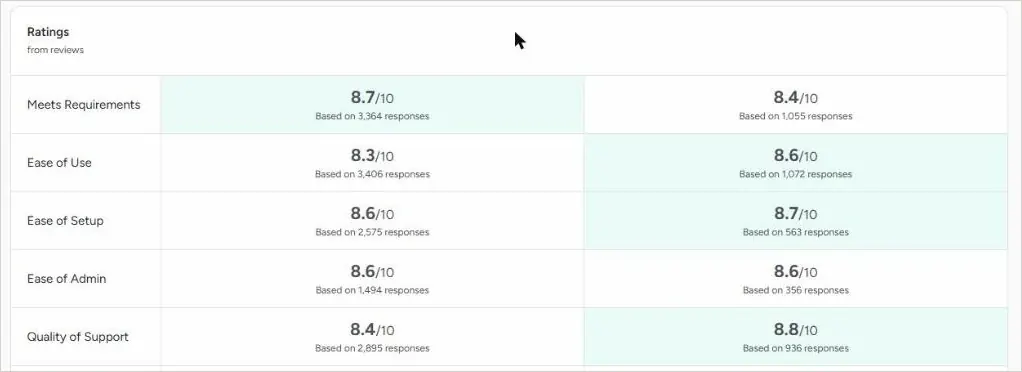
In my experience, Semrush has a real learning curve because it does so much. New users need time to learn which toolkit holds which report. Similarweb’s dashboards are simpler, which fits its narrower job.
Pros and cons
Semrush
Pros
- Largest keyword and backlink data of the two (28.8B keywords, 43T links)
- Full SEO workflow on the entry plan: keywords, links, rank tracking, audits
- Traffic & Market history goes back to 2017
- Cheap extra seats for SEO work ($45 to $100)
- AI visibility built into Semrush One
Cons
- All-channel traffic data costs $289 a month extra, per seat
- Two different traffic numbers confuse new users
- Tends to overestimate traffic, per SparkToro
- Busy interface with a real learning curve
Similarweb
Pros
- All-channel traffic and audience data from $125 a month
- App data, deduplicated audiences and industry benchmarks
- Amazon and YouTube keyword data
- Higher G2 scores for ease of use and support
- Cheap standalone AEO plan at $99
Cons
- Self-serve history capped at 3 to 6 months
- SEO tools start at $333 a month
- No numbers for sites under 5,000 visits
- Backlink data is much smaller, and vendor figures conflict
- Annual billing and team pricing need a sales or support contact
Which one should you choose?
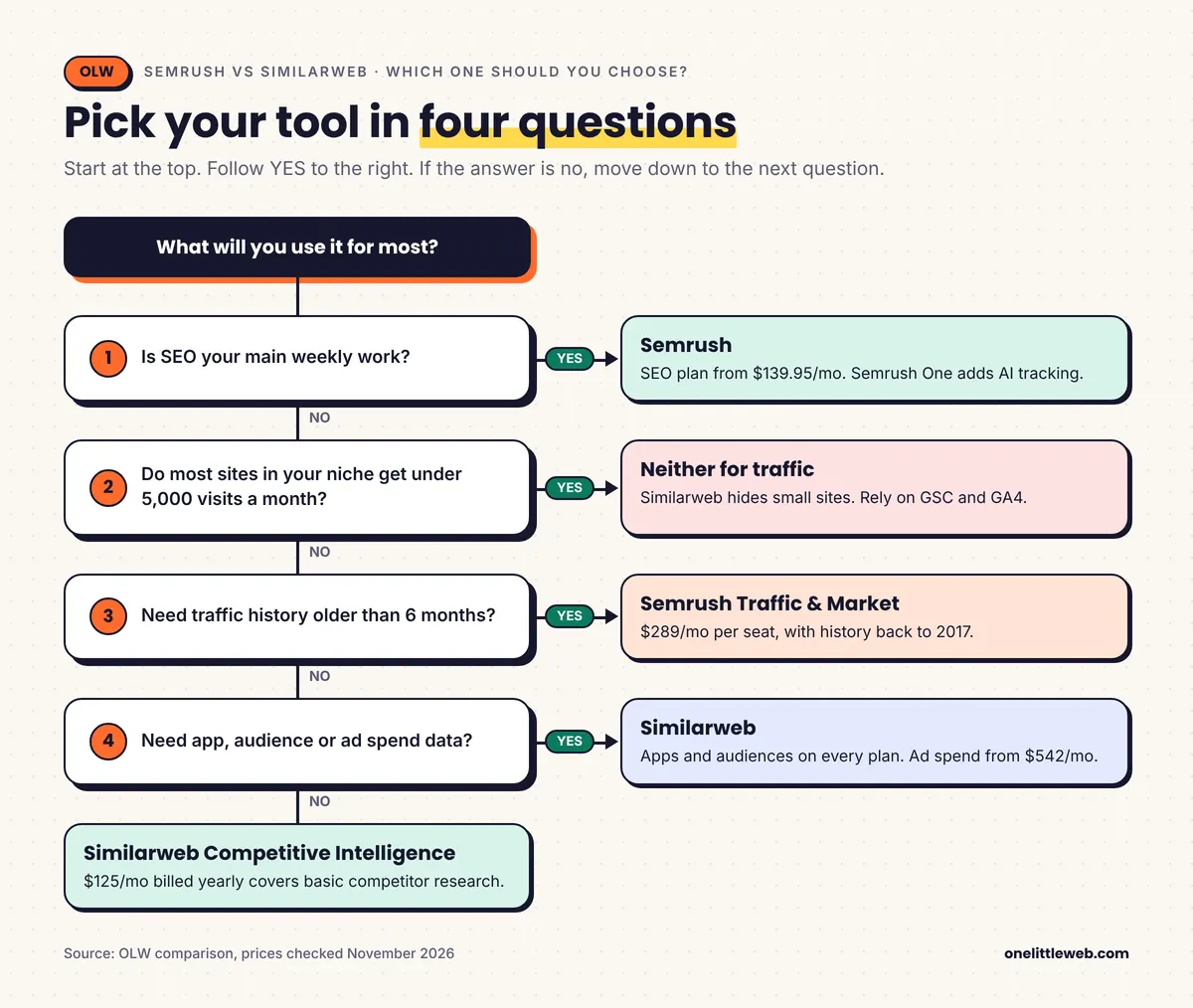
| If you are… | Pick | Why |
|---|---|---|
| An SEO agency | Semrush | Full SEO workflow, cheap seats, multi-project setup |
| An in-house SEO or content team | Semrush | Keyword depth and rank tracking from $139.95 |
| A founder on a tight budget | Semrush SEO plan | Most SEO value per dollar |
| A market researcher or analyst | Similarweb | Audience, channel and industry data on every plan |
| An investor or BD team | Similarweb | Market share, app data, enterprise data feeds |
| A performance marketer | Similarweb + Ads tier | Ad spend and display insights |
| A growth team entering new markets | Both | Similarweb sizes the market, Semrush wins the search traffic |
Skip Semrush if you never touch SEO and only need market sizing. You’d pay for tools you won’t open.
Skip Similarweb if most sites in your niche get under 5,000 visits a month. You’ll see “not enough data” more than you’ll see numbers.
Our take: For most of our clients, Semrush is the right first buy. If you’re still weighing it against other SEO suites, our Semrush review and Semrush alternatives guide go deeper. For a wider view, see our list of the best competitor analysis tools.
How we use Semrush and Similarweb together
Some teams don’t have to pick. Here’s the workflow we follow when a client wants to enter a new market and has budget for both.
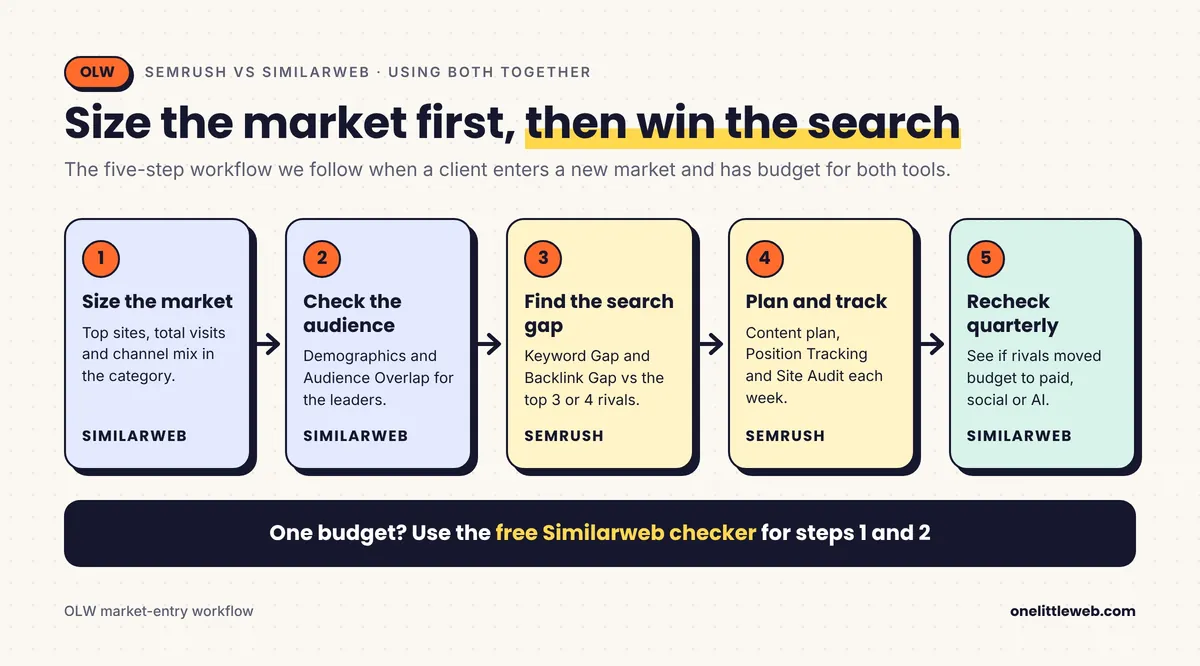
- Size the market in Similarweb. Pull the top sites in the category, their total visits and their channel mix. This shows whether search is even the main way people find these brands.
- Check the audience. Use Similarweb’s demographics and Audience Overlap to see who visits the leaders and which other sites they read.
- Find the search gap in Semrush. Run Keyword Gap and Backlink Gap against the 3 or 4 strongest competitors. This turns the market view into a list of keywords and link targets.
- Plan and track. Build the content plan in Semrush, then set up Position Tracking and Site Audit for the weekly routine.
- Recheck the market every quarter. Go back to Similarweb to see if competitors shifted budget to paid, social or AI channels.
If you can only afford one, you can still copy most of this. Use Similarweb’s free checker for steps 1 and 2 at a basic level, and run the rest in Semrush.
Alternatives to Semrush and Similarweb
Neither tool is the only option. These are the ones I’d look at first:
- Ahrefs: The closest rival to Semrush for SEO, with a strong backlink index. See how they compare in our Ahrefs vs Semrush vs Moz breakdown.
- SE Ranking: A cheaper SEO suite for small teams and freelancers who don’t need every Semrush report.
- SpyFu: Focused on competitor search ads and keyword history, usually for less than either.
- Sensor Tower: A better fit than Similarweb if your research is mostly about mobile apps.
For a full list, read our guide to the best SEO tools.
Mistakes to avoid when choosing
- Comparing the wrong plans. Semrush’s SEO plan and Similarweb’s traffic plan do different jobs. Compare Traffic & Market with Competitive Intelligence instead.
- Quoting one estimate as fact. Both tools model traffic. Check trends across a few months and calibrate against your own data.
- Mixing up Semrush’s two traffic numbers. Domain Overview shows a keyword-based organic estimate. Traffic & Market shows all channels.
- Ignoring history caps. Similarweb’s 3 or 6 months won’t cover a year-over-year report.
- Buying a seat for everyone. Most teams need one or two Traffic & Market or Similarweb seats, not one per person.
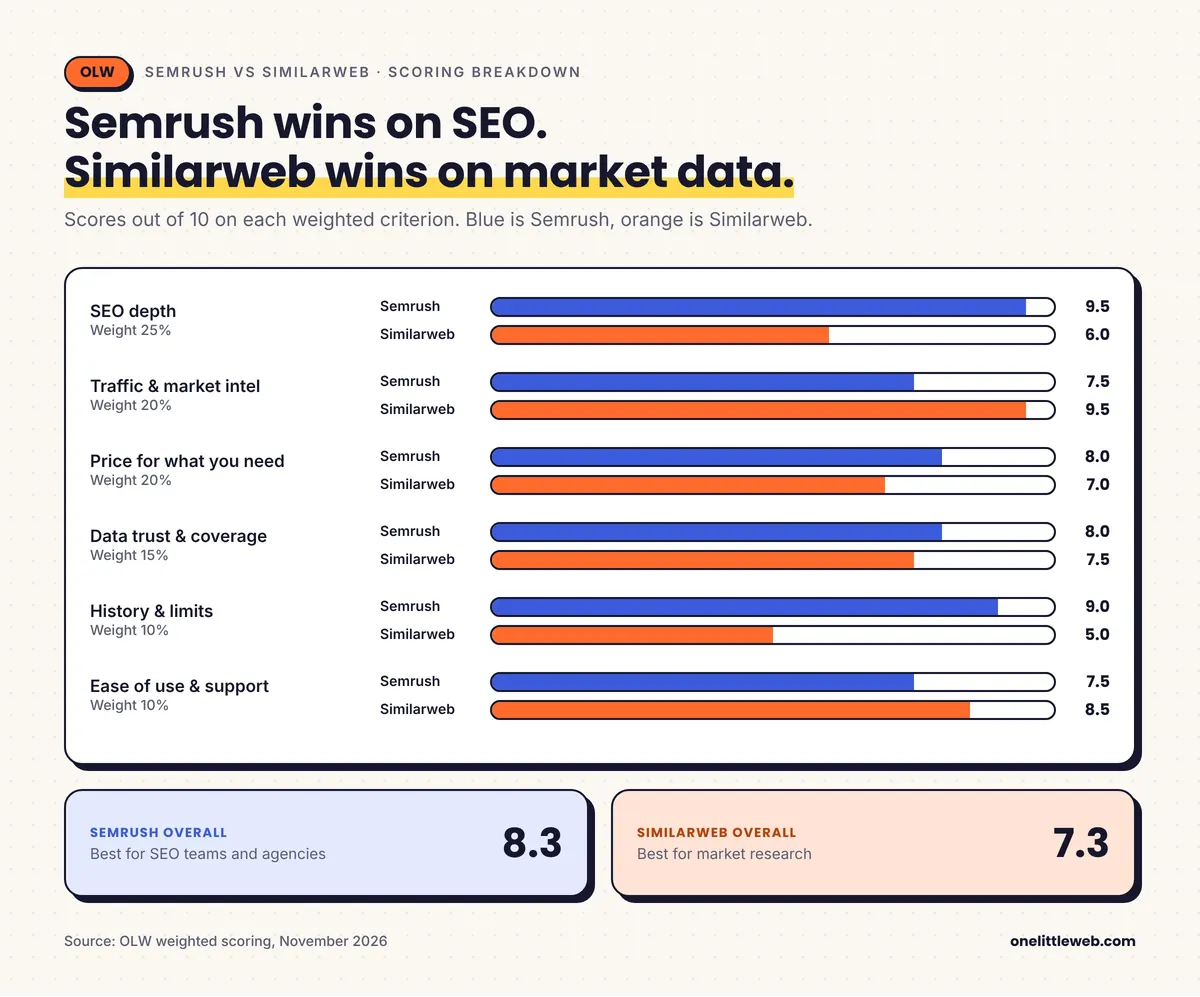
Scoring breakdown
| Tool | SEO depth (25%) | Traffic & market intel (20%) | Price for what you need (20%) | Data trust & coverage (15%) | History & limits (10%) | Ease of use & support (10%) | Overall |
|---|---|---|---|---|---|---|---|
| Semrush | 9.5 | 7.5 | 8.0 | 8.0 | 9.0 | 7.5 | 8.3 |
| Similarweb | 6.0 | 9.5 | 7.0 | 7.5 | 5.0 | 8.5 | 7.3 |
How we scored:
- SEO depth (25%): High scores need large keyword and link data plus rank tracking and audits on the entry plan. Gated or thin SEO tools score low.
- Traffic & market intel (20%): High scores cover all channels, audiences and industry benchmarks. Search-only data scores low.
- Price for what you need (20%): We looked at the cheapest plan that does the core job. Add-ons and per-seat costs pull scores down.
- Data trust & coverage (15%): Based on SparkToro, OWOX and Ahrefs studies, plus small-site coverage. Neither tool scores above 8 because no estimate is reliable enough to quote as fact.
- History & limits (10%): Years of history score high. A 3-month cap scores low.
- Ease of use & support (10%): Based on G2 and Capterra ratings and our team’s daily use of Semrush.
The weights reflect what readers searching this comparison care about most: SEO work and the cost of getting traffic data.
Frequently Asked Questions
Is Similarweb better than Semrush?
Similarweb is better for market research and all-channel traffic data. Semrush is better for SEO. Pick based on the job, not the brand.
Is Semrush’s traffic data accurate?
It’s an estimate. In SparkToro’s 641-site study, Semrush had the highest correlation with Google Analytics (0.790) but tended to overestimate. Use it for trends and comparisons, not exact numbers.
Does Semrush have Similarweb-style traffic data?
Yes. The Traffic & Market toolkit covers all-channel traffic, audiences and market trends. It costs $289 a month per seat on top of any SEO plan.
How much does Similarweb cost?
Self-serve plans run from $125 a month billed yearly ($199 monthly) up to $542 yearly ($649 monthly). Business and enterprise plans are quote-only.
Can I use Similarweb for free?
Partly. The free website checker and Chrome extension show top-line ranks, engagement and countries for any site, but only the top 3 traffic channels. Deeper data needs a paid plan or trial.
Why does Similarweb show no data for my site?
Similarweb hides numbers when a site’s estimated visits fall under 5,000 for the period. The estimate isn’t reliable enough below that.
Which is better for keyword research?
Semrush. It has 28.8 billion keywords and includes keyword research on every paid plan. Similarweb’s keyword tools start at $333 a month.
Which tool tracks AI search visibility?
Both. Semrush One includes it from $199 a month. Similarweb’s AEO Intelligence plan starts at $99 a month billed yearly.
Should I buy both?
Only if you need deep SEO work and deep market research. A common setup is Semrush for SEO plus one Similarweb seat for pitches and market sizing.
Did Adobe buying Semrush change its pricing?
Not so far. Adobe completed the deal on April 28, 2026. At closing, Semrush told customers it had no planned changes to existing contracts. Plans and prices are still sold on semrush.com.
Final verdict
For SEO, Semrush is the stronger and cheaper tool. You get the bigger keyword and link data, rank tracking and audits from $139.95 a month.
For market intelligence, Similarweb wins. Its audience, channel and app data is deeper, and it starts at $125 a month.
If you need both, compare Semrush Traffic & Market with Similarweb’s SEO tier. The totals land close, so let history limits and team size decide.
If you’re still choosing between the big SEO suites, read our Semrush vs Ahrefs comparison. Or, if you’d rather hand off the work, our SEO consulting team can build the plan with you.