Quick answer
Perplexity vs ChatGPT: pick Perplexity if you mostly research and want a clickable source for every claim. Pick ChatGPT if you want one assistant that writes, codes, makes images and runs tasks. Both main paid plans cost $20 a month.
Key takeaways
- Accuracy. In the Tow Center citation test, Perplexity got 37% wrong and ChatGPT Search got 67% wrong.
- Sources. ChatGPT cites Wikipedia most. Perplexity cites Reddit most, at 20% to 24% of all its citations.
- Writing and coding. ChatGPT wins clearly, with Codex, images and memory in one app.
- Free plans. ChatGPT Free does more. Perplexity Free has no ads and cites every answer.
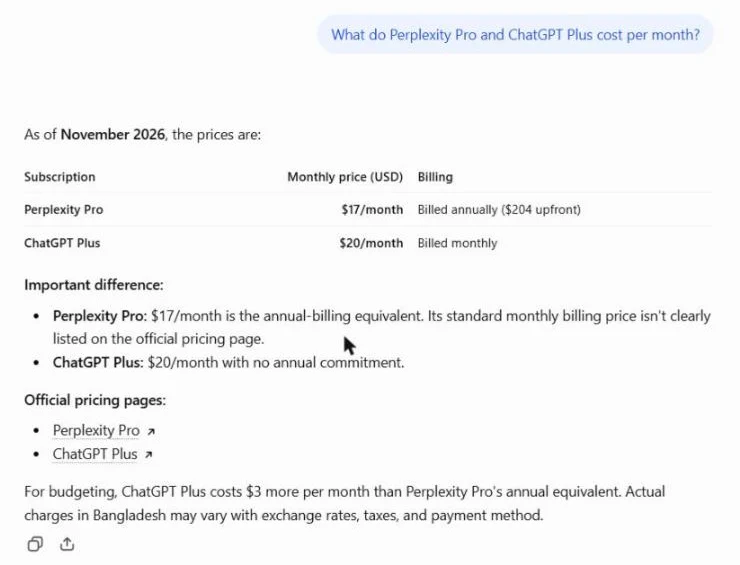
- Price. Perplexity Pro is $200 a year. ChatGPT Plus has no yearly plan, so a year costs $240.
- Momentum. Perplexity’s website lost 62% of its unique visitors in a year. ChatGPT grew 12%.
Pick Perplexity if you mostly look things up and want a source for every claim. Pick ChatGPT if you want one assistant that writes, codes, makes images and runs tasks for you.
Both cost $20 a month on their main paid plans. So the choice comes down to how you work, and to a few facts most comparisons skip.
Here’s one of them. ChatGPT now has 1.2 billion weekly users, according to OpenAI. Over the same 12 months, Perplexity’s website lost 62% of its unique visitors in our own tracking data.
That doesn’t make Perplexity worse. It does change what you’re buying into.
In this guide I’ll show you the accuracy studies, the sources each tool trusts, the real free plan limits and the traffic trends behind both tools. Then you can decide with numbers instead of vibes.
Prices and limits were checked on OpenAI’s and Perplexity’s own pages on 20 November 2026. Screenshots were taken in our own browser on 20 November 2026.
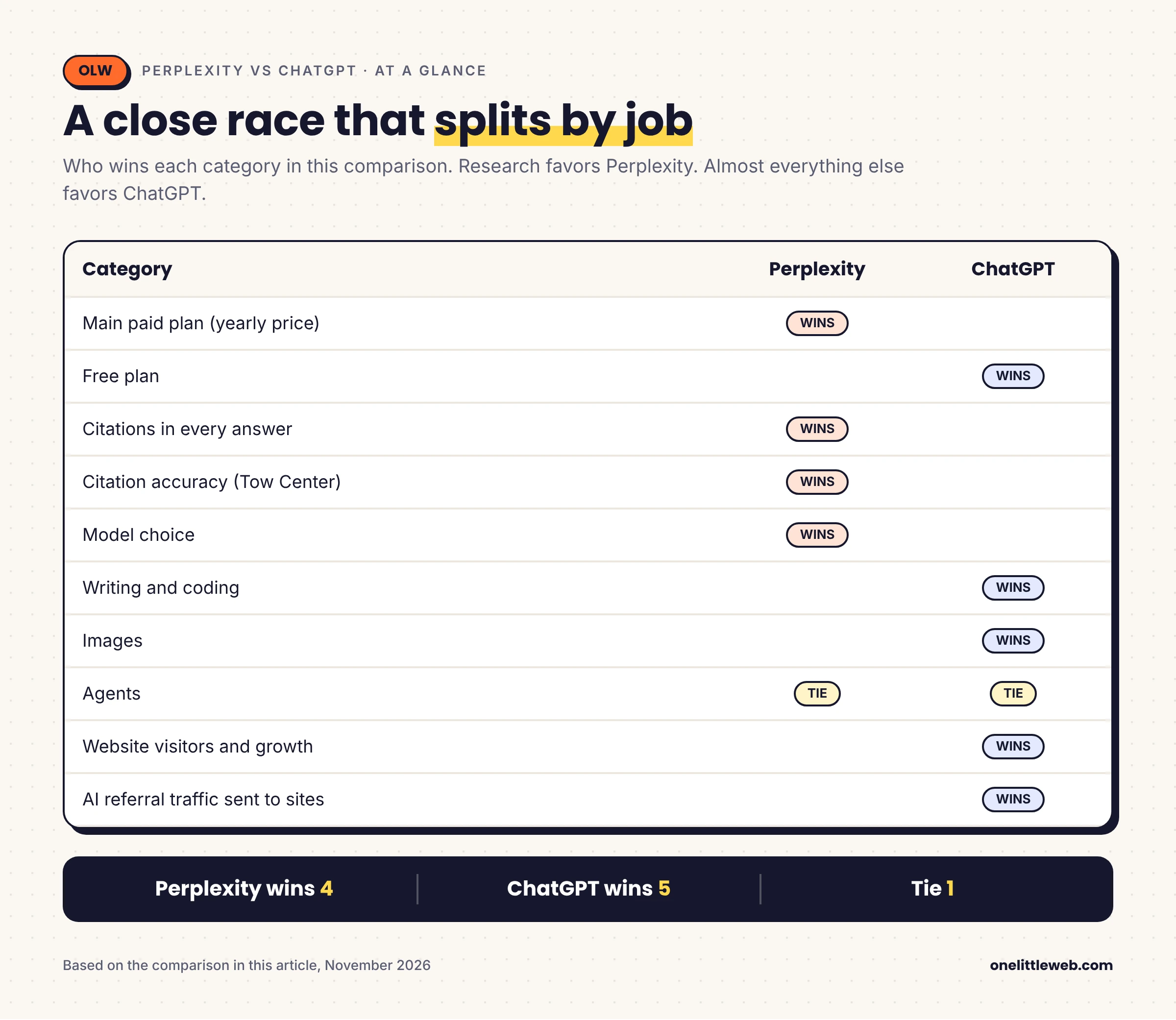
Perplexity vs ChatGPT at a glance
| Perplexity | ChatGPT | Edge | |
|---|---|---|---|
| Built as | An answer engine that searches the web for every question | A general AI assistant that searches when it needs to | Depends on the job |
| Best for | Research and fact-checking with sources | Writing, coding and everyday help | Depends on the job |
| Main paid plan | Pro: $20/month or $200/year | Plus: $20/month (monthly only) | Perplexity, if you pay yearly |
| Free plan | Unlimited basic searches, 3 Pro Searches a day, 1 Deep Research a month | Unlimited text chats, with limits on uploads, images and other tools | ChatGPT |
| Citations | In every answer | When it searches or runs deep research | Perplexity |
| Citation errors (Tow Center test) | 37% wrong | 67% wrong (ChatGPT Search) | Perplexity |
| Models | 8 models from 7 labs on Pro, 11 on Max | OpenAI’s GPT-6 family only | Perplexity |
| Agent | Perplexity Computer (4,000 bonus credits on Pro) | ChatGPT Work (desktop, web and mobile on Plus) | Tie |
| Images | Pro only, plus limited video | Free and paid plans | ChatGPT |
| Website visitors (Sep 2026) | 31.3M unique, down 62% in a year | 867.9M unique, up 12% in a year | ChatGPT |
| Share of AI referral traffic sent to websites | 7.23% | 74.78% | ChatGPT |
Traffic rows: OLW Digital Market Intelligence and SE Ranking’s 2026 AI traffic study. Details in each section below.
What is Perplexity?
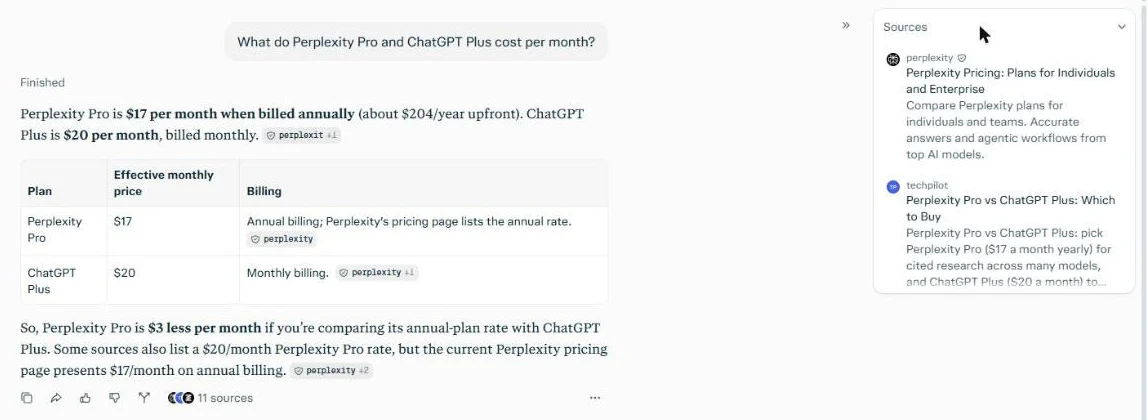
Perplexity is an AI answer engine. You ask a question, it searches the live web, and it writes a short answer with numbered sources you can click.
That’s the core of the product. Every answer comes with citations, and Pro gives you 10x as many citations per answer as the free plan.
Perplexity builds its own search model, called Sonar. On Pro, you can also switch to models from OpenAI, Anthropic, Google and others.
Around that search core, it has added a few tools worth knowing:
- Comet: Perplexity’s AI browser. It launched inside the $200 Max plan in July 2025 and became free for everyone in October 2025.
- Projects (formerly Spaces): Folders for research threads and files. Each one holds up to 10,000 files and 5 GB.
- Premium Sources: Paid business data, such as PitchBook and Statista, inside your answers.
- Perplexity Computer: An agent that builds documents, slides and apps for you.
What reviewers say
Perplexity’s reviews split hard by audience. On G2, where most reviewers are professionals, it scores 4.4 out of 5 from 360+ reviews. On Trustpilot, where most reviewers are paying individuals, it scores 1.5 out of 5 from 820+ reviews, and 79% of those reviews are one star.
The Trustpilot complaints repeat the same story. Users say Pro search limits shrank without warning and reasoning models cut out mid-task. Others say refund tickets only got bot replies. Perplexity doesn’t publish exact Pro limits, which makes those complaints hard to check and easy to believe.
Ratings as reported on 19 October 2026.
Pros
- Every answer links to its sources, so checking a claim takes one click.
- Pro lets you pick models from several labs instead of one.
- Premium Sources bring in business data you’d normally pay for separately.
- Comet is free, so you can try Perplexity inside your browser at no cost.
- It now has memory, so it can use your past searches and saved notes.
Cons
- Writing long drafts or editing in a set brand voice isn’t its strength.
- No image generation on the free plan.
- Pro Search and Deep Research limits aren’t published, and users report silent cuts.
- File uploads reset weekly and cap at 40 MB per file.
What is ChatGPT?
ChatGPT is OpenAI’s general AI assistant. It chats, writes, reasons through problems, makes images, talks with you by voice and can run multi-step tasks.
It’s also the default. OpenAI reported 1.2 billion weekly users at its DevDay event on 29 September 2026. That’s up from 400 million in February 2025.
On paid plans it runs on GPT-6 Sol by default. Free and Go users get GPT-6 Luna, a faster, lighter model.
Search is one tool among many here. ChatGPT decides when it needs the web, or you can turn search on yourself.
What you get beyond chat:
- Memory: ChatGPT remembers your preferences and past details across chats. It’s limited on Free and expanded on Plus.
- Projects and custom GPTs: Saved workspaces and reusable assistants with your own instructions. Both need Plus or higher.
- Codex: OpenAI’s coding agent, included on every plan with different limits.
- Voice: Plus gets up to 3 hours with OpenAI’s newest voice model. Pro $200 is unlimited.
- ChatGPT Work: An agent that works across your apps and files.
One note if you read older comparisons: OpenAI shut down its ChatGPT Atlas browser on 9 August 2026. Its features moved into the ChatGPT desktop app and ChatGPT Work.
Pros
- Strong at drafting, rewriting and matching a tone you describe.
- The free plan gives unlimited text chats.
- Images, voice, coding and an agent all live in one app.
- Memory and projects make it better the longer you use it.
Cons
- It doesn’t cite sources unless it searches, so plain answers need checking.
- You only get OpenAI’s models.
- Free and Go plans may show ads.
- Plus has no yearly discount.
Difference #1: Accuracy and citations
This is the difference that matters most for research.
Perplexity searches the web for every question and shows its sources inline. ChatGPT only shows sources when it runs a search or deep research. A plain ChatGPT answer comes from what the model already knows.
That’s a big reason people now use Perplexity in place of a search engine for research questions. Our AI chatbots vs search engines study tracks how that shift is playing out.
It matters because AI tools still make things up. These errors are called hallucinations. Two large independent studies show how often it happens.
Study 1: Columbia’s citation test
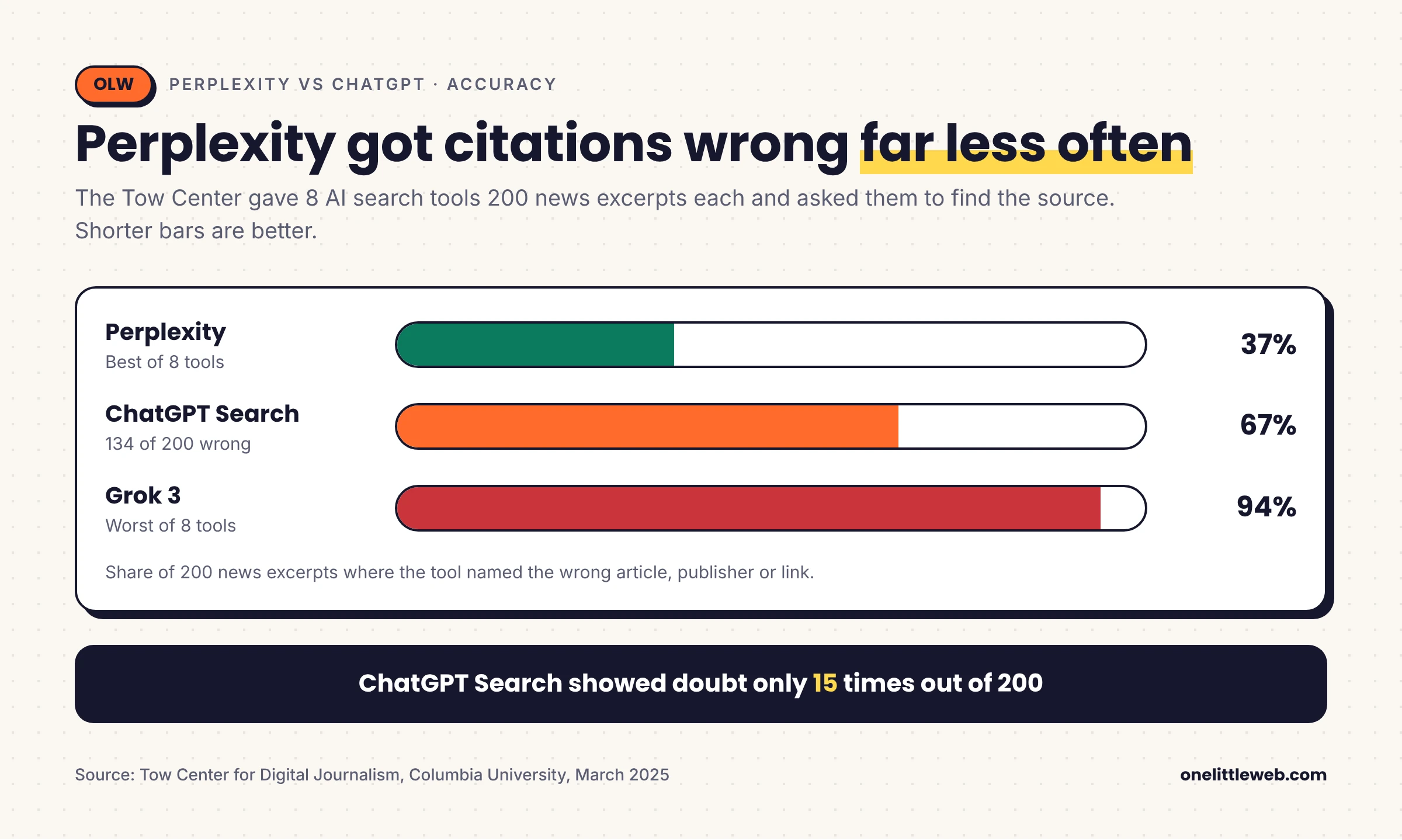
Researchers at the Tow Center for Digital Journalism gave 8 AI search tools 200 news excerpts each. They asked each tool to name the original article and link to it.
- Perplexity got 37% wrong, the best result in the group.
- ChatGPT Search got 134 of 200 wrong (67%). It expressed doubt only 15 times.
- Grok 3 was the worst at 94% wrong.
The scary part isn’t the error rate. It’s that ChatGPT almost never said “I’m not sure.” It gave wrong answers in the same confident tone as right ones.
Study 2: The BBC and EBU news study
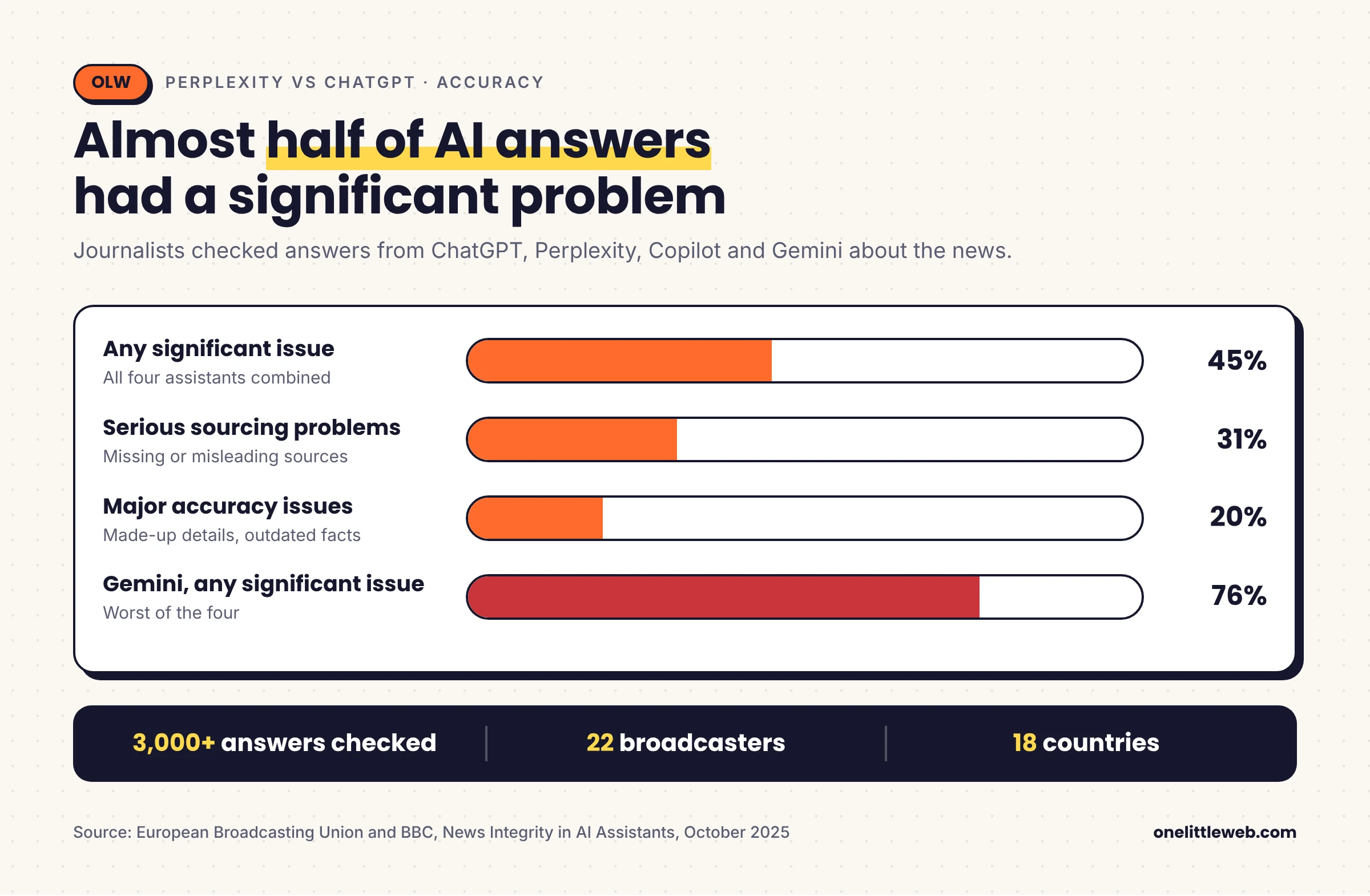
In October 2025, the European Broadcasting Union and the BBC published a bigger test. Journalists from 22 public broadcasters in 18 countries checked more than 3,000 answers from ChatGPT, Perplexity, Copilot and Gemini.
- 45% of all answers had at least one significant issue.
- 31% had serious sourcing problems, such as missing or misleading sources.
- 20% had major accuracy issues, including made-up details and outdated facts.
- Gemini did worst, with significant issues in 76% of answers.
ChatGPT and Perplexity both did much better than Gemini. Neither came close to safe enough to trust blind.
What this means for you
Citations don’t make Perplexity right. They make it faster for you to catch a mistake before it lands in your work.
Freshness is the other gap. ChatGPT’s built-in knowledge stops at a cutoff date (OpenAI’s API docs list 18 May 2026 for GPT-6 Luna). Anything newer needs a search. Perplexity searches every time.
OpenAI says GPT-6 Sol makes far fewer factual errors than older models on its internal test. That’s a vendor claim with no outside check yet.
A simple rule: if the answer will end up in a client report, use Perplexity and click at least two sources. If you only need an idea or a draft, ChatGPT is fine.
Difference #2: Where each one gets its sources
Most comparisons stop at “Perplexity cites sources.” The more useful question is which sources.
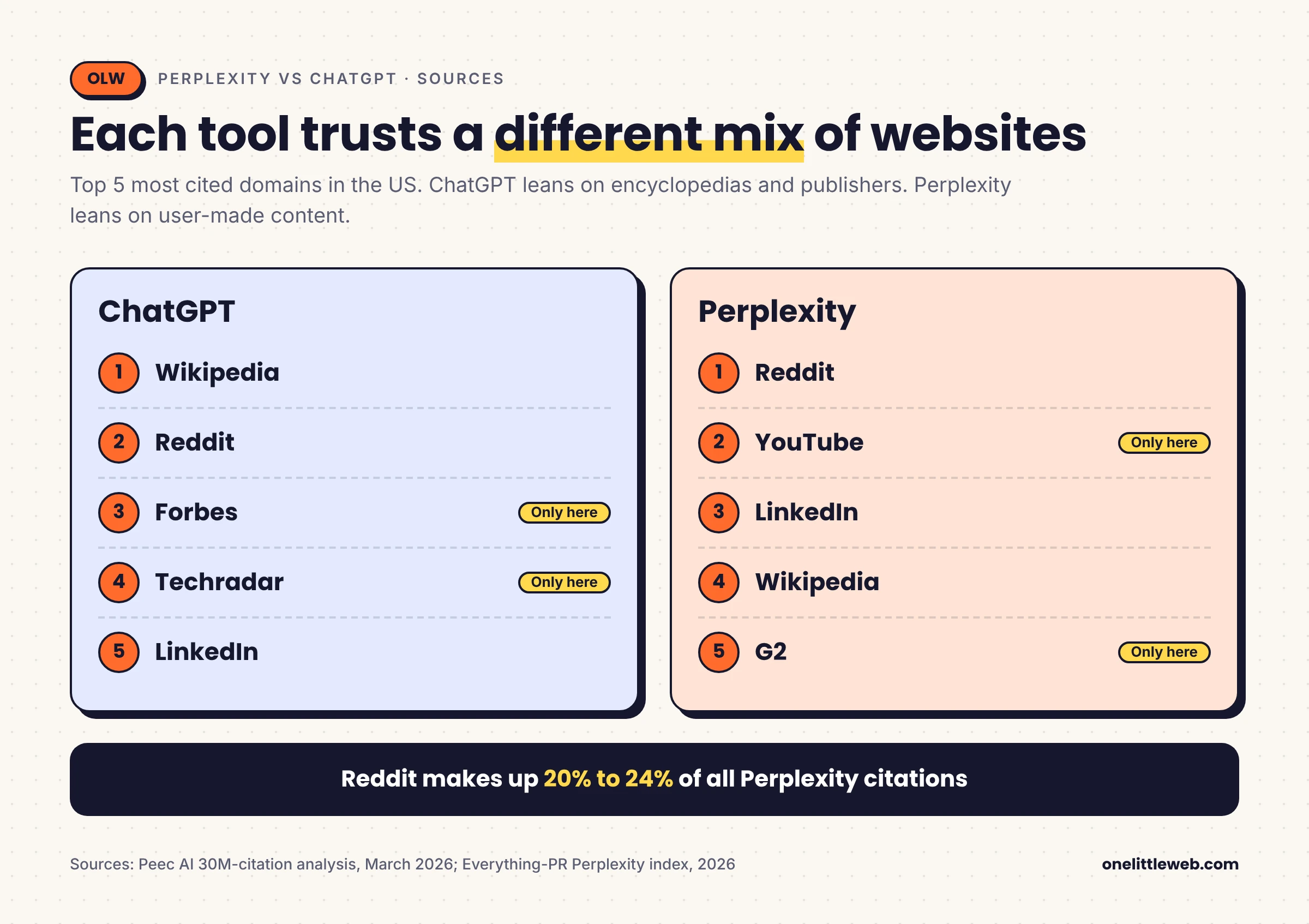
Peec AI analyzed 30 million citations across five AI platforms in March 2026. Each tool leans on a different mix:
| Rank | ChatGPT’s top cited domains | Perplexity’s top cited domains |
|---|---|---|
| 1 | Wikipedia | |
| 2 | YouTube | |
| 3 | Forbes | |
| 4 | Techradar | Wikipedia |
| 5 | G2 |
Source: Peec AI, 30M-source analysis, US, March 2026.
Perplexity’s Reddit habit is strong. Everything-PR’s 2026 index puts Reddit at 20% to 24% of all Perplexity citations. No other AI engine leans on one site that much.
ChatGPT leans toward Wikipedia and big publishers instead. That makes its answers feel more “encyclopedia.” Perplexity’s answers feel more like what real users are saying.
This matters for two reasons.
First, it tells you how to read each answer. A Perplexity answer built on three Reddit threads is opinion, not fact. Click through before you quote it.
Second, if you run a business, it tells you where to show up. G2 only appears in Perplexity’s top five, so B2B review profiles matter more there. For ChatGPT, editorial coverage and Wikipedia carry more weight. That’s the core of generative engine optimization.
Difference #3: Writing, coding and creative work
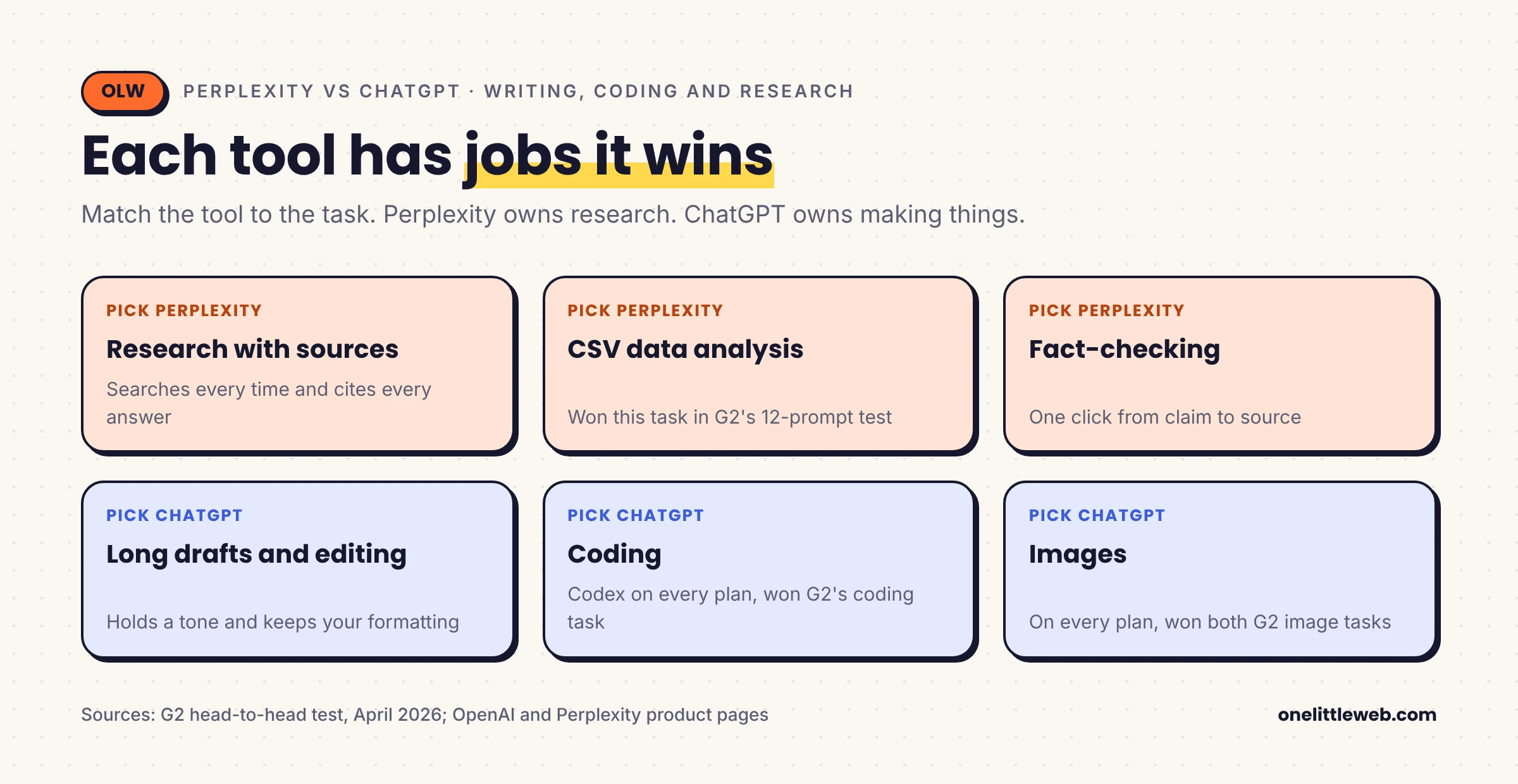
ChatGPT wins this one, and it’s not close.
It holds a tone across a long draft. It edits a document you paste in and keeps your formatting. With memory and custom GPTs, you can set your brand voice once and reuse it.
G2 ran both tools through 12 prompts in April 2026. ChatGPT won the coding task and both image tasks. Content creation and creative writing were split.
Perplexity’s own reviewers say the same thing in plain words. One G2 reviewer called it “an answer engine, not a creative workspace.”
Coding is a clear gap. ChatGPT includes Codex, OpenAI’s coding agent, on every plan. Perplexity can write and explain code, but its coding help lives mostly inside Computer.
Images and video work differently on each:
- ChatGPT: Image creation on every plan. Free is limited, while ChatGPT Pro is unlimited and faster.
- Perplexity: No images on Free. Pro adds image generation and limited video generation.
On video, be careful with older articles. OpenAI shut down its Sora video app on 26 April 2026. Check your plan before you count on video inside ChatGPT.
Difference #4: Deep research and file analysis
Both tools have a Deep Research mode that reads dozens of sources and writes a long report. They feel different in use.
Perplexity’s version runs on its search engine, so reports lean on many cited web sources. ChatGPT lets you review and edit the research plan before it starts. You can also point it at specific websites or your connected apps.
Here are the limits each company publishes:
| Perplexity | ChatGPT | |
|---|---|---|
| Free | 1 Deep Research a month | Limited (number not published) |
| Main paid plan | Monthly limit on Pro (number not published) | “Expanded” on Plus (number not published) |
| Business plan | 50 a month per Enterprise Pro seat | Varies by plan |
| How it resets | Rolling | Every 30 days from first use |
For your own files, the rules differ too.
Perplexity caps each upload at 40 MB, and your upload allowance resets weekly. Files you attach to a search are kept for 30 days. Files in a Project stay until you delete them.
ChatGPT publishes its context window, which is how much text it can keep in view at once. Plus gets 54K tokens in a fast reply (about 40 pages) and 256K when it reasons (about 320 pages). Free drops to 27K tokens, about 12 pages. Perplexity doesn’t publish a single number.
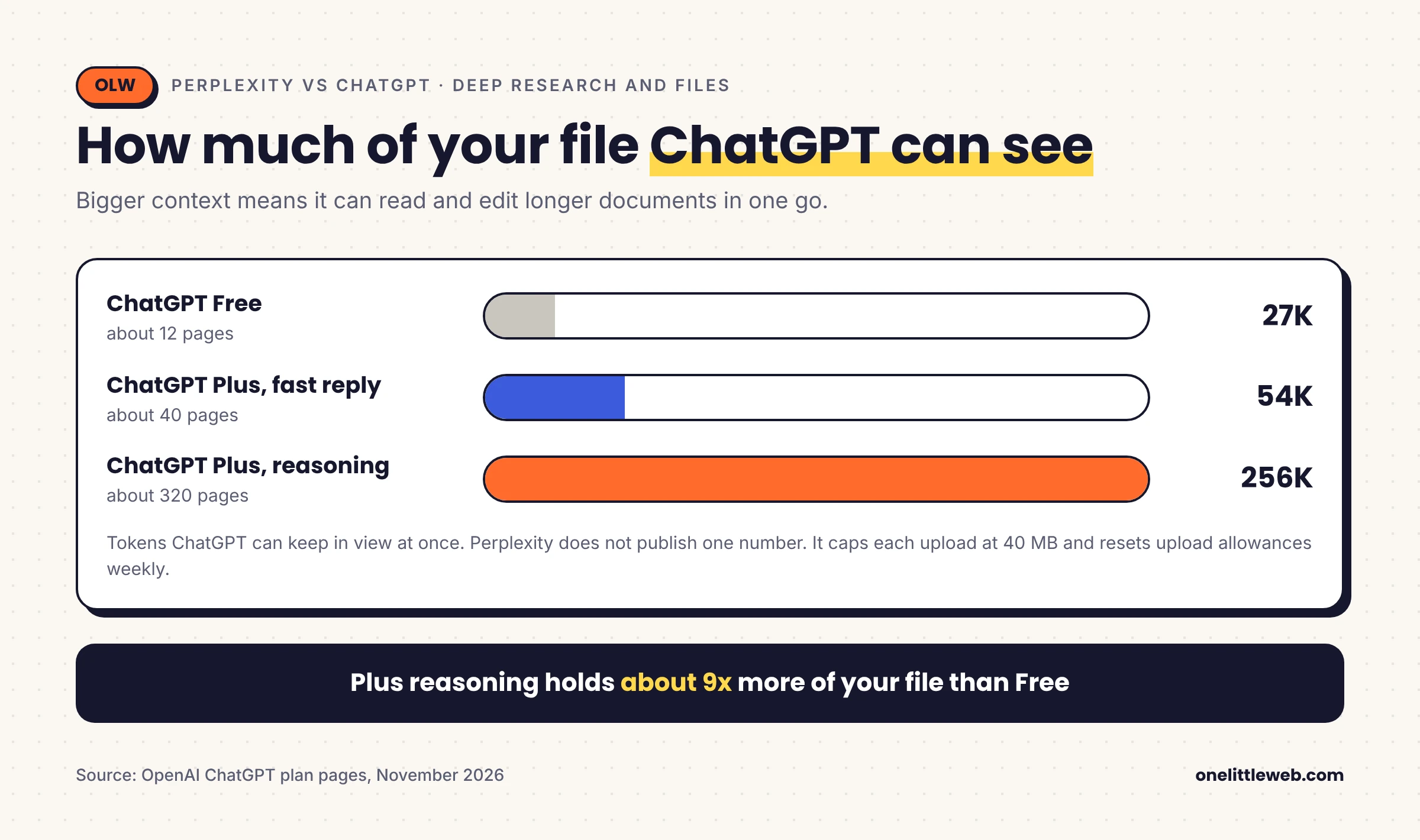
In G2’s test, Perplexity won the CSV data analysis task. ChatGPT is still the safer pick for long documents you want edited, since it keeps more of your file in view.
Difference #5: Agents that do the work for you
Both companies now sell agents that take a goal and work through the steps.
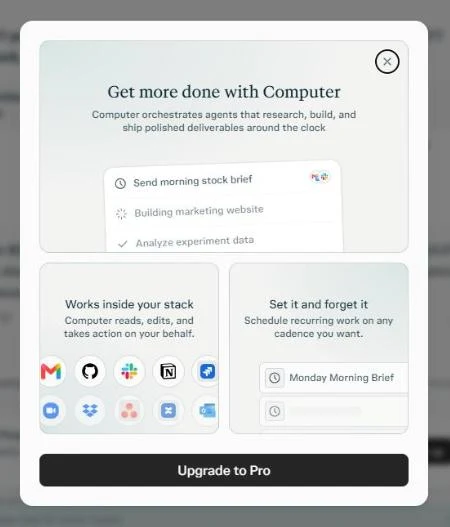
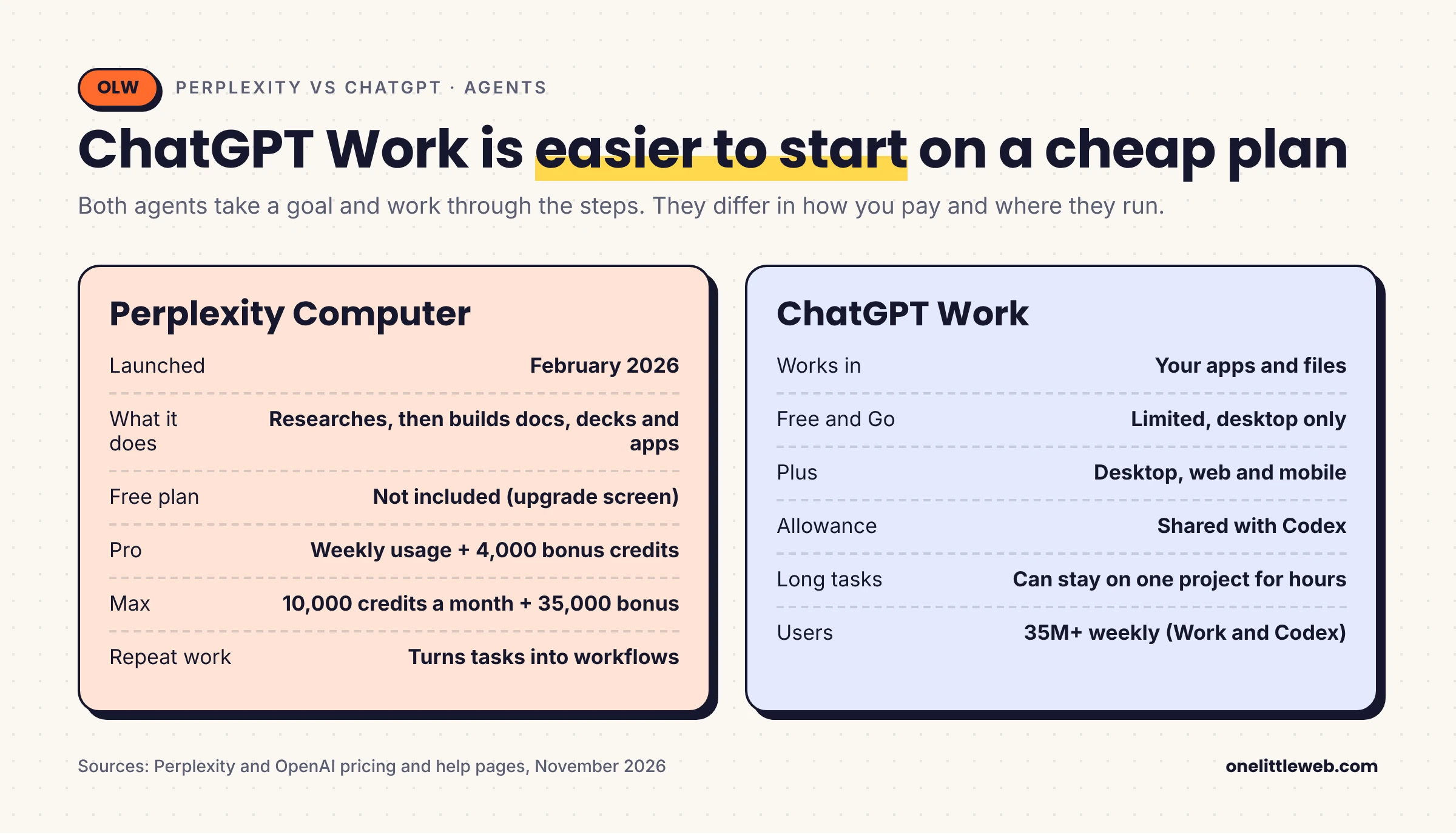
Perplexity Computer launched in February 2026. It researches a goal, then builds the document, deck or app for you. It can also turn that work into a repeat workflow. It runs on credits. Pro includes weekly Computer usage plus 4,000 bonus credits. Max includes 10,000 credits a month plus 35,000 bonus credits.
ChatGPT Work is OpenAI’s agent. It acts across your apps and files and can stay on one project for hours. Free and Go get limited access on desktop. Plus opens it up on desktop, web and mobile, and it shares its allowance with Codex. OpenAI says more than 35 million people use Work and Codex every week.
The risk side of agents
Agents that click and type for you can also be tricked. Perplexity’s Comet browser is the clearest example so far.
In August 2025, Brave’s security team showed that hidden text on a web page could hijack Comet’s assistant. In their demo, a comment hidden behind a Reddit spoiler tag told Comet to grab the user’s email and a one-time login code. Brave found more issues in October 2025, this time with instructions hidden inside screenshots.
Perplexity patched the first issue. Brave said it couldn’t confirm every variant was fixed.
Then Amazon sued Perplexity in November 2025. It said Comet shopped on Amazon while posing as a normal Chrome browser. A federal judge later granted Amazon a preliminary injunction that bars Comet from logged-in Amazon accounts.
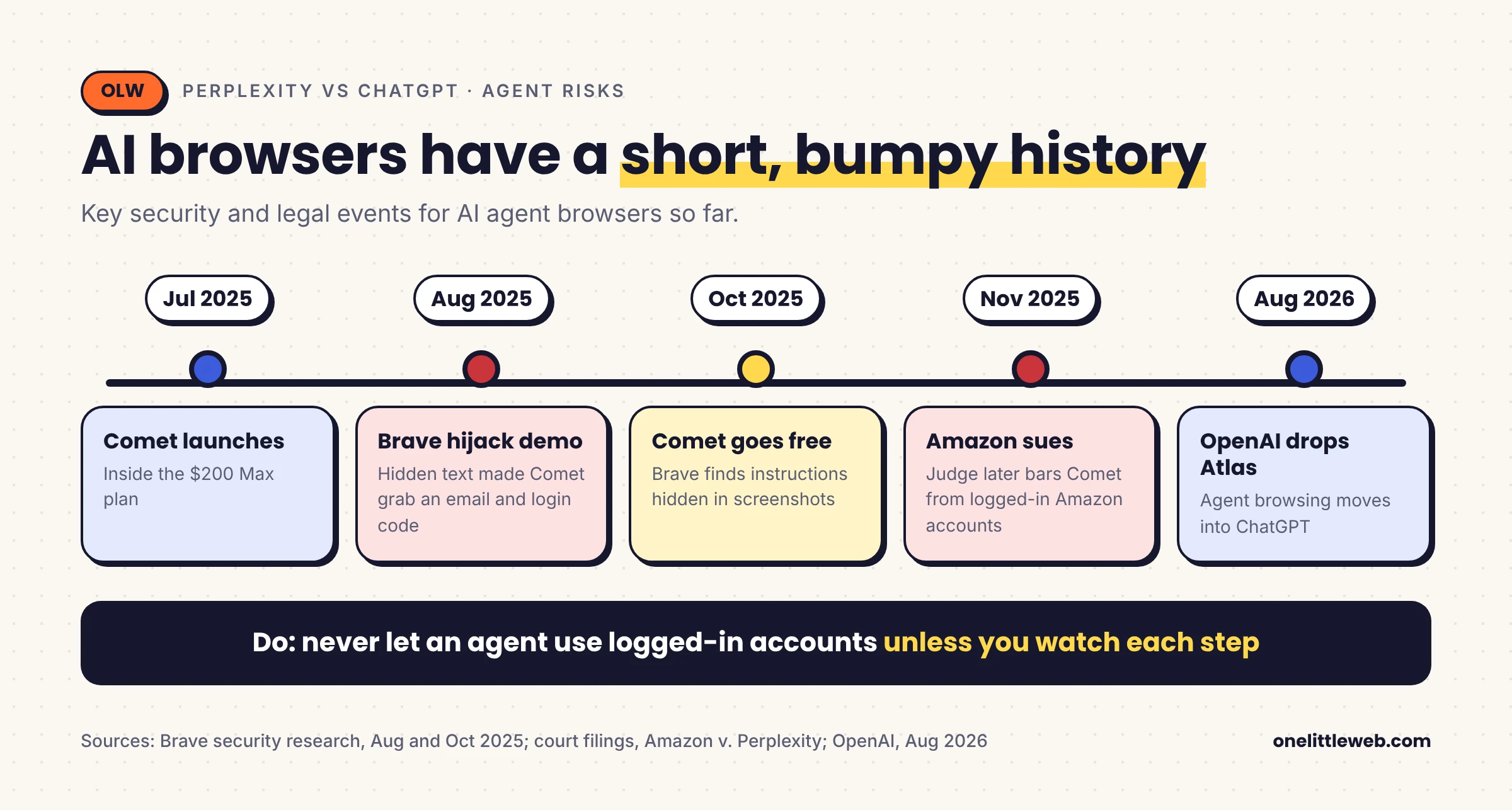
OpenAI took a different path. It shut down its own Atlas browser in August 2026 and moved agent browsing into ChatGPT and a cloud browser.
My advice: don’t let any AI agent use your logged-in accounts, like email or banking, unless you watch each step. That applies to both tools.
Difference #6: Model choice
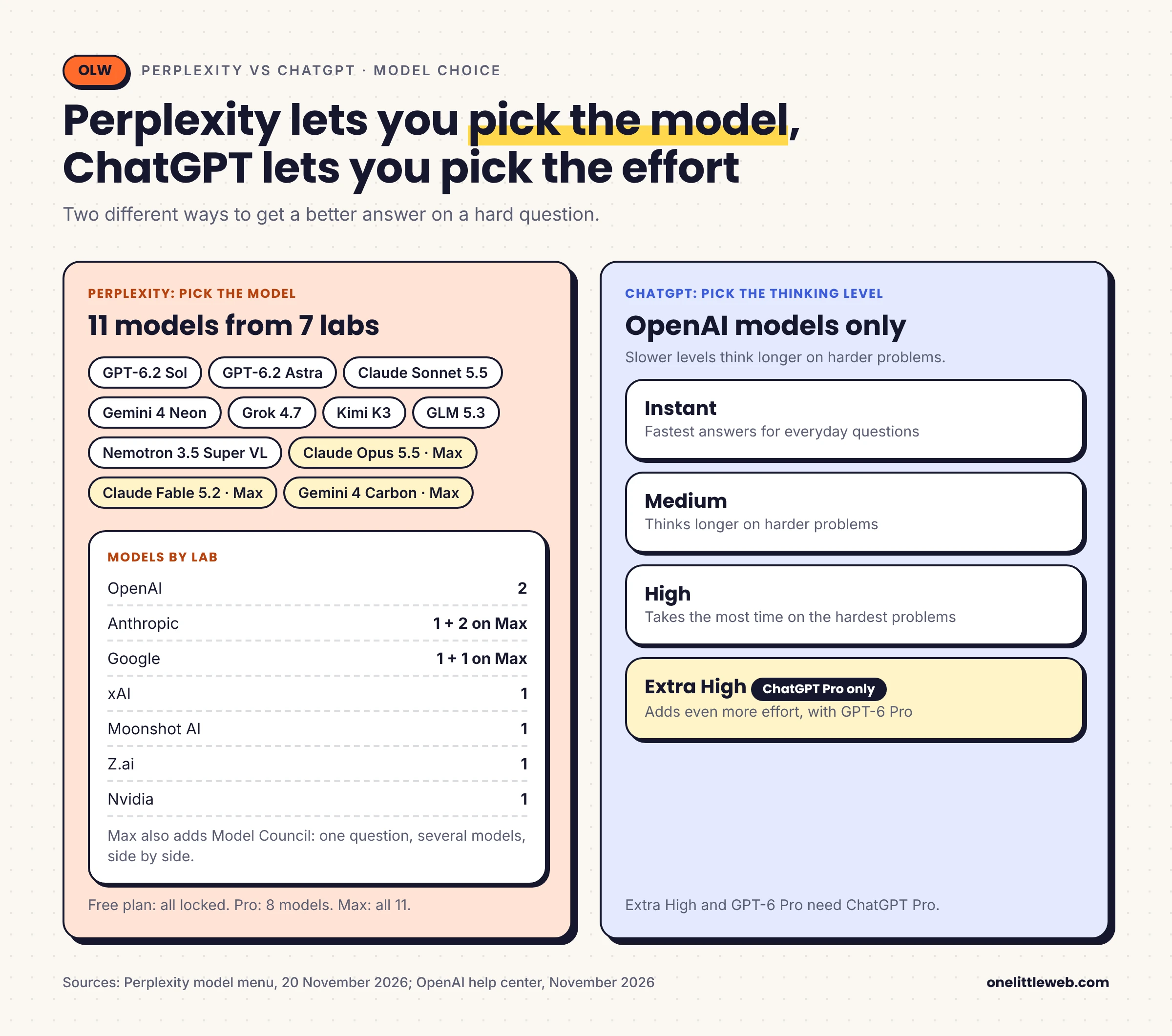
Perplexity lets you pick the model. ChatGPT doesn’t.
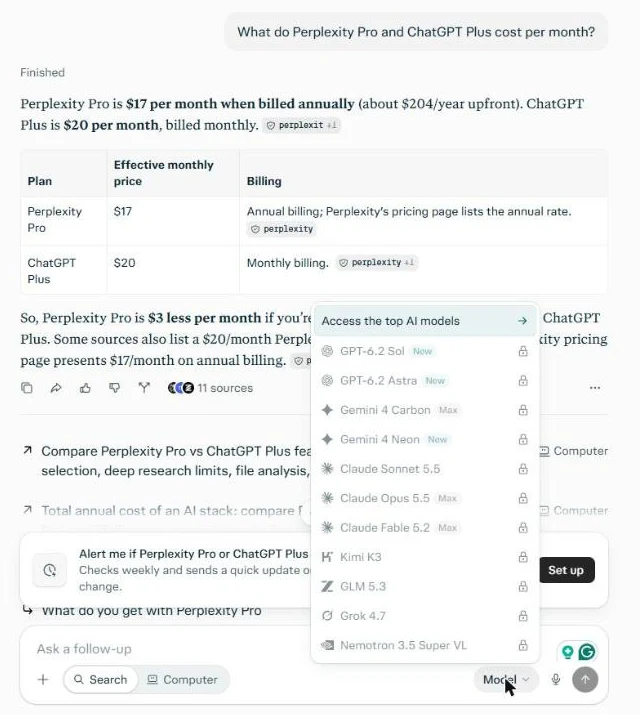
When we opened Perplexity’s model menu on 20 November 2026, it showed 11 models from 7 labs. Eight are on Pro, including GPT-6.2 Sol from OpenAI, Claude Sonnet 5.5 from Anthropic, Gemini 4 Neon from Google, Grok 4.7 from xAI and Kimi K3. Three are tagged Max only: Gemini 4 Carbon, Claude Opus 5.5 and Claude Fable 5.2.
Max also has Model Council. It sends one question to several models at once and shows where they agree and where they don’t. That helps when a wrong answer would cost you.
ChatGPT only uses OpenAI’s models. You choose a thinking level instead. Instant answers fastest, while Medium and High take longer on harder problems. ChatGPT Pro adds Extra High and GPT-6 Pro.
One common mix-up: using a GPT model inside Perplexity isn’t the same as using ChatGPT. You get the model’s answers through Perplexity’s search. You don’t get ChatGPT’s own features, such as its memory and image tools.
Pricing and free plans compared
Both paid plans cost $20 a month. The gaps show up in the free plans and the yearly price.
Free plans
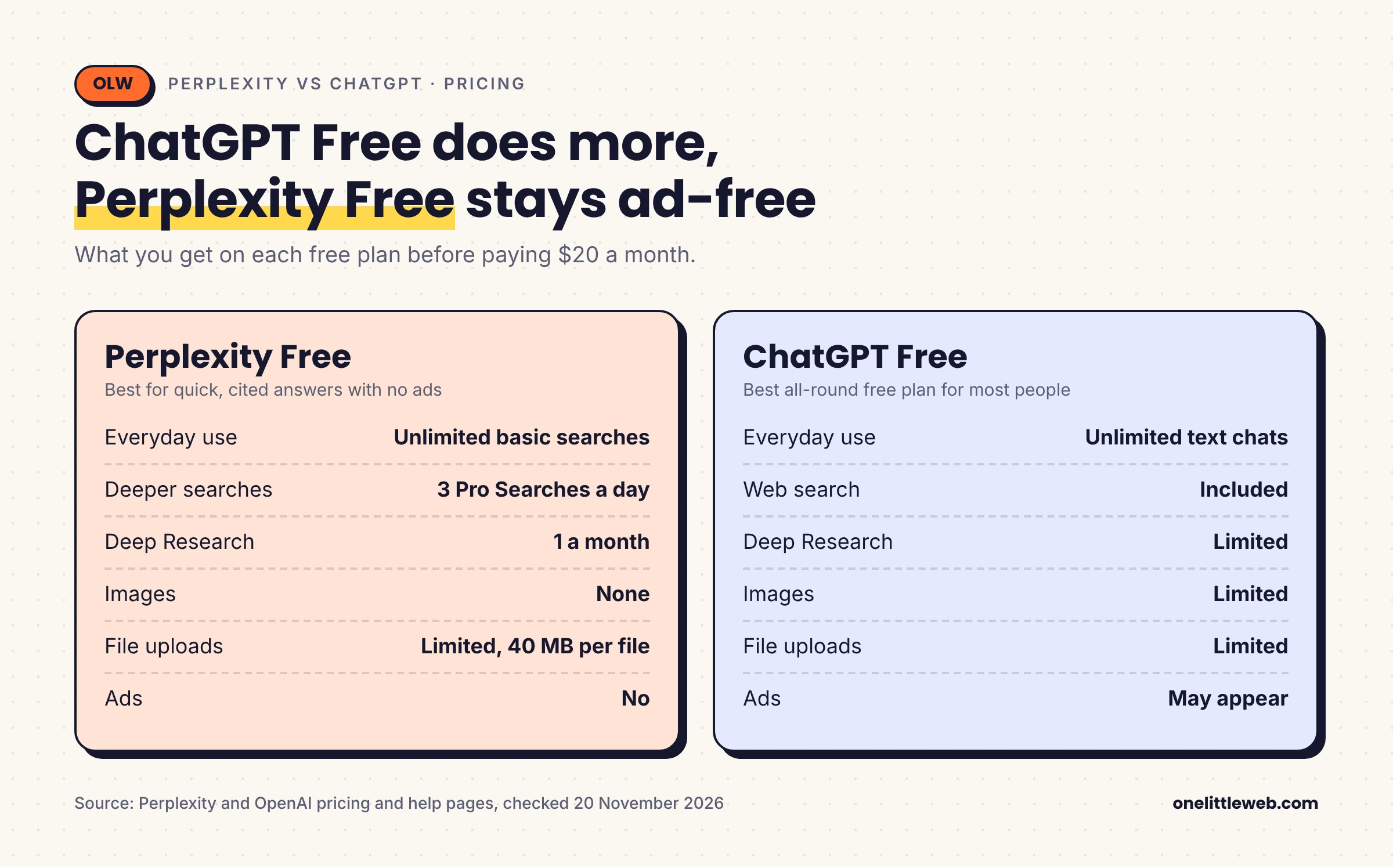
| Perplexity Free | ChatGPT Free | |
|---|---|---|
| Everyday use | Practically unlimited basic searches | Unlimited text chats with GPT-6 Luna |
| Deeper searches | 3 Pro Searches a day | Web search included |
| Deep Research | 1 a month | Limited |
| Images | None | Limited |
| File uploads | Limited, 40 MB per file | Limited |
| Ads | No | May appear |
ChatGPT has the better free plan for most people. Perplexity’s free plan is better if you only want quick, cited answers with no ads.
Paid plans
| Plan | Perplexity | ChatGPT |
|---|---|---|
| Budget | Education Pro: $10/month (verified students and teachers) | Go: $8/month (may include ads) |
| Main | Pro: $20/month or $200/year | Plus: $20/month |
| Power user | Perplexity Max: $200/month or $2,000/year | ChatGPT Pro: $100, $200 or $500/month |
| Teams | Enterprise Pro: $40/seat/month | Business: $25/seat/month, or $20 billed yearly |
Prices as of 20 November 2026, in US dollars, from the Perplexity pricing page and ChatGPT pricing page.
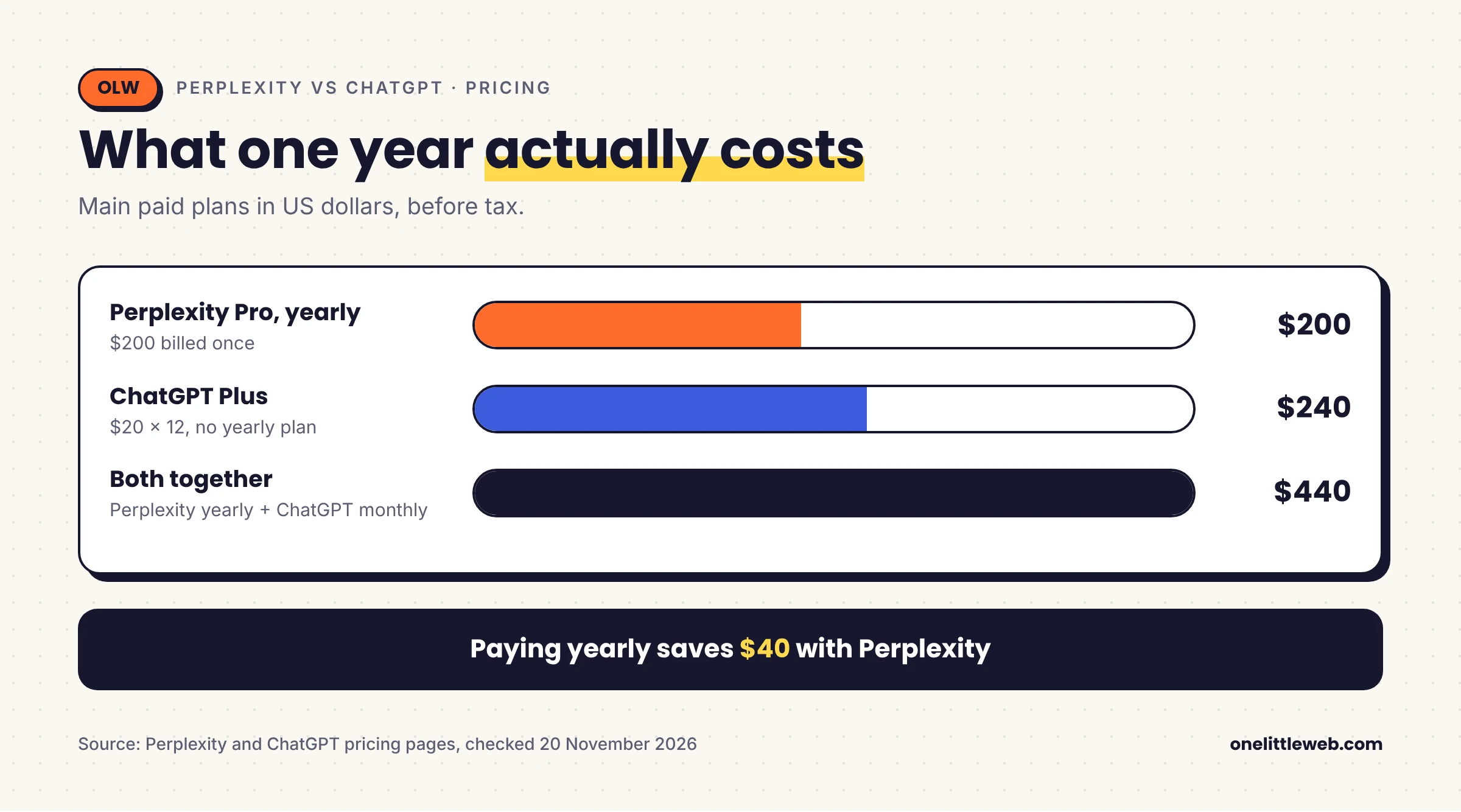
If you pay yearly, Perplexity Pro costs $200. ChatGPT Plus has no yearly plan, so a year costs $240. That’s a $40 gap in Perplexity’s favor.
Is it worth paying for both?
Paying for both costs $40 a month. With Perplexity on a yearly plan, it comes to $440 a year.
That’s worth it if you research and write every day. If you only do one of those, pick the matching tool and use the other one’s free plan.
Privacy: which one trains on your chats?
Both tools may use your chats to improve their models on personal plans. Both let you turn that off.
To stop ChatGPT from training on your chats:
- Open Settings.
- Go to Data controls.
- Turn off “Improve the model for everyone”.
To stop Perplexity from training on your searches:
- Open Settings.
- Go to Preferences, then Artificial Intelligence.
- Turn off “AI Data Retention”.
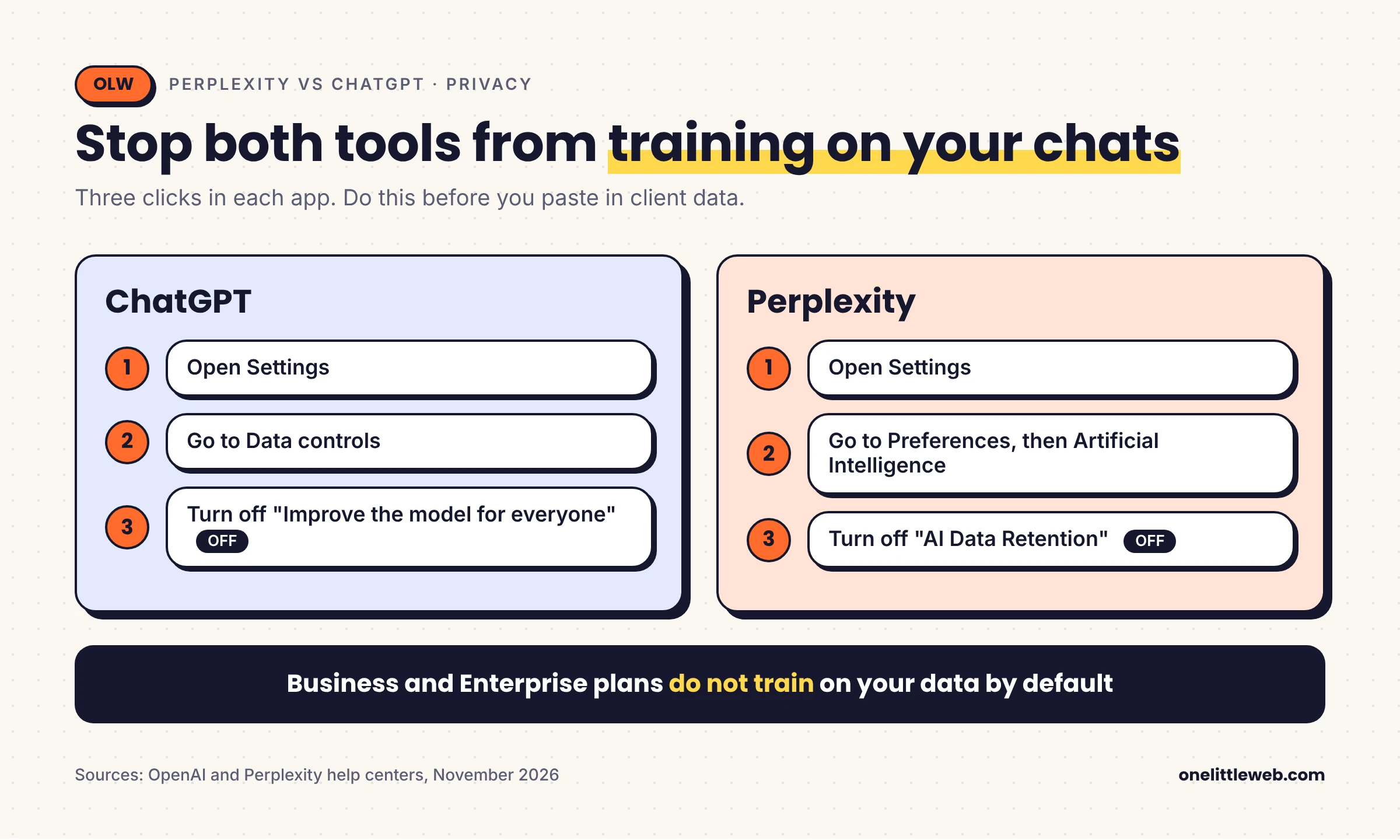
Business plans skip this step. ChatGPT Business and Enterprise don’t train on your data by default. Perplexity’s Enterprise plans never do.
Perplexity also says its deals with OpenAI and Anthropic stop those companies from training on Perplexity data.
For one-off sensitive questions, use ChatGPT’s Temporary Chat or Perplexity’s Incognito mode. Neither saves to memory.
If you handle client data, use the business tier or at least flip these toggles before you paste anything in.
Who’s winning? The traffic data
ChatGPT isn’t just bigger. The gap is getting wider.
We track monthly visits to more than 6,000 AI tools in our Digital Market Intelligence dashboard. Here’s what the last 12 months show:
| Website visitors | Oct 2025 | Sep 2026 | Change |
|---|---|---|---|
| ChatGPT (unique) | 775.6M | 867.9M | +12% |
| Perplexity (unique) | 82.3M | 31.3M | -62% |
| Claude (unique) | 33.6M | 207.0M | +516% |
| Perplexity (total visits) | 276.5M | 102.2M | -63% |
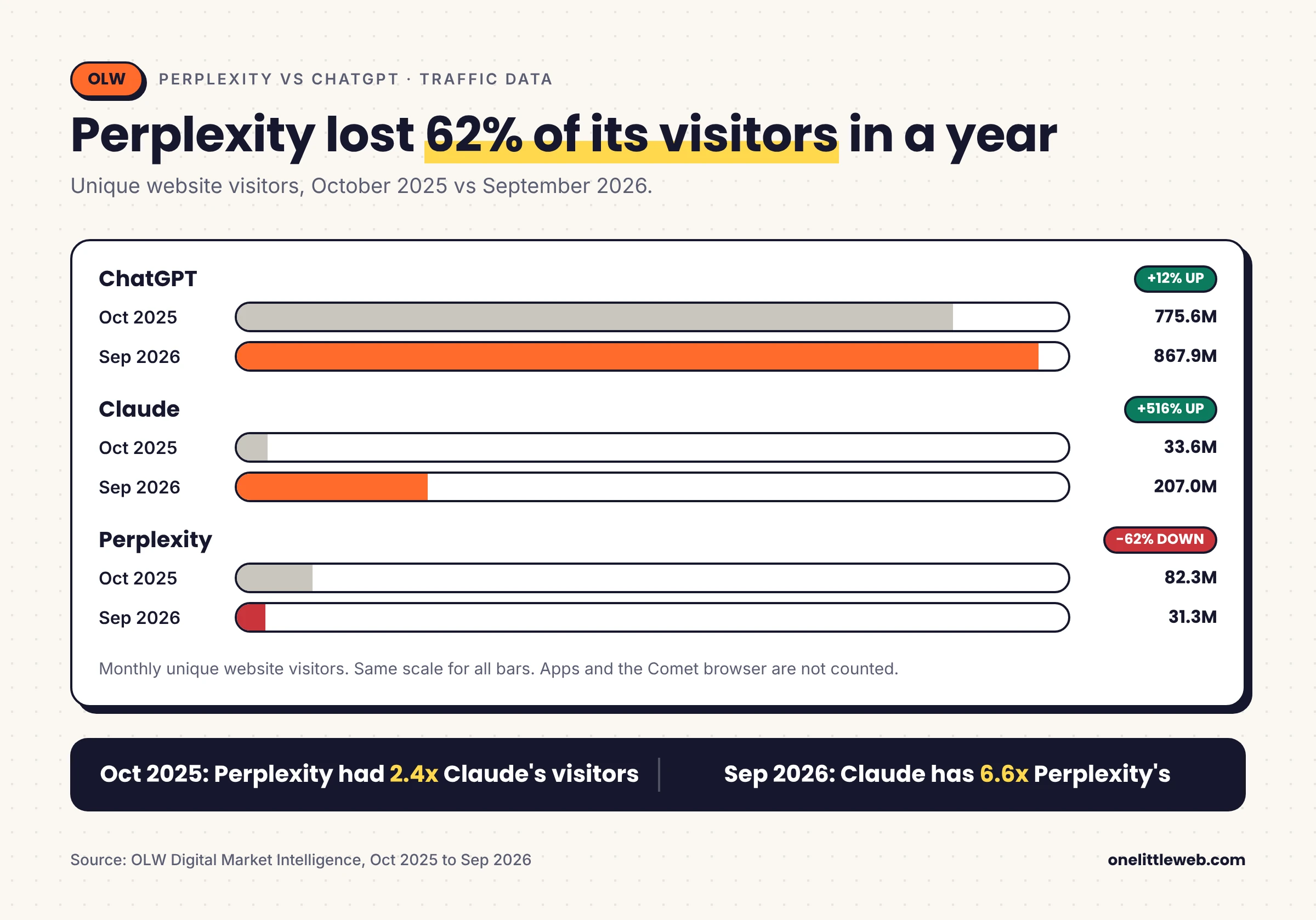
In October 2025, Perplexity had more than twice Claude’s unique visitors. By September 2026, Claude had more than six times Perplexity’s.
Other studies point the same way. SE Ranking’s 2026 AI traffic study found Perplexity’s share of AI referral traffic in the US fell from 11.42% in 2025 to 6.85% in 2026. Gemini passed it as the second-largest AI traffic source.
Worldwide, ChatGPT sends 74.78% of all AI referral traffic to websites. Perplexity sends 7.23%.
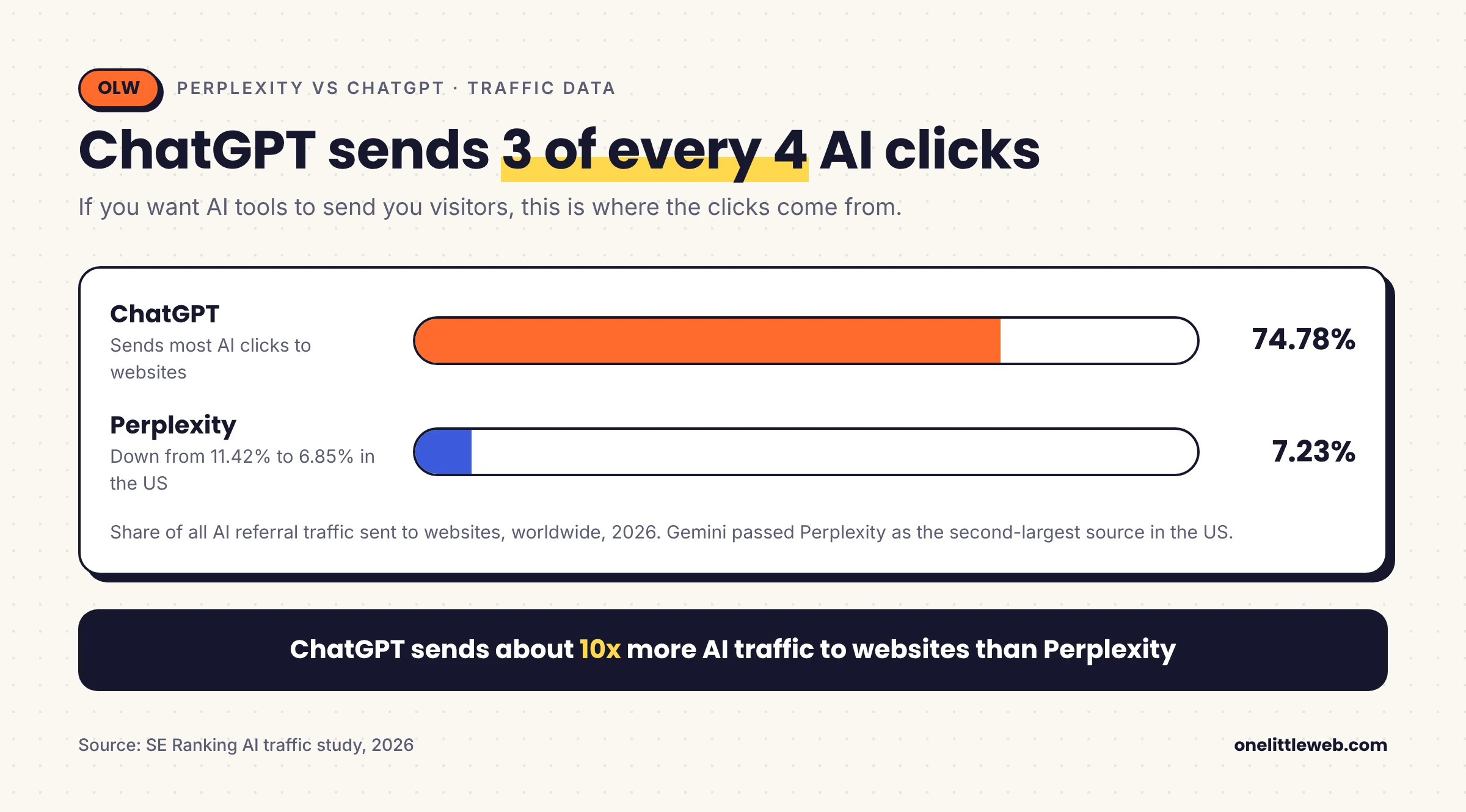
Two caveats matter here. Our numbers count website visits only, not mobile apps. They also miss people who use Perplexity inside its Comet browser, and Perplexity has pushed Comet hard since it went free.
So Perplexity may be losing less than the website numbers suggest. But the direction is clear, and it matters for one reason. A product losing users tends to cut costs, and that often means tighter limits on paid plans. That matches what Trustpilot reviewers already report.
For the longer view, our AI chatbot race study modeled 250,000 futures to see who could catch ChatGPT.
Which one should you pick?
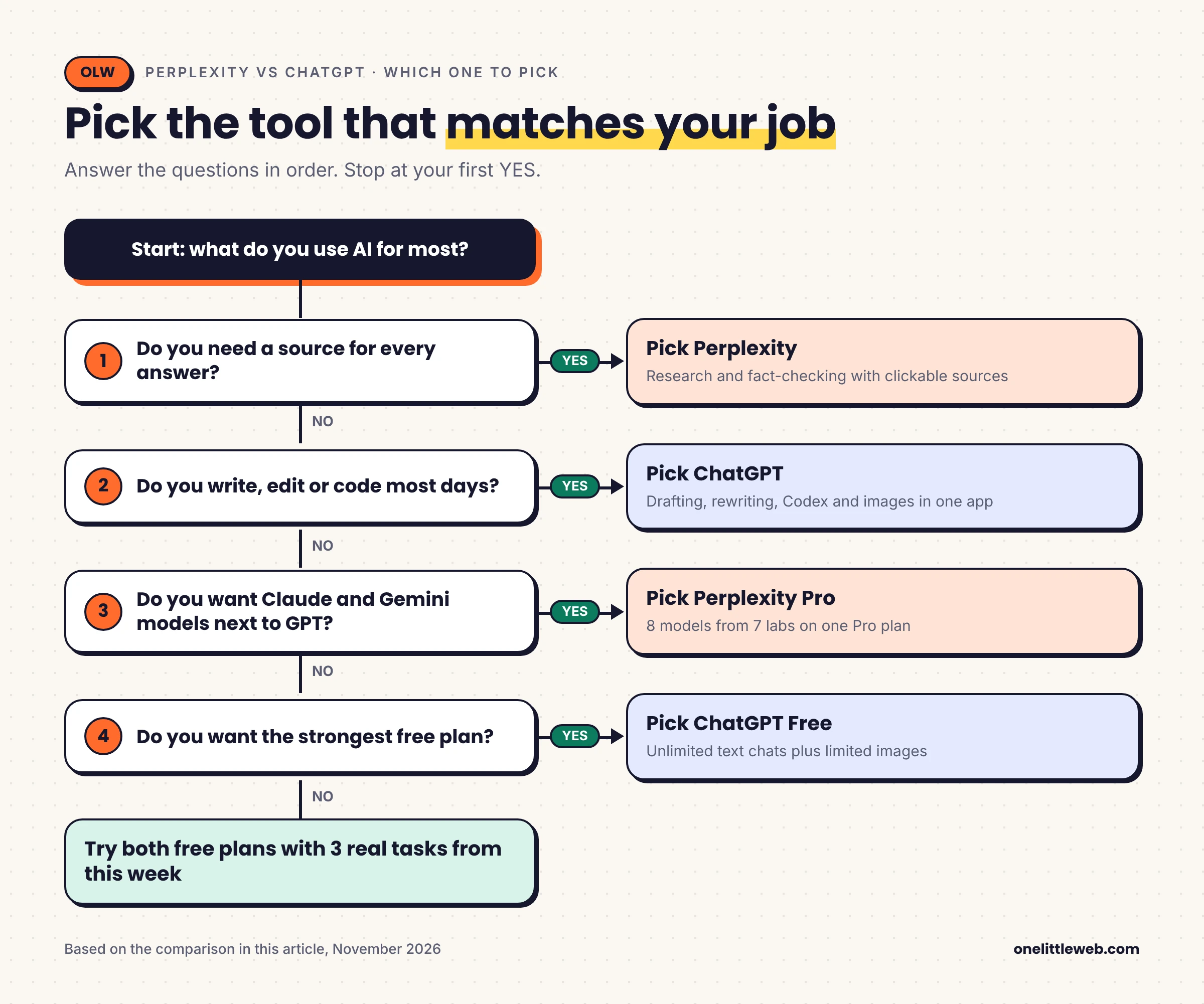
Pick Perplexity if:
- You research topics or check facts for work.
- You want a clickable source for every claim.
- You want Claude and Gemini models next to GPT in one place.
- You’ll pay yearly and want the lower price.
Pick ChatGPT if:
- You write, edit or code most days.
- You want images and voice in the same app as your chats.
- You want a strong free plan.
- You want a tool that’s growing, with the most guides and help.
For marketers and SEO teams, I’d start with both free plans. A split that works well: Perplexity for SERP checks, competitor research and fact-checking, then ChatGPT for briefs, outlines and outreach drafts.
If you’re building a wider AI toolkit for SEO, our list of the best AI SEO tools covers the tools that sit on top of these two.
For students, Perplexity Education Pro at $10 a month is the cheapest way to get a paid AI research tool with sources.
FAQ
Can I use Perplexity and ChatGPT together?
Yes, and many people do. A common split is Perplexity for finding and checking facts, then ChatGPT for turning them into a draft. Both paid plans together cost $40 a month.
Which has the better free plan?
ChatGPT has the better free plan for most people. It gives unlimited text chats plus limited image creation and deep research. Perplexity Free gives unlimited basic searches, 3 Pro Searches a day and 1 Deep Research a month.
Does ChatGPT search the web like Perplexity?
Yes, but not every time. ChatGPT searches when it decides the question needs fresh information, or when you turn search on. Perplexity searches the web for every question.
Is Perplexity more accurate than ChatGPT?
In the Tow Center’s citation test, yes. Perplexity got 37% of citations wrong, while ChatGPT Search got 67% wrong. In the larger BBC and EBU study, both still had significant issues in many answers, so check sources either way.
Does Perplexity use ChatGPT?
No. Perplexity can use OpenAI’s GPT models, but not the ChatGPT app. You don’t get ChatGPT’s memory or image tools inside Perplexity.
Is Perplexity losing users?
Its website is. Our data shows Perplexity’s unique website visitors fell 62% between October 2025 and September 2026. That excludes its apps and the Comet browser, so the full picture may be less steep.
Is Perplexity replacing Google Search?
Not for everything. Perplexity is good at replacing the “search and open ten tabs” routine for research questions. Google still works better for local results and for finding a specific website. Our SEO vs AEO vs GEO guide explains what this means for how people get found.
Is the Comet browser safe to use?
It’s safe for browsing and summaries, but be careful with its agent. Security researchers at Brave showed in 2025 that hidden text on web pages could hijack it. Don’t let it use logged-in accounts, like email or banking, without watching each step.
Which is better for students?
Perplexity Education Pro is the better value at $10 a month with a student check. ChatGPT is better for help with writing and explaining concepts step by step.
Do I get API access with either subscription?
No. Both APIs are billed separately by usage. Perplexity’s Sonar API starts at $0.25 per million input tokens. OpenAI’s GPT-6 Luna API starts at $0.10 per million input tokens.
Where to go next
- AI Chatbots vs Search Engines: our 24-month traffic study
- The AI Big Bang study: best AI chatbots by traffic
- Live AI tool traffic rankings
- Best AI SEO tools
- Best SEO tools
- AI search optimization guide
Methodology: how we compared them
We checked every price, limit and feature on OpenAI’s and Perplexity’s own pricing pages and help centers on 20 November 2026. Where a company doesn’t publish a number, we say so instead of guessing.
Screenshots were taken on 20 November 2026 in our own Chrome browser. The Perplexity account was on the Free plan, so the model menu shows locked models and Computer shows an upgrade screen. The ChatGPT answer was taken logged out.
For accuracy, we used the Tow Center for Digital Journalism’s citation study (March 2025) and the BBC and EBU news integrity study (October 2025). Citation-source data comes from Peec AI’s 30-million-source analysis (March 2026) and Everything-PR’s Perplexity index (June 2026).
Traffic numbers come from OLW’s Digital Market Intelligence data, October 2025 to September 2026. They count website visits, not app users. Referral share comes from SE Ranking’s 2026 AI traffic study.
User numbers come from OpenAI’s DevDay announcement (29 September 2026). Review ratings were reported on 19 October 2026.
Your next step
Don’t pick based on a feature list. Take three questions from your actual work this week and run them through both free plans.
If you check sources before you trust an answer, you’ll likely end up on Perplexity. If you spent more time rewriting than checking, ChatGPT is your tool.
If you want your brand to show up when people ask these tools for recommendations, start with our guide to AI search optimization. If you’d rather hand it off, that’s what our generative engine optimization services are for.
Your turn: which of your daily tasks would you hand to an AI first?