
You’d think the hard part of choosing among web design companies in Seoul is finding good work. It isn’t.
Seoul has global agencies and local studios, and every one shows a polished portfolio. So you end up choosing on gut feel.
That’s where buyers get burned. A site built only for Google can miss Naver, where many searchers in South Korea start.
And a foreign brand entering Korea needs a website built for Korean users before it can sell anything. Pick wrong, and you pay twice, once to build the site and again to fix it.
So I scored the numbers instead of the portfolios. I compared 6 agencies on client ratings, review counts, team size, years in business, and cost.
The data came from Clutch, DesignRush, G2, Glassdoor, Indeed, LinkedIn, Google Business Profile, Trustpilot and SEMrush.
Now you’re comparing real differences, not who has the nicest homepage.
Top Web Design Agencies in Seoul (2026): The Shortlist
In a hurry? Here’s the ranked list and the one thing each agency is known for, no filler.
- Tallium Inc. — Best for custom software and product builds, backed by the biggest team on the list.
- Hitek — A busy web and software shop that pulls the most site traffic here.
- Daylight — The longest track record on the list, with design work that leans on branding and UX.
- Top Remotely — Holds the most client reviews here, mostly for software and staff augmentation.
- Touchlane LLC — Mobile-first product builds with QA baked in, from a lean team.
- Umber.Tech — A niche pick for fintech and highload platforms, with the thinnest public data trail of the six.
Top 6 Web Design Agencies in Seoul (2026), Scored and Ranked
Every agency here was scored the same way, then ranked from highest score to lowest. Start at the top, or jump to the agency that fits your project.
List of The Top 6 Web Design Companies in Seoul (2026)
| Rank | Agency Name | Website | Location | Service Focus (%) | Rating for Cost (5) | Web Visits (Monthly) | Associated Members on LinkedIn | Industry Experience (Years) | Client's Satisfaction Rating (5) | Total Number of Reviews | Employee Satisfaction Score (5) | Total Number of Reviews (Glassdoor & Indeed) | Estimated Hourly Rate () | MinimumProjectCost() | Final Score (100) |
|---|---|---|---|---|---|---|---|---|---|---|---|---|---|---|---|
| 1 | Tallium Inc. | Kyiv , Ukraine | 20 | 4.90 | 422 | 89 | 14 | 4.68 | 77 | 4.70 | 8 | 25 | 10000 | 83 | |
| 2 | Hitek | Ho Chi Minh City , Vietnam | 10 | 4.90 | 1133 | 32 | 8 | 5.00 | 16 | 4.50 | 4 | 100 | 1000 | 63 | |
| 3 | Daylight | Seoul, South Korea | 25 | 4.50 | 55 | 63 | 19 | 5.00 | 3 | 3.90 | 10 | 100 | 1000 | 61 | |
| 4 | Top Remotely | Brooklyn , NY | 10 | 5.00 | N/A | 78 | 16 | 5.00 | 92 | N/A | N/A | 25 | 5000 | 58 | |
| 5 | Touchlane LLC | Tallinn, Estonia | 10 | 4.70 | 780 | 16 | 12 | 4.80 | 13 | 5.00 | 1 | 25 | 25000 | 49 | |
| 6 | Umber.Tech | Tallinn, Estonia | 10 | 5.00 | N/A | 16 | 9 | 5.00 | 13 | N/A | N/A | 50 | 25000 | 21 |
Deep Dive: What Each Agency Actually Does
See what each agency is good at, and where it may not fit your project.
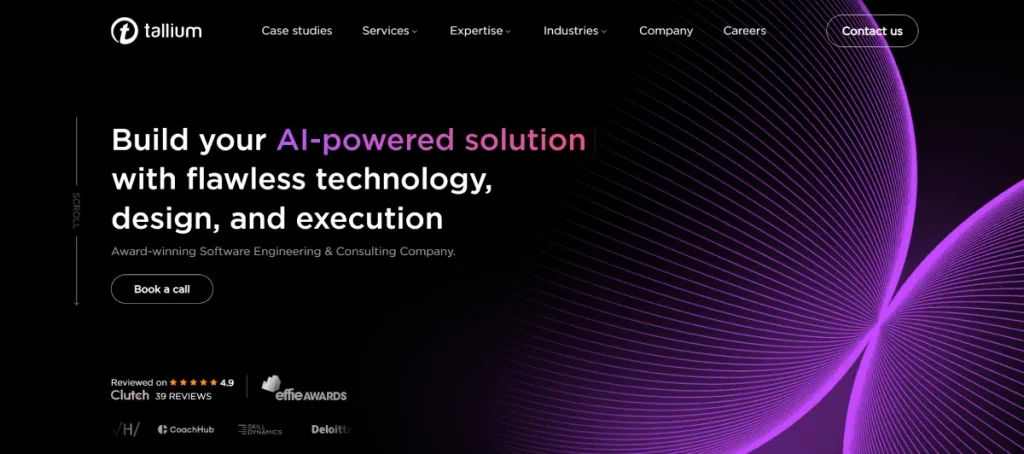
1. Tallium Inc. — Best if you want design and engineering from one in-house team
- Website: tallium.com
- Minimum Project Cost: $10,000
- Average Client Satisfaction Rating: 4.68 (77 reviews)
- Team Size: 89 (LinkedIn)
- Years in Business: 14
- Monthly Website Visits: 422
- Employee Review Score: 4.7 (8 reviews)
Overview
Tallium’s pitch is simple. The people you meet on the sales call do the work, because it doesn’t subcontract or resell freelancers. Every designer and engineer is on its own payroll.
That claim is believable because the firm is big. It began as a small boutique studio and grew into the largest team on this list.
Most of its work sits in fintech, healthcare, and education. Several client engagements run for years, which points to relationships that outlast the launch.
Lately it has leaned into AI, with agent and search tools running in production. It also says plainly when a simple rules engine would do the job.
I’d borrow that honesty for your own decision. If you only need a simple brochure site, Tallium is more firm than the job calls for.
Core Services
- UI/UX and product design, including UX audits and redesigns
- Web and web application development
- Custom software development from concept to launch
- Mobile app development for iOS and Android
- AI development and consulting
Why They Rank #1
- Clients rate its value for cost near the top of this list. The low rate is not cheap work.
- It has the biggest team here, so design, engineering, and QA can run side by side.
- Its average client rating is the lowest of the six, by a small margin. It rests on far more reviews than most.
- No other agency here pairs the largest team with a bottom-tier hourly rate.
Snapshot of Client Reviews
Deadlines earn the most credit here. Reviewers mention on-time delivery and clear communication more than anything else, then design skill and value for cost. The complaints are small: more user testing, and one budget surprise from an unapproved technology choice.
Our Take
A product team that needs design and engineering under one roof should shortlist Tallium. Skip it if you want a small studio for a brochure site or a quick redesign. You’d pay for software depth you won’t use.
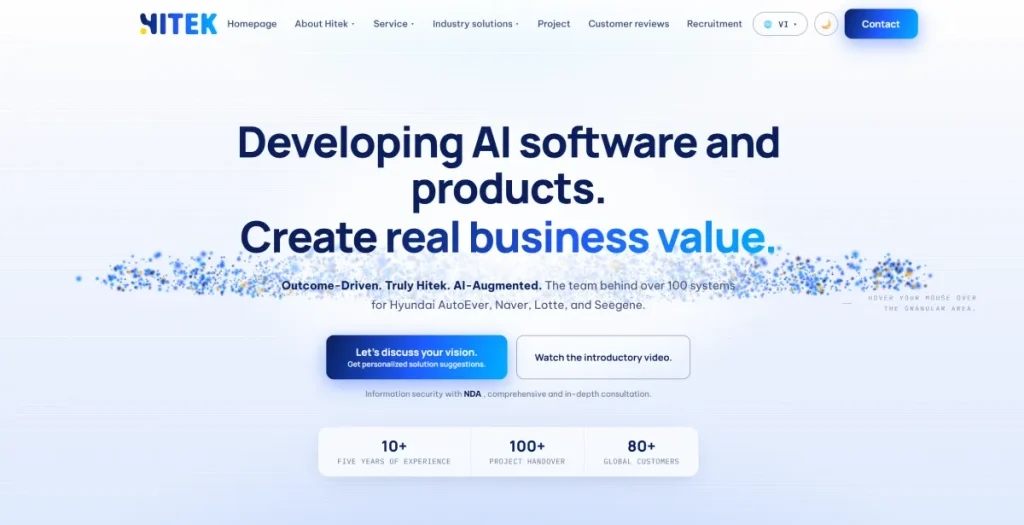
2. Hitek — Pick it if you want Korean-client experience on a small budget
- Website: hitek.com.vn
- Minimum Project Cost: $1,000
- Average Client Satisfaction Rating: 5.00 (16 reviews)
- Team Size: 32 (LinkedIn)
- Years in Business: 8
- Monthly Website Visits: 1,133
- Employee Review Score: 4.5 (4 reviews)
Overview
Hitek built its early business on Korean clients. Most of its first projects came from that market. Its own profile names Korean partners such as Hyundai AutoEver and Seegene.
It started with a handful of freelance engineers building web and mobile apps. Now it also takes outsourcing and product work from clients on several continents. Its web work runs from marketing sites to full web applications.
Chairman and founder Tran Anh Khoi frames the approach around language. His message stresses consultants who speak the client’s language and close the gap with foreign customers. That matters if your project runs in more than one language.
The credentials are solid. Hitek lists ISO certifications for quality and information security, plus testing and project management qualifications.
It’s a mid-sized team, bigger than a freelance shop and smaller than the largest names here. I’d shortlist Hitek for a web or app build on a small budget. Its team already works with Korean clients.
Core Services
- Web design and website development, including WordPress builds
- Web application development
- UI/UX design
- Mobile app development for iOS and Android
- Software testing and QA
Why They Rank #2
- The minimum project cost is tied for the lowest on this list. A small budget can still get started.
- Clients rate its value for cost near the top of this list. That holds even at the highest hourly tier.
- Capacity keeps it below Tallium. The team is roughly a third the size, so fewer projects can run side by side.
- It is the most visited agency here and also the youngest. Its visibility runs ahead of its track record.
Snapshot of Client Reviews
Communication comes up in most reviews, and the Korean-speaking project managers get the credit. The wish list is short: earlier documentation, weekend coverage, and better time-zone overlap. Budget fit is the usual reason clients picked Hitek.
Our Take
A Korea-facing startup that needs a web or mobile build on a tight budget should look here first. If you want a design-led brand refresh, Hitek isn’t the right shop for it.
3. Daylight — Choose it if you want research and design before any code
- Website: daylightdesign.com
- Minimum Project Cost: $1,000
- Average Client Satisfaction Rating: 5.00 (3 reviews)
- Team Size: 63 (LinkedIn)
- Years in Business: 19
- Monthly Website Visits: 55
- Employee Review Score: 3.9 (10 reviews)
Overview
Daylight’s Hyundai project shows how it works. The team built one design system for an in-car experience that had been split across siloed teams. It started with research interviews with drivers in the US and Korea.
That approach traces back to its roots. Former IDEO leaders started the firm, and it still sells human-centered design as a way of working.
Its most distinctive work sits in social impact. Foundations, nonprofits, and financial-access startups all show up in its case studies, alongside consumer and auto brands.
Recent work leans toward AI, such as a career-coaching product, and toward clean energy. Web design here means digital product and brand work. I’d pick Daylight for an app or a rebrand. If you need a plain marketing site built fast, look elsewhere.
Core Services
- UX and visual design for digital products and websites
- Design systems and engineering partnerships
- Brand strategy, brand language, and brand design systems
- Human-centered research and synthesis
- Product and physical product design
Why They Rank #3
- Its history is the longest on this list. That gives you the most track record to check before you sign.
- Design is a bigger share of its work than at any other agency here. You’d hire a design studio, not a software shop with designers.
- Clients rate its value for cost lower than for any other agency here. The hourly rate also sits in the top tier.
- Its employee rating is the lowest of any agency with a score here. It rests on the most employee reviews, so it’s a solid read, not a fluke.
- Evidence keeps it just under Hitek. A perfect client rating rests on only a few reviews, so the record is long but lightly documented.
Snapshot of Client Reviews
Reviews are thin. The single Clutch review praises the project management and how fast the team grasped a complex business. It also mentions occasional deadline slips. With so few voices, treat that as a hint, not a pattern.
Our Take
A team launching a new product or a rebrand that wants research before pixels should call Daylight. Skip it if you need a marketing site built fast on a tight budget.
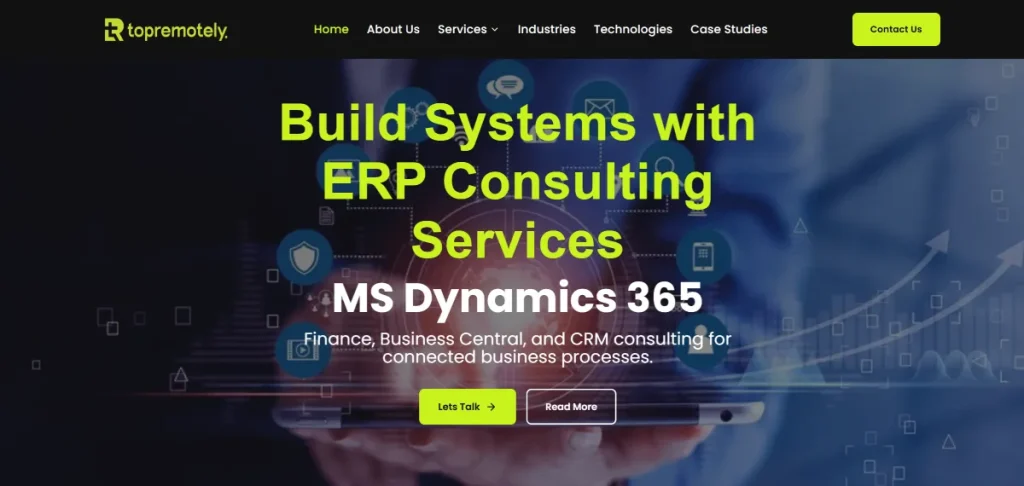
4. Top Remotely — Best if you want ERP consulting and custom development together
- Website: topremotely.com
- Minimum Project Cost: $5,000
- Average Client Satisfaction Rating: 5.00 (92 reviews)
- Team Size: 78 (LinkedIn)
- Years in Business: 16
- Monthly Website Visits: N/A
- Employee Review Score: N/A
Overview
Ask Top Remotely what it sells and the answer is ERP. Its specialists cover SAP, Oracle, Salesforce, Dynamics, NetSuite, and Odoo. The firm says each one knows a single platform deeply.
That focus goes back to the start. The firm began as a small network of remote ERP consultants. Later it added custom software, mobile apps, and web apps.
Projects follow four steps: consultation, strategy, implementation, and a handover with training. You see the roadmap before anyone configures a module.
Its client work spans finance, retail, health tech, manufacturing, and logistics. Badges from Clutch, GoodFirms, and DesignRush fill its homepage, and it says its consultants are pre-vetted.
If you want a design-led studio for a marketing site, this isn’t the place to start. Its center of gravity is ERP and software.
Core Services
- Web app development
- Custom software and MVP development
- ERP consulting for Dynamics 365, Odoo, Salesforce, NetSuite, SAP, and Oracle
- AI chatbot and agent development
- Mobile app development
Why They Rank #4
- Its client review count is the largest on this list, and the average rating is perfect. No other agency backs a perfect score with that many voices.
- Clients give it the top mark for value for cost, tied with one other agency. The hourly rate also sits in the lowest tier.
- Its team is the second largest here, so it can staff several projects at once.
- Focus keeps it below Daylight. Web design is a small part of what it sells. Three other agencies sit at the same low level.
- Only Daylight has a longer track record, so the ratings behind it have had time to build.
Snapshot of Client Reviews
Read the reviews and one thing stands out. Much of the praise is for staffing, support outsourcing, and ERP work, not website builds. Clients credit clear updates and tasks finished on schedule. The praise is uniform, which leaves little sign of where it slips.
Our Take
A mid-sized company that needs an ERP rollout or a staffed development team should shortlist Top Remotely. Skip it if you want a design-led website. Web design is a small part of what it sells.
5. Touchlane LLC — Choose it if you want a lean team to build your mobile app
- Website: touchlane.com
- Minimum Project Cost: $25,000
- Average Client Satisfaction Rating: 4.80 (13 reviews)
- Team Size: 16 (LinkedIn)
- Years in Business: 12
- Monthly Website Visits: 780
- Employee Review Score: 5.0 (1 review)
Overview
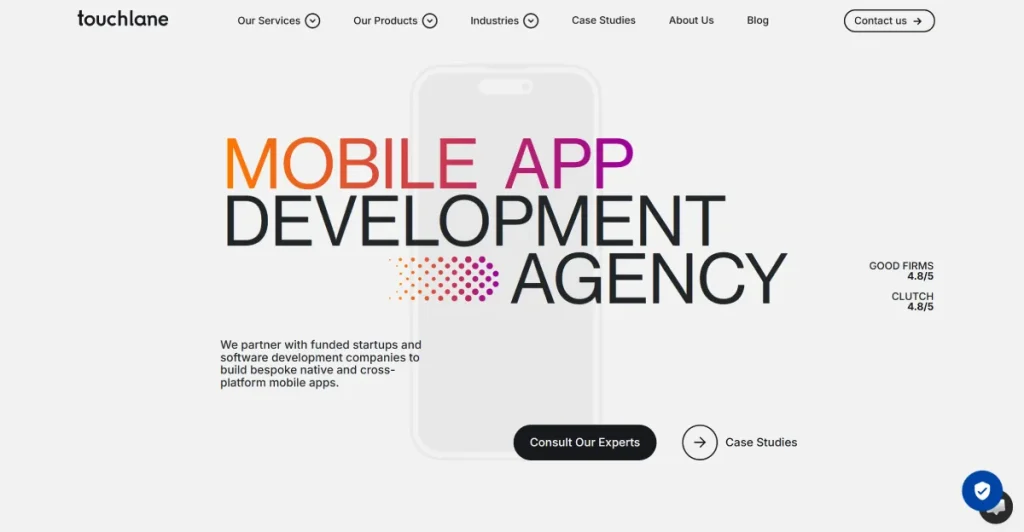
CEO and co-founder Irina Veremeichuk describes Touchlane’s work as secure mobile apps. It serves clients in Europe, the US, and the UK. Her bio mentions turnkey apps for savings banks and back ends for payment systems.
Fintech is one lane, alongside health and fitness and entertainment apps. Most clients are small businesses and funded startups. A few are software companies that hire it to extend their own teams.
Clutch once named it a leading mobile app developer, and its CEO highlights that honor on her profile. I’d send a funded startup with a mobile-first product here. UI/UX design comes bundled into its app projects, so a plain marketing website is a different job.
Core Services
- UI/UX design as part of mobile product builds
- Native iOS and Android app development
- Cross-platform apps with Flutter and React Native
- Custom backend development
- QA and post-release support
Why They Rank #5
- Its site draws the second most visits on this list, behind only Hitek.
- Its hourly rate sits in the lowest tier, yet clients rate its value for cost second lowest. Cheap hourly work does not automatically feel like good value.
- The minimum project cost is tied for the highest here. That makes it a poor fit for a small first project.
- Its perfect employee score rests on a single review, so treat the workplace picture as thin.
- Capacity keeps it below Top Remotely. It ties for the smallest team on this list.
Snapshot of Client Reviews
Startup clients are the loudest voice here, and they like how easily the team shifts priorities mid-project. Reasonable rates, transparency, and reliability come up too. The set is small and the feedback is consistent, so weak points are hard to spot.
Our Take
A funded startup that needs a native or Flutter app from a small senior team should call Touchlane. If your main need is a website, or your budget is small, look elsewhere.
6. Umber.Tech — Look here if you need fintech-grade design and engineering together
- Website: umber.tech
- Minimum Project Cost: $25,000
- Average Client Satisfaction Rating: 5.00 (13 reviews)
- Team Size: 16 (LinkedIn)
- Years in Business: 9
- Monthly Website Visits: N/A
- Employee Review Score: N/A
Overview
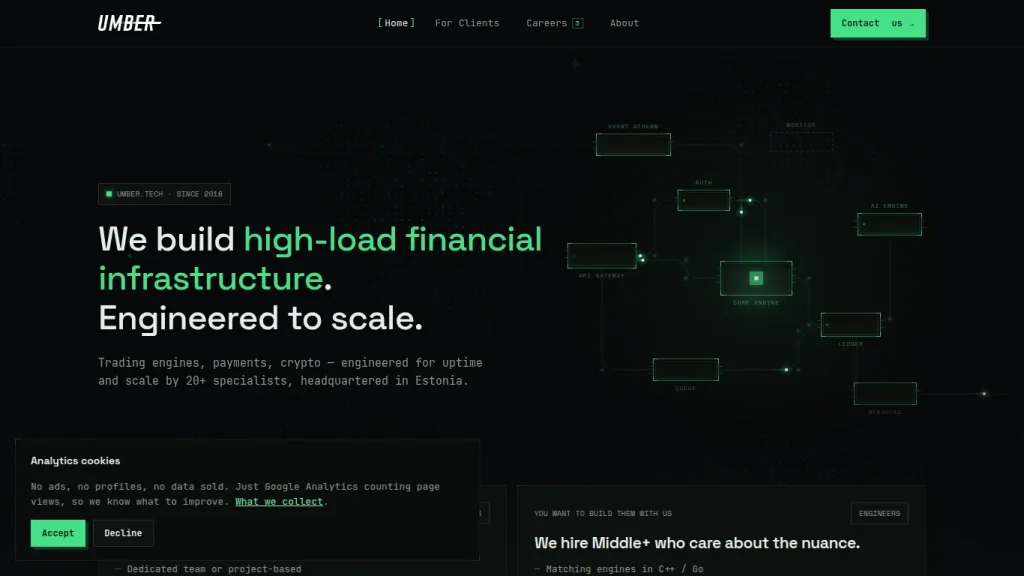
Umber.Tech’s client list leans toward financial services and mid-sized companies. That fits its own pitch: highload systems where uptime, speed, and trust matter.
A good example is KZ Group, an online entertainment company. Umber.Tech designed the UX and UI for its sites. Then it built the payment gateway behind them.
Its biggest service line is microservices, which split a platform into small parts that scale on their own. It also builds custom CMS platforms, such as a Strapi-based system for a marketing data provider.
Its clients span Asia, Europe, North America, South Korea, and some work outside finance. I’d shortlist Umber.Tech for a payment-heavy or data-heavy platform that needs design and engineering together.
Core Services
- UX/UI design and web development for financial and data platforms
- Custom CMS and content platform builds
- Payment gateway and fintech platform development
- Microservices and highload architecture
- Mobile app development and DevOps support
Why They Rank #6
- A perfect average rests on a modest review base, far smaller than Top Remotely’s or Tallium’s.
- Clients give its value for cost the top mark, tied with Top Remotely.
- Its hourly rate sits in the middle of this list, well above the lowest tier.
- The minimum project cost is tied for the highest here, and the team ties for the smallest.
- A pricier hourly rate and a shorter history keep it below Touchlane. That leaves it at the bottom of this list.
Snapshot of Client Reviews
Capacity is the one recurring wish. Clients say a larger team would shorten the wait to start. Otherwise reviewers point to communication, creative ideas, and on-time delivery, mostly on design and web work.
Our Take
A fintech or payments team that needs design and engineering for a high-traffic platform should call Umber.Tech. Skip it for a simple brand site on a small budget. Public data on its traffic and workplace is thin, so ask for references.
Disclosure: Our recommendations include both locally headquartered agencies and offshore firms that provide services in this region. Some agencies featured do not maintain a physical office here but have an established track record of delivering services to clients in the area.
Questions to Ask Before Choosing a Web Design Company
Agencies pitch well and volunteer their weak spots badly. So bring the questions yourself. These seven expose the gaps fast, and each one has an answer you can check.
1. Can They Show Work Like Yours?
Ask for live sites, not slide decks, and judge the UI/UX design on your phone. Check how Hangul text sets on the screen. Dense Korean pages look cramped when the type is wrong. If several recent sites feel off, move on.
2. What Does the Quote Actually Cover?
Ask for an itemized quote that lists design, development, testing, hosting, and support. Prices in won can swing widely between a small business site and an enterprise build. A cost calculator gives you a range before the first call. Vague quotes usually hide extras.
3. Do They Plan for Naver, Not Just Google?
Ask what their SEO plan covers on Naver. Blog and cafe results shape how many Korean buyers research vendors, so content matters there too. Strong teams plan to search into the site structure from day one.
4. Who Will You Actually Talk To?
Ask who your daily contact is and which language the work runs in. Many local teams work in Korean first, and English fluency varies. If you don’t speak Korean, confirm a fluent English speaker sits on your project.
5. Can the Site Grow With Your Business?
Ask what happens when you add a language, a store, or a new product line. Exporters and foreign brands often want Korean and English versions side by side. A flexible build makes that an add-on. A rigid one means a rebuild.
6. Do They Know the Korean Market Firsthand?
Ask for Korean client references you can call. Then ask how they set up local payment options at checkout. Seoul is compact, so if you want an in-person kickoff, ask early whether they can do one.
7. What Happens After Launch?
Ask who owns the domain, hosting, and source code when the project ends. Then ask what ongoing support costs. Maintenance retainers are still underserved, so an agency that offers one has planned past launch day.
Common Errors When Evaluating a Web Design Company
Most bad hires start with a shortcut that sounded reasonable at the time. These are the ones that cost buyers the most, and what to do instead.
1. Choosing on Price Alone
A cheap web design quote often skips the expensive parts. Native Korean editing is a common cut, so translated pages read stiff and lose trust.
You save at signing and pay later in rework. Compare what each quote includes, and check the total against typical website design costs.
2. Relying on a “Near Me” Search Alone
A Google search for a web design company near me shows only part of the picture. Many locals check Naver Maps and Kakao Maps, where listings and reviews sit. Search there too. Then compare what you find with the directory ratings.
3. Treating SEO as a Launch-Day Extra
Many Korean buyers search in Korean first like the natives. An English-only site never shows up for them. Ask for international SEO keyword work before design starts. A fix after launch means rewriting pages.
4. Skipping the Portfolio Review
A portfolio shows what an agency has built, not what it will build for you. Ask for sites in your industry. Open each one and check that it still works. Dead links and broken pages show how they treat past clients.
5. Skimming the Reviews
Most buyers lean on Clutch and DesignRush to compare agencies. That’s fine, but a glowing average hides the details. Read the mixed reviews first. They show what actually goes wrong, and whether the agency fixed it.
6. Overlooking Mobile Speed
Slow load times cost sales, especially on image-heavy store pages. Test their live sites on mobile data, not office Wi-Fi. If a page drags, ask what they’d change. A vague answer means the problem lands on you.
7. Treating Privacy Rules as an Afterthought
Korea’s privacy law, PIPA, applies to sites that collect personal data. A stock template rarely covers it. Ask how the agency handles consent forms and data storage. Late fixes are slower and cost more.
8. Having No Support Plan After Launch
A site is never really finished. Plugins need updates, security patches come out, and small edits pile up. Ask for a written website maintenance scope before you sign. Otherwise every fix becomes a new quote.
Wrapping Up
Use this ranking as a filter, not a verdict. Start with the score order, then read the profiles for the agencies that match your project.
A software-heavy team suits a product build. A design-first studio suits an app or a rebrand. Pick the one whose strengths match your job, not the one with the biggest number.
If you’re weighing web design agencies in Seoul, remember the Naver and Korean-language points.
They count as much as any score. Agencies that pair design with Naver search work can launch you in one package. Ask who handles both.
We at OneLittleWeb built this ranking to make that choice easier, and every score comes from public data. Shortlist a few agencies, ask them the questions above, and book the calls this week.
Behind the Rankings: Our Evaluation Process
Why This Ranking Is Different
Most agency roundups lean heavily on editorial opinion, self-reported claims, or paid placement. This one uses a repeatable scoring framework instead. Every agency is measured the same way.
This list covers web design agencies serving Seoul, not only firms based there. Physical location is not a ranking factor. No agency gets extra points for being local, and none paid for inclusion or a higher position.
Scores are one thing and research is another. We read service pages, portfolios, case studies, awards, partnerships, and certifications to understand each agency.
That research shapes the profiles. It never moves a ranking unless it matches one of the weighted metrics below.
Where Your Data Comes From
We collected the data independently during 2026. Each number comes from a source built to track that kind of signal. Traffic figures are SEMrush estimates, so read them as estimates, not exact counts.
Client ratings and review counts came from Clutch, DesignRush, G2, Google Business Profile, and Trustpilot. Employee ratings and review volume came from Glassdoor and Indeed. LinkedIn gave us team size.
Agency websites and other public sources supplied services, pricing, hourly rates, minimum project size, and business history.
We also reviewed service pages, portfolios, case studies, public client examples, awards, partnerships, and certifications. That confirmed each agency’s web design capabilities and added context for its profile. Unless represented by one of the weighted metrics below, these qualitative findings do not affect the numerical score.
The Five Dimensions That Shape Your Rankings
Each agency is scored across five weighted areas. Positive categories add points, while pricing metrics apply deductions for higher cost barriers.
1. Web Design Focus & Value Assessment (20%)
This category measures how central web design is to the agency’s offering. It also captures how clients rate the value they received relative to cost.
| Metric | Weight | How We Calculated It |
| Web Design Focus | 10% | Share of the agency’s offering devoted to UI/UX-led web design |
| Client Rating for Cost | 10% | Average cost/value rating from selected review platforms |
Agencies score higher when web design is core to the business and clients report strong value.
2. Brand Authority (45%)
Brand Authority measures visibility, scale, and operating history.
| Metric | Weight | How We Calculated It |
| Website Traffic | 20% | Higher estimated SEMrush traffic contributed more points |
| LinkedIn Team Size | 15% | Larger teams contributed more points |
| Years in Business | 10% | Longer operating histories contributed more points |
We use these metrics as comparative signals of market presence, delivery capacity, and operating stability. A bigger agency is not automatically a better one.
3. Client Satisfaction (30%)
This category combines rating quality with review volume.
| Metric | Weight | How We Calculated It |
| Average Client Rating | 15% | Combined ratings from selected review platforms |
| Total Client Reviews | 15% | Greater review volume contributed more confidence to the score |
A high rating with many reviews counts for more than the same rating with only a few.
4. Employee Satisfaction (25%)
Employee sentiment gives us an extra signal about how stable each agency is.
| Metric | Weight | How We Calculated It |
| Average Employee Rating | 10% | Average rating from Glassdoor and Indeed |
| Number of Employee Reviews | 15% | Greater review volume reduced the influence of very small samples |
Both the rating and the number of employee reviews matter. We only draw conclusions the measured data supports.
5. Cost Accessibility Adjustment (-20%)
This is the only category that subtracts points.
| Metric | Weight | How We Calculated It |
| Hourly Rate | -10% | Higher hourly rates received larger deductions |
| Minimum Project Cost | -10% | Higher entry costs reduced accessibility scores |
A deduction does not mean expensive agencies do worse work. It only reflects how accessible each agency is across a wider range of budgets.
How the Final Score Works
Each metric is normalized, weighted, and combined into a score out of 100.
Positive metrics contribute up to 120 points. A Cost Accessibility Adjustment can deduct up to 20 points, based on hourly rate and minimum project cost.
No single metric decides an agency’s ranking. Larger agencies may gain from stronger traffic, team size, or longevity.
Smaller agencies may do better on client satisfaction, employee sentiment, web design focus, value, or affordability.
Only the weighted metrics affect rankings. Awards, clients, partnerships, certifications, and case studies may appear in profiles.
So may portfolio quality, local presence, technical expertise, proprietary processes, and media mentions. None of them change scores on their own.
This framework lets us compare agencies of different sizes, pricing models, and market positions on the same terms.
Note: All rankings and scores are based solely on publicly available data collected at the time of publication. These rankings reflect the market landscape at the time of publication. Although individual metrics may change over time, the evaluation framework prioritizes long-term capability signals, making major ranking fluctuations unlikely.