The wrong UI/UX design agency doesn’t just waste your budget. It costs months of rebuilds, dev handoff failures, and products that ship broken. The average UX engagement runs close to $85K. That investment deserves more than a portfolio scroll and a gut feeling.
That’s why we analysed over 300 ui/ux design agencies across Clutch, DesignRush, Glassdoor, LinkedIn, and SEMrush. Each agency was scored on minimum project cost, monthly traffic, client satisfaction, total reviews, design focus percentage, employee scores, and years of experience.
North American firms dominate the premium tier. Eastern European studios compete hard on quality at a fraction of the cost. Both are represented here, because budget range is a real selection variable.
Top UI/UX Design Agencies in 2026 (At a Glance)
The market splits cleanly into two types of agencies. Pure-play design specialists who do nothing else. And full-service shops where UI/UX is one service line among several. Both can deliver strong work. But they solve different problems at different price points.
Every agency below was scored on client satisfaction, design focus, verified review volume, years in business, and employee ratings. Here are the ones worth your attention.
⭐ Top Pick: OneLittleWeb. Best for brands that want SEO-first, conversion-ready custom web design built to perform well after launch, not just look good at handoff.
- Eleken. The go-to for SaaS product teams who need a design partner that takes ownership early, moves fast, and re-scopes without losing momentum.
- AgileEngine. A development-led operation with a serious design studio arm, built for teams that need UX and engineering to move as one unit.
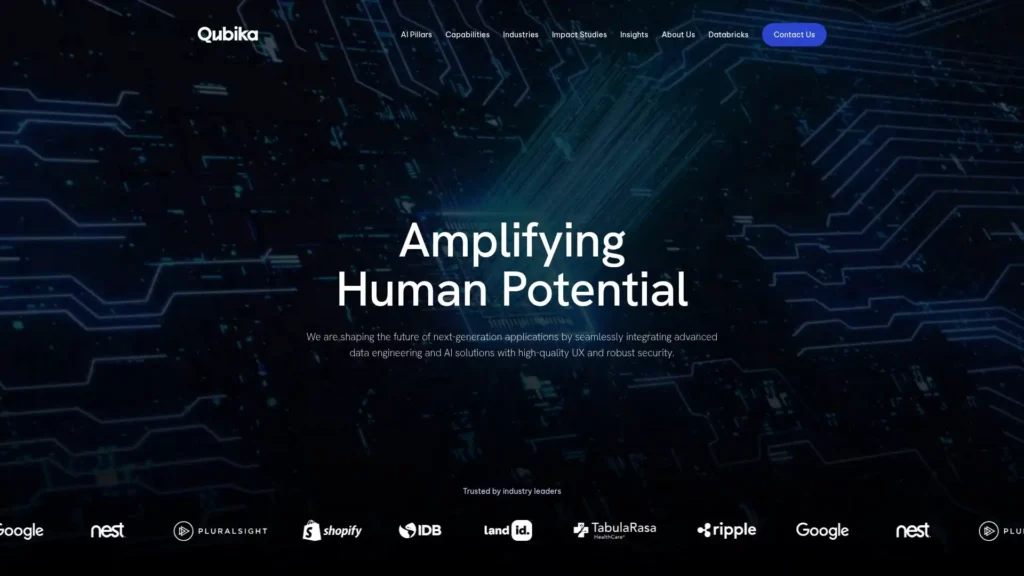
- Qubika. Product design and full-stack engineering under one roof, with a strong track record across complex digital platforms and AI-powered products.
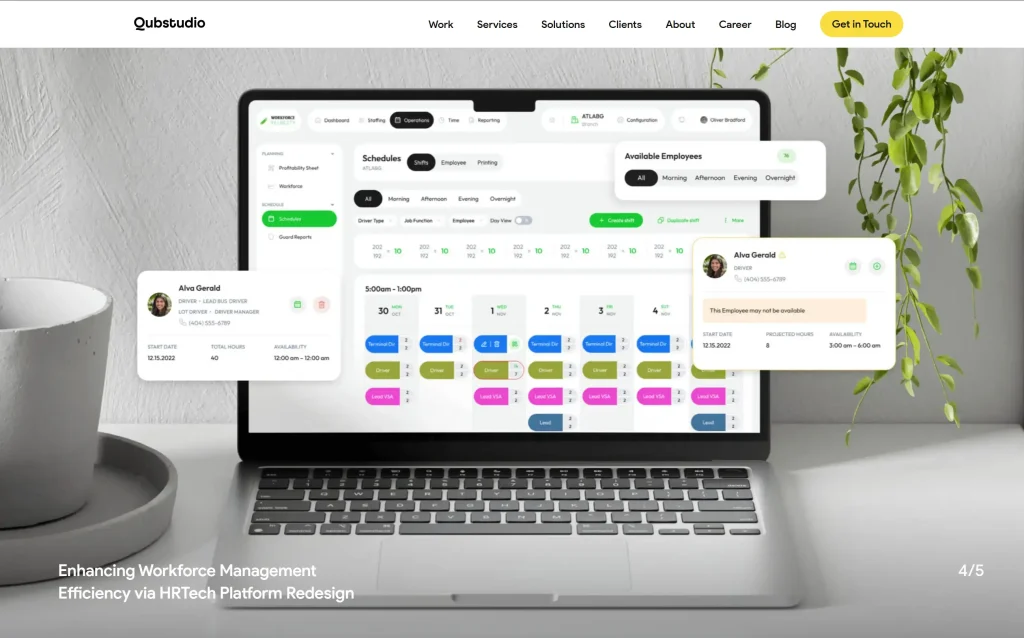
- Qubstudio. A fully design-focused studio with two decades of UX practice and a research-driven process for product teams that want rigour, not guesswork.
- Boldare. Full-cycle product development out of Poland, strong in Agile delivery, and direct about what your product actually needs before a single screen gets designed.
- Cieden. Enterprise UX strategy and product design from a team that has built its entire practice around complex B2B and SaaS environments.
- Praxent. Fintech specialists who combine UX strategy with full-stack development and consistently think ahead of the brief before problems surface.
- Creative Navy. A London-based pure-play UX studio that solves technically complex interface problems through a cognitive science foundation. Not for simple briefs.
- Big Red Jelly. Brand-forward web design and UX with an accessible entry point, well-suited to growing businesses building their first serious digital presence.
How to Choose the Right UI/UX Design Agency for Your Project
Picking a UI/UX design agency is not a shortlisting exercise. It is a scoping exercise. The agency that fits a SaaS startup redesigning its onboarding flow is rarely the right agency for a fintech firm rebuilding a compliance dashboard. Know what problem you are actually solving before you send a single brief.
1. Separate UI specialists from UX specialists
Most agencies sell both. Few are equally strong at both. UI design is visual execution. UX design is structural thinking, flow logic, and user behaviour. These are different skills.
Ask for case studies that show process, not just final screens. If the portfolio is all polished mockups and no research documentation, you are looking at a UI shop selling itself as a full UX partner. That is fine for some projects. It is a problem for others.
2. Treat the discovery phase as a test, not a formality
How an agency structures and prices discovery tells you everything about how it operates. Agencies that compress discovery into a free one-hour call, then move straight to wireframes, are running on assumptions.
Strong agencies charge for discovery. They run stakeholder interviews, audit existing analytics, and map real user flows before a single screen gets designed. If an agency skips this step to win your business, it will cost you more in revision cycles later. Every time.
3. Ask who will actually work on your account
This is the most consistently ignored question in the hiring process. Senior designers close deals. Junior designers often execute them. The team on the sales call is rarely the team in your Figma file six weeks later.
Ask for the names and seniority of the people assigned to your project before signing. Ask who owns the relationship when problems surface. If the answer is vague, that vagueness is your answer.
4. Check whether they understand custom web design beyond aesthetics
A lot of agencies deliver beautiful custom web design that performs poorly after launch. Conversion rates stay flat. Pages load slow. Forms get abandoned. Great visual work and strong functional execution are not the same thing.
If your site needs to generate leads or drive revenue, the agency needs to think in user flows and conversion logic, not just layout grids. Ask how they define success. Agencies that answer in business metrics are different from agencies that answer in design awards.
5. Find out how they handle SEO during the design process
Most UI/UX agencies treat SEO as someone else’s problem. They hand off a Figma file and move on. If you are investing in an seo service alongside your redesign, or if organic traffic is part of your growth model, the design and SEO work need to be coordinated from the start.
Information architecture, page hierarchy, URL structure, and heading logic all get set during the design phase. Changing them after development is expensive. Find an agency that at minimum has a clear handoff process that does not force your SEO team to undo structural decisions made in Figma.
6. Evaluate the dev handoff process directly
The gap between a finished design and a built product is where most projects break down. Figma files are not a product. They are a blueprint. If the agency does not produce annotation documentation, component libraries, or development-ready specifications, the build team inherits a guessing game.
Ask to see an example handoff package from a previous project. If the agency cannot show you one, or dismisses the question as a developer concern, take that seriously. Misaligned handoff is the single most common reason a well-designed product ships broken.
7. Match the engagement model to your actual situation
Agencies operate on three main models. Project-based. Retainer-based. Embedded team. Each suits a different stage of work.
Project-based works when your scope is defined and your internal team can own it post-handoff. Retainers work when you ship continuously and need ongoing design capacity. Embedded teams work when your product moves fast and you want a designer who thinks like an internal hire. Choosing the wrong model costs you either money or momentum, sometimes both.
8. Read the downside signals in reviews, not just the praise
Every agency on Clutch has a wall of five-star reviews. The real signal is in the patterns across less-than-perfect scores, and in what the positive reviews do not say.
If ten clients all praise responsiveness but none mention strategic impact, the agency is well-managed but not particularly thoughtful. If every review praises delivery speed but nothing mentions post-launch results, the relationship ends at handoff. Read for what is absent as much as what is present.
9. Verify industry experience, not just years in business
A twenty-year-old agency that has spent most of that time on marketing websites is not experienced in SaaS product design. A six-year-old agency that has shipped fintech dashboards for regulated clients probably knows more about compliance-constrained UX than any generalist with twice the history.
Match their portfolio to your actual product type. B2B workflows, consumer apps, e-commerce, and enterprise platforms each have their own interaction patterns, user behaviours, and design constraints. Domain experience shortens ramp-up time and lowers the risk of expensive assumptions.
10. Test communication before commitment
Responsiveness during the proposal stage is the clearest predictor of responsiveness during the project. Agencies that take four days to return a scoping email will not improve once they have your retainer.
Run a small paid discovery engagement before committing to full project scope. Watch how they handle ambiguity. Watch how they respond to pushback. The working relationship is the product. A beautiful design from an agency you cannot communicate with is worth less than you think.
List of the Top 54+ UI/UX Design Agencies in 2026
Every agency below was evaluated against the same framework – no exceptions and no paid placements. The table covers design focus, client satisfaction, verified review volume, employee ratings, monthly web traffic, minimum project cost, and final score. Use it to filter by budget, specialisation, and geography before reading the full deep dives.
List of Top 54 UI/UX Design Agencies in 2026
| Rank | Agency Name | Website | Location | Web Visits (Monthly) | UX/UI Design Focus (%) | Rating for Cost (5) | LinkedIn Members | Experience (Years) | Client Rating (5) | Client Reviews | Employee Rating (5) | Employee Reviews | Hourly Rate (USD) | Min Project (USD) | Final Score (100) |
|---|---|---|---|---|---|---|---|---|---|---|---|---|---|---|---|
| 1 | Eleken | eleken.co | Kyiv, Ukraine | 31.5K | 100% | 4.80 | 167 | 11 | 4.85 | 153 | 4.7 | 8 | 25 | 10,000 | 71 |
| 2 | AgileEngine | agileengine.com | Boca Raton, FL | 3.2K | 20% | 4.70 | 743 | 16 | 4.83 | 91 | 4.65 | 340 | 25 | 25,000 | 68 |
| 3 | Qubika | qubika.com | Austin, TX | 2.0K | 20% | 4.60 | 877 | 19 | 4.90 | 61 | 4.3 | 44 | 50 | 10,000 | 56 |
| 4 | Qubstudio | qubstudio.com | L’viv, Ukraine | 3.5K | 100% | 4.90 | 57 | 20 | 4.87 | 138 | 4.5 | 6 | 50 | 10,000 | 52 |
| 5 | Boldare | boldare.com | Gliwice, Poland | 18.4K | 20% | 4.60 | 85 | 22 | 3.95 | 96 | 4.35 | 29 | 50 | 25,000 | 50 |
| 6 | Cieden | cieden.com | Toronto, Canada | 3.8K | 100% | 4.80 | 41 | 10 | 4.95 | 60 | 5 | 5 | 50 | 10,000 | 48 |
| 7 | Praxent | praxent.com | Austin, TX | 2.7K | 30% | 4.50 | 172 | 26 | 4.70 | 72 | 4.85 | 68 | 50 | 25,000 | 48 |
| 8 | Creative Navy | interface-design.co.uk | London, England | 1.9K | 100% | 4.90 | 15 | 16 | 4.98 | 111 | 5 | 11 | 100 | 5,000 | 47 |
| 9 | Big Red Jelly | bigredjelly.com | Provo, UT | 2.1K | 10% | 4.80 | 44 | 9 | 4.65 | 598 | 4.6 | 70 | 150 | 1,000 | 47 |
| 10 | Designli | designli.co | Greenville, SC | 1.9K | 10% | 4.80 | 87 | 14 | 4.98 | 283 | 5 | 1 | 50 | 10,000 | 45 |
| 11 | Beetroot AB | beetroot.co | Stockholm, Sweden | 0.1K | 10% | 4.50 | 352 | 14 | 4.90 | 39 | 4.6 | 56 | 25 | 10,000 | 45 |
| 12 | Simpalm | simpalm.com | Rockville, MD | 15.9K | 5% | 4.90 | 63 | 17 | 4.72 | 142 | 3.2 | 41 | 100 | 10,000 | 45 |
| 13 | eSEOspace | eseospace.com | San Diego, CA | 11.8K | 10% | 5.00 | 0 | 7 | 4.72 | 127 | 5 | 1 | 50 | 1,000 | 45 |
| 14 | Adam Fard UX Studio | adamfard.com | New York, NY | 2.8K | 100% | 5.00 | 5 | 10 | 4.35 | 35 | 5 | 1 | 50 | 10,000 | 45 |
| 15 | Halo Lab | halo-lab.com | Dubai, United Arab Emirates | 4.0K | 10% | 4.90 | 144 | 13 | 4.75 | 135 | 4.5 | 8 | 25 | 10,000 | 44 |
| 16 | Method | method.com | New York, NY | 3.0K | 30% | 4.30 | 534 | 27 | 4.85 | 36 | 4.45 | 71 | 150 | 50,000 | 44 |
| 17 | Redwerk | redwerk.com | Kyiv, Ukraine | 4.0K | 10% | 4.10 | 64 | 21 | 4.33 | 50 | 4.9 | 100 | 50 | 10,000 | 44 |
| 18 | Merge Rocks | merge.rocks | Tallinn, EE | 0.9K | 60% | 4.90 | 37 | 8 | 4.90 | 67 | 5 | 3 | 25 | 10,000 | 43 |
| 19 | UX Studio | uxstudioteam.com | Budapest, Hungary | 17.8K | 50% | 4.80 | 71 | 13 | 4.90 | 69 | 0.00 | 0 | 50 | 10,000 | 43 |
| 20 | KrishaWeb | krishaweb.com | Loveland, CO | 0.7K | 10% | 4.90 | 133 | 18 | 4.87 | 151 | 4.3 | 15 | 50 | 5,000 | 43 |
| 21 | Inoxoft | inoxoft.com | Newark, DE | 0.4K | 10% | 4.90 | 205 | 12 | 4.80 | 155 | 4.9 | 14 | 25 | 25,000 | 43 |
| 22 | Seahawk Media | seahawkmedia.com | Boston, MA | 0.8K | 10% | 4.80 | 104 | 11 | 4.85 | 203 | 4.6 | 22 | 50 | 1,000 | 43 |
| 23 | Linkup ST | linkupst.com | Wrocław, Poland | 3.5K | 100% | 4.80 | 222 | 13 | 4.90 | 96 | 0 | 0 | 50 | 10,000 | 42 |
| 24 | One Beyond | one-beyond.com | Farnborough, England | 4.2K | 10% | 4.70 | 0 | 32 | 4.50 | 67 | 2.85 | 149 | 50 | 50,000 | 42 |
| 25 | Shakuro | shakuro.com | Dubai, United Arab Emirates | 3.0K | 10% | 4.80 | 57 | 20 | 4.73 | 74 | 4.75 | 2 | 25 | 5,000 | 43 |
| 26 | Infinum | infinum.com | New York, NY | 6.9K | 10% | 4.50 | 385 | 21 | 4.48 | 140 | 4.75 | 60 | 150 | 50,000 | 42 |
| 27 | Door3 | door3.com | New York, NY | 6.9K | 33% | 4.80 | 60 | 24 | 4.70 | 61 | 3.75 | 39 | 100 | 25,000 | 41 |
| 28 | Excited | excited.agency | L’viv, Ukraine | 11.1K | 90% | 4.90 | 27 | 8 | 5.00 | 54 | 0 | 0 | 50 | 10,000 | 41 |
| 29 | Tapptitude | tapptitude.com | Cluj-Napoca, Romania | 0.5K | 10% | 4.90 | 34 | 13 | 4.77 | 139 | 3.90 | 35 | 25 | 5,000 | 41 |
| 30 | Rubyroid Labs | rubyroidlabs.com | Warszawa, Poland | 1.3K | 15% | 4.90 | 64 | 13 | 4.97 | 69 | 5 | 13 | 50 | 10,000 | 40 |
| 31 | ElifTech | eliftech.com | L’viv, Ukraine | 0.8K | 10% | 4.70 | 100 | 11 | 4.90 | 89 | 4.3 | 9 | 25 | 10,000 | 39 |
| 32 | AnyforSoft | anyforsoft.com | Sarasota, FL | 1.2K | 10% | 4.80 | 52 | 15 | 4.78 | 106 | 4.15 | 18 | 25 | 25,000 | 39 |
| 33 | Gapsy Studio | gapsystudio.com | Warszawa, Poland | 1.6K | 20% | 5.00 | 15 | 9 | 4.95 | 66 | 4 | 1 | 25 | 5,000 | 38 |
| 34 | Atomic Digital Marketing / Atomic Digital Labs | atomicdigitalmarketing.co.uk | Warrington, England | 11.0K | 15% | 4.90 | 7 | 6 | 4.37 | 110 | 4.6 | 5 | 100 | 5,000 | 38 |
| 35 | DigitalSuits | digitalsuits.co | Miami, FL | 0.6K | 10% | 4.90 | 74 | 10 | 4.93 | 70 | 4 | 1 | 25 | 5,000 | 38 |
| 36 | You are launched | urlaunched.com | Limassol, Cyprus | 1.2K | 5% | 5.00 | 41 | 10 | 4.74 | 100 | 5 | 2 | 25 | 25,000 | 38 |
| 37 | Utility | utility.agency | New York, NY | 7.4K | 10% | 4.70 | 168 | 13 | 4.80 | 36 | 4.6 | 36 | 100 | 50,000 | 36 |
| 38 | Bop Design | bopdesign.com | San Diego, CA | 3.5K | 10% | 4.90 | 65 | 18 | 4.73 | 136 | 5 | 4 | 150 | 25,000 | 35 |
| 39 | STRV | strv.com | Prague, Czech Republic | 3.3K | 10% | 4.40 | 1 | 22 | 4.43 | 208 | 4.55 | 108 | 100 | 100,000 | 34 |
| 40 | Orizon Design | orizon.co | Montréal, Canada | 0.5K | 40% | 4.90 | 26 | 8 | 4.80 | 64 | 5 | 2 | 100 | 25,000 | 34 |
| 41 | Fuzzy Math | fuzzymath.com | Highland Park, IL | 0.7K | 30% | 4.80 | 16 | 17 | 4.85 | 32 | 5 | 1 | 150 | 25,000 | 32 |
| 42 | Outcrowd | outcrowd.io | Oakland Park, FL | 0.7K | 40% | 4.80 | 0 | 10 | 4.90 | 126 | 0 | 0 | 50 | 5,000 | 31 |
| 43 | Stormbrain | stormbrain.com | Carlsbad, CA | 0.9K | 10% | 4.90 | 55 | 25 | 4.97 | 275 | 0 | 0 | 150 | 10,000 | 31 |
| 44 | Vardot | vardot.com | Santa Clara, CA | 1.0K | 10% | 4.90 | 62 | 15 | 4.85 | 66 | 4.2 | 23 | 150 | 25,000 | 30 |
| 45 | Arounda | arounda.agency | București, Romania | 0.6K | 30% | 4.90 | 40 | 10 | 5.00 | 82 | 0 | 0 | 25 | 25,000 | 30 |
| 46 | DreamX | dreamxweb.com | San Francisco, CA | 2.0K | 10% | 5.00 | 24 | 6 | 4.85 | 88 | 0 | 0 | 25 | 1,000 | 30 |
| 47 | Metalab | metalab.com | Vancouver, Canada | 2.0K | 25% | 0.00 | 249 | 20 | 4.90 | 11 | 4.1 | 43 | 0 | 100,000 | 29 |
| 48 | Neuron | neuronux.com | San Francisco, CA | 3.2K | 100% | 4.70 | 27 | 10 | 4.70 | 93 | 0 | 0 | 150 | 25,000 | 29 |
| 49 | Goji Labs | gojilabs.com | Los Angeles, CA | 1.3K | 10% | 4.80 | 104 | 12 | 4.98 | 232 | 0 | 0 | 100 | 25,000 | 29 |
| 50 | Baunfire | baunfire.com | San Jose, CA | 0.5K | 10% | 4.70 | 32 | 25 | 4.87 | 94 | 4.4 | 2 | 150 | 75,000 | 27 |
| 51 | Brand Vision | brandvm.com | Toronto, Canada | 3.1K | 10% | 4.80 | 34 | 8 | 4.90 | 176 | 0 | 0 | 100 | 10,000 | 27 |
| 52 | Beyond Agency | beyond.agency | Sheffield, United Kingdom | 1.1K | 10% | 4.50 | 28 | 7 | 5.00 | 50 | 0 | 0 | 50 | 1,000 | 26 |
| 53 | Clay | clay.global | San Francisco, CA | 4.6K | 30% | 4.50 | 81 | 10 | 4.83 | 92 | 0 | 0 | 150 | 50,000 | 21 |
| 54 | eDesign Interactive | edesigninteractive.com | Morristown, NJ | 0.3K | 20% | 4.90 | 32 | 22 | 4.90 | 75 | 0 | 0 | 150 | 50,000 | 21 |
Deep Dive: Top 15 UI/UX Design Agencies in 2026
The profiles below go beyond surface-level descriptions. Each agency was evaluated against the same framework – client satisfaction, design focus, verified review signals, employee ratings, and pricing transparency. Read the data block first. Then let the overview and Our Take section tell you whether the fit is real.
⭐ Top Pick: OneLittleWeb – Best for SEO-First, Conversion-Ready Custom Web Design
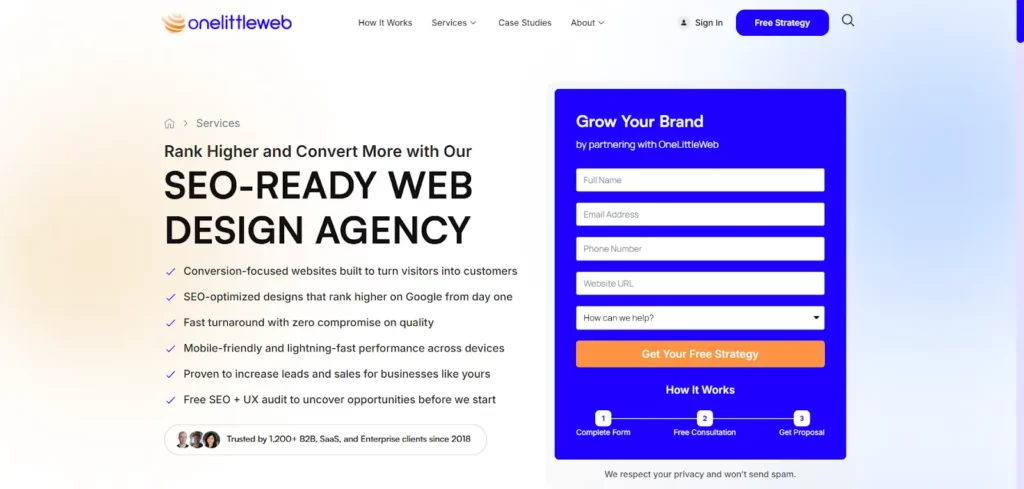
- Website: onelittleweb.com
- Minimum Project Cost: $1,000
- Client Rating: 4.9 (based on 26 reviews)
- Team Size: 29 (LinkedIn)
- Years in Business: 8
- Monthly Website Visits: 80,000+
- Employee Review Score: 4.5 (based on 32 reviews)
What separates OLW from most UI/UX design agencies is where the thinking starts. Most agencies begin with visual hierarchy and interaction patterns. We begin with how the finished product will perform after launch.
UI/UX design, SEO structure, conversion logic, and content architecture all get resolved together during the design phase. That integration saves clients from expensive post-launch corrections that most design-only agencies never flag in the first place.
The gap between beautiful UI/UX design and a site that actually generates revenue is wider than most agencies admit. A polished interface means nothing if the information architecture buries the conversion path, if the page hierarchy confuses crawlers, or if the interaction design adds friction where users should be moving forward.
We design to close that gap from day one, not patch it after handoff. Clients get strategic UI/UX direction alongside cost-efficient delivery. Both without compromise.
Our client base spans SaaS companies, B2B service firms, eCommerce brands, and local businesses across competitive markets. That range is deliberate. The UI/UX considerations for an AI SaaS onboarding flow and a professional services firm’s lead generation site are genuinely different problems.
We adapt the approach to the business model and the user, not the other way around.
The research side reinforces the credibility. Studies published in Forbes, AP News, and TechCrunch demonstrate that our team understands how authority and user trust compound online. The same principles that drive those placements inform how we design digital experiences for clients.
Core Services
- SEO-Optimised Ui/Ux Design
- Link Building and Digital PR
- Technical SEO and Site Strategy
- Generative Engine Optimization (GEO)
- Content Strategy and Organic Growth
- White Label SEO and Link Building
Why They Rank #Top Pick
- Highest client satisfaction rating in this roundup at 4.9 across 26 verified reviews
- Accessible $1,000 minimum project cost opens the door for growing businesses without sacrificing strategic quality
- Monthly web traffic exceeding 80,000 visits signals genuine domain authority, not just claimed expertise
- Trusted by over 1,200 B2B, SaaS, and enterprise clients since 2018 across competitive verticals
- Research published in Forbes, AP News, and TechCrunch demonstrates real digital PR capability
- Employee score of 4.5 across 32 reviews suggests a stable, well-run team, not a revolving-door operation
- Dual-continent operations deliver senior strategy alongside cost-efficient execution
Snapshot of Client Reviews
Clients consistently highlight responsiveness, strategic depth, and measurable traffic results. One client noted a near-tripling of MRR alongside significant organic traffic growth after a PR backlink campaign. Communication and transparency across campaigns are the most repeated praise signals.
Our Take
OneLittleWeb fits businesses that need SEO and web design to work as one strategy, not two separate projects. The $1,000 entry point makes them accessible to growing brands. They are not the right fit for large enterprise builds requiring deep UX research. For performance-focused web design, they are the clearest choice in this list.
1. Eleken
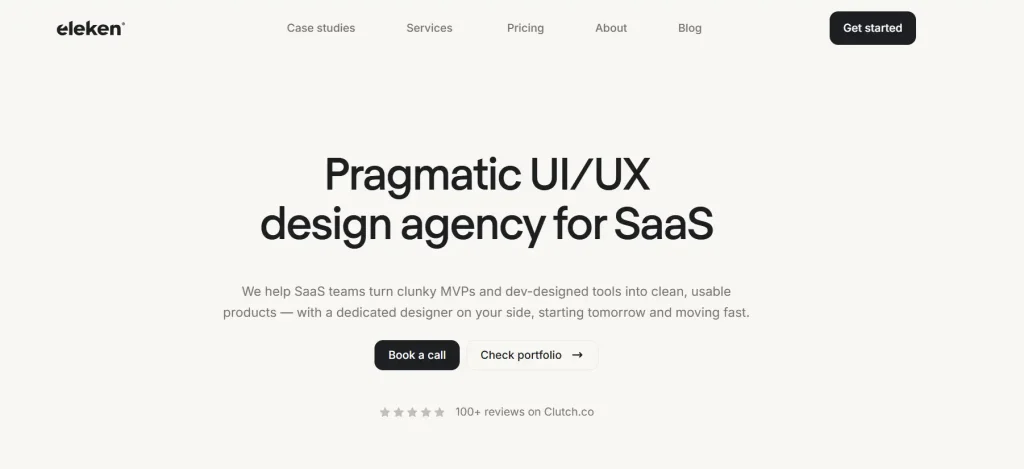
- Website: eleken.co
- Minimum Project Cost: $10,000
- Client Rating: 4.85 (based on 153 reviews)
- Team Size: 167 (LinkedIn)
- Years in Business: 11
- Monthly Website Visits: 31,500
- Employee Review Score: 4.7 (based on 8 reviews)
Most SaaS products don’t fail on features. They fail because engineers built the interface, nobody questioned the navigation, and users left before they ever found the value. Eleken was built specifically for that problem.
The agency operates exclusively in SaaS. No marketing sites. No brand identity projects. No eCommerce builds. That narrow scope is not a constraint – it is a deliberate filtering mechanism.
A designer who has shipped across fintech dashboards, AI platforms, geospatial analytics tools, and healthcare SaaS brings a depth of pattern recognition that generalist agencies cannot replicate.
Kyiv has produced some of the strongest SaaS product design talent in Eastern Europe. The city’s deep engineering culture creates designers who think in systems, not just screens.
Eleken draws from the top of that talent pool, then runs every hire through an intensive internal bootcamp before they touch a client project. Senior design leads review all work throughout. The client never inherits a junior-only execution.
The subscription model changes the engagement dynamic entirely. One dedicated designer integrates directly into the client’s team from day one. No project manager relaying feedback. No handoff delays. The designer joins the existing workflow, absorbs context fast, and starts shipping. When priorities shift mid-sprint, they re-scope without losing momentum.
A US legal entity in Newark, Delaware handles North American operations. That dual setup matters for SaaS teams managing contractor compliance, timezone coordination, and procurement requirements. The operational structure is built to reduce friction on the client side, not just the design side.
SaaS products ship continuously. A one-off project engagement ends at handoff. Eleken’s subscription model scales with the product roadmap. Add a designer when the team accelerates, pause when it slows. That flexibility at this quality level is genuinely rare.
Core Services
- SaaS UI/UX Design (product redesign, MVP design, design from scratch)
- Dedicated Designer Team Extension
- UI/UX Audit
- Design Systems
- Mobile App Design
- Web App Design
- UX Consulting
Why They Rank #1
- Highest final score in the full dataset – leads the entire roundup by a clear margin
- Pure-play SaaS design focus with no competing service lines diluting attention
- Client satisfaction of 4.85 across a strong verified review volume places them at the top of the satisfaction tier
- Most competitive hourly rate in the pure-play specialist category
- Clutch top mentions include timely delivery, high-quality work, and communication – signals that hold across a large review base
- Senior design lead oversight on every project prevents junior-only execution
- Three-day free trial before subscription commitment eliminates engagement risk entirely
- Subscription model with no long-term contracts is structurally aligned with how SaaS product teams actually operate
Snapshot of Client Reviews
Speed and ownership are the two signals that appear consistently. Designers re-scope tasks without losing momentum when product priorities shift. One SaaS team noted their Eleken designer was consistently ahead of the internal team on delivery. Complex B2B environments, including AI platforms and fintech tools, are where the praise runs deepest.
Our Take
Eleken is built for SaaS product teams that need a senior designer embedded in their workflow, not a vendor delivering files from a distance. The subscription model, SaaS-only depth, and direct designer access make them the strongest specialist on this list. Teams outside SaaS should look elsewhere.
2. AgileEngine
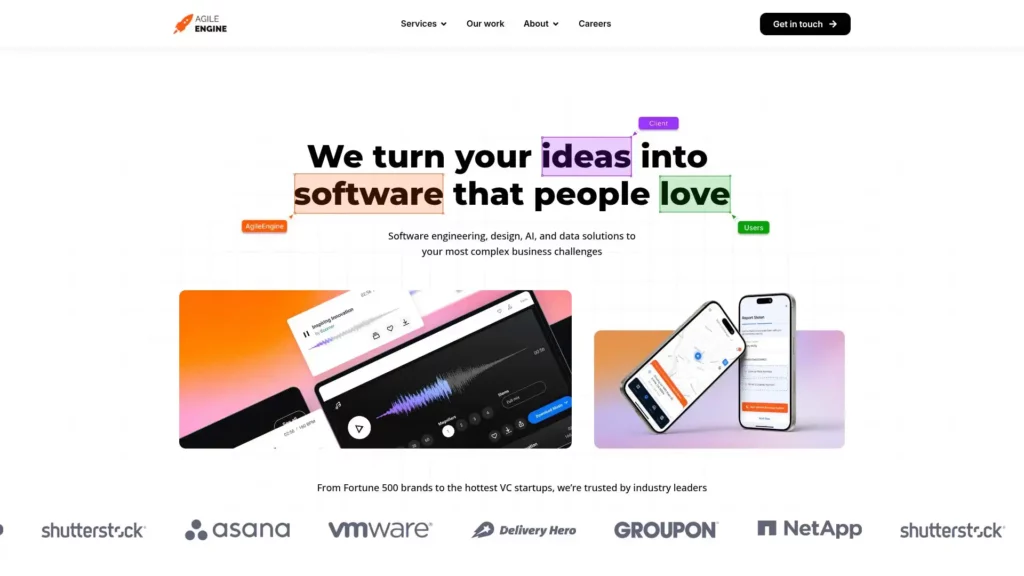
- Website: agileengine.com
- Minimum Project Cost: $25,000
- Client Rating: 4.83 (based on 91 reviews)
- Team Size: 743 (LinkedIn)
- Years in Business: 16
- Monthly Website Visits: 3,200
- Employee Review Score: 4.65 (based on 340 reviews)
There is a structural problem that haunts most digital product builds. Engineering and design operate in separate lanes, hand off files across a gap, and then spend weeks reconciling decisions that were never made together. AgileEngine was built to eliminate that gap entirely.
The company started as a software product business in 2010 before evolving into a full-spectrum engineering partner. Design came later – deliberately, and as an extension of the engineering operation rather than a bolt-on service.
The Design Studio sits inside the same delivery infrastructure as the AI, data, and quality studios. When a UX decision has downstream engineering implications, the conversation happens inside the team, not across an email chain between two separate vendors.
Boca Raton is not the obvious home for a global technology operation of this scale. South Florida’s tech ecosystem has grown quietly but steadily over the past decade, drawing enterprise clients and venture-backed startups who want serious engineering capability without San Francisco pricing.
AgileEngine planted its US headquarters there early and has used the region’s talent accessibility to build outward, now operating across more than fifteen global hubs spanning the Americas, Europe, and Asia.
The AI-augmented delivery model changes what the Design Studio can actually deliver. UX/UI work enhanced through AI tooling accelerates iteration cycles, compresses time-to-prototype, and keeps design tightly coupled to engineering velocity.
One flagship engagement resulted in conversion growth exceeding double the baseline for a globally recognised stock content platform – a signal of what happens when design and engineering share a delivery cadence rather than a handoff date.
Enterprise organisations requiring embedded capacity and venture-backed startups scaling fast both appear prominently in the client base. That range reflects a delivery model designed around team integration rather than project scoping.
Clients consistently describe AgileEngine as functioning like an internal team – adapting to existing workflows, absorbing context without extensive onboarding, and taking ownership of outcomes rather than deliverables.
Core Services
- UI/UX Design and Product Design (Design Studio)
- Custom Software Development
- AI Studio – GenAI and ML product development
- Data Studio – Predictive analytics and data visualisation
- Quality Studio – Agentic QA and testing
- IT Staff Augmentation and Dedicated Engineering Teams
- Accessibility Solutions
- Mobile, Frontend, and Backend Development
Why They Rank #2
- Second-highest final score in the full dataset with a strong verified review base across multiple service lines
- Engineering-design integration eliminates the handoff gap that breaks most agency-client relationships
- Perfect overall rating on Clutch across all reviews – the consistency across a large volume is the real signal
- AI-augmented delivery model demonstrably accelerates UX iteration and reduces design-to-build cycle time
- Employee satisfaction score backed by the largest review volume in the entire dataset – internal stability at this scale is rare
- Fifteen-plus global talent hubs give enterprise clients genuine timezone and budget flexibility without sacrificing seniority
- Nine consecutive Inc. 5000 listings signal operational consistency that project-based agencies rarely achieve
- Competitive hourly rate for a US-headquartered operation of this capability level
Snapshot of Client Reviews
The phrase that appears most consistently across reviews is not about design quality – it is about team integration. Clients describe AgileEngine as becoming part of their internal workflow rather than operating as an external vendor. Ownership mentality and proactive problem-solving are the signals that separate them from comparable-sized competitors.
Our Take
AgileEngine suits organisations where design and engineering need to move as a single unit rather than sequential phases. Enterprise teams managing complex product builds and startups scaling fast will find the most value here. Pure design briefs with no engineering component are not where this team operates at its ceiling.
3. Qubika
- Website: qubika.com
- Minimum Project Cost: $10,000
- Client Rating: 4.90 (based on 61 reviews)
- Team Size: 877 (LinkedIn)
- Years in Business: 19
- Monthly Website Visits: 2,000
- Employee Review Score: 4.3 (based on 44 reviews)
Qubika started in Uruguay in 2006. That origin matters because it shaped the delivery model. Latin American engineering talent is timezone-aligned with the US market, cost-competitive without sacrificing seniority, and increasingly recognised for deep technical capability in data and AI infrastructure.
Qubika built its foundation in that environment before expanding northward, eventually planting its US headquarters in Austin, Texas. A city that has become one of the most active enterprise technology markets in the country.
Austin’s emergence as a serious enterprise tech hub is not incidental context. Companies like Shopify, Dell, and a dense cluster of fintech and healthtech firms have established significant operations there.
Qubika’s proximity to that client base, combined with nearshore delivery from Latin America, gives it a structural cost and communication advantage over comparable firms operating out of higher-overhead US coastal cities.
What distinguishes Qubika from most agencies in this roundup is the depth of the AI infrastructure layer sitting underneath the product design practice. The Design Studio does not operate in isolation.
It sits alongside a Data Studio, an AI Studio, a Cloud practice, and a Cybersecurity function. When a UX decision has downstream implications for a machine learning pipeline, a compliance requirement, or a data governance framework, the relevant expertise is internal – not referred out.
The Constellation Research AI Exponential designation places Qubika among a very small group of firms globally recognised for genuine enterprise AI capability. That recognition is not a design award.
It is an evaluation of whether a firm can operate meaningfully across the full AI stack – from data foundations to agentic systems. Very few agencies writing UI/UX copy in their marketing also hold that designation.
Enterprise clients in regulated industries – fintech, healthcare, financial services – require more from a design partner than polished screens. They require designers who understand compliance constraints, data sensitivity, and the interaction patterns specific to workflow-heavy enterprise software.
Qubika’s client roster across Shopify, Ripple, Pluralsight, and Google Nest reflects exactly that kind of technically sophisticated engagement.
The PwC-audited Net Promoter Score is an unusual signal. Most agencies self-report client satisfaction. Having that metric independently verified carries a different weight, particularly for procurement teams running formal vendor evaluations.
Core Services
- UX/UI Design and Product Design
- Enterprise AI Consulting and Custom AI Agent Development
- Generative AI Implementation and LLM Development
- Data Platform Modernisation and Data Engineering
- Cloud Transformation and Infrastructure (AWS, Azure, Databricks)
- Cybersecurity and DevSecOps
- Mobile and Full-Stack Application Development
- IT Staff Augmentation and Nearshore Engineering Teams
Why They Rank #3
- Highest client satisfaction rating among multi-service agencies in this tier – the consistency across a large verified review base is the real signal
- Constellation Research AI Exponential designation places them among fewer than ten firms worldwide recognised at this capability level
- Nearshore Latin America delivery model provides US timezone alignment at a structural cost advantage over onshore-only competitors
- SOC 2 Type 2 and ISO 27001 certifications address compliance requirements that eliminate most agencies from regulated industry procurement
- PwC-audited Net Promoter Score adds independent verification to client satisfaction claims that most agencies make without third-party validation
- Databricks Gold Partner status with a large certified engineering team signals genuine data infrastructure depth, not surface-level AI positioning
- Multiple years on the Financial Times Americas Fastest-Growing Companies list indicates sustained operational health across economic cycles
Snapshot of Client Reviews
The pattern across reviews is not about design polish – it is about what happens when complex technical requirements meet tight timelines. Clients in data-heavy and AI-driven product environments consistently highlight Qubika’s ability to scale resources quickly, absorb technical context without extensive ramp-up, and deliver without drama.
Our Take
Qubika is the right call when design cannot be separated from data infrastructure, AI pipelines, or compliance requirements. Fintech platforms, healthtech products, and enterprise software with serious backend complexity are where this team operates at full strength. Pure UI/UX briefs with no technical depth are underserving what they actually offer.
4. Qubstudio
- Website: qubstudio.com
- Minimum Project Cost: $10,000
- Client Rating: 4.87 (based on 138 reviews)
- Team Size: 57 (LinkedIn)
- Years in Business: 19
- Monthly Website Visits: 3,500
- Employee Review Score: 4.5 (based on 6 reviews)
Lviv has quietly become one of the strongest design talent markets in Eastern Europe. The city has a dense concentration of technology universities, a mature freelance-to-studio pipeline, and a design community that has been building product experience for global clients since the early 2010s. Qubstudio has been headquartered there since its founding, and that location is not incidental – it shaped the quality of the team and the depth of the design culture the agency operates within.
The agency does one thing. Digital product design and branding. No development teams, no engineering studios, no adjacent services added to increase invoice size. That singular focus over nearly two decades means the practice is genuinely deep rather than broad.
For clients who need design that holds up under external scrutiny – investor presentations, product launches, rebrand announcements – that level of recognised quality matters.
The client base spans fintech, logistics, healthcare, edtech, HR tech, and entertainment. What is notable about that spread is not the breadth but the complexity. These are not simple marketing sites.
Fintech platforms carry regulatory constraints and trust-sensitive interaction patterns. Healthcare products require accessibility depth and workflow clarity that most generalist agencies underestimate.
Qubstudio has case studies across all of them, including a partnership with Truecaller and a long-running engagement with a fintech firm that saw platform performance improve dramatically after redesign.
Core Services
- Digital Product Design and UX/UI Design
- Brand Strategy and Visual Identity
- UX/UI Audit and Improvements
- Market and User Research
- Product Vision and Strategy
- Design Process Consultancy
- Product Management Support
- Web Design and Branding Packages
Why They Rank #4
- Pure-play UX/UI design focus with no competing service lines – every resource is a designer, strategist, or researcher
- Globally ranked in Clutch’s top five UX design agencies consistently since 2017 – one of the longest unbroken streaks in the category
- Red Dot Best of the Best award places the quality of their output at an internationally recognised standard
- Net Promoter Score of plus 97 is among the highest reportable figures in professional services
- Strong verified review volume with creativity cited as a top mention alongside the standard delivery signals
- Fintech and healthcare portfolio depth demonstrates experience with compliance-sensitive and workflow-complex design environments
- Canary Wharf office positions the agency directly inside London’s fintech ecosystem for European and UK client access
- Y Combinator and 500 Startups partnerships indicate credibility with high-scrutiny startup investors who vet agency quality carefully
Snapshot of Client Reviews
Creativity comes up more frequently in Qubstudio reviews than in almost any other agency on this list. Clients describe getting multiple design directions, unexpected solutions to structural problems, and a team that challenges briefs rather than just executing them. The fintech and HR tech clients are the most vocal about measurable product improvement.
Our Take
Qubstudio fits companies where design quality is visible to external audiences – investors, users, press. The Red Dot recognition, fintech depth, and creative reputation make them the right partner when the product needs to look and function at an award-worthy standard. Teams needing fast execution over creative exploration should weigh that trade-off carefully.
5. Boldare
- Website: boldare.com
- Minimum Project Cost: $25,000
- Client Rating: 3.95 (based on 96 reviews)
- Team Size: 85 (LinkedIn)
- Years in Business: 22
- Monthly Website Visits: 18,400
- Employee Review Score: 4.35 (based on 29 reviews)
Poland’s technology industry has matured significantly over the past decade. Gliwice, where Boldare is headquartered, sits in the Silesian region – historically an industrial hub that has quietly repositioned itself around technology and engineering talent.
The city hosts a strong technical university pipeline and a growing cluster of software companies that operate at European enterprise scale. Boldare has been embedded in that environment since 2004, which gives the agency a depth of operational experience that most competitors in this roundup cannot claim.
The agency operates across four offices in Poland – Gliwice, Warsaw, Wrocław, and Kraków. That multi-city presence is not a branding decision. It reflects a deliberate talent strategy built around accessing the strongest engineering and design pools across the country rather than concentrating in a single location and accepting the limitations that come with it.
What makes Boldare structurally different from most agencies in this list is the separation of product stages into distinct delivery environments. Prototyping, MVP development, product-market fit work, and scaling each operate under different processes, team configurations, and success metrics.
Most agencies apply a single methodology across all project types. Boldare recognised early that what works for a prototype is actively wrong for a scaling platform, and built separate operational tracks accordingly.
The AI augmentation layer is real rather than marketed. The agency reports measurable delivery acceleration through AI-enhanced coding, design, and testing – not as a future capability but as a daily operational practice.
For clients evaluating whether an agency’s AI claims translate to actual output velocity, the case studies with DTiQ, Sonnen, and Maxeon Solar Technologies provide concrete reference points across different industries.
The client satisfaction score in our dataset sits below the field average for this roundup. That is worth naming directly. The Clutch review base is large and the scores are strong, but a lower cost rating relative to peers – combined with occasional feedback about team rotation – suggests that project continuity and value perception can vary depending on engagement scope and duration.
Transparency appears as a top review signal on Clutch. Clients consistently cite clear communication, honest progress reporting, and a willingness to flag problems early. For mid-sized companies managing digital transformation without a large internal technology team, that operational transparency is often more valuable than pure design polish.
Core Services
- UX/UI Design and Digital Design
- Full Cycle Product Development
- MVP and Prototype Development
- Custom Software Development and Engineering
- AI Software Development and Consulting
- Code Audit and UX Audit
- Product Scaling and Product-Market Fit
- DevOps, Infrastructure, and Digital Transformation
- Dedicated Development Teams and Team Augmentation
Why They Rank #5
- Over two decades of continuous product delivery places them among the most operationally experienced agencies in this roundup
- Four-stage delivery model – prototype, MVP, product-market fit, scaling – is a structural differentiator that most agencies do not replicate
- Transparency is the most distinctive Clutch review signal, appearing consistently across engagements of varying size and complexity
- AI augmentation applied across coding, design, and testing delivers measurable delivery velocity rather than positioning it as a future differentiator
- Client base includes BlaBlaCar, Bosch, and Decathlon alongside mid-market companies – range indicates the delivery model scales across company size
- Awwwards, German Design Awards, and Webby Awards recognition signals design quality that holds up under external creative scrutiny
- Customer retention rate of eighty percent reflects long-term client relationships rather than single-project engagements
Snapshot of Client Reviews
Transparency and communication are the signals that carry across Boldare’s review base more than any other agency in this roundup. Clients describe a team that reports progress honestly, flags problems early, and organises work clearly. The most critical feedback centres on team rotation consistency – worth asking about before committing to longer engagements.
Our Take
Boldare suits mid-sized companies navigating digital transformation who need a partner that can move from concept to scaled product without switching agencies at each stage. The four-environment delivery model is genuinely useful for products with a long roadmap. Teams seeking pure UI/UX design without an engineering component will find this operation over-scoped for their needs.
6. Cieden
- Website: cieden.com
- Minimum Project Cost: $10,000
- Client Rating: 4.95 (based on 60 reviews)
- Team Size: 41 (LinkedIn)
- Years in Business: 10
- Monthly Website Visits: 3,800
- Employee Review Score: 5.0 (based on 5 reviews)
Cieden was founded by siblings Yuriy Mykhasyak and Iryna Serednia in Lviv in 2016. That founding story is relevant because it explains the culture. A sibling co-founding team running a design-only practice tends to build differently from a venture-backed operation chasing headcount growth.
The decisions at Cieden – staying lean, staying focused on complex B2B, maintaining a boutique engagement model – reflect a deliberate choice to go deep rather than wide.
The agency operates at the intersection of two locations that matter to its client base. A Canadian headquarters in Toronto gives North American clients a familiar commercial and legal context.
A delivery team in Lviv gives the practice access to some of the strongest product design talent in Eastern Europe without the overhead structure of a larger agency. That combination – Toronto accountability, Lviv craft – is the operational model.
Complex B2B is not a positioning statement at Cieden. It is a filter. The agency explicitly turns away projects that do not fit: no logos, no landing pages, no briefs under a certain budget threshold.
That selectivity is unusual and worth noting. Most agencies say yes to everything. Cieden has built its track record by saying no to work that does not require the depth they have developed.
Healthcare and fintech are the two verticals where Cieden’s case studies run deepest. Both are environments where UX decisions carry downstream consequences – compliance implications, clinical workflow dependencies, financial transaction trust signals – that require designers who think beyond visual hierarchy.
The healthcare portfolio includes everything from digital health apps to clinical platforms. The fintech work spans wealth management tools, delivery app conversion optimisation, and AI-driven financial products.
The highest client satisfaction score among pure-play design agencies in this dataset is worth examining in context. The review volume is smaller than some competitors, but the signal across those reviews is unusually consistent.
“Easy to work with” appears as a top mention alongside high-quality work – a combination that suggests the collaboration experience matches the output quality, not just one without the other.
Core Services
- UX/UI Design for Complex B2B and AI Products
- Product Design and Design Systems
- Dedicated Design Teams
- UX Audit
- Business Analysis and Product Management
- AI UX Design and Prototyping
- Web App and Mobile App Design
- Development Support and Documentation
Why They Rank #6
- Highest client satisfaction score among pure-play design agencies in the dataset – consistency across the review base is the real differentiator
- Perfect employee satisfaction score signals a stable, well-managed team with low attrition risk for clients in long-term engagements
- Enterprise client roster including Apollo.io, Blizzard, and Y Combinator-backed SaaS companies demonstrates credibility at the highest product complexity level
- Verified business outcomes across the portfolio – including significant NPS growth for a digital health platform and post-redesign funding for a telecom startup – connect design work to measurable impact
- Toronto headquarters provides North American clients with familiar contracting and communication norms alongside Eastern European design talent
- Selective intake process means every project benefits from a team that chose to work on it, not one filling capacity
- AI UX design capability is demonstrated through active experimentation and client case studies, not just stated as a service offering
Snapshot of Client Reviews
What stands out across Cieden’s review base is not a single praise category but a combination that rarely appears together: design quality, business thinking, and genuine ease of collaboration. Several clients describe receiving unsolicited design improvements after final approval – a team that cares about the outcome past the deliverable milestone.
Our Take
Cieden is the agency for founders and product leaders who need a design partner that thinks commercially, not just visually. The complex B2B focus, healthcare and fintech depth, and boutique engagement model suit teams building products where UX decisions have real downstream consequences. High-volume, fast-turnaround briefs will find the pace mismatched.
7. Praxent
- Website: praxent.com
- Minimum Project Cost: $25,000
- Client Rating: 4.70 (based on 72 reviews)
- Team Size: 172 (LinkedIn)
- Years in Business: 26
- Monthly Website Visits: 2,700
- Employee Review Score: 4.85 (based on 68 reviews)
Austin has become one of the most significant financial technology markets in the United States. The city hosts a dense concentration of fintech startups, established financial services firms with technology operations, and a growing cluster of insurtech and lending platforms.
Praxent has been headquartered in Austin since its founding in 2000, predating the city’s tech boom by a full decade. The relationships and reputation built over that period represent a structural advantage in a market where financial services firms buy on trust first.
The Decode, Activate, Compound framework is the clearest articulation of how Praxent thinks about the problem most of their clients arrive with. Legacy financial platforms do not just need redesigning – they carry decades of embedded business logic, compliance rules, and integration dependencies that must be extracted and preserved before anything new gets built.
Skipping that step is how UX redesigns in financial services produce interfaces that look modern but break operational workflows that nobody documented. Praxent built a methodology specifically to address that failure mode.
The employee satisfaction score backed by a substantial review volume is a signal worth examining separately from client ratings. High employee scores in a services business typically reflect lower attrition, which in financial services engagements matters significantly. Context continuity on a multi-year platform transformation is not a soft benefit – losing a developer who knows your legacy codebase mid-engagement has real project cost implications.
A project success rate nearly three times higher than the industry average is the headline metric Praxent leads with. The underlying factor is their fixed-budget, scope-controlled engagement model.
Most agencies scope projects and then manage change orders when complexity surfaces. Praxent’s model commits to delivering business objectives rather than specific deliverables, which changes the incentive structure for both sides. When scope evolves – and in financial services it always does – the methodology absorbs it rather than invoicing for it.
Core Services
- UX/UI Design and Experience Strategy for Financial Services
- Custom Software Development and Legacy Modernisation
- AI Consulting and Governed AI Agent Deployment
- Fintech Platform Architecture and Engineering
- Mobile Application Design and Development
- Managed Engineering Teams
- UX Research and Usability Testing
- DevOps and Cloud Infrastructure
Why They Rank #7
- Exclusive financial services focus across the full dataset makes them the clearest specialist for any buyer in banking, lending, insurance, or fintech
- Employee satisfaction score backed by a large verified review base – internal stability of this depth is rare in a services business operating at scale
- Fixed-budget, scope-controlled engagement model directly addresses the most common failure mode in complex financial platform projects
- Proactive problem-solving is the most distinctive Clutch review signal – clients describe a team that anticipates issues before they surface rather than reporting them after they cost time
- Claude Partner Network membership – the only financial services-focused member – signals AI governance capability relevant to regulated industry deployment
- Project success rate significantly above the industry average reflects structural delivery discipline rather than individual project luck
- Transparent as a top Clutch mention distinguishes Praxent in a category where clients consistently complain about visibility
Snapshot of Client Reviews
The phrase that recurs most distinctly in Praxent reviews is not about delivery speed or design quality – it is about anticipation. Clients describe a team that hears the stated requirement, interprets it in context, and surfaces implications the client had not considered. For financial services firms navigating complex platform decisions, that advisory instinct separates Praxent from execution-only vendors.
Our Take
Praxent is purpose-built for financial services organisations where UX decisions intersect with regulatory constraints, legacy system dependencies, and compliance workflows. No other agency in this roundup brings comparable depth to that specific problem. For any project outside financial services, the domain focus that makes Praxent exceptional in its lane offers no advantage.
8. Creative Navy
- Website: interface-design.co.uk
- Minimum Project Cost: $5,000
- Client Rating: 4.98 (based on 111 reviews)
- Team Size: 15 (LinkedIn)
- Years in Business: 16
- Monthly Website Visits: 1,900
- Employee Review Score: 5.0 (based on 11 reviews)
Most UI/UX agencies describe their work as user-centred. Creative Navy describes theirs as cognitively grounded. The distinction is not semantic. The agency positions itself at the intersection of design and cognitive science – a discipline that studies how the mind perceives, processes, and responds to information under pressure.
When the interface being designed controls fire simulation software in an oil refinery, or manages fraud detection across millions of financial transactions per second, the gap between conventional UX thinking and cognitive science-informed design is the difference between a tool that works under stress and one that introduces dangerous error.
London is one of the deepest markets globally for enterprise software, embedded systems, and regulated industry digital products. The city concentrates financial institutions, global industrial firms, and government bodies that all operate technically complex software environments.
Creative Navy has been embedded in that ecosystem for well over a decade, and the client roster reflects it directly. Bosch, Philips, General Motors, PwC, eToro, Miele, UNICEF, ABB, and Saint Gobain are not brands that appear in a portfolio by accident.
They represent procurement processes that favour agencies with verifiable technical credibility and a demonstrable ability to handle complexity at enterprise scale.
The embedded GUI practice is the most distinctive capability in this agency’s offering – and the rarest in the entire UX industry. Designing for outboard marine engines, in-vehicle experiences, and industrial control systems requires a fundamentally different design approach than web or mobile.
Display constraints, environmental context, physical interaction models, and safety-critical error states all shape what good UX means in those environments. When Yamaha acquired a Creative Navy client specifically because of an embedded GUI design, the agency delivered. One that solved technical interface challenges nobody else in the industry had managed – that outcome tells you more about the team’s capability than any award citation.
The cognitive science foundation shows up most clearly in the fintech and industrial work. Fraud officers responding to cybersecurity threats across millions of simultaneous transactions need an interface that prevents errors during high-cognitive-load scenarios, not one that simply looks clean in a demo.
Creative Navy’s approach to that problem focuses on mapping user mental models, designing for error prevention rather than error correction, and accounting for attention degradation under stress. These practices draw on research traditions that most design agencies have never engaged with.
Core Services
- UX/UI Design for Complex Enterprise and Industrial Software
- Embedded GUI Design for Hardware and Connected Devices
- Cognitive Science-Informed User Research
- Product Strategy and UX Audit
- Mobile App UX and UI Design
- Web Platform Design and Development
- Prototyping and Usability Testing
- B2B E-Commerce Experience Design
Why They Rank #8
- Highest client satisfaction rating among London-based agencies in the dataset – consistency across a large verified review base with a perfect score is exceptionally rare
- Perfect employee satisfaction score signals a team operating with low attrition and high craft investment per project
- Cognitive science methodology is a genuine capability differentiator – not a positioning claim but a demonstrated approach visible across the industrial and fintech portfolio
- Ranked among the top five global UX design agencies on Clutch every year from 2017 through 2025 – a consistency record very few agencies in any category can match
- Enterprise client roster including Bosch, General Motors, Philips, PwC, and eToro demonstrates credibility at the highest level of technical and procurement scrutiny
- Embedded GUI expertise is effectively uncontested in this roundup – no other agency listed works at the intersection of physical hardware, industrial software, and UX design
- Client base spanning over three dozen countries from a boutique team signals referral-driven growth rather than outbound sales volume
Snapshot of Client Reviews
Reviews for Creative Navy do not follow the standard praise pattern. Clients rarely lead with communication or delivery speed. They lead with what the design solved – a learning curve reduced on industrial simulation software, an interface that holds up under the cognitive pressure of real-time fraud detection.The technical problem-solving is the signal that distinguishes them.
Our Take
Creative Navy is the only agency in this roundup that operates where hardcore engineering meets cognitive science. Enterprise clients building complex industrial software, embedded systems, or high-stakes financial interfaces will find a level of domain rigour here that generalist agencies cannot match.
9. Big Red Jelly
- Website: bigredjelly.com
- Minimum Project Cost: $1,000
- Client Rating: 4.65 (based on 598 reviews)
- Team Size: 44 (LinkedIn)
- Years in Business: 8
- Monthly Website Visits: 2,100
- Employee Review Score: 4.6 (based on 70 reviews)
Big Red Jelly is not a UI/UX design agency in the specialist sense. It is a brand-build-grow agency where web design and UX sit inside a wider process that starts with brand strategy and ends with measurable business growth. That distinction matters before you read anything else about them.
If you need deep product UX research, interaction design systems, or enterprise-level interface architecture, this is not the right fit. If you need a brand-forward website that is conversion-focused, visually polished, and built to support a growing business, this is where they operate at full strength.
Provo, Utah is not a city that appears in most agency conversations. But the market it serves is significant. Utah’s business ecosystem is characterised by a high concentration of small and medium-sized companies, a strong entrepreneurial culture, and a buyer profile that prioritises practical outcomes over design theory.
Big Red Jelly’s Brand, Build, Grow methodology was built for exactly that buyer – a business owner who needs a professional digital presence, a clear brand story, and a foundation that supports actual revenue growth, not an agency engagement that produces deliverables nobody uses after launch.
The review volume in our dataset is the clearest signal about where Big Red Jelly sits in the market. Across all 54 agencies evaluated, no other firm comes close to their verified review count. That scale reflects years of consistent small and mid-market project delivery across a wide range of industries – event venues, pest control, biotech, roofing, retail, and professional services all appear in the portfolio.
The breadth is intentional. The agency built its operation to serve businesses that cannot afford a boutique specialist but need more than a template website and a logo from a freelancer.
The five-stage proven process – Brand, Content, Build, Growth Strategy, Grow – is structured differently from most web design agencies. It starts with brand discovery before a single design decision gets made.
That sequencing matters because businesses that skip brand strategy often end up redesigning their website again within two years when they realise the visual direction did not align with how they actually position in the market. Big Red Jelly’s intake process is designed to close that gap upfront.
The case results are grounded in the business types they serve. A pest control company growing leads by over one thousand percent after a redesign is not a vanity metric – it is what happens when a local service business gets a properly structured website for the first time.
These are not SaaS conversion rates or enterprise platform adoption scores. They are the measurable outcomes that matter to the specific buyer segment Big Red Jelly has spent eight years serving.
Core Services
- Brand Strategy, Positioning, and Visual Identity
- Web Design and UX/UI (WordPress, Shopify, WooCommerce, Wix)
- Web Development and Plugin Development
- Content Strategy and Copywriting
- Growth Strategy and Marketing Planning
- Brand Management and Rollout
- Sales Enablement and Online Tool Integration
- eCommerce Design and Development
Why They Rank #9
- Highest verified review volume in the entire dataset by a substantial margin – scale of client feedback at this level reflects consistent delivery across many years and project types
- Accessible entry-point pricing opens the door for growing businesses that genuine specialists price out of reach
- Brand-first process architecture prevents the common failure mode of building a website before defining what the brand actually stands for
- Employee satisfaction score backed by a large verified internal review base signals a stable, well-managed team
- US-based team with a structured weekly engagement model reduces the communication friction that offshore-heavy agencies introduce for small business clients
- Shopify Plus, WooCommerce PRO, and Pressable partner status signals platform depth beyond surface-level web design capability
- Clutch Premier verification and consistent award recognition from multiple credible sources establish market credibility in the SMB tier
Snapshot of Client Reviews
The review pattern at Big Red Jelly is notably different from specialist agencies in this list. Clients talk about confidence – feeling guided through a process they did not fully understand, leaving with a brand and website they are proud of. The praise is warm and personal rather than technical. That tone reflects who their client base is.
Our Take
Big Red Jelly fits growing small and mid-sized businesses that need brand strategy and conversion-focused web design delivered by a structured, US-based team at an accessible price point. The Brand, Build, Grow model is genuinely useful for businesses building their digital foundation for the first time.
10. Designli
- Website: designli.co
- Minimum Project Cost: $10,000
- Client Rating: 4.98 (based on 283 reviews)
- Team Size: 87 (LinkedIn)
- Years in Business: 14
- Monthly Website Visits: 1,900
- Employee Review Score: 5.0 (based on 1 review)
Designli was built around a specific failure mode that repeats constantly in the software industry. A non-technical founder hires a development shop. The developers disappear mid-project, deliverables slip without explanation, and the founder ends up with a half-built product, a depleted budget, and no clear path forward.
Designli named that failure mode explicitly and built its entire operating model to prevent it.
Greenville, South Carolina is an unusual location for a software agency with national reach. The city has undergone a significant economic transformation over the past two decades – from a textile manufacturing hub to a diversified business market with a growing technology sector.
That environment shaped Designli’s client orientation. The agency serves founders and growing businesses, not enterprise procurement teams. The South Carolina market rewards straightforward communication, practical outcomes, and relationships built on accountability rather than credentials.
The dedicated product team model is the structural answer to the problem the agency was built around. Every client gets a full-time, single-client-focused team. A Product Owner who manages scope and protects the vision, a designer focused on UX outcomes rather than mockup delivery. Engineers are embedded in the codebase rather than spread across multiple clients, and QA tests are run before users do.
That configuration is standard in in-house software teams. It is unusual in agency models, where profitability typically depends on shared resources across multiple engagements simultaneously.
The positioning toward non-technical founders is precise and deliberate. Building software without a technical background is genuinely high-risk. The failure modes are invisible until it is too late – bad architecture choices, poor API design, UX flows that look functional in Figma but break in production.
Designli’s intake process includes a transparent takeover protocol for founders recovering from broken builds. That specific offering – code auditing, risk isolation, and rebuilding confidence before resuming development – addresses a real market need that most agencies decline to touch because legacy code creates liability.
Hypothesis-driven development is the methodology that separates sprint planning from actual product thinking. Rather than shipping features against a fixed requirements list, Designli structures each sprint around a testable assumption tied to a measurable outcome.
For founders who are still learning what their users actually need, that approach builds in the feedback loops that prevent expensive wrong turns. It is closer to how strong in-house product teams operate than how most agencies work.
Core Services
- UX/UI Design for Mobile and Web Applications
- Mobile App Development (iOS and Android via React Native)
- Web App and Custom Software Development
- Cross-Platform Development
- Product Strategy and Roadmap Development
- Legacy Code Audit and Transparent Takeover
- Dedicated Full-Time Product Teams
- QA and Software Testing
Why They Rank #10
- Joint-highest client satisfaction score among development-led agencies in the dataset – consistency across a large verified review base is the distinguishing signal
- Perfect employee satisfaction score reflects internal team stability that directly impacts the continuity clients experience across their engagements
- Dedicated full-time product team model structurally prevents the shared-resource fragmentation that causes most agency builds to derail
- Transparent takeover protocol for recovering broken builds addresses a market need that most agencies in this category refuse to engage with
- Hypothesis-driven development methodology connects sprint delivery to validated user outcomes rather than feature checkboxes
- AI-empowered engineering team accelerates development velocity without replacing the craft judgment that determines whether the right things get built
- Accessible entry-point pricing for a full dedicated team model makes serious software delivery available to early-stage founders who cannot afford enterprise agencies
Snapshot of Client Reviews
The emotional register of Designli reviews is distinct from almost every other agency in this roundup. Clients do not lead with technical praise – they lead with relief. The word that surfaces most is trust. Founders who arrived after failed engagements elsewhere describe Designli as the team that finally made building software feel manageable rather than terrifying.
Our Take
Designli is the right choice for non-technical founders who have either been burned by a previous development shop or are building their first software product and need a team that behaves like a co-founder rather than a contractor.
11. Beetroot AB
- Website: beetroot.co
- Minimum Project Cost: $10,000
- Client Rating: 4.90 (based on 39 reviews)
- Team Size: 352 (LinkedIn)
- Years in Business: 14
- Monthly Website Visits: 100
- Employee Review Score: 4.6 (based on 56 reviews)
The agency has always been structured as a social enterprise, with a deliberate commitment to creating economic opportunity in the regions where it builds its delivery capacity. R&D offices across Ukraine, Poland, Bulgaria, and Vietnam are not cost arbitrage plays. They are the social mission made operational.
Stockholm is one of Europe’s most sophisticated technology markets. Swedish enterprise clients operate with high standards for security, documentation, and engineering governance.
Building a tech services company there from day one means Beetroot developed its delivery processes to meet that bar – ISO 27001 certification, GDPR-compliant data handling, and AWS infrastructure practices are not add-ons. They reflect more than a decade of serving clients who would not accept anything less.
The ecosystem structure distinguishes Beetroot from every other agency in this roundup. The company is not a single studio with a service menu. It is a network of connected entities – Beetroot Tech for engineering and AI delivery, Beetroot Academy for tech training and upskilling, Beetweb for WordPress and web development, and Varangians for defence technology consulting.
UX/UI design appears in Beetroot’s service mix but as a supporting capability within broader engineering and product delivery engagements rather than as a standalone practice.
The social mission has a practical dimension that clients cite directly. Beetroot’s retention rate for placed talent is notably high compared to conventional staff augmentation providers. One client reported retaining every single hire made through Beetroot with zero performance issues.
That stability reflects a recruitment model built around culture fit and long-term motivation, not just technical screening. In engineering engagements where knowledge continuity is critical, that retention signal is commercially significant.
The security-first positioning is pointed directly at a real market concern. AI adoption in enterprise environments creates genuine exposure – prompt injection vulnerabilities, data leakage through LLM integrations, and governance failures in agentic systems.
Beetroot’s explicit focus on building AI solutions with locally hosted LLMs, reproducible methods, and cybersecurity partnerships addresses that concern practically rather than rhetorically.
Core Services
- IT Staff Augmentation and Dedicated Engineering Teams
- Custom AI Software Development and GenAI Integration
- UX/UI Design (within product and engineering engagements)
- Custom Software Development and Web Development
- Cloud Architecture and DevOps
- Robotic Process Automation and Agentic AI
- Tech Training and AI Upskilling for Teams
- Predictive Analytics and Computer Vision
Why They Rank #11
- Strong client satisfaction across a verified review base with communication and quality as the most consistent signals
- ISO 27001 certification and GDPR-compliant processes address enterprise security requirements that eliminate most agencies from regulated industry procurement
- Talent retention signal – clients reporting zero attrition across extended engagements – reflects a recruitment and culture model that outperforms conventional staff augmentation
- Social enterprise structure creates intrinsic motivation dynamics that clients describe translating directly into work quality and ownership mentality
- Ecosystem structure covering engineering, training, and advisory from a single partner reduces vendor complexity for organisations managing multiple capability gaps simultaneously
- Competitive hourly rate for a Stockholm-headquartered operation with ISO certification and enterprise-grade delivery infrastructure
- AI delivery practice grounded in security-first principles is directly relevant to enterprise clients navigating production AI deployment risks
Snapshot of Client Reviews
What runs through Beetroot’s reviews is a quality that is hard to manufacture: genuine engagement. Clients describe engineers who learned the business deeply enough to act as consultants, teams that stayed committed through extraordinary external pressures, and talent that suggests technology improvements unprompted.
Our Take
Beetroot fits organisations that need engineering teams with genuine ownership mentality, strong security governance, and the staying power for long-term engagements. The social enterprise structure and talent retention model make them particularly valuable where knowledge continuity matters.
12. Simpalm

- Website: simpalm.com
- Minimum Project Cost: $10,000
- Client Rating: 4.72 (based on 142 reviews)
- Team Size: 63 (LinkedIn)
- Years in Business: 17
- Monthly Website Visits: 15,900
- Employee Review Score: 3.2 (based on 41 reviews)
The Washington DC, Maryland, and Virginia corridor is one of the most distinctive technology markets in the United States. It is not a startup hub in the Silicon Valley sense. It is a market built around associations, nonprofits, government contractors, healthcare organisations, and established mid-market companies that need digital products built reliably within defined budgets.
Simpalm has operated in that environment since its founding in Rockville, Maryland, and the client roster reflects it directly – the Department of Defense, George Washington University, the American Society of Regional Anesthesia, Medline Industries, and Pearson Education all appear alongside fintech startups and consumer app companies.
The agency’s founder holds a PhD from Johns Hopkins, one of the most rigorous research institutions in the country. That academic background shaped the company’s operating philosophy – methodical, detail-oriented, and structured around clearly defined discovery processes before a line of design or code gets written.
The journey from idea to shipped product follows five stages: discovery, design, build, launch, and maintain. That sequencing is not unusual in theory. Simpalm executes it consistently enough that timely delivery is the single most mentioned signal across their Clutch review base.
Offices in Rockville, Chicago, New York, and Northern Virginia give the agency genuine multi-market US presence. The Chicago office expanded the client base into B2B software, logistics, and Midwest-based mid-market companies that carry different needs than the DMV association and nonprofit sector.
The result is a portfolio that spans gaming loyalty platforms, healthcare product selectors, financial services apps, wellness tools, and parking solutions – an unusually wide range that reflects a deliberately generalist approach to the American mid-market.
Core Services
- Mobile App Development (iOS, Android, React Native)
- UX/UI Design and App Design
- Web Application Development
- Website Design and Redesign
- Custom Software Development
- AI Solutions and Cloud Backend
- SaaS Platform Development
- IT Staffing and Dedicated Teams
Why They Rank #12
- Strong verified review volume across a broad range of project types and industries – the breadth of consistent delivery signals operational reliability
- Highest cost rating in the dataset reflects a clear perception of value relative to scope among a large client base
- Multi-city US presence across Rockville, Chicago, New York, and Northern Virginia provides accessible proximity to a wide range of American mid-market buyers
- Design-led development process integrates UX decision-making into engineering workflows rather than treating them as sequential handoffs
- Consistent timely delivery is the dominant Clutch signal – more clients mention deadlines met than any other quality indicator
- Client base spans nonprofits, associations, healthcare, fintech, and government-adjacent organisations – the range signals adaptability across procurement environments with different compliance and communication requirements
Snapshot of Client Reviews
Reliability is the word that anchors Simpalm’s review base. Clients from nonprofits, startups, and healthcare organisations describe a team that stays on schedule, answers questions quickly, and treats smaller projects with the same attention as larger ones. The phrase that surfaces most is some variation of: they treated us like we mattered.
Our Take
Simpalm works well for US-based startups, associations, nonprofits, and mid-market companies that need a mobile app or web product built from a single American team with a structured process. Design is part of the build rather than the starting point. The employee satisfaction
13. eSEOspace
- Website: eseospace.com
- Minimum Project Cost: $1,000
- Client Rating: 4.72 (based on 127 reviews)
- Team Size: N/A (LinkedIn)
- Years in Business: 7
- Monthly Website Visits: 11,800
- Employee Review Score: 5.0 (based on 1 review)
The problem most web design agencies create without realising it is this: they build websites that look strong in a presentation but perform weakly in search. SEO gets treated as something to bolt on after launch.
By then the information architecture is set, the page hierarchy is locked, the URL structure is baked into the CMS, and the headings have been written for aesthetics rather than indexing logic. Fixing it means rebuilding what should have been right from the start.
eSEOspace was built around that specific frustration. The agency integrates web design, SEO, and increasingly GEO – Generative Engine Optimisation – into a single delivery process from day one.
The design decisions and the search optimisation decisions happen together, not sequentially. For small and mid-sized businesses whose website is their primary lead generation channel, that integration has measurable consequences.
Clients across healthcare, retail, transportation, and education all report improved engagement and search visibility after launch rather than discovering problems post-handoff.
San Diego’s business environment is characterised by a dense concentration of healthcare firms, biotech companies, defence contractors, and a growing cluster of technology startups. It is not the high-profile tech market that San Francisco represents, but it is a practical, revenue-focused market where small and mid-sized businesses make up the majority of the economy.
eSEOspace’s accessible entry-point pricing and results-focused positioning map directly to that buyer profile. The client list extends well beyond California – Brazil, Israel, and the UK all appear in recent Clutch reviews – but the agency’s sensibility is rooted in serving businesses that need measurable outcomes, not award-winning aesthetics.
The GEO practice is worth specific attention. Most agencies are still catching up to the fact that AI-powered search engines – ChatGPT, Claude, Perplexity, Google’s AI Overviews – surface information differently from traditional keyword-matched search results.
Structured data, semantic architecture, and entity relationships all influence whether a business gets cited in AI responses. eSEOspace positioned itself early in this space and actively produces content and client work in the category. For businesses whose buyers increasingly rely on AI search for vendor discovery, that positioning is directly relevant.
The healthcare vertical receives dedicated attention within the service menu – HIPAA-compliant design, patient portal integration, therapy clinic specialisation, and telehealth-aware architecture.
Core Services
- Web Design and UX/UI Design
- Search Engine Optimisation (Local, Organic, B2B)
- Generative Engine Optimisation (GEO) and AEO
- Website Development (WordPress, Shopify, Wix, Custom)
- eCommerce Design and Development
- Software Design and Development
- App Design and Development
- CRO and Analytics Integration
Why They Rank #13
- Perfect cost rating across a verified review base – the strongest value perception signal in the entire dataset
- SEO-integrated design process eliminates the most common post-launch failure mode for lead generation websites
- GEO and AEO capabilities position clients for AI-powered search visibility at a point when most agencies have not yet developed this practice
- Healthcare vertical specialisation with HIPAA-compliant design experience addresses constraints that generic web design agencies routinely miss
- Accessible entry-point pricing makes professional web design with genuine SEO integration available to businesses that most specialist agencies price out of reach
- Multi-city California presence spanning San Diego, Los Angeles, San Francisco, and the Bay Area covers the most competitive digital markets in the US
- Timeliness is the dominant review signal – clients across industries consistently describe projects delivered on schedule with strong communication throughout
Snapshot of Client Reviews
The pattern across eSEOspace reviews is unusually consistent for an agency serving such a broad range of clients. Organisations ranging from a medical laboratory in Canada to a geek culture retailer in Brazil describe the same experience: a team that understood the brief, asked the right questions, and delivered ahead of schedule without creating friction. The SEO and GEO results appear as frequently as design praise.
Our Take
eSEOspace is the right choice for small and mid-sized businesses that need web design and SEO to work as a single integrated system from the start. The GEO capability is a genuine differentiator for businesses whose buyers use AI search. This is not where complex product UX, SaaS interface design, or enterprise platform work belong.
14. Adam Fard UX Studio
- Website: adamfard.com
- Minimum Project Cost: $10,000
- Client Rating: 4.35 (based on 35 reviews)
- Team Size: 5 (LinkedIn)
- Years in Business: 10
- Monthly Website Visits: 2,800
- Employee Review Score: 5.0 (based on 1 review)
There is a specific failure mode in B2B SaaS product design that Adam Fard UX Studio built its practice around. A founder launches a product with solid backend engineering and a long feature list. Activation rates stagnate. Retention drops.
The instinct is to add more features, increase marketing spend, or hire sales. The actual problem is that users cannot find the value fast enough and leave before they do. Adam Fard calls this “low activation and adoption” and has structured an entire agency methodology around solving it.
New York’s tech market is dominated by fintech, adtech, and enterprise SaaS. The city’s product teams operate under pressure to show user metrics that justify funding rounds and board expectations.
That context shapes what Adam Fard’s clients need from a design partner – not prettier interfaces, but measurable shifts in conversion, retention, and perceived product value. The studio’s case studies lead with those outcomes rather than visual portfolios. That sequencing is unusual and deliberate.
The agency runs a distributed remote team despite its New York headquarters. Senior-only practitioners – full-stack designers who handle research, architecture, and visual design without handing off between roles – cover European and North American timezones simultaneously.
The model eliminates the context loss that happens when a researcher hands findings to a separate design team. One practitioner carries the understanding from user interview through to final screen. That continuity shows up in the output quality.
Beyond the agency, Adam Fard built UX Pilot – an AI startup specifically for product designers. The tool generates wireframes, UI suggestions, and design analysis through AI. Building that product from within an agency practice is a strong signal.
The team understands AI interface design not just as a service category but as an operational problem they solved for themselves. For clients building AI-powered products – which now represents a significant portion of B2B SaaS investment – that insider understanding is genuinely valuable.
The subscription pricing model starts well below what comparable specialist agencies charge. The subscription structure also changes how design work flows. Rather than scoping project milestones that create deadline pressure and revision anxiety, the retainer model lets design iterate alongside the product roadmap without constant renegotiation. For SaaS teams shipping continuously, that alignment matters.
Deutsche Telekom, Samsung, Kinteract, Qolo, and Sciforma represent the range of complexity the team has handled. The Sciforma engagement – merging two enterprise ERP products into a single cohesive interface after an acquisition – is the kind of structurally complex design challenge that reveals whether a team genuinely thinks in systems or just in screens.
Core Services
- UX/UI Design for B2B SaaS, Fintech, and AI Products
- UX Audit and Heuristic Evaluation
- User Research and Competitive Analysis
- Information Architecture and User Flow Design
- Wireframing, Prototyping, and Usability Testing
- Design Systems and UI Libraries
- AI Development (UX Pilot AI Studio)
- UX Design Subscription (retainer model)
Why They Rank #14
- Pure-play UX/UI design focus with zero competing service lines – all capacity dedicated to design strategy and execution
- Perfect cost rating signals strong value perception relative to the specialist quality delivered
- Six-phase design methodology documented and practised consistently – not a marketing claim but a verified process visible across case studies
- UX Pilot AI tool demonstrates genuine AI-interface expertise built through practice, not positioned as a future capability
- Enterprise client roster spanning fintech, telecoms, and SaaS at significant scale proves the team handles high-complexity mandates
- Subscription model aligns design capacity with continuous SaaS product delivery rather than milestone-based project scoping
- Distributed senior-only team covering EU and US timezones reduces the coverage gaps that frustrate international product teams
Snapshot of Client Reviews
The metric-forward language in Adam Fard reviews stands out across this list. Clients do not just describe good design – they cite conversion lifts, retention improvements, and engagement changes. The advertising firm MuteSix noted improved click-through rates alongside conversion gains. That specificity reflects an agency that scopes work around measurable outcomes from the start.
Our Take
Adam Fard fits B2B SaaS founders and product leaders whose growth problem is rooted in UX, not marketing. If users are activating but not converting, or converting but churning early, this is the design partner built for that diagnosis. The subscription model suits teams shipping continuously. Businesses needing a one-time website redesign or brand-level design work should look elsewhere on this list.
15. Halo Lab
- Website: halo-lab.com
- Minimum Project Cost: $10,000
- Client Rating: 4.75 (based on 135 reviews)
- Team Size: 144 (LinkedIn)
- Years in Business: 13
- Monthly Website Visits: 4,000
- Employee Review Score: 4.5 (based on 8 reviews)
Dubai has become one of the world’s most active markets for digital product investment. The UAE government’s sustained push toward digital transformation across public and private sectors has created consistent demand for design and development capacity that local talent pools cannot fully absorb.
Halo Lab established its presence in that environment and uses it as a gateway to clients across Europe, North America, and the Middle East simultaneously – a geographic reach that few agencies at this scale manage effectively.
The studio’s headline metrics tell a clear story about who they serve. Clients have collectively raised hundreds of millions in funding. The largest client commands a market capitalisation that places it among the world’s most valuable companies.
Those reference points are not incidental. They reflect a consistent track record of working alongside high-growth startups and established technology brands at the moments of most intense product pressure – pre-funding, pre-launch, and post-acquisition scaling.
Design and development integration is the structural feature that makes Halo Lab different from pure-play design agencies on this list. A dedicated team at Halo Lab includes UI/UX designers, front-end and back-end developers, mobile engineers, DevOps specialists, and cloud engineers working in Agile sprints under a single project lead. The output is not a Figma file. It is a shipped product.
The healthcare, fintech, transportation, and education verticals all appear consistently in the portfolio. Each of these sectors has design requirements that punish generalist thinking – HIPAA considerations in healthcare, trust-signal architecture in fintech, multi-role access logic in logistics platforms.
Twelve years of work across those environments builds the kind of pattern recognition that shortens ramp-up time significantly when a new brief arrives in the same space.
The accessible hourly rate combined with Dubai’s operational cost structure gives Halo Lab a pricing position that undercuts comparable US or Western European studios without sacrificing the senior practitioner involvement that complex product work requires. For founders managing burn rates alongside serious design and development needs, that combination is structurally valuable.
Core Services
- UI/UX Design and Product Design
- Web Design and Landing Page Design
- Branding and Rebranding
- Mobile App Design and Development
- Web Development (React, Next.js, Webflow, Gatsby)
- Software Development and MVP Build
- CMS and Cloud App Development
- Dedicated Design and Development Teams
- Product Audit and UX Audit
Why They Rank #15
- Strong verified review volume across design and development engagements – consistency across a large base reflects operational reliability at scale
- Competitive hourly rate for a studio delivering integrated design and development from a team with genuine senior coverage across disciplines
- Client portfolio with measurable funding outcomes – series A and B rounds raised by product teams following Halo Lab engagements signal credibility in high-scrutiny investor environments
- Dedicated team model with project management, design, development, and DevOps under one roof eliminates the vendor coordination overhead that derails multi-agency product builds
- Dubai headquarters provides a strategic time zone bridge between European and North American clients
- Multi-vertical experience across healthcare, fintech, logistics, and education demonstrates design and engineering adaptability across structurally different product environments
- Agile sprint structure with documented roadmaps gives clients visibility into progress without requiring deep technical oversight from their own teams
Snapshot of Client Reviews
What surfaces across Halo Lab reviews is the combination of creative problem-solving and execution reliability that most clients struggle to find in a single partner. One client cited the team’s ability to find solutions to exposed issues consistently across a complex logistics project. Another extended the partnership specifically because the service quality held through delivery.
Our Take
Halo Lab is the right choice for founders and product teams that need design and development to move together at speed without managing two separate vendors. The funding track record across their client base makes them a credible partner for pre-Series A and Series B companies where product quality directly influences investor perception.
Common Mistakes to Avoid When Hiring a UI/UX Design Agency
Most hiring mistakes happen before the contract is signed. Buyers focus on portfolios, price, and Clutch ratings while ignoring the operational signals that actually predict whether a project will succeed. These are the patterns that consistently create expensive problems.
Choosing on Visual Portfolio Alone
A polished portfolio proves aesthetic taste. It does not prove strategic thinking, research depth, or the ability to solve your specific problem. Most agencies show their best work, in the best light, without context.
Ask for case studies that explain the problem before the solution. Ask how the design performed after launch. If an agency cannot connect their work to a business outcome, you are evaluating decoration, not design capability. In B2B and SaaS environments especially, the interface that looks impressive in a Dribbble shot often ships with broken flows and ignored edge cases.
Ignoring the Dev Handoff Process
This is where most projects quietly fall apart. Figma files are a blueprint. They are not a product. The gap between a finished design and a functional build is where scope gets reinterpreted, decisions get undone, and months of design work get quietly overridden by engineering constraints.
Ask to see a sample handoff package before you sign. Look for component documentation, annotation logic, and interaction specifications. Agencies that treat handoff as an afterthought are not dishonest – they simply have not experienced the downstream consequences from the client’s side. You will.
Confusing a Generalist with a Specialist
An agency that lists UI/UX among twelve other services is not a UI/UX agency. It is a full-service studio with a design team. The distinction matters because the depth of thinking, the seniority of practitioners, and the research investment differ significantly between the two.
For SaaS products, healthcare platforms, and fintech tools, this gap has real consequences. A generalist may produce something that looks right but misses the interaction patterns that users in those environments expect.
Domain experience shortens ramp-up time and reduces assumption risk. Website cost comparisons between specialists and generalists often miss this depth factor entirely.
Skipping the Discovery Phase to Save Budget
Discovery is not a formality. It is the phase where wrong assumptions get caught before they become expensive ones. Agencies that offer to skip it, or compress it into a single free call, are not being efficient. They are shifting the risk of wrong assumptions onto you.
In regulated industries – healthcare, fintech, legal tech – skipping structured discovery creates downstream compliance problems that redesigns cannot easily fix.
In competitive consumer markets, it produces products built on what founders think users want rather than what users actually need. The discovery phase is the cheapest point in the project to fix a wrong direction.
Not Asking Who Will Actually Work on Your Project
Senior designers close deals. Junior designers often deliver them. This is one of the most consistent and least discussed problems in agency procurement. The team on the sales call is frequently not the team in your workflow six weeks later.
Ask for names. Ask for seniority levels. Ask who owns the relationship when problems surface. In Eastern European agency markets, where strong mid-level talent is plentiful but senior practitioners are the competitive differentiator, this question matters especially. An agency’s Clutch rating reflects the work of its best practitioners. Your experience will reflect whoever gets assigned.
Treating SEO as a Post-Design Problem
Information architecture, heading hierarchy, URL structure, and page logic all get set during the design phase. Changing them after a site is built is expensive. Changing them after a site has been indexed is more expensive still.
Most UI/UX agencies design for user experience and leave organic search to a separate engagement. The result is beautiful websites that rank poorly, generate thin traffic, and underperform commercially.
If organic search is part of your growth model – and for most businesses it should be – the design process and the SEO strategy need to be coordinated from the start, not reconciled after handoff.
Evaluating Clutch Reviews Too Literally
Five-star reviews on Clutch are necessary but not sufficient. The real signal is in what the positive reviews do not say. If ten consecutive reviews praise responsiveness but none mention business impact, the agency is well-managed but may not connect design decisions to commercial outcomes.
Also read the negative signals. A single pattern across multiple reviews – scope creep, team rotation, slow revision cycles – tells you more than a wall of praise. In the North American and UK agency markets especially, where review culture is polished and managed, the absence of certain praise categories is often more informative than the presence of others.
Choosing the Wrong Engagement Model for Your Stage
Project-based, retainer-based, and embedded team models each suit a different situation. A fixed-scope project works when requirements are defined and your team can own the product post-handoff. A retainer works when you ship continuously. An embedded designer works when your product moves fast and context continuity is critical.
Choosing the wrong model creates friction that compounds over time. A founder who needs ongoing design capacity but signs a project contract will face renegotiation every few months.
An enterprise team that needs a defined deliverable but signs a retainer will struggle to measure value. Before you compare agencies, define which model your situation actually requires. The agencies in this roundup operate across all three, but their strengths are not evenly distributed across them.
Final Thoughts
The right UI/UX design agency is not the one with the highest Clutch score or the most recognisable client logos. It is the one whose strengths match your actual problem – your product type, your stage, your budget, and your internal capacity to collaborate.
Specialists like Eleken and Cieden win when the problem is deep and domain-specific. Full-service studios like AgileEngine and Qubika win when design and engineering need to move together. Agencies like Big Red Jelly and eSEOspace win when the brief is practical and the budget is real.
Use the data in this list as a starting filter. Then ask the hard questions – about handoff, about who works your account, about what success looks like after launch. The answers will tell you more than any portfolio ever will.
Methodology of Our Study
How we ranked the top web design agencies in 2026.
Our goal in ranking the top UI/UX design agency for 2026 was simple: create a transparent, unbiased, and fully data-driven assessment of the industry’s best.
While many online lists rely on opinions, sponsorships, or promotional placements, our rankings are based entirely on measurable performance indicators – the metrics that truly reflect an agency’s capability, consistency, and impact on real businesses.
Data Sources:
All data was independently collected and analyzed by our research team in 2026. We did not accept payment, sponsorship, or influence from any agency featured. Our data was sourced from:
- SEMrush – Monthly website traffic and visibility
- Clutch, G2, DesignRush, Google Business Profile & TrustPilot – Client satisfaction ratings and review counts
- Glassdoor & Indeed – Employee satisfaction and review volume
- LinkedIn – Employee headcount (current associated members)
- Official Agency Websites – Service offerings, minimum project size, hourly rates, and years in business
This allowed us to create a reliable, multi-layered dataset capturing both external performance and internal team health.
Scoring Categories and Weighting:
To identify the best UI/UX design agencies of 2026, we evaluated each company across five key dimensions – each chosen to reflect real-world quality, reliability, and value. Every category was broken down into weighted metrics, collectively contributing to a Final Composite Score out of 100.
1. Service Focus & Value Assessment (20%)
This measures how much emphasis an agency places on web design, and evaluates the affordability and cost-effectiveness within its service offerings.
| Metric | Weight | How It Was Calculated |
| UX/UI Design Services Focus | 10% | Agencies highlighting UX/UI as a core or primary service |
| Client’s Rating for Cost (1–5) | 10% | Average cost-related rating from Clutch, G2, and DesignRush |
2. Brand Authority (40%):
This reflects how established, visible, and credible an agency is in the industry.
| Metric | Weight | How It Was Calculated |
| Website Traffic (via SEMrush) | 20% | Higher traffic = stronger online visibility |
| LinkedIn Team Size | 10% | Indicates agency scale and operational capacity |
| Years in Business | 10% | Reflects longevity and experience |
3. Client Satisfaction (35%):
Client outcomes are the most important factor. We prioritized review quantity and quality.
| Metric | Weight | How It Was Calculated |
| Average Client Rating (1–5) | 15% | Ratings from Clutch, G2, and DesignRush |
| Total Number of Client Reviews | 20% | More reviews = greater proof of consistency and satisfaction |
4. Employee Satisfaction (25%):
Agencies with strong internal culture are more likely to deliver quality service.
| Metric | Weight | How It Was Calculated |
| Average Employee Rating (1–5) | 10% | Scores from Glassdoor and Indeed |
| Number of Employee Reviews | 15% | Ensures reliability and reduces skew from small samples |
4. Cost Accessibility (-20%):
To account for affordability and flexibility, we applied a small penalty for higher pricing.
| Metric | Weight | How It Was Calculated |
| Hourly Rate | -10% | Higher hourly rates received modest deductions |
| Minimum Project Cost | -10% | Agencies with high entry thresholds were lightly penalized |
Final Scoring System:
Each metric was normalized and weighted using the formulas above to generate a Final Weighted Score (0–100). This allows for a fair, comparable evaluation across agencies of all sizes, structures, and pricing tiers.
By focusing on measurable quality – client satisfaction, service focus, team strength, value, and internal culture – this ranking highlights the most well-rounded UI/UX design agency of 2026.
Note: No agency paid to be included or ranked. All placements are based strictly on scoring outcomes.
These rankings reflect the market landscape at the time of publication. Although individual metrics may change over time, the evaluation framework prioritizes long-term capability signals, making major ranking fluctuations unlikely.