Choosing between Semrush and Ahrefs is one of the most common conversations we have with clients. Both tools are excellent, and the Semrush vs. Ahrefs debate comes up constantly in the SEO world for good reason. Both are used by some of the best SEO teams in the world.
At OneLittleWeb, we’ve used both tools across hundreds of client campaigns over the years, working with businesses across the US, UK, Canada, and Australia.
We’ve run keyword research, technical audits, backlink campaigns, and competitor analysis inside both platforms, sometimes on the same project.
One recent example: an AI SaaS client where we used Ahrefs for competitive backlink research and prospect discovery, and Semrush for site audits and position tracking throughout a 12-month campaign.
That client grew monthly SEO traffic from 10.5M to 18.5M visits, a 76% year-on-year increase. You can read the full breakdown in our AI SaaS SEO and GEO case study. The tools we chose mattered.
This guide is built from that kind of hands-on use. By the end of this article, you’ll know exactly which tool fits your workflow, your budget, and your goals.
To make that call, we evaluated both platforms across 8 categories that actually matter in day-to-day SEO work:
- Keyword research
- Site audit
- Rank tracking
- Competitor analysis
- Content tools
- Backlink analysis and link building
- Search intent classification
- Google algorithm monitoring
- Local SEO
- Reporting and data export
Now let’s get into the full picture.
At a Glance: Semrush vs. Ahrefs
Before we get into the details, here’s a quick side-by-side look at both tools. This should help you get a feel for where each one stands before we dig deeper.
| Feature | Semrush | Ahrefs | Winner |
| Starting Price | $165.17/month | $129/month | Ahrefs (more affordable entry) |
| Plans Available | Starter, Pro+, Advanced | Lite, Standard, Advanced, Enterprise | Ahrefs (4 tiers vs 3) |
| Free Version | Yes (10 searches per day, 100 pages per month) | Ahrefs Webmaster Tools (limited) | Tie (different strengths) |
| Free Trial | 7 days | No | Semrush |
| Keyword Database | 27.8 billion+ keywords | 28.7 billion+ keywords | Ahrefs (900M more keywords) |
| Backlink Database | 43+ trillion backlinks | 35+ trillion live backlinks | Semrush (larger index) |
| Backlink Freshness | Updates every 2-4 weeks | Updates every 15 minutes | Ahrefs (real-time discovery) |
| Keyword Research | Excellent (topic clustering, intent) | Excellent (clicks data, traffic potential) | Tie (different strengths) |
| Site Audit | 140+ checks, AI health score | Always-on crawl, clean UI | Tie (different strengths) |
| Rank Tracking | Daily updates included | Daily updates cost extra | Semrush (included by default) |
| Competitor Analysis | Very strong (SEO + PPC + content) | Strong (SEO only) | Semrush (broader coverage) |
| PPC/Paid Search Tools | Yes (comprehensive) | No | Semrush (Ahrefs doesn’t offer) |
| Content Marketing Tools | AI writer, brief generator, optimizer | Content Explorer only | Semrush (full content suite) |
| White-Label Reporting | Included, fully automated | Paid add-on | Semrush (better for agencies) |
| AI Visibility Tracking | ChatGPT, Perplexity, AI Overviews | Brand Radar (basic) | Semrush (more comprehensive) |
| Local SEO | Full toolkit (listings, map tracking, reviews) | N/A | Semrush (Complete kit) |
| Algorithm Monitoring | Sensor (real-time volatility tracking) | Google Update overlay on rank tracker | Semrush (real-time tracking) |
| Domain Authority Metric | Authority Score | Domain Rating (DR) | Ahrefs (industry standard) |
| Best For | All-in-one marketing, PPC, agencies | Link building, backlink analysis, content | Depends on your workflow |
Key Takeaways from This Comparison
Choose Semrush if you:
- Manage both SEO and PPC campaigns (Ahrefs has zero paid search features).
- Need white-label client reporting with automated PDF delivery.
- Want AI visibility tracking for ChatGPT, Perplexity, and AI Overviews.
- Build content at scale using AI writers, brief generators, and optimizers.
- Run an agency where clients expect comprehensive marketing reports, not just SEO.
Choose Ahrefs if you:
- Live in backlink data daily and need the freshest link discovery (updates every 15 minutes vs Semrush’s 2-4 weeks).
- Build links as your primary service and need Domain Rating as the industry-standard authority metric.
- Want a cleaner, faster interface without the complexity of an all-in-one platform.
- Focus purely on organic SEO without touching paid ads or social media.
What is Semrush?
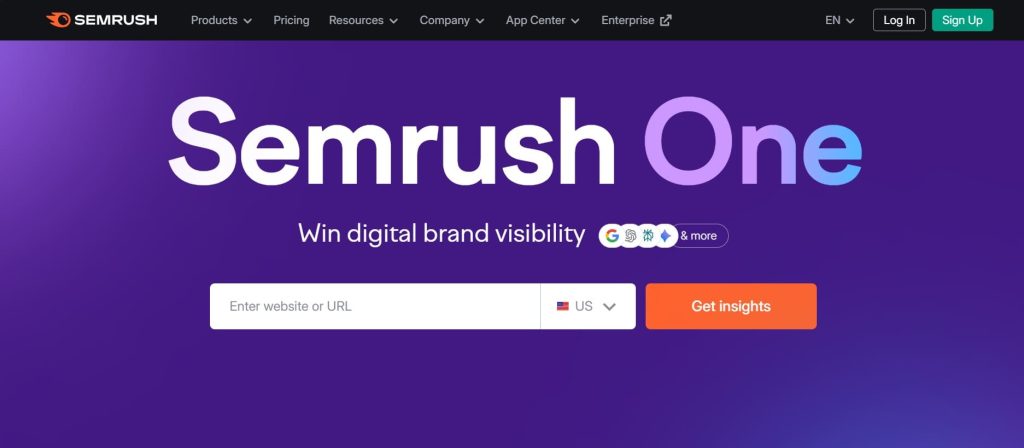
Semrush started as a keyword research tool back in 2008, and over the years it has grown into one of the most comprehensive digital marketing platforms on the market.
Today, it covers SEO, PPC, content marketing, social media, competitor analysis, and now AI visibility tracking, all from a single dashboard. It’s the kind of tool that removes the need for 5 separate subscriptions.
What makes Semrush stand out is its breadth. At OLW, we use it across multiple client campaigns because it gives us everything in one place: keyword data, backlink insights, site health, and competitive intelligence.
The learning curve is real for beginners, but once you’re inside the platform, the depth of data is hard to match.
Who It’s Built For
Semrush is a strong fit for:
- Digital marketing agencies managing multiple clients who need a full-stack tool.
- In-house SEO teams that also run paid search or content campaigns.
- E-commerce brands tracking large keyword sets and competitor activity.
- Enterprises that need advanced reporting, white-label options, and API access.
Core Strengths at a Glance
- Keyword Magic Tool with over 27.9 billion keywords across 142 geographic databases.
- Comprehensive site audit with technical SEO recommendations.
- PPC and competitor ad research, something Ahrefs does not offer.
- Backlink gap analysis to find link opportunities your competitors already have.
- Position tracking with daily updates and SERP feature monitoring.
- Content marketing tools including topic research and the SEO Writing Assistant.
- AI visibility tracking to monitor how your brand appears in ChatGPT, Perplexity, and Google AI Overviews (via Semrush One).
What is Ahrefs?
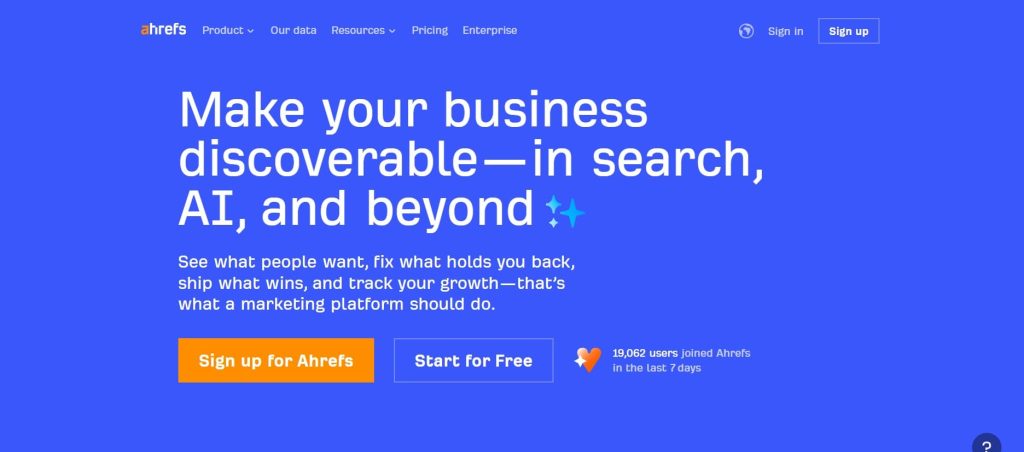
Ahrefs was founded in 2010 in Singapore and built its reputation on one thing: backlink data. Over time it grew into a full SEO platform, adding keyword research, site auditing, rank tracking, and content analysis.
But even today, with all those features in place, backlink analysis remains the core of what Ahrefs does best. Its crawler is the second most active on the web after Google, which is a big reason why its backlink database is considered one of the most reliable in the industry.
What separates Ahrefs from Semrush is the focus. Where Semrush tries to cover everything including PPC, social, and content marketing, Ahrefs stays closer to pure SEO.
The interface is clean, the data is deep, and for anyone whose primary focus is organic search and link building, it’s hard to argue against it.
At OLW, we reach for Ahrefs whenever we need to dig into a competitor’s backlink profile or find quality link opportunities for a campaign.
Who It’s Built For
Ahrefs is a strong fit for:
- Link builders and SEO specialists who need deep, accurate backlink data every day.
- Content marketers looking for proven content ideas through Content Explorer.
- In-house SEO teams focused purely on organic search without the need for PPC tools.
- Agencies managing multiple client sites that need reliable competitor and keyword research.
Core Strengths at a Glance
- Site Explorer with one of the most comprehensive 35+ trillion live backlinks available, covering 28.7 billion keywords across 217 locations.
- Keywords Explorer pulling data from Google, YouTube, Amazon, Bing, and more.
- Content Explorer to discover top-performing content in any niche, great for link prospecting and content ideation.
- Site Audit with a clear health score and actionable technical SEO recommendations.
- Rank Tracker with keyword-level and page-level position monitoring.
- Domain Rating and URL Rating metrics that are widely trusted across the SEO industry.
- Brand Radar for tracking how your brand appears across AI platforms like ChatGPT, Perplexity, and Google AI Overviews.
Semrush vs. Ahrefs: Head-to-Head Comparison
Features lists only tell you so much. What matters is how each tool actually performs when you’re in the middle of a campaign. Here’s what we’ve found across 8 key categories:
1. Keyword Research
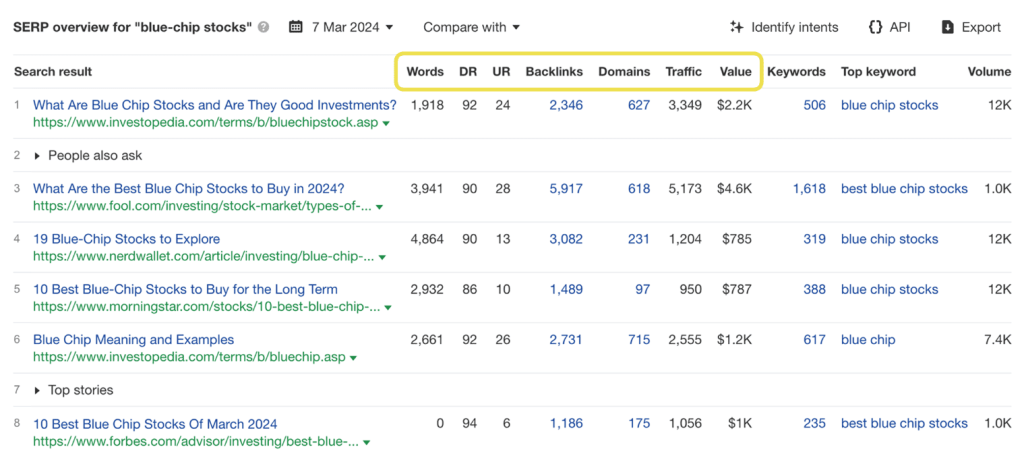
Both tools have large keyword databases, but they approach keyword research differently and serve slightly different needs.
Semrush covers 27.9 billion keywords across 142 geo databases, with 3.7 billion in the US alone. Ahrefs runs 28.7 billion keywords across 217+ locations, though its US-specific database sits at around 2.5 billion.
Ahrefs wins on global breadth. Semrush offers more depth for US-focused campaigns. The real difference shows up in how each tool presents the data.
Semrush Keyword Magic Tool
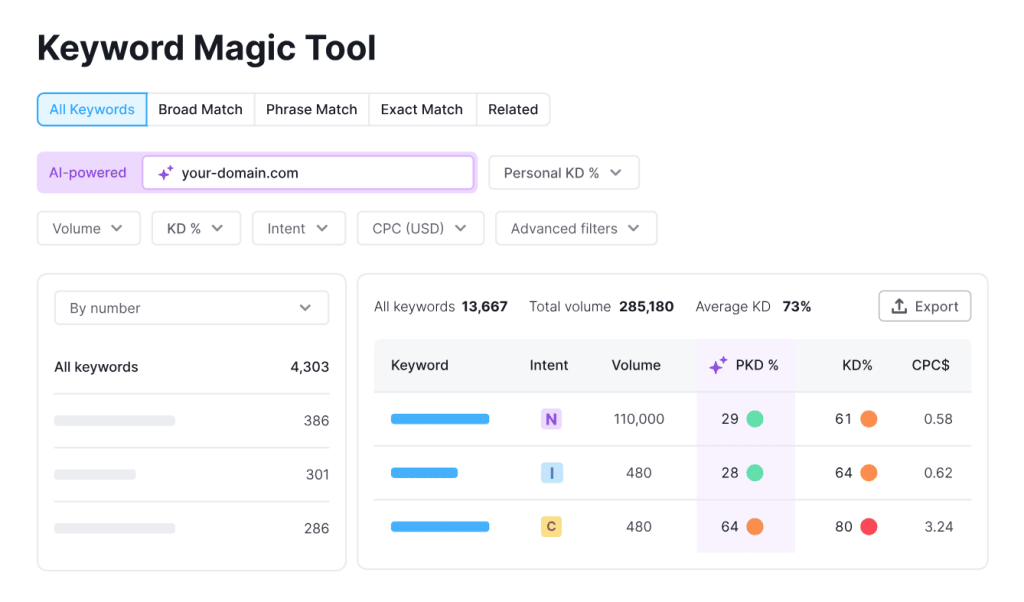
This tool returns thousands of keyword variations organized by topic clusters, making it much easier to build out a content strategy.
What makes it stand out is the additional layers of data it surfaces: search intent classification, SERP feature data, competitive density, trend history, and a Personal Keyword Difficulty score that adjusts based on your domain’s authority.
It’s not just showing you a list of keywords. It’s helping you decide which ones you can actually win right now, and which ones to save for later.
Ahrefs Keywords Explorer
This tool takes a cleaner, more focused approach. The standout feature is its clicks data. Rather than just showing search volume, it shows how many users actually click through to a result.
This matters because a keyword with 5,000 searches a month can have a fraction of that in real clicks if AI Overviews or featured snippets absorb most of the traffic.
Ahrefs also shows a “Traffic Potential” metric, which estimates the total traffic a page could get if it ranks for the main keyword and all related variations.
In my experience, Semrush gives you more to work with when building content plans at scale. Ahrefs is better when you need surgical accuracy on whether a specific keyword is actually worth pursuing.
Winner: Semrush for content planning and volume. Ahrefs for click-based intent and traffic potential accuracy.
2. Site Audit
Both tools do a solid job identifying technical SEO issues, but they handle the data differently. Let’s have a look.
Semrush Site Audit
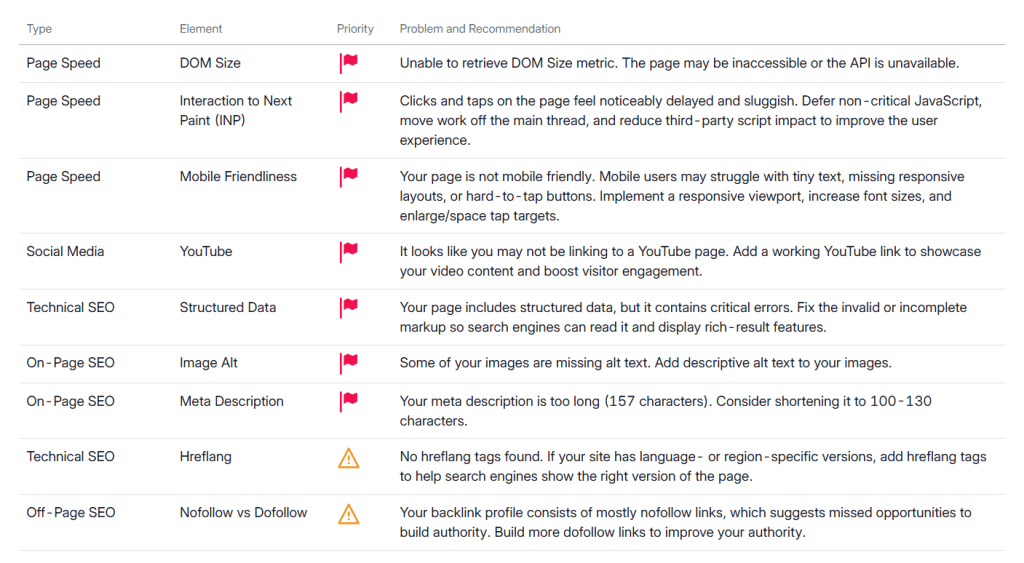
This one checks for more than 140 issues and organizes them into thematic reports covering crawlability, HTTPS, Core Web Vitals, and internal linking. It doesn’t just flag problems. It tells you what to fix and why it matters.
There’s also an AI Search Health score built into the audit now, which checks whether AI bots can properly crawl and interpret your pages. For sites with heavy technical debt, this categorized structure is easier to work through systematically.
Ahrefs Site Audit
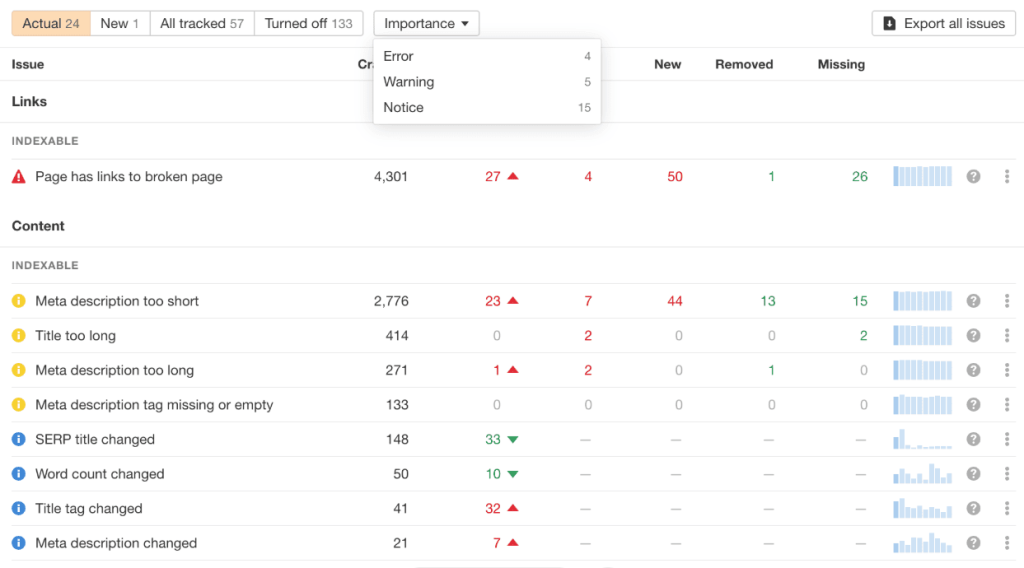
Ahrefs is cleaner and more visually intuitive. The health score is front and center, issues are clearly prioritized, and the layout is easier to walk a client through without overwhelming them.
One genuine advantage: Ahrefs has an always-on crawl that checks sites continuously. That kind of real-time monitoring helps catch issues as they happen, not just during scheduled crawls.
At OLW, we use Semrush for detailed in-house audits where we’re working through everything methodically. For client-facing reports or quick health checks, Ahrefs’ cleaner layout is easier to present without a long explanation.
Winner: Semrush for depth and actionable recommendations. Ahrefs for client-friendly reporting and real-time monitoring.
3. Rank Tracking
Both tools track rankings reliably, but the depth of what they offer is noticeably different.
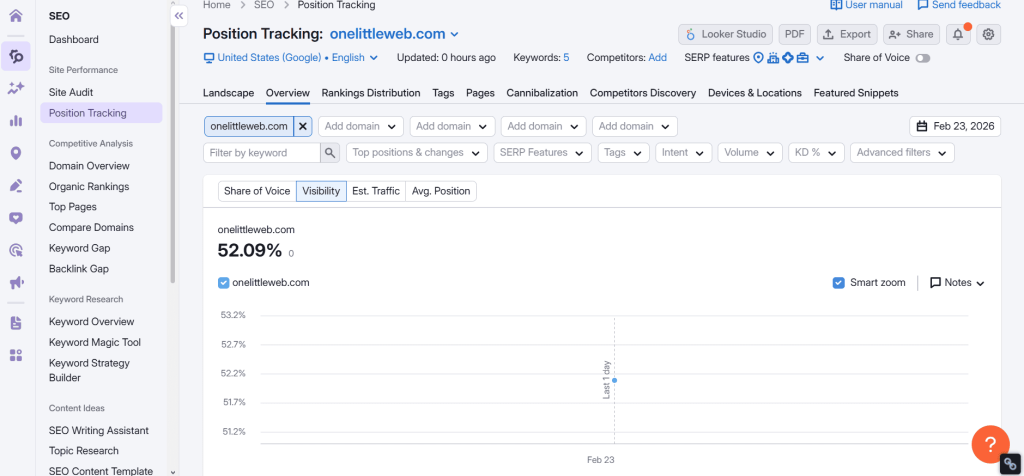
Semrush Position Tracking
Semrush gives you daily ranking updates across keywords, devices, and locations. It tracks SERP features including featured snippets, local packs, and AI Overviews, and lets you monitor competitor rankings in the same dashboard.
Automated alerts and scheduled PDF reports for clients are included in the base plan at no extra cost. For agencies managing multiple clients across different locations, this level of built-in reporting is hard to replicate elsewhere.
Ahrefs Rank Tracker
Ahrefs’ Rank Tracker is accurate and clean, but simpler. You get keyword and page-level position monitoring, historical data, and competitor comparisons.
The notable gap is cost: daily ranking updates require a paid Project Boost add-on, something Semrush includes as standard. If daily alerts are part of your workflow, that extra cost adds up quickly across multiple client projects.
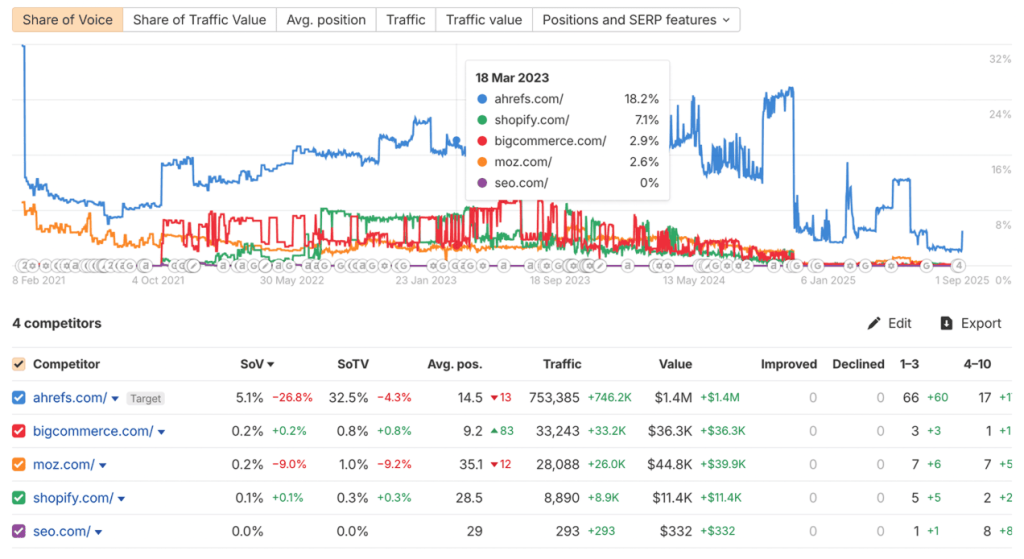
Winner: Semrush for reporting flexibility, automated alerts, and SERP feature tracking.
4. Competitor Analysis
Both tools give you a solid view of what competitors are doing, but from different angles.
Semrush Competitor Analysis
Semrush covers more ground than almost any other tool in this category. Traffic analytics, keyword gap analysis, backlink gap reports, and advertising research all sit inside the same platform, giving you a complete view of how competitors operate across both organic and paid channels.
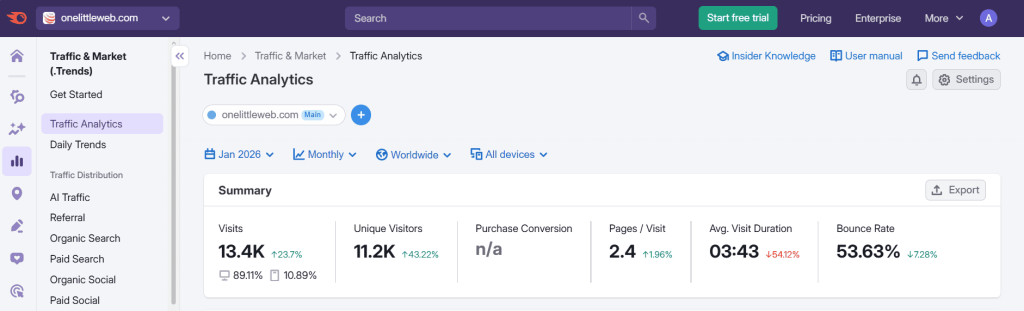
The Traffic Analytics tool estimates competitor traffic reliably for established sites, and Market Explorer gives you a high-level view of market share, audience behavior, and growth trends across your niche.
The Keyword Gap tool is particularly useful for finding terms your competitors rank for that you don’t, which is one of the fastest ways to identify content opportunities with proven demand.
Ahrefs Competitor Analysis
Ahrefs approaches competitor analysis through Site Explorer. You can pull a competitor’s top pages by traffic, their ranking keywords, their backlink sources, and their content gaps quickly and cleanly.
The data is reliable and moving between competitors is fast. Where it falls short is paid search. Ahrefs offers ad intelligence for researching competitor creatives, but there is no workflow to build or export campaigns from there.
For purely organic competitor research, both tools hold up well. For a complete picture that includes paid search, Semrush is the stronger option.
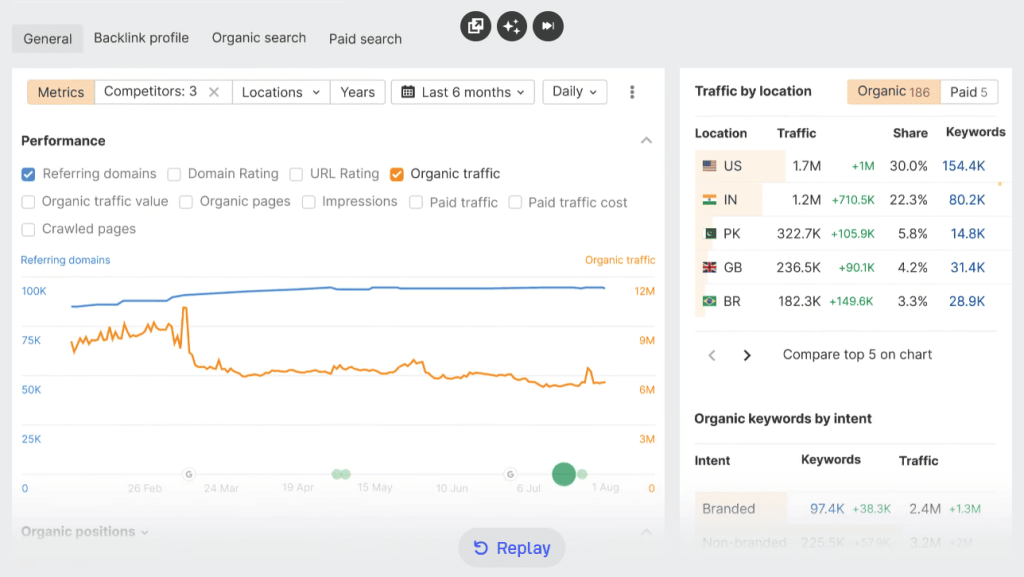
Winner: Semrush for a full competitive picture. Ahrefs for deep organic-only competitor research.
5. Content Tools
This is one of the clearest points of differentiation between the two platforms.
Semrush Content Marketing Toolkit
Semrush’s Content Toolkit covers every stage of the content process in one place. Topic Finder handles ideation, the SEO Brief Generator creates competitor-based briefs, and the AI Article Generator produces full drafts ready for optimization.
You can then optimize for both SEO and AI search, repurpose into social and email formats, and publish across channels without leaving the platform.
At OLW, we’ve used it to speed up brief production on large-scale campaigns. The time saved between research and a ready-to-use brief is noticeable when you’re producing content across multiple client accounts.
Ahrefs Content Explorer
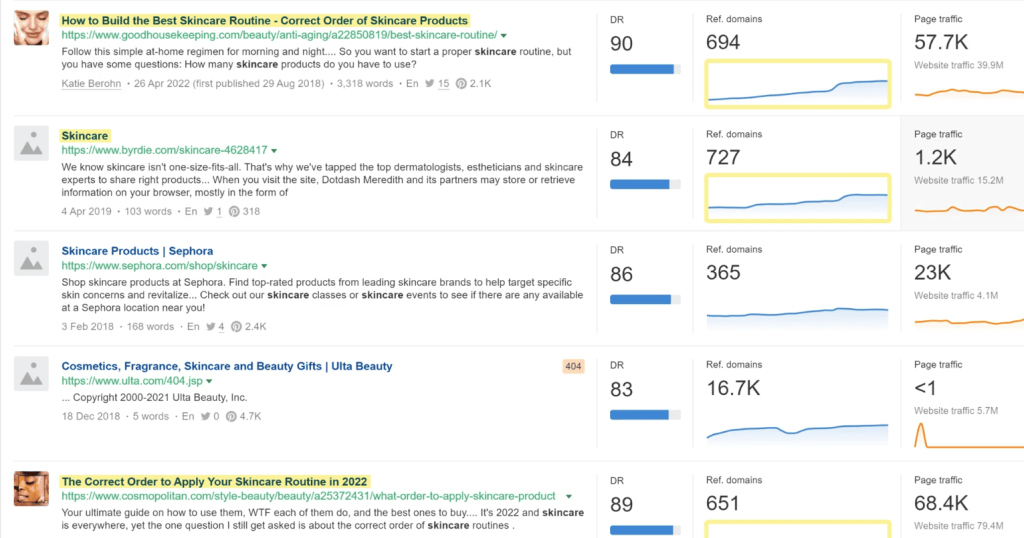
This one is a different kind of tool. Think of it as a search engine for content. You can find the top-performing articles on any topic, sorted by traffic, backlinks, and social shares.
It’s excellent for content ideation, link prospecting, and finding broken link opportunities. But it is not a writing assistant or brief builder. It is a research and discovery tool.
If you need a full end-to-end content workflow inside a single platform, Semrush is the better fit. If you primarily need to discover what content is performing in your space and use that for link building or topic research, Ahrefs’ Content Explorer does that job well.
Winner: Semrush for content workflow. Ahrefs for content discovery and research.
6. Backlink Analysis and Link Building
Both tools offer backlink analysis, but this is the category where the difference in quality is most obvious. It’s also where your workflow should guide your decision more than any other factor.
Semrush’s Backlink Analytics and Link Building Tool
Semrush has 390 million referring domains and 43 trillion backlinks in its index. It gives you a thorough breakdown of any domain’s link profile, surfaces toxic links for disavowal, and integrates with Google Search Console for a cleaner cleanup workflow.
Where Semrush pulls ahead on the workflow side is its Link Building Tool, which takes a CRM-style approach.
You can find link prospects, manage outreach, track the status of each request, and monitor new and lost backlinks all without leaving the platform.
The Backlink Gap tool bridges both sides of this section well: it identifies domains linking to multiple competitors but not to you, making it one of the fastest ways to surface quality prospects before outreach even begins.
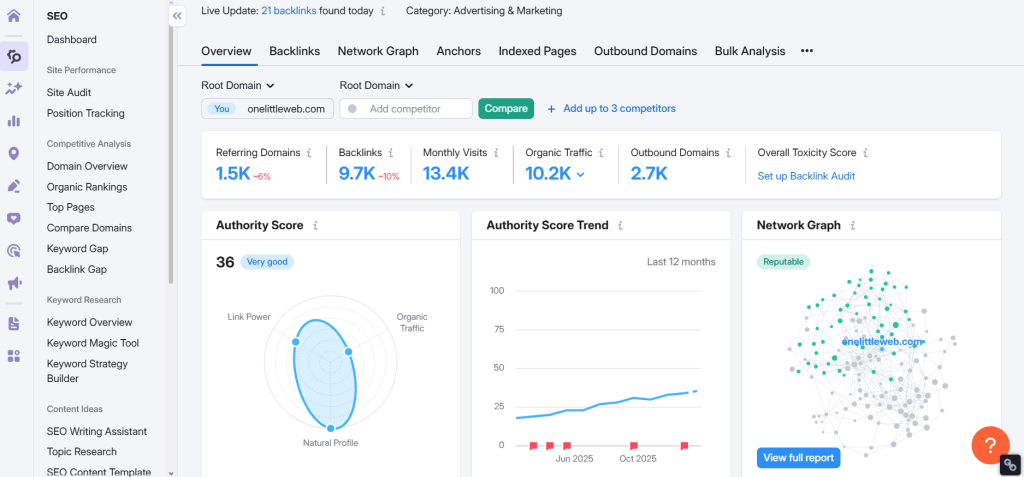
At OLW, it’s one of the first reports we run when scoping a new campaign. Semrush uses Authority Score as its link quality metric. It’s a reliable proxy for domain strength, though less widely referenced in the industry than Ahrefs’ equivalent.
Ahrefs’ Site Explorer and Link Prospecting
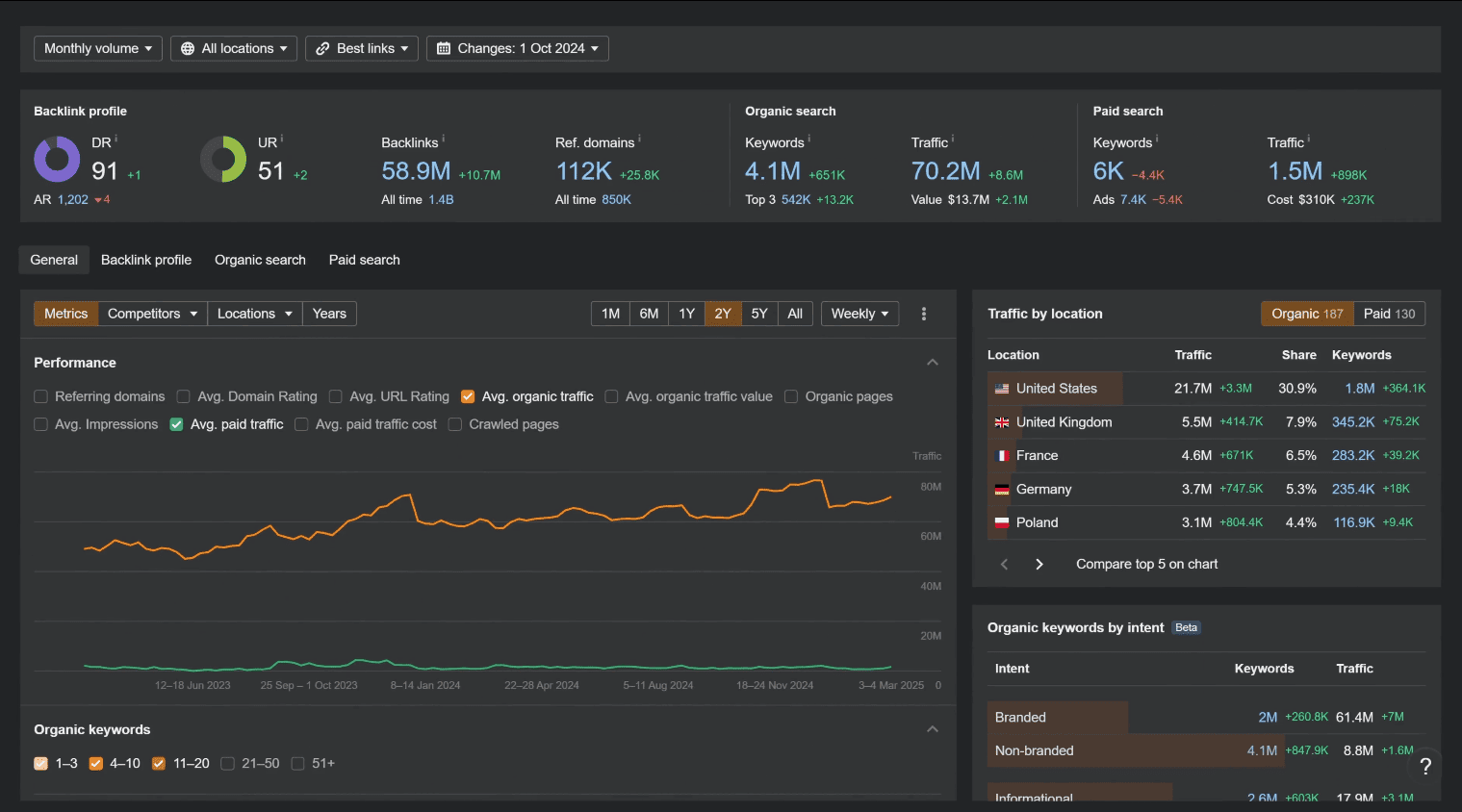
Ahrefs has 500 million referring domains and 35 trillion backlinks in its index. For link building, unique referring domains matter more than raw backlink count, and that’s where Ahrefs holds the edge.
Its crawler is also the second most active on the web after Google, meaning it discovers new backlinks faster than almost any other tool. When you’re running an active campaign and need to know the moment a new link goes live, that freshness matters.
Site Explorer remains the gold standard for competitive backlink research. You can pull any competitor’s backlink profile, filter by link quality, sort by DR, and export a clean list of prospects in minutes.
Ahrefs uses Domain Rating as its link quality metric, which has become the default benchmark most link builders use when qualifying prospects and evaluating outreach targets.
At OLW, our typical workflow is to use Ahrefs for prospecting and competitive backlink research, then manage outreach separately. We use Semrush when we want to keep everything in one place, particularly on campaigns where the client wants visibility into the outreach process.
Winner: Ahrefs for backlink data quality and link prospecting. Semrush for managed outreach and end-to-end link building workflows.
7. Search Intent Classification
Understanding search intent is now a core part of keyword research, and both tools handle it well but in very different ways.
Semrush
Semrush makes keyword intent incredibly easy to work with. Every keyword in the Keyword Magic Tool is automatically tagged as Informational, Navigational, Commercial, or Transactional, so you can filter your list by funnel stage without any guesswork.
In my experience, this saves hours of manual sorting. You can immediately prioritize the keywords most likely to drive conversions versus those better suited for awareness content.
Ahrefs
Ahrefs takes a slightly different approach to intent. The Parent Topic feature helps you understand what a keyword truly belongs to, which shapes how you structure your content strategy.
The Traffic Potential metric goes beyond search volume by showing you what traffic a page could realistically earn. Combined with click data, you get a clearer picture of how users actually behave after searching.
Winner: Semrush. Automatic intent tagging in the Keyword Magic Tool makes funnel-stage segmentation faster and more practical.
8. Google Algorithm Monitoring
When a core update rolls out on Google, you need to know fast whether your rankings moved and why. Check the comparison here:
Semrush Sensor
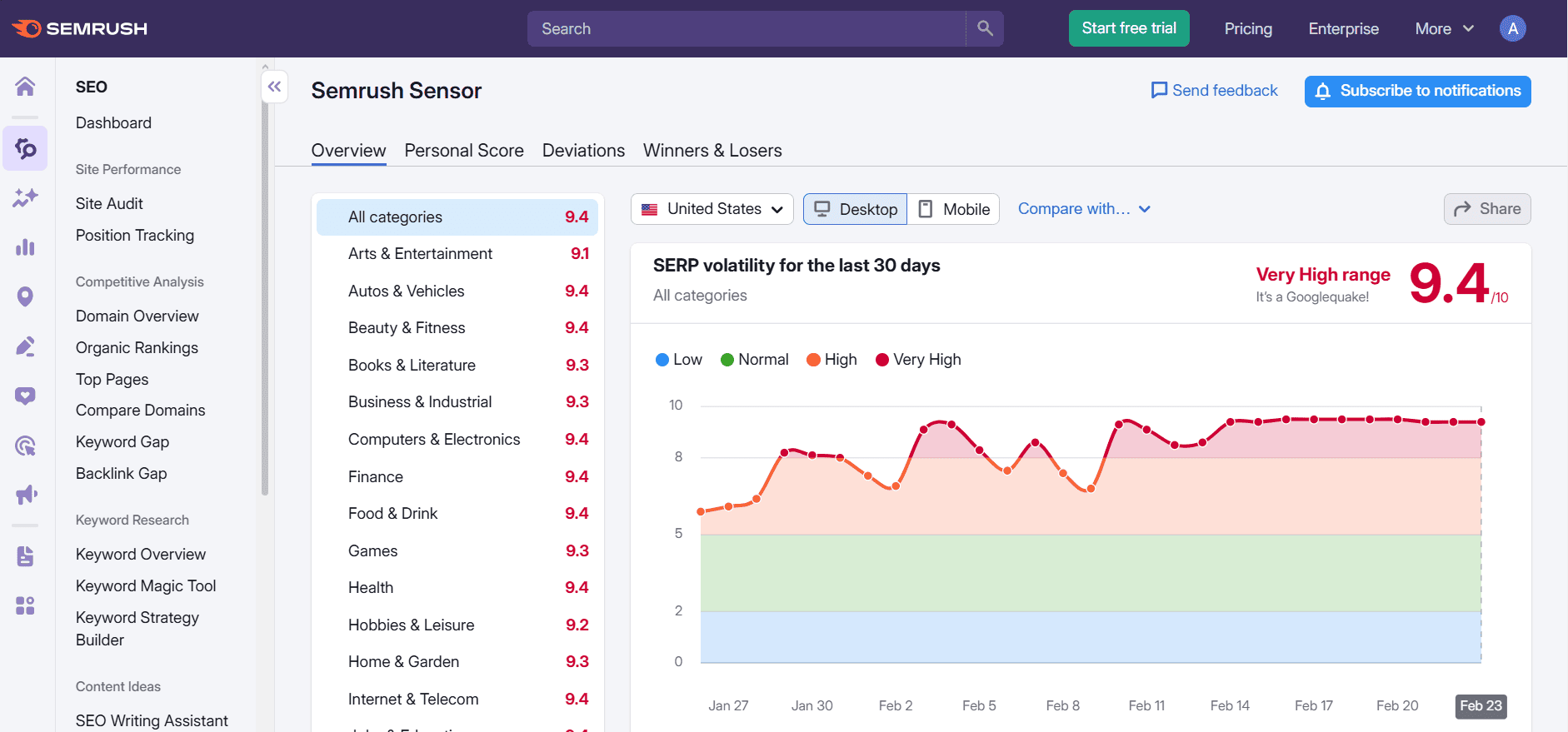
Semrush has a Sensor tool that tracks Google algorithm volatility across industries and device types every day. When rankings shift after an update, you can cross-reference the volatility data with your own rank tracking to spot patterns quickly.
The Position Tracking tool also flags unusual ranking changes, which helps you connect the dots between a Google update and drops in your specific keyword set.
Ahrefs
Ahrefs doesn’t have a dedicated algorithm monitoring tool like Semrush Sensor. That said, it does offer a Google Broad Core Update monitor inside its rank tracker, which flags when a major update is active and overlays it on your ranking history graph.
It’s a useful reference point for connecting ranking shifts to a specific update period, but it works more as a historical marker than a live monitoring tool. You won’t get a real-time volatility score or industry-level tracking the way Semrush Sensor delivers.
Winner: Semrush Sensor gives you real-time volatility tracking across industries that Ahrefs simply doesn’t offer. Ahrefs helps you understand what happened after an update, but Semrush helps you react while it’s happening.
9. Local SEO
If you have clients with physical locations, local SEO features can make or break your tool choice.
Semrush Local
Semrush has a dedicated Local SEO toolkit that covers most of what an agency needs. The Listing Management tool lets you distribute business information across major directories from one place, which saves a lot of manual work.
It also includes a Map Rank Tracker to monitor Google Maps rankings by location, and a review management feature to track and respond to customer reviews. For agencies running local campaigns, this is a solid end-to-end setup built into the platform.
Ahrefs
Ahrefs doesn’t have a dedicated local SEO toolkit. You can still use it for local keyword research and competitor analysis, but features like listing management, map rank tracking, and review monitoring are not part of the platform.
If local SEO is a core part of your service offering, you would need to pair Ahrefs with a separate tool like BrightLocal or Whitespark to cover those gaps.
Winner: Semrush offers a built-in local SEO suite that Ahrefs simply doesn’t have.
10. Reporting and Data Export
For agencies, reporting is not a minor detail. It’s often the main thing clients see.
Semrush
It has a more mature reporting setup. Custom PDF reports can be built from pre-built templates, scheduled for automatic delivery, and white-labeled with your branding.
Integration with Google Analytics and Google Search Console gives you consolidated data in a single report. For agencies managing multiple clients, this setup saves significant time each month.
Ahrefs
It recently added a Report Builder that lets you create custom reports using 15+ SEO metrics and export them as PDFs. It’s a step forward, but it’s a paid add-on and doesn’t match Semrush’s scheduling depth or white-labeling options.
On API access, Ahrefs includes it from the Standard plan. Semrush requires a business plan. If your team needs to pull data into custom dashboards or internal tools, Ahrefs gives you that capability at a lower price point.
Winner: Semrush for agency reporting and white-label needs. Ahrefs for API access at a lower plan tier.
Semrush vs. Ahrefs: Pricing
Pricing is often the deciding factor, especially for smaller teams and solo SEOs. Let’s break down what each tool actually costs and whether the price matches what you get.
Semrush Pricing
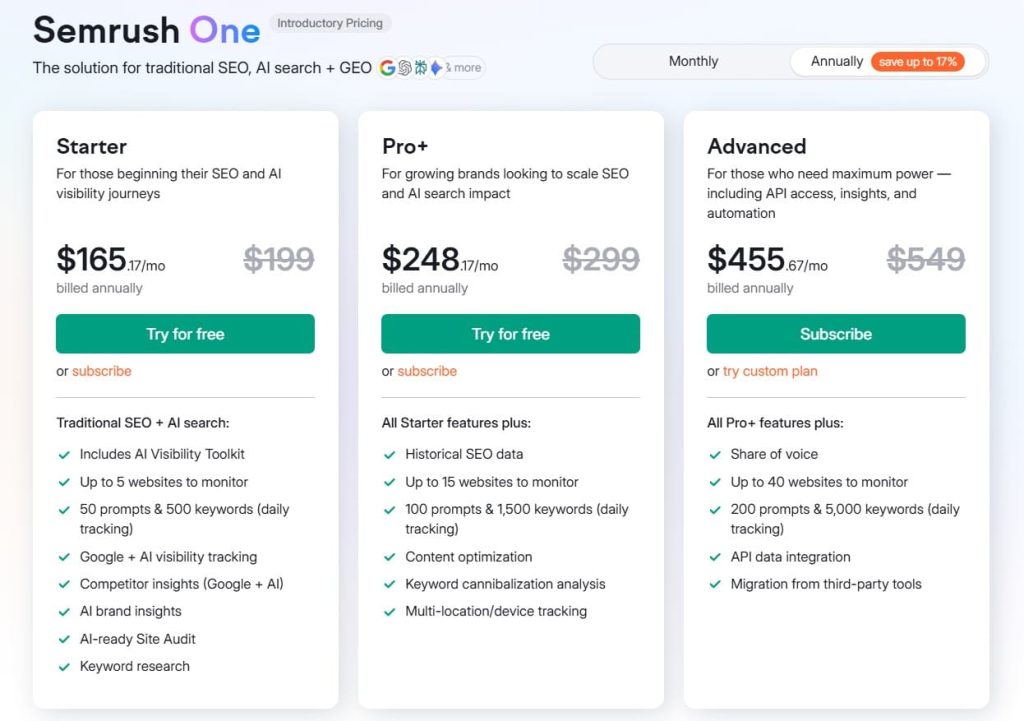
Semrush offers 3 core plans. All prices below are monthly billing rates. Annual billing saves 17% across all plans.
Starter: $165.17/month
The entry-level Semrush One plan. You get keyword research, AI-ready site audit, backlink analysis, and position tracking across both Google and AI platforms like ChatGPT and Perplexity. Limits are tight: 5 websites, 500 tracked keywords, and 50 daily prompts.
There’s no historical data or content optimization at this level, but it’s a solid starting point for solo SEOs who want visibility across both traditional and AI search.
Worth it for: Solo SEOs, freelancers, and small businesses doing basic SEO work across a handful of sites.
Pro+: $248.17/month
The Pro+ plan covers both traditional SEO and AI search visibility in one package. You get 15 websites, 1,500 tracked keywords, and 100 daily prompts across Google and AI platforms.
It also unlocks content optimization, keyword cannibalization analysis, multi-location tracking, historical data, and AI brand insights.
Worth it for: Growing agencies, in-house teams, and anyone who needs content marketing tools and deeper data access alongside core SEO features.
Advanced: $455.67/month
You get everything in Starter and Pro+, plus Share of Voice tracking, 40 websites, 5,000 tracked keywords, 200 daily prompts, API data integration, and migration support from third-party tools.
If you’re running large-scale SEO and AI visibility campaigns across multiple clients and need your data connected to external systems, this is the plan built for that.
Worth it for: Large agencies, enterprise SEO teams, and businesses that need API access and high-volume tracking across both Google and AI search.
Ahrefs Pricing
Every Ahrefs plan includes the same core tools. What you’re really paying for as you move up is more data, more projects, and more users.
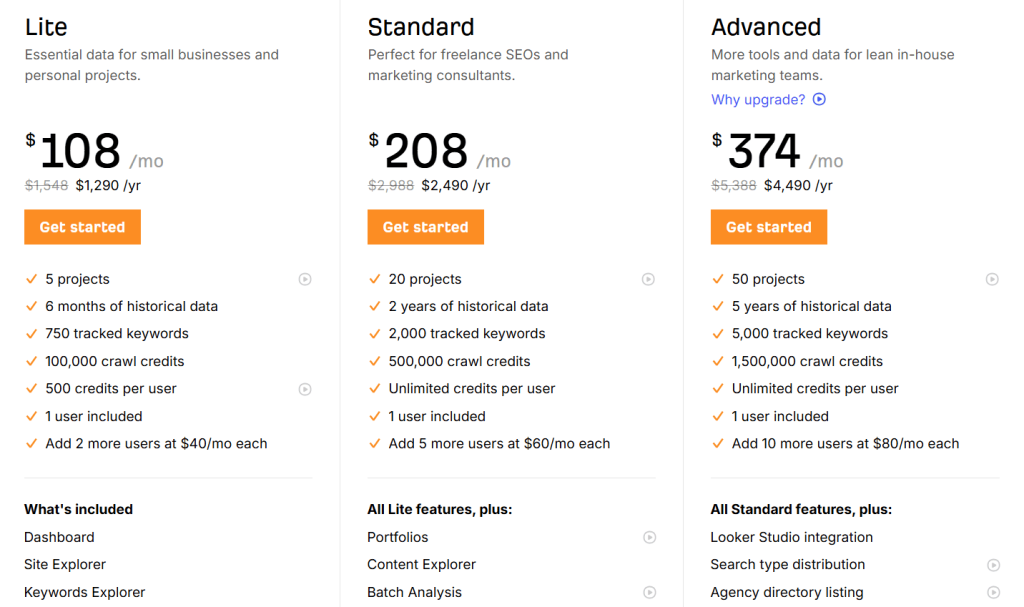
Lite: $108/month
You get 5 projects, 750 tracked keywords, 6 months of historical data, and 100,000 crawl credits. At 500 credits per user, they run out faster than you’d expect on an active campaign.
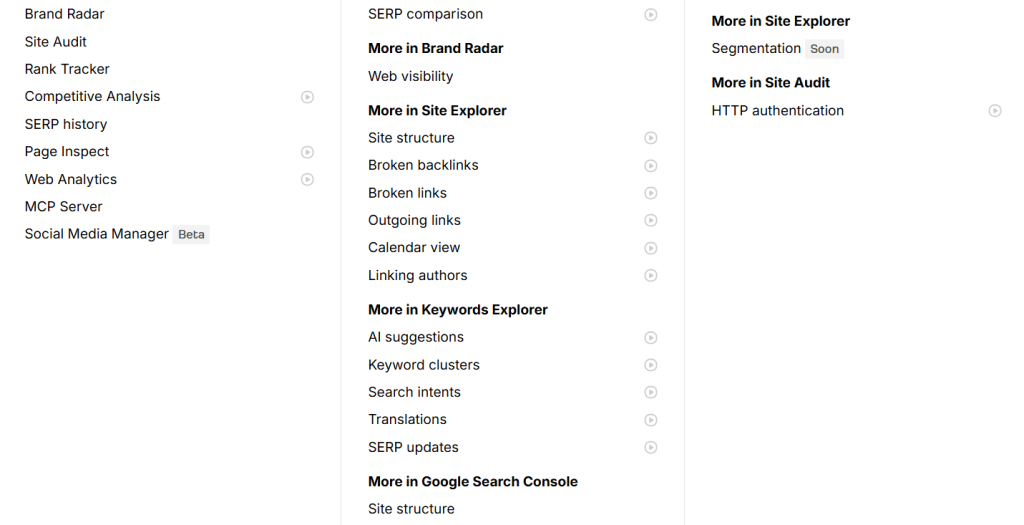
Includes access to Site Explorer, Keywords Explorer, Site Audit, Rank Tracker, Competitive Analysis, Brand Radar, Web Analytics, and more.
Worth it for: Freelancers and solo SEOs doing light, infrequent research rather than heavy daily use.
Standard: $208/month
You get 20 projects, 2,000 tracked keywords, 2 years of historical data, and 500,000 crawl credits with no per-user credit limits.
On top of everything in Lite, you unlock Content Explorer, Portfolios, Batch Analysis, SERP comparison, keyword clustering, AI keyword suggestions, search intent data, broken backlink reports, site structure analysis, and deeper Brand Radar and GSC reporting.
Worth it for: Small to mid-size agencies and in-house SEO teams running consistent backlink research, competitor analysis, and link building as a core part of their workflow.
Advanced: $374/month
You get 50 projects, 5,000 tracked keywords, 5 years of historical data, and 1,500,000 crawl credits with no per-user credit limits.
On top of everything in Standard, you unlock Looker Studio integration, search type distribution, an agency directory listing, HTTP authentication for site audits, and deeper Site Explorer segmentation.
Worth it for: Larger agencies and established in-house teams that need higher project capacity, extended historical data, and client-ready reporting through Looker Studio.
Which Offers Better Value?
At the entry level, Ahrefs Lite at $108/month and Semrush One Starter at $165.17/month are similarly priced, but Semrush gives you more at that tier.
You get SEO tools alongside AI visibility tracking with no credit caps. Ahrefs Lite’s 500 credits per user run out faster than expected on an active campaign.
At the mid tier, both tools land at nearly identical pricing. Semrush wins on breadth with content tools, AI search tracking, and multi-location tracking included.
Ahrefs wins on backlink depth and a cleaner interface for link research. Your choice here comes down to whether you prioritize coverage or pure SEO depth.
At the top tier, Semrush One Advanced includes API access as standard. Ahrefs requires the Enterprise plan at $1,499/month to get it built in. For teams that need data integration, Semrush is the more cost-effective path.
Semrush Pros and Cons
Pros
- All-in-One Platform: Covers SEO, PPC, content marketing, social media, and AI visibility tracking without needing separate tools for each channel.
- Best-in-Class Keyword Research: The Keyword Magic Tool surfaces thousands of keyword variations with search intent, difficulty, and trend data all in one view.
- Superior Reporting for Agencies: Scheduled PDF reports, white-label options, and Looker Studio integration make client reporting faster and more professional.
- AI Search Visibility Tracking: Semrush One tracks how your brand appears across ChatGPT, Perplexity, and Google AI Overviews, a critical feature as AI search grows.
Cons
- Backlink Data Lags Behind Ahrefs: While Semrush’s backlink database is large, Ahrefs consistently surfaces referring domains faster and with greater accuracy for link building.
- Add-On Costs Stack Up: Extra users, the AI Visibility Toolkit, and local SEO tools all cost extra, meaning the real monthly cost often exceeds the base plan price.
Ahrefs Pros and Cons
Pros
- Industry-Leading Backlink Database: With 500.4 million referring domains indexed, Ahrefs surfaces link opportunities faster and more accurately than any competing tool.
- Clean, Focused Interface: The platform is easier to navigate than Semrush, with less clutter and a more intuitive layout for day-to-day SEO research tasks.
- Clicks Data in Keyword Research: Keywords Explorer shows actual click-through estimates, not just search volume, giving a more realistic picture of real traffic potential.
- Always-On Site Crawl: Ahrefs crawls your site continuously rather than waiting for scheduled audits, catching technical issues in real time before they compound.
- Trusted Metrics: Domain Rating is the most widely referenced authority metric in the SEO industry, making it the default benchmark for link prospecting and outreach qualification.
Cons
- Daily Rank Tracking Costs Extra: Unlike Semrush, daily ranking updates require a paid Project Boost add-on, adding unexpected cost to what already feels like a premium subscription.
- No PPC or Content Marketing Tools: Ahrefs focuses purely on SEO, so teams running paid search or content workflows will still need additional tools alongside it.
Who Should Use Semrush?
- Digital marketing agencies managing SEO, PPC, and content for multiple clients will get the most out of Semrush’s all-in-one platform, especially when juggling different channels under one roof.
- In-house marketing teams that need to report across organic, paid, and social in one place will find Semrush saves a lot of time versus switching between tools.
- Businesses that need client reporting will appreciate the white-label reports and scheduled delivery options, which make it easy to keep clients updated without manual effort.
- SEO professionals tracking AI visibility can monitor how their brand appears in AI-generated search results alongside traditional rank tracking, something Ahrefs doesn’t offer yet.
- Enterprises with advanced data needs benefit from API access, Share of Voice tracking, and deep integration options that support large-scale SEO operations.
Who Should Use Ahrefs?
- Link builders and SEO specialists who live inside backlink data daily will find Ahrefs more comfortable, with one of the most comprehensive link indexes available.
- Content marketers using Content Explorer to find proven topics, estimate traffic potential, and identify link prospects will get more out of Ahrefs than any other tool.
- In-house SEO teams focused on organic growth without paid search needs will appreciate that Ahrefs stays focused and doesn’t overwhelm you with features you’ll never use.
- Agencies driven by backlink research and competitor analysis will find Ahrefs fits naturally into that workflow, with fast data and a clean interface built around those tasks.
- SEO professionals who value simplicity will prefer Ahrefs if a clean, fast experience matters more to them than having every possible feature in one platform.
Can You Use Both?
Some teams do, and it makes sense in the right context.
The most common workflow is using Ahrefs for backlink research and link prospecting, then Semrush for keyword research, site audits, and client reporting. The tools complement each other well because they each do something the other doesn’t quite match.
At OLW, this is exactly how we approach it. We reach for Ahrefs when we need to dig into a competitor’s backlink profile, find link prospects, or qualify outreach targets by Domain Rating.
We use Semrush for keyword strategy, technical audits, position tracking, and any campaign where the client wants visibility into reporting. On our AI SaaS campaigns, having both tools gave us a fuller picture than either could provide alone.
Frequently Asked Questions
Which is Better for Backlink Analysis – Semrush or Ahrefs?
Ahrefs is better for backlink analysis with 500+ million referring domains and faster link discovery. Ahrefs’ crawler is the second-most active after Google, meaning new backlinks appear within hours. Semrush has 43 trillion backlinks but updates slower.
Is Semrush or Ahrefs Better for Keyword Research?
Semrush is better for content planning with the Keyword Magic Tool showing 27.9 billion keywords organized by topic clusters and search intent. Ahrefs excels at showing actual click data and traffic potential rather than just search volume.
Which Tool is Cheaper – Semrush or Ahrefs?
Ahrefs Lite starts at $108/month vs Semrush Starter at $165.17/month. However, Semrush includes AI visibility tracking and more features at entry-level. At mid-tier, Ahrefs costs $208/month and Semrush costs $248.17/month. So, Ahrefs is cheaper.
Which Tool Has Better Rank Tracking – Semrush or Ahrefs?
Semrush includes daily rank tracking with automated alerts and SERP feature monitoring at no extra cost. Ahrefs requires a paid Project Boost add-on for daily updates, making Semrush more cost-effective for position tracking.
Is Ahrefs or Semrush Better for Content Marketing?
Semrush offers a complete Content Marketing Toolkit with AI article generation, SEO brief builder, and content optimization. Ahrefs provides Content Explorer for discovering high-performing content but doesn’t include writing or optimization tools.
Which Has More Accurate Keyword Data – Semrush or Ahrefs?
Both tools show similar keyword volumes, but Ahrefs includes clicks data showing actual traffic potential after SERP features. Semrush provides more US-specific keywords (3.8B vs 2.5B) while Ahrefs covers more international markets (217+ locations vs 142).