
A virtual medical receptionist answers patient calls remotely, as live agents, as AI or as a mix of both. Your front desk can stay with the patient in the room. It schedules and changes visits, takes refill requests and sends urgent calls to your on-call clinician.
We ranked 12 services for US practices, out of more than 20 we screened. Each one states on its own pages that a business associate agreement (BAA) is available. It is the contract that HIPAA asks a practice to sign with any vendor touching patient records.
The cheapest service we ranked starts at $44 a month and uses live agents. The priciest published entry plan is $500 and runs on AI.
Prices, ratings and review counts come from vendor sites and review listings read in November 2026. The 12 differ in who picks up the phone and how they hand off urgent calls. They also differ in which records systems they name and how they bill.
Our top picks
Virtual medical receptionist services come in three types, so shortlist one of each. Start with MedReception AI for AI, Specialty Answering Service for live agents and PerfectServe for hybrid. Each suits a different front desk, as the groups below show.
AI receptionists
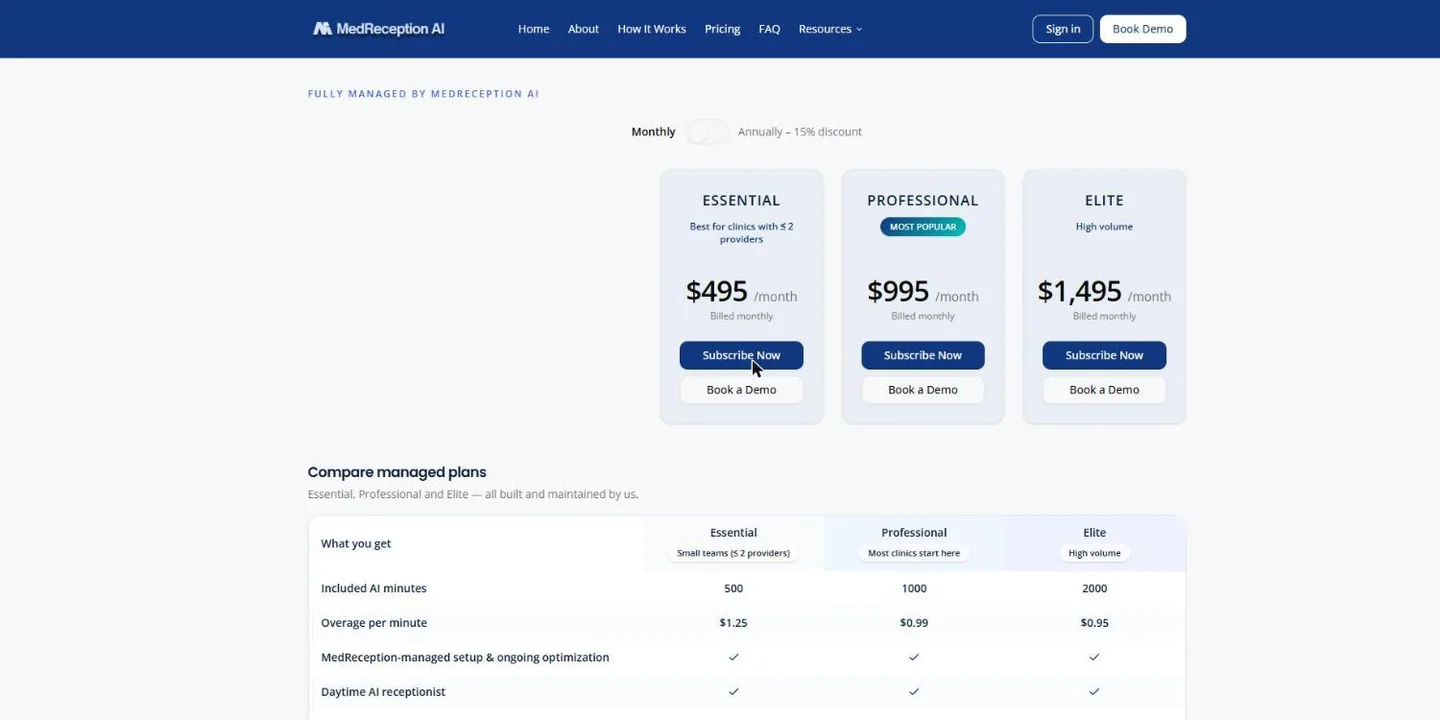
- 1. MedReception AI: best for clinics that want published plans and a long list of named EHR systems. Essential plan: $495 a month for 500 minutes.
- 3. DeepCura: best for practices that want an AI team under one per-provider price. $129 a month per provider, bundle price.
- 5. Hello Patient: best for practices that want voice, text and web chat from one assistant. Usage-based pricing.
Live agents
- 2. Specialty Answering Service: best for practices that want live agents, a low entry plan and a 14-day free trial. Economy plan: $44 a month plus $1.54 a minute.
Hybrid services (live team plus AI)
- 4. PerfectServe: best for practices that route urgent calls by live on-call schedules. FAQ range of $89 to $119 per doctor a month.
- 6. Helpware: best for groups that want a managed multilingual team with insurance checks. Priced by quote.
Numbers show each service’s rank. Prices are entry-plan, in US dollars, checked November 18, 2026. Scores are out of 76, and six more services sit below with their own reviews. How we scored them.
Quick comparison table
| Provider | Best for | Entry price and billing | Type | Key capability (vendor-stated) | Main trade-off | Our rating |
|---|---|---|---|---|---|---|
| 1. MedReception AI | Published plans, long EHR list | Essential $495/month, month-to-month | AI | 17 named EHR and practice systems; live transfer to an on-call line by clinic rule | Essential needs a $99 add-on for after-hours cover | 57.0 / 76 |
| 2. Specialty Answering Service | Live agents, low entry plan | Economy $44/month plus $1.54/min | Live agents | On-call schedules; scheduling and insurance questions | Names only an online calendar for records | 46.0 / 76 |
| 3. DeepCura | AI team under one price | $129/month per provider | AI | Texts an intake link during the call; EHR write-back claimed for eight systems | Receptionist-only price not shown | 46.0 / 76 |
| 4. PerfectServe | On-call routing | FAQ range $89 to $119 per doctor/month | Live agents plus AI | Routes urgent calls by live on-call schedule; names Epic and Oracle Health | Contract terms by quote | 46.0 / 76 |
| 5. Hello Patient | Voice, text and web chat | Usage-based | AI | Seven named EHRs; routes clinical requests to a person | No published price | 43.0 / 76 |
| 6. Helpware | Managed multilingual team | Quote only | Managed team with AI options | 45+ languages; coverage and eligibility checks | No published price | 43.0 / 76 |
| 7. Newo | Monthly plan, no lock-in | AI Receptionist $299/month | AI | BAA signed before patient data is processed | General receptionist; no medical EHR named | 42.0 / 76 |
| 8. Frontdesk | No-contract voice plan | From $99/month | AI | Triage routing; urgent calls to a human supervisor | CRM links only | 42.0 / 76 |
| 9. Ruby | Polished live team | 50 minutes, $250/month | Live agents | Opt-in HIPAA mode with a BAA and secure portal | No overage rate shown | 40.0 / 76 |
| 10. OhMD | Texting plus AI voice | AI & Automation from $500/month | AI | Reschedules inside the connected system; 60+ languages | Calling usage billed separately | 38.0 / 76 |
| 11. Sully.ai | Receptionist, scribe, coder | Demo only | AI | Ten named EHRs; write-back claimed | No price published | 37.0 / 76 |
| 12. DoctorConnect | AI voice on an engagement platform | Not published | AI | 100+ EHR and practice systems cited | No ARIA price | 33.0 / 76 |
Table note: Prices were checked between November 18 and 25, 2026 and exclude taxes. Ratings are out of 76 and do not compare with other guides. Gaps under 1 point are ties, and gaps of 1 to 3 points are small.
What is a virtual medical receptionist?
A virtual medical receptionist answers a practice’s phone from outside the building. Some are live agents, some are AI and some are both. Each one takes the call, captures the reason and sends it where your rules say.
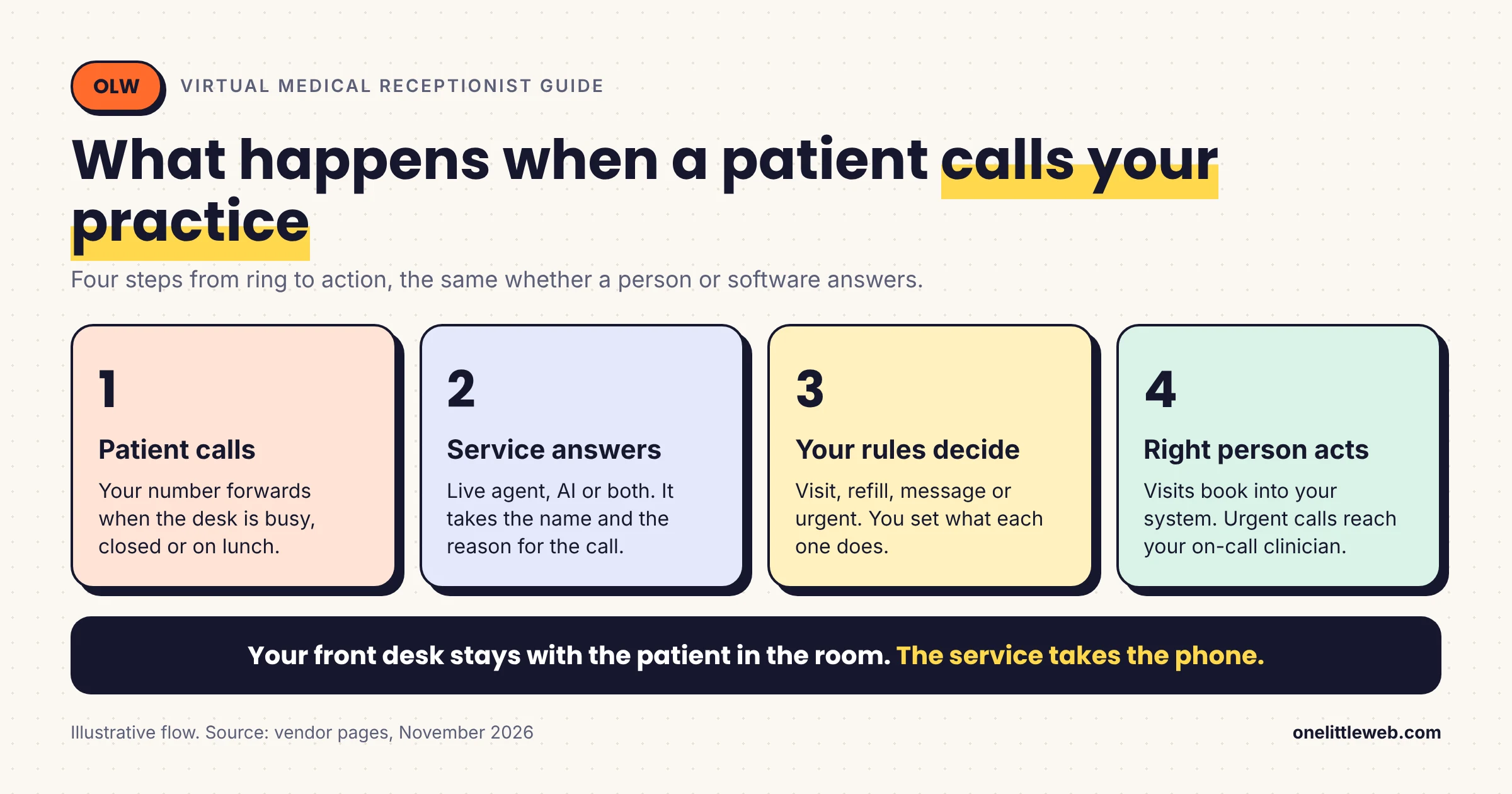
The 12 services fall into three kinds. Live-agent services put a trained person on the line. AI receptionists answer with software. Hybrid services pair a team with AI tools.
A BAA is a business associate agreement. It sets out how a vendor may handle patient information for you. HHS publishes sample BAA language and a business associate FAQ.
A vendor saying it offers a BAA does not prove your plan is covered. This is not legal advice.
Is a virtual medical receptionist worth it?
It depends on your call volume and on what your front desk does all day. One benchmark helps. The BLS reports median receptionist pay of $38,010 a year in May 2025, about $18.27 an hour.
A hire is paid for every hour, quiet or busy. Most services here bill by plan, minute or provider, so your cost follows your calls.
A remote service tends to fit when:
- Calls arrive in bursts that your front desk cannot answer in time.
- Many calls are routine, such as hours, scheduling and refill requests.
- You can name a person who takes over urgent calls.
It fits less well when most calls are complex clinical questions. It also fits less well when nobody can review call summaries.
How we picked
We looked at remote services that answer patient calls for US practices. That included live agents, AI and hybrid services. The first gate was data handling. Each provider had to publish how it handles patient data and state that a BAA is available.
Why data handling came first. A patient call carries protected health information, such as a name, a symptom or a refill. HIPAA expects a practice to hold a BAA with any vendor that handles it.
So we checked this before price, features or reviews. Urgent-call escalation was scored, not required. Services without a BAA statement sit under Other options with no rating.
How many made the list. We screened more than 20 candidates and ranked 12. Developer platforms such as Retell AI and Synthflow are listed as alternatives and not ranked. India and Pakistan based providers were left out by an editor rule, and US availability was not a gate.
A published BAA statement is a vendor claim. We did not see a signed agreement, and we did not run a compliance check. Read it as a minimum bar, then ask for the agreement in writing.
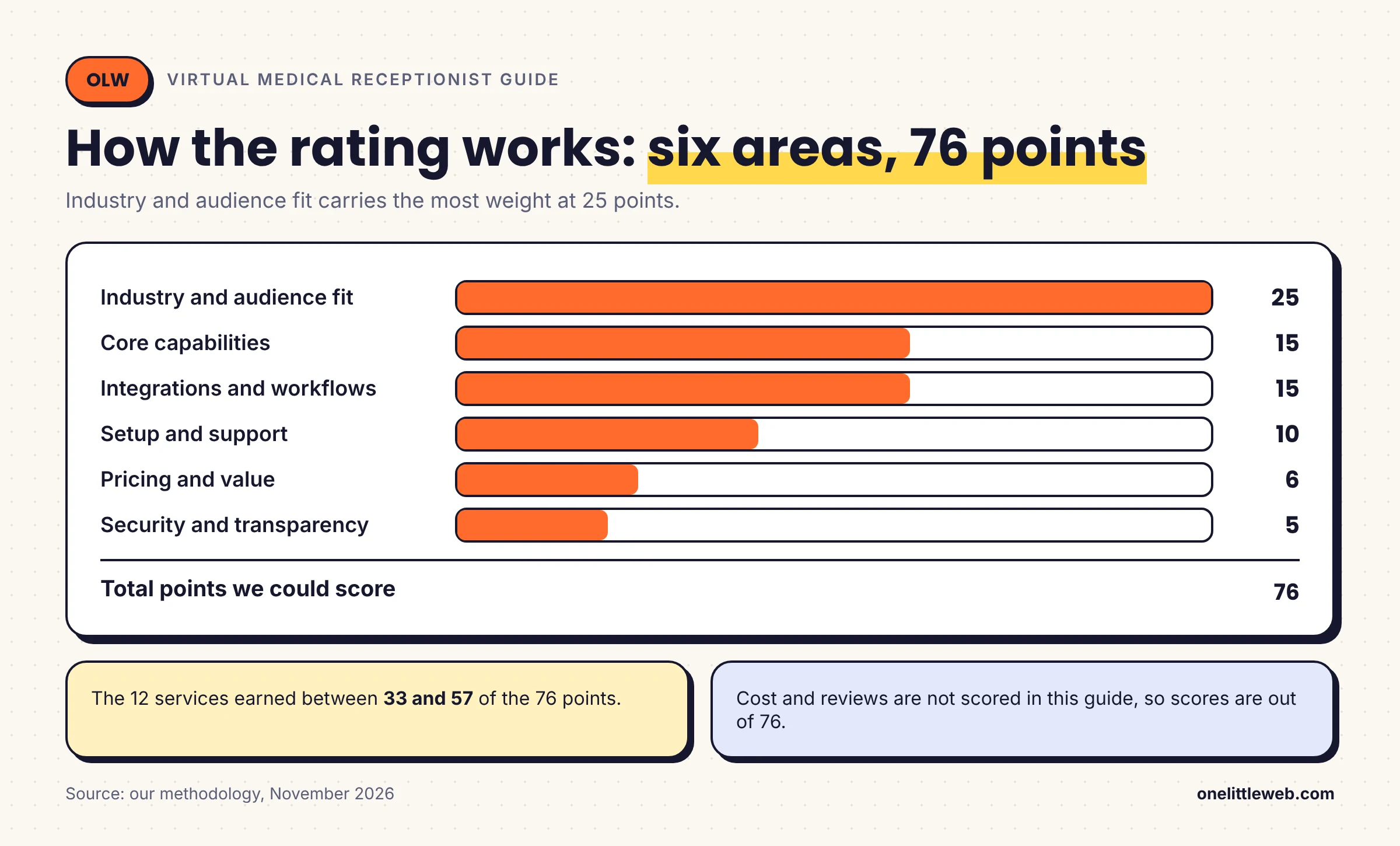
The rating has six evidence areas, and the 12 services earned between 33 and 57 of the 76 points. Between 80% and 99% of each provider’s evidence is verified. The full methodology explains how.
The 12 best virtual medical receptionist services for US practices
The reviews run from the highest score to the lowest. Providers with the same score count as tied. Each review shows what stands out, what to check and who it suits.
1. MedReception AI: best for clinics that want published plans and a long list of named EHR systems
Our verdict: MedReception AI leads this guide at 57.0 / 76. It publishes plans, prices and a long list of EHR and practice systems. Its AI agents carry names such as Katie and Annie.
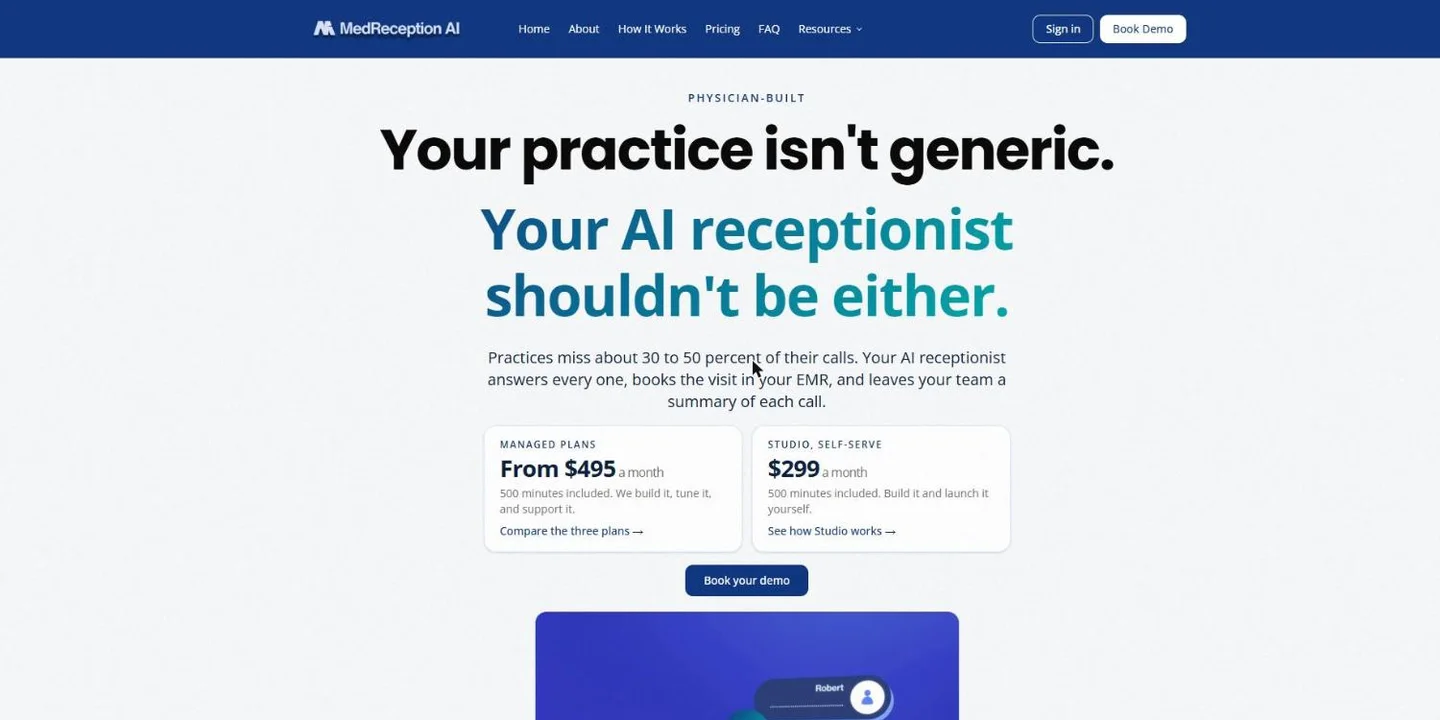
| Plan we priced | Essential $495 a month (500 minutes); Professional $995 (1,000); Elite $1,495 |
| Type | AI receptionist with named agents; separate Studio self-build plan |
| BAA | Vendor states “BAA included” |
| Billing note | Month-to-month; no setup fee; overage $1.25, $0.99 or $0.95 a minute by plan |
| Reviews | G2 0 and Capterra 0 (no reviews yet) |
| Our rating | 57.0 / 76 |
Table note: Prices were checked on November 18, 2026. The product is MedReception AI’s receptionist plans, shown on its site as Essential, Professional and Elite.
What stands out:
- Long EHR list. The vendor names 17 EHR and practice systems, including athenahealth, eClinicalWorks, Elation, ModMed and Tebra. It does not say whether each link reads, writes or both.
- Clinic-defined urgency. Clinicians set the rules, and the AI transfers live to a nurse or on-call line when one matches.
- Call records. Each call produces a transcript and a structured summary in a dashboard.
- After-hours agent. Its Annie agent handles after-hours, weekend and holiday calls.
Pricing. Essential costs $495 a month for 500 minutes. Professional is $995 for 1,000 minutes, and Elite is $1,495. The Studio self-serve plan is $299 for 500 minutes.
After-hours cover and smart voicemail are $99 a month add-ons on Essential, and come with Professional and Elite. Intake, referrals and chart preparation can be added at $99 a month each.
What customers say. G2 and Capterra both list MedReception AI with no reviews yet. Ask the vendor for two clinic references, and ask which plan each reference uses.
Watch out for:
- Recording and consent. Its recording and consent pages are topic links only. Ask for the written terms before you start.
- Plan limits. Essential has no after-hours cover without the $99 add-on. The Elite allowance is 2,000 minutes on the vendor’s site and 1,500 on Capterra, so confirm it.
- BAA scope. The vendor says it signs BAAs for every deployment that touches patient data. It does not name the self-build tier.
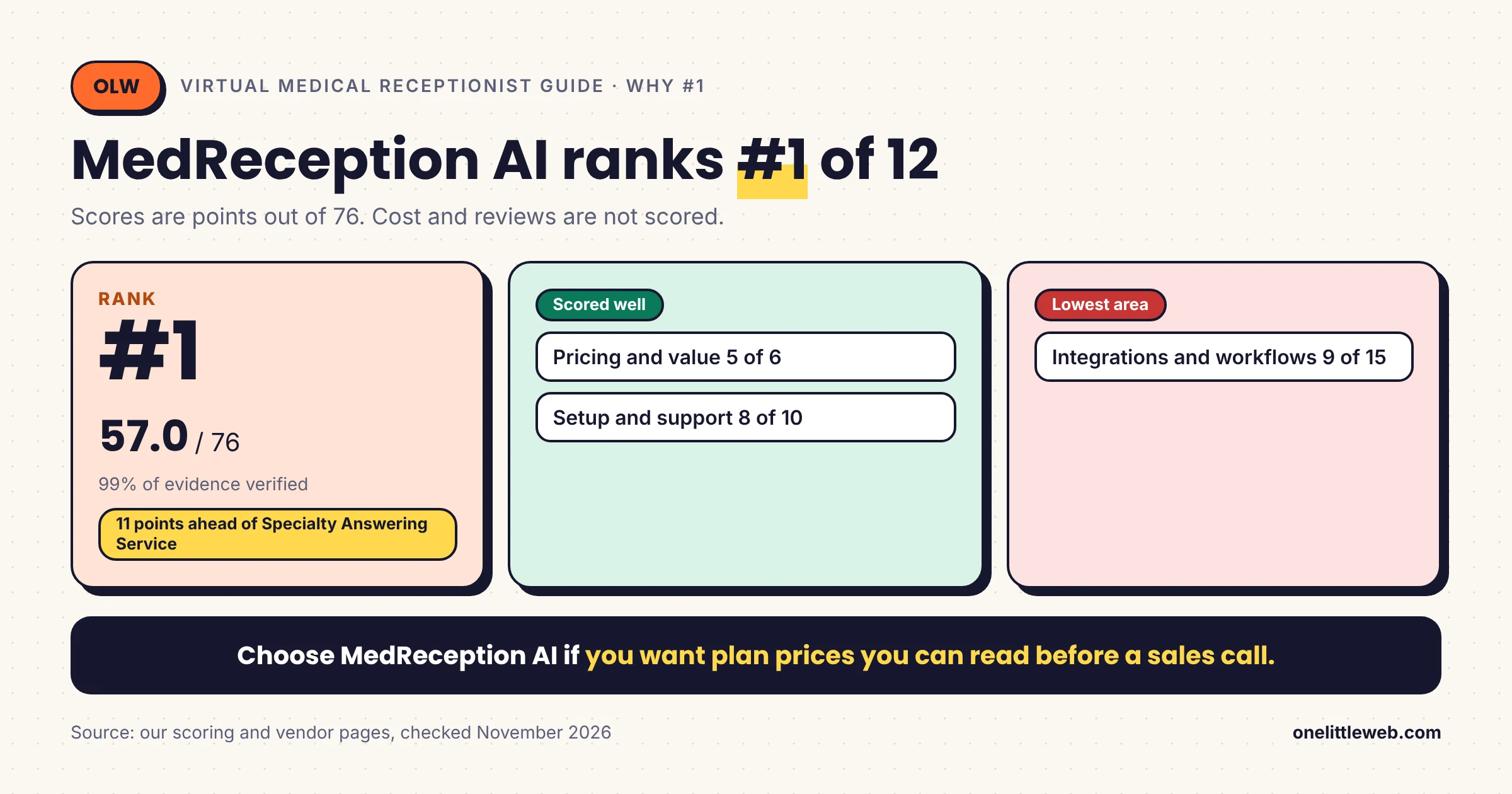
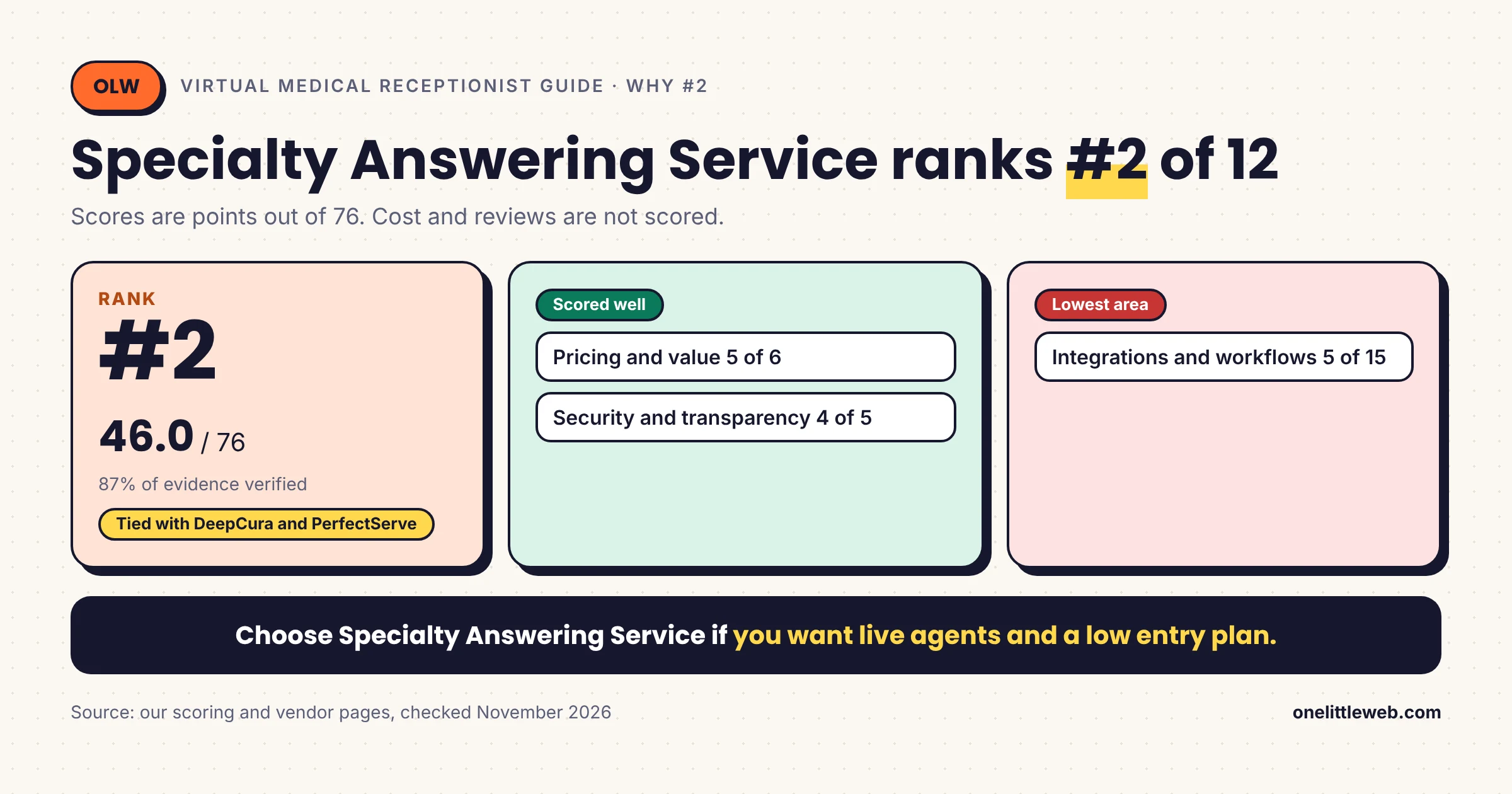
Why MedReception AI ranks #1. MedReception AI scores 57.0 / 76, with 99% of the evidence verified. Pricing and value (5 of 6 points) and setup and support (8 of 10 points) are its strongest areas. Integrations and workflows (9 of 15 points) is its lowest.
It is 11 points ahead of Specialty Answering Service, a clear gap.
Choose MedReception AI if you want plan prices you can read before a sales call. It also suits you if your EHR is on the vendor’s named list.
Skip MedReception AI if you need after-hours cover in the base price.
Skip it too if you need written recording and consent terms before you start.
2. Specialty Answering Service: best for practices that want live agents, a low entry plan and a 14-day free trial
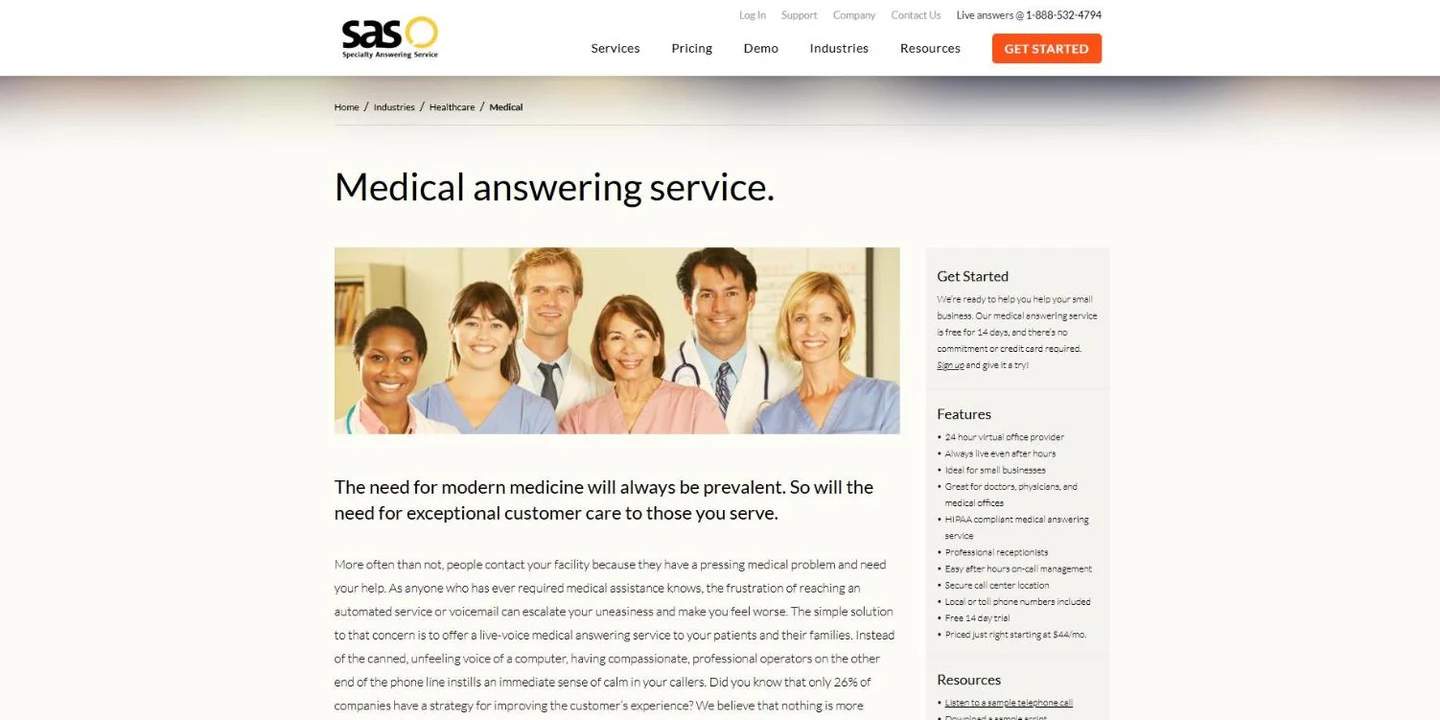
Our verdict: Specialty Answering Service (SAS) scores 46.0 / 76 and is the lowest-priced live-agent plan here. It suits small practices that want people on the line, and it links only to an online calendar.
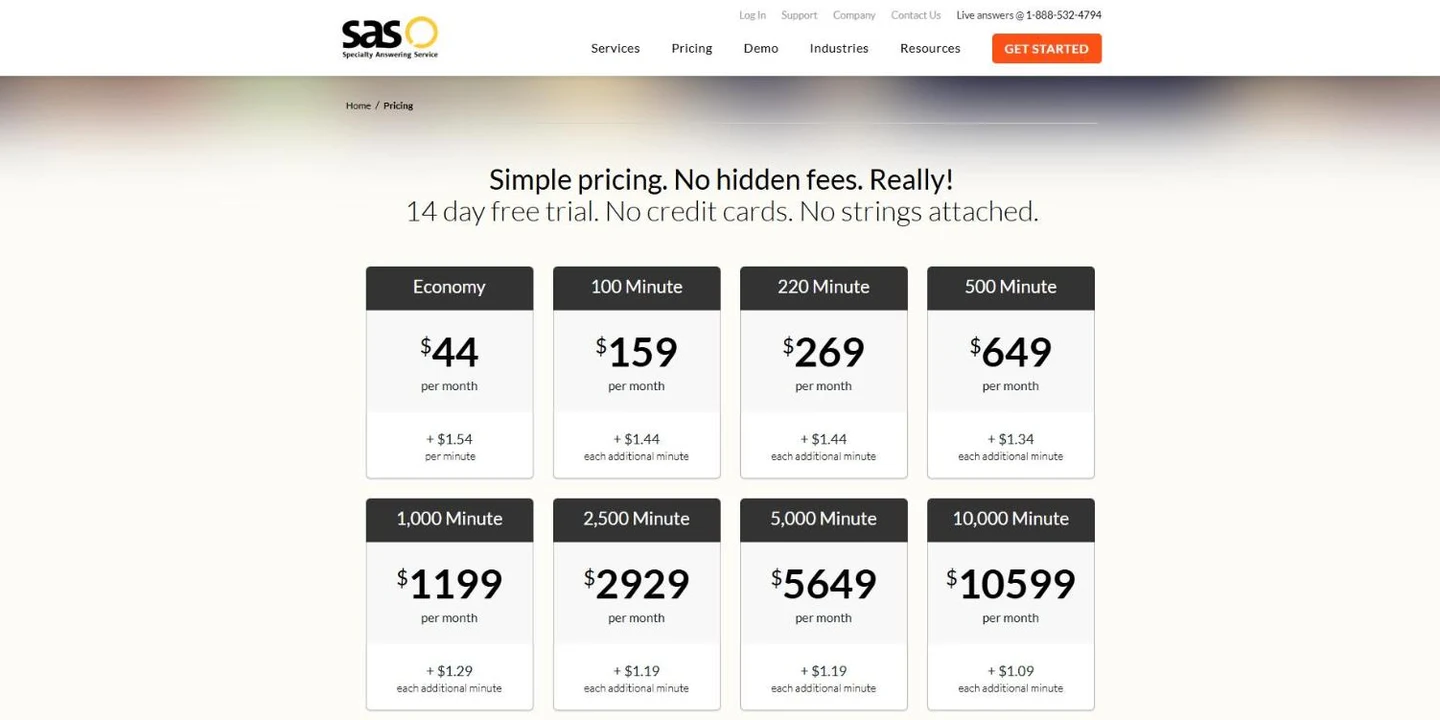
| Plan we priced | Economy, $44 a month plus $1.54 a minute |
| Type | Live answering service with a medical page |
| Other plans | 100 minutes at $159 a month up to 10,000 minutes at $10,599 |
| Billing note | Billed by the second; month-to-month; no setup or cancellation fees; 14-day free trial, no card |
| BAA | The vendor says it can sign a BAA |
| Records systems | An online calendar application only |
| Reviews | No usable G2, Capterra or Trustpilot listing located |
| Our rating | 46.0 / 76 |
Table note: Prices were checked on November 23, 2026. The product is SAS’s live answering service, shown on its medical answering page. The Economy plan lists no included minutes.
What stands out:
- Security and transparency. The pricing page lists PCI compliance and SSL encryption, and a separate page offers a BAA.
- On-call tools. The medical page says you can create or update on-call schedules and be reached by phone, email, text or pager.
- Scheduling and intake. Agents schedule, change or cancel appointments and answer insurance or referral questions, per the page.
- Trial. The 14-day trial needs no card, so you can test on real call volume.
Pricing. Economy costs $44 a month plus $1.54 a minute. Larger plans start at $159 for 100 minutes, with extra minutes from $1.44 down to $1.09. Billing runs by the second.
Add-ons are $0.15 a minute for IVR and voicemail, $0.10 for patching and $10 a month per sub-account. There is no setup fee and no contract.
What customers say. We located no usable G2, Capterra or Trustpilot listing, so we show no rating. Ask for clinic references and use the free trial to hear the agents yourself.
Watch out for:
- Records links. The page names only an online calendar application. Ask whether messages can reach your EHR.
- Onboarding and retention. Ask for onboarding steps and call-recording retention terms in writing.
- Spanish. The medical page does not mention Spanish or bilingual handling. Ask for a test call.
Why Specialty Answering Service ranks #2. SAS scores 46.0 / 76, with 87% of the evidence verified. Pricing and value (5 of 6 points) and security and transparency (4 of 5 points) are its strongest areas. Integrations and workflows (5 of 15 points) is its lowest.
DeepCura and PerfectServe have the same score, so their order carries no meaning.
Choose SAS if you want live agents and a low entry plan. The free trial lets you test on real call volume.
Skip SAS if you need links into your records system.
Skip it too if you want Spanish handling confirmed first.
3. DeepCura: best for practices that want an AI team under one per-provider price
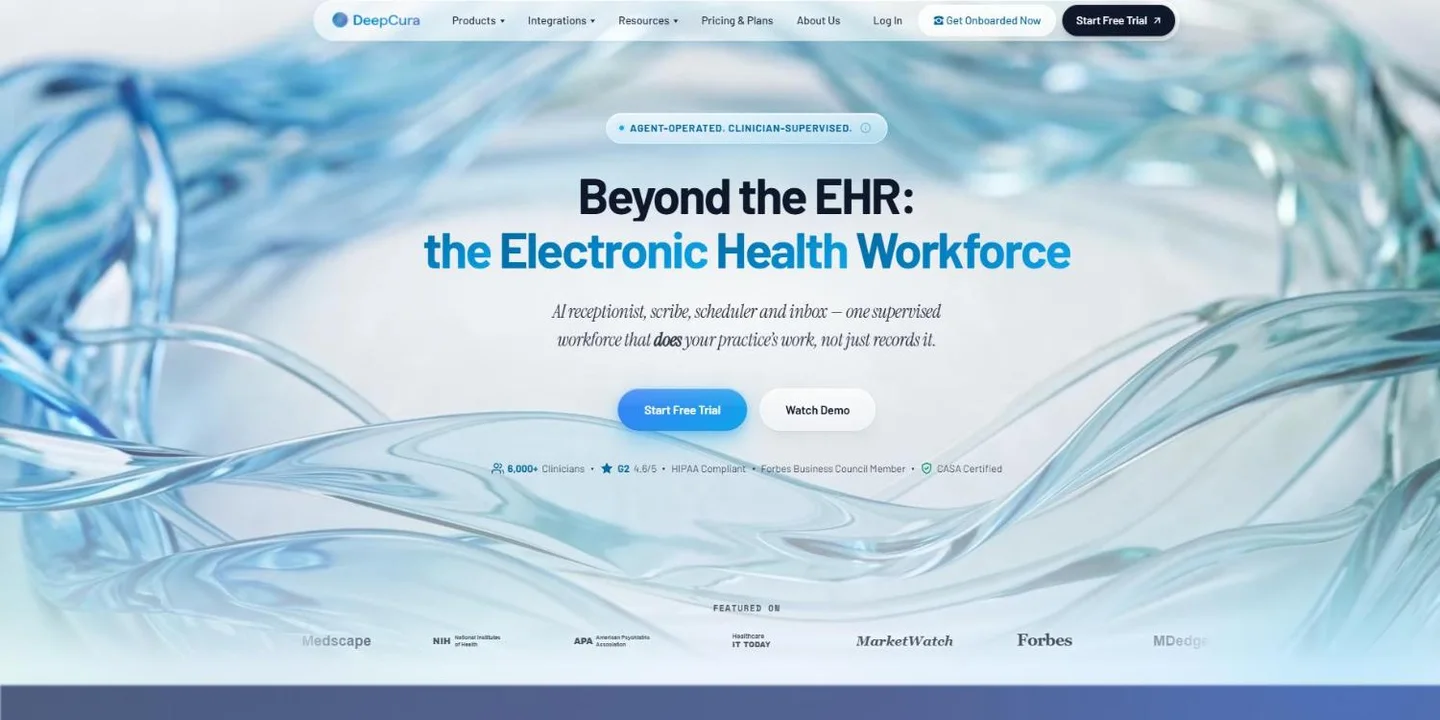
Our verdict: DeepCura scores 46.0 / 76. It sells its AI receptionist inside a bundle with a scribe, intake and billing agents. The bundle price is clear, and the receptionist-only price is not.
| Plan we priced | $129 a month per provider ($999 a year), all agents included |
| Type | AI receptionist in a multi-agent suite |
| BAA | Vendor states “We sign BAAs with every customer”; the BAA is Annex I of its Terms |
| Billing note | 1,000 credits a month across all agents; free trial, no card |
| Reviews | No matched listing (G2 and Capterra cover its earlier scribe product) |
| Our rating | 46.0 / 76 |
Table note: Prices were checked on November 18, 2026. The product is DeepCura’s AI receptionist, sold inside its Electronic Health Workforce plan.
What stands out:
- One price, many agents. DeepCura’s plan covers the receptionist, a scribe and other agents for one per-provider fee.
- Call tasks. The vendor lists scheduling, triage, refills, referrals, insurance questions and after-hours handling. It can text an intake link during the call.
- EHR list. The site names Epic, athenahealth, eClinicalWorks, AdvancedMD and others, and claims write-back for eight systems.
- Call summaries. Each call produces an AI summary with an email notice.
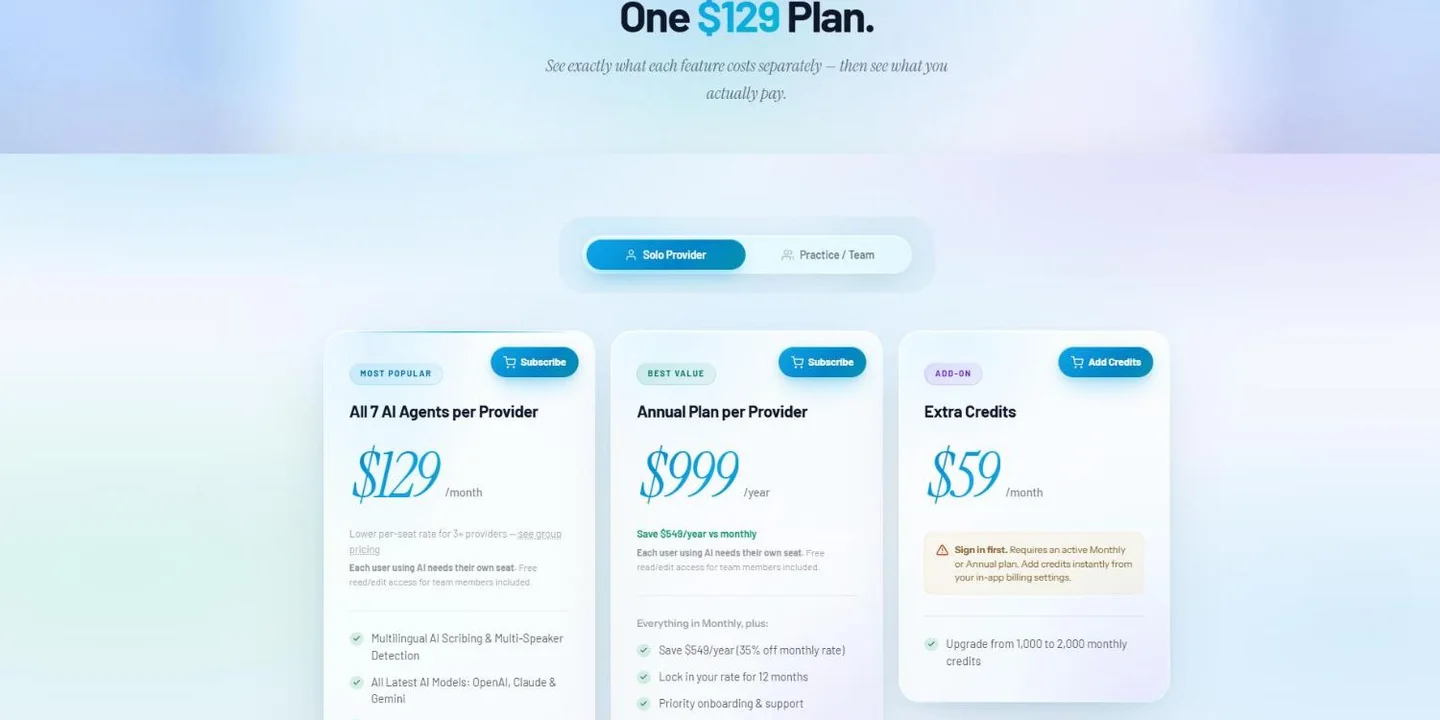
Pricing. The plan is $129 a month per provider, or $999 a year. It includes 1,000 credits a month shared across all agents. A free trial needs no card, and extra credits are $59 a month.
The pricing page shows the AI Receptionist at $199 a month as a stand-alone value. Ask whether it sells alone. A clinic that wants only the phone agent may pay for tools it does not use.
What customers say. We found no review listing for the receptionist. G2 shows 13 reviews at 4.6 stars, but they cover its earlier scribe product, so treat them as reference only. Use the free trial and ask for references from clinics your size.
Watch out for:
- Bundle pricing. The price covers several agents, so the receptionist alone has no stated price.
- Credits. Ask how many calls 1,000 shared credits cover for your practice.
- Customer duties. The terms put AI-disclosure and call-consent duties on you. Ask for the administration details.
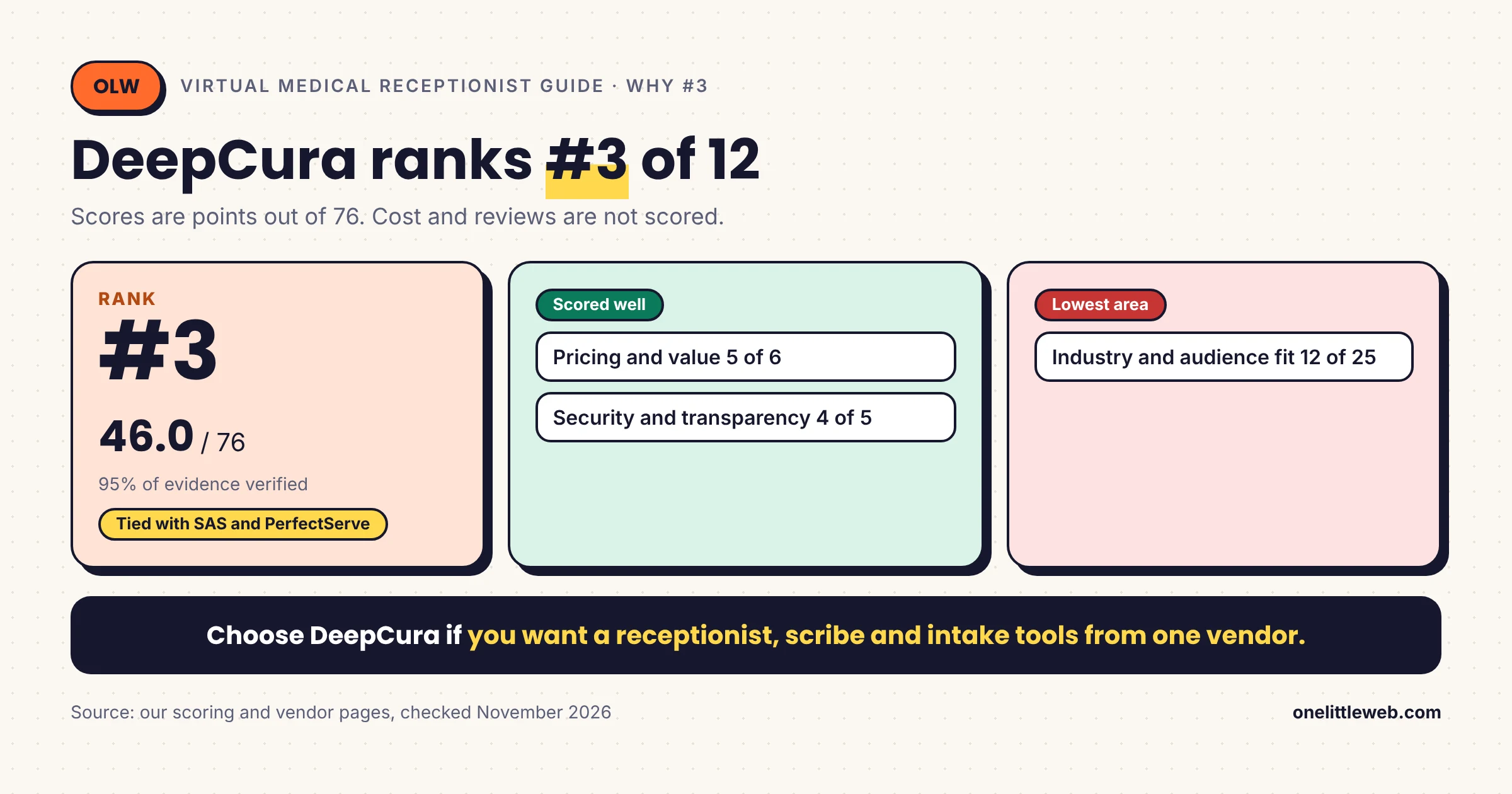
Why DeepCura ranks #3. DeepCura scores 46.0 / 76, with 95% of the evidence verified. Pricing and value (5 of 6 points) and security and transparency (4 of 5 points) are its strongest areas. Industry and audience fit (12 of 25 points) is its lowest.
SAS and PerfectServe have the same score, so their order carries no meaning.
Choose DeepCura if you want a receptionist, scribe and intake tools from one vendor. The free trial lets you test before you commit.
Skip DeepCura if you want a phone agent only, priced alone.
Skip it too if you need reviews that cover the receptionist.
4. PerfectServe: best for practices that route urgent calls by live on-call schedules
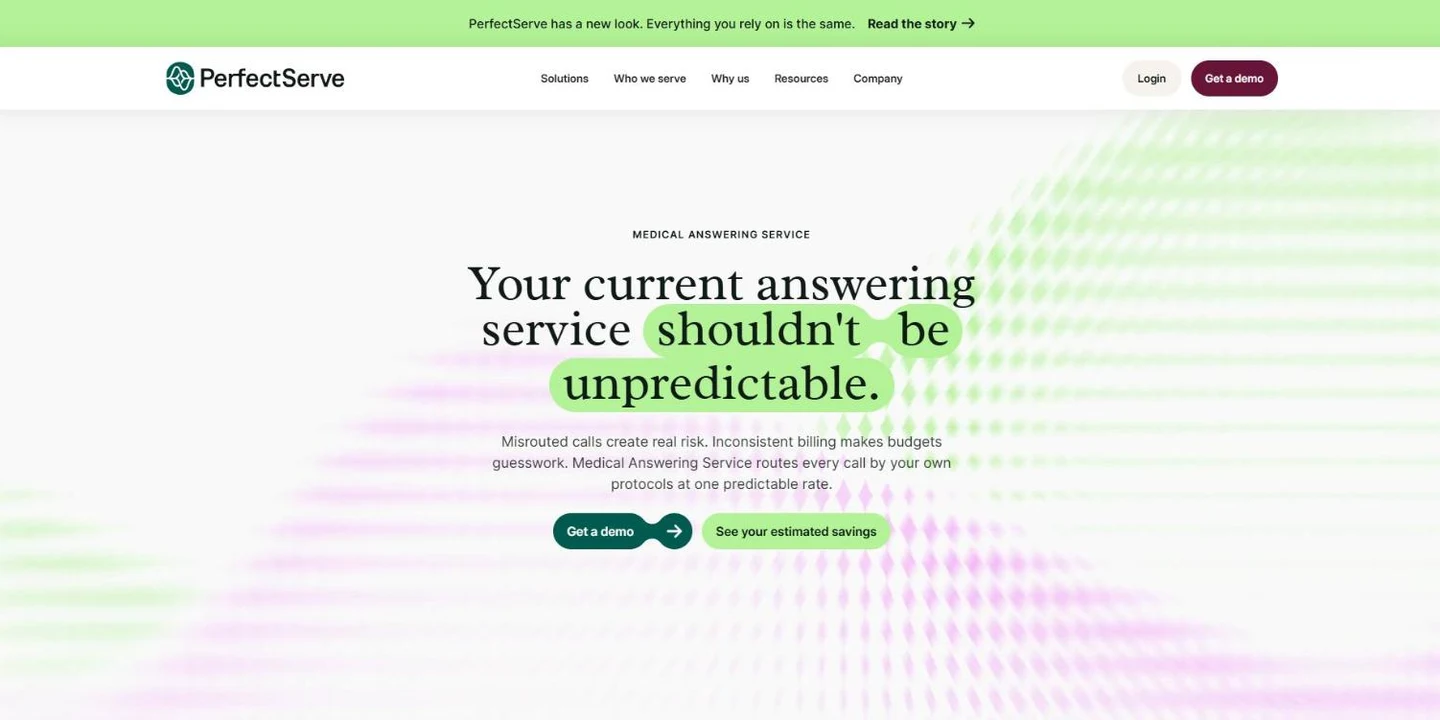
Our verdict: PerfectServe scores 46.0 / 76. It sells a human Medical Answering Service and Intelligent Answering, an AI voice agent named Sloane. Both route urgent calls by the on-call schedule.
| Plan we priced | Medical Answering Service, custom pricing; FAQ range $89 to $119 per doctor a month |
| Type | Human answering service plus an AI voice agent (“Sloane”) |
| BAA | Signed Business Associate Addendum before go-live, per the vendor |
| Billing note | Flat monthly rate with no per-minute charges on the human service; Sloane prices by practice size and call volume |
| Records systems | Epic, Oracle Health (Cerner) and 270+ clinical systems; direction not specified |
| Reviews | G2 3.5 (1) and Capterra 4.0 (2); platform-level listings |
| Our rating | 46.0 / 76 |
Table note: Prices were checked on November 23, 2026. The product is PerfectServe’s Medical Answering Service, shown with its Intelligent Answering AI voice agent.
What stands out:
- On-call routing. Urgent messages reach whoever covers tonight, by rule. Escalation continues until someone answers.
- Records links. The vendor names Epic, Oracle Health and more than 270 systems. It does not say whether calls read from or write to the record.
- Call records. Every engaged AI call is recorded, transcribed and documented, with a summary for your team.
- Languages. Sloane speaks English and Spanish at launch.
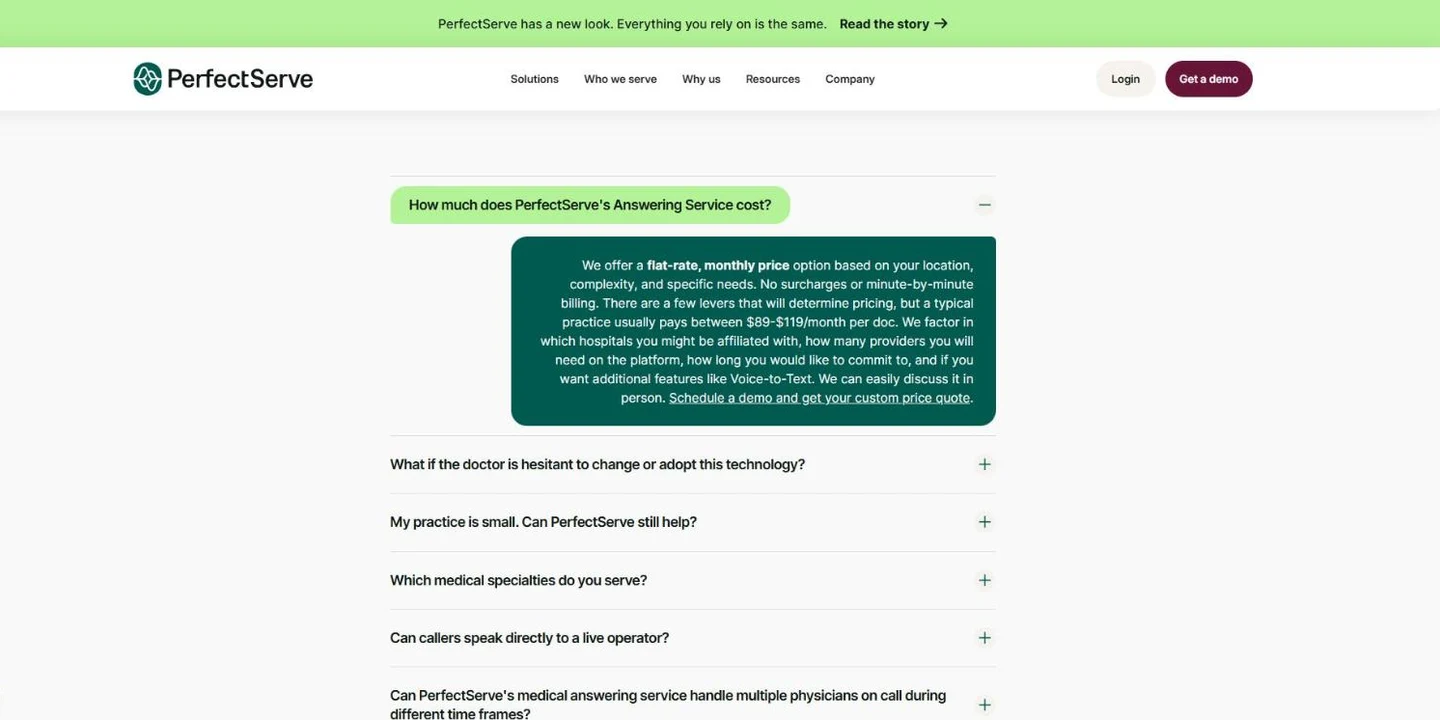
Pricing. PerfectServe publishes no plan price. The FAQ on its Medical Answering Service page gives a typical range. It is $89 to $119 per doctor a month, as a flat rate.
By our arithmetic, a three-doctor practice would pay about $267 to $357 a month at that range. Sloane is priced by practice size and call volume, so ask for a written quote.
What customers say. G2 lists one review at 3.5, and Capterra lists two at 4.0. Both cover PerfectServe’s wider platform, and three reviews are too few to show a pattern. Ask for references from practices with an on-call rotation.
Watch out for:
- Routing, not triage. The vendor says Sloane does not diagnose, triage or give medical advice. It directs emergencies to 911.
- Booking. The Sloane page does not say it books appointments. Ask which service handles scheduling.
- Contract terms. Ask for the contract term and the recording and consent terms in writing.
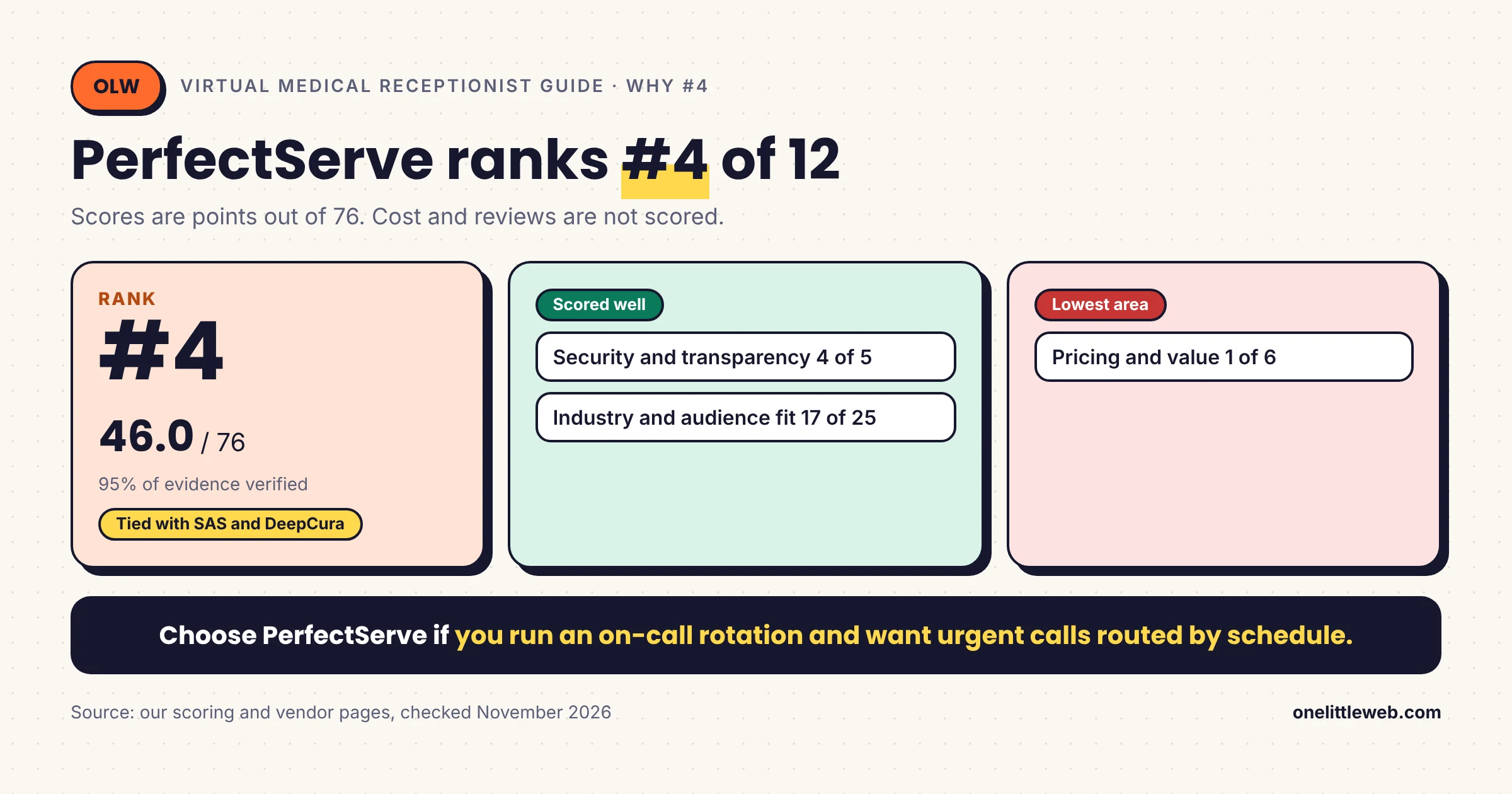
Why PerfectServe ranks #4. PerfectServe scores 46.0 / 76, with 95% of the evidence verified. Security and transparency (4 of 5 points) and industry and audience fit (17 of 25 points) are its strongest areas. Pricing and value (1 of 6 points) is its lowest.
It shares its score with SAS and DeepCura, so their order carries no meaning. Hello Patient is 3 points behind, a small gap.
Choose PerfectServe if you run an on-call rotation and want urgent calls routed by schedule. It also suits you if you use Epic or Oracle Health.
Skip PerfectServe if you want a published plan price you can budget today.
Skip it too if you need contract terms in hand before you talk to sales.
5. Hello Patient: best for practices that want voice, text and web chat from one assistant
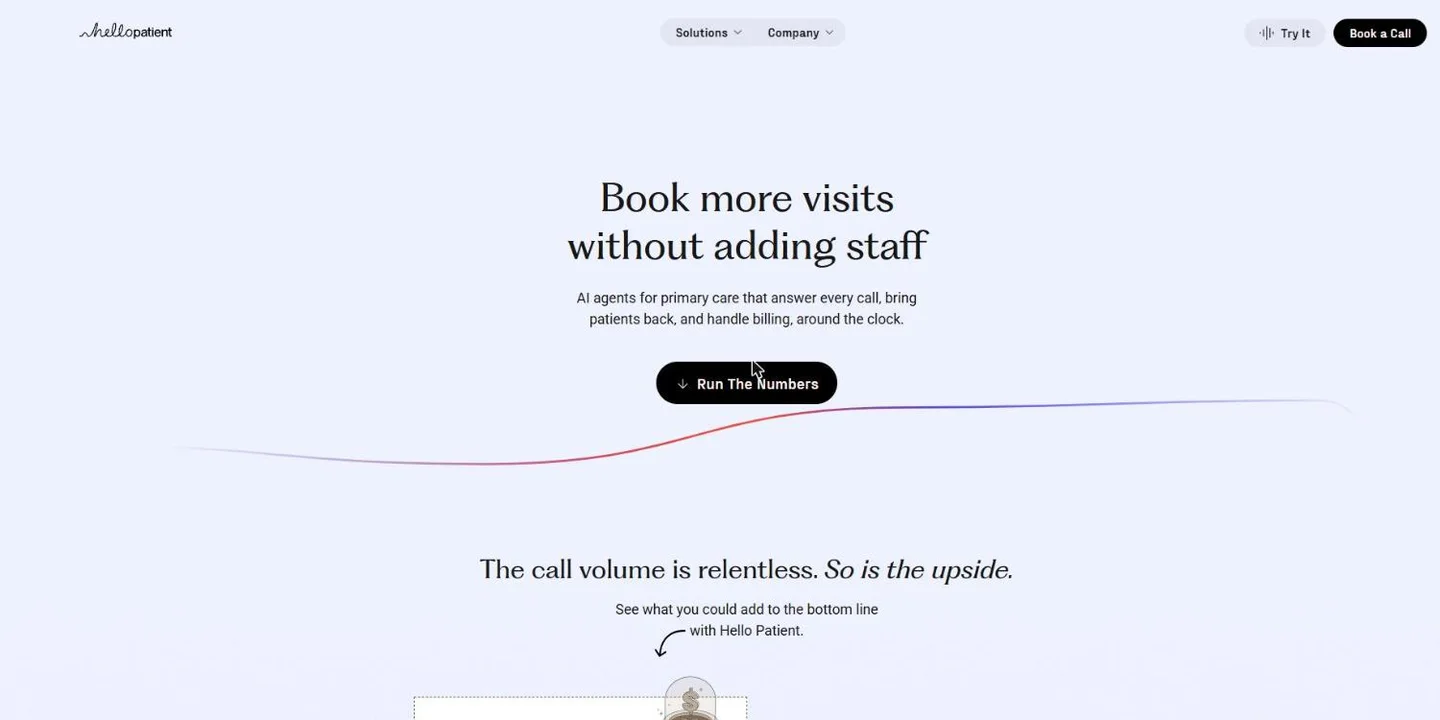
Our verdict: Hello Patient scores 43.0 / 76. It covers more channels than most services here, and it sells by usage with no published price.
| Plan we priced | None published; usage-based across voice, text and web chat |
| Type | AI assistant (“Mia”) for voice, SMS and web chat |
| BAA | Vendor states it “signs a BAA with every client” |
| Billing note | Contract length not stated; vendor cites a go-live of about six to eight weeks |
| Reviews | G2 7 at 4.6 (reference only) |
| Our rating | 43.0 / 76 |
Table note: Prices were checked on November 18, 2026. The product is Hello Patient’s AI agents, shown on its site with the assistant Mia.
What stands out:
- Named EHRs. The vendor lists native integrations with athenahealth, eClinicalWorks, Veradigm, ModMed, Epic, NextGen and AdvancedMD.
- Primary care tasks. It schedules sick visits, physicals and follow-ups, and captures the medication and pharmacy on refill requests.
- Handoff. Clinical or out-of-scope requests go to a person with context attached.
- Languages. English and Spanish are supported, with more on request.
Pricing. Hello Patient publishes no prices. Its FAQ describes usage-based pricing, so ask for fee detail and contract length in a written quote.
Go-live is not instant. The vendor cites six to eight weeks in one answer and about six in another, so plan the rollout.
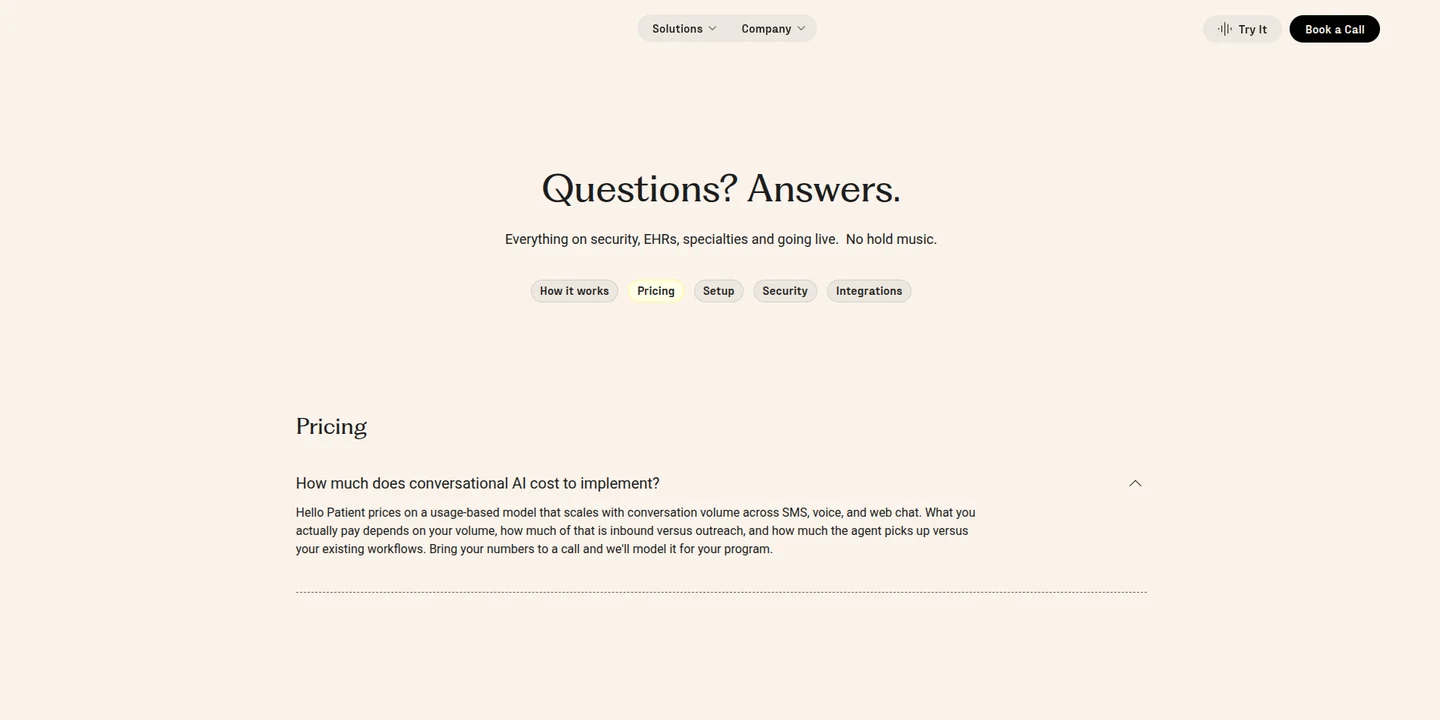
What customers say. G2 lists Hello Patient with 7 reviews at 4.6 stars. That is a thin pool, so ask for clinic references before you sign.
Watch out for:
- Quote first. Ask for usage fees and contract terms before a demo.
- Delivery details. Ask about telephony, data delivery, administration and recording consent.
- Escalation. The pages describe handing clinical requests to staff, with no on-call protocol.
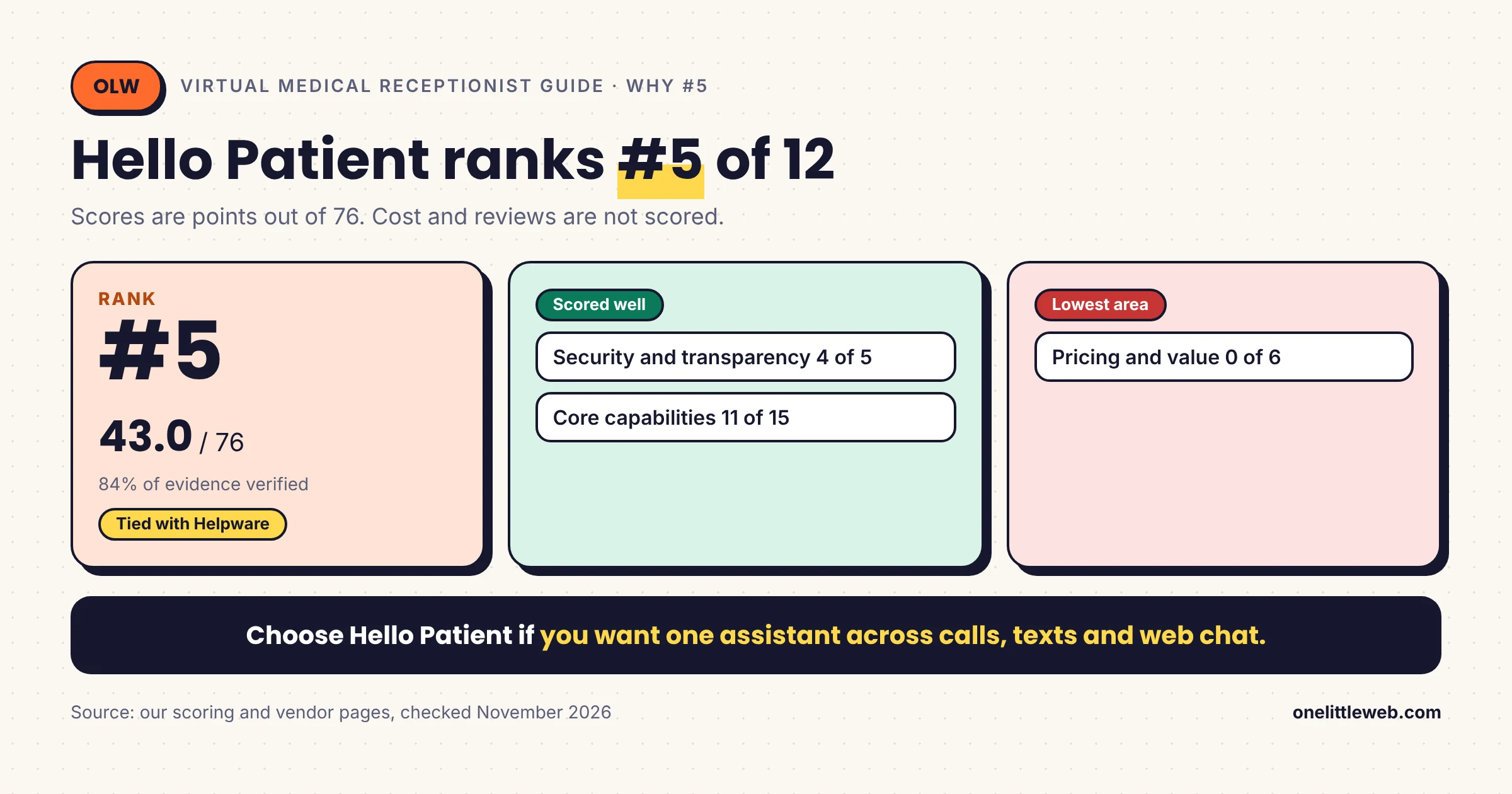
Why Hello Patient ranks #5. Hello Patient scores 43.0 / 76, with 84% of the evidence verified. Security and transparency (4 of 5 points) and core capabilities (11 of 15 points) are its strongest areas. Pricing and value (0 of 6 points) is its lowest.
Helpware has the same score, so we count the two as tied.
Choose Hello Patient if you want one assistant across calls, texts and web chat. Confirm fees and contract terms first.
Skip Hello Patient if you need a price before a sales call.
Skip it too if you need a fast start. The vendor cites weeks, not days.
6. Helpware: best for groups that want a managed multilingual team with insurance checks
Our verdict: Helpware scores 43.0 / 76. It suits groups that want a managed team across many languages, with coverage and eligibility checks before visits. It sells by quote.
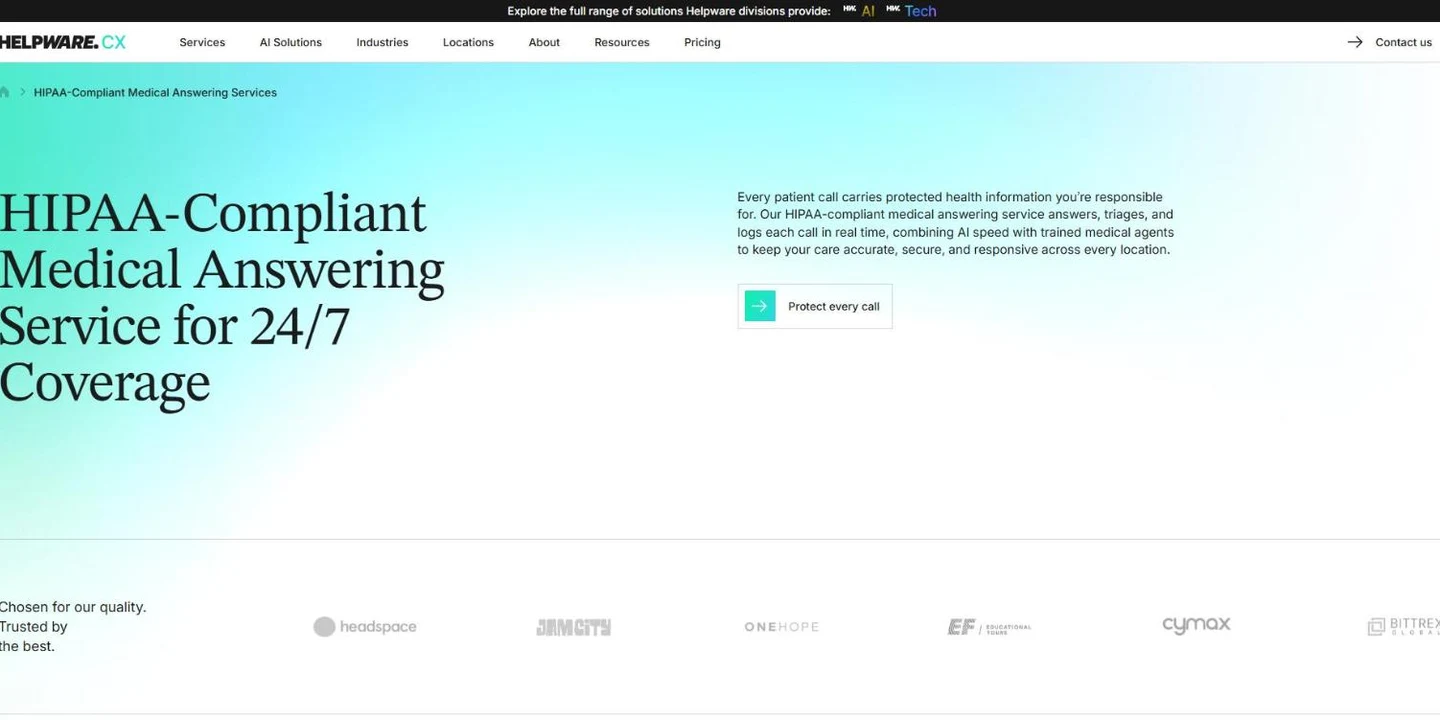
| Plan we priced | Quote only; the page says to contact Helpware for a personalized quote |
| Type | Managed answering service with a human team; the vendor also sells an automated AI service |
| Coverage | 19 locations and 45+ languages, per the vendor |
| Booking | Books, reschedules and cancels visits; runs coverage and eligibility checks first |
| Records systems | Updates sent into “your calendar or EHR”; no system named |
| BAA | Signed at onboarding, per the vendor |
| Reviews | G2 4.9 (30); whole-company profile, reference only |
| Our rating | 43.0 / 76 |
Table note: Prices were checked on November 23, 2026. The product is Helpware’s HIPAA-compliant medical answering service on its CX services site.
What stands out:
- Security and transparency. The BAA is signed at onboarding, per the vendor.
- First-call intake. The page says the team collects first-time patient details in one interaction.
- Insurance checks. The team completes coverage and eligibility checks before appointments.
- Escalation. Urgent calls go to your on-call provider within minutes, per the page.
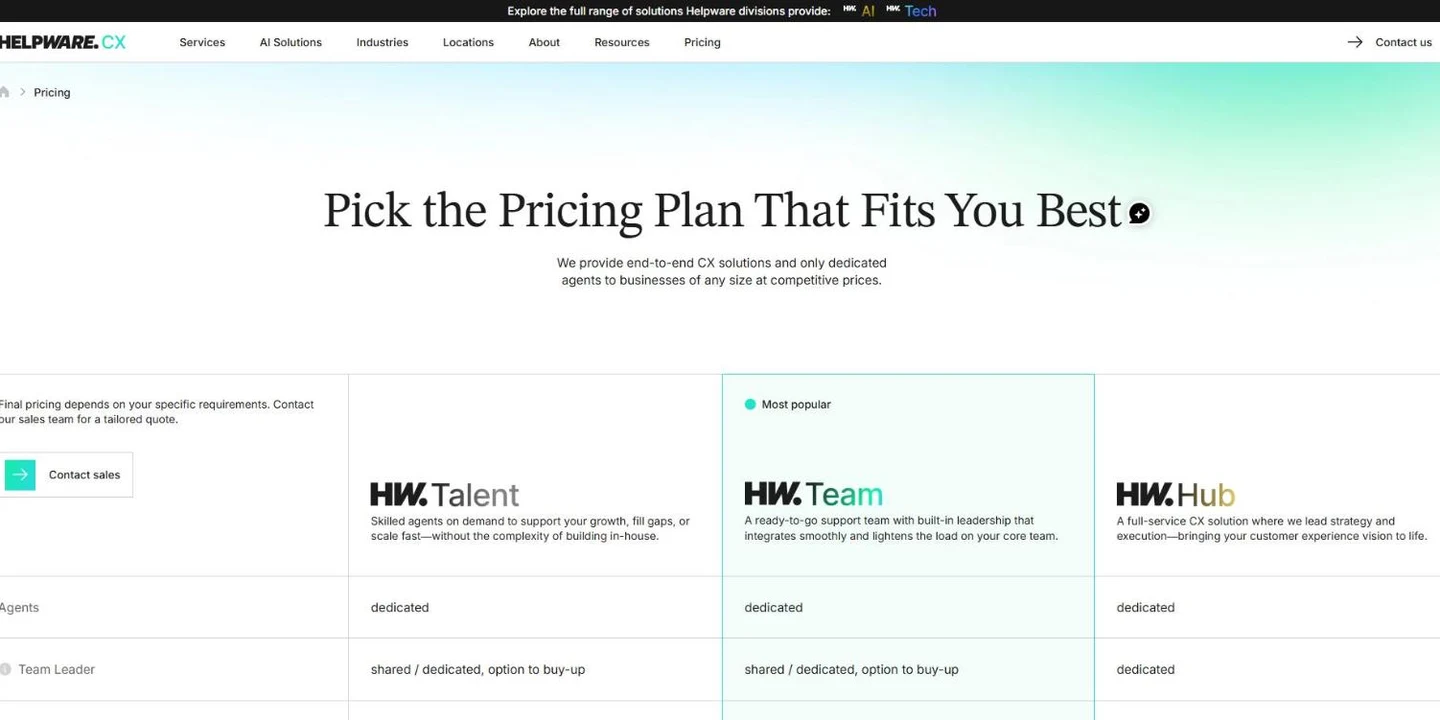
Pricing. Helpware publishes no plan price. Its pricing page names three plan tiers, shows no dollar amounts and sends buyers to sales for a quote.
Ask for a quote that covers your minutes, your languages and any setup work. Ask what changes if your volume doubles.
What customers say. G2 lists 30 reviews averaging 4.9. The listing covers Helpware as a contact-center outsourcing company, not its medical answering service. We show it for reference only.
Watch out for:
- Quote only. Pricing and value was its lowest area, so get a written quote early.
- Contract and consent terms. Ask for contract flexibility and recording and consent terms in writing.
- No system named. Updates reach your “calendar or EHR”. Ask which systems it writes into.
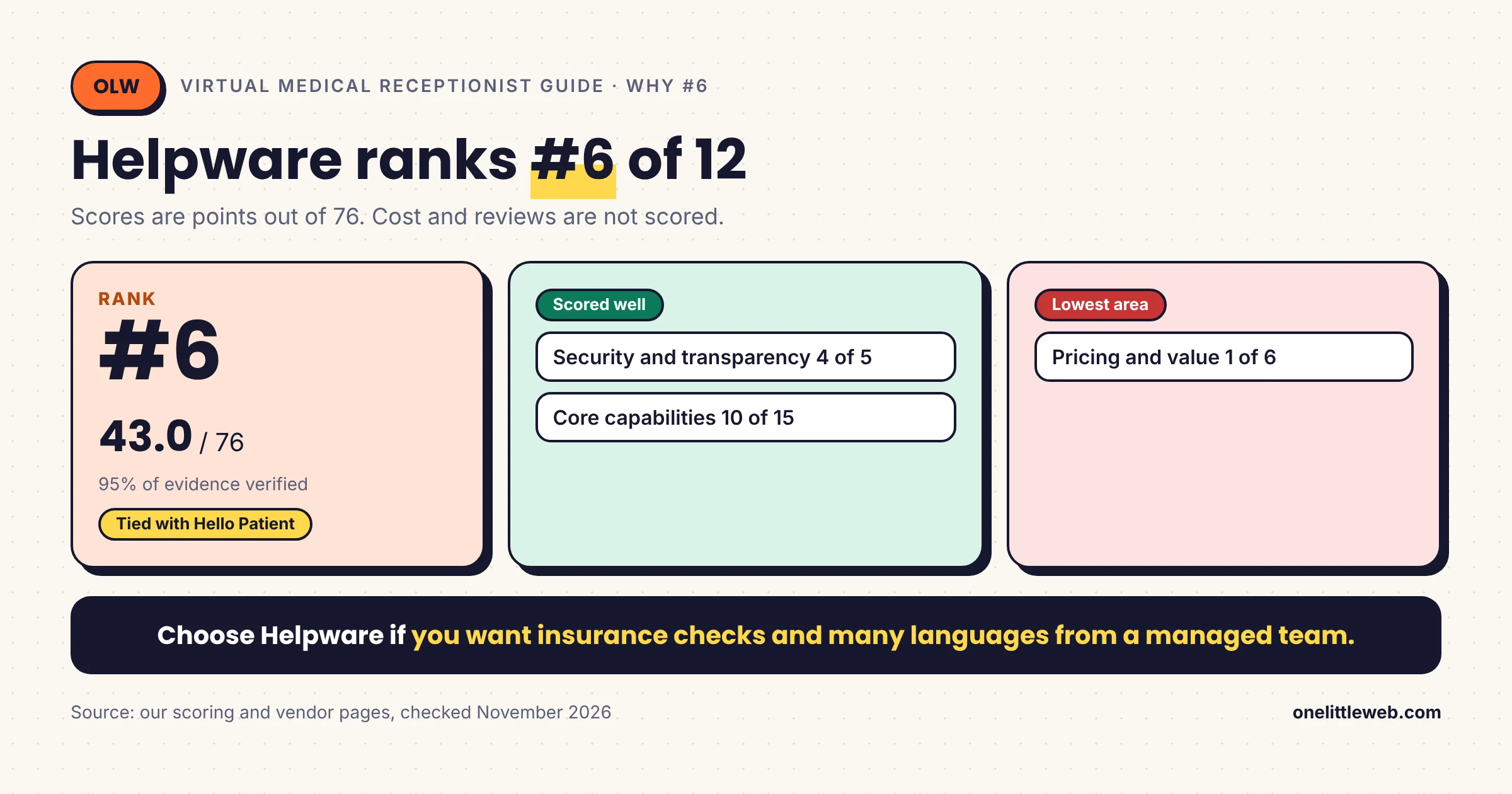
Why Helpware ranks #6. Helpware scores 43.0 / 76, with 95% of the evidence verified. Security and transparency (4 of 5 points) and core capabilities (10 of 15 points) are its strongest areas. Pricing and value (1 of 6 points) is its lowest.
Hello Patient has the same score, so we count the two as tied. Newo is 1 point behind, a small gap.
Choose Helpware if you want insurance checks and many languages from a managed team.
Skip Helpware if you want a published price.
Skip it too if you need a named EHR link confirmed before a demo.
7. Newo: best for single-location clinics that want a monthly plan with no lock-in
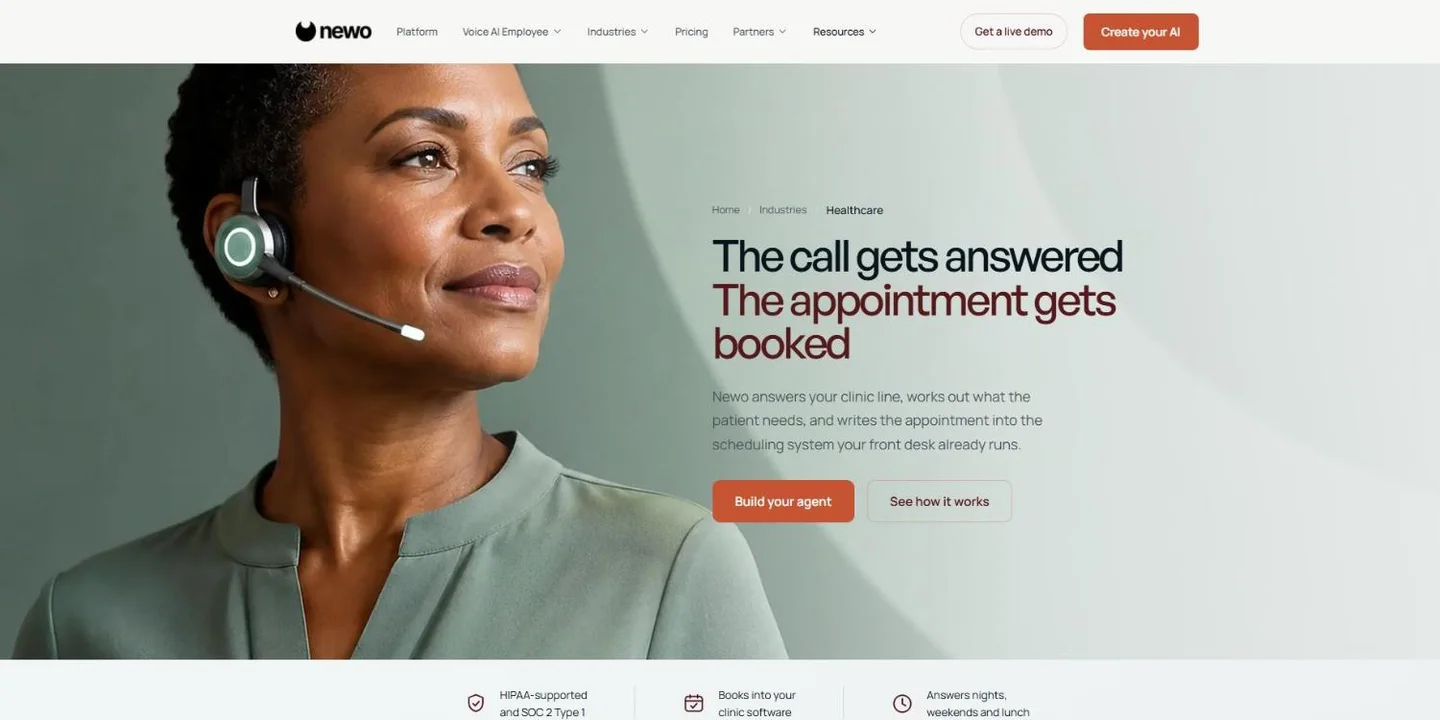
Our verdict: Newo scores 42.0 / 76. It publishes clear plan terms and BAA language. It is a general AI receptionist with a healthcare page. Treat it as an AI-only option and confirm your EHR.
| Plan we priced | AI Receptionist $299 a month (200 units); Pay As You Go $0 |
| Type | AI-only receptionist; general product with a healthcare page |
| BAA | Vendor states a BAA is signed before any patient data is processed |
| Billing note | One agent at one location per plan; monthly billing; no setup cost |
| Reviews | G2 11 at 4.9 (reference only) |
| Our rating | 42.0 / 76 |
Table note: Prices were checked on November 18, 2026. The product is Newo’s AI Receptionist, shown on its site with a healthcare page.
What stands out:
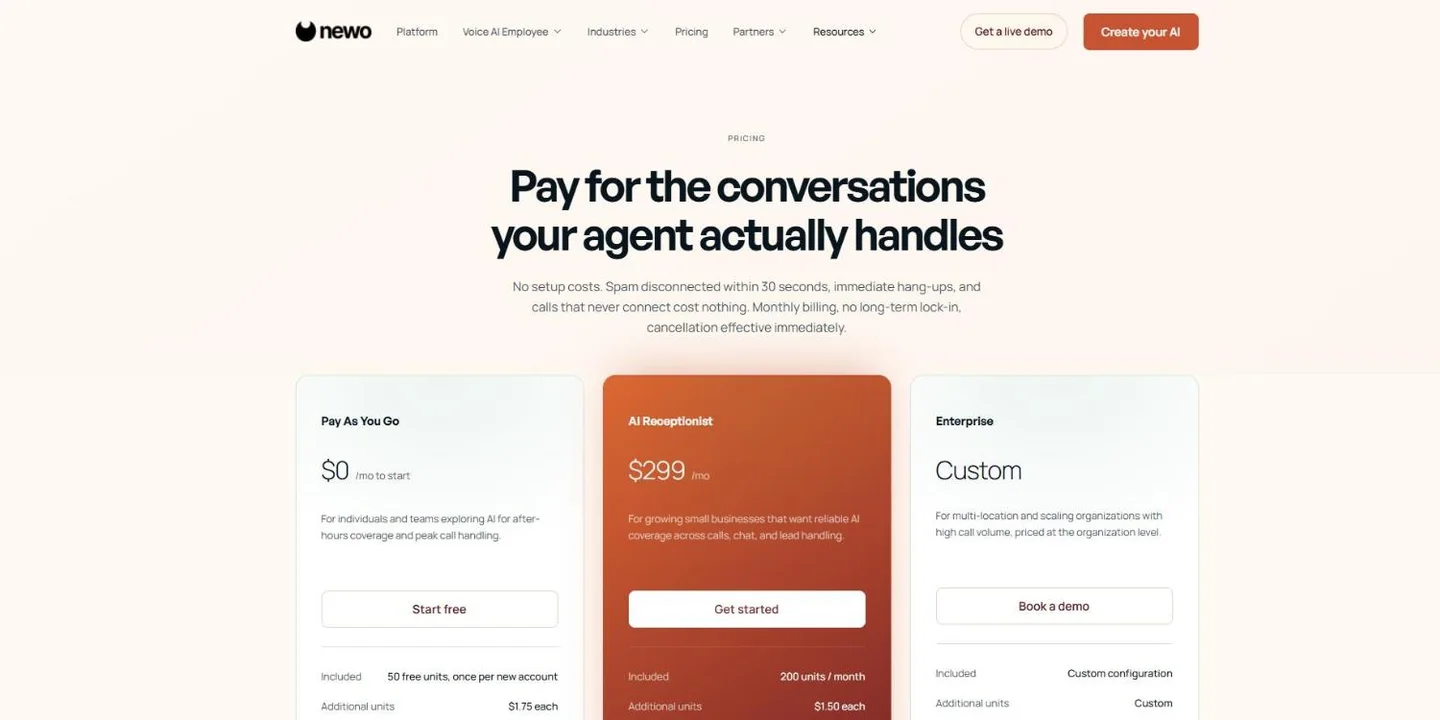
- Clear plan terms. The AI Receptionist plan costs $299 a month for 200 units. One unit is roughly one voice call or about 30 texts.
- No lock-in. Billing is monthly, with no long-term commitment and immediate cancellation, per the vendor.
- Security documents. Its compliance page mentions ISO 27001 and SOC 2 Type 1, and says recordings and transcripts are encrypted.
- Scheduling. The healthcare page says it writes appointments into the scheduling system your front desk already uses.
Pricing. The plan is $299 a month, with $1.50 per unit above 200. Pay As You Go is $0 to start, with 50 free units once, then $1.75 a unit. Enterprise is custom.
A plan covers one agent at one location, so a multi-site group should price each location.
What customers say. G2 lists Newo with 11 reviews at 4.9 stars. The pool is small, so ask for clinic references.
Watch out for:
- No medical EHR named. The homepage names dental practice systems, so ask for your medical EHR in writing.
- Intake capture. Ask how intake and information capture work for new patients.
- Unit counting. A unit is roughly one call. Ask how longer or repeated calls are counted.
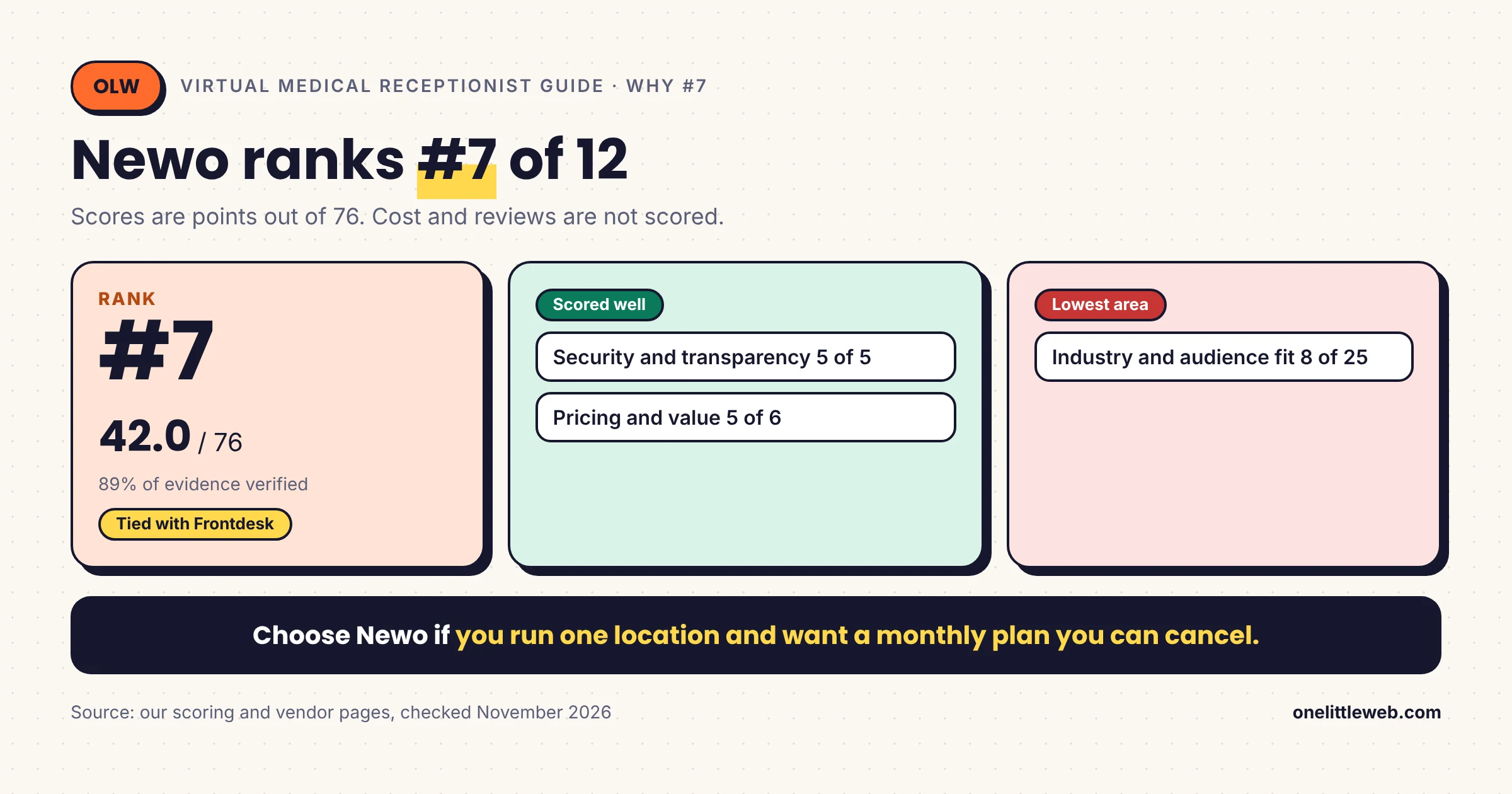
Why Newo ranks #7. Newo scores 42.0 / 76, with 89% of the evidence verified. Security and transparency (5 of 5 points) and pricing and value (5 of 6 points) are its strongest areas. Industry and audience fit (8 of 25 points) is its lowest.
Frontdesk has the same score, so we count the two as tied. Ruby is 2 points behind, a small gap.
Choose Newo if you run one location and want a monthly plan you can cancel. Confirm your EHR first.
Skip Newo if you need a medical EHR named in writing before you start.
Skip it too if you run several sites and want one flat price.
8. Frontdesk: best for small practices that want a no-contract voice plan
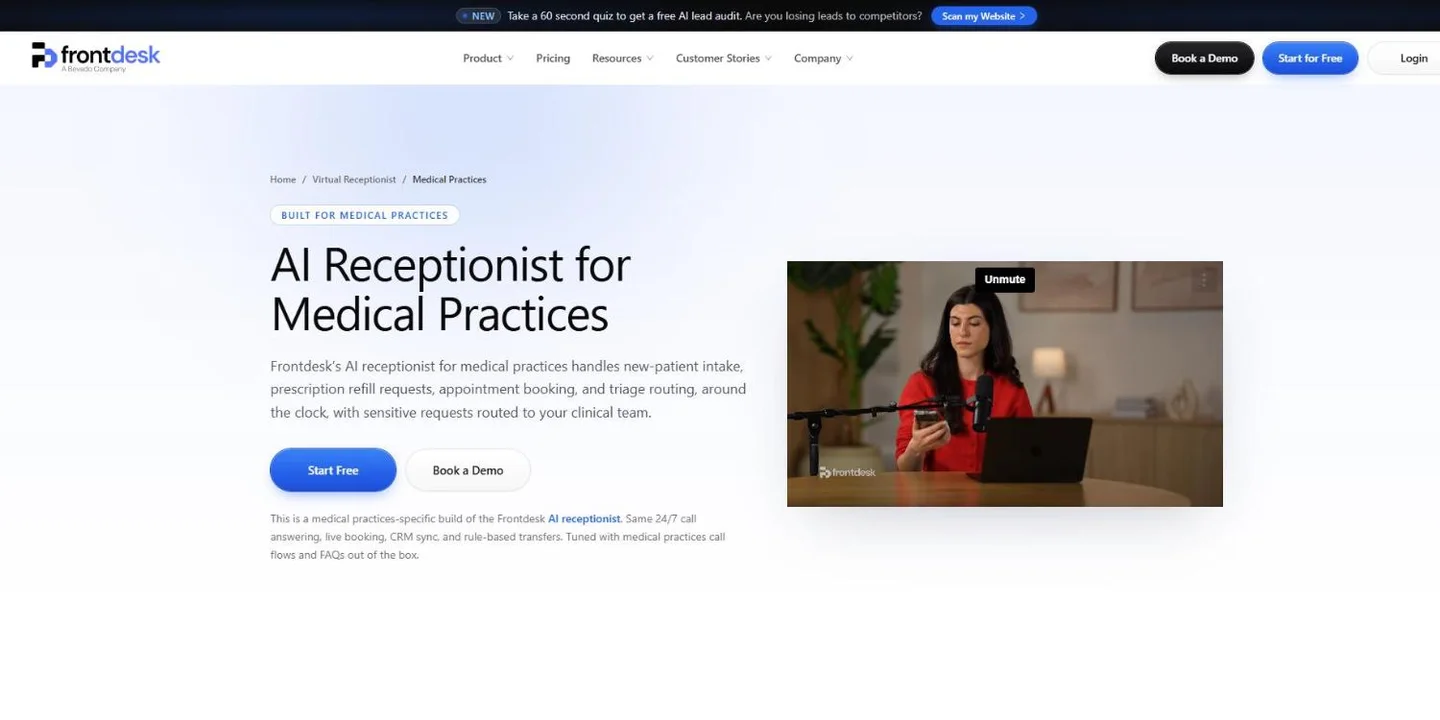
Our verdict: Frontdesk, sold as My AI Front Desk, scores 42.0 / 76. It has a medical practices page and voice plans from $99, links to CRMs and names no EHR.
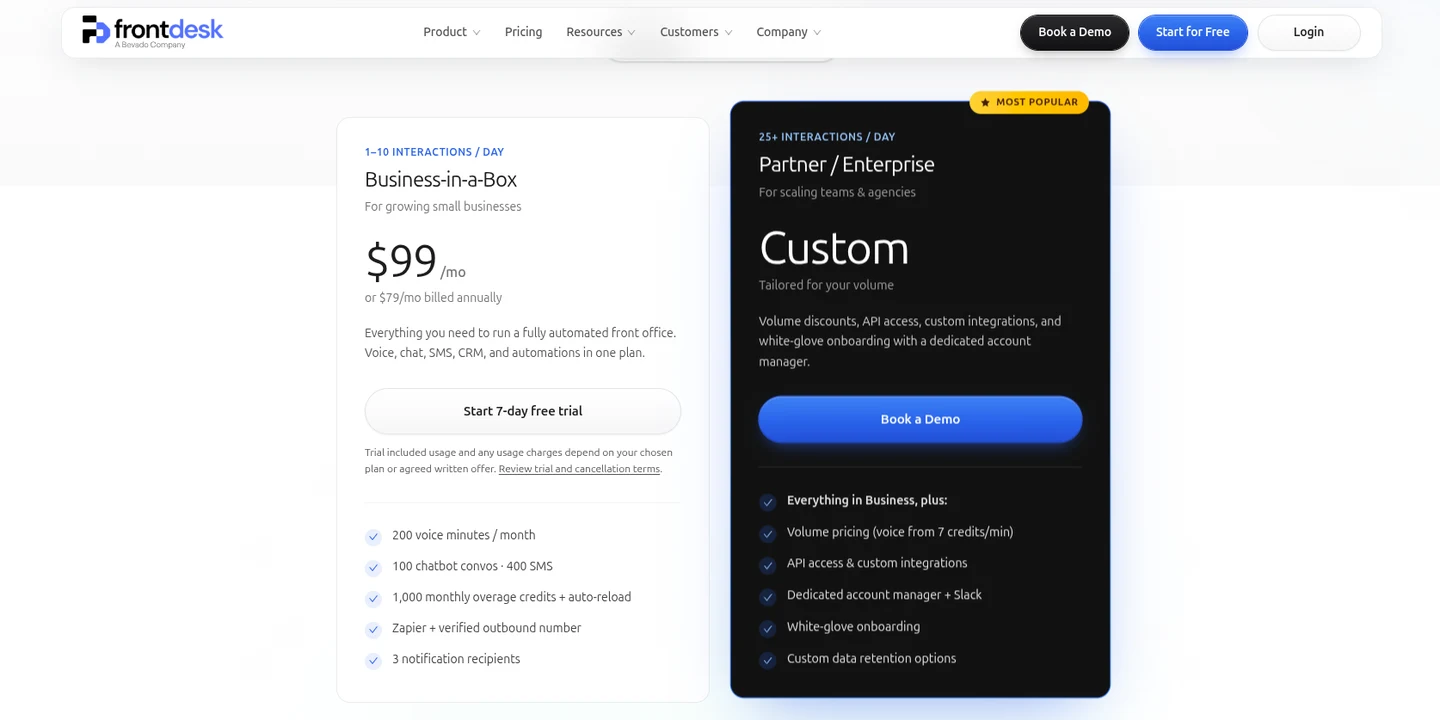
| Plan we priced | Voice plan from $99 a month ($79 billed annually; 200 minutes) |
| Type | AI-only receptionist; general product with a medical practices page |
| BAA | Homepage states “signed BAAs”; plan scope not stated |
| Billing note | No contract; overage in credits at $0.01 each |
| Reviews | G2 13 at 4.8 (reference only) |
| Our rating | 42.0 / 76 |
Table note: Prices were checked on November 18, 2026. The product is My AI Front Desk’s voice plan, shown on its medical practices page.
What stands out:
- Medical tasks. The medical practices page lists new-patient intake, refill requests, appointment booking and triage routing.
- Urgent calls. The vendor says it routes urgent calls instantly and escalates to a human supervisor in real time.
- Languages. It states it speaks 20+ languages.
- Controls. The homepage mentions encryption in transit and at rest and strict access controls.
Pricing. Voice plans start at $99 a month for 200 minutes, with overage in credits at $0.01 each. The vendor says there is no contract. Billed annually, the plan is $79 a month.
Ask whether the BAA covers your exact plan, because the terms of service never mention HIPAA or a BAA.
What customers say. G2 lists My AI Front Desk with 13 reviews at 4.8 stars. Trustpilot shows 17 reviews at 3.5. Ask for clinic references and trial it first.
Watch out for:
- CRM links only. The page names HubSpot, Salesforce and Pipedrive. Ask about your EHR.
- BAA scope. The BAA is a homepage statement. The medical page has no BAA text, so confirm plan coverage.
- Two rates. The pricing page shows $99 monthly and $79 billed annually.
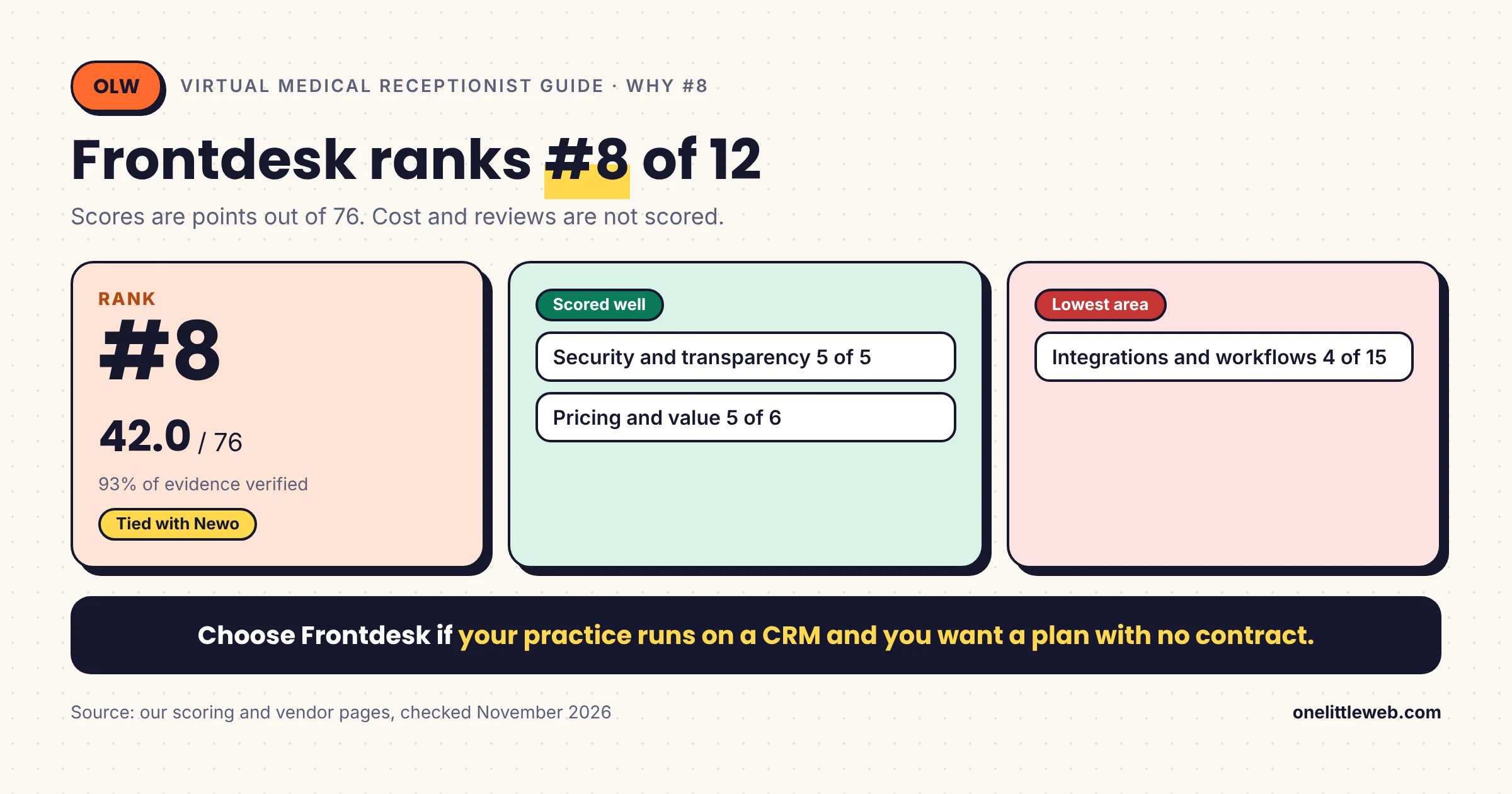
Why Frontdesk ranks #8. Frontdesk scores 42.0 / 76, with 93% of the evidence verified. Security and transparency (5 of 5 points) and pricing and value (5 of 6 points) are its strongest areas. Integrations and workflows (4 of 15 points) is its lowest.
Newo has the same score, so we count the two as tied. Ruby is 2 points behind, a small gap.
Choose Frontdesk if your practice runs on a CRM and you want a plan with no contract.
Skip Frontdesk if you need a named EHR link that writes into patient records.
Skip it too if you need the BAA confirmed for your exact plan before you buy.
9. Ruby: best for practices that want a polished live receptionist team priced by the minute
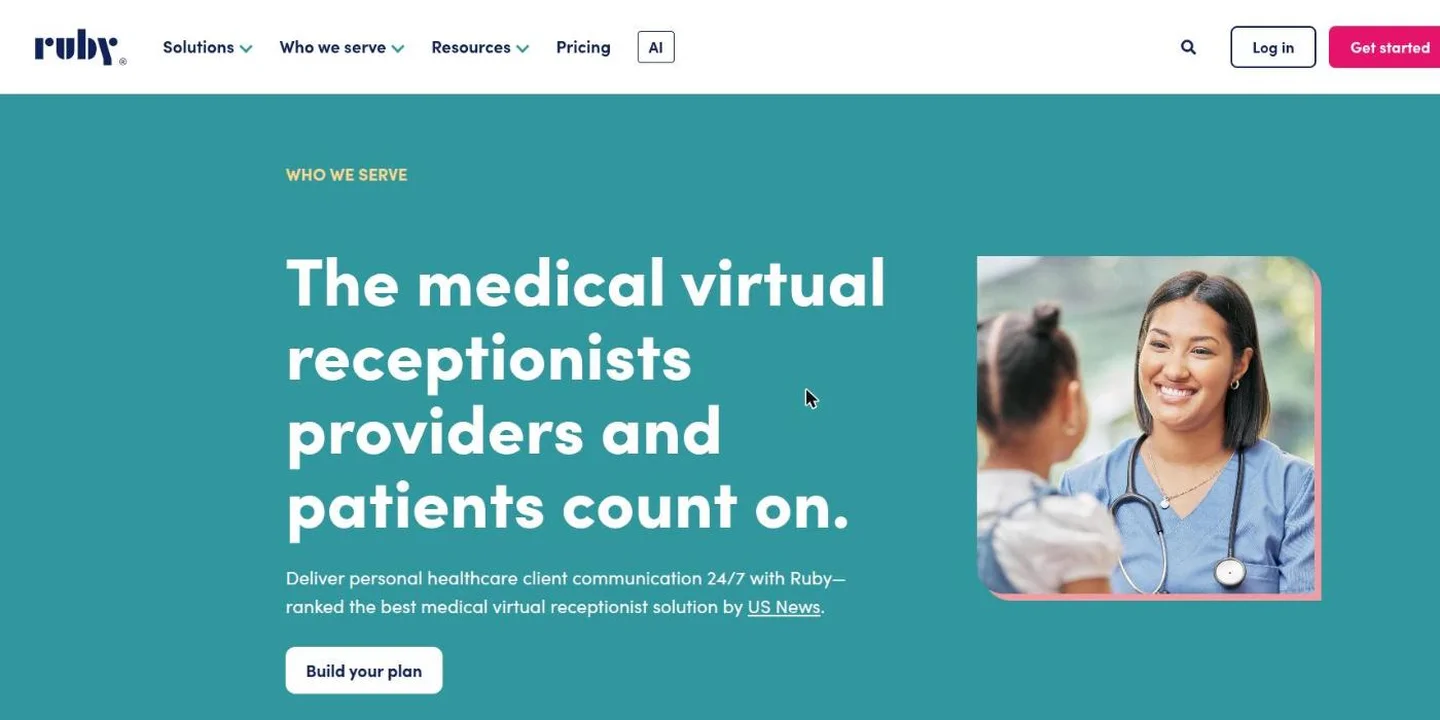
Our verdict: Ruby scores 40.0 / 76. It suits practices that value a polished live receptionist team and have the budget for it. It offers an opt-in HIPAA mode with a BAA.
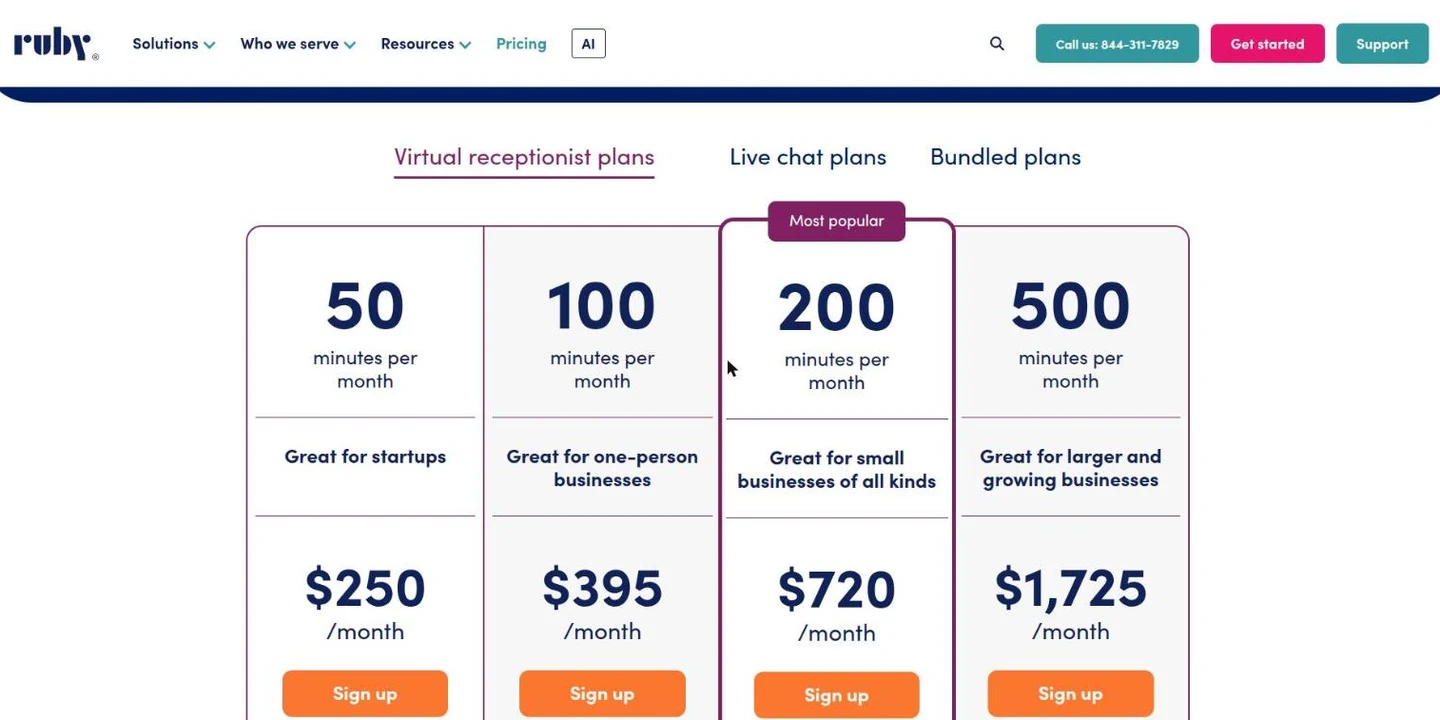
| Plan we priced | 50 minutes, $250 a month |
| Type | Live receptionists |
| Other plans | 100 minutes, $395; 200, $720; 500, $1,725 |
| BAA | An opt-in HIPAA mode with a BAA and a secure portal, per the vendor |
| Billing note | No setup fee; we found no overage rate on the pages we read |
| Reviews | G2 3.8 (12), Capterra 3.9 (11), Trustpilot 4.5 (853) |
| Our rating | 40.0 / 76 |
Table note: Prices were checked on November 25, 2026. The product is Ruby’s receptionist service, shown on its site with the HIPAA option.
What stands out:
- Security and transparency. It earned the full 5 of 5 here, including the opt-in BAA and secure portal.
- Core capabilities. The pages describe live call handling, booking and message delivery.
- Automation. The pages describe Zapier and more than 20 scheduling tools.
- Coverage. The general page lists full-time, part-time, overflow and after-hours options.
Pricing. Ruby lists four plans by minutes. The 50-minute plan costs $250 a month, and the 100-minute plan costs $395.
The 200-minute plan costs $720, and the 500-minute plan costs $1,725. Ask for the overage rate before you sign.
What customers say. G2 lists 12 reviews at 3.8, Capterra lists 11 at 3.9 and Trustpilot shows 853 at 4.5. We show them for reference only, and Trustpilot invites reviews, so read that rating with care.
Watch out for:
- Entry price. The 50-minute plan is among the higher entry prices here.
- Records systems. The pages name Clio and Calendly, not a medical EHR. Ask how messages reach your practice tools.
- Opt-in HIPAA mode. Confirm in writing that the BAA covers your plan.
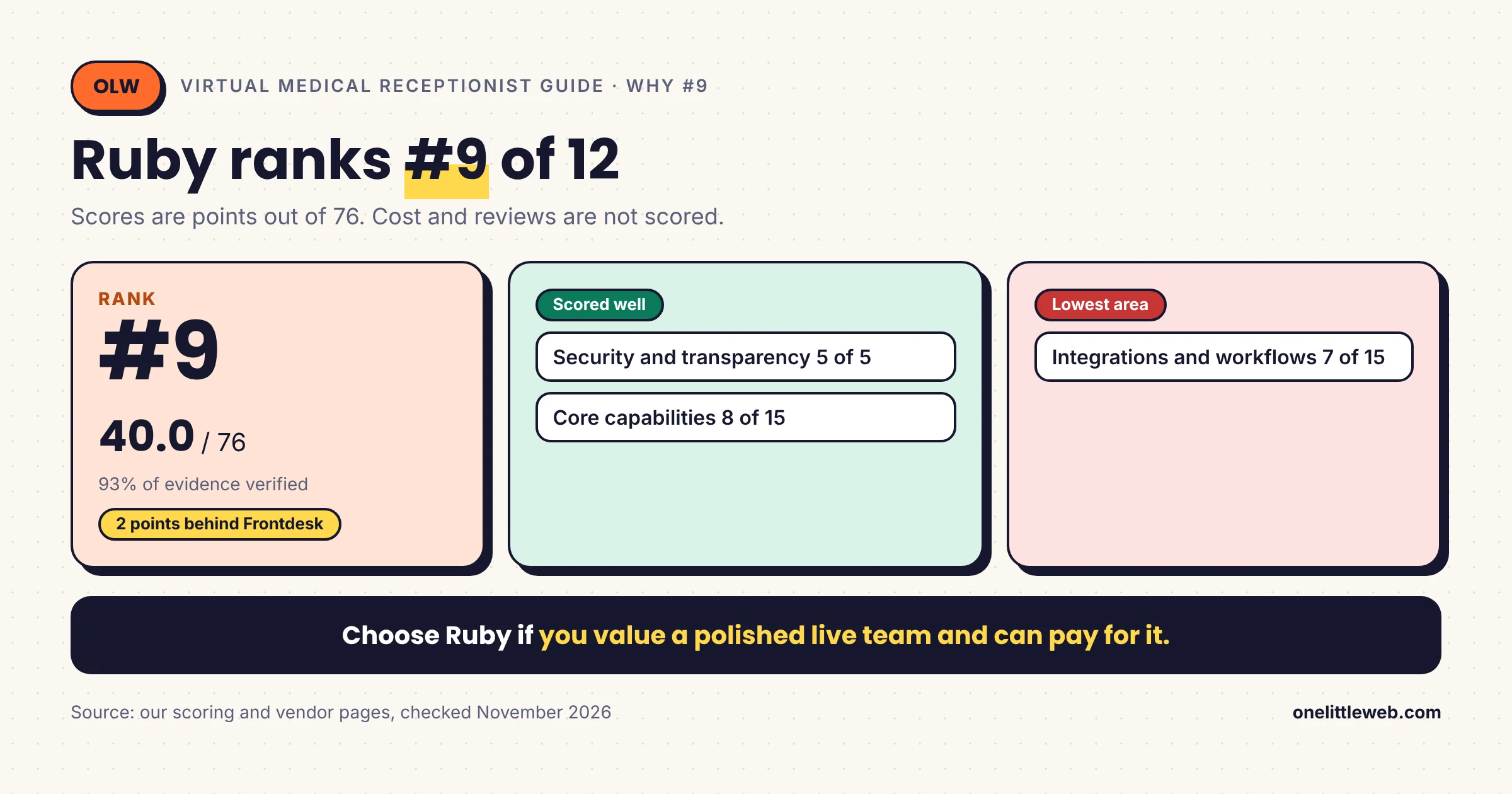
Why Ruby ranks #9. Ruby scores 40.0 / 76, with 93% of the evidence verified. Security and transparency (5 of 5 points) and core capabilities (8 of 15 points) are its strongest areas. Integrations and workflows (7 of 15 points) is its lowest.
It is 2 points behind Frontdesk and 2 ahead of OhMD, both small gaps.
Choose Ruby if you value a polished live team and can pay for it.
Skip Ruby if you are a small practice watching cost.
Skip it too if you need a medical EHR link named on the page.
10. OhMD: best for practices that want HIPAA texting and AI voice in one platform
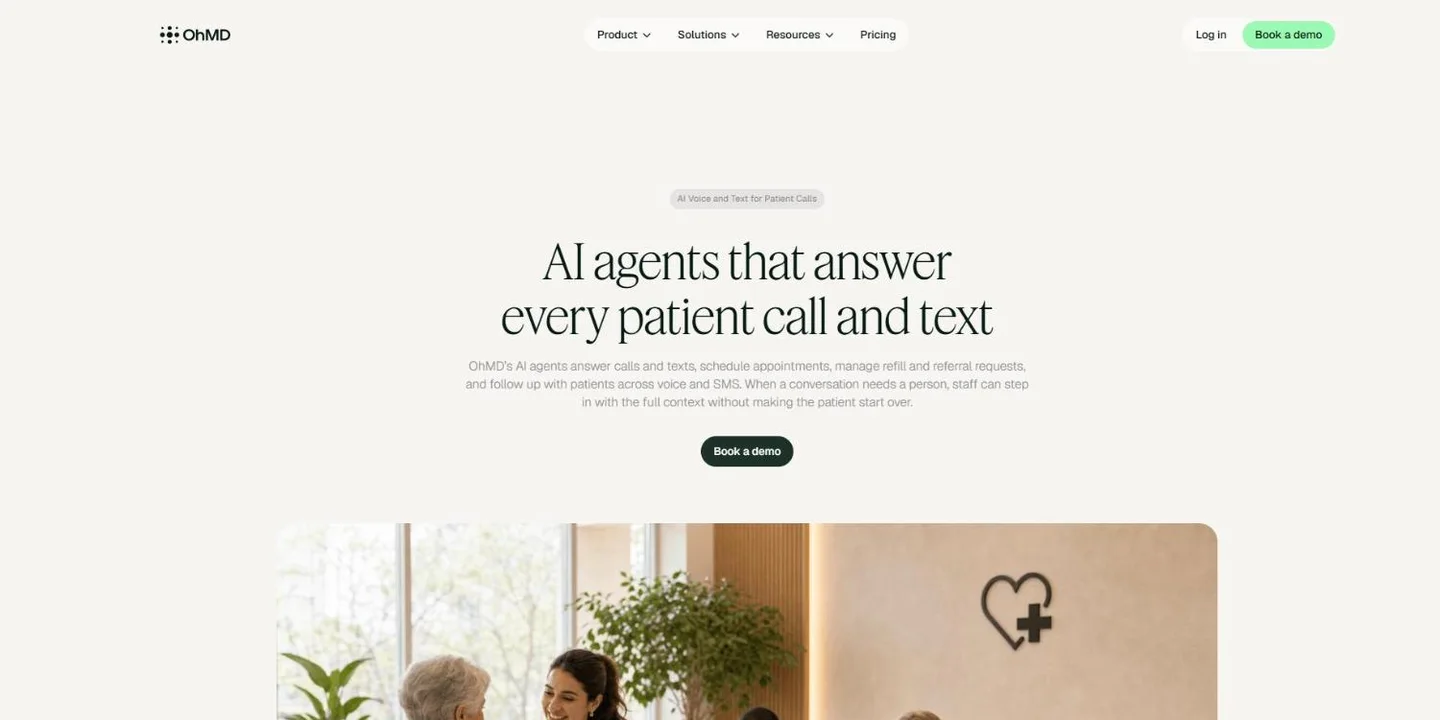
Our verdict: OhMD scores 38.0 / 76. It began as a HIPAA texting product and added AI voice and text agents. It suits practices that already text patients through it.
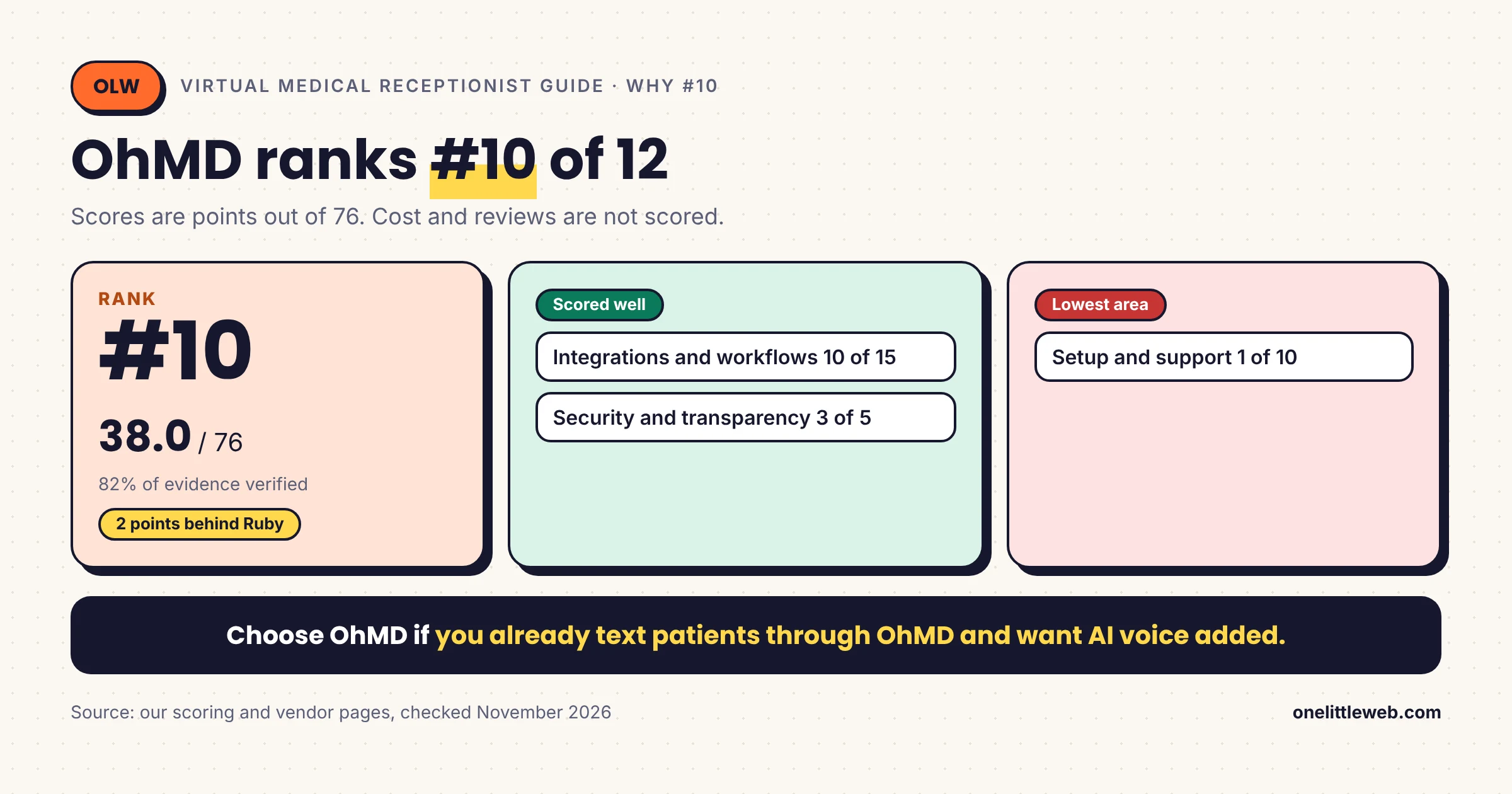
| Plan we priced | AI & Automation from $500 a month; Core from $300 (messaging and calling); Enterprise custom |
| Type | AI voice and text agents inside a HIPAA texting platform (Communicate, Answer, Reach, Conduct) |
| BAA | Vendor states an automatic BAA for every user on all three plans |
| Billing note | Starting prices; calling usage billed separately |
| Reviews | G2 170 at 4.8 (whole suite, reference only) |
| Our rating | 38.0 / 76 |
Table note: Prices were checked on November 18, 2026. The product is OhMD’s Answer AI agents, priced on its AI & Automation plan.
What stands out:
- Scheduling in the connected system. The Answer product page says the agent can schedule or reschedule inside the connected system.
- EHR coverage. OhMD names athenahealth, Veradigm and eClinicalWorks, and cites 85 EHR and practice systems.
- Languages. The vendor says the agent speaks and understands over 60 languages.
- Security controls. It lists AES-256 encryption, role-based permissions and a HITRUST assessment.
Pricing. AI & Automation starts at $500 a month. It lists AI voice and text calling, message routing and scheduling. Core starts at $300 a month for messaging and calling, and Enterprise is custom.
The page says calling usage is billed separately and gives no rate. Ask what a month of calls would add.
What customers say. G2 lists OhMD with 170 reviews at 4.8 stars. Those reviews cover the whole texting suite and most likely predate the AI voice product. Ask for references from practices that use its AI agents.
Watch out for:
- Suite-wide reviews. The G2 pool covers the whole suite, not the AI agent alone.
- Open terms. Ask for contract flexibility, deployment and onboarding, and retention and deletion terms.
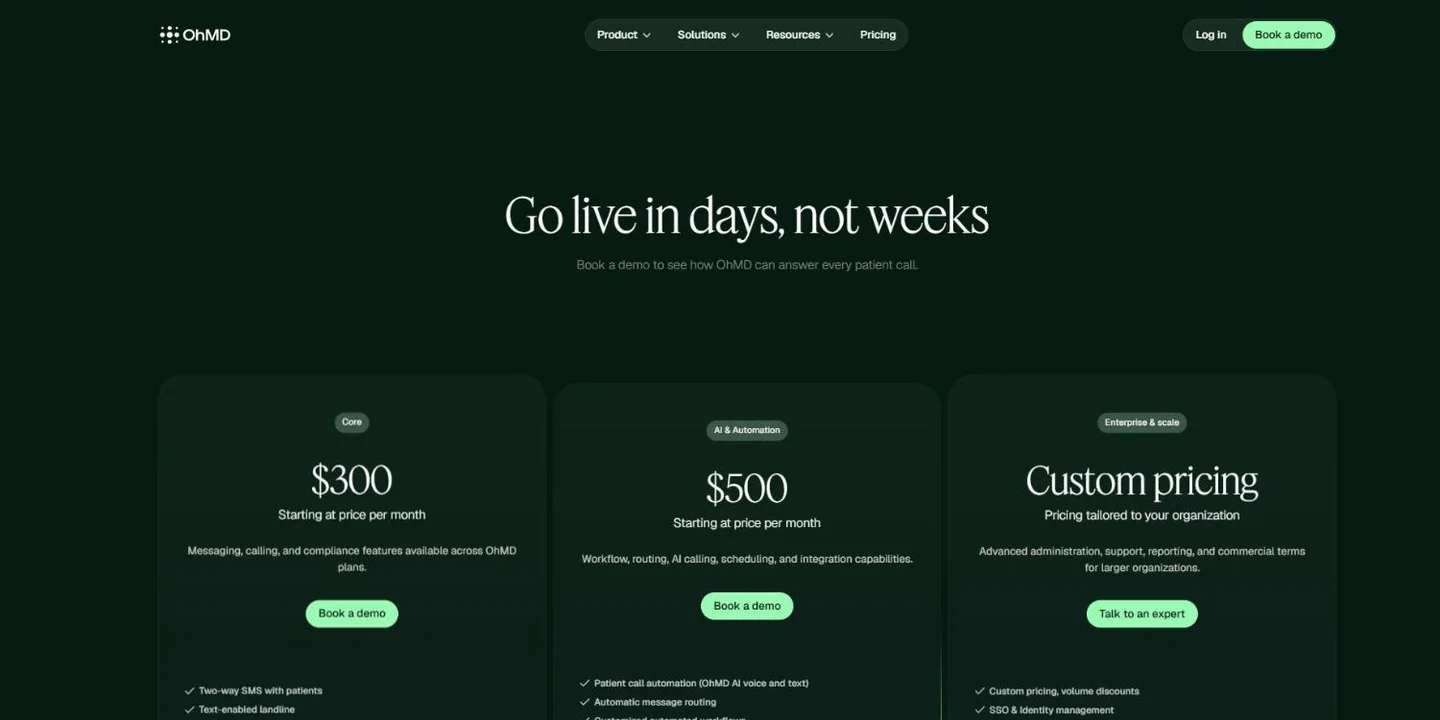
- Setup support. Setup and support was its lowest area, so ask what onboarding includes.
Why OhMD ranks #10. OhMD scores 38.0 / 76, with 82% of the evidence verified. Integrations and workflows (10 of 15 points) and security and transparency (3 of 5 points) are its strongest areas. Setup and support (1 of 10 points) is its lowest.
It is 2 points behind Ruby and 1 ahead of Sully.ai, both small gaps.
Choose OhMD if you already text patients through OhMD and want AI voice added.
Skip OhMD if you need usage rates or contract terms before a demo.
Skip it too if you need reviews that cover the AI product alone.
11. Sully.ai: best for practices that want a receptionist, scribe and coder from one vendor
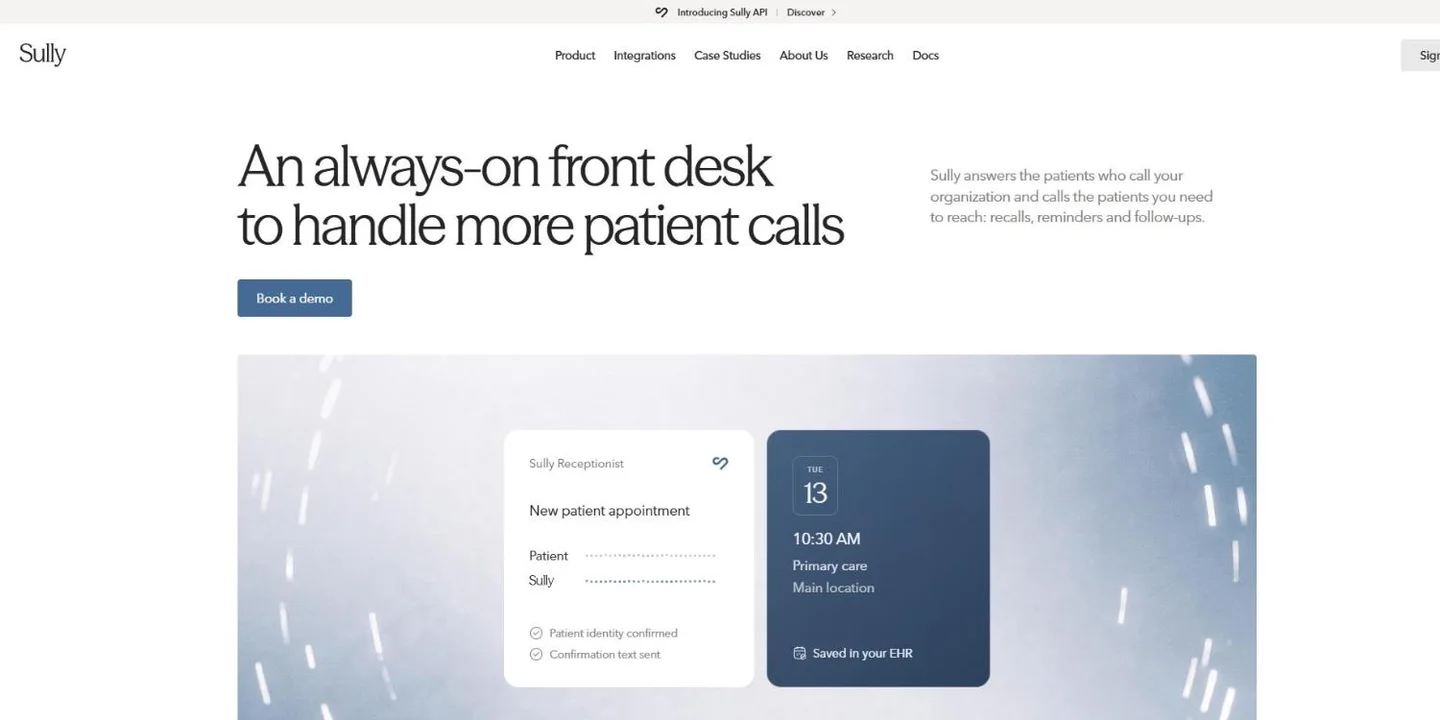
Our verdict: Sully.ai scores 37.0 / 76. It sells an AI receptionist beside a scribe, medical coder and consultant. It sells through a demo with no published price.
| Plan we priced | None published; demo only |
| Type | AI receptionist in a suite (also Scribe, Medical Coder, Consultant) |
| BAA | Vendor states “BAA with every customer” on its receptionist page |
| Billing note | Demo-based sales |
| Reviews | G2 0 (listing with no reviews yet) |
| Our rating | 37.0 / 76 |
Table note: Prices were checked on November 18, 2026. The product is the Sully.ai Receptionist, shown on its receptionist page. It publishes no pricing page.
What stands out:
- EHR list. The receptionist page shows logos for Epic, Cerner, athenahealth, AdvancedMD, eClinicalWorks, MEDITECH, NextGen, DrChrono, Elation and Healthie.
- Works inside your EHR. The vendor says the agent works inside the EHR you already use.
- Suite. A scribe, coder and consultant sit beside the receptionist.
- Trust page. The vendor links a trust page that lists SOC 2 Type 2, HITRUST and ISO 27001.
Pricing. Sully.ai publishes no prices, and the vendor sells through a demo. Ask for a written quote that names the receptionist alone.
What customers say. G2 lists Sully.ai with no reviews yet. Ask for clinic references and the trial terms.
Watch out for:
- Open terms. Ask about intake capture, usage and fee detail, contract flexibility and recording consent.
- Logos are not proof. An EHR logo does not show what the link reads or writes. Ask for a live demo in your EHR.
- Escalation. Warm transfers are described. The pages we read describe no on-call protocol.
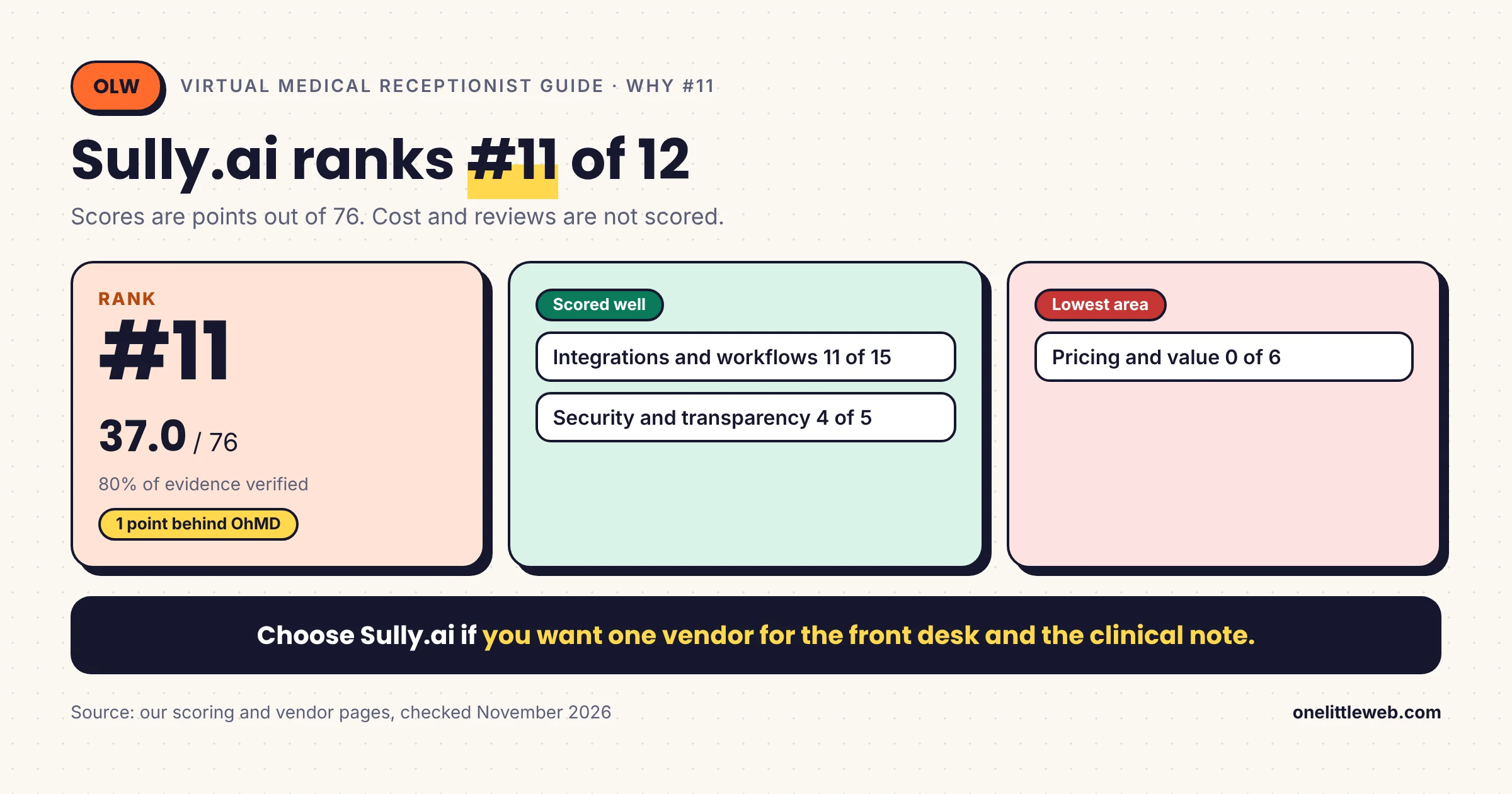
Why Sully.ai ranks #11. Sully.ai scores 37.0 / 76, with 80% of the evidence verified. Integrations and workflows (11 of 15 points) and security and transparency (4 of 5 points) are its strongest areas. Pricing and value (0 of 6 points) is its lowest.
It is 1 point behind OhMD, a small gap, and 4 ahead of DoctorConnect, a clear gap.
Choose Sully.ai if you want one vendor for the front desk and the clinical note. Treat it as a demo candidate.
Skip Sully.ai if you need published prices or contract terms.
Skip it too if you want a first choice with more verified evidence.
12. DoctorConnect: best for practices that want AI voice added to a patient engagement platform
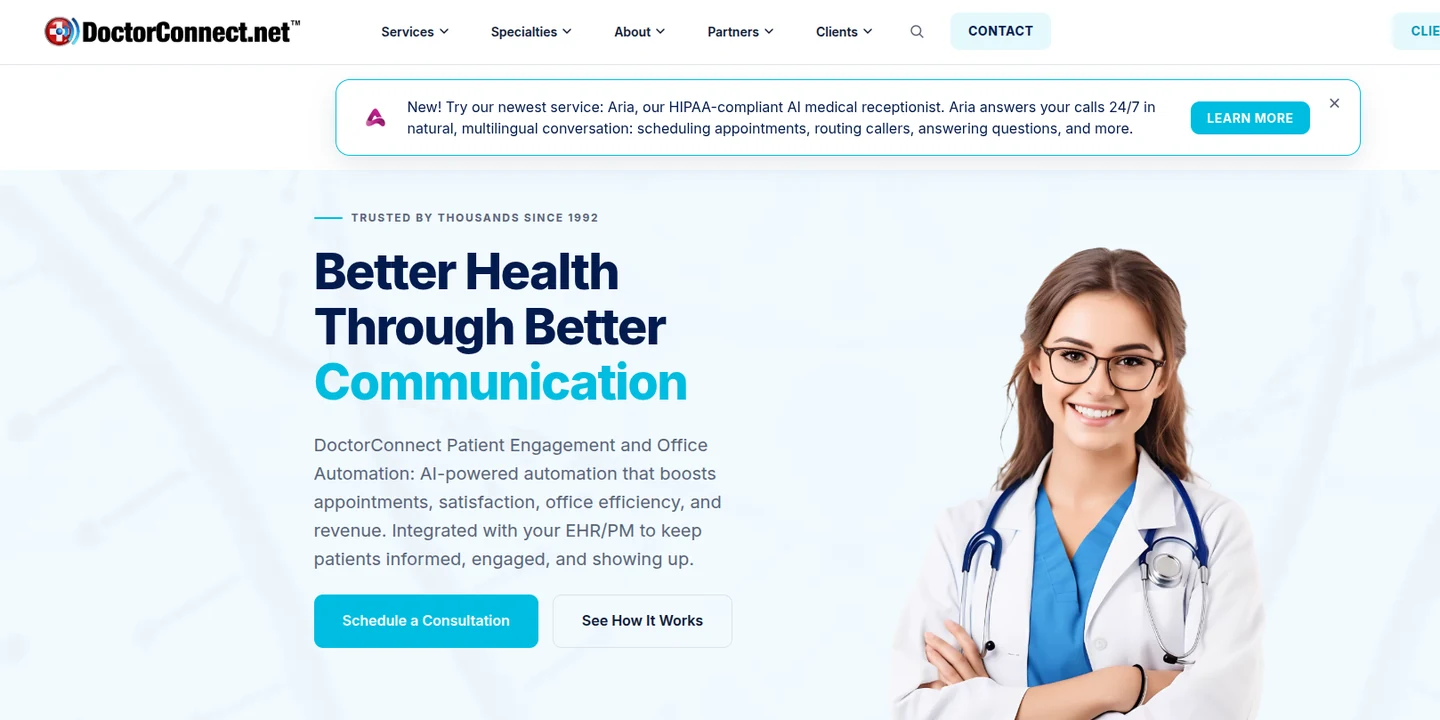
Our verdict: DoctorConnect scores 33.0 / 76. It adds an AI receptionist, ARIA, to a platform built for patient reminders, and it states a BAA is available.
| Plan we priced | None published for ARIA; pricing scales with practice size and modules |
| Type | AI voice agents on a patient engagement platform (ARIA, MIRA, KIRA, TITAN AI VOIP) |
| BAA | Vendor states a custom BAA is available to every healthcare customer |
| Billing note | Sales-led; no ARIA price |
| Reviews | No ARIA-specific listing; Capterra 4.7 (72) covers its reminder platform |
| Our rating | 33.0 / 76 |
Table note: Prices were checked on November 18, 2026. The product is DoctorConnect’s ARIA AI receptionist, shown on its ARIA page.
What stands out:
- Call routing. ARIA detects caller intent and routes or transfers the call. You can name transfer targets for the front desk, billing or on-call.
- Scheduling and answers. It books appointments in your schedule and answers questions on hours, directions and insurance.
- Integrations. The vendor cites 100+ EHR and practice systems and names none on the page we read.
- Data handling. The HIPAA page says patient data is stored in US data centers. It lists role-based access, audit logging and optional MFA.
Pricing. DoctorConnect publishes no ARIA price. The site says pricing scales with practice size and the modules you use, so ask for a written quote.
What customers say. We found no ARIA-specific review listing. Capterra shows 72 reviews at 4.7 stars, but they cover its reminders and texting. Ask for references from clinics that use ARIA.
Watch out for:
- Open terms. Ask for fee detail, contract flexibility, onboarding and recording consent in writing.
- Unnamed EHRs. “100+ systems” is not a named list. Ask whether yours is on it.
- Escalation. The page names transfer targets and describes no clinical urgency protocol.
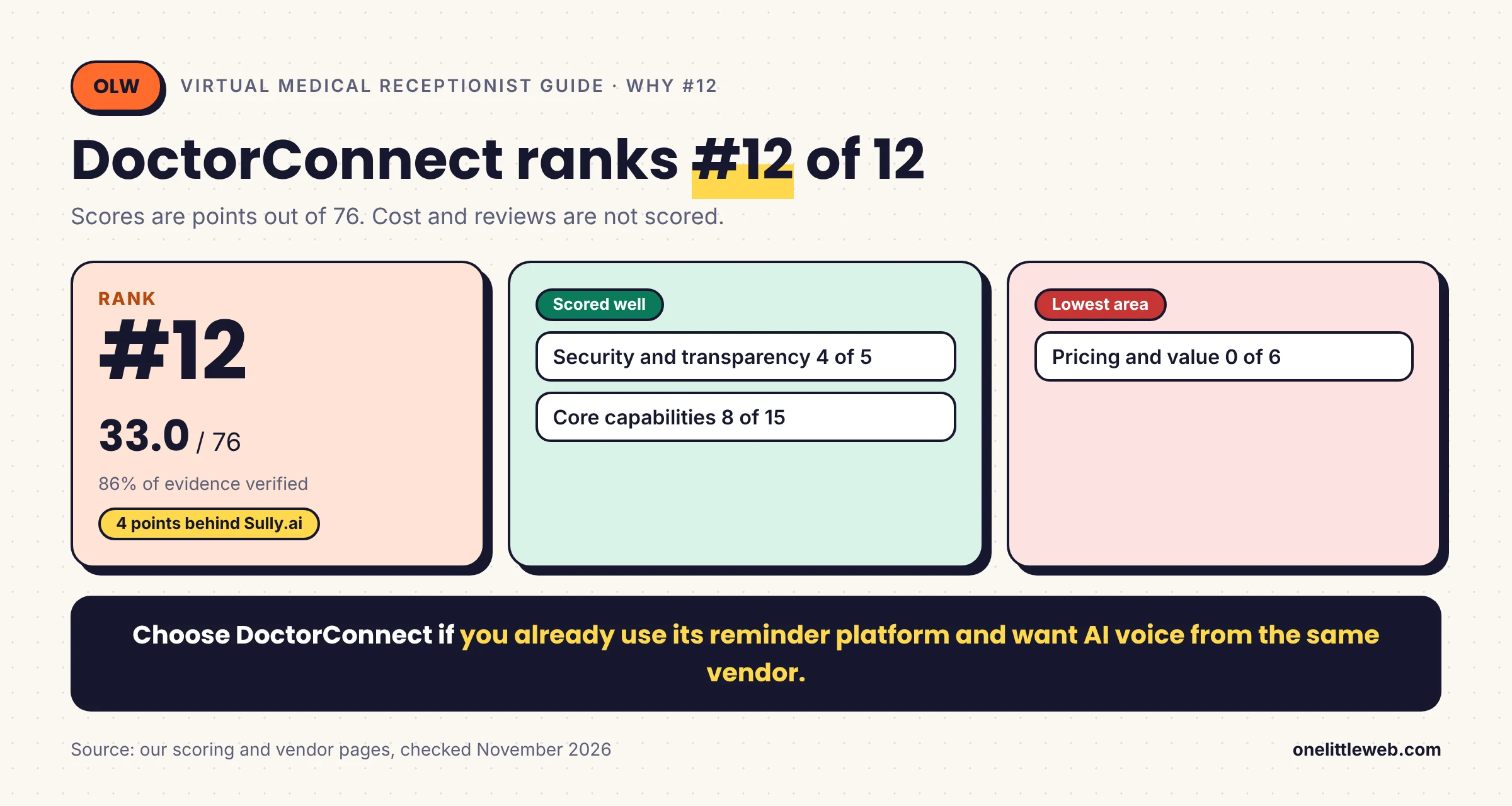
Why DoctorConnect ranks #12. DoctorConnect scores 33.0 / 76, with 86% of the evidence verified. Security and transparency (4 of 5 points) and core capabilities (8 of 15 points) are its strongest areas. Pricing and value (0 of 6 points) is its lowest.
It is 4 points behind Sully.ai, a clear gap.
Choose DoctorConnect if you already use its reminder platform and want AI voice from the same vendor.
Skip DoctorConnect if you need a published price or a named EHR list.
Skip it too if you want a first choice with a published price.
What the price leaves out
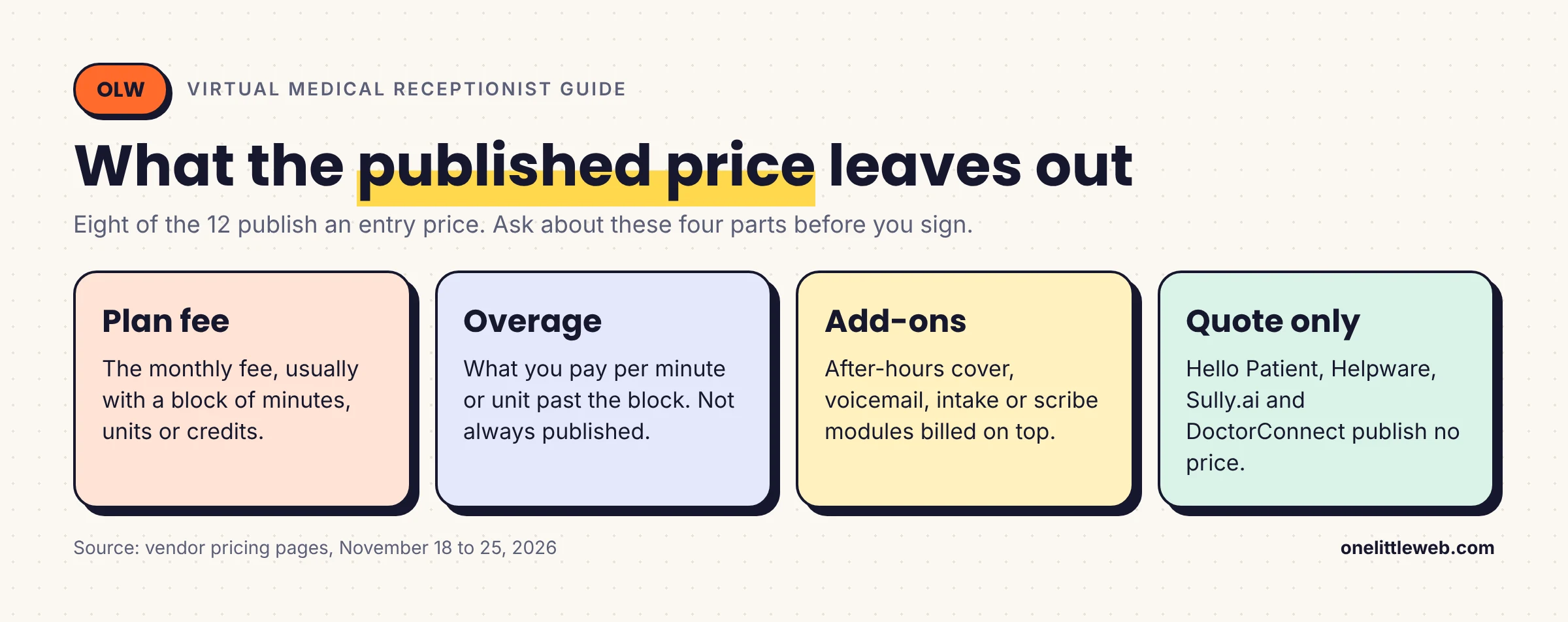
A published price rarely tells you the monthly bill. Some plans include a block of minutes or units. Others bill by provider, by call volume or by quote.
Eight of the 12 publish an entry price. The table shows what each published figure covers, and what to ask about before you sign.
| Provider | What the published price covers | Billed on top or worth asking about |
|---|---|---|
| MedReception AI | Plan fee with 500 or 1,000 minutes; Elite shows 2,000 (1,500 on Capterra) | Overage $1.25, $0.99 or $0.95 a minute; after-hours and voicemail are $99 add-ons on Essential |
| Specialty Answering Service | Economy $44 a month; larger plans from 100 minutes | $1.54 a minute on Economy; IVR and voicemail $0.15 a minute; patching $0.10 |
| DeepCura | Per-provider fee for the full agent bundle; 1,000 shared credits | Extra credits $59 a month; receptionist-only price not shown |
| PerfectServe | FAQ range of $89 to $119 per doctor a month for the human service | Sloane priced by practice size and call volume; scheduling coverage not stated |
| Hello Patient | Not published; usage-based across voice, text and web chat | Fees and contract length |
| Helpware | Not published; three plan tiers, quote only | Minutes, languages and setup work |
| Newo | 200 units a month for one agent at one location | $1.50 a unit over; Pay As You Go $1.75 a unit |
| Frontdesk | 200 voice minutes a month; $79 a month billed annually | Overage credits at $0.01 each; BAA plan coverage |
| Ruby | Four plans from 50 to 500 minutes | No overage rate shown |
| OhMD | AI & Automation from $500 a month; Core from $300 | Calling usage billed separately; rate not published |
| Sully.ai | Not published; demo only | Everything, until you have a quote |
| DoctorConnect | No ARIA price; scales with practice size and modules | Module and usage fees |
Table note: Figures come from vendor pages checked between November 18 and 25, 2026. Taxes are excluded. These are published prices, not total costs.
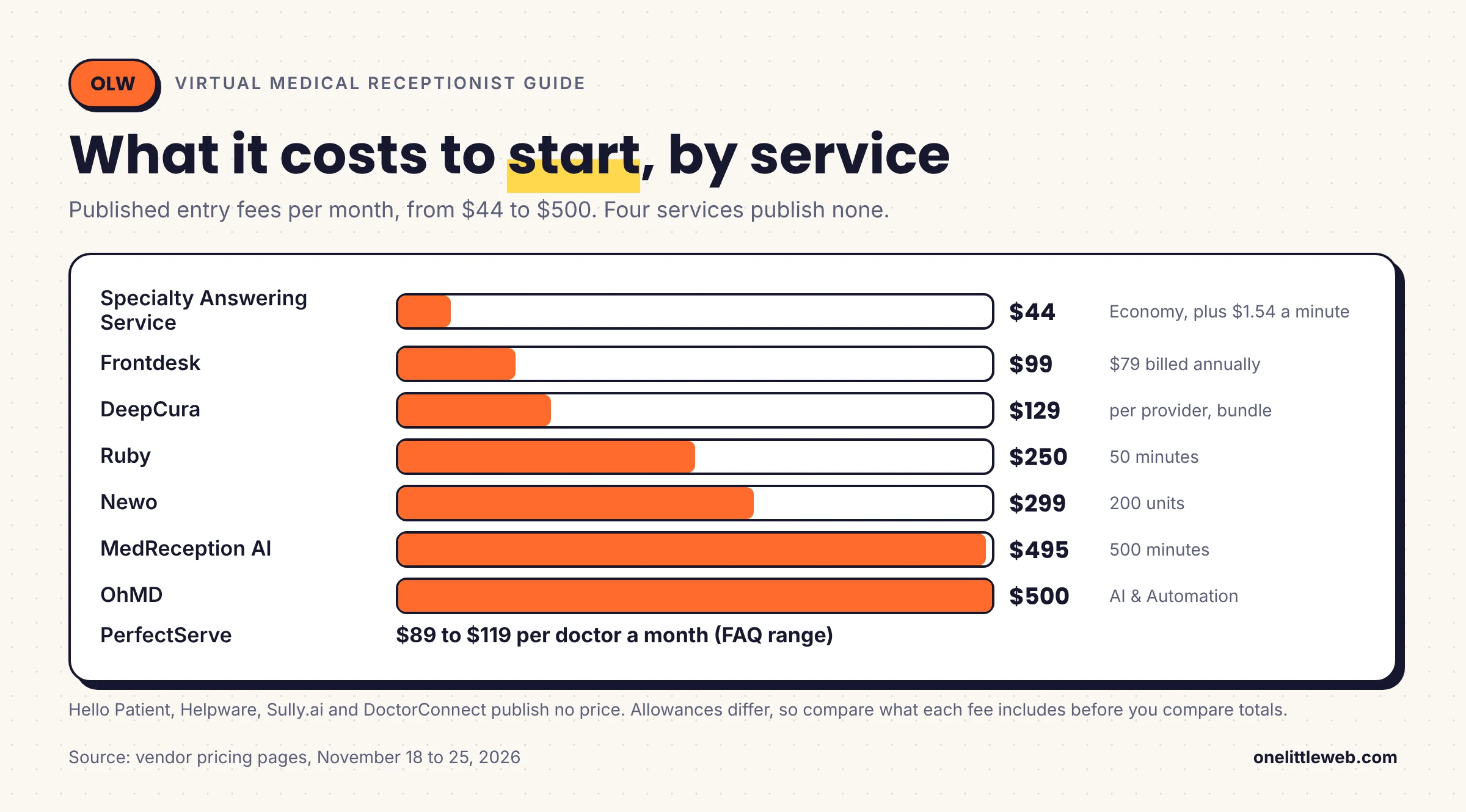
What it costs to start, and how to work out your bill
Fixed fees are the part you can plan for. The table lists the fee to start and the allowance each vendor states.
| Provider | Fee to start | Allowance and overage |
|---|---|---|
| MedReception AI | Essential $495/month; Studio self-build $299/month | 500 min; $1.25/min over |
| Specialty Answering Service | Economy $44/month | $1.54/min; billed by the second |
| DeepCura | $129/month per provider | 1,000 credits shared across agents |
| PerfectServe | $89 to $119 per doctor/month (FAQ range) | Flat rate; no per-minute charge on the human service |
| Hello Patient | Not published | Not published |
| Helpware | Quote only | Not published |
| Newo | $299/month; Pay As You Go $0 | 200 units; $1.50/unit over |
| Frontdesk | From $99/month ($79 billed annually) | 200 min; $0.01/credit over |
| Ruby | 50 minutes, $250/month | Not published |
| OhMD | AI & Automation from $500/month | Calling usage billed separately |
| Sully.ai | Demo only | Not published |
| DoctorConnect | Not published | Not published |
Table note: Prices checked between November 18 and 25, 2026. Each fee is from the vendor’s pages.
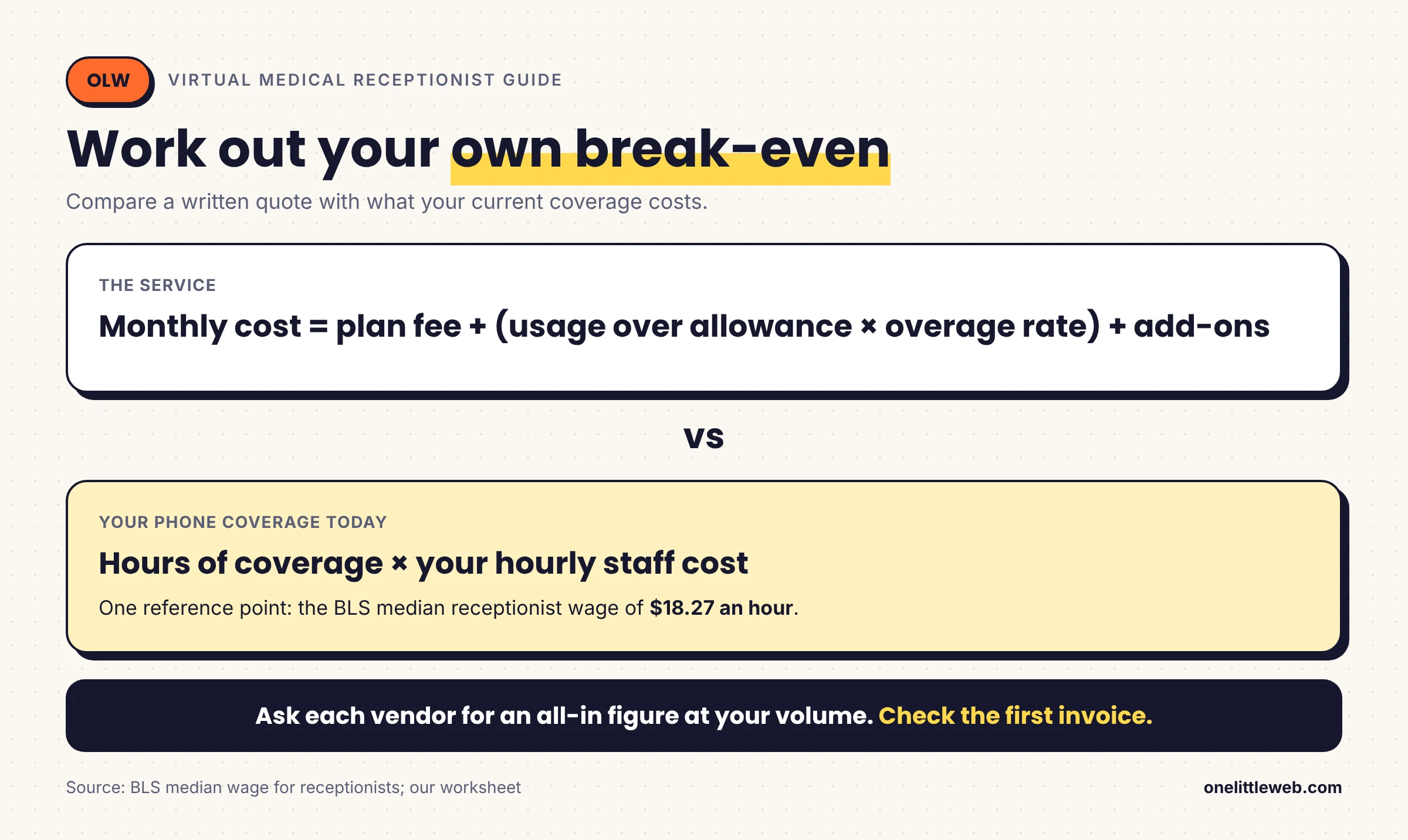
We did not build a cost-by-volume table. The plans bill in minutes, units, credits, doctors and quotes, and four publish no price for this service. A table would imply a comparison the pages do not support.
Use this worksheet with a vendor’s written quote. It compares the service with what your own phone coverage costs today.
Monthly cost = plan fee + (usage over the allowance × overage rate) + add-ons.
Next, add up what the same calls cost you now: hours of phone coverage times your hourly staff cost. The BLS median receptionist wage of $18.27 an hour is one reference point. Ask each vendor for an all-in figure at your call volume, then check the first invoice.
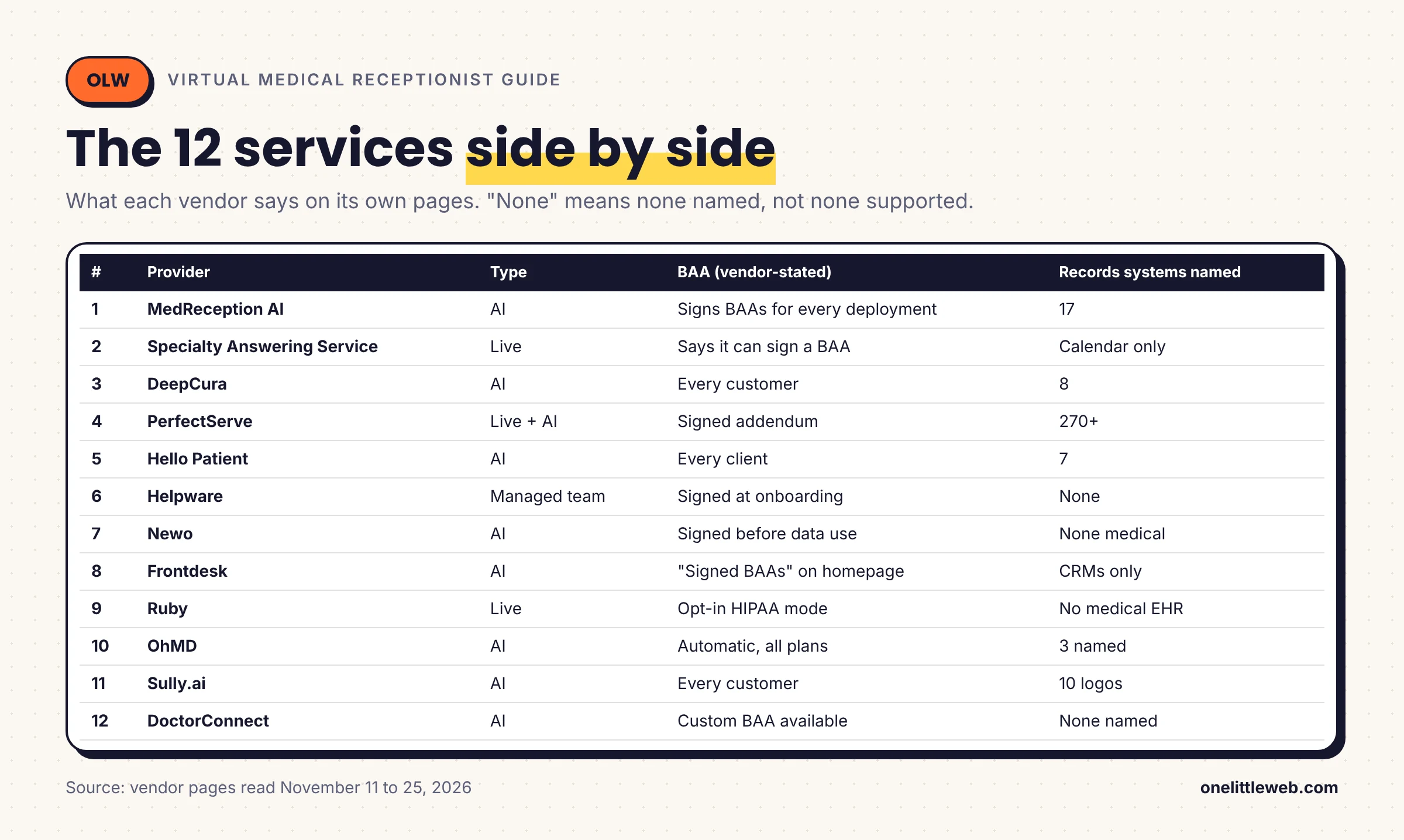
Side-by-side comparison
The table shows what each vendor’s own pages state. “Not stated” means the pages we read do not say it. It does not mean the feature is missing. BAA entries are vendor statements.
| Provider | BAA (vendor-stated) | Records systems named | Urgent calls | Scheduling | Languages stated |
|---|---|---|---|---|---|
| 1. MedReception AI | Signs BAAs for every deployment that touches patient data | 17 named | Live transfer to a nurse or on-call line by clinic rule | Books into the connected system | Multilingual support available |
| 2. Specialty Answering Service | Says it can sign a BAA | Online calendar only | Reaches you by phone, email, text or pager | Schedules, changes and cancels | Not stated for medical |
| 3. DeepCura | Every customer; Annex I of its Terms | Epic, athenahealth, eClinicalWorks and 5 more | Warm transfer when a human is needed | Books into DeepCura’s calendar | Not stated |
| 4. PerfectServe | Signed addendum before go-live | Epic, Oracle Health, 270+ systems | Routes by live on-call schedules; directs emergencies to 911 | Booking not stated for Sloane | English and Spanish (Sloane) |
| 5. Hello Patient | Every client | 7 named | Clinical requests go to a person | Visits and follow-ups | English and Spanish, more on request |
| 6. Helpware | Signed at onboarding | None named | Urgent calls to your on-call provider | Books, reschedules, cancels | 45+ |
| 7. Newo | Signed before patient data is processed | No medical EHR named | Person handoff stated | Writes into the scheduling system | 60 |
| 8. Frontdesk | “Signed BAAs” on the homepage; plan scope not stated | None; CRMs only | Routes urgent calls; human supervisor | Books with SMS confirmation | 20+ |
| 9. Ruby | Opt-in HIPAA mode with a BAA | Clio, Calendly; no medical EHR | Not stated | Booking and message delivery | Not stated |
| 10. OhMD | Automatic BAA for every user, on all plans | 3 named; 85 cited | Edge cases go to a person | Reschedules in the connected system | 60+ |
| 11. Sully.ai | Every customer | 10 logos shown | Warm transfers described | Reschedule, cancel, confirm | Not stated |
| 12. DoctorConnect | Custom BAA available | None named; 100+ cited | Transfer targets named | Books in your schedule | 34 |
Table note: Based on vendor pages read between November 11 and 25, 2026. A vendor statement is not a compliance check.
Which one fits your practice?
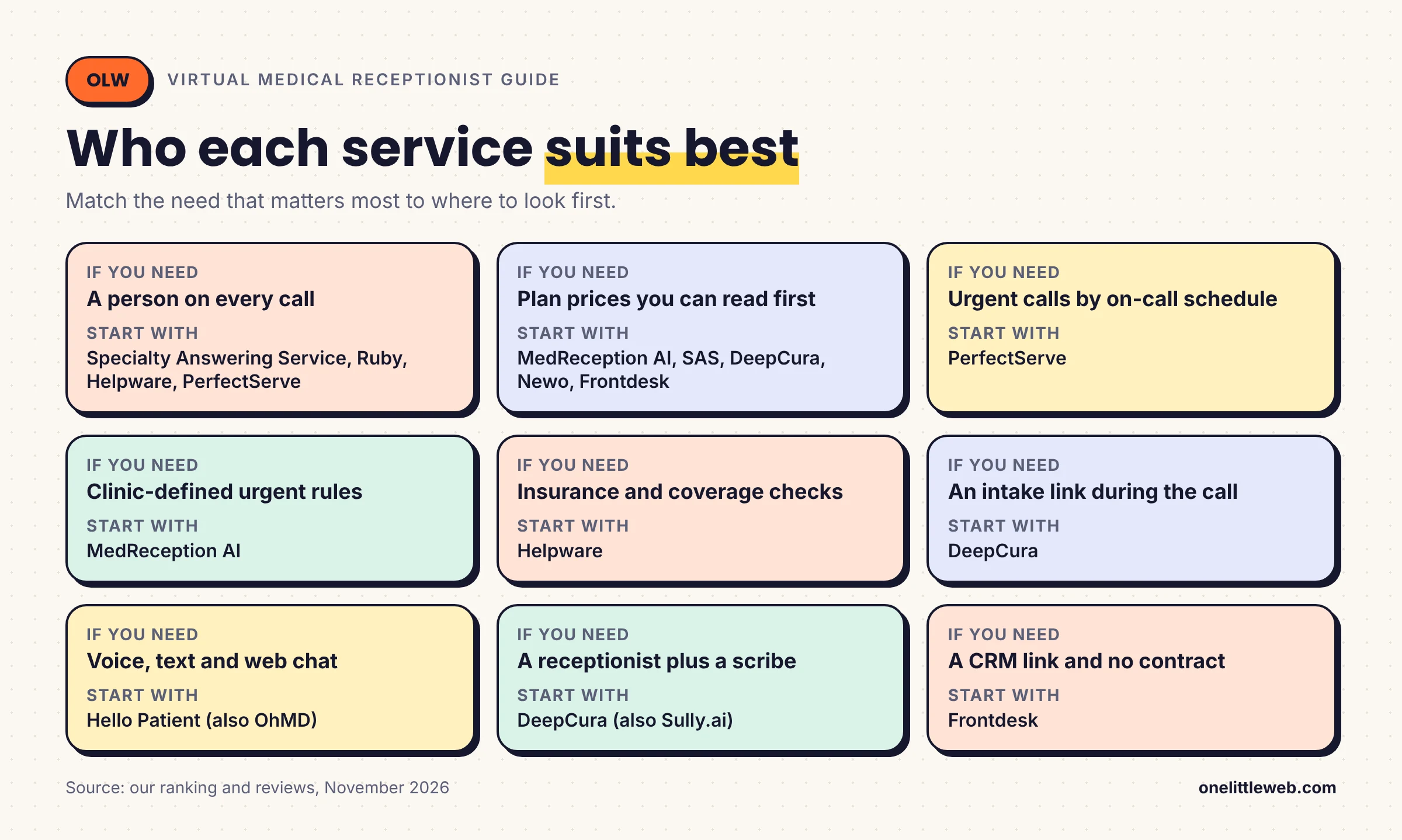
Your best fit depends on the need that matters most to your practice. The table points to where to look first. It is not a recommendation, because cost is unscored and reviews could not be matched to the exact products.
| If you need | Start by looking at | Why |
|---|---|---|
| A person on every call | Specialty Answering Service, Ruby, Helpware or PerfectServe | Each runs live agents or a managed team |
| Plan prices you can read first | MedReception AI, Specialty Answering Service, DeepCura, Newo or Frontdesk | Each publishes a monthly plan or starting price |
| Urgent calls routed by on-call schedule | PerfectServe | It states live on-call schedule routing |
| Clinic-defined urgent rules | MedReception AI | Clinicians set the rules; transfers go to a nurse or on-call line |
| Insurance and coverage checks | Helpware | The team checks coverage and eligibility before visits |
| An intake link sent during the call | DeepCura | It states it can text the link mid-call |
| Voice, text and web chat | Hello Patient | Also check OhMD, which pairs texting with AI voice |
| A receptionist plus a scribe | DeepCura | Also check Sully.ai, which adds a scribe and coder |
| A CRM link and no contract | Frontdesk | It states no contract and CRM links |
How to choose in six steps
- Decide who answers. Pick live agents, AI or a mix, and list the calls that must reach a person.
- Get the BAA. Ask for the agreement and check that it covers your exact plan.
- Confirm your EHR in writing. Ask whether the link reads, writes or both.
- Set the urgent-call rule. Write down who answers, and how fast.
- Ask for an all-in price. Use your real call volume, then compare with your current phone cost.
- Pilot before you commit. Start with one line, and read the call summaries each day.
Run a five-check pilot
Run these five checks yourself before you route patient calls to any service.
| Step | What to do | What to look for |
|---|---|---|
| 1. Routine call | Ask for a refill and a visit | Does it capture the details and read them back? |
| 2. Booking | Book a visit, then change it | Does the change appear in your EHR? |
| 3. Urgent call | Use a scenario your clinical lead wrote | Does it reach the right person fast? |
| 4. Language | Place a call in Spanish | Does it stay accurate and offer a person? |
| 5. Records | Ask for recording, retention and consent terms | Are they written down, and can you export calls? |
Decision checklist
Other options we looked at but didn’t rank
More services came up in our screening. We did not rank them, so they carry no rating. Each group was left out for a different reason.
| Group | Products | What kept them unranked |
|---|---|---|
| Hourly medical virtual assistants | Honest Taskers, Medical Staff Relief, Hello Rache, MEDVA | They supply dedicated staff, not call answering. Honest Taskers lists $12 an hour part-time and $10.65 full-time. Medical Staff Relief starts at $10 an hour and Hello Rache is $9.50. Staff location is not stated for several, so the data-handling check stayed open. |
| Healthcare AI with an unclear gate | Assort Health, Clinekt Health, CureMD AI Contact Center, OmniMD, Voicify, PilotPractice, Nexa | The pages we read did not confirm a BAA that covers the AI product. Several price by quote or show no price. PilotPractice shows $499 a month on its dental page. |
| General services with a healthcare option | Abby Connect, Posh, Smith.ai, AnswerConnect | They did not state a BAA on the pages we read. Abby Connect starts at $164 a month for 50 minutes, and Posh starts at $65 a month. Smith.ai starts at $1.60 a call for AI-first. |
| Developer platforms | Retell AI, Synthflow | You build the agent yourself, so they are not ready-made receptionists. |
| States it does not sign BAAs | Aira | Aira states that it does not sign BAAs, so it did not pass our first gate. |
Table note: Prices come from vendor pages checked between November 11 and 25, 2026. Unclear means the pages we read did not settle the check, and it is not a fail.
Want an AI-only option? See our guide to the best AI receptionists for small business.
Want more AI picks for clinics? Our AI medical answering services guide ranks nine AI-only products.
Comparing live-agent costs? See our virtual receptionist services guide, which compares eight services by real monthly cost.
Frequently asked questions
What is a virtual medical receptionist?
It is a remote service that answers a practice’s calls. The caller may reach a live agent, an AI voice agent or a mix of both. It books visits, takes refill requests and sends urgent calls to your on-call clinician.
Is a virtual medical receptionist HIPAA compliant?
Compliance depends on your agreement and how the vendor handles patient data. All 12 services state they offer a BAA, and we did not verify compliance. Ask for the agreement, check it covers your plan and consult a qualified adviser.
Do virtual medical receptionists sign a BAA?
All 12 state that a BAA is available, in different ways. Some sign at onboarding, some before go-live and some on request. HHS explains the rule in its business associate FAQ. This is not legal advice.
What is the difference between a virtual medical receptionist and an AI receptionist?
A virtual medical receptionist is the broader term. It covers live agents, AI and hybrid services. An AI receptionist is software that answers without a person on the line. Eight of the 12 ranked services are AI, and four put people on calls.
Can a virtual receptionist handle urgent calls?
Services describe routing or transferring urgent calls to staff or an on-call line. They do not replace emergency care. Write down who answers and how fast. Tell patients with an emergency to call 911, and test the rule before you rely on it.
Which virtual medical receptionists connect to my EHR?
It depends on your system. MedReception AI names 17 systems, Hello Patient seven, DeepCura eight and OhMD three. PerfectServe names Epic and Oracle Health, and several services name none. Ask whether the link reads, writes or both.
Can a virtual medical receptionist book and reschedule appointments?
Several state they can. The vendor pages describe booking into a connected system, a built-in calendar or an online calendar. PerfectServe’s Sloane page does not say it books. Confirm which system the booking lands in.
Do virtual medical receptionists speak Spanish?
Some state it. PerfectServe’s Sloane and Hello Patient name English and Spanish. OhMD cites 60+ languages, Newo 60, Helpware 45+, DoctorConnect 34 and Frontdesk 20+. Ask for a test call in Spanish.
How is a virtual medical receptionist priced?
It depends on how the vendor bills. Some charge a plan with included minutes, units or credits. Others bill per doctor, by usage or by quote. See what the price leaves out for how each published fee works.
How did you rank these services?
We ordered the 12 services by confirmed points on one rubric with 76 points. The points come from vendor pages and published sources. Cost and reviews are not scored, so compare scores only within this guide.
Methodology
This guide ranks remote services that answer patient calls for US practices. It is research-based. We read and checked published sources, and we placed no test calls.
What this guide covers
This guide covers three kinds of service.
- Live-agent services. People answer your calls. SAS and Ruby are in this group.
- Hybrid services. A managed team or human service pairs with AI tools. PerfectServe and Helpware are in this group.
- AI receptionists. Software answers the call. The other eight are in this group.
Some providers also appear in our other healthcare guides. This guide covers live, AI and hybrid options together. Scores from this guide do not compare with scores from other guides.
Why BAA and data handling came first
A practice’s phone line carries patient information. Under HIPAA, a vendor that handles protected health information for a practice is a business associate. The practice needs a written agreement with it. HHS explains this in its business associate FAQ.
So data handling was our first requirement, ahead of cost, features and reviews. Each provider had to describe how it handles patient data and state that a BAA is available. A statement of “available on request” counted.
This gate screens on what vendors say. It is not an audit. We did not see signed agreements, review security reports or test any product. Services with no clear statement appear under Other options with no rating.
Which services we considered
A service had to publish how it handles patient data and state that a BAA is available. Urgent-call escalation was scored, not required. A term we did not find is recorded as unclear, never as a fail.
We screened more than 20 candidates and ranked 12. Developer platforms are listed as alternatives. Providers with an India or Pakistan headquarters address and contact number were left out by an editor rule. US availability was not a gate.
Hourly virtual-assistant providers and several healthcare AI products stayed unranked, because their pages did not settle the gate.
What we checked
The rubric has six evidence areas that add up to 76 points.
| Area | Points | What we looked at |
|---|---|---|
| Industry and audience fit | 25 | Practice call types, workflows and specialty capabilities such as EHR links, BAA and on-call handling |
| Core capabilities | 15 | Call handling, intake, scheduling, urgent escalation, call records |
| Integrations and workflows | 15 | EHR and practice system links, actions it can take, telephony and data delivery |
| Setup and support | 10 | Onboarding, administration and adaptability |
| Pricing and value | 6 | Usage and fee transparency, contract flexibility |
| Security and transparency | 5 | Data handling, retention, recording consent, access controls, BAA availability |
How the score works
Each check is marked Verified, Confirmed absent, Not Verified or Conflicting. A provider earns points only for Verified or Confirmed absent checks. Not Verified earns zero, which is a gap in our evidence and not a failure.
Between 80% and 99% of each provider’s evidence is verified. A lower share means more items are still being confirmed, so a lower-evidence provider could move once they are.
Why the score is out of 76
Our full rubric also holds points for reviews and for cost under a standard scenario. We could not score either one for this list. Plans bill in minutes, units, credits, doctors and quotes, and exact-product review listings were not located.
So the rating counts the 76 points we could score. A score of 57 means 57 of 76. Compare scores only within this guide. We did not rescale them, and we did not guess the missing points.
How we handle reviews
We show review ratings for reference only. A listing counts only if it names the product we evaluated. Several listings cover a whole company or a different product, such as a texting suite or a scribe. We label those as reference and do not score them.
A review count shows how much evidence exists. It does not show call quality. Where a vendor-invited pool such as Trustpilot appears, we say so.
How we handle pricing
We recorded published plans and rates from each vendor’s pages between November 11 and 25, 2026. Taxes are excluded. Where a vendor publishes no price, we say so and state none.
A published price is not a total cost. Read what the price leaves out.
How we handle BAA and HIPAA claims
BAA and HIPAA points are what each vendor states on its own pages. We did not see a signed agreement for any provider. We did not run a compliance check. Treat every such point as a claim to confirm in writing.
How we rank
Providers are ordered by confirmed points, highest first. Gaps under 1 point are ties. Gaps of 1 to 3 points are small, and larger gaps are clear. Services with the same score share a tie, so their order carries no meaning.
What we did not do
We did not place test calls. We did not measure voice quality, accuracy or uptime. When a vendor says its service can do something, we report it as the vendor’s claim. Our pilot checks show how to test one yourself.
Limits of our data
This guide is research-based. We read published vendor pages and review sites, and we placed no test calls.
Cost and exact-product reviews could not be scored. Read the order as a first filter, and confirm price, BAA and EHR links with each vendor in writing.
- Every fact comes from vendor pages and published sources, not from our own calls or tests.
- Pages change. Prices were checked between November 18 and 25, 2026.
- PerfectServe is scored as one combined offer, the human service plus Sloane.
- DoctorConnect’s BAA and ARIA pages were read as text after our browser was blocked.
- The 12 ranked providers are not the whole market.
Independence and disclosure
No provider paid for placement in this guide. Rankings come from the scored evidence only.
This guide has no affiliate links. If that changes, we will say which links earn a fee and mark them as sponsored.
The bottom line
No service wins on every point. MedReception AI scores highest at 57.0 / 76 and has the most complete evidence. Specialty Answering Service, DeepCura and PerfectServe share the next score, 46.0.
Pick by who you want on the phone. Choose live agents if every call needs a person. Choose AI if routine calls dominate, and a hybrid if you want both. Then ask two finalists for a written BAA, an EHR confirmation and an all-in quote.
Your practice also needs patients to find it online. If your site needs work too, see our list of healthcare web design agencies.
Sources
Prices and plans were read from the vendor pages linked in this guide between November 18 and 25, 2026.
Each source is linked where the article uses it, so we do not repeat the links here. Vendor pages sit in the verdicts, tables and Other options. The BLS and HHS pages sit in the explainer sections.