Taking a claim call and handling a claim are two different jobs. An answering service does the first, and your adjuster or the carrier does the second.
That first job still decides how a policyholder feels about your agency. A storm can bring a wave of loss notices in one night. A quote request can arrive at any hour, and a certificate request often has a deadline.
The six insurance answering services we ranked split into five AI services and one live answering team. Three publish a price, and three quote on request.
Each review shows how the service takes a loss notice, which agency-management systems it names and what it costs.
Our top picks
Insurance answering services worth shortlisting first are Aloware, JustCall, Sonant and CallSphere. Start with Aloware if you want claim, quote and certificate calls written into your agency-management system. Pick JustCall for published security standards, Sonant for caller checks, and CallSphere for a low monthly price.
- Aloware is best for claim, quote and certificate intake written into your agency system. Its voice agent starts at $0.10 a minute.
- JustCall is best for published security standards and a per-minute price. Its voice agent starts at $0.15 a minute.
- Sonant is best for P&C agencies that want caller checks before any detail is shared. It quotes a price after a demo.
- CallSphere is best for a low monthly price and a handoff to the carrier’s claim line. Its Act plan costs $49 a month plus usage.
Prices are entry-plan, in US dollars, checked November 23, 2026. Scores are out of 100, and two more services sit below with their own reviews. How we scored them.
Quick comparison table
| Provider | Best for | Entry price and billing | Type | Key capability | Main trade-off | Our rating |
|---|---|---|---|---|---|---|
| 1. Aloware | Claim, quote and certificate intake written into your agency system | From $0.10 a minute | AI | Core capabilities 15 of 15 | Setup and support 5 of 10 | 78.9 / 100 |
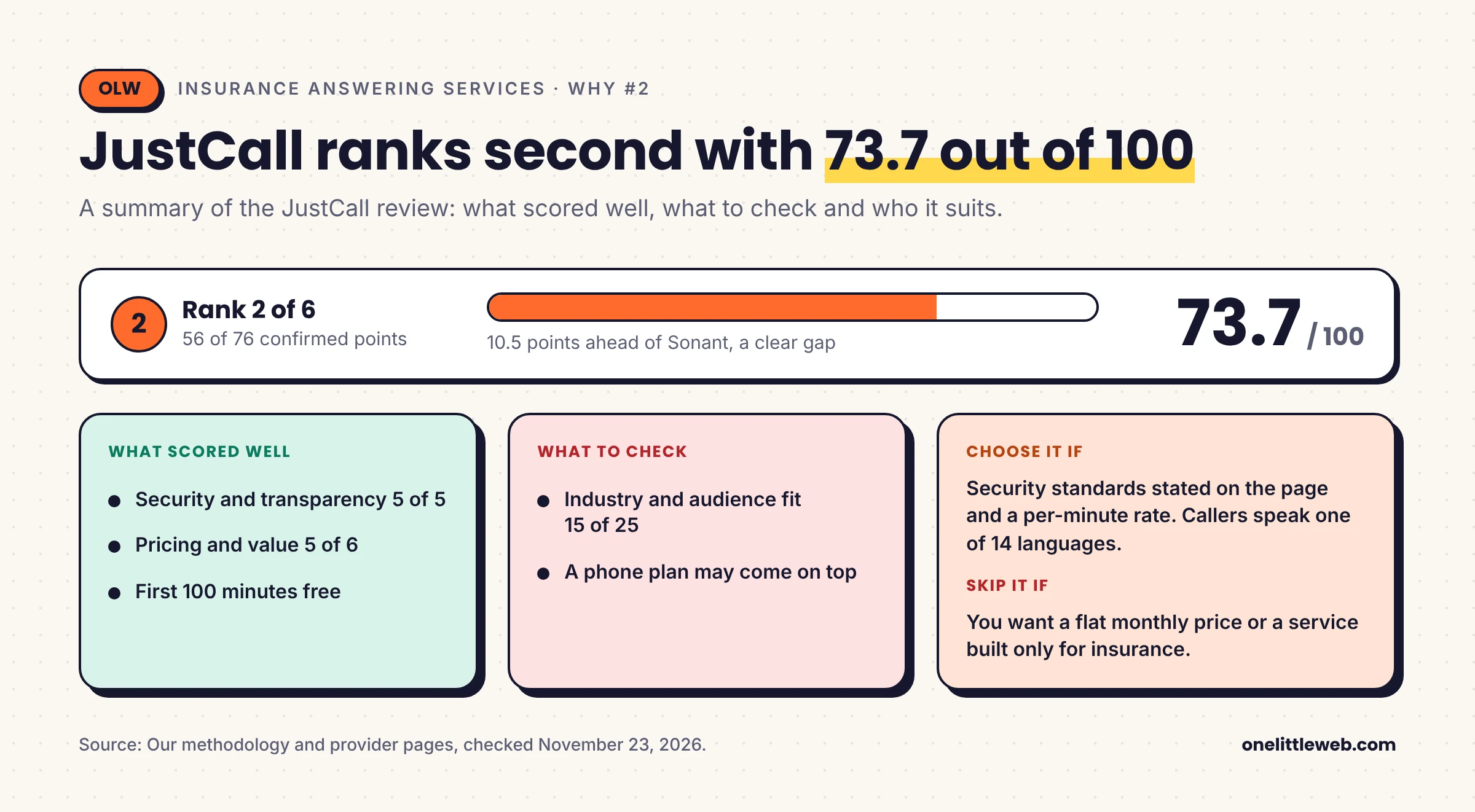
| 2. JustCall | Published security standards and a per-minute price | From $0.15 a minute | AI | Security and transparency 5 of 5 | Industry and audience fit 15 of 25 | 73.7 / 100 |
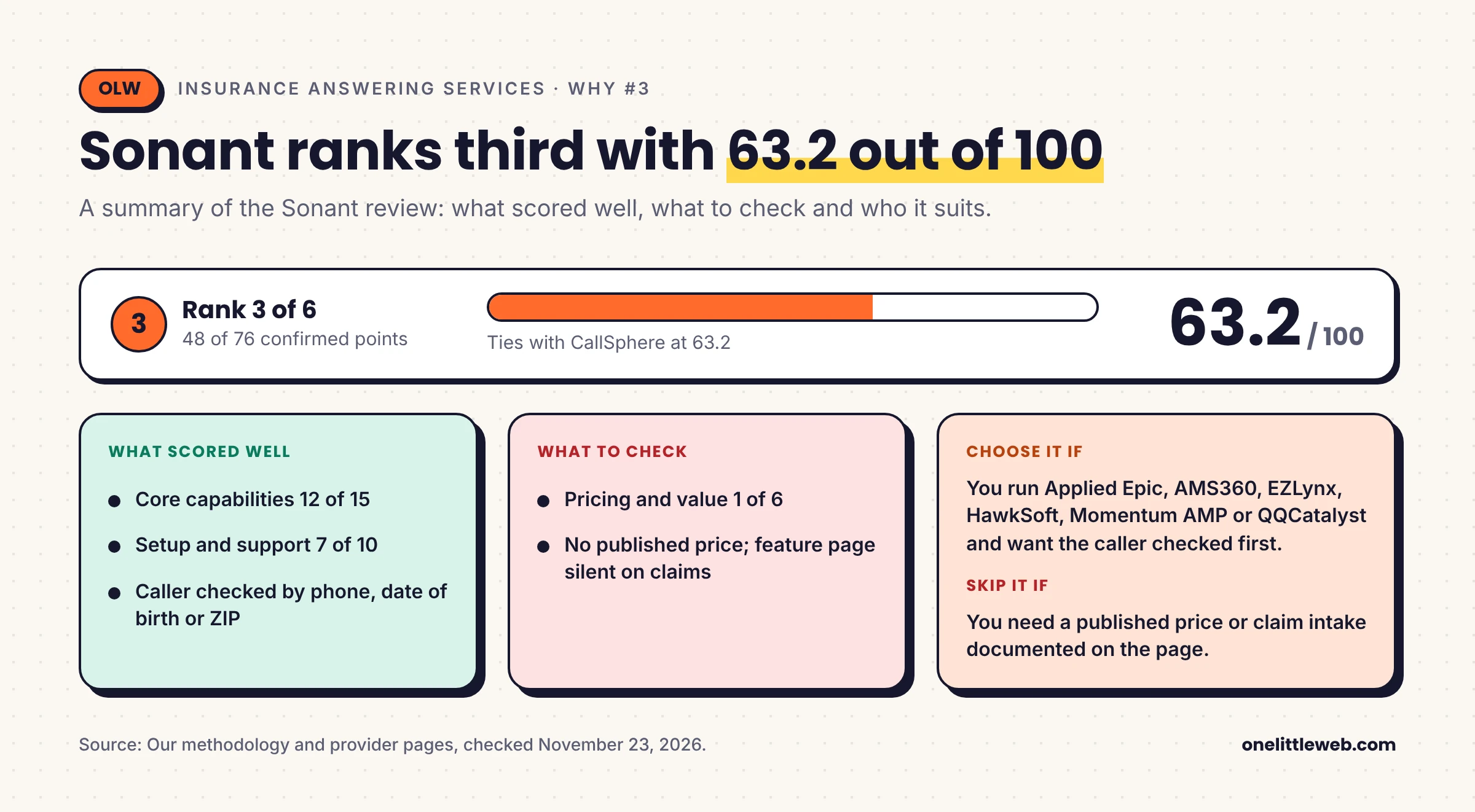
| 3. Sonant | Caller checks before any detail is shared | No price published; quote after a demo | AI | Core capabilities 12 of 15 | Pricing and value 1 of 6 | 63.2 / 100 |
| 4. CallSphere | A low monthly price and a handoff to the carrier’s claim line | Act $49 a month plus usage | AI | Security and transparency 5 of 5 | Industry and audience fit 11 of 25 | 63.2 / 100 |
| 5. Ainora | A custom build for callers in many languages | Fixed quote after a consultation | AI | Security and transparency 5 of 5 | Pricing and value 0 of 6 | 60.5 / 100 |
| 6. Answer United | Live agents for storm claim overflow | No price published; quote on request | Live agents | Core capabilities 9 of 15 | Integrations and workflows 3 of 15 | 42.1 / 100 |
Table note: Prices were checked on November 23, 2026, and exclude taxes. Ratings are out of 100 and do not compare with other guides. Gaps under 1.3 points are ties, and gaps of 1.3 to 3.9 are small.
What is an insurance answering service?
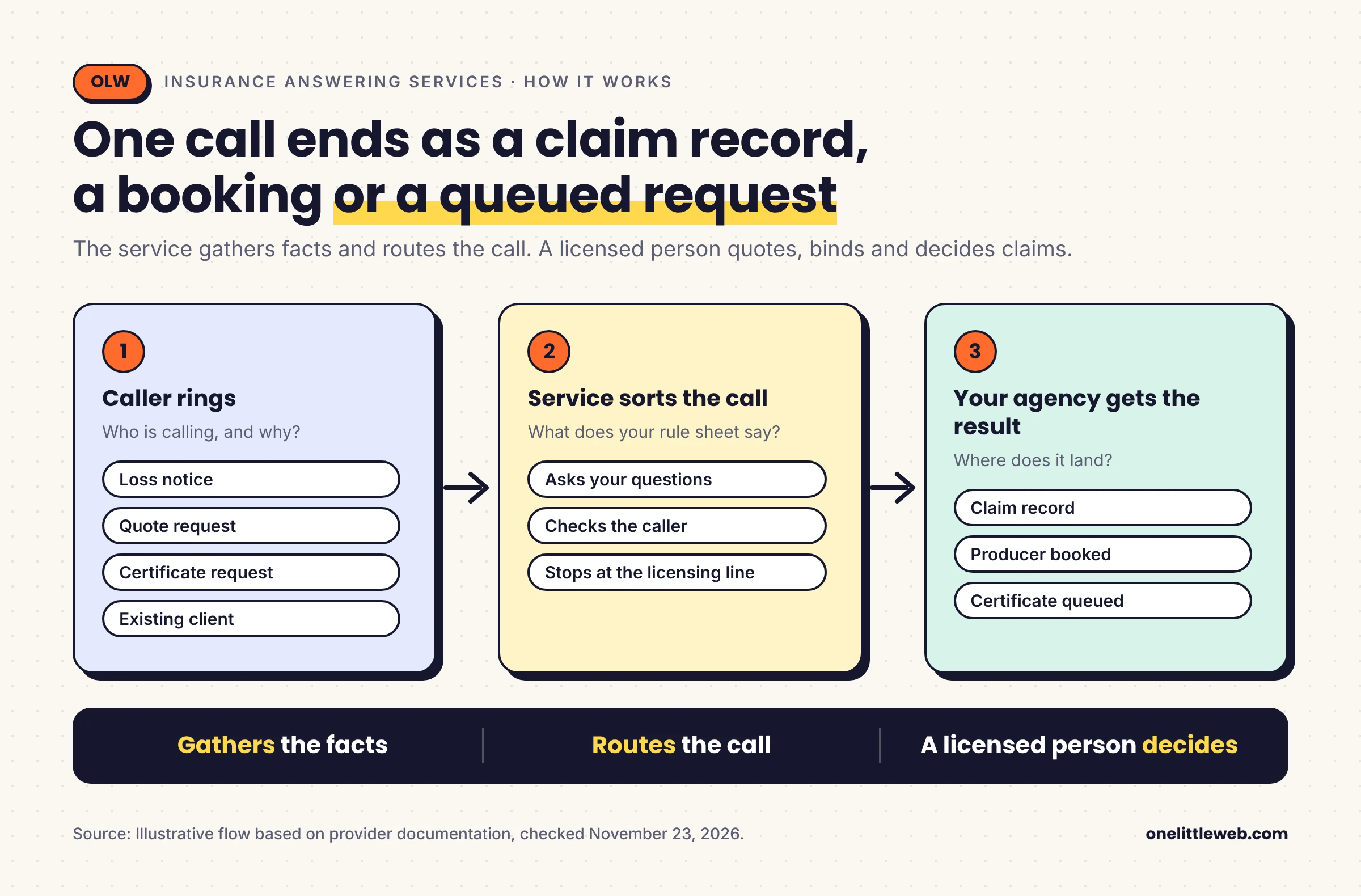
An insurance answering service picks up your calls and sends each one where your rules say. A loss notice becomes a record in your agency-management system. A quote request becomes a booked slot with a producer.
Services come in three kinds, based on how you buy them. Some AI services publish a price. Others quote after a demo. A live service uses human agents only.
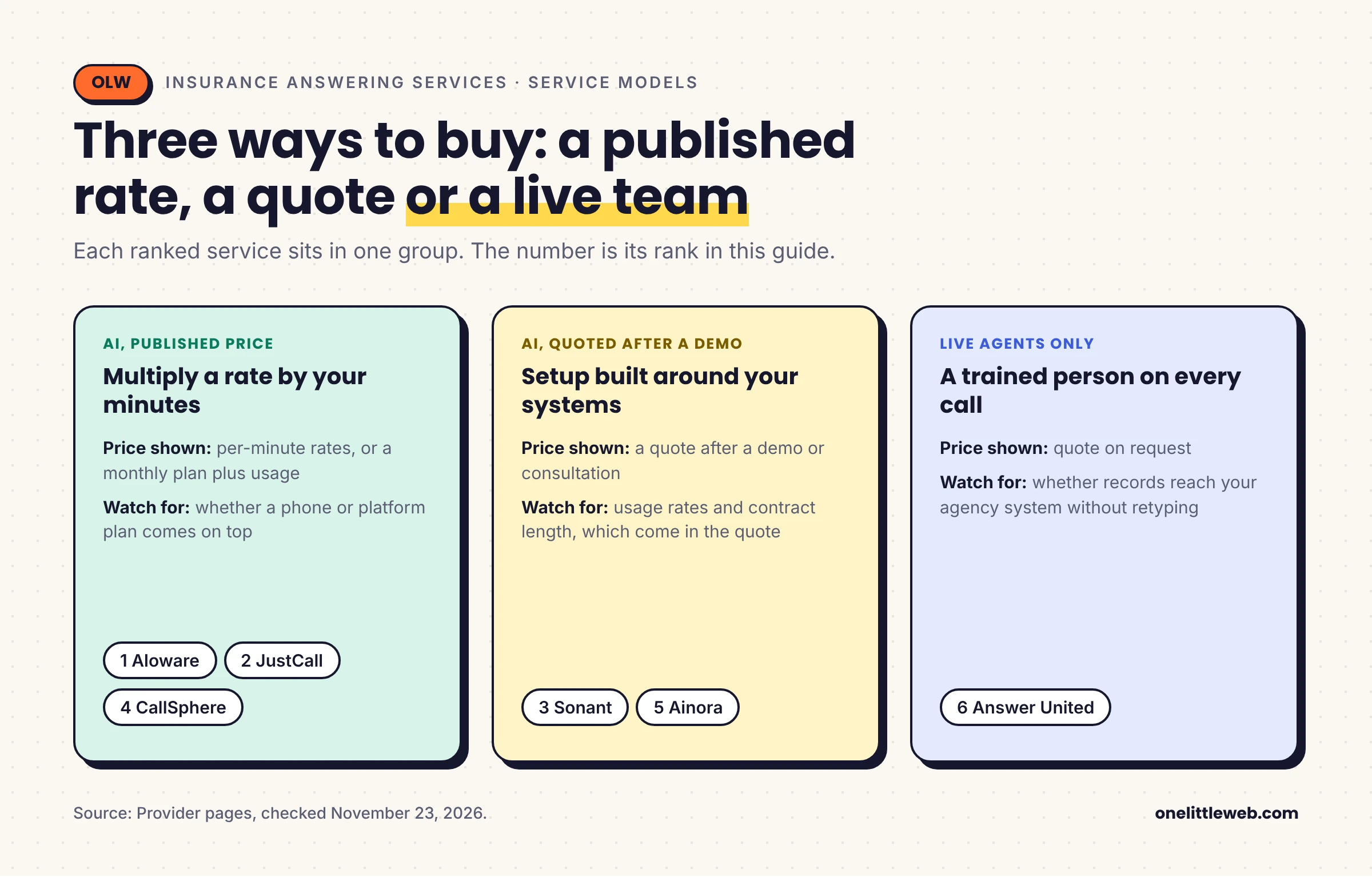
The table compares the three kinds and shows where each ranked service sits.
| Model | Best for | Watch for | Price shown | In this guide |
|---|---|---|---|---|
| AI with a published price | Agencies that want to multiply a rate by their own minutes | Whether a phone or platform plan is needed on top | Per-minute rates, or a monthly plan plus usage | Aloware (1), JustCall (2), CallSphere (4) |
| AI quoted after a demo | Agencies that want a setup built around their own systems | Usage rates and contract length, which come in the quote | Quote after a demo or consultation | Sonant (3), Ainora (5) |
| Live agents only | Agencies that want a trained person on every call | Whether records reach your agency system without retyping | Quote on request | Answer United (6) |
Table note: Groups follow how each provider sells its service. Numbers in brackets are each service’s rank in this guide. Services in the same group still differ in claim intake, system links and language coverage.
Every AI service here states the same limit. It gathers facts and routes the call, and a licensed person quotes, binds and decides claims. Ask each vendor where its service stops.
Storm weeks change the picture. Calls arrive in bursts, and many are loss notices. The five-call test shows how to check each service on a real call.
Is an answering service worth it for an insurance agency?
Yes, if calls reach voicemail while your team is with clients or the office is closed. A service covers hours and busy spells that one hire cannot. The U.S. Bureau of Labor Statistics reports median receptionist pay of $38,010 a year in 2025.
That is about $18.27 an hour for one front-desk hire, before benefits. An insurance service adds two jobs a general service may skip.
It takes a loss notice with the details your adjuster or the carrier needs, and it stops at the licensing line. Ask each vendor what its service will not do.
How we picked
We screened 10 services and ranked six. The entry gate looked for three things: claims intake, a named agency-management system or CRM, and a published data-handling page.
Five of the six documented all three on their pages, and each review says what those pages show. Answer United documented two and ranks last. Four others sit under other options with the check each one missed.
Phone systems and out-of-type products are excluded. Services that missed one gate item rank below every service that met all three.
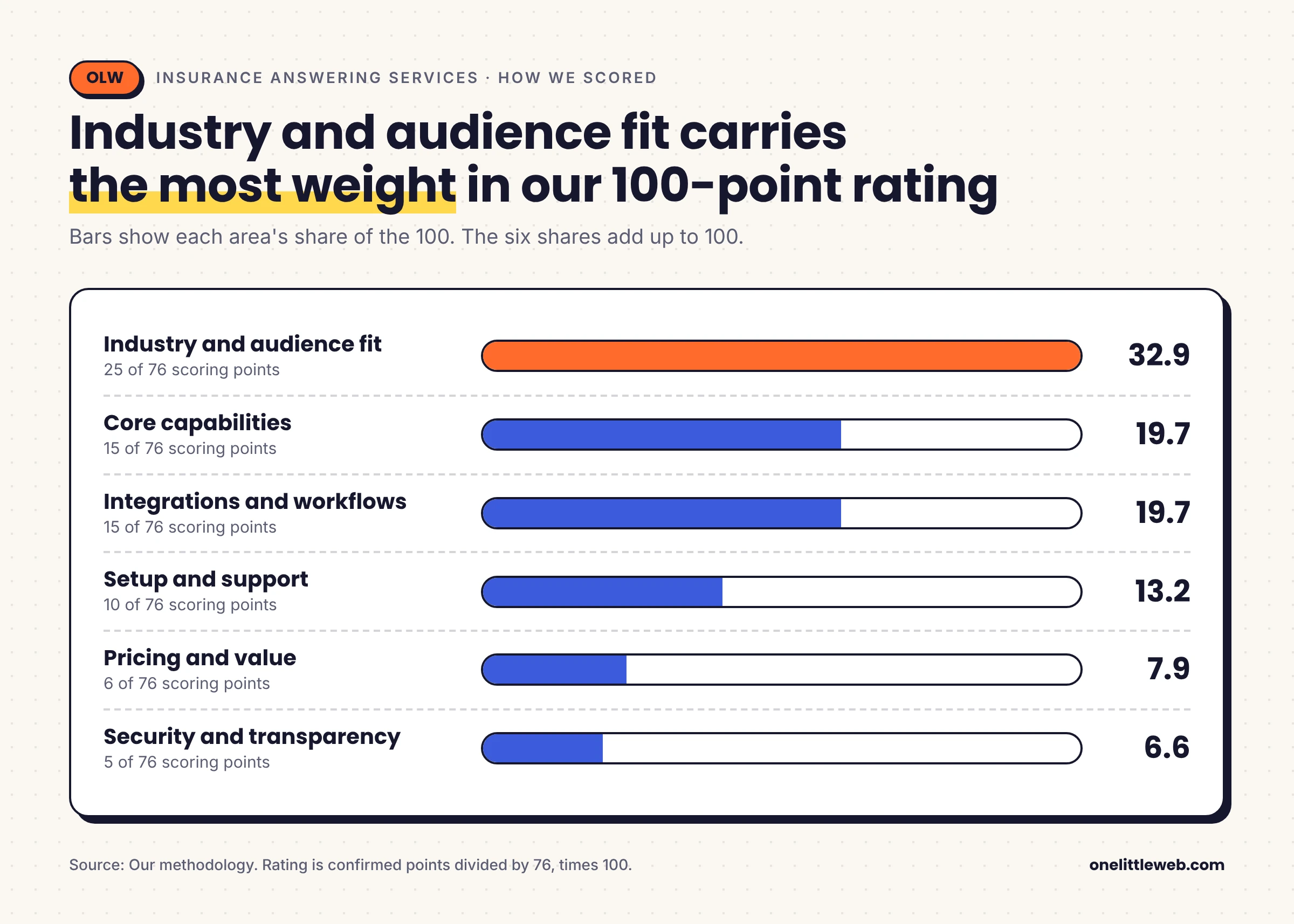
The rating is out of 100 and has six areas. Industry and audience fit carries the most weight, at 32.9 points. The full methodology explains the areas and the rating.
The 6 best insurance answering services
The six reviews run from the highest rating to the lowest. Each review shows what scored well, what to check and who it suits.
1. Aloware: best for claim, quote and certificate intake written into your agency system
Our verdict: Aloware suits agencies that want every claim, quote and certificate call to land in the system their team already works in. Demo it first if storm-season volume worries you.
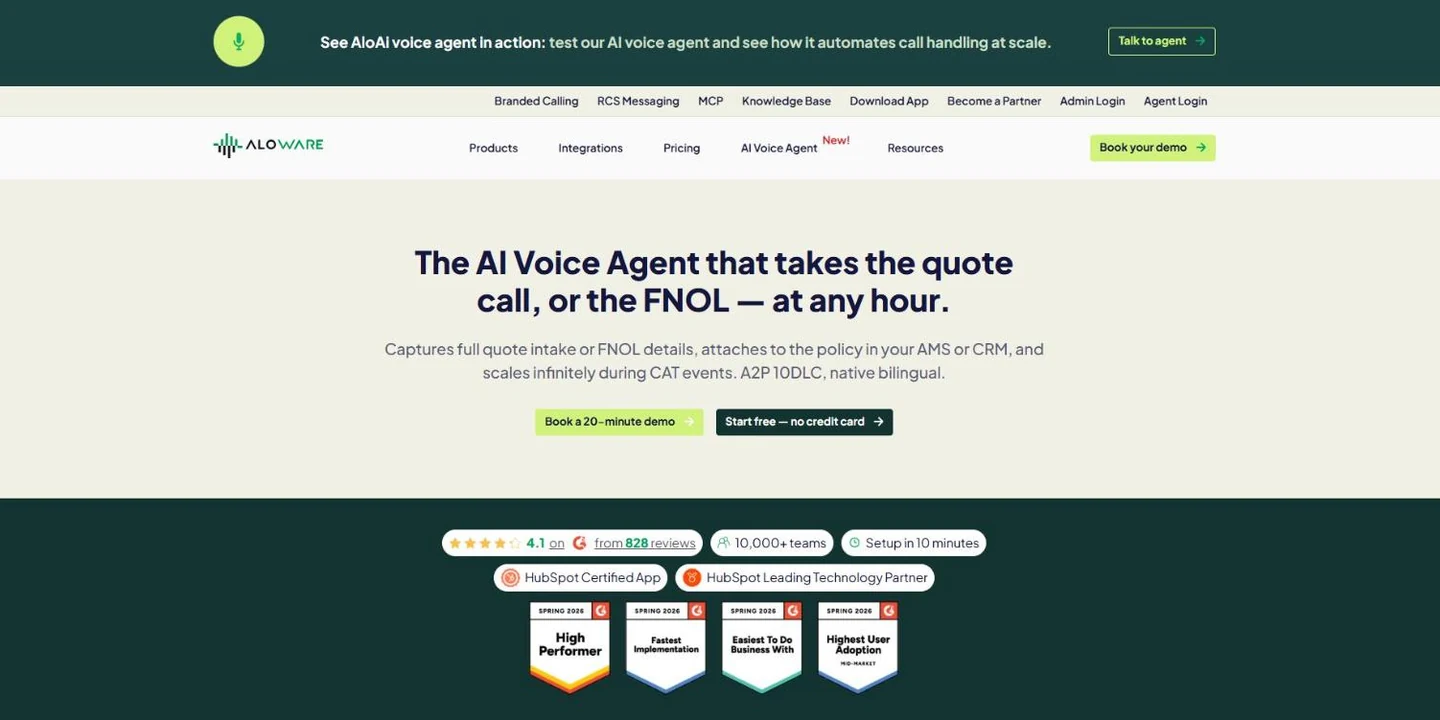
| Plan we priced | AloAi voice agent, from $0.10 a minute |
| Type | AI voice agent on a business phone platform |
| Platform plans | iPro, uPro and xPro, from $40 per user a month, or $30 billed annually |
| Terms | Free start with no credit card; the platform offers a 7-day free trial |
| Claims and quotes | First notice of loss by line, quote qualification, certificate requests and renewal calls |
| Agency systems | Applied Epic, AMS360, EZLynx, HawkSoft, NowCerts, AgencyZoom and Better Agency |
| Languages | 35 |
| Company | Los Angeles, California |
| Reviews | No exact-product reviews located; G2 lists 4.1 (828) for the whole platform |
| Our rating | 78.9 / 100 |
Table note: Prices were checked on November 23, 2026. The product is the Aloware AI voice agent, shown on its insurance page.
What stands out:
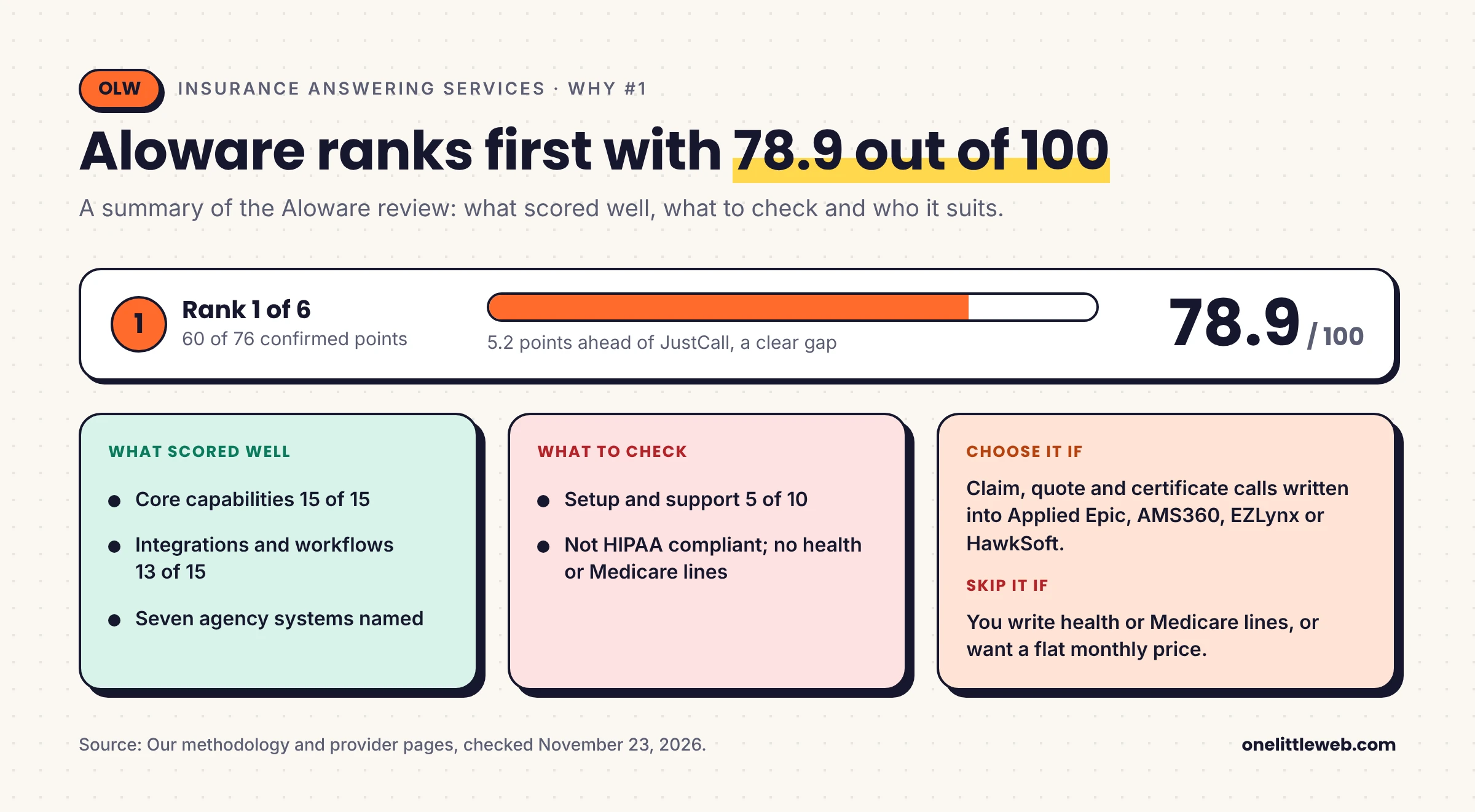
- Core capabilities. It scored the full 15 of 15 in this area.
- Integrations and workflows. It scored 13 of 15, its other strongest area.
- Claim intake. The page says it runs loss-notice scripts by line, such as auto, home and workers’ comp. It texts the caller an upload link for photos and reports.
- Agency systems. The page names seven and says claim, quote and certificate records land live, not on an overnight sync.
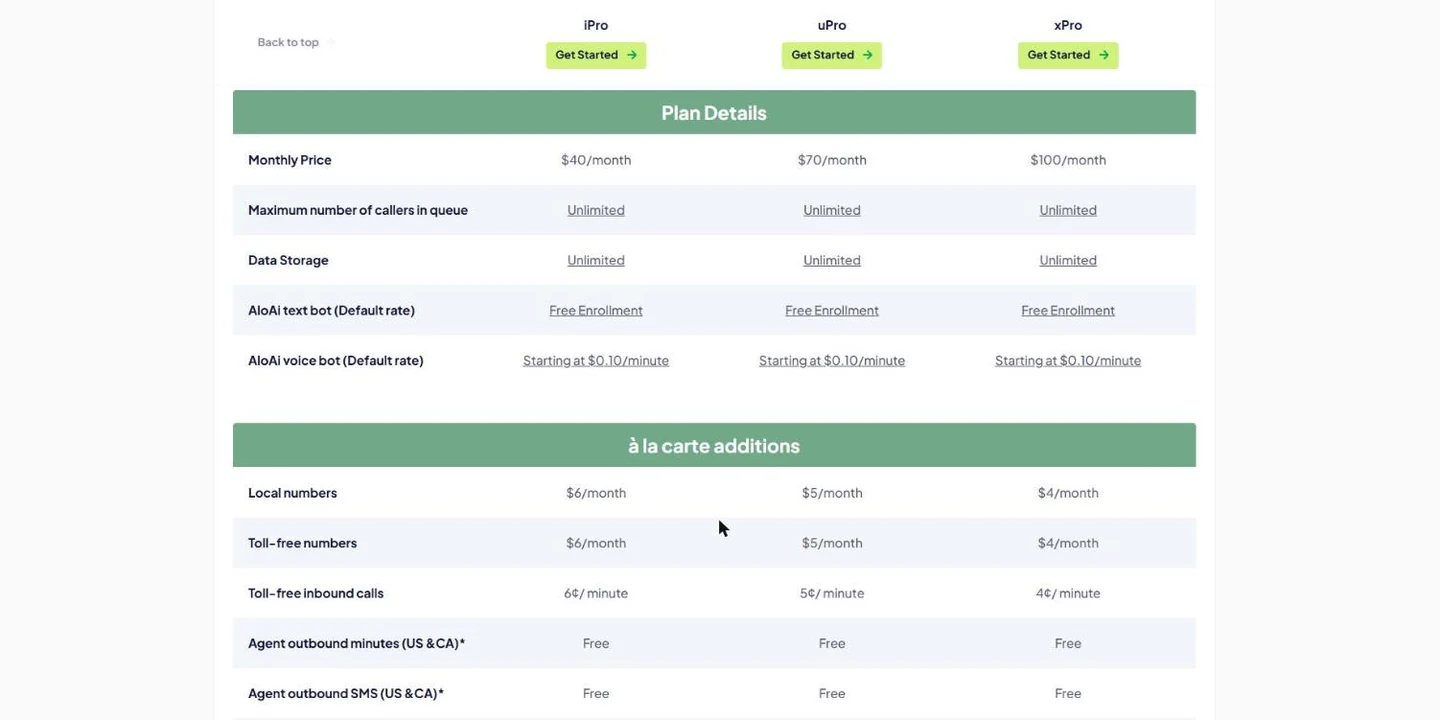
Pricing. Aloware lists its voice agent at $0.10 a minute. The insurance page says the rate stays the same for a loss notice or a renewal call.
The page’s cost estimator shows $0.115 a minute for its default model and voice. Platform plans run $40, $70 and $100 per user a month. Ask whether you need a platform plan to run the agent.
What customers say. We located no review pool for the voice agent itself, so we show no rating. G2’s listing covers the whole platform, and we did not score it.
Watch out for:
- Setup and support. It scored 5 of 10, its lowest area.
- Health lines. The page says Aloware is not HIPAA compliant and rules out health and Medicare lines.
- Terms to ask about. We found no agreements or security documents to review. Ask for each in writing.
Why Aloware ranks #1. Aloware rates 78.9 / 100 on 60 confirmed points, the highest rating in this guide. It sits 5.2 points ahead of JustCall, a clear gap.
Choose Aloware if you want claim, quote and certificate calls written into Applied Epic, AMS360, EZLynx or HawkSoft. You should write property, casualty, life or commercial lines.
Skip Aloware if you write health or Medicare lines.
Skip it too if you want a flat monthly price with no per-minute billing.
2. JustCall: best for published security standards and a per-minute price
Our verdict: JustCall suits agencies that want security standards stated on the page and a rate they can multiply by their own minutes. It is a phone system first, so check how the AI agent fits your lines.
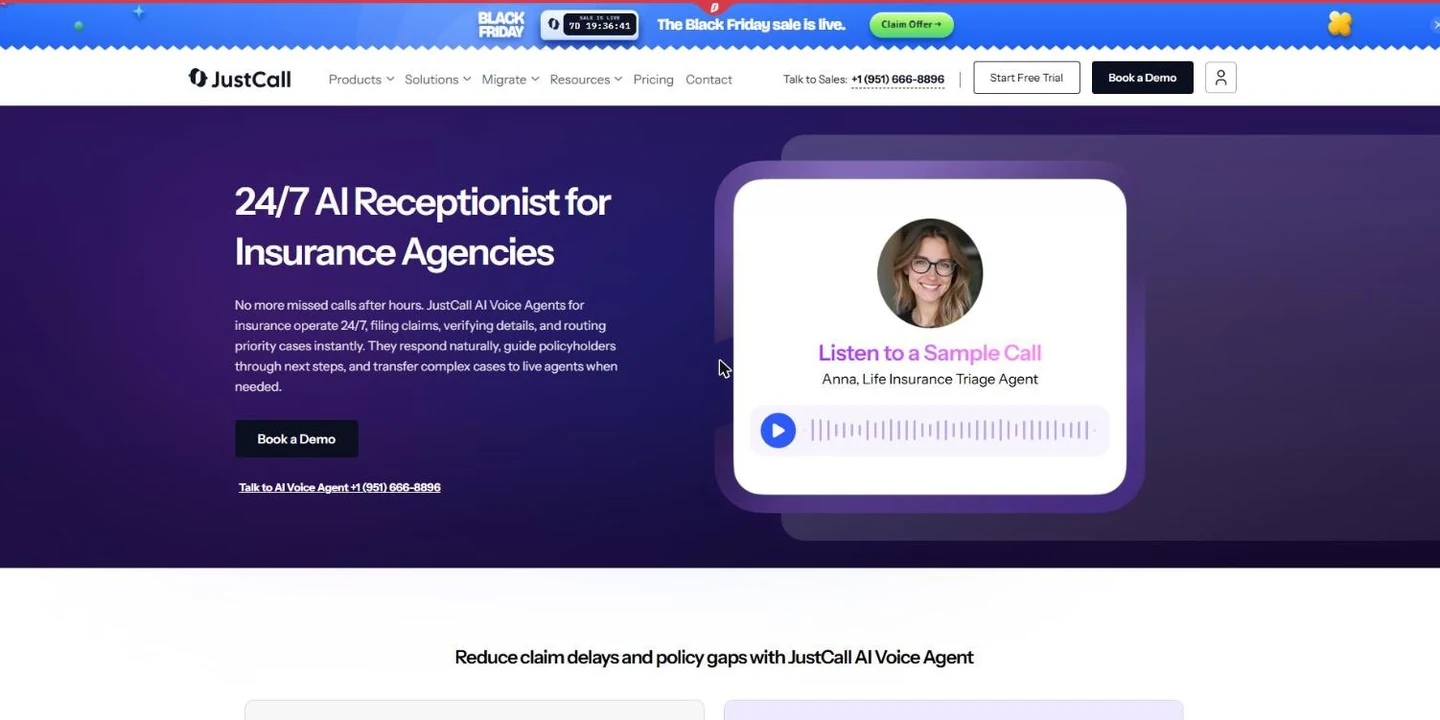
| Plan we priced | AI Voice Agent, from $0.15 a minute at volume |
| Type | AI voice agent inside a business phone system |
| Free minutes | The first 100 minutes are free |
| Phone plans | Team from $29 per user a month, billed annually, with a two-user minimum |
| Claims intake | Loss date, damage type, policy number and photos |
| Agency systems | Applied Epic or TAM, AMS360, HawkSoft, EZLynx, QQCatalyst and NowCerts |
| Languages | 14 |
| Go-live | Most agencies launch in 3 to 5 business days, per the FAQ |
| Company | San Francisco, California |
| Reviews | No exact-product reviews located; G2 lists 4.3 (2,399) for the whole platform |
| Our rating | 73.7 / 100 |
Table note: Prices were checked on November 23, 2026. The product is the JustCall AI Voice Agent, shown on its insurance page.
What stands out:
- Security and transparency. It scored the full 5 of 5 in this area.
- Pricing and value. It scored 5 of 6, its other strongest area.
- Claims intake. The page says it captures loss date, damage type, policy number and photos. It routes urgent cases to an adjuster.
- Security statements. The page states SOC 2 Type 2, GDPR, HIPAA and PCI-DSS. These are the vendor’s own words, and we did not verify them.
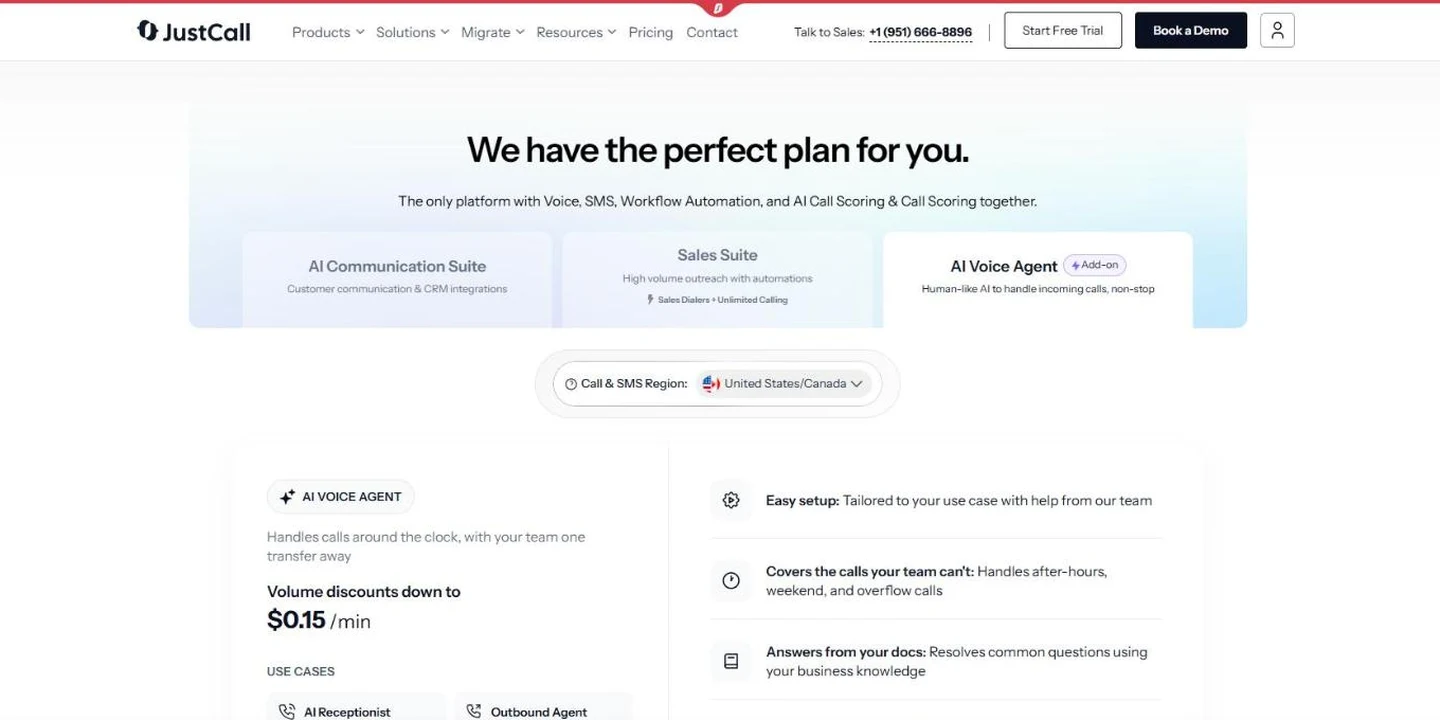
Pricing. The AI Voice Agent starts at $0.15 a minute with volume discounts, and the first 100 minutes are free. The agent works with your JustCall numbers, so a phone plan may come on top.
Team plans start at $29 per user a month on annual billing, with a two-user minimum. Ask what a month costs for your users and your minutes.
What customers say. We located no review pool for the AI Voice Agent itself, so we show no rating. G2’s listing covers the whole platform, and we did not score it.
Watch out for:
- Industry fit. Its lowest area is industry and audience fit, at 15 of 25.
- Phone plan. The agent uses your JustCall numbers. Ask whether a per-user plan is required and what it adds.
- Language count. The page lists 14 languages. Check that your policyholders’ languages are covered.
Why JustCall ranks #2. JustCall rates 73.7 / 100 on 56 confirmed points. It is 5.2 points behind Aloware and 10.5 ahead of Sonant, both clear gaps.
Choose JustCall if you want security standards stated on the page and a per-minute rate you can price. Your callers should speak one of its 14 languages.
Skip JustCall if you want a flat monthly price with no per-minute billing.
Skip it too if you want a service built only for insurance agencies.
3. Sonant: best for P&C agencies that want caller checks before any detail is shared
Our verdict: Sonant suits property and casualty agencies that want the caller identified before the agent shares anything. It publishes no price, so book a demo and ask to hear a loss call.
| Plan we priced | No price published; partner pricing quoted after a demo |
| Type | AI receptionist built for property and casualty agencies |
| Terms | No per-call charge, per the page; most agencies go live in under 30 days |
| Claims intake | The feature page does not mention claims; a vendor blog post says it completes first notice of loss |
| Caller checks | Phone match, confirmed by date of birth or ZIP |
| Agency systems | Applied Epic, AMS360, EZLynx, HawkSoft, Momentum AMP and QQCatalyst |
| Languages | Any language, with mid-call switching |
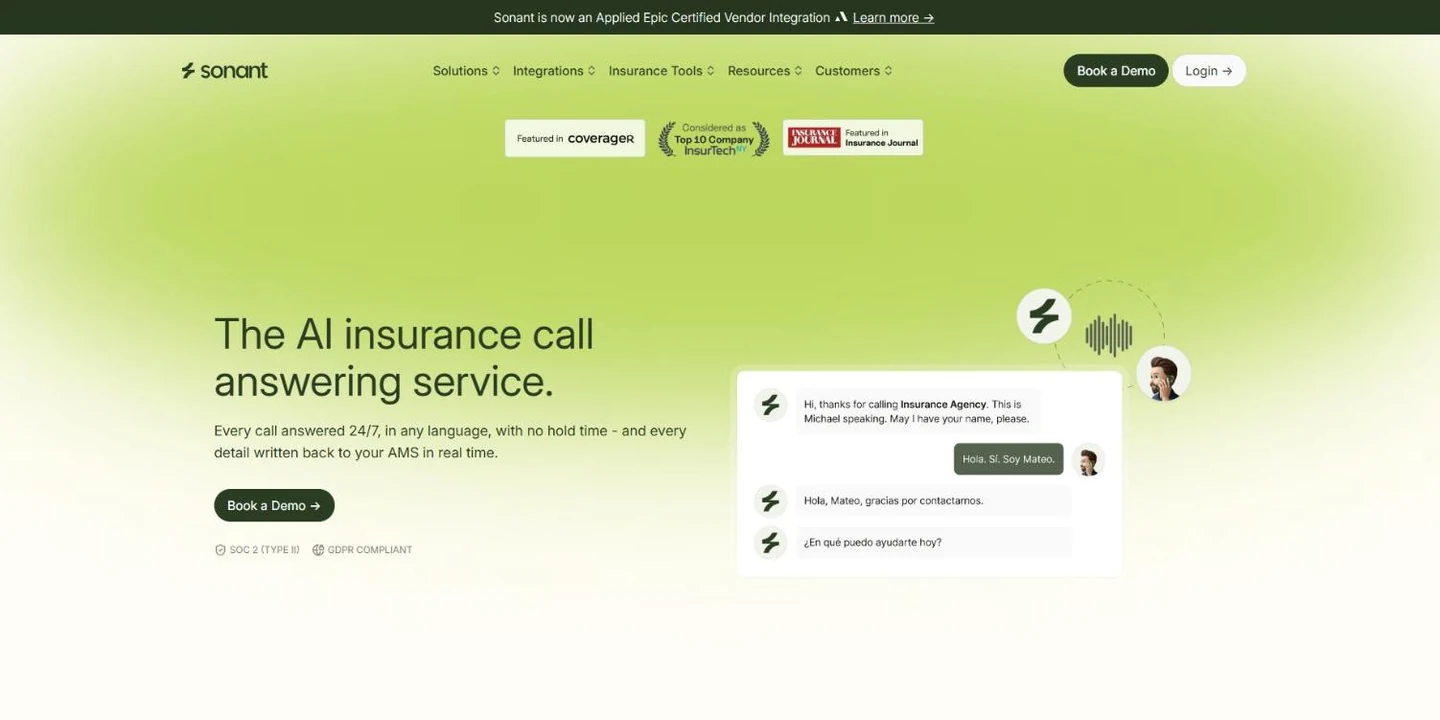
| Security | SOC 2 Type II and GDPR badges on the page |
| Company | Bluberry AI, Inc.; location not stated |
| Reviews | No independent customer reviews located |
| Our rating | 63.2 / 100 |
Table note: Prices were checked on November 23, 2026. The product is Sonant’s AI insurance call answering service, shown on its feature page. It has no pricing page.
What stands out:
- Core capabilities. It scored 12 of 15, its strongest area.
- Setup and support. It scored 7 of 10 in this area.
- Caller checks. The page says the agent matches the caller by phone and confirms by date of birth or ZIP before it handles the request.
- Agency system write-back. The page says each call writes a structured activity to the right account mid-call. Sonant is an Applied Epic certified vendor integration.
Pricing. Sonant publishes no price. Its page says it charges a predictable partner rate with no per-call fee.
Ask for a quote that covers your monthly calls and your contract length.
What customers say. We located no independent customer reviews, so we show no rating.
Watch out for:
- Pricing and value. It scored 1 of 6, its lowest area.
- Claims intake. The feature page says nothing about claims. Ask to hear a loss call in the demo.
- Terms to ask about. The pages state no contract terms, recording and consent rules or access controls. Ask for each in writing.
Why Sonant ranks #3. Sonant rates 63.2 / 100 on 48 confirmed points. It ties with CallSphere, and it is 10.5 points behind JustCall, a clear gap.
Choose Sonant if you run Applied Epic, AMS360, EZLynx, HawkSoft, Momentum AMP or QQCatalyst. You want the caller checked before the agent shares anything.
Skip Sonant if you need a published price.
Skip it too if you need claim intake documented on the product page.
4. CallSphere: best for a low monthly price and a handoff to the carrier’s claim line
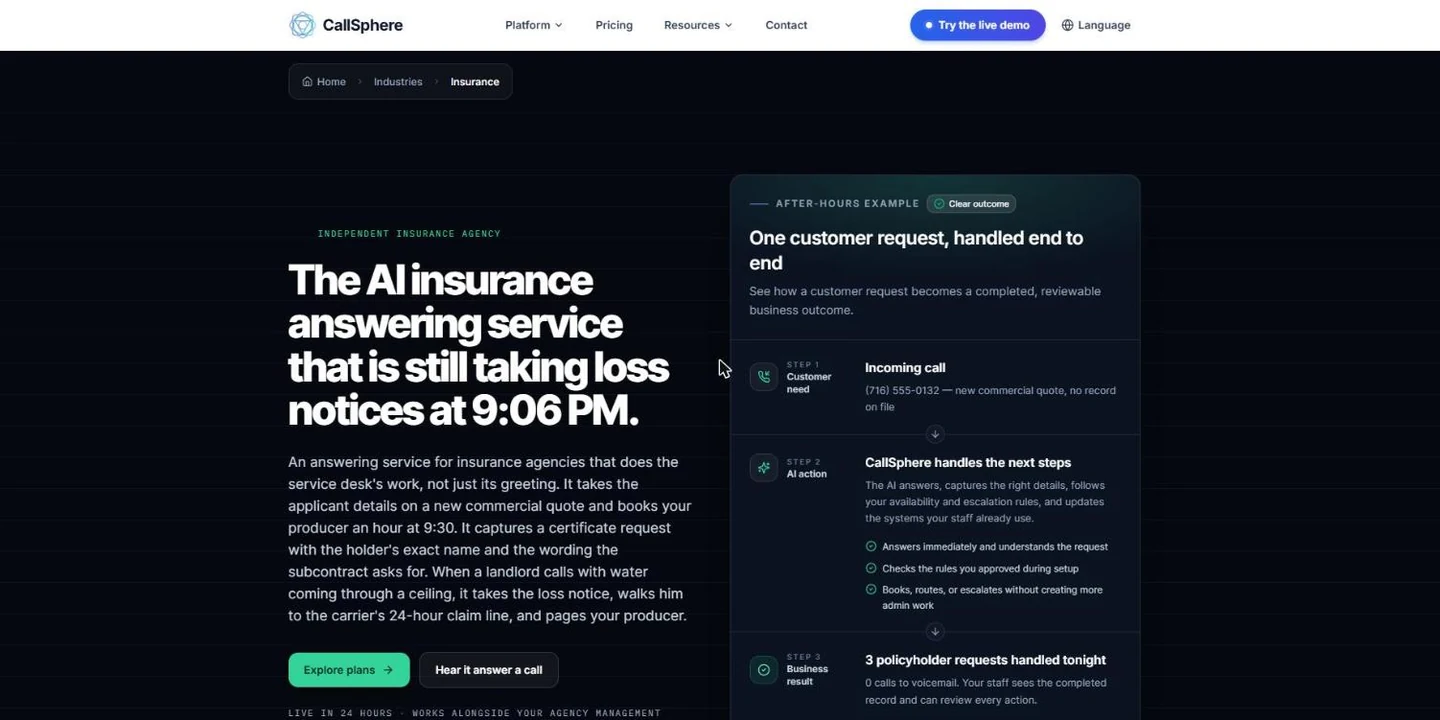
Our verdict: CallSphere suits agencies that want a low monthly price and a loss notice that ends with the caller on the carrier’s claim line. The vendor calls itself early, so run the seven-night test it offers.
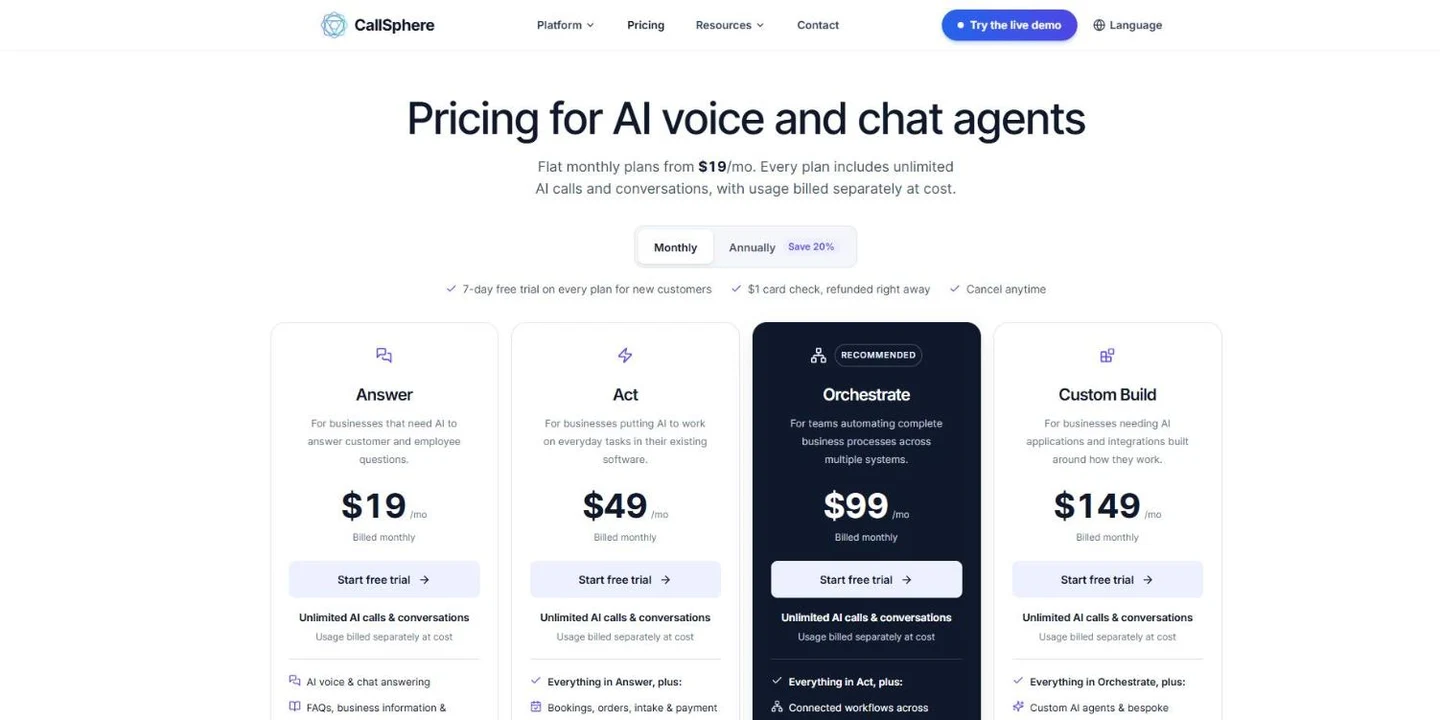
| Plan we priced | Act, $49 a month plus usage at cost, about $0.15 a minute inbound |
| Type | AI voice and chat agents, deployed for you |
| Other plans | Answer, $19; Orchestrate, $99; Custom Build, $149; Enterprise, custom |
| Terms | 7-day free trial with a $1 card check that is refunded; cancel anytime; no long-term contract; live in 24 hours, per the page |
| Claims intake | Takes the loss notice, gives the carrier’s 24-hour claim line and pages your producer |
| Agency systems | Applied Epic, HawkSoft and AMS360; a shared queue where a system is closed |
| Languages | 57 or more |
| Security | TLS in transit, AES-256 at rest and role-based access, as the vendor states |
| Company | San Francisco, California |
| Reviews | No independent customer reviews located |
| Our rating | 63.2 / 100 |
Table note: Prices were checked on November 23, 2026. The usage estimate is the vendor’s, from its insurance page and pricing page. We priced Act because it adds intake and system updates, which the Answer plan leaves out.
What stands out:
- Security and transparency. It scored the full 5 of 5 in this area.
- Pricing and value. It scored 5 of 6, its other strongest area.
- Loss notices. The page says it takes the date, cause, location and injuries. The carrier assigns the claim number, and the producer gets a page.
- Closed systems. The page says that where a system has no open link, the agent writes to a shared queue and emails a structured activity.
Pricing. Act costs $49 a month, and usage bills at cost with no markup. The vendor estimates about $0.15 a minute for inbound voice.
Answer costs $19, Orchestrate costs $99 and Custom Build costs $149. Ask for a usage estimate at your minutes.
What customers say. We located no independent customer reviews, so we show no rating.
Watch out for:
- Industry fit. Its lowest area is industry and audience fit, at 11 of 25.
- Early vendor. The page calls CallSphere early. The industry figures on it come from other sources, not from its own agencies.
- Usage costs. Usage bills on top of the plan. Ask what a month costs at your minutes.
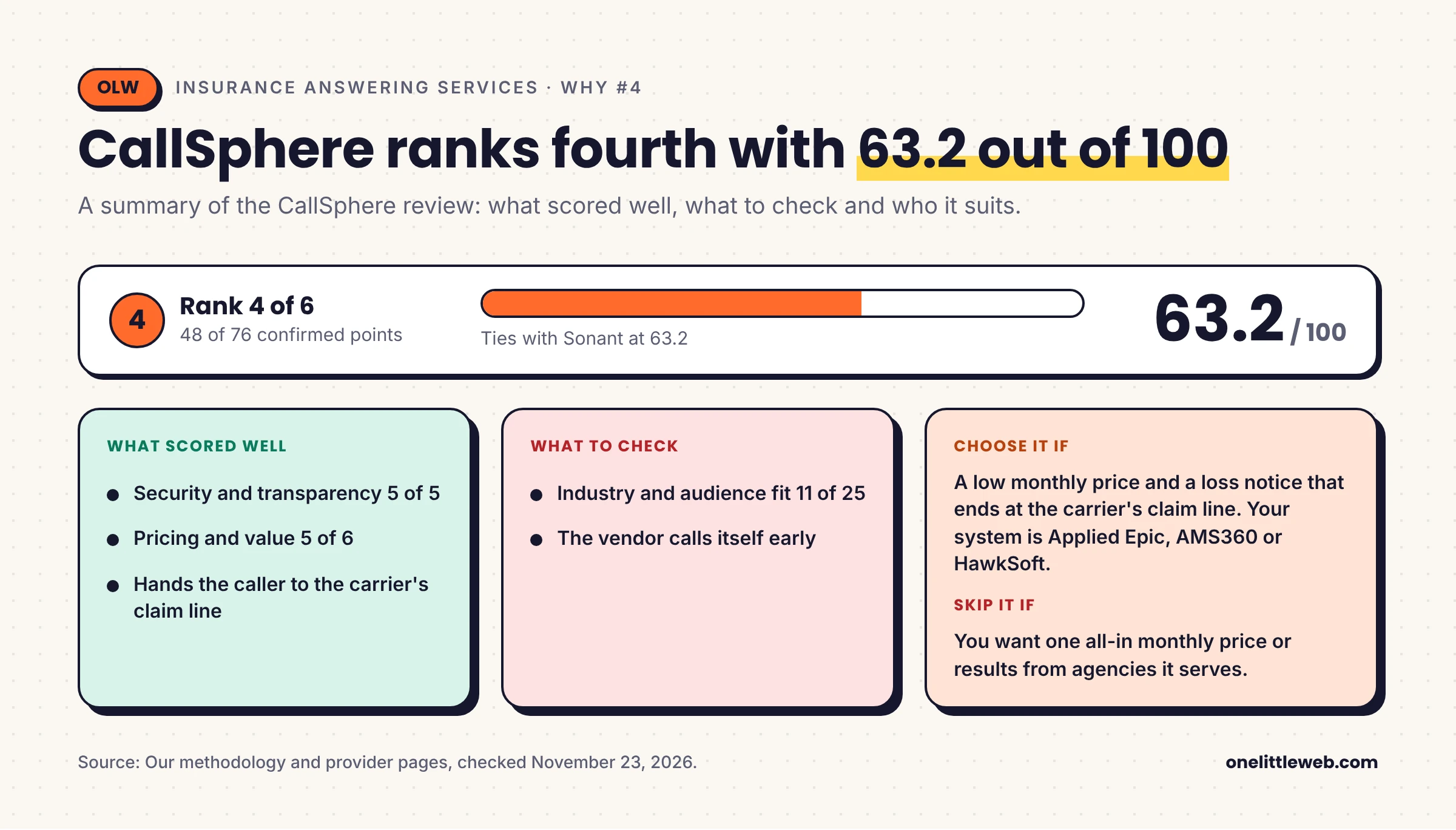
Why CallSphere ranks #4. CallSphere rates 63.2 / 100 on 48 confirmed points. It ties with Sonant, and it is 2.7 points ahead of Ainora, a small gap.
Choose CallSphere if you want a low monthly price and a loss notice that hands the caller to the carrier’s claim line. Your system should be Applied Epic, AMS360 or HawkSoft.
Skip CallSphere if you want one all-in monthly price.
Skip it too if you want results from agencies the vendor already serves.
5. Ainora: best for a custom build for callers in many languages
Our verdict: Ainora suits agencies that want an AI agent built around their lines and carriers, for callers who speak many languages. It quotes after a consultation, so ask to hear a US claim call.
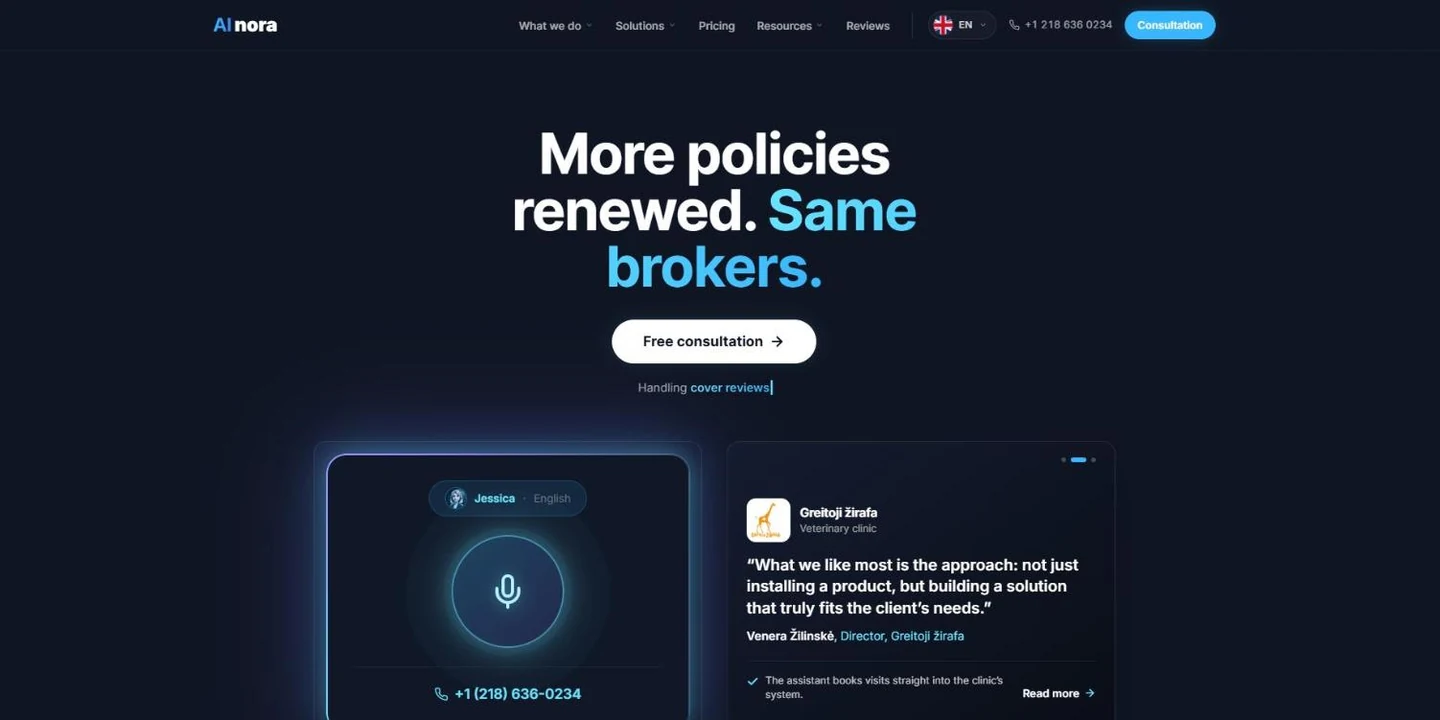
| Plan we priced | No published plans; fixed quote after a 30-minute consultation |
| Type | AI voice agent, built and tuned for your agency |
| Terms | The pricing page promises no hidden fees and flexible terms; onboarding takes about two weeks |
| Claims intake | First notice of loss taken day or night; serious injury or severe damage goes to a person |
| Agency systems | Applied Epic and EZLynx named on the page, plus any system with an API |
| Languages | 90 or more |
| Company | Lithuania, with a US phone number |
| Reviews | No independent customer reviews located |
| Our rating | 60.5 / 100 |
Table note: Prices were checked on November 23, 2026. The product is Ainora’s AI voice agent, shown on its insurance page. Its pricing page is a quote request.
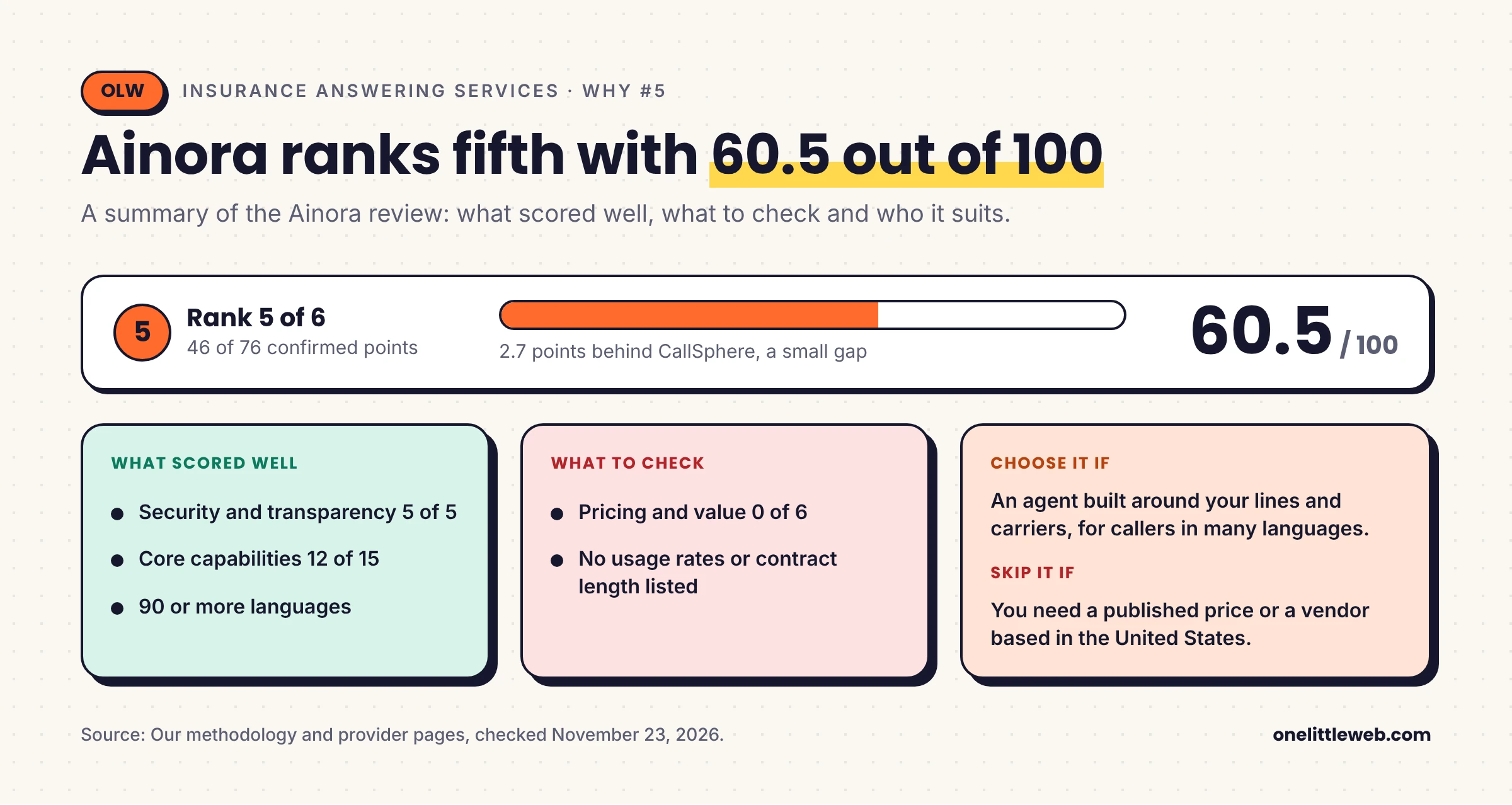
What stands out:
- Security and transparency. It scored the full 5 of 5 in this area.
- Core capabilities. It scored 12 of 15, its other strongest area.
- Claim triage. The page says it takes the loss notice, assigns a claim number and routes the file to your adjuster queue.
- Handoff and languages. The page says severe calls transfer to a person with a briefing. It lists 90 or more languages.
Pricing. Ainora publishes no plans. Its pricing page says a 30-minute consultation leads to a written scope and a fixed quote.
Six factors set the price, including call volume, integrations and languages. Onboarding takes about two weeks, and you review test recordings before go-live.
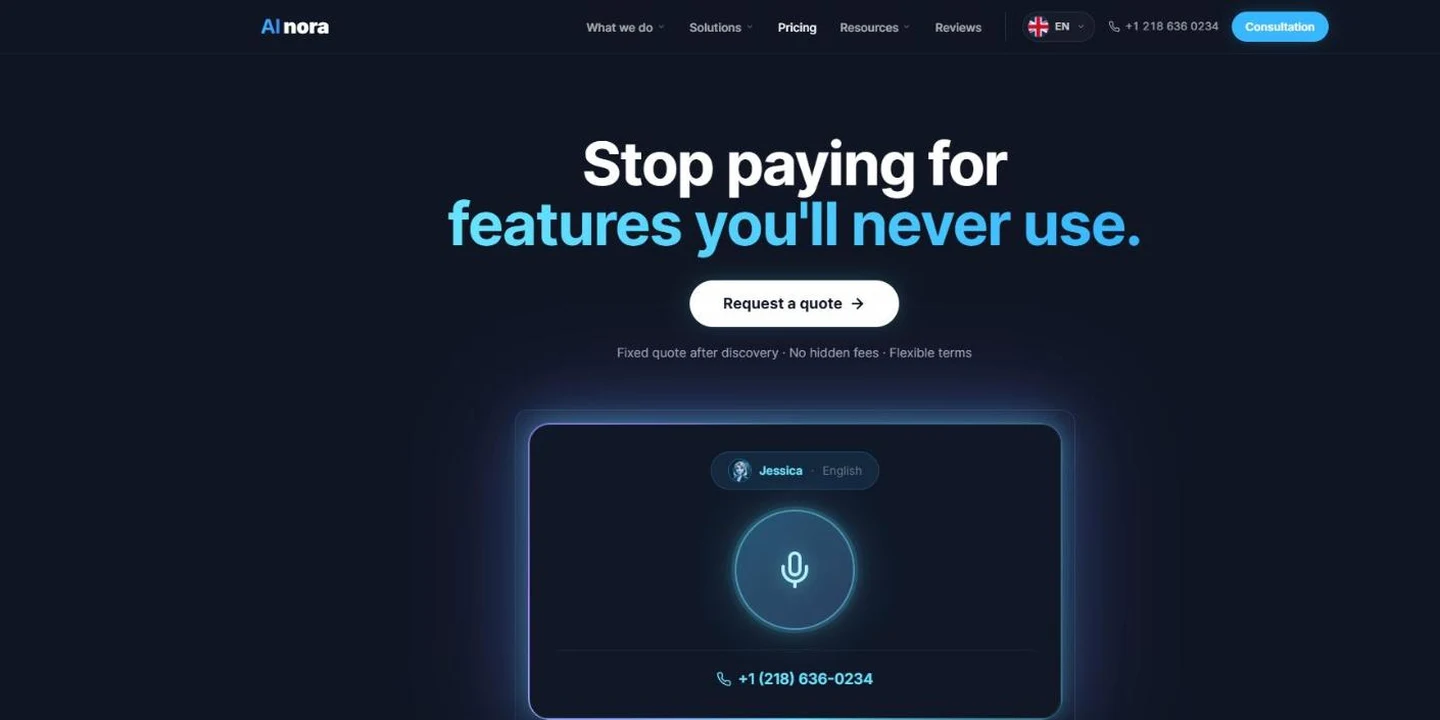
What customers say. We located no independent customer reviews, so we show no rating.
Watch out for:
- Pricing and value. It scored 0 of 6, its lowest area.
- Terms to ask about. The pages list no usage rates or contract length. Ask for both in the quote.
- Company base. Ainora is a Lithuanian company, and its sample call is a UK van quote. Ask about US support hours and to hear a US claim call.
Why Ainora ranks #5. Ainora rates 60.5 / 100 on 46 confirmed points. It is 2.7 points behind CallSphere, a small gap, and 18.4 ahead of Answer United, a clear gap.
Choose Ainora if you want an agent built around your lines and carriers. Your callers should speak many languages.
Skip Ainora if you need a published price.
Skip it too if you need a vendor based in the United States.
6. Answer United: best for live agents on storm claim overflow
Our verdict: Answer United suits agencies that want trained people on the phone when storm claims flood the office. Its pages name no agency system, so confirm yours before you buy.
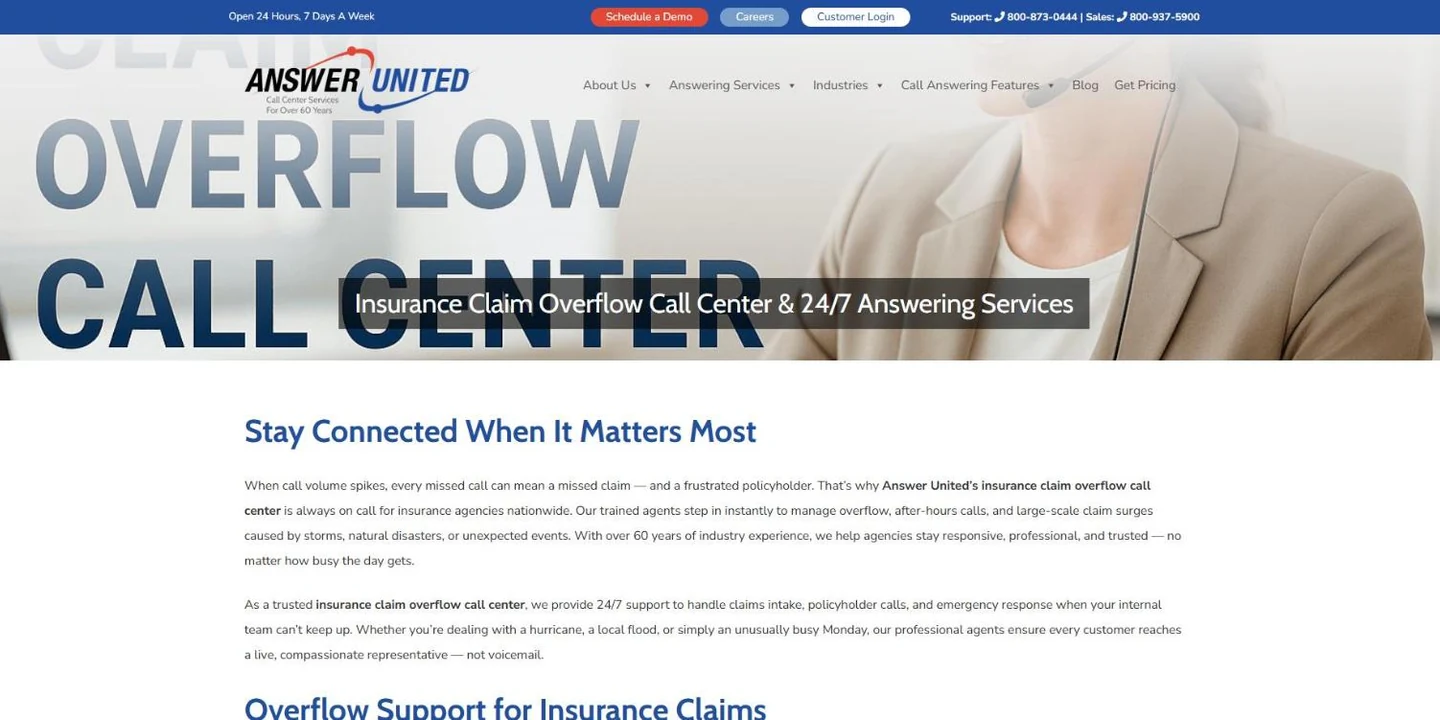
| Plan we priced | No price published; quote on request |
| Type | Live answering service with claim overflow |
| Hours | 24 hours a day, every day of the year |
| Terms | The insurance page says you pay only for the calls handled |
| Claims intake | New claim intake, emergency dispatch and overflow during storms |
| Languages | English and Spanish |
| Agency systems | None named; the page mentions integration with your CRM or claim software |
| Onboarding | Five steps, from a kick-off call to launch |
| Company | Kalamazoo, Michigan |
| Reviews | Trustpilot lists 1 review, too few to rate |
| Our rating | 42.1 / 100 |
Table note: Prices were checked on November 23, 2026. The product is Answer United’s insurance claim overflow answering service, shown on its insurance page. It has no pricing page.
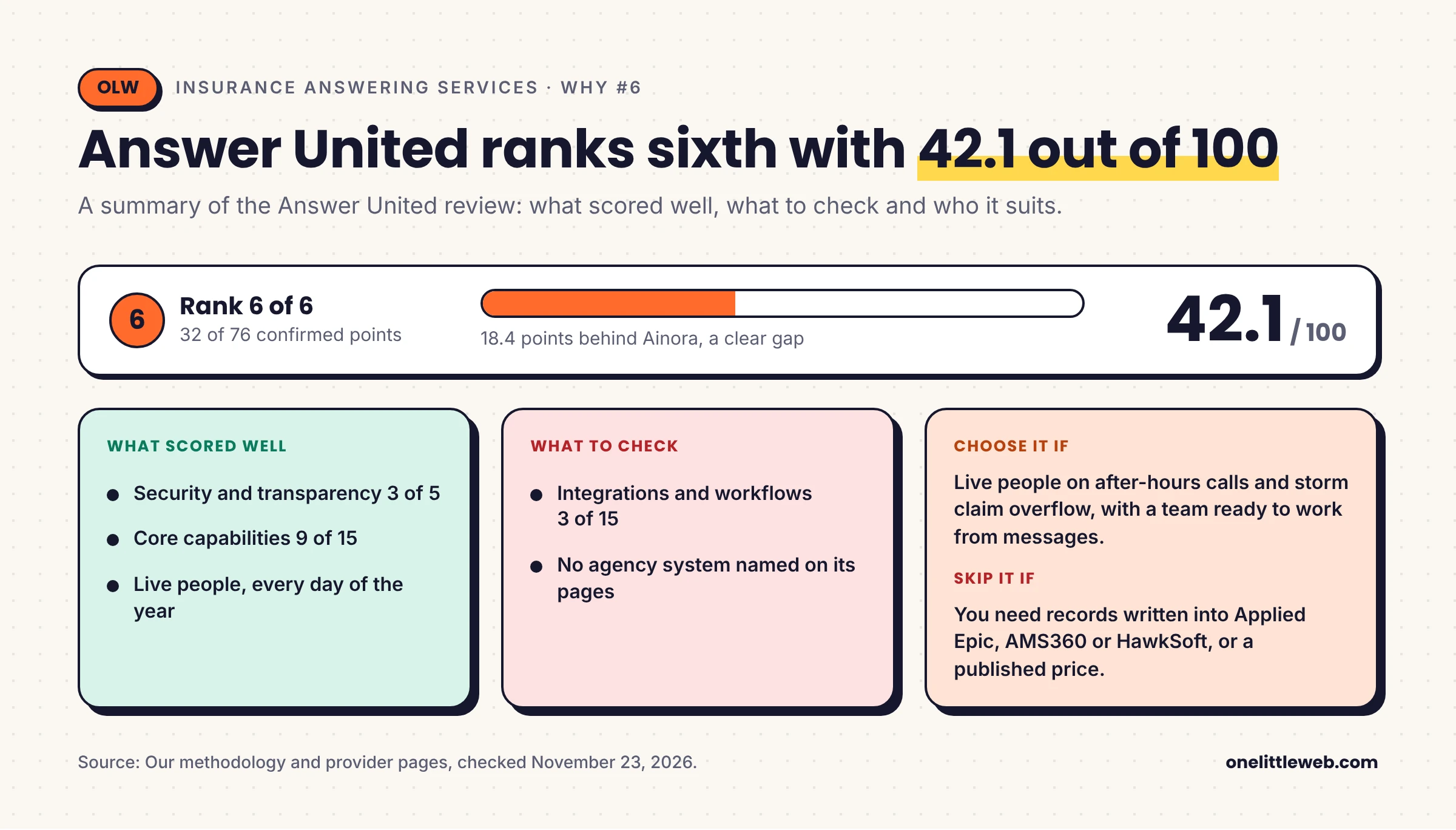
What stands out:
- Security and transparency. It scored 3 of 5, its strongest area.
- Core capabilities. It scored 9 of 15 in this area.
- Storm overflow. The page says agents step in for overflow, after-hours calls and claim surges from storms.
- Live people. The page says every caller reaches a live representative and not voicemail.
Pricing. Answer United publishes no price. The insurance page says you pay only for the calls the service handles.
Its legal page describes per-second billing with a small monthly base and no extra after-hours charge. Ask what applies to an insurance account.
What customers say. Trustpilot lists one review for the company, which is too few to rate. We show no rating.
Watch out for:
- Integrations and workflows. It scored 3 of 15, its lowest area. The pages name no agency-management system, so confirm yours before buying.
- Terms to ask about. The pages state no pricing, access control or security document detail. Ask for each in writing.
- Records. The page mentions secure message handling. Ask how a loss notice reaches your agency system.
Why Answer United ranks #6. Answer United rates 42.1 / 100 on 32 confirmed points, the lowest in this guide. It is 18.4 points behind Ainora, a clear gap.
Choose Answer United if you want live people on after-hours calls and storm claim overflow. Your team should be ready to work from messages.
Skip Answer United if you need records written into Applied Epic, AMS360 or HawkSoft.
Skip it too if you need a published price.
What insurance answering service plans cost
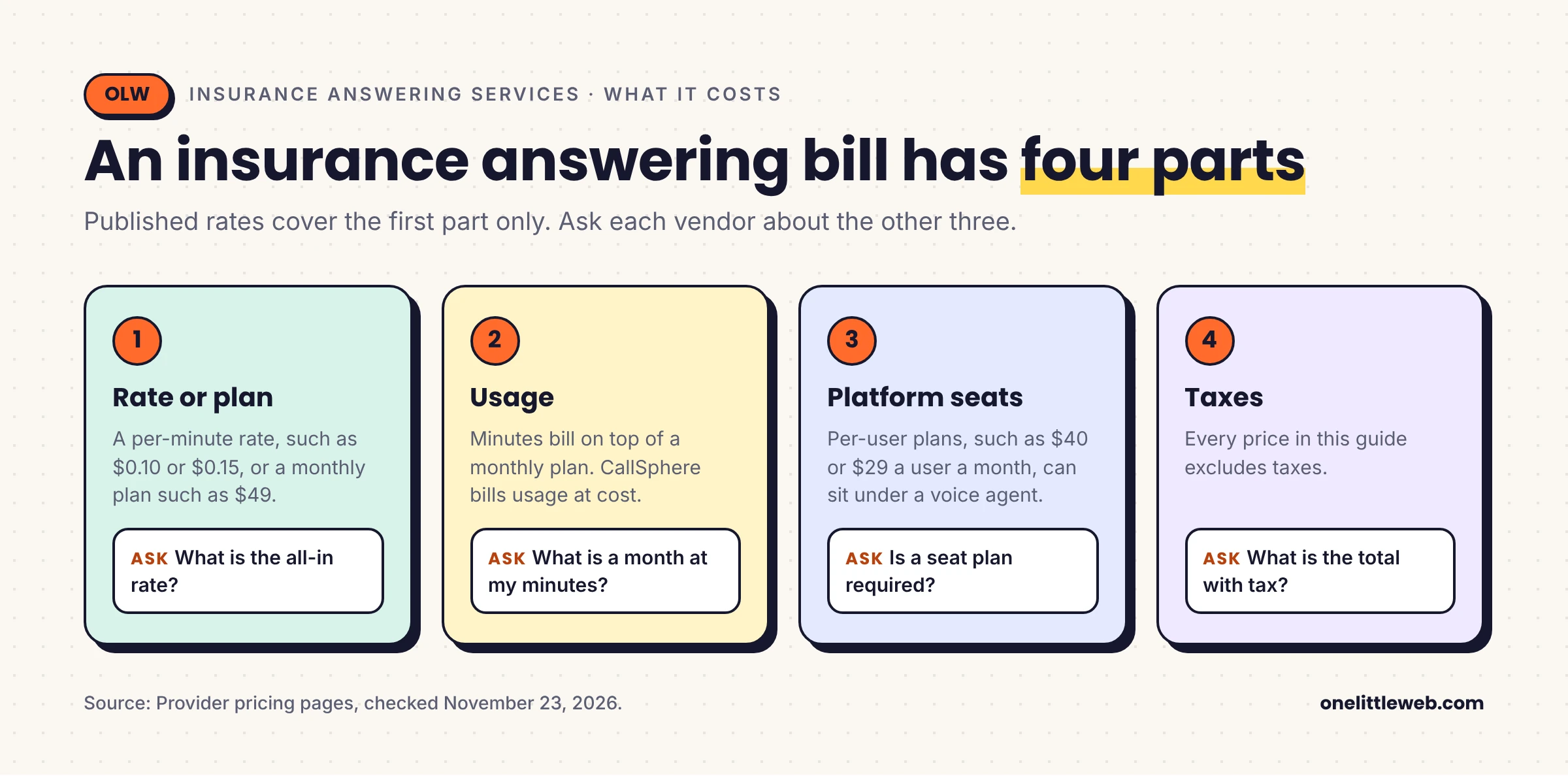
Insurance answering services bill in one of three ways. A per-minute rate covers the AI agent. A monthly plan adds usage on top. A quote follows a demo or a consultation.
Three services publish a rate. The table shows how each service bills and what to ask.
| Provider | How it bills | Entry price | Ask for |
|---|---|---|---|
| Aloware | Per-minute rate for the voice agent; per-user platform plans | From $0.10 a minute | Whether a platform plan is required, and the all-in rate |
| JustCall | Per-minute rate for the AI Voice Agent; per-user phone plans | From $0.15 a minute | Whether a phone plan is required, and what it adds |
| Sonant | Partner rate, quoted after a demo | Not published | A quote for your monthly calls and the contract length |
| CallSphere | Monthly plan, plus usage at cost | $49 a month, plus usage | A usage estimate at your minutes |
| Ainora | Fixed quote after a consultation | Not published | Usage rates and the contract length |
| Answer United | Quote on request; the page says you pay for calls handled | Not published | The monthly base and the rate for each call or minute |
Table note: Prices were checked on November 23, 2026, and exclude taxes. Entry price is the lowest published rate or plan. Services that bill by quote have no price to compare.
What it costs at your volume
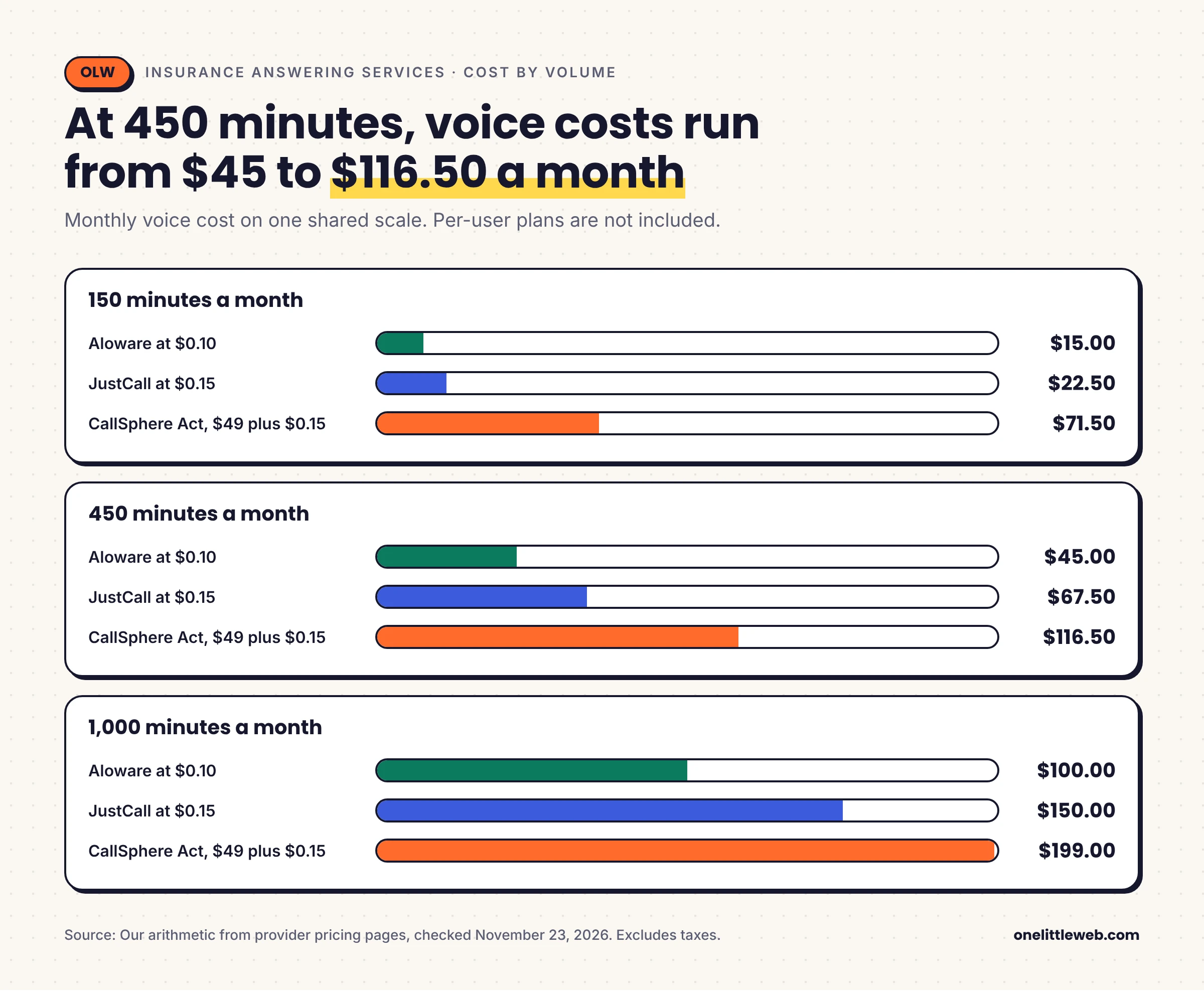
Count your minutes first. Multiply calls per month by minutes per call. As an illustration, 150 calls at 3 minutes each is 450 minutes. This is an example and not an industry average.
Three services publish rates we can multiply. The table shows the monthly voice cost at three volumes.
| Monthly minutes | Aloware at $0.10 | JustCall at $0.15 | CallSphere Act at $49 plus $0.15 |
|---|---|---|---|
| 150 | $15.00 | $22.50 | $71.50 |
| 450 | $45.00 | $67.50 | $116.50 |
| 1,000 | $100.00 | $150.00 | $199.00 |
Table note: This is our arithmetic from published rates, checked on November 23, 2026. JustCall’s $0.15 is the volume floor, and its 100 free minutes are not modeled. Aloware’s estimator shows $0.115 for its default setup. Per-user plans are not included. CallSphere’s $0.15 is the vendor’s estimate.
At 450 minutes, Aloware costs about $45 in voice minutes and JustCall about $68. Storm weeks can multiply your minutes, so plan for your busiest month. For Sonant, Ainora and Answer United, ask each vendor to price your minutes in writing.
Side-by-side comparison
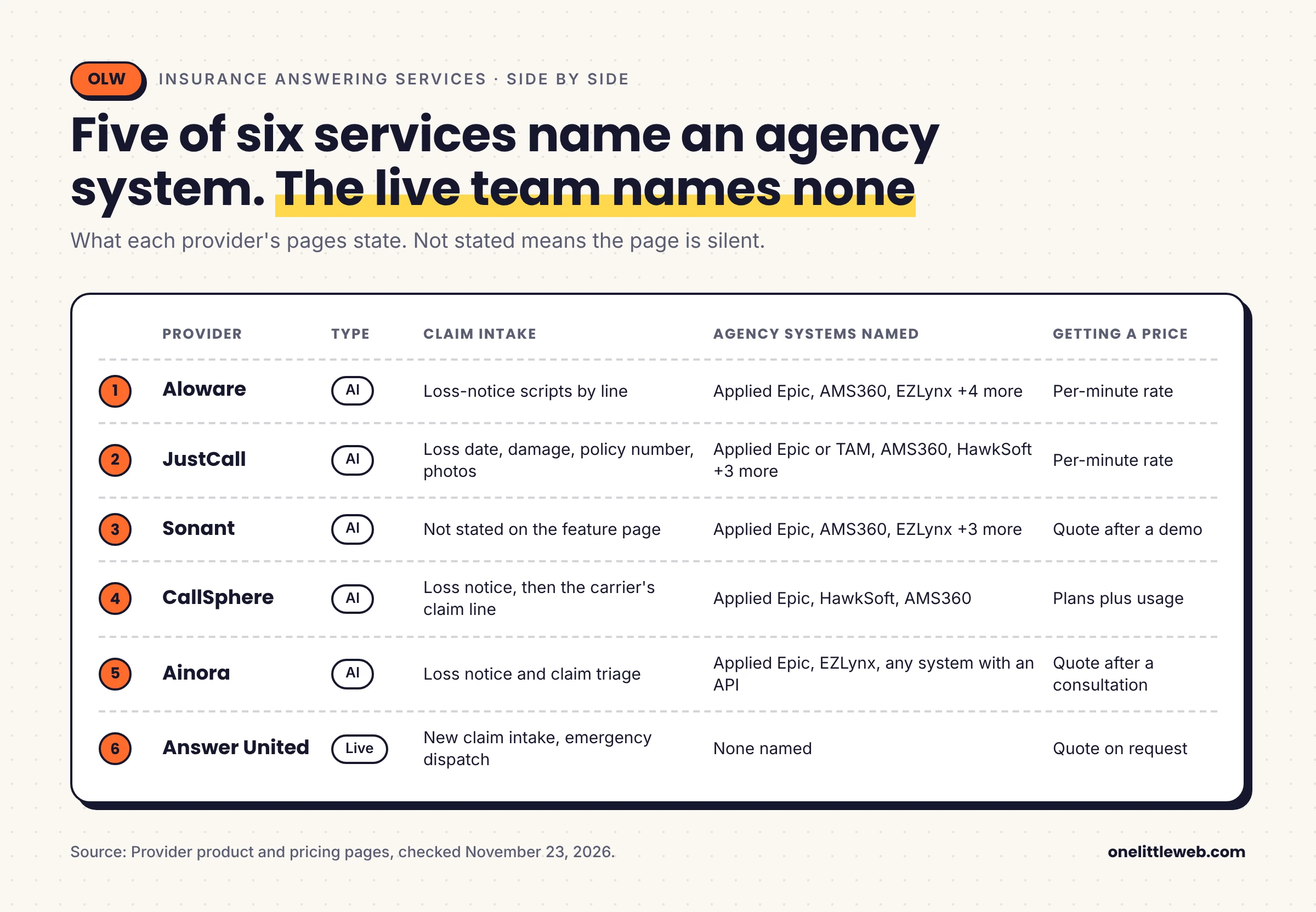
This table shows each service’s type, its claim intake and the agency systems it names. It also shows languages and how you get a price. “Not stated” means the pages we read say nothing either way. It does not mean the feature is missing.
| Provider | Type | Claim intake | Agency systems named | Languages | How you get a price |
|---|---|---|---|---|---|
| Aloware | AI | Loss-notice scripts by line; documents by text link | Applied Epic, AMS360, EZLynx, HawkSoft, NowCerts, AgencyZoom, Better Agency | 35 | Per-minute rate |
| JustCall | AI | Loss date, damage type, policy number and photos | Applied Epic or TAM, AMS360, HawkSoft, EZLynx, QQCatalyst, NowCerts | 14 | Per-minute rate |
| Sonant | AI | Not stated on the feature page | Applied Epic, AMS360, EZLynx, HawkSoft, Momentum AMP, QQCatalyst | Any, with mid-call switching | Quote after a demo |
| CallSphere | AI | Loss notice taken; caller sent to the carrier’s claim line | Applied Epic, HawkSoft, AMS360; shared queue if closed | 57 or more | Published plans plus usage |
| Ainora | AI | Loss notice and claim triage; severe calls to a person | Applied Epic, EZLynx, any system with an API | 90 or more | Quote after a consultation |
| Answer United | Live agents | New claim intake and emergency dispatch | None named | English and Spanish | Quote on request |
Table note: This table is based on vendor pages, checked on November 23, 2026. Agency systems are the ones each vendor’s pages name for insurance work.
Which one fits your agency?
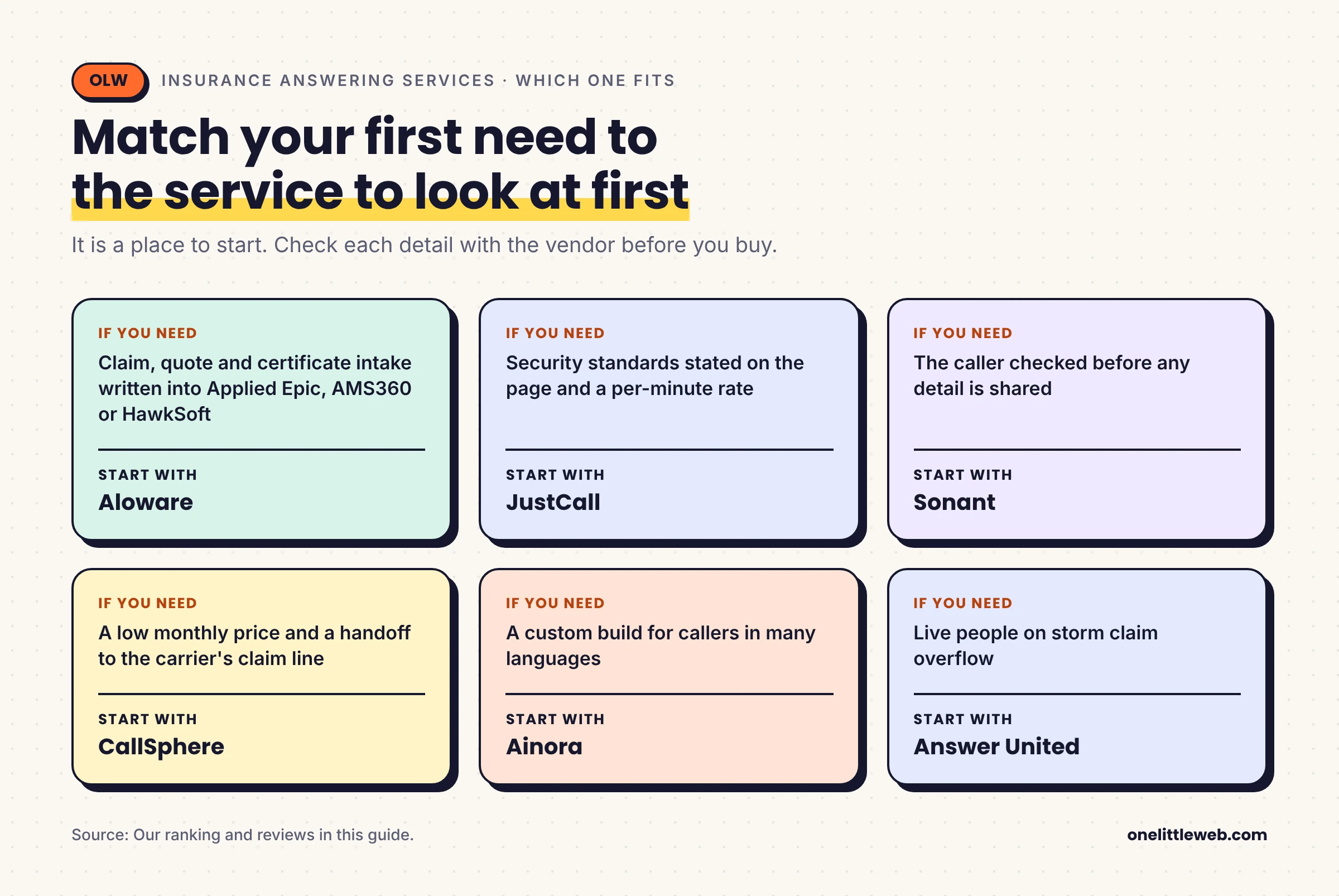
Start with the need that matters most to you. The table points to where to look first. It is a place to start, and each detail needs a check with the vendor.
| If you need | Start by looking at | Why |
|---|---|---|
| Claim, quote and certificate intake written into Applied Epic, AMS360 or HawkSoft | Aloware | Core capabilities 15 of 15, with seven agency systems named |
| Security standards stated on the page and a per-minute rate | JustCall | Security and transparency 5 of 5, with the first 100 minutes free |
| The caller checked before any detail is shared | Sonant | Phone, date of birth and ZIP checks, with write-back mid-call |
| A low monthly price and a handoff to the carrier’s claim line | CallSphere | Pricing and value 5 of 6, with a page that names the claim line |
| A custom build for callers in many languages | Ainora | 90 or more languages and a fixed quote after a consultation |
| Live people on storm claim overflow | Answer United | A live team on claim surges, every day of the year |
How to choose in six steps
- Decide who answers. Pick between AI and live agents. Our guide to AI receptionists for small business explains the AI side.
- Write your licensing rules. List what the service must never do, such as quote a premium, bind coverage or say a loss is covered. Name who takes those calls.
- List the calls you get. Include loss notices, quote requests, certificate requests, billing questions, renewals and policy changes.
- Name your agency system. Say whether you work in Applied Epic, AMS360, HawkSoft or EZLynx, and ask whether records write back.
- Check the billing unit. Compare two finalists on a price based on your minutes. Our answering service cost guide lists monthly prices for 27 providers.
- Run the five-call test. Do it inside the trial or demo.
Run a five-call test
Run these five checks yourself before you sign.
| Call | What to do | What to look for |
|---|---|---|
| 1. Loss notice | Report water coming through a ceiling after hours | Does it take the date, location, cause and injuries, and route the call, without saying the loss is covered? |
| 2. Quote request | Ask for a new commercial quote | Does it capture the line, state and renewal date, and book your producer, without naming a premium? |
| 3. Certificate request | Ask for a certificate with additional insured wording | Does it capture the holder and wording, and queue it for the person who issues it? |
| 4. Existing client | Ask when the adjuster will call | Does it find the record, or say plainly what it cannot do? |
| 5. Storm surge | Ask the vendor to run several calls at once in the demo | Does every caller get answered and asked the same questions? |
Decision checklist
Other options we looked at but didn’t rank
More products came up in our research. We did not rank them, so they carry no rating. None of them failed a check outright.
The gate has three checks. They are claims intake, a named agency-management system and a published data-handling page. The table shows what kept each group unranked.
| Group | Products | What kept them unranked |
|---|---|---|
| Claims intake or a named agency system not confirmed | AnswerHero, Josie, HelpSquad | AnswerHero is a live service. Its insurance page mentions claims only as agents’ workload and names no integration. Josie is an AI receptionist whose insurance page names Google Calendar and does not mention claims intake. HelpSquad lists insurance agencies under financial services, and we read no claims page or integration list. |
| Build-your-own platform | Dapta | Dapta is a no-code builder for AI voice agents. Its insurance page names HubSpot, GoHighLevel and Salesforce and no agency-management system. It is a developer-style platform, so it is an alternative and not a ranked pick. |
Table note: Each check was read from the vendor’s own pages. Josie lists $29 a month for 200 minutes and $79 for 500, with $0.25 a minute above the plan. Dapta is free to build and publishes no call rates. The six ranked services are not repeated here.
Work in a related trade? Our HVAC answering services guide covers that trade on its own.
Want a general answering service? Our best answering services guide compares live, virtual and AI options.
Run a wider contracting business? Our construction answering services guide covers job-site calls across trades.
Frequently asked questions
What does an answering service do for an insurance agency?
It answers your agency’s calls and sends each one where your rules say. That can mean taking a loss notice, capturing a quote request or queuing a certificate request. It works while your team is with clients or the office is closed.
Can an answering service take a first notice of loss?
Most of the services here say they can. Aloware, JustCall, CallSphere, Ainora and Answer United each describe loss-notice intake on an insurance page. Sonant’s feature page is silent on claims. Ask each vendor to take a test loss call in your demo.
Can an answering service quote or bind coverage?
No. A licensed person quotes premiums, binds coverage and decides claims. The AI services here say they gather facts, qualify the caller and book your producer. Ask each vendor to show where its service stops.
Will an answering service work with Applied Epic, AMS360 or HawkSoft?
It depends on the service. Aloware, JustCall and Sonant name all three, and CallSphere names all three with a shared queue for closed systems. Ainora names Applied Epic and EZLynx. Answer United names none.
Can an answering service handle certificate of insurance requests?
Some can. Aloware says it captures the holder, additional insured wording and deadline, and routes the request to your certificate processor. CallSphere says it captures the request and a licensed person issues it. Ask other vendors how they handle certificates.
Can an answering service handle a surge of claim calls after a storm?
Some say they can. Aloware and Sonant say they handle calls without a queue. Answer United says its agents take overflow during storms. Ask each vendor to run several calls at once during your demo.
Should an insurance agency choose AI or live agents?
It depends on your storm process and your agency system. Choose live agents for a trained person on every call. Choose AI for records written into your system and an answer on every call. Test the model you pick against your own rules.
How do insurance answering services charge?
They use three approaches. A per-minute rate covers an AI agent. A monthly plan adds usage on top, and a quote follows a demo or consultation. The cost section shows how each ranked service bills.
Can an answering service cover Spanish-speaking policyholders?
Several can. Aloware lists 35 languages and CallSphere lists 57 or more. Ainora lists 90 or more, and Sonant says it switches languages mid-call. Answer United covers English and Spanish with live agents.
How are these answering services ranked?
We rank them by rating, from highest to lowest. The rating is confirmed points divided by 76, times 100. Aloware rates highest at 78.9, and Answer United rates lowest at 42.1.
Methodology
This guide ranks answering services for US independent insurance agencies. It is research-based. We read published vendor sources and placed no test calls.
What this guide covers
We split the candidates into groups. Scores from this guide do not compare with scores from other guides.
- Ranked services. Six are scored and ranked here.
- Other options. Services whose claims intake or agency system we could not confirm, and one build-your-own platform, are listed under Other options.
Phone systems and out-of-type products are excluded.
Which services we considered
The entry gate looked for claims intake, a named agency-management system or CRM, and a published data-handling page. Eligible types were human answering services, AI plus human services, industry-specific AI and standalone AI receptionists.
US availability was not an entry gate, so confirm coverage for your area.
We screened 10 candidates and ranked six. Five documented all three gate items. Answer United documented all but a named agency-management system, so it ranks below the other five. The other four candidates are listed under other options.
What we checked
The six areas hold 76 base scoring points in total. We show the total as a rating out of 100. The second column shows each area’s scoring points, and the third shows its share of the 100.
| Area | Scoring points | Share of 100 | What we looked at |
|---|---|---|---|
| Industry and audience fit | 25 | 32.9 | Insurance workflows such as first notice of loss, storm-surge claim intake, quote intake with producer booking, certificate requests, billing and policy changes, renewals, client routing and warm transfers to licensed staff |
| Core capabilities | 15 | 19.7 | How the service answers, routes and hands off calls |
| Integrations and workflows | 15 | 19.7 | Named agency-management systems with write-back, caller verification and carrier claim-line routing |
| Setup and support | 10 | 13.2 | Setup effort and support access |
| Pricing and value | 6 | 7.9 | Published prices, usage and fee transparency, contract flexibility |
| Security and transparency | 5 | 6.6 | Retention and deletion, recording and consent, access controls, security documents |
| Total | 76 | 100 | The sum of the six areas |
Customer reviews are a seventh area. They add points only where a service has a usable review pool.
How the score works
Each check is marked as verified or not verified. Only verified evidence earns points. A check we could not verify counts as zero, which reflects missing evidence and not a failure.
A service that publishes less on its own pages scores lower, because it has fewer checks we can confirm. Answer United has the fewest confirmed points of the six, and it scores lowest.
Why we scored out of 76 first
Our full scoring rubric has 100 points. Cost for an illustrative scenario holds 9, and customer reviews hold 15. We could not score cost for any of the six services, because no scenario cost could be verified.
We found no exact-product review pool for any of them either. So 76 points were open to every service, and we scored on those. Scoring out of 100 would have made every service look short on points that none could earn.
Why the rating is out of 100
We show the rating out of 100 because readers compare scores more easily on that scale. Divide a provider’s confirmed points by 76, multiply by 100 and round to one decimal. For example, 60 points becomes 78.9.
The rescale is proportional. It adds no points and changes no area weight. The tie and small-gap limits scale the same way: 1 point becomes 1.3, and 3 points becomes 3.9.
Area scores in the reviews stay as scoring points, such as 15 of 15. Each one then traces to the checks behind it. Only the overall rating is rescaled.
| Rank | Provider | Confirmed points | Rating out of 100 |
|---|---|---|---|
| 1 | Aloware | 60 | 78.9 |
| 2 | JustCall | 56 | 73.7 |
| 3 | Sonant | 48 | 63.2 |
| 4 | CallSphere | 48 | 63.2 |
| 5 | Ainora | 46 | 60.5 |
| 6 | Answer United | 32 | 42.1 |
Table note: Rating is confirmed points divided by 76, times 100, rounded to one decimal. Gaps in the guide use the rounded ratings.
How we handle reviews
We use one review pool for each service. The order is G2, then Capterra, then Trustpilot only where G2 and Capterra have no reviews. We do not mix pools or average them. We did not read individual reviews.
We located no exact-product review pool for any of the six services. G2 lists Aloware and JustCall as whole platforms, and the AI voice agent has no listing of its own. We show those figures for context and do not score them.
Rating claims that sit on a vendor’s own page with no review count are not used either. Review points favor services that have reviews, so they say little about call quality.
How we handle pricing
We recorded published plan prices and rates as each vendor’s page states them. Taxes are excluded. Where a vendor publishes no price, we say how to get one.
The volume table in the cost section is our arithmetic from published rates. Cost for a scenario also carries points in the full rubric. None could be verified, so it is unscored.
How we rank
We rank the six by rating, highest first. Gaps under 1.3 points are ties, and gaps of 1.3 to 3.9 points are small. Sonant and CallSphere tie at 63.2, so their order carries no meaning. Every other neighboring pair sits at least 1.3 points apart, so the order follows the points.
What we did not do
We did not place test calls. We did not read individual customer reviews. We did not measure voice quality, accuracy or uptime. Security and compliance claims are what each vendor states, and we did not verify them.
Where to double-check before you buy
Facts come from each vendor’s official pages. Exact wording is worth a quick look on the live page before you commit.
- Three of the six services publish no price. Each review says how to get one.
- US availability was not an entry gate, so check that the service covers your area.
- Pages change. Prices were checked on November 23, 2026.
Independence and disclosure
No provider paid for placement in this guide. Rankings come from the scored evidence only.
The bottom line
Aloware takes first place with a rating of 78.9 / 100. JustCall follows at 73.7, and Sonant and CallSphere tie at 63.2. Shortlist those four first.
Pick by your agency system and your licensing rules. Choose Aloware or Sonant if Applied Epic is where your team works. Choose CallSphere if a low monthly price comes first, or Answer United if you want live people on storm claims.
Then run the five-call test with two finalists.
Once your calls are covered, the next job is getting more policyholders to ring. See our local SEO services, or compare local SEO companies.
Sources
Prices and plans were read from the vendor pages linked in this guide on or before November 23, 2026.
Each source is linked where the article uses it, so we do not repeat the links here. Vendor pages sit in the verdicts, quick table and Other options. The BLS page sits in the worth-it section.